F
ACULDADE DEE
NGENHARIA DAU
NIVERSIDADE DOP
ORTOElectronic Assessment for Software
Development Certifications
Nelson Daniel Ribeiro Mendes
Mestrado Integrado em Engenharia Informática e Computação Supervisor: João Pascoal Faria
Electronic Assessment for Software Development
Certifications
Nelson Daniel Ribeiro Mendes
Mestrado Integrado em Engenharia Informática e Computação
Approved in oral examination by the committee:
Chair: Prof. Miguel Pimenta MonteiroExternal Examiner: Prof. Alberto Sampaio Supervisor: Prof. João Pascoal Faria
Abstract
Due to the change of the paradigm of current markets, resulting from the phenomenon of glob-alization, organizations are forced to streamline their business, in order to be able to maintain their competitiveness and ensure a favorable market position. To achieve such agility, their processes need to be less time consuming and more effortless, so they can focus on what really matters: value creation.
Certifications are a formal recognition of an organization that will provide guidance and tools for those who want to ensure that their products and services consistently meet customer’s re-quirements, and that quality is consistently improved. However useful for the organization, the evaluation for certification takes too much effort and time. For example, the SCAMPI method takes a significant effort, being in some cases a very painful and expensive process. SCAMPI is the Standard CMMI Appraisal Method for Process Improvement, the evaluation method of CMMI model. CMMI is a model for organizations to improve their processes and is required by many U.S. Government contracts, especially in software development. Tool support is fundamental for facilitating the adoption of CMMI practices. SCRAIM is an example of a project life cycle man-agement tool specifically designed to facilitate CMMI implementations.
The main goal of this dissertation is to develop methodologies, techniques and tools, integrated in the SCRAIM interface, that will make evaluations and certain parts of certifications easier and less painful for the SCRAIM users.
Although there are a number of life cycle and project management tools, few combine this with process management techniques. SCRAIM combines the two and will provide the users new features that will semiautomate the assessment for certification of an organization. The full automated process is not yet feasible, so human intervention is still mandatory.
After an initial assessment of the the level of support of SCRAIM regarding CMMI practices, it was decided to focus the electronic assessment on maturity level 2, for which assessment rules were defined, and a prototype was implemented and validated on a real world project.
Experimental results show that the rules provided accurate results (with a maximum error of 1 point) for 79% of the practices evaluated.
We can see many advantages of this innovation, and we believe that the application of this innovation will help reduce the costs and time of an evaluation using the SCAMPI method.
Resumo
Com o efeito da globalização, assistimos a uma mudança no paradigma dos mercados atuais, mudança essa que forçou as organizações a melhorar os seus processos de modo a manter a sua competitividade e deste modo garantir uma posição favorável no mercado. Para que tal aconteça, é necessário que comecem a simplificar e a perder menos tempo nos processos, pois só assim é possível à organização focar-se no que realmente interessa: a criação de valor.
As certificações são um reconhecimento formal de uma organização que fornecem orientação e ferramentas, no sentido de garantir que os produtos e serviços vão de encontro às necessidades e requisitos dos clientes e a sua qualidade é constantemente melhorada. Apesar de serem úteis para a organização, as certificações exigem um esforço muito elevado e consomem muito tempo. Por exemplo, o método SCAMPI exige um esforço elevado, sendo por vezes muito doloroso e custoso monetariamente para a organização. O método SCAMPI é o método standard de avaliação para a melhoria de processos, associado ao modelo CMMI que é um modelo para as organizações mel-horarem os seus processos e é exigido por muitos contratos do governo dos EUA, especialmente no âmbito do desenvolvimento de software. SCRAIM é a ferramenta que vai fornecer meios para simplificar esse tipo de avaliações, com o objetivo de economizar tempo e consequentemente din-heiro.
O objetivo principal do presente trabalho de dissertação é desenvolver de metodologias, téc-nicas e ferramentas, integradas no SCRAIM, que irão tornar as avaliações e certas partes das certificações mais fáceis e menos extenuantes para os utilizadores do SCRAIM. Embora haja um número elevado de ferramentas que permitem gerir os projetos e o ciclo de vida deles, poucas combinam isso com técnicas de gestão de processos. O SCRAIM combina os dois e irá fornecer funcionalidades que irão permitir semi-automatizar a avaliação para a certificação de uma organi-zação. O processo totalmente automatizado ainda não é viável, pois a intervenção humana ainda é obrigatória.
Após uma avaliação inicial do nível de suporte do SCRAIM em relação às práticas do CMMI, foi decidido focar a avaliação automática no nível 2 de maturidade, para o qual foram definidas regras de avaliação e implementado um protótipo, que foi testado e validado com um projecto do mundo real.
Resultados experimentais mostram que as regras forneceram resultados precisos (com um erro máximo de 1 ponto) para 79% das práticas avaliadas.
Podemos ver muitas vantagens da criação e desenvolvimento desta inovação e acreditamos que a sua aplicação ajudará a reduzir os custos e o tempo de uma avaliação utilizando o método SCAMPI.
Acknowledgements
First of all I would like to express my deepest gratitude to my supervisor, Professor Doutor João Pascoal Faria, for an excellent guidance, patience, and for sharing his extensive knowledge.
A special thanks to my supervisor from Strongstep, César Duarte, for his guidance, availability, suggestions and for always believing in my work.
I would never have been able to finish my thesis without the guidance of all the members from the company that welcomed me in this process, in particular Anabela Esteves for helping me with the conception and the implementation and for being always available to all of my questions even the dumb ones, Jessica Teixeira, for making this work a little more "prettier" and user friendly and Rita Cunha for the advice and suggestions.
Last but not least, I would like to thank my family and close friends, they were always sup-porting me and encouraging me with their best wishes.
“All Models are wrong, but some are useful.”
Contents
1 Introduction 1
1.1 Context and motivation . . . 1
1.2 Goals and expected results . . . 2
1.3 Document structure . . . 2
2 Problem analysis 5 2.1 CMMI . . . 5
2.1.1 What is CMMI . . . 5
2.1.2 CMMI models and process areas . . . 6
2.1.3 CMMI model framework . . . 7
2.1.4 CMMI representations . . . 7
2.1.5 Maturity levels in CMMI for development . . . 8
2.1.6 Capability levels in CMMI for development . . . 9
2.2 SCAMPI . . . 9
2.2.1 What is SCAMPI . . . 10
2.2.2 SCAMPI principles . . . 10
2.2.3 The SCAMPI process . . . 11
2.2.4 Special terms . . . 11 2.2.5 Practice characterization . . . 12 2.2.6 Appraisal participants . . . 14 2.2.7 Appraisal team . . . 15 2.2.8 SCAMPI results . . . 15 2.3 SCRAIM . . . 16 2.3.1 Software-as-a-Service . . . 16
2.3.2 Methodologies and processes definition . . . 16
2.3.3 Project planning and tracking . . . 17
2.3.4 Risk and issue management . . . 17
2.3.5 Test management . . . 18
2.3.6 Other functionalities . . . 18
3 State of the art analysis 21 3.1 CMMI assessment checklist . . . 21
3.2 PSP checker . . . 23
3.3 Appraisal assistant . . . 25
CONTENTS
4 Conception 29
4.1 Assessment Process . . . 29
4.2 Pre-assessment of Scraim support . . . 31
4.3 Electronic assessment rules . . . 32
4.3.1 Project Planning . . . 34
4.3.2 Project Monitoring and Control . . . 36
4.3.3 Requirements Management . . . 38
4.3.4 Supplier Agreement Management . . . 39
4.3.5 Measurement and Analysis . . . 40
4.3.6 Process and Product Quality Assurance . . . 41
4.3.7 Configuration Management . . . 42
4.4 Electronic assessment questions . . . 43
4.5 Recommendations for extending the Scraim support . . . 43
5 Implementation 45 5.1 Architecture of the solution . . . 45
5.2 Database structure . . . 45
5.3 Module structure . . . 47
5.4 Scalability and flexibility . . . 48
6 Usage and experimentation 51 6.1 Usage example . . . 51
6.2 Comparison between automatic and manual assessment . . . 54
7 Conclusions and future work 61 7.1 Achievements . . . 61
7.2 Future work . . . 62
List of Figures
2.1 History of CMMs . . . 6
2.2 Specific and generic goals and practices . . . 7
2.3 CMMI representations . . . 8
2.4 CMMI maturity levels . . . 8
2.5 CMMI-DEV process areas organized by categories and maturity levels . . . 9
2.6 Plan and Prepare for Appraisal Activities . . . 11
2.7 Conduct Appraisal Activities . . . 12
2.8 SCAMPI results . . . 16
2.9 SCRAIM process choose wizard . . . 17
2.10 SCRAIM Planning Page . . . 17
2.11 SCRAIM Risk View . . . 18
2.12 SCRAIM Test configuration view . . . 18
3.1 Assessment item question . . . 21
3.2 Assessment item scale . . . 22
3.3 Example of a result an assessment . . . 23
3.4 Example of a data import for PSPChecker . . . 24
3.5 Final results of PSPChecker . . . 24
3.6 Appraisal Assistant New Project Screen . . . 25
3.7 Appraisal Scope Customization . . . 26
3.8 Appraisal Assistant Results . . . 26
3.9 ITMark Appraisal tool question example . . . 28
3.10 ITMark Appraisal tool result example . . . 28
3.11 ITMark Appraisal tool result overall example . . . 28
4.1 UML activity diagram depicting the Assessment Process Workflow . . . 30
4.2 Scraim Assessment to CMMI for Development Level 3 . . . 31
4.3 Scraim Assessment to CMMI for Development Level 2 . . . 32
4.4 Project Planning SP1.1 Map to 5 levels . . . 33
4.5 Project Planning SP1.1 Map to 4 levels . . . 33
4.6 Question example to cover Supplier Agreement Management Special Practice 1.1 43 5.1 Data Model of the tables added to the SCRAIM databaseTables added to database (UML class diagram) . . . 46
5.2 Eletronic assessment process . . . 47
6.1 Homepage without any assessments done . . . 52
6.2 Homepage with three assessments done . . . 52
LIST OF FIGURES
6.4 After Automatic Assessment, needed Survey . . . 53
6.5 Result of assessment, area view . . . 54
6.6 Result of assessment, practices view . . . 55
6.7 Result of assessment, practice view details . . . 55
6.8 Manual assessment, done for one appraisal . . . 56
6.9 Scraim Automatic Assessment . . . 57
6.10 Project Monitoring and Control Results . . . 57
6.11 Project Planning Results . . . 58
List of Tables
2.1 Indicators Types . . . 13
2.2 Practice characterization table . . . 14
4.1 Scale comparison . . . 33
Abbreviations
ARC Appraisal Requirements for CMMI
CAR Causal Analysis and Resolution
CM Configuration Management
CMM Capability Maturity Model
CMMI Capability Maturity Model Integration
DAR Decision Analysis and Resolution
IPM Integrated Project Management
OE Objective Evidence
OPD Organizational Process Definition
OPF Organizational Process Focus
OPM Organizational Performance Management
OPP Organizational Process Performance
OT Organizational Training
OU Organizational Unit
PI Product Integration
PII Practices Implementation Indicators
PM Process Management
PMC Project Monitoring and Control
PP Project Planning
PPQA Process and Product Quality Assurance
PSP Personal Software Process
QPM Quantitative Project Management
RD Requirements Development
REQM Requirements Management
RSKM Risk Management
SaaS Software-as-a-service
SAM Supplier Agreement Management
SCAMPI Standard CMMI Appraisal Method for Process Improvement
SEI Software Engineering Institute
SPICE Software Process Improvement and Capability Determination
SQI Software Quality Institute
TS Technical Solution
VAL Validation
VER Verification
Chapter 1
Introduction
This chapter presents the context and motivation of this thesis, describing the main goals, its objectives and the expected results.
1.1
Context and motivation
Nowadays current markets are changing, we can see more often the globalization phenomenon and with that organizations are compelled to streamline their business in order to achieve a favor-able market position and be favor-able to maintain or increase their competitiveness.
In our everyday lives software takes an important role, it is everywhere and is needed more often. When is in development it is important to make it more efficient and with more quality. For software development organizations failures and errors are not allowed and each one of them im-plies increased costs and resources being wasted. To avoid this scenario and to achieve maximum efficiency and agility, their processes and their methodologies need to be less time consuming and more effortless so good practices need to be followed in order to allow them focus on what really matters: value creation. This will provide them advantages and make them more trustworthy.
Organizations need to ensure that their products and services consistently meet customer’s requirements, and that quality is consistently improved and certifications are a formal recognition of those ideals. Sadly those recognitions take too much time and effort and in some cases they are very painful and expensive.
Capability Maturity Model Integration(CMMI)[CMM] is a framework of best practices and does not describe the processes themselves, it describes the characteristics of good processes in order to improve organizations and is required by many U.S. Government contracts, especially in software development.
SCAMPI is the Standard CMMI Appraisal Method for Process Improvement and it provides benchmark quality ratings related to CMMI models.
Introduction
SCRAIM is a life cycle and project management tool developed by Stronstep combined with process management techniques. It is going to provide the background and the base to work and simplify those kind of evaluations in order to save time and money. That way companies will deliver their products and services better, faster, and cheaper.
1.2
Goals and expected results
The main goal is of this dissertation is to develop a group of methodologies, techniques and tools integrated in the SCRAIM, that will make evaluations and certain parts of certifications easier and less painful for the SCRAIM users. Although there are a number of life cycle and project management tools, few combine this with process management techniques. SCRAIM combines the two and will provide the users new features that will semi-automate the assessment for certification of an organization.
More specifically, the goals of this dissertation work are as follows:
i Analyze to what extent the SCRAIM tool supports the implementation (including the collec-tion of evidences) of the specific practices of CMMI-DEV for maturiy levels 2 and 3 (ML2-3), and recommend relevant improvements to SCRAIM;
ii Define rules to automatically assess the degree of fulfillment of CMMI-DEV ML2 practices by SCRAIM users, by analysing organizational project data and any other relevant evidences recorded in SCRAIM;
iii Define questionnaires to assist the users in doing a manual assessment, for the practices of CMMI-DEV ML2 that cannot be assessed automatically, ;
iv Implement in SCRAIM rules and questionnaires defined in steps (ii) and (iii), for some process areas, including appropriate user interfaces to conduct assessments and visualize assessment results;
v Validate the electronic assessment approach in real world projects.
The full-automated process is not yet feasible, so human intervention is still mandatory. With the use of SCRAIM, good practices will be followed and in the end the generated information will facilitate the decision making process. We can see many advantages of this innovation, and we believe that the application of this innovation will help reduce the costs and time of an evaluation using the SCAMPI method.
1.3
Document structure
This document is divided into six main chapters. The first and present chapter serves as an introduction where it is presented the context and motivation for this thesis as well as the goals and expected results to be delivered.
Introduction
In chapter 2 it is made a problem analysis, giving insight about CMMI, SCAMPI and the tool to be used SCRAIM.
Chapter 3 presents the state of the art and related work regarding electronic assessment. It is described in detail the most used and most important tools that are currently being used in the appraisals.
In chapter 4 it is clarified the scope of the project and in chapter 5 it is made a description of the found solution.
Chapter 6 presents an example of usage and experimentation of the developed solution. The final chapter sums up the document, presents the final conclusion and future work.
Chapter 2
Problem analysis
The evaluation for certification is a complex process, and requires many approaches, some acquired knowledge and some experience. To understand the problem and objectives of this dis-sertation, it is necessary to understand what CMMI is, in particular the SCAMPI [SCA13] method as well as what SCRAIM is.
2.1
CMMI
2.1.1 What is CMMI
To understand better what CMMI is [CMM10], we need to understand what a capability ma-turity model is.
Capability Maturity Models[FMG02] contain essential elements of effective processes, based on concepts developed by Crosby, Deming, Juran, and Humphrey.
The SEI (The Carnegie Mellon Software Engineering Institute that is a federally funded re-search and development center headquartered on the campus of Carnegie Mellon University in Pittsburgh, Pennsylvania, United States) adopted the process management premise, "the quality of a system or product is highly influenced by the quality of the process used to develop it and keep it" and defined CMMs that incorporated this premise.
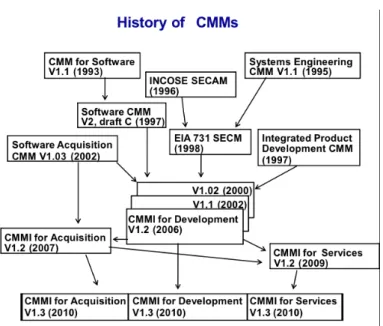
CMMI stands for Capability Maturity Model Integration and is an evolution of CMM like shown in Figure2.1.
CMMI is a framework of best practices administered and sold by the Carnegie Mellon Uni-versity. This framework in some business activities is required and mandatory like many DOD (United States Department of Defense) and U.S. Government contracts, especially in software development.
The CMMI model does not describe the processes themselves; it describes the characteristics of good processes, thus providing guidelines for companies developing or honing their own sets of processes.
Problem analysis
Figure 2.1: History of CMMs
Carnegie Mellon University says that CMMI can be used to guide an organization, a divi-sion and process improvement across projects. The CMMI processes and methodologies can be classified according to maturity levels.
Currently CMMI is on Version 1.3 and is registered in the United States Patent and Trademark Office by Carnegie Mellon University.
2.1.2 CMMI models and process areas
Best practices of CMMI are published in documents called models; each model addressing a different area of interest. The current version of CMMI, version 1.3, has three different areas of interest: development [CKS06], acquisition and services.
These models are produced taking for base the CMMI framework that contains all the goals and practices used to produce the models that are part of CMMI constellations. The CMMI models contain 16 core process areas, covering basic concepts fundamental to process improvement in any area of interest.
For each process area it can be defined a set of goals and practices. The Figure2.2is a diagram where it is shown the connection between process areas, goals and practices.
There are two types of goals and practices:
• Generic goals and practices: Part of every process area.
• Specific goals and practices: Specific to a given process area.
A process area is satisfied only when the company processes cover all specific and generic practices and goals for the process area idealized.
Problem analysis
Figure 2.2: Specific and generic goals and practices
The material in core process areas is almost the same for all constellations of CMMI, the rest of the material needs to be adjusted to a specific area of interest, so the material won’t be exactly the same.
2.1.3 CMMI model framework
CMMI framework is a basic structure that organizes and groups the CMMI components, ele-ments of the current models, rules, methods for model generations, appraisal methods and training material. It contains process areas that will vary for each one of the CMMI areas that will be used. Process areas are the areas that cover the organization processes.
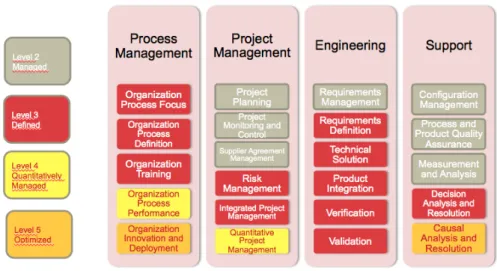
For the latest version of CMMI for Development (Version 1.3) there are 22 Process Areas, which represent the product aspects and the coverage for the organizational processes.
2.1.4 CMMI representations
CMMI is available in two representations: continuous and staged.
The continuous representation is represented by capability levels. It allows each organization to select the order of improvement that best meets their business objectives or those to which the organization assigns a high degree of risks. It enables comparisons across and among organizations on a process-area by process-area basis.
The staged representation is designed to provide a standard sequence of improvements, by maturity levels, each serving as foundation for the next. This representation results in a single rating (Maturity Level) that summarizes appraisal results and can serve as a basis for comparing the maturity of different projects and organizations.
Problem analysis
Each representation has advantages and disadvantages. The staged representation is focused by organizational maturity, continuous representation, whilst the continuous representation is fo-cused on process area capability.
Organizational maturity and process area capability are similar concepts. The difference be-tween them is that organizational maturity pertains to a set of process areas across an organization, while process area capability deals with a set of processes relating to a single process area or spe-cific practice.
In the pictorial diagram below in Figure2.3both representations are shown where ML repre-sents Maturity Level and PA reprerepre-sents Process Area.
Figure 2.3: CMMI representations
2.1.5 Maturity levels in CMMI for development
Figure 2.4: CMMI maturity levels
Processes under the CMMI methodology are rated and grouped in maturity levels. As shown in Figure2.3there are five maturity levels defined as: Initial, Managed, Defined, Quantitatively
Problem analysis
Managed, Optimizing. These maturity levels that are rated are presented and awarded for levels 2 through 5.
2.1.6 Capability levels in CMMI for development
In CMMI models with a continuous representation, there are six capability levels designated by the numbers 0 to 5.
A capability level is a plateau that describes the organization’s capability relative to a process area and consists in a group of related specific and generic practices associated with a process area. Capability levels are also cumulative, so a higher capability levels contains the attributes of the lower levels.
Figure 2.5: CMMI-DEV process areas organized by categories and maturity levels
2.2
SCAMPI
Organizations cannot be certified in CMMI, so they are appraised.
In an appraisal the organization gets awarded a maturity level from one to five or a capabil-ity level achievement profile. As said before, many organizations are required to get some kind of recognition and others find value measuring their progress and determining how well the pro-cesses adopted by the organization are compared to CMMI best practices, to meet contractual and customers requirements and to know which areas they can improve and appraisals are the right way to do it.
Appraisals using a CMMI model must comply with the requirements set out in the Appraisal Requirements for CMMI (ARC) document[Tea01]. There are three classes of appraisals, A, B and C. All of them compare the processes used in the organization to CMMI processes and best practices, that way are identified improvements to make. From all of the three classes of appraisals the most formal is class A and it is the only one that can output a level rating.
Problem analysis
When an appraisal is done teams use a CMMI model and an ARC document. The results from the teams are used to plan improvements for the organization.
Statistics are made and updated every six months in a maturity profile since the release of CMMI show us that the median times to move from Level 1 to Level 2 is 5 months, and from that to Level 3 more 21 months.
2.2.1 What is SCAMPI
SCAMPI is the abbreviation for Standard CMMI Appraisal Method for Process Improvement and is an appraisal method that meets all the ARC requirements. In SCAMPI appraisals there are three types of classes: Class A, B and C appraisal methods. The most rigorous method and officially recognized as that is the Class A method and it’s the only method that can result in a benchmark quality rating.
Results of a SCAMPI appraisal can be published on the CMMI web site of SEI, if the orga-nizations approves this. This appraisal supports ISO/IEC 15504, Software Process Improvement and Capability Determination (SPICE) [Dor93], a set of technical standards documents for the computer software development process and related business management functions.
The ARC Class A appraisal is normally conducted by SCAMPI A appraisal. The SCAMPI A Method Definition Document is where are defined rules to ensure the consistency of the appraisal ratings, so the same maturity rated in two companies means they are equal in methodologies and business processes.
2.2.2 SCAMPI principles
As said before the class A appraisal is the only full comprehensive appraisal method that involves an ARC class A method and uses CMMI models as reference models.
This appraisal will allow organizations to gain insight about their capability by identifying the strengths and weaknesses of its current processes, prioritize improvement plans, focus on those improvements, correcting weakness that will generate risks, derive capability rating as a maturity level rating and identify risks related to capability and maturity determinations.
This appraisal follows these principals: • Start with a process reference model. • Use a defined appraisal method.
• Involve senior management as an appraisal sponsor. • Observe strict confidentiality and non-attribution.
• Approach the appraisal collaboratively. (When SCAMPI is used for Supplier Selection or Process Monitoring modes, it may not be possible to use a collaborative appraisal approach.) • Focus on the sponsors business objectives.
Problem analysis
2.2.3 The SCAMPI process
The Method Definition Document [SCA13] is a document that describes the SCAMPI ap-praisal method; this document sets the key elements of apap-praisal planning and the rules of conduct. It is also included in this document the level of process tailoring permitted, qualifications of the team members, evidence requirements, how to scope the appraisal and more.
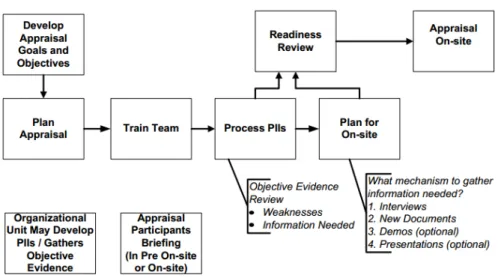
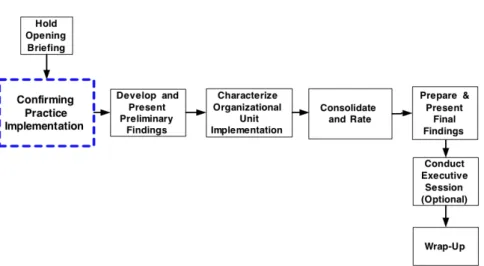
There are essentially three phases in the process:
• Phase I - Plan and Prepare for Appraisal (presented in the Figure2.6) • Phase II – Conduct Appraisal (presented in the Figure2.7)
• Phase III – Report Results
The following charts shows us these phases, where the last one includes the results reporting phase.
Figure 2.6: Plan and Prepare for Appraisal Activities
2.2.4 Special terms
There are some terms to consider with special meaning: Organizational Unit (OU), Orga-nizational Scope, Subgroup, Basic Unit, Support Function, Objective Evidence, Instantiation, Database of Objective Evidence and Practice Characterization.
Organizational Unit is the subject of an appraisal. Can be deployed one or more processes that have a consistent process context, operates in a coherent set of business objectives and is typically part of a larger organization. In a small organization, this unit can be the whole organization.
Basic Unit stands for a set of interrelated and managed resources that delivers products or services to a customer and usually works like planned. The plan is documented and specifies the
Problem analysis
Figure 2.7: Conduct Appraisal Activities
services or products delivered or implemented, the funds, the future work and the work that is currently being done.
A collection of basic unit and support functions that represent practices used within and orga-nizational unit is the Orgaorga-nizational scope.
A Subgroup is a cluster of basic units that are shared between similar process implementations and a common sampling factor alternatives.
Support Function is an organizational group that for a certain and well defined set of activities needed by other parts of the organization provides products and/or services.
Objective Evidence (OE) are indicators of the implementation or institutionalization of model practices. Verifying practice implementation is the review of Objective Evidence to determine whether a practice is implemented within a basic unit, support function, and/or organization. Can be of two types: artifacts or affirmations. The artifacts are a tangible form of evidence indicative of work being done, which is both the main output of a practical model or a consequence of the implementation of a model of practice. Affirmation is an oral or written statement confirming or supporting the implementation (or lack of implementation) in a practical model provided by the practice performers, provided through an interactive forum in which the evaluation team has control over the interaction. In certain cases for some practices, documents are accepted as artifacts even if they are not the primary desired result of practical practice.
Instantiation is the implementation of a model practice used in its context in the organizational unit boundaries.
2.2.5 Practice characterization
Practices Implementation Indicators (PII) are a proof of a correct implementation of a certain CMMI Practice. When a Practice is performed it will leave a mark or evidence of that operation, for example that evidence can be a document produced while the practice is performed.
Problem analysis
Appraisers look for an objective evidence in order to make an assessment. There are three types of indicators presented in the Table2.1.
Table 2.1: Indicators Types Indicator
Type
Description Examples
Direct artifacts
The tangible outputs resulting directly from implementation of a specific or generic prac-tice. An integral part of verifying practice plementation. May be explicitly stated or im-plied by the practice statement or associated informative material.
Typical work products
listed in reference model practices
Target products of an Es-tablish and Maintain spe-cific practice
Documents,
deliver-able products, training materials, etc.
Indirect arti-facts
Artifacts that are a consequence of perform-ing a specific or generic practice or that sub-stantiate its implementation, but which are not the purpose for which the practice is per-formed. This indicator type is especially use-ful when there may be doubts about whether the intent of the practice has been met (e.g., an artifact exists but there is no indication of where it came from, who worked to develop it, or how it is used).
Typical work products
listed in reference model practices
Meeting minutes, review results, status reports, pre-sentations, etc.
Performance measures
Affirmations Oral or written statements confirming or sup-porting implementation (or lack of implemen-tation) of a specific or generic practice. These statements are usually provided by the imple-menters of the practice and/or internal or ex-ternal customers, but may also include other stakeholders (e.g., managers and suppliers).
Instruments Interviews
Presentations, demonstra-tions, etc.
Problem analysis
After the collection and examination of evidences, it is made a characterization of the extent to which Model practices are implemented. The model practices are characterized as described in the Table2.2.
Table 2.2: Practice characterization table
Fully Implemented (FI) Sufficient artifacts and/or affirmations are present and judged to be adequate to demonstrate practice implemen-tation, and no weaknesses are noted.
Largely Implemented (LI) Sufficient artifacts and/or affirmations are present and judged to be adequate to demonstrate practice implemen-tation, and one or more weaknesses are noted.
Partially Implemented
(PI)
Some data are present to suggest some aspects of the prac-tice are implemented, and one or more weaknesses are noted.
OR
Data supplied to the team (artifacts and/or affirmations) conflict –some data indicate the practice is implemented and some data indicate the practice is not implemented, and one or more weaknesses are noted.
Not Implemented (NI) Some or all data required are absent or judged to be inad-equate. Data supplied does not support the conclusion that the practice is implemented, and one or more weaknesses are noted.
Not Yet (NY) The basic unit or support function has not yet reached the
stage in the sequence of work, or point in time to have im-plemented the practice.
2.2.6 Appraisal participants
In an appraisal there are several participants with roles and responsibilities crucial to its suc-cess.
The Appraisal sponsor is responsible to sponsor the appraisal and owns the appraisal results and signs the Appraisal Disclosure Statement.
Middle managers are originally from the line or staff management positions and are intervie-wees and data providers; if they are participant, they review preliminary findings.
Basic Unit leaders have leadership responsibilities for a project or service. They are as well interviewees and data providers and if they are participants, they review preliminary findings too. Support Function as the past roles are interviewees and data providers; they are practitioners and review preliminary findings.
Problem analysis
2.2.7 Appraisal team
The appraisal team is composed by two main key roles: Team Leader and Team Members. Team Leader is the person who has the overall responsibility for the appraisal, is a SEI - Certified SCAMPI [SCA13] leader appraisal and has experience and training; he also signs the final find-ings. Team members are those who satisfy requirements of experience and training to be part of the team and they assume one or more specific roles.
One of the key roles of the appraisal team is the team leader who has overall responsibility for the appraisal. He is also responsible for: assigning team roles for each member, ensuring that the planning activities are complete, that the SCAMPI process is being followed; scheduling, moni-toring and checking performance; facilitating team resolution in case of conflicts and impasses; and reporting results to SEI.
For each team member the team leader will assign a role that will ensure the proper function of the team and will facilitate the appraisal. Those roles are the following:
• Appraisal coordinator - Responsible for handling on-site logistics. This position is also composed by more than one member for a multi-site appraisal.
• Librarian - Documents are managed by this member and in the end of the appraisal they are returned.
• Timekeeper - For each mini-team can be one Timekeeper and his main purpose is track team time and schedule constraints during interviews and other activities.
• Note takers - For all PAs is responsible for taking notes during data gathering sessions. • Appraisal team - All the work is reviewed by members.
• Mini-teams - Teams typically consist of two or three members and verify the implementa-tion of reference model practices, reviewing objective evidence provided and identify weak-nesses in the implementation. The practices at instantiation levels are characterized by its implementation extent. They have the power to request additional information if needed.
2.2.8 SCAMPI results
The appraisal is completed after the collection and evaluation of objective evidence to support the implementation of practices.
Goal satisfaction depends on satisfaction of practices associated with it.
A goal is rated as satisfied if and only if all associated practices are characterized as largely implemented or fully implemented, and all the weaknesses associated with the defined goal don’t have a significant impact on goal achievement. With the help of a program we can obtain a matrix as shown in Figure2.8.
When a given goal is determined to be either satisfied or not, then a Capability Level (for the continuous representation) can be derived.
Problem analysis
Figure 2.8: SCAMPI results
2.3
SCRAIM
SCRAIM [SCR] is a project management tool developed at Strongstep based on advanced methodologies with intelligent decision support mechanisms. It also has some ready-made pro-cesses that facilitate a better management.
2.3.1 Software-as-a-Service
SCRAIM is a Software-as-a-Service (SaaS) product. SaaS emerges as an innovative approach to deliver software applications based on cloud-computing technology. [CC07]
This type of software sometimes refered as simply hosted applications allows organizations and clients to access functionalities and all data stored on that platform everywhere, and it costs less than a typical licensed application. SaaS has many advantages compared to typical software. Since it is hosted remotely and accessed through Web browser, it bypasses server provisioning and software installation as requirement, making software cheaper. Another advantage is that organizations don’t need to perform and handle installation problems, updates and performing maintenance.
“SaaS is one of the biggest technology trends to affect business applications in recent years.” [Hou09]
2.3.2 Methodologies and processes definition
One of the reasons that can lead to a project failure is the lack of use of a defined software development process. It is also known that one of the success factors is the adoption of appropriate
Problem analysis
development processes in organizations projects.
Figure 2.9: SCRAIM process choose wizard
SCRAIM supports the most advanced technologies like CMMI [CMM10], TSP [Hum00] and SixSigma [Six] to help organizations increase projects quality. SCRAIM has a set of ready made processes like SCRUM [PQ11], chosen in the Figure2.9and it’s possible to adapt to the specific needs of a project and save to use it later.
2.3.3 Project planning and tracking
The Planning page represented in Figure2.10presents to the user a chronological view of the project’s iterations (Centralized on the current iteration).
Figure 2.10: SCRAIM Planning Page
In this page users are able to create, update and estimate tasks and assign those tasks to itera-tions and team members.
2.3.4 Risk and issue management
Risk Management is also supported by SCRAIM. This part of the software is designed to give the possibility to identify what can go wrong (risks), how to prevent that from happening
Problem analysis
(mitigation actions) and what to do if something happens (contingency actions).
Figure 2.11: SCRAIM Risk View
2.3.5 Test management
Test management features provided in SCRAIM are used to store information on how testing is to be done, plan testing activities and report the status of quality assurance activities.
Figure2.12is presents the project tests configuration, presenting all the actions that can be made by the user, and that are related to traceability and execution of test cases.
Figure 2.12: SCRAIM Test configuration view
2.3.6 Other functionalities
The project information is easily trackable. SCRAIM allows to manage files and documenta-tion associated to each one of the project and to attach external repositories in order to track the changes of source code.
Problem analysis
In SCRAIM it’s possible to schedule deliverables for each release of the project; with this it is possible to know in real time what’s being delivered, what’s being scheduled and who’s in charge of each deliverable.
Chapter 3
State of the art analysis
In this chapter it is presented the related work. Here is introduced some electronic assessment tools that are currently being used in the market and others made for teaching purposes.
3.1
CMMI assessment checklist
CMMI assessment checklist [cap] appears as an online solution to make a lightweight assess-ment tool and is a free online assessassess-ment tool that make it possible to get and track an organization capability across eight key business functions based in a group of 31 questions.
Assessment items
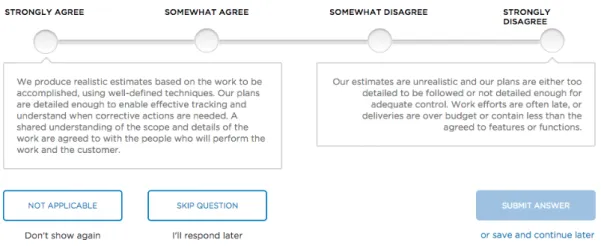
In this tool, each assessment item has a statement about a particular capability or several capabilities and a scale that allows to indicate the level of agreement with the statement, based on the organization performance. An example is shown in Figure3.1.
Figure 3.1: Assessment item question
The scale included in the assessment item also includes a descriptive information about the organization performance at both ends of the scale, visible on the example given in Figure3.2.
These descriptions are given to the user with the intention of helping the most accurate posi-tioning of the organization on the scale.
State of the art analysis
Figure 3.2: Assessment item scale
The organization term in the assessment tool is defined by the user for purposes of self-assessment. The evaluated scope is also defined by the user and can be the company, organizational unit, division, directorate, department or work group.
It’s possible to skip a question in the list of items and comeback later to answer and there is an option named Not Applicable to exclude the question from the results. This answer should only be chosen if:
• The actual question is related to an area outside of the organization scope. • It’s valid for the organization but the performance of the activity is not known.
• The user that is performing the assessment has insufficient expertise in the subject to under-stand the intent of the question.
The answers are editable before the submission of the assessment in a screen for a final review. It is possible to save the current state and progress at any time and resume it later. It is only possible to submit and get an assessment if all questions are answered.
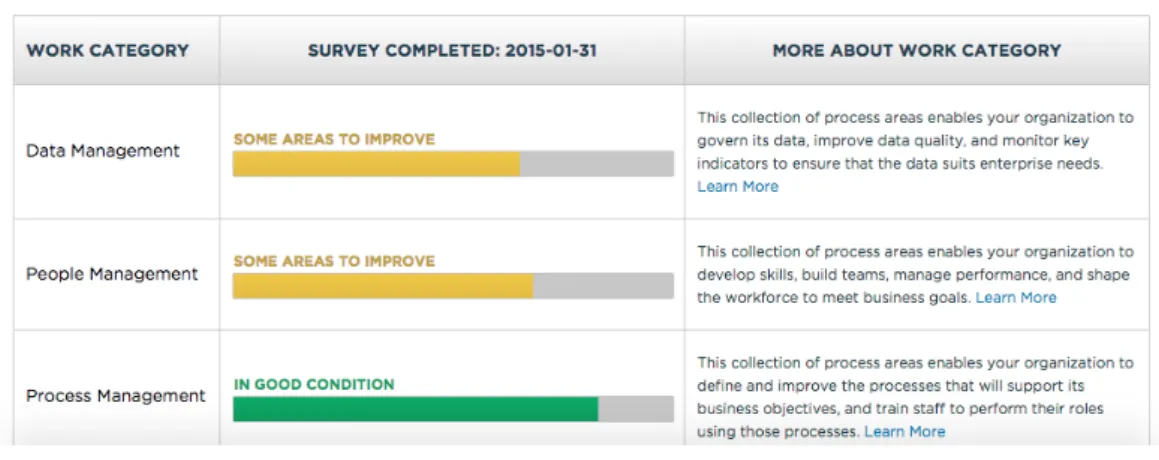
After answering all questions provided as requirement the survey is submitted and will be shown a high level snapshot of the organization current capability states and will be included in each item some suggestions for developing the next steps as seen in Figure3.3.
The goal of this research work is to fully automate the assessment for as many practices as possible. As explained in Section4.4, we take advantage of some of the questions in this tool to help in the assessment of the remaining practices.
State of the art analysis
Figure 3.3: Example of a result an assessment
3.2
PSP checker
The Personal Software Process (PSP) [Hum05] is a process framework with the objective of guiding developers to define their own processes, track and plan their work and manage the quality of the produced products.
PSP checker [PF10] is a tool developed at FEUP that has the main objective of helping teachers to evaluate the assignments submitted by PSP students and help them to achieve better results and understand PSP.
The PSP checker was only made and planned for teachers as a support for evaluation and feedback. It is also suitable for students too depending on the type of teaching. That way they can improve their work. A short period of time is required to use this tool and is currently available only as a desktop application.
This desktop application has as main functionalities: • Automatic verification of checklists
Each checklist item has different types of verification and as output; if an item in the checklist is completely satisfied, it is shown the line in green, otherwise the line is high-lighted in red or given a special message on the screen.
• Custom processes
The user, when starting the program, can choose which items of the PSP process to associate with this evaluation.
State of the art analysis
• Remote data importation • Illustrative charts
Charts that facilitate the perception of whats is wrong and well done to understand which points can be improved.
• Automation of support messages (use of knowledge acquired by specialists)
Messages provided by specialist to understand the errors in a more complex level. • Information Import/Export (Figure3.4)
• Modularity and scalability
Figure 3.4: Example of a data import for PSPChecker
Figure 3.5: Final results of PSPChecker
In Figure3.5it is represented two of the last screens of PSPChecker. It is shown on the left hand side the checklist imported or chosen and on the right side the final screen, where we can
State of the art analysis
generate charts and export the data. Items successfully checked are colored in green. Items not satisfied are colored in red. Items that could not be evaluated automatically are colored in yellow.
This method of evaluation is used to make a similar approach to CMMI instead of PSP.
3.3
Appraisal assistant
The Software Quality Institute of the Griffith University [Sof] developed the Appraisal Assis-tant tool. The Appraisal AssisAssis-tant [App] is a software application that supports the appraisal or assessment of process capability or organization maturity.
This tool follows consistent approaches with the requirements of ISO/IEC 15504 [ISO] and it’s distinguished from other tools by taking an evidence-driven approach to the recording of evidences generated in an assessment.
SQI personnels have performed SCAMPI A and B appraisals and SPICE assessments with the help of Appraisal Assistant and have been it using since the first beta release. The Beta release was used to examine relationships between ISO 15504-2 and SCAMPI appraisals
Figure 3.6: Appraisal Assistant New Project Screen
The Appraisal Assistant provides several functionalities and benefits:
• Support for multiple process models such as: ISO/IEC 15504-5, ISO/IEC 15504-6 (FDIS) [Rou03], Automotive SPICE, CMMI -DEV v.1.2, +SAFE, and CMMIR SE/SW/IPPD/SSR
V 1.1 [Tea02];
• User defined appraisal models;
• Multiple methods for performing an appraisal / assessment; • User defined assessment methods;
• Conversion of results between frameworks; • Split and consolidate evidence capture activities;
• Generate automatically reports such as Appraisal Disclosure Statement, PIID, Assessment Record, Appraisal / Assessment Findings, Strength / Weakness summaries, Rating Profiles, and workload summaries;
State of the art analysis
Figure 3.7: Appraisal Scope Customization
• Model coverage and automatic reporting by collected evidence.
Figure 3.8: Appraisal Assistant Results
In Figure 3.8 it is shown an example of an appraisal result and the output of the tool after labelling all the process areas.
We take advantage of the way results are presented on this tool, regarding CMMI practices organized by their areas, goals and practices.
State of the art analysis
3.4
ITMark appraisal tool
ITmark [ITMa] is a certification scheme designed specifically for SMEs that combines various improvement models streamlined into only one scheme.
This certification is developed by leading appraisal providers across technical and business related disciplines, gathered in an International Consortium of Centers of Excellence dedicated to support Software Intensive Organizations throughout the world.
This certification assesses and certifies the processes in small organization in three different areas:
• Business Management
• Software, Systems and Services Engineering
• Security Management
It provides a group of analysis tools that help a company enhance its business, information security management and software development processes. A company can have additional recog-nition for their level of capability through ITMark certification.
ITMark will provide organizations:
• Process improvement of product development and services
• Improvement of other critical processes of the organization: business and security
• Low cost and quick implementation of the improvements
• Philosophy of quality
• Internationally recognized
The ITMark Appraisal tool [ITMb] fully supports this process.
When an assessment is created in the interface we can access the three areas and see all the specific questions that we need to answer in order to get the results in Figure3.9, we can see in the top the three areas and an example of a question with the possible answers that are "yes", "no" or "not applicable".
State of the art analysis
Figure 3.9: ITMark Appraisal tool question example
After answering all the questions this tool will provide us graphs and some charts with the assessment results. We can see an example of those graphs in Figure3.10
Figure 3.10: ITMark Appraisal tool result example
The overall assessment results will be available on a bar graph like the one presented in Figure 3.11, where we can see the maturity level associated.
Figure 3.11: ITMark Appraisal tool result overall example
As will be explained in Section4.4, we take advantage of the questions in this tool to help in the assessment of the practices not evaluated automatically.
Chapter 4
Conception
In this chapter is presented the process, rules and questionnaires that were conceived to enable semi-automatic SCAMPI evaluations. It is also presented an assessment of the level of support provided by SCRAIM regarding CMMI practices.
4.1
Assessment Process
The Electronic assessment process is represented in Figure 4.1. The process starts with a selection of the projects and process areas to evaluate. Then for each evaluation, we have two ongoing tasks; the survey based electronic assessment and the rule based assessment.
The survey based electronic assessment is a manual process (conducted with tool support) where the user needs to answer the questions that are provided. The rule based electronic assess-ment is fully automatic using the rules described later in this section.
Both assessments receive project data to generate the results that can be seen afterwards. This workflow also presents the manual adjustment, a part that can be useful if in some case a certain part is not evaluated correctly or the assessment result is by consented opinion of the team accepted or rejected. And lastly it shows the final results.
The details of rule based and survey based assessment are provided in section4.3and4.4. In order to get a full overview of SCRAIM, an assessment of the tool was performed. That assessment provides the current state of the tool and possible gaps to overcome.
Conception
Conception
4.2
Pre-assessment of Scraim support
In a primary phase as mentioned before, an assessment of the tool was performed. The actual purpose of this assessment was to check if it was possible and currently viable to match Scraim and its functionalities with the third maturity level of CMMI for Development.
Maturity levels comprise a set of process areas, each with a set of goals and practices. So, if Scraim could be mapped to a more extensive number of practices and goals, a higher level of maturity could be covered.
The assessment was done with Appraisal Assistant, a tool currently used to assist and help appraisals in the field (see Section 3). This tool allows us to visualize the results in a matrix, providing a full overview of the current state and the coverage of Scraim in relation to the maturity level 3 of CMMI for Development.
Figure 4.2: Scraim Assessment to CMMI for Development Level 3
In Figure4.2we can see that, despite the fact that Scraim covers many practices, the maturity level three is still too far from being achieved successfully.
For example some areas like Verification (VER) and Decision Analysis and Resolution (DAR), are not currently supported by SCRAIM, so it will be impossible to automatically assess the ful-fillment of their respective goals and practices by SCRAIM users.
In Figure4.3we can see that the map for the second level of maturity is more accurate, more trustful and can be more covered automatically.
Conception
Figure 4.3: Scraim Assessment to CMMI for Development Level 2
The initial decision of making this set of tools to SCRAIM focusing in the level is supported by these two assessments to the tool.
4.3
Electronic assessment rules
In order to get rules it was needed to perform a mapping between CMMI concepts and SCRAIM data items.
Taking as reference the previous assessments of the tool, this map was possible with the cre-ation of a new scale to show the results of the assessment and be possible the map corresponding the information.
One appraisal consists in classifying each practice in one of four states: Fully Implemented, Largely Implemented, Partially implemented and Not implemented.
In the first attempt, was tried to match those levels with 5 levels, corresponding to different evaluation levels in Scraim. In the Figure 4.4 is possible to see the map between CMMI for Development and Scraim. In this example it is analyzed the criteria from the practice 1.1 from
Conception
Figure 4.4: Project Planning SP1.1 Map to 5 levels
the Project Planning area, which says, "Establish a top-level work breakdown structure (WBS) to estimate the scope of the project." and can be mapped into Scraim into this 5 levels. The first Level would be where there is none WBS item or backlog item, and the max level where all WBS are fully defined and epics with backlog items associated.
Figure 4.5: Project Planning SP1.1 Map to 4 levels
After some mapping this scale was confusing and far from real so the best way was to map and try to match the four levels of SCAMPI with four levels of Scraim assessment.
This new scale is more accurate and closer to a real assessment as shown in Table 4.1. In Figure4.5is observable that the mid levels are more easily distinguished and more differentiable from the others.
Table 4.1: Scale comparison
SCRAIM SCAMPI
1 Not Implemented
2 Partially Implemented
3 Largely Implemented
4 Fully Implemented
In the tables presented below are explained the Rules established for the automatic assessment. The rules were validated with consultants from Strongstep.
When in the tables are shown 2 levels (Yes or No), represents the Maximum and the Minimum of the scale considered, Yes corresponds to the level 4 and No the level 1.
The practices that currently cannot be evaluated automatically, are assigned the result of 1 (Not Implemented) during the automatic assessment. They should be subsequently reevaluated with the survey.
Levels& PP.SP&1.1&Estimate&the&Scope&of&the&Project& 1& No&WBS&,&epics,&backlog&items& 2& Existence&of&a&few&backlog&items&less&than&5& 3& Several&epics&with&several&backlog&items&each& 4& WBS&defined,&epics&with&backlog&items(user&story,&task,&…)&associated& & Levels& PP.SP&1.2&Establish&Estimates&of&Work&Product&and&Task&Attributes& 1& No&estimates& 2& Estimates&in&size&or&complexity&(story&points)&(less&than&1/2)& 3& Most&items&estimated&(between&1/2&and&2/3)& 4& All&items&estimated&in&size&or&complexity& & Levels& PP.SP&1.3&Define&Project&Lifecycle&Phases& 1& No&iterations&defined& 2& One&iteration&defined& 3& Several&iterations&with&just&one&phase& 4& All&iterations&related&with&process&phases& & Levels& PP.SP&1.4&Estimate&Effort&and&Cost& 1& No&estimates&found& 2& A&few&tasks&have&effort&estimated& 3& Most&task&effort&estimated&
4& All&tasks&have&effort&estimated&(directly&or&derived&from&points&and&velocity)&and&project&costs&are&estimated& & Levels& PP.SP&2.1&Establish&the&Budget&and&Schedule& 1& No&budget&or&releases& 2& Budget& 3& Budget&+&Releases&& 4& Budget&+&Releases&plan&+&next&iteration&plan& & Levels& PP.SP&2.2&Identify&Project&Risks& 1& No&risks&identified& 2& One&risk&identified& 3& Several&risks&identified& 4& Risks&identified&and&quantified& & Conception 4.3.1 Project Planning
Levels& PP.SP&2.3&Plan&Data&Management& Yes& Existence&of&a&page&on&scraim&wiki&module&to&manage&data&as&forms&of& documentation& No& & Levels& PP.SP&2.4&Plan&the&Project’s&Resources& Yes& Existence&of&a&page&on&scraim&wiki&module&to&explain&the&project& resources&and&needs&as&labor,&equipment,&materials,&methods& No& & Levels& PP.SP&2.5&Plan&Needed&Knowledge&and&Skills& Yes& Existence&of&a&page&on&scraim&wiki&module&to&explain&the&needed& knowledge&and&skills.& No& & Levels& PP.SP&2.6&Plan&Stakeholder&Involvement& 1& No&stakeholder&involvement& 2& Existence&of&an&account&of&the&type&customer& 3& No&existence&of&account&but&periodic&meetings&with&customer& 4& Existence&of&an&&group&with&the&customer&attached&to&meetings& & Levels& PP.SP&2.7&Establish&the&Project&Plan& Yes& Existence&of&a&page&on&scraim&with&the&project&plan&or&a&document&with&a& template&name.& No& & Levels& PP.SP&3.1&Review&Plans&That&Affect&the&Project& Yes& The&project&plan&document&was&updated&more&than&once& No& && & Levels& PP.SP&3.2&Reconcile&Work&and&Resource&Levels& Yes& Calendar&updated&and&organized& No& && & Levels& PP.SP&3.3&Obtain&Plan&Commitment& Yes& Existence&of&the&project&plan&documentation&and&the&kick\off&meeting& No& && & Conception
Levels&
PMC.SP&1.1&Monitor&Project&Planning&Parameters&
4&
With&the&use&of&scraim&is&satisfied:&typical&indicators&of&project&
progress&and&performance&and&include&attributes&of&work&
products&and&tasks,&costs,&effort,&and&schedule.&
&
Levels&
PMC.SP&1.2&Monitor&Commitments&
1&
No&meetings&created&on&Scraim&
2&
Existence&of&one&meeting&created&
3&
At&most&3&meetings&
4&
More&than&5&meetings&created&
&
Levels&
PMC.SP&1.3&Monitor&Project&Risks&
1&
No&risk&identified&
2&
One&risk&identified&
3&
Several&risks&identified&
4&
Risks&identified&and&quantified&
&
Levels&
PMC.SP&1.4&Monitor&Data&Management&
Yes&
Existence&of&a&page&on&scraim&wiki&module&to&manage&data&as&
forms&of&documentation&
No&
&
Levels&
PMC.SP&1.5&Monitor&Stakeholder&Involvement&
1&
No&stakeholder&involvement&
2&
Existence&of&an&account&of&the&type&customer&
3&
No&existence&of&account&but&periodic&meetings&with&customer&
4&
Existence&of&an&&group&with&the&customer&attached&to&meetings&
&
Conception&
&
&
Levels&
PMC.SP&1.7&Conduct&Milestone&Reviews&
1&
No&budget&or&releases&
2&
Budget&
3&
Budget&+&Releases&&
4&
Budget&+&Releases&plan&+&next&iteration&plan&
&
Levels&
PMC.SP&2.1&Analyze&Issues&
1&
No&defects&or&bugs&reported&
2&
At&least&one&bug&or&one&defect&reported&
3&
One&bug&and&one&defect&reported&
4&
More&than&5&bugs&and&defects&reported&
&
Levels&
PMC.SP&2.2&Take&Corrective&Action&
Yes&
Status&of&bug&or&defect&changed&and&progressing&
No&
&&
&
&
&
Levels&
PMC.SP&2.3&Manage&Corrective&Actions&
Yes&
Status&of&bug&or&defect&changed&and&progressing&
No&
&&
&
&
Levels&
PMC.SP&1.6&Conduct&Progress&Reviews&
4&
With&the&use&of&scraim&is&satisfied:&burndownWchart&
ConceptionLevels& REQM.SP&1.1&Understand&Requirements& 4& Use&of&the&given&templates& & Levels& REQM.SP&1.2&Obtain&Commitment&to&Requirements& Yes& Existence&of&a&kickGoff&meeting&and&project&plan&updated& No& && && && & Levels& REQM.SP&1.3&Manage&Requirements&Changes& Yes& Track&changes&on&Scraim&interface& No& Lookup&history&of&issues& && Track&impact& && && && && & Levels& REQM.SP&1.4&Maintain&Bidirectional&Traceability&of&Requirements& Yes& Related&issues,&use&of&test&cases&module& No& && && && & Levels& REQM.SP&1.5&Ensure&Alignment&Between&Project&Work&and&Requirements& Yes& Status&of&bug&or&defect&changed&and&progressing&and&impediments& No& && && && & Conception 4.3.3 Requirements Management
Levels& SAM.SP&1.1&Determine&Acquisition&Type& 1& Necessary&take&survey&to&determine&the&acquisition&type.&Examples&of& acquisitions&types&are:&purchasing&modified&COTS&(Commercial&offGtheG shelf)&products&of&significant&value&to&the&project,&obtaining&products& through&a&supplier&agreement,&products&from&an&inGhouse&supplier,& products&from&the&customer&and&obtaining&products&from&a&preferred& supplier.& & Levels& SAM.SP&1.2&Select&Suppliers& 1& Necessary&take&survey&to&determine&if&the&suppliers&were&selected&using&a& formal&evaluation&process&that&evaluates&identified&alternatives&against& established&criteria.& & Levels& SAM.SP&1.3&Establish&Supplier&Agreements& Yes& Document&Submitted&on&SCRAIM& No& & Levels& SAM.SP&2.1&Execute&the&Supplier&Agreement& 1& Necessary&take&survey&to&check&supplier&progress&reports&and&performance& measures,&review&materials,&reports&and&items&tracked&to&closure&and& product&and&documentation&deliveries& & Levels& SAM.SP&2.2&Accept&the&Acquired&Product& 1& Take&survey&to&Ensure&that&the&supplier&agreement&is&satisfied&before& accepting&the&acquired&product.& & Levels& SAM.SP&2.3&Ensure&Transition&of&Products& 1& Only&evaluated&through&question&where&is&seen&if&is&ensured&the&transition& of&products&acquired&from&the&supplier.& & Conception
Levels& MA.SP&1.1&Establish&Measurement&Objectives& 4& Using&SCRAIM&the&project&performance&monitoring&objectives&are& & Levels& MA.SP&1.2&Specify&Measures& 1& Needed&survey&to:&estimate&and&measure&of&effort&and&cost&(e.g.,& number&of&person&hours),&quality&measures&(e.g.,&number&of&defects& by&severity),&information&security&measures&(e.g.,&number&of&system& vulnerabilities&identified)&and&customer&satisfaction&survey&scores& & Levels& MA.SP&1.3&Specify&Data&Collection&and&Storage&Procedures& Yes& Documents&stored&on&SCRAIM&or&links&on&wiki&page&for&MA& No& && & Levels& MA.SP&1.4&Specify&Analysis&Procedures& Yes& Document&submitted&on&SCRAIM&to&specify&how&measurement&data& are&analyzed&and&communicated& No& & Levels& MA.SP&2.1&Obtain&Measurement&Data& 4& Using&SCRAIM&the&data&to&measure&if&obtained&automatically,&but& necessary&question&on&survey&to&check&if&is&properly&obtained.& & Levels& MA.SP&2.2&Analyze&Measurement&Data& 4& Using&SCRAIM&the&data&analysis&is&computerized&but&is&still&necessary& a&question&on&survey&to&check&if&the&data&from&the&document& submitted&is¬&empty&and&provides&all&the&information&needed&to& satisfy& & Levels& MA.SP&2.3&Store&Data&and&Results& 4& Data&is&stored&and&analyzed&on&SCRAIM&repositories&and&databases& & Levels& MA.SP&2.4&Communicate&Results& 4& Possible&with&the&dashboard&view&of&SCRAIM& & Conception