COHESION POLICY IN THE EU: MAPPING MAIN FEATURES OF
INTERREG
Lucas Vellinho Nardin
Dissertation
Master in Economics
Supervised by
Sandra Maria Tavares da Silva
Maria Isabel Gonçalves da Mota Campos
ii
Acknowledgments
My special thanks to Professors Maria Isabel Gonçalves da Mota Campos and Sandra Maria Tavares da Silva, who wisely and graciously guided the development of this research for almost a year. I am deeply grateful for all the support and attention they devoted to this project.
To Professor Pedro José Moreira de Campos, I express my gratitude for his guidance on the quantitative analysis and for finding space on his busy schedule to squeeze me in on a couple times.
To my family, Alexandre, Adriana and Valentina, for all the love and support. I am vey grateful for having you in my life. To my dear friends, both in Brazil and in Europe, thank you very much for being the second family I chose for myself. Here I give a special thank you to my friend Mauricio Peres, who helped me organizing the database used on this research.
iii
Abstract
This research has the cohesion policy as the main theoretical support and aims at mapping the Interreg programmes. Particularly, it aims at finding similarities amongst EU countries concerning Interreg and checking for potential overlapping amidst the pro-grammes that make up for Interreg. In spite of existing a vast research covering the topic of cohesion policy, not much effort has been directed towards the analysis and systematization of the Interreg programmes. Therefore, this research intends to contribute to the existing literature by adopting a new approach towards the cohesion policy topic.
In order to contextualize the subject, the definition of cohesion policy is provided by an extensive literature review. In addition, the three dimensions that consensually consti-tute the cohesion policy are theoretically and conceptually addressed. Finally, the topic shifts towards the Interreg programmes. This policy instrument is analyzed both within a historical perspective, focusing on its evolution over the years, and under a conceptual perspective, in which the objectives of this type of programmes are explained and the reasons for its exist-ence are presented.
In terms of the methodology employed in the dissertation, in addition to the quali-tative description of Interreg programmes, a quantiquali-tative technique is also employed. In the qualitative approach, a deep categorization of the policy instrument is presented, based on fundamental dimensions such as priority axes, objectives and indicators. Then, the quantita-tive approach corresponds to a TwoStep Cluster Analysis based on data obtained from the database KEEP.eu.
The findings of our research suggest that some transnational and cross-border In-terreg programmes cover the same geographic region and share the same objectives, which imply the occurrence of overlapping. In addition, the cluster analysis also showed that, re-gardless of the programming period, the countries and thematics involved with the largest number of projects seem to repeat.
JEL codes: O2, C38
iv
Resumo
Este trabalho escolhe a política de coesão como referência teórica e tem como obje-tivo principal mapear os programas Interreg, identificando a existência de semelhanças entre os estados membros da União Europeia em relação à participação nos Interreg e analisando se existe sobreposição entre estes programas. Apesar de existirem diversos trabalhos acerca da política de coesão, há uma carência de estudos destinados a analisar e sistematizar os programas Interreg. Assim, esta dissertação pretende contribuir para a literatura existente através do uso de uma nova abordagem ao tópico da política de coesão.
De forma a contextualizar o tema de investigação, a política de coesão é tratada atra-vés de uma revisão de literatura exaustiva. É feito o enquadramento teórico e conceptual das três dimensões da política de coesão, focando-se posteriormente o instrumento político In-terreg. Este é analisado quer sob uma perspectiva histórica, expondo, assim, como evoluiu ao longo dos anos, quer conceptual, apresentando-se os objetivos estratégicos desse pro-grama e as razões para sua existência.
Em relação à metodologia utilizada, esta dissertação faz uso da descrição qualitativa dos programas Interreg e também de métodos quantitativos como a análise de clusters. No âmbito qualitativo, os intrumentos políticos do programa são categorizadados com base nos seus eixos prioritários, objetivos e indicadores. Posteriormente, é utilizado o método quanti-tativo TwoStep Cluster Analysis, o qual efetua a análise de agrupamento sobre a base de dados construída a partir de informações recolhidas na plataforma Keep.eu.
Os resultados de nosso estudo sugerem que alguns programas transnacionais e trans-fronteiriços cobrem a mesma região geográfica e compartilham os mesmos objetivos, o que indica que poderá existir sobreposição. Além disso, a análise de clusters também demonstrou que, independentemente do período programático em análise, os países e as temáticas envol-vidas com o maior número de projetos tendem a repetir-se.
Códigos-JEL: O2, C38
Palavras-chave: Política de coesão, Interreg, Cooperação Territorial Europeia, análise de
v
Contents
Acknowledgments ... ii Resumo ... iv List of tables ... vi Chapter 1. Introduction ... 1Chapter 2. Cohesion policy: main insights from the literature ... 4
2.1 Cohesion policy: a historical perspective ... 4
2.2 Cohesion policy: main concepts ... 9
2.3 Interreg ... 16
Chapter 3. Methodology ... 21
3.1 Cluster Analysis ... 21
3.2 Database description ... 22
Chapter 4. Mapping main features of Interreg using cluster analysis ... 29
4.1 Finding similarities among projects ... 30
4.1.1 Programming period 2000-2006 ... 30
4.1.2 Programming period 2007-2013 ... 33
4.1.3 Programming period 2014-2020 ... 37
4.1.4 Results overview: comparison between programming periods... 40
4.2 Finding overlapping of programmes ... 43
Chapter 5. Conclusions ... 48
References ... 51
vi
List of tables
Table 1: Thematic objectives and matching cohesion policy goals ... 15
Table 2: The Interreg strands ... 18
Table 3: Evolution of the Interreg programmes ... 20
Table 4: Projects and programmes per programming period ... 23
Table 5: Quality of data on each programming period... 24
Table 6: Projects with complete information on each programming period ... 24
Table 7: Thematic groups ... 25
Table 8: Relevance of the thematics over the programming periods ... 26
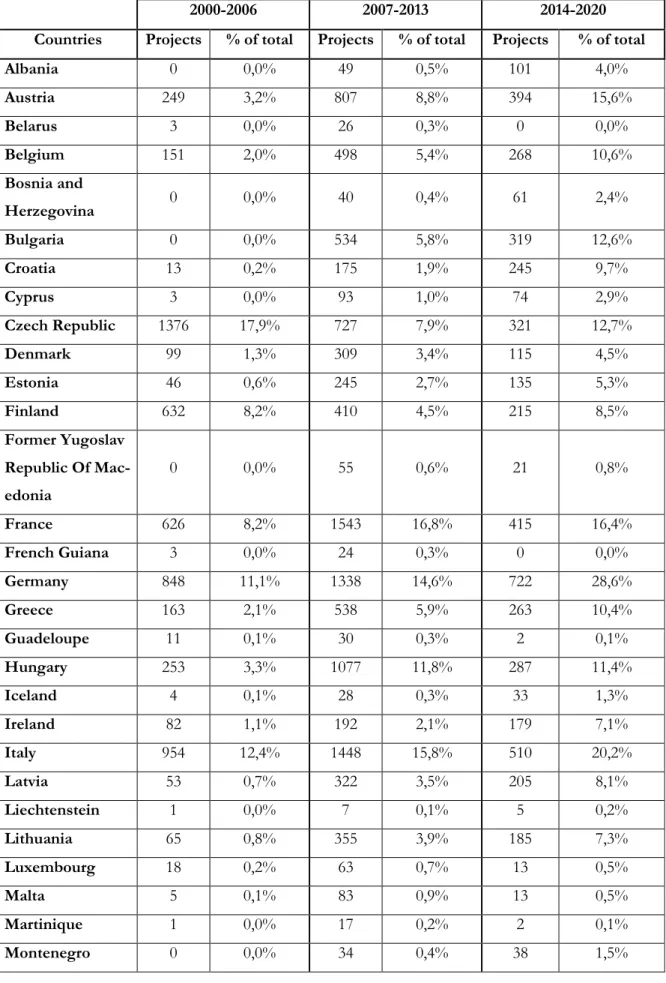
Table 9: Interreg projects per country by programming period ... 27
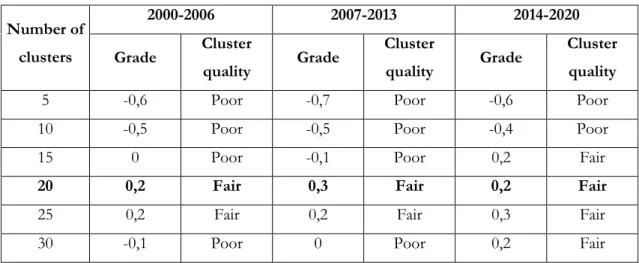
Table 10: Cluster quality ... 30
Table 11: Centroids and Cluster Distributions ... 30
Table 12: Clusters programming period 2000-2006 ... 32
Table 13: Centroids and cluster distribution ... 34
Table 14: Clusters programming period 2007-2013 ... 35
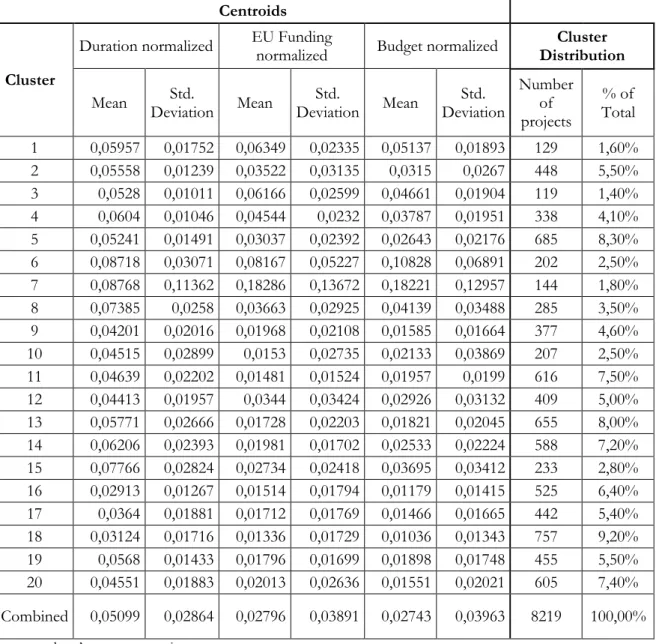
Table 15: Centroids and cluster distribution ... 37
Table 16: Clusters Programming Period 2014-2020 ... 39
Table 17: TwoStep Cluster Analysis results overview ... 41
Table 18: Cluster quality ... 44
Table 19: Centroids and cluster distribution ... 44
1
Chapter 1. Introduction
Since the foundation of the European Union (EU), one of its most important pillars has been the development of regional and urban development policies, the so-called Cohe-sion Policy. Through coheCohe-sion policy, the EU aims at spreading the benefits of integration among its members and promoting a balanced development in geographic terms (Gang, 2012). According to Fratesi and Wishlade (2017), the Directorate-General for Regional Policy was conceived 50 years ago, in 1968, and the foundations for how the policy is carried out nowadays have been laid in 1988, with the revision of the Structural Funds, which, in its turn, followed the Single European Act from 1986. Referring to Cohesion Policy, the same authors state that its relevance is easily observable by the share of the EU budget allocated to it, about one-third, for the programming period 2014-20. Additionally, the authors state that this policy is idiosyncratically unique in terms of governance since it involves a multilevel-governance structure that commits national, regional and local communities towards the same objective, in what can be labeled as “shared management” alongside the European Commission (Fratesi & Wishlade, 2017).
In accordance, Farole, Rodríguez-Pose and Storper (2011) argue that, following the previously mentioned reform of the Structural Funds, the EU has established the principle of cohesion as one of the key points on its agenda, especially in a context marked by dynamic changes in the political, demographic and economic realities within the EU. Regarding the interest on developing a solid cohesion policy, Fratesi and Wishlade (2017) emphasize that, since its creation, the EU has been concerned with the hypothesis that deeper economic integration may create a scenario where some regions are clearly benefited from it and others are increasingly left poorer behind. For Farole et al. (2011), the level of economic activity is unevenly distributed throughout the world and also among the Member States of the EU. These differences result on conspicuous gaps in wealth, in population density, in business cycles and economic growth, as well as in the composition of their economies. Therefore, the EU has structured its cohesion policy mainly in the form of funds intended for lagging regions which aim at pushing for economic convergence.
Therefore, cohesion policy appears as the instrument capable of reducing the gap between different regions and members and, more specifically, attenuating the disparities between developed and developing areas. Thus, it represents an important instrument of financial solidarity and implies a more integrated economy (Dumciuviene, Stundziene and Startiene, 2015). Still, according to Dumciuviene et al. (2015, p. 507), the Treaty of Lisbon,
2 which forms the constitutional basis of the EU, confirms the objective of promoting “eco-nomic, social and territorial cohesion and solidarity of the Member States”. Hence, the Eu-ropean cohesion policy extrapolates the scope of simply being a funds distribution mecha-nism and, instead, pushes for increasing efficiency in the less developed regions, higher life standards, sustainable development, economic growth and reducing opportunities disparities amidst its members.
As commented by Barca (2009), the objective assigned by the EU Treaty to cohesion policy, through the Cohesion Fund and Structural Funds, is to advocate for a harmonious development among its members. Cohesion, therefore, corresponds to a mix of efficiency, growth and economic goals combined with equity and social ones. Thus, cohesion policy is the means through which the EU aims at reducing the economic development disparities and the backwardness of the least developed regions.
Within the European cohesion policy framework, for the programming period 2014-2020, European Territorial Cooperation (ETC), better known as Interreg, is one of the two established goals for cohesion policy – together with investments for Growth and Job (European Commission, 2015). Back in 1990, the Interreg initiative was conceived with a budget of just EUR 1 billion and focused exclusively on cooperation at the cross-border form. As the initiative evolved, besides having its commitment budget multiplied by ten in little less than thirty years, in current prices, it also had its scope extended to cover also transnational and interregional cooperation. As stated by the European Commission (2015), the ETC’s underlying objective is to build up a coordinated economic, social and territorial development of the EU, and the initiative lays down the framework for the development of cooperative operations and policy exchanges between different governance-level actors – national, regional and local – from the Member States.
This dissertation, thus, aims at (i) mapping the ETC programmes and associated pro-jects, also known as Interreg programmes; (ii), having the cohesion policy as the main theo-retical support, find similarities amongst EU countries and/or regions concerning the Inter-reg programme; and (iii) check for potential overlapping among the programmes that make up for Interreg. Our main research questions are the following: how does the Interreg pro-gramme fit within the cohesion policy structure? Are there any similarities amongst EU re-gions in respect with Interreg programme? Is there an overlapping phenomena among In-terreg programmes?
3 evaluation of this initiative is still particularly useful, especially for the political decision-mak-ers. In spite of existing a vast research covering the topic of cohesion policy, not much effort has been directed towards the analysis and systematization of the Interreg programmes. Therefore, it is understood that this project will complement the existing literature and pro-vide a useful framework that can be used in future studies and support policy decision mak-ing.
In order to fulfill our goals, both quantitative and qualitative methods will be em-ployed. First, an extensive categorization of the policy instrument will be implemented, based on fundamental dimensions such as priority axes, objectives and indicators. As an exploratory research, the qualitative method will be used to map the programmes in their most relevant dimensions, analyzing their evolution and providing a theoretical basis for an attempt to un-derstand the underlying reasons for the existence of these programmes. In order to accom-plish that, secondary data, in the form of books, papers and official documents and publica-tions, will be extensively analyzed and interpreted. Then, a cluster analysis based on data obtained from the database KEEP.eu will be developed in order to classify geographic areas, such as countries and/or regions, and programmes according to their similarities concerning the Interreg.
This dissertation is organized as follows: Chapter 2 consists in a literature review and addresses the definition of cohesion policy, its dimensions and a description of what the Interreg initiative is. Chapter 3 explains the methodology used in the dissertation, as well as the data used for the quantitative analysis. Chapter 4 presents the quantitative analysis and discusses the results. Finally, Chapter 5 ends with the conclusion, main limitations and future research paths.
4
Chapter 2. Cohesion policy: main insights from the literature
In this chapter, a definition of cohesion policy is introduced, as well as a historical panorama of the concept. Therefore, on the first topic we address cohesion policy and pro-vide a historical context of when it was created and later evolved, so it becomes possible to discuss how it changed since its establishment. Then, on the following topic, we conceptually define each one of cohesion policy’s goals, economic, social and territorial cohesion, and relate them to the thematic priorities of the current programming period, in order to make the conceptual definitions more palpable.
2.1 Cohesion policy: a historical perspective
Cohesion policy, as previously, yet briefly, described can be labeled as a policy of soli-darity, in the sense that it is a vehicle of aid within the European Union (Gang, 2012). Through this policy, the EU aims at spreading the benefits of integration as widely as possi-ble among its members and promoting a balanced development in geographic terms. As mentioned by Gang (2012), if regional disparities already represent a major concern for gov-ernments of well-developed countries, when it comes to the political and economic integra-tion process of a group, this topic deserves even more attenintegra-tion. Addressing specifically the European cohesion policy, Carballo-cruz (2015) states that its importance varies significantly along the different stages of the process of European construction. For the author, that importance is deeply related to the priorities set on the European political agenda. Because of that, the overriding political interests influence the priorities, matter and scope of regional policy, as well as its framework and plan of action. In accordance, Manzella & Mendez (2009) defend that the historical evolution of the European cohesion policy is marked by recurrent turning points.
As described by Gang (2012), since the early stage of European integration, the founding members placed a lot of emphasis on trying to mitigate regional inequality. For instance, in the preamble of the Treaty of Rome, which dates to 1957 and established the European Economic Community (EEC), it is mentioned the need “to strengthen the unity of their economies and to ensure their harmonious development by reducing the differences existing among the various regions and the backwardness of the less-favored regions”. Also, the Article 2 specifies that the newly formed organization aims at promoting a ‘harmonious development of economic activities and a “continuous and balanced expansion”'. Further-more, Gang (2012) adds that two funds were created to ensure these objectives, the European
5 Social Fund (ESF) and the European Agricultural Guidance and Guarantee Fund (EAGGF).
However, Manzella and Mendez (2009) disagree with Gang (2012) and argue that cohesion policy appears to be the great absentee at the official documents that formed the EEC, which later became the European Union. According to the authors, despite recogniz-ing the existence of a “regional issue” in the Treaty of Rome, the attention to cohesion policy was minimal. Even though the preamble and Article 2 advocate for objectives focused on reducing regional disparities, Manzella and Mendez (2009) defend that in the main body of the text, the regional issue is not addressed directly, but by a series of provisions relating to some particular sectoral policies, like transport and agriculture. Also, the authors reinforce their argument by stating that the only financial instrument conceived to directly endorse a cohesive regional development was the European Investment Bank, which, among many other tasks, would also grant loans for projects that had the capability of developing less developed regions.
For Baldwin and Wyplosz (2009), the existence of disadvantaged regions in Europe has always been a major concern of the international organizations formed in the continent. However, during the 1950s, 1960s and 1970s the task of aiding less-developed regions was firmly placed in the hands of national governments. As argued by the authors, in line with Manzella and Mendez (2009), the EEC indeed had some programs focused on promoting economic growth in rural regions, but the level of EU funding was insignificant. Spending on these programmes accounted for only 3% of the budget on the 70s and 11% a decade later. The situation changed when poorer members joined the organization. In 1973, when Ireland entered, the European Regional Development Fund (ERDF) was conceived with the objective to redistribute funds towards the poorest region – but its budget was still negligible. Nonetheless, in the 1980s, when the Community admitted three new members which were relatively poorer than the founding ones, Greece, Spain and Portugal, the organization’s spending priorities had to be realigned. Since these countries did not benefit from the same agricultural incentives as the others, if these nations were to benefit economically from join-ing the EU, the way funds were channeled would have to be reshaped (Baldwin & Wyplosz, 2009). Throughout the Iberian enlargement meetings, as the authors continue, the Commu-nity promised to significantly increase the budget allocated to spending on poor regions. The official rationale for this upsurge was that deepening economic integration, formally estab-lished by the 1986 Single European Act, would favour Europe’s industrial core and counter-balance the burden of the single market for less-developed regions.
6 As commented by Carballo-cruz (2015) similarly to what Baldwin and Wyplosz (2012) stated, the inclusion of new countries fetched increased regional disparities and, there-fore, subsidizing became a key means of balancing wealth around the EU. According to the same author, the sanction of the Single European Act gave an important boost to the Euro-pean regional policy, once that, together with the prospects of a single market in the conti-nent, it pushed for deep reforms on the Structural Funds, in terms of scope and operation. As stated by Manzella and Mendez (2009), the year of 1988 marked a new era for cohesion policy. Under the leadership of Jacques Delors, the new president of the Comission, the importance ascribed to this set of policy was very bold and straightforward: transform the European cohesion policy from a fundamentally intragovernmental budgetary transfer to that of a legitimate regional development instrument, aimed at providing effective solutions to the problems faced by the poorer members. The most important reforms on this period, according to Carballo-Cruz (2015), Gang (2012) and Manzella and Mendes (2009), were the: i) increase funding due to the so-called Delors I package, which doubled the structural funds endowment from 1988 to 1993 (during this programming period, it accounted for ECU 65 billions); ii) the integration of the ERDF with the other financial instruments, ESF and EAGGF; iii) the establishment of four main principles to underpin policy implementation: concentration, programming, partnership and additionality; iv) multi-level governance, which emphasizes a shared and interlinked nature of decision-making among the Community and the national and subnational actors, as oppose to the previous model forged by state-centric decisions regarding policy-making.
As Manzella and Mendes (2009) asserted, the 1988 reform is considered the water-shed of the EU’s cohesion policy and, according to Carballo-Cruz (2015), with this reform, the European regional policy became a true cohesion policy of the economic, social and territorial spheres within the EEC, which aimed at counterbalancing the hex of an European single market for regions lagged behind on economic and social development matters. Re-gional policy’s main goals, thus, turned out to be the retrieval of poorer regions, recovering industrial areas in decline, giving incentives for a more diversified production in the first sector and the revitalization of tainted urban areas. Baldwin and Wyplosz (2012) added that, for the first time, it was established the permanent focus on generating new jobs. Starting with this reform, cohesion policy is organized in multiannual programs. Initially, it lasted for five years (1989-1993), then it was added one more year (1994-1999) and, more recently, its duration changed for seven years (2000-2006, 2007-2013 and 2014-2020).
7 While the 1988 reform can be considered a defining moment for the European co-hesion policy, the next two set of reforms, in 1993 and 1999, according to Manzella and Mendes (2009), focused more on fine-tuning the newly established governing principles, par-ticularly aiming at improving policy effectiveness. The authors also highlight that these re-forms must be analyzed within the conjuncture they occurred, a period notable by deepening economic integration, Treaty reform and two new enlargements in the EU.
The Treaty of the European Union was approved in 1992 in Maastricht and entered into force in 1993. This event marked a new age in European integration, once it provides the establishment of the Economic and Monetary Union (EMU) and reinforces the priority devoted to social and economic cohesion by setting it up as core EU objective, on parity with EMU and the internal market (Manzella & Mendes, 2009). In this context, cohesion policy’s framework was reformed once again, even though its main objective remained the same as in the preceding period: to buffer the adverse impacts of the single market on cohesion. Under this circumstance, the Cohesion Fund, a new financing instrument, was launched to co-finance infrastructure and environmental projects in countries with a Gross National Product per capita (GNPpc) lying below 90% of the ECC’s average – Ireland, Greece, Portu-gal and Spain, and, therefore, help these Member States fulfill the EMU convergence criteria. For that, the Delors II package was approved and reinforced the cohesion’s policy endow-ment up to ECU 177 billions for the 1994-1999 programming period, doubling the resources allocated for the policy. Also, the Financial Instrument for Fisheries Guidance (FIFG) was conceived to support the restructuring of the fisheries sector. Still on the late nineties, the subsidiary principles was introduced. Based on it, national authorities were granted the re-sponsibility for choosing and executing the projects to be financed (Manzella & Mendes, 2009; Baldwin & Wyplosz, 2012; Carballo-Cruz, 2015)
In order to prepare for the 2000-2006 programming period, a new reform took place in 1999. At that time, enlargement negotiations towards Eastern European countries were undergoing and the economic climate was not very smooth, once that the unemployment levels were continuously rising. As reported by European Comission (2015), the reforms on this period received the label “making a success of enlargement” and had two key themes: efficiency, in the sense of simplification of design and procedures, and preparation for en-largement. In this context, in 1997 the Commission presented a document called “Agenda 2000: for a stronger and wider Union” and paved the way for the ascension of ten new Members, which increased the EU population by 20%, but the GDP by only 5%. In the
8 beginning of 1999, at the European Council of Berlin, an agreement was reached over the new reform of the Structural Funds and a modification on the Cohesion Fund. The budget for the 2000-2006 programming period was slightly increased, reaching €213 billion, €39.6 billion of which was destined for by post accession support. Also, in line of the Agenda 2000 document, four main goals underpinned the reforms: i) increase the concentration of sup-port – reduction in the number of priority objectives and of Community Initiatives from thirteen to four (INTERREG, LEADER, URBAN and EQUAL), with a cut on the budget-ary allocation for them to 5.3% of the total amount; ii) simplification of the procedural and decentralization due to changes in the programming and cooperation principles; iii) simplifi-cation of programming and implementation, enhancing the cost/effectiveness relation; iv) improvement of mechanisms of control by refining supervision and monitoring instruments (Manzella & Mendes, 2009; Gang, 2012; Carballo-Cruz, 2015).
As stated by Manzella and Mendes (2009), the reform for the 2007-2013 program-ming period was a moment of strategic turn. The reforms were succeeded by very contro-versial times, as mentioned by Carballo-Cruz (2015), marked by the debate between many opposing aspirations, such as: i) members of the former EU-15 kept receiving assistance from cohesion funds; ii) new members enjoyed a substantial share of cohesion policy funds, and; iii) net contributors saw a drop in their contribution to cohesion policy backing. For the 2007-13 period, the overall amount of resources available for cohesion policy was set at €347 billion, which accounted for 35.7% of the EU budget. According to Manzella and Mendes (2009), the regulatory package approved represented the most radical modification in the policy since 1988. The operational programmes were designed on top of the EU strategic objectives compiled on the Community Strategic Guidelines (CSG) and in a National Strate-gic Reference Framework (NSRF), the latter formulated exclusively by the member states. Also, as settled on the commitments agreed by member states in the Councils of Lisbon and Gothenburg, cohesion policy’s objectives should shift towards the perfection of Europe’s competitiveness. The goals for this period were, then: i) Convergence; ii) Regional competi-tiveness and employment and; iii) European territorial cooperation. 82% of the budget was allocated to the first objective, which aimed at aiding regions with a GDP per capita below 75% of Europe’s average, and the remaining 18% was distributed among the other two.
For the 2014-2020 programming period, the European Commission planned note-worthy changes in the design, structure and implementation of cohesion policy. As presented by European Commission (2015), these changes occurred in seven aspects: i) emphasis on
9 the urgencies of the Europe 2020 Strategy; ii) compensating performance; iii) supporting integrated programming; iv) focus on results; v) gearing towards investment; vi) solidification of territorial cohesion; and, vii) simplification of execution procedures. According to European Commission (2014), the Europe 2020 strategy established five main objectives for the programming period, which address topics like raising employment levels, increasing the budget allocated to R&D, promote a more environmental friendly economy, push for a more educated society and reduce poverty and social exclusion.
In order to achieve these goals, as presented by European Commission (2014), seven initiatives were proposed, which were split in three different themes: three of them belong to the smart growth objective, two correspond to sustainable growth and the last two are part of the inclusive growth objective. In addition, European Commission (2014) comments that for the 2014-2020 period eleven thematic objectives were formulated. They are all related to the cohesion policy goals and to the specific objectives of the programming period they belong to.
Still according to European Commission (2014), cohesion policy funds for the 2014-2020 programming period will be used entirely with two key objectives: investment in the promotion of economic growth and job creation and on promoting European territorial cooperation. The budget for cohesion policy funding 2014-2020 is of € 351.8 billion and, as explained by European Commission (2014), investment from the ERDF will channeled to all 11 thematic objectives. However, objectives that relate to development of R&D, commu-nication technologies and boost of competitiveness are the main priorities. The ESF primar-ily channels funds for objectives that deal with social matters and, finally, the Cohesion Fund supports the objectives connected to better practices for pubic administration, improvement of the transportation system and progress towards a more “green” economy.
2.2 Cohesion policy: main concepts
As commented by Barca (2009), cohesion policy was conceived in order to give the European Union a tool so that European citizens do not cast doubt on the common will of the Union to uphold their standards of living. As the author continues, cohesion policy pushes for a more harmonious development amidst the member states. As Barca (2009) conceptualizes, both the equity and efficiency dimensions are included in the general objec-tives of cohesion policy – equal opportunities for all regions to develop their full potential (efficiency) and for all citizens to live a live worth living wherever they are born (equity).
10 Still according to Barca (2009), the condition of “fitting together” inherent in the concept of “cohesion” is explicitly addressed by the Treaty through three dimensions. As stated by the Treaty on the Functioning of the European Union, by European Union (2012, p. 81) on the Article IV, “In order to promote its overall harmonious development, the Union shall develop and pursue its actions leading to the strengthening of its economic, social and territorial cohesion”. Therefore, “harmonious development and the reduction of disparities must therefore be pursued through an action, and by creating a condition, where: economic relations are dense and fluid; social relations are open and participatory; and territorial effects are taken into account and monitored” (Barca, 2009, p. 3). The conceptual dissociation of economic from social cohesion is a complicated theoretical exercise. As defended by Barca (2009), harmonious development is about both efficiency, which is described as the output achieved from the exploitation of the full potential of available resources, and equity, a term the author uses to refer to social inclusion. However, when the economic dimension of
cohesion policy is particularly specified, scholars and political agents essentially associate it
with the notion of economic convergence. For Rakauskienė and Kozlovskij (2014), the con-cept can also be narrowed down to employment opportunities, living standards or even re-distribution of the GDP. According to these authors, when it comes to the economic aspect of cohesion, this can be explained through three different lenses: economic, financial and technology/innovation.
Essentially, according to Rakauskienė and Kozlovskij (2014), when measuring eco-nomic cohesion in the EU, scholars and the official reports rely on macroecoeco-nomic indica-tors such as GDP per capita and unemployment levels to analyze how it has been developing and to identify the ideal targets. Still about these indicators, a critique made towards the EU’s cohesion policy is the lack of indexes used to evaluate the inequality levels between regions is the GDP per capita. Regarding financial cohesion, the authors explain that the main indi-cators used for analysis are inflation, government debt, exchange rate and interest rate. Fi-nally, the technology and innovative aspect is evaluated by looking at the budget allocated for investments in science and innovation, labour productivity, human capital investment and common investment.
On their turn, Farole et al. (2011) argue that economic cohesion is the part of cohe-sion policy that focuses on minimizing conspicuous gaps on wealth across the member states and lessening the obstacles to the process of deepening and completion of the European Monetary Union. Thus, the target is pushing for cross-national convergence, which means
11 that countries initially from the peripheral parts of Europe and lagging in terms of economic development catch-up with the richest members. Also, according to the European Economic and Social Committee (2017, p.1), and in line with Farole et al. (2011), the highest priority of economic cohesion is “putting the European economy on the track of sustained conver-gence, growth and employment, and bringing prosperity back to the European people and companies”.
As supported by the 7th Report on economic, social and territorial cohesion, by the European Commission (2017, p. 31), cohesion policy, with its economic strand, targets at dipping economic discrepancies across EU regions. To achieve that, in the past few years the EU has invested and co-financed projects in the areas of “innovation, education and digital and transport networks, so helping to create a single market that boosts growth, productivity and specialization in areas of comparative advantage in all regions”. Addressing the same idea, Novy et al. (2012) state that economic cohesion gathered importance within the EU because of the fear that the lack of proper accompanying policies, regional divergences would not be able to be eliminated solely by market mechanisms.
When it comes to social cohesion, Barca (2009) writes that, in Europe, the attention given to social issues has significantly increased in the past two decades. The major concern is that a scenario set by high and increasing levels of inequality, as well as the growing concern with globalization, may put in danger economic integration. In parallel, social issues in the EU level are getting more and more important due to the fact that national welfare systems are tied to EU budgetary norms and also because of the expectation that surrounds the EU in which citizens should have equal rights, the so-called federal motivation, as the author defines.
As reported by Novy et al. (2012), social cohesion arose as a key concern across Europe because of its acknowledgement as an important pillar for deepening economic in-tegration. Novy et al. (2012), comment that Jacques Delors, former President of the Euro-pean Comission described social cohesion when it first appeared in the EuroEuro-pean cohesion policy, with the Single European Act from 1986, by stating that wealthier members should demonstrate solidarity to the less developed peers to create a more homogenous environ-ment essential for building cohesion. Also, Novy et al. (2012) argue that the concept of social cohesion stood out in the policy rhetoric only when social cohesion turned out to be a tena-cious matter. For the authors, the non-economic aspects of social cohesion obtain its im-portance mainly because of their economic functionality and under the competitiveness
12 agenda.
With the Report of High-Level Task Force on Social Cohesion, the Council of Europe (2008) states that social cohesion is a mechanism used by policy makers to achieve social goals in Europe. Social cohesion, therefore, focuses on the well-being of the citizens and believes that harmonious and reliable social connections are a necessity for economic and social evolution, as well as pacific co-existence. Because of that, a major concern for social cohesion is the degree to which the citizens feel as a member of society and, in return, are loyal and committed to a set of beliefs and social goals that are commonly shared. As the Report follows, in 2000, with the Lisbon Strategy, the importance of social cohesion as the basis for a competitive economy in terms of knowledge and employment was highlighted.
About the interpretations of social cohesion, the Council of Europe (2008) under-stands that this term can relate to a vast number of definitions. For instance, some interpre-tations are that social cohesion: i) is generated by stable social connections and acceptance by citizens of the same group of their shared responsibilities; ii) demands all members to be able to enjoy the advantages that derive from economic life; iii) requires the distribution of means in society; and iv) necessitates recognition and tolerance of people with different background and cultural values.
However, the Report states that maybe the most influential definition of social co-hesion is the one that describes it as a mechanism that underlines shared ideals and commit-ment towards a unified community. From this prism, social cohesion relies on the bonds and connectedness among the members of a society, which closely relates to the notion of social solidarity – when individuals unite around the same cause and are prepared to act in favor of the collective good.
Another interpretation for social cohesion links it with the belief of participation – especially in economic life – and emphasizes the significance of economic inclusion and the role that, besides individuals, the market play. As commented by the Council of Europe (2008), the ultimate goal of the policy is to ensure that everyone has the right to take part in the economic life, especially when it comes to access to employment. Therefore, all the ac-tions that marginalize individuals from the labour market represent a risk to social cohesion.
Assuming a different approach, some scholars view social cohesion from a perspec-tive in which the society is forged by continuous conflict and, because of that, these authors rather emphasizing the concentration of power, especially in terms of economic interests, and how markets will poorly distribute resources among the society. As the Council of
13 Europe (2008) states, the policy projects that derive from this perspective assume that social cohesion requires that means are redistributed to those in need and the creation of institu-tions that will challenge the status quo and promote both the distribution of resources and the mediation between shares of the society that differ in terms of interests and ambitions. A further approach contemplates the thematic of diversity. According to the Council of Europe (2008), researchers and scholars that interpret social cohesion this way place em-phasis on cultural factors and assume the context of multi-cultural societies on their analysis. For them, social cohesion is seen as a policy that demands tolerance and respect for different cultures. Here, both identity and recognition play a central role, in the sense that people expect to see their own beliefs and cultural values valorized, especially if they do not belong to the dominant majority. Under this approach, social cohesion is jeopardized when diversity is not sustained and recognized.
As shown by the 7th Report on economic, social and territorial cohesion, by the European Commission (2017), the main indicators used by the EU to analyze the effective-ness of social cohesion are the employment and income levels, the internal migration rate, economic inclusion and some other life quality indicators, such as access to health, social welfare and education. In addition, it is important to state that they are, in most of the cases, interdependent. For instance, the EU understands that significant differences in unemploy-ment and income levels may stimulate Europeans to move to other regions in search for better life opportunities and to escape poverty.
In order to explain the rationale for territorial cohesion, Barca (2009) attests that there are two reasons for a place to require external intervention. First, a country, for exam-ple, can be viciously trapped in a circle of social exclusion and inefficiency entangled by ineffective economic institutions or even institutions that, advocating for the elite’s interest, intentionally fail to tackle the real problems, therefore precluding the country from overcom-ing the poverty threshold. Also, the author points out that social exclusion shows hereditary traces, in the sense that this condition is prone to be perpetuated. Thus, the intervention desired to deal with these issues should be done by integrated packages of public services and goods intended to push for structural changes, leaving as consequence improvements in terms of well-being, productivity and innovation. However, the mentioned bundle of public goods and services used for these reforms should be tailored according to the local reality and preferences, besides fitting for the linkage with other places. For this reason, territorial cohesion is particularly relevant.
14 As defined by the Council of European Municipalities and Regions (CEMR) (2009),
territorial cohesion underlines the importance of the notion of territory in sustainable
de-velopment and in cohesion policy. The major challenge of this dimension is to trigger the potential development of each region and undertake any shortcomings and weaknesses. For that to happen, a multi-level governance is needed, with regional and local authorities assum-ing the central role due to their proximity with the citizens and know-how on the area’s necessities. Therefore, the CEMR (2009) advocates that territorial cohesion calls for a bot-tom-up approach and that all actors and sector must cooperate.
Still about the definition of territorial cohesion, the CEMR (2009) describes that the territorial aspect of cohesion policy aims at guaranteeing a harmonious and polycentric de-velopment. Also, the Council explains that territorial cohesion brings geographical and spa-tial planning components to economic and social cohesion. In practice, then, since socioec-onomic inequalities are tackled within the territorial context where they are situated, territo-rial cohesion essentially integrates economic and social cohesion, alongside their respective policies, within a specific territory in all the regions that constitute the European Union.
As commented by Medeiros (2016), even though the concept of territorial cohesion was only formalized as a cohesion policy main objective, alongside the socioeconomic di-mensions, with the Lisbon Treaty, from 2009, it has always been somehow present in the specific objectives of the EU, especially the ones that focused on bringing progress to lagging regions. Medeiros (2016) classifies as “curious” that it took two decades since the beginning of the multiannual programming periods for the EU to include the territorial dimension of cohesion. However, as he continues, it does not mean that this dimension was neglected by the political agenda. Since 1983, with the inclusion of “spatial planning” on the release of the European Regional/Spatial Planning Charter, territorial cohesion has been figuring somehow on the policies implemented by the EU. Nonetheless, through an empirical analy-sis, such as looking at the Cohesion Reports published by the European Commission, Medei-ros (2016) was able to attest that the usage of the term “territorial cohesion” has been sig-nificantly increasing over time.
About the meaning of territorial cohesion for the European cohesion policy, Medei-ros (2016) states that the role played by this dimension: i) makes it easier to identify the location where the policy is implemented; ii) defines the spatial level for the policy; iii) com-promises regional and local institutions. Also, by assuming an econometric approach, the author mentions that the territorial dimension highlights some important aspects regarding
15 territorial disparities, such as unequal access to markets, to know-how, to innovation and the lack of availability of certain services.
As explained previously, it is very difficult to dissociate the three cohesion policy goals from each other. Since they are in most aspects interdependent, there will hardly be one project or program that addresses solely one of them. However, on a theoretical attempt to match the cohesion policy goals with the main priorities for the current programming period, 2014-2020, a possibility that emerges to provide some analytical background is ex-amining how the priorities are funded. By analyzing the objectives of each fund and combing this information with what the priorities aim at achieving, one may attempt to link the goals with the priorities they relate to.
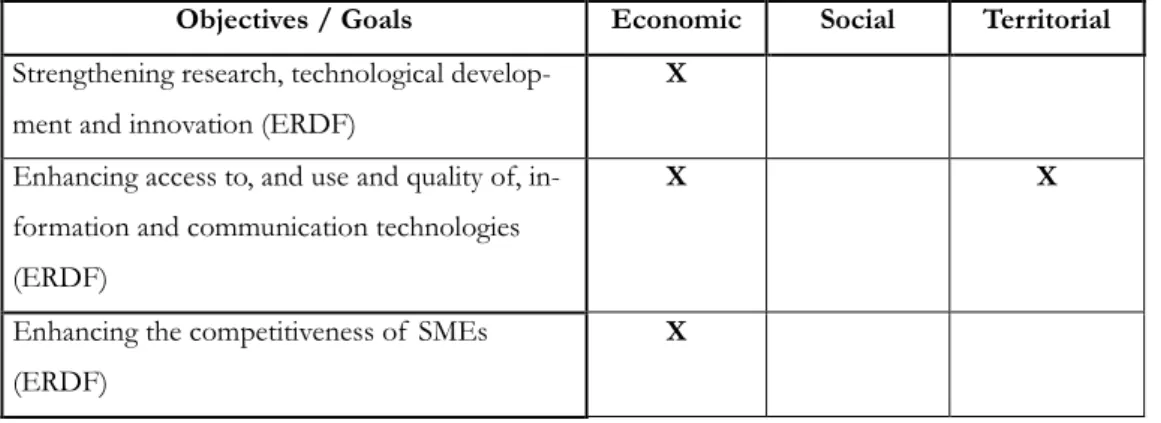
As explained by European Commission (2014a), there are three main funds respon-sible for delivering cohesion policy. The European Regional Development Fund’s (ERDF) purpose is to reinforce economic and social cohesion through investments on growth-en-hancing sector, which allows the creation of new jobs and the increase on competitiveness levels. The European Social Fund (ESF) is focused on social cohesion. For that, it channels funds to projects which focus on improving the employment situation and generating better education opportunities. Also, it intends to assist disadvantaged people under social exclusion and/or below the poverty line. Finally, the Cohesion Fund (CF) aims at proliferating sustain-able development and green growth. Also, it targets at improving the connectivity in relatively poor Member States, the ones with a GDP below 90% of the EU average. On the following table, the thematic objectives for the programming period 2014-20 are listed on the vertical, as presented by the European Commission (2014a, p. 5) and on the horizontal line are high-lighted the three cohesion policy goals addressed on this topic. In parenthesis it is labeled which fund is the main financier of each objective.
Table 1: Thematic objectives and matching cohesion policy goals
Objectives / Goals Economic Social Territorial Strengthening research, technological
develop-ment and innovation (ERDF)
X
Enhancing access to, and use and quality of, in-formation and communication technologies (ERDF)
X X
Enhancing the competitiveness of SMEs (ERDF)
16 Supporting the shift towards a low carbon
econ-omy (ERDF)
X
Promoting climate change adaptation, risk pre-vention and management (CF)
X
Preserving and protecting the environment and promoting resource efficiency (CF)
X
Promoting sustainable transport and improving network infrastructures (CF)
X X
Promoting sustainable and quality employment and supporting labour mobility (ESF)
X X
Promoting social inclusion, combating poverty and any discrimination (ESF)
X
Investing in education, training and lifelong learning (ESF)
X
Improving the efficiency of public administra-tion (ESF)
X X
Source: Own elaboration based on European Commission (2017) and European Commission (2014a)
2.3 Interreg
As defined by Interreg Europe (2018), the Interreg initiative aims at supporting re-gional and local governments from the EU to deliver better policy. For that, Interreg pro-motes an environment prone to the sharing of solutions and opportunities, which intends to ensure that governmental efforts, in terms of investment and innovation, lead to a sus-tainable and integrated impact for citizens and the region. As commented by European Com-mission (2015), the creation of Interreg places it as a community initiative programme (CIP), with the intent to build solid connections between neighbouring countries among the mem-ber states. Also, European Commission (2015, p. 29) states that Interreg targets the “stitching together of border areas, which was part of the perspective of the single market in 1993”, and it is “intended to reduce the obstacle to relations and exchanges that the border repre-sents”.
In accordance, European Union (2011) adds that Interreg, being since 1990 part of cohesion policy, assumes a place-based approach and its importance derives from its problem solving nature, which tackles issues that transcend national boundaries and demands a com-mon approach. Additionally, Interreg is defined as the key mechanism for helping regions
17 through the share of knowledge across Europe. Regarding the key features of Interreg, In-teract (2015) labels the programme as EU´s most important mechanism to promote cooper-ation across ncooper-ational borders. Furthermore, the same author, when addressing Interreg’s stra-tegic objectives, states that it aims at redressing regional imbalances across the member states, which represents the cohesion objective of ERDF.
Also, Interact (2015) situates the conception of Interreg within the context of the deepening process of European integration. For the author, this progressive process, which entailed the creation of a Single Market and Monetary Union, exposed the social and eco-nomic discrepancies across the member states, especially in the border regions. As the author continues, even though the Single Market provided a vast number of opportunities for growth and development, the regions did not equally benefit from the benefits of free move-ment of people, goods and capital. In order to address these challenges, therefore, a struc-tured initiative to deal with cross-border cooperation was needed. As added by Interact (2015, p.1), “through coordinated actions and joint decision making, authorities and people from border regions could work jointly on developing their cross-border areas as centers of com-merce and services, transitioning their peripheral locations into attractive Europe-internal locations”. The objective, therefore, is to bring to cross-bordering areas regions opportuni-ties for them to become hubs and bridges between the member states.
In the end of the 80s, the European Commission decided to address territorial co-hesion through long-term and consistent strategies. For that, in 1989 the European Com-mission allocated EUR 21 million in the form of financial support to fourteen cross-border projects, which aimed at addressing the structural causes for lagging development in border regions (European Union, 2011). These regions, as explained by European Commission (2015), are peripheral areas whose economy depends on them being at the border. The im-plementation of a single market could, therefore, impact negatively these areas, and this pro-gramme intended to mitigate the possible undesirable effects. As stated by the author, this initiative can be seen as a trial for the Interreg programme, and its success propelled the implementation of the latter.
In 1990, the European Commission created the Interreg I Community Initiative, comprising 31 programmes implemented at internal EU borders with a community contri-bution on €1.082 billion and over 2,500 projects could be carried out. Interreg I lasted from 1990 to 1993 and, as commented by Interact (2015), its actions intended to hasten the inte-gration or the border regions into the single market, lessening the seclusion of border regions
18 and to advocate for joint efforts towards spatial development matters. Furthermore, Interreg I provided the border regions’ authorities the necessary resources and incentives to promote cooperation projects that push bordering regions to work together towards the same goals, tackling common territorial challenges and, therefore, bringing Europe together, also through the sharing of good practices. In addition, Interact (2015) states that Interreg I served as the main instrument to push forward a multi-level governance structure, as it did not demand funds to be allocated strictly to nation-states, but also to regions covered by one of its programmes. For European Commission (2015), one of the merits of Interreg I is that, even though it covered only a limited area, it successfully incorporated a vast range of bordering areas when it comes to their populations, development and activities. About its legacy, Interact (2010) considers Interreg I a success. As reported, in 15 of the 31 pro-grammes the original amount channeled had to be enlarged. Moreover, cooperation was quite dynamic in the areas of tourism, environment and infrastructure.
After the resolution of Interreg I, which enabled the programme to be tested at Eu-ropean level, Interreg II ran from 1994 to 1999 to continue the initiative. As contextualized by European Union (2011), in the programme’s second edition, the Treaty on European Union (1992) was signed, three new members joined the Union, Austria, Finland and Swe-den, and cooperation was extended besides the limited geographical focus, as in cross-border cooperation, to include also transnational cooperation. According to Interact (2015), Interreg II was initially made up by two strands. Interreg IIA basically arose as the natural substitute of Interreg I and focused on cross-border cooperation, whereas Interreg IIB was a continu-ation of the former Community Initiative REGEN (1989-1993) and took over the funds allocated to cross-border energy networks, mainly between Greece and Italy and Spain and Portugal. In 1997, a third strand was introduced. Interreg IIC, as mentioned by Interact (2010, p. 7) was added to comprise “seven general transnational cooperation programmes, two cooperation programmes in the field of flood prevention6 and four programmes for drought prevention (Portugal, Spain, Italy and Greece)”. According to Interact (2015), the Community contributed to Interreg II with around €2.69 billion and these funds helped more than 10,000 cooperation projects to become reality in the programming period. The follow-ing table summarizes the three strands of Interreg, which began with Interreg II.
Table 2: The Interreg Strands
19
A. Cross-border Proximity Contiguity Local, regional
B. Transnational Cohesion
Planning as the overarching theme (transport, environment,
etc.)
Regional, supraregional, na-tional
C. Interregional Network Interactions Regional, supraregional, local Source: European Commission (2015)
Following Interreg II, the third edition of Interreg continued from 2000 to 2006 with a budget of €5.1 billion (European Commission, 2015). As reported by Interact (2010), In-terreg III was developed in the context of the eastern enlargement of the EU and the result-ant increase in the number of Interreg IIIA programmes to 62. Conforming Interact (2015), Interreg III was composed by five operational elements. Strand A was directed to cross-border cooperation and strand B, as a continuation of Interreg IIC, was on transnational cooperation, focusing on developing of a truly integrated territorial approach for the Euro-pean regional policy. Strand C was on interregional cooperation, with the objective of bring-ing development to EU regions laggbring-ing behind by the interregional cooperation, exchange of information and sharing of know-how. Then, two new programmes were added. The European Spatial Planning Observatory Network (ESPON) was conceived in order to pro-vide analysis of regional development trends within the EU and of spatial planning net-worked research significant to the EU. Finally, the INTERREG Animation, Cooperation and Transfer (Interact) programme was launched with the mission of providing technical assis-tance to all the stakeholders implementing the Interreg projects.
For the 2007-2013 programming period, Interreg changed its name. As explained by Interact (2015, p. 5), “in 2007–2013 cooperation was recognized as a cornerstone of EU cohesion policy, and INTERREG was made into a separate structural fund objective – Eu-ropean Territorial Cooperation (ETC) – alongside the ‘convergence’ and ‘competitiveness’ objectives”. The ETC initiative was granted €7.8 billion by the Community, making Interreg IV a remarkable mechanism in financial terms to induce cooperation (Interact, 2010). After acquiring the status of becoming one of the three goals of cohesion policy, ETC pro-grammes were seen on the same level as the conventional regional and national development programmes and obtained more visibility, an improved legal basis structure, besides higher expectations for accomplishments. In this programming period, Interreg IV/ETC was en-larged and supported 75 cooperation programmes, including cross and external borders (Strand A), 13 transnational projects (Strand B) and four EU-wide programmes: ESPON,
20 Interreg IVC, Interact and the new arrival Urbact, focused on transnational exchanges on urban development (Strand C). Additionally, ETC on this period was guided by the “Com-munity Strategic Guidelines for Cohesion’ and directed towards achieving thematic priorities such as innovation, environment, accessibility and sustainable urban development” (Interact, 2015, p. 5).
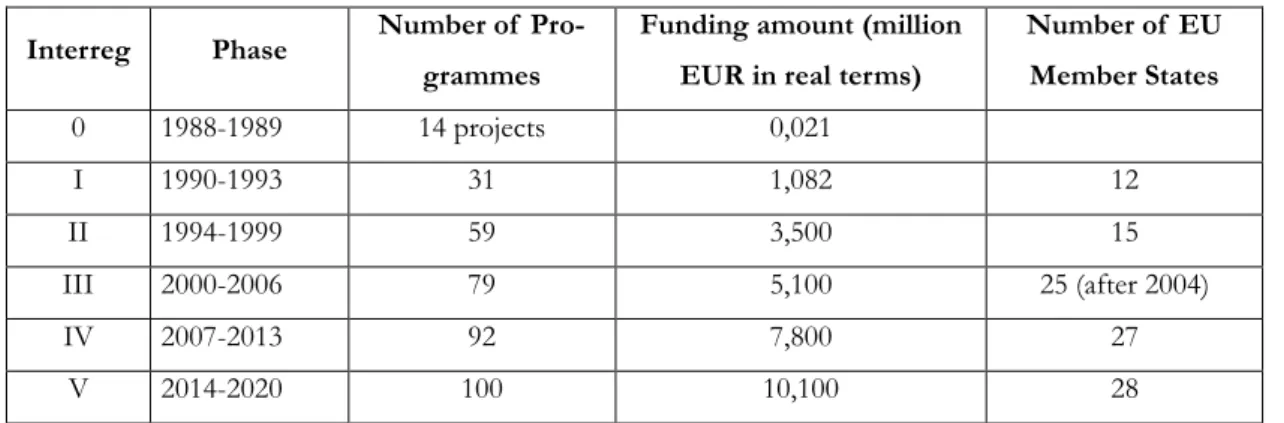
Table 3: Evolution of the Interreg Programmes
Interreg Phase Number of Pro-grammes
Funding amount (million EUR in real terms)
Number of EU Member States 0 1988-1989 14 projects 0,021 I 1990-1993 31 1,082 12 II 1994-1999 59 3,500 15 III 2000-2006 79 5,100 25 (after 2004) IV 2007-2013 92 7,800 27 V 2014-2020 100 10,100 28
Source: European Commission (2015)
The fifth edition of the programme started to operate in 2014, to last until 2020, as part of the European Union’s Europe 2020 strategy. For this programming period, Interreg was identified as goal two of EU cohesion policy, besides investment for Growth and Job, and received a Community contribution of €10.1 billion (Interact, 2015). According to Eu-ropean Commission (2015), Interreg V focuses on promoting smart and sustainable growth, as well as a more inclusive society. As described by European Commission (2018), over 100 cooperation programmes are supported by Interreg V. Out of these, 60 projects are of cross-border nature, corresponding to Interreg VA; 15 transnational – Interreg VB; and 4 Interreg VC programmes, which includes the cooperation projects Interreg Europe, Interact, Urbact and ESPON. The table below illustrates the evolution of the Interreg programmes, as well as its phases and funding.
21
Chapter 3. Methodology
In this section, the methodology used in the dissertation is explained. Therefore, in addition to the qualitative description of Interreg programmes, we will employ a quantitative technique. We will use a cluster analysis in order to map the Interreg programmes and to understand how they fit within the cohesion policy structure.
3.1 Cluster Analysis
As explained by Hair, Black, Babin, and Anderson (2014, p. 415), when a researcher makes use of a cluster analysis, the objective is to group “individuals or objects into clusters so that objects in the same cluster are more similar to one another than they are to objects in other clusters”. Therefore, the goal is to maximize the similarity of objects included in the same cluster and, at the same time, maximize the heterogeneity amongst the clusters. In ac-cordance, Hair et al. (2014) attest that cluster analysis consists of a multivariate technique in which the intent is to bring together objects based on common traces they possess.
As described by Hair et al. (2014), the classical methods of clustering use hierarchical algorithms, in which the clusters are formed successively on top of clusters previously estab-lished, or partitioning algorithms, where the clusters are determined at the same time by forming different partitions and then classifying them in regards with a certain criteria. How-ever, in the case of this research, the method employed is the TwoStep Cluster Analysis, by using the software SPSS – version 25. In SPSS, the clustering method can be performed using either Hierarchical Cluster, K-Means Cluster or TwoStep. The first two are classical methods of analysis, whereas TwoStep was specially designed for SPSS, as mentioned by Şchiopu (2010). As commented by the same author, the SPSS TwoStep Cluster Analysis was con-ceived to handle large data and, additionally, this method allows the researcher to use both continuous and categorical variables on the analysis in a very straightforward way. For these reasons, TwoStep Cluster by SPSS is more appropriate for this research. As explained by Şchiopu (2010), TwoStep Cluster Analysis is an algorithm written to handle large datasets in two steps. The first one is the “pre-cluster” phase, when all the data is scanned individually and the method decides, one by one, if the current record should be included in the previ-ously created cluster or if it should begin a new one, based on the distance criterion – which can be the Euclidean or the log-likelihood distance; in this research, SPSS automatically em-ployed the log-likelihood distance, since the Euclidean distance is only valid for the cases where all the variables are continuous. Then, the “cluster” step takes the sub-clusters resulted
22 from the pre-cluster step as an input and merges them according to the desired number of clusters. In this dissertation, cluster analysis will be used to analyze Interreg and identify similarities among its projects and potential overlapping among its programmes, based on a set of characteristics selected by the researcher. The dataset used will be gathered from Keep.eu, the official source of aggregated data on EU’s cross-border, transnational and in-terregional cooperation programmes, which offers useful information on the Interreg initia-tive from the year 2000 until the current programming period. Also, the database allows the user to filter for NUTS, thematic objectives and types of programmes. The variables ex-tracted, such as thematic, geographic area and duration of the projects, will be labelled in order to be turned into quantitative variables. Additionally, we also consider the budget allo-cated to each project and the total amount received by each country or region. In order to standardize all the quantitative variables of the dataset, and give them equal weight and im-portance, the variables Budget, EU Funding and Duration were normalized. The data, then, was normalized according to the Minimum – Maximum method, which employs the follow-ing formula, as stated by OECD (2008):
𝑦 =max (𝑥)−min(𝑥)𝑥−min(𝑥) (3.1)
With cluster analysis, the researcher intents to identify the similar characteristics found among the countries that receive EU funds through Interreg programmes.
3.2 Database description
In order to define data to be used in the cluster analysis, the database found at Keep.eu was exploited. As above mentioned, Keep.eu is the official source of data regarding Euro-pean cooperation programmes – cross-border, transnational and international – among member states and between these and neighbouring countries (Keep.eu, 2019). For this work, the data was searched under the criteria “projects” and the only filters applied were on the “types of programmes”, where the options “Interreg Cross-border”, “Interreg Transna-tional”, “Interreg Networking” and “Interreg-IPA Cross-border” were checked.
When downloaded, however, the data obtained from Keep.eu did not come ready for this analysis. The information on the countries involved in the projects, the lead and the other partners, came in two separate tables and in a not quite organized way. For instance, each partner corresponded to a new entry (line) on two different tables, and, therefore, some adjustments had to be made to have the info put together. Also, some effort was directed
23 towards the categorization of qualitative data. As it will be explained with more details fur-ther on, the variables for the countries, thematics and programmes had to be labelled on a binary form. For that, each thematic, country and programme became a new column, and the number one was added for a country if the project had that particular country involved, and zero when it did not – same logic applies for the thematics and programmes.
With this, the data available, downloaded on February 10th of 2019, presents 19.360
projects comprising the three programming periods, 2000-2006, 2007-2013 and 2014-2020, accounted for in the database. On the table below the number of projects and programmes on each programming period are presented:
Table 4: Projects and programmes per programming period
Programming Period Number of programmes Number of projects
2000-2006 82 7670
2007-2013 78 9162
2014-2020 49 2528
Source: authors computation based on Keep.eu.
Keep.eu presents few variables related with our research. For this dissertation, the ones used were: the programme in which each project is included, the countries involved, con-sidering both the lead partner and the other partners, the total budget, the EU funding, the
thematics of each project and, finally, the duration of projects. In order to do a more efficient
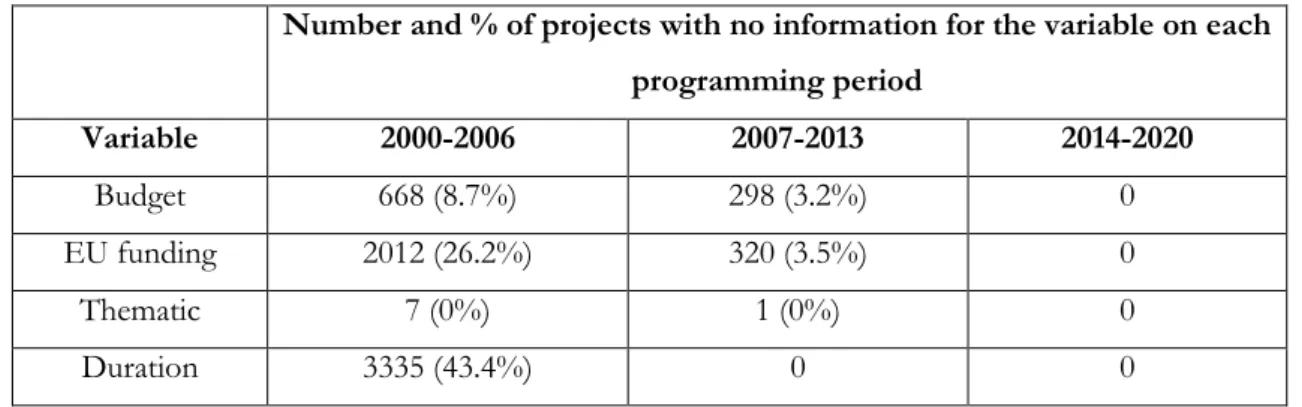
analysis, each programming period was evaluated individually. Still about the variables used, it is important to highlight that not all the projects presented values for all the variables. To avoid that this situation invalidate the analysis, these projects were removed from the data-base.
Still about the variables analyzed in this research, as the name suggests, Budget and
EU funding correspond, respectively, to the total amount spent on it and how much of the
budget will be funded by the EU. The duration, on its behalf, corresponds to the difference between the starting date and the end date.
24
Table 5: Quality of data on each programming period
Number and % of projects with no information for the variable on each programming period Variable 2000-2006 2007-2013 2014-2020 Budget 668 (8.7%) 298 (3.2%) 0 EU funding 2012 (26.2%) 320 (3.5%) 0 Thematic 7 (0%) 1 (0%) 0 Duration 3335 (43.4%) 0 0
Legend: In parentheses, the percentage over the total number of projects. Source: authors computation based on Keep.eu.
Table 6: Projects with complete information on each programming period
Number and % of projects with complete information on each program-ming period
2000-2006 2007-2013 2014-2020
Number (%) of
projects 3676 (48%) 8219 (89.7%) 2528 (100%)
Legend: In parentheses, the percentage of projects this amount represents over the total number of projects initially dis-played.
Source: authors computation based on Keep.eu
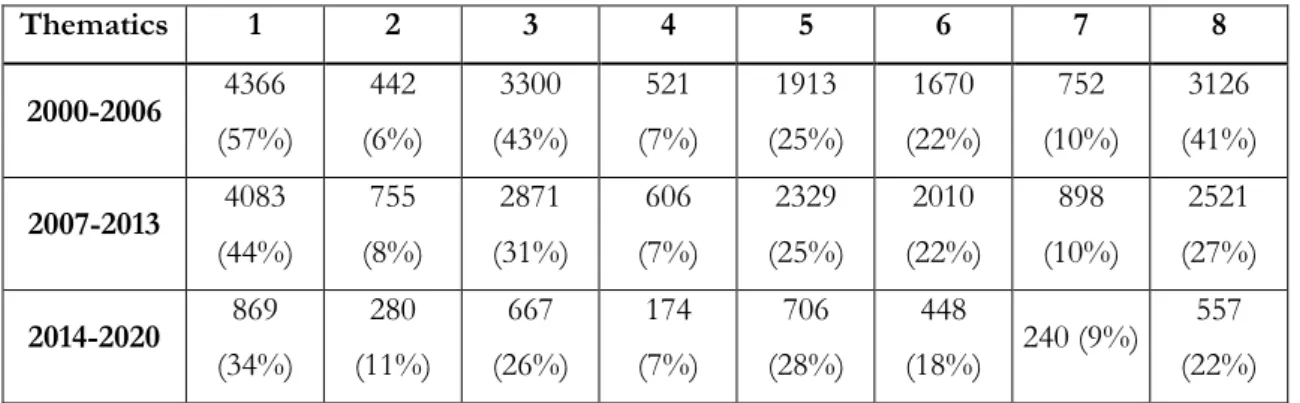
The variable thematics is related to the thematic objectives of the programming period in which each project is included and each one may be associated with up to three thematics, as presented in the dataset. However, the thematic choices may vary from one programming period to another, depending on the priority axes defined by the EU. Therefore, in order to allow this variable to be matched across periods, it was necessary to categorize it in common and comparable thematic areas, as did by Interact (2016). For this research, based on the framework presented by Interact (2016), the classification has been made by grouping to-gether the 42 possible thematic choices into the following eight groups: 1) Employment, social inclusion, education and institutional capacity; 2) Health; 3) Innovation and competi-tiveness; 4) Transport and mobility; 5) Environment and energy efficiency; 6) Sustainable urban and rural development; 7) Agriculture, fisheries and forestry (AFF) and coastal man-agement; and 8) Tourism and culture.
25
Table 7: Thematic groups
Thematic Label Thematic Label
Education and training 1 Climate change and biodiversity 5
Social inclusion and equal opportunities 1 Water management 5
Community integration and common
identity 1 Renewable energy 5
Governance, partnership 1 Sustainable management of natural
resources 5
Clustering and economic cooperation 1 Soil and air quality 5
Institutional cooperation and
coopera-tion networks 1 Waste and pollution 5
Labour market and employment 1 Managing natural and man-made
threats, risk management 5 Demographic change and immigration 1 Waterways, lakes and rivers 5
Safety 1 Traditional energy 5
Health and social services 2 Energy efficiency 5
Cooperation between emergency
services 2 Construction and renovation 6
Innovation capacity and
awareness-rais-ing 3 Evaluation systems and results 6
Green technologies 3 Regional planning and development 6
Scientific cooperation 3 Urban development 6
SME and entrepreneurship 3 Infrastructure 6
New products and services 3 Rural and peripheral development 6
ICT and digital society 3 Coastal management and maritime
is-sues 7
Knowledge and technology transfer 3 Agriculture and fisheries and forestry 7
Transport and mobility 4 Tourism 8
Multimodal transport 4 Cultural heritage and arts 8
Logistics and freight transport 4
Improving transport connections 4
Source: authors computation based on Keep.eu and the labelling of thematics proposed by Interact (2016).