Printed version ISSN 0001-3765 / Online version ISSN 1678-2690 http://dx.doi.org/10.1590/0001-3765201720170601
www.scielo.br/aabc | www.fb.com/aabcjournal
Biomarkers as predictors of mortality in critically ill patients with solid tumors
AUDREY M. DOS REIS¹, ANA V.G. FRUCHTENICHT², LUIZA C. DE ATHAYDES³, SÉRGIO LOSS4
and LUIS FERNANDO MOREIRA²
¹Programa de Pós-Graduação em Nutrição, Departamento de Nutrição, Universidade Federal do Rio Grande do Sul/UFRGS, FAMED, HCPA, Rua Ramiro Barcelos, 2400, 91035-095 Porto Alegre, RS, Brazil ²Programa de Pós-Graduação em Cirurgia, Departamento de Medicina, Universidade Federal do Rio Grande
do Sul/UFRGS, FAMED, HCPA, Rua Ramiro Barcelos, 2400, 91035-095 Porto Alegre, RS, Brazil ³Departamento de Nutrição, Universidade Federal do Rio Grande do Sul/UFRGS,
FAMED, Rua Ramiro Barcelos, 2400, 91035-095 Porto Alegre, RS, Brazil 4
Programa de Pós-Graduação em Medicina, Departamento de Medicina, FAMED, HCPA, Universidade Federal do Rio Grande do Sul/UFRGS, Rua Ramiro Barcelos, 2400, 91035-095 Porto Alegre, RS, Brazil
Manuscript received on August 5, 2017; accepted for publication on October 3, 2017
ABSTRACT
Biochemical markers produced by the affected organ or body in response to disease have gained high clinical value due to assess disease development and being excellent predictors of morbidity and mortality. The aim of this study is to analyze different biochemical markers in critically cancer patients and to determine which of them can be used as predictors of mortality. This is a prospective, cross-sectional study conducted at a University Hospital in Porto Alegre - RS. Screening was done to include patients in the study. Serum biochemical markers obtained in the first 24 hours of Intensive Care Unit hospitalization were analyzed. A second review of medical records occurred after three months objected to identify death or Unit discharged. A sample of 130 individuals was obtained (control group n = 65, study group n = 65). In the multivariate model, serum magnesium values OR = 3.97 (1.17; 13.5), presence of neoplasia OR = 2.68 (95% CI 1.13; 6.37) and absence of sepsis OR = 0.31 (95% CI 0.12; 0.79) were robust predictors of mortality. The association of solid tumors, sepsis presence and alteration in serum magnesium levels resulted in an increased chance of mortality in critically ill patients.
Key words: intensive care, critically ill cancer patient, intensive care mortality, biochemical markers.
Correspondence to: Audrey Machado dos Reis E-mail: [email protected]
INTRODUCTION
Recently, the number of cancer patients admitted to Intensive Care Units (ICUs) has increased (Azoulay and Afessa 2006). Therapy and neoplasia may lead
to clinical complications with immediate risk of life, such as in spontaneous tumor lysis syndrome,
or due to tumor compression, causing respiratory
failure, renal insufficiency or intestinal obstruction
(Hallahan et al. 2000). To reduce mortality of these patients are being developed new procedures, such as non-invasive mechanical ventilation, and appropriate use of resources available in the ICU (Hilbert et al. 2001).
Produced by the affected organ or the body
have gained high scientific and clinical value over the last few years and have been extremely useful throughout the development of the disease (Group BDW 2001, Kumar and Sarin 2010), being considered excellent predictors of complications and morbidity and mortality (Abidi et al. 2011, Blasco et al. 2011, Egi et al. 2011, Jansen et al. 2010, Grander et al. 2010).
Thus, it is fundamental that the analysis of biochemical markers is performed not only in critically ill patients, but also in critically ill oncologic patients, aiming to better predict mortality in this population. Therefore, the main objective
of this study is to analyze different biochemical
markers in critically ill cancer patients, compared to general critically ill people, and to determine which can be used as predictors of mortality in these individuals.
MATERIALS AND METHODS
This is a prospective, cross-sectional study carried out in an ICU located in a University Hospital in Porto Alegre - RS.
Data collection was done through a search of medical records from July to December in 2015. The sample was divided into two groups: the control group, composed of critically ill patients with various diseases, and the study group, composed of critically ill cancer patients.
The Ethics Committee from Hospital dispensed the application of the informed consent form. The patients had their identity removed before analyzes.
Daily screening was performed for inclusion of patients in the study. Biochemical markers obtained
in the first 24 hours of ICU stay were analyzed. A
second review of medical records occurred after 3 months aimed to identify death or ICU discharge.
Both groups had collected serum levels of fasting glucose, C-reactive protein (CRP), phosphorus, magnesium, chlorine, ionic calcium, creatinine, urea, troponin, hemogram (leukocytes,
lymphocytes, erythrocytes, hemoglobin, hematocrit and platelets), PH, bicarbonate and lactate. Patients were also assessed by anthropometry: weight, usual weight, height and Body Mass Index (BMI).
We used bed scale and stadiometer available at the Unit. The duration of ICU stay was assessed through days that the patient remained until ICU
discharge or death.
Previous surgical procedures and diagnosis of sepsis before hospitalization were also investigated in order to evaluate possible biases.
The eligibility criteria were patients of both sexes, older than 18 years, non-cancer critically ill patients, and critically ill cancer patients with solid
tumors were included. Patients with other types of neoplasia (e.g., hematologic) and complicated by febrile neutropenia were excluded.
STATISTICAL METHOD
The data were analyzed regarding the probability of parametric distribution using the
Komolgorov-Smirnov test.
The variables were reported using descriptive and inferential statistics. For inferential analysis, binary logistic regression was used, where the
independent variables were initially included in groups: (a) demographic parameters (age, sex and race); (B) clinical condition (presence of surgery,
cancer and sepsis); (C) Biochemical parameters; and (d) other parameters (weight, BMI and nutritional status). The dependent variable was mortality.
The variables that had a p-value of <0.2 were included in the multivariate model in a progressive
form. The final regression considered only those
variables whose p values were less than 0.05 as
hepatic, pancreatic or bile duct (12.3%), cervical or breast (4.6%) and thyroid (1.5%).
On the other hand, the control group presented diseases of origin: infectious (32.3%), cardiovascular (15.4%), respiratory (15.4), neurological (10.8%), renal (7,7%), hepatic, pancreatic or bile duct (6.1%) and others (13.3%).
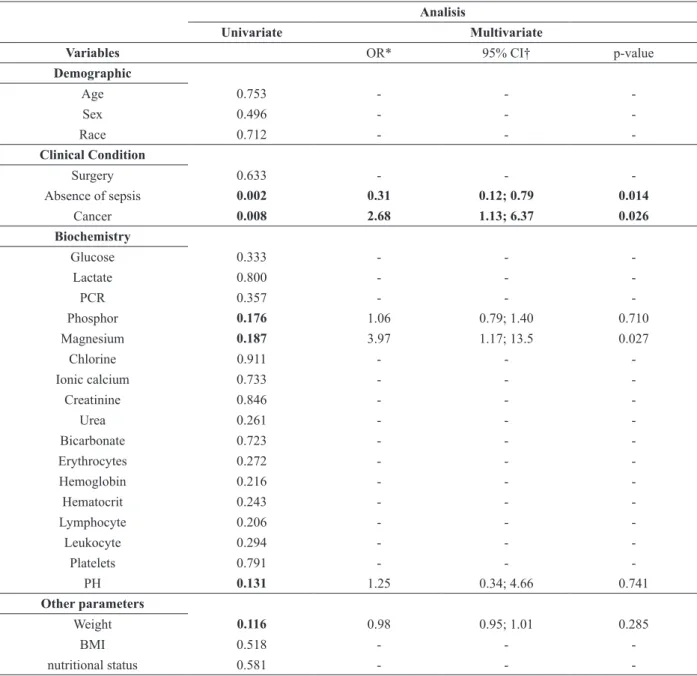
Initially, when variables were included by affinity groups, the presence of neoplasia and sepsis were clinical conditions that could be associated with mortality. In addition, the values of phosphorus, magnesium, blood pH and current weight were also initially associated with mortality through interpretations of only the p-value of the univariate analysis.
However, including these variables mentioned in the multivariate model it was detected that serum magnesium values OR = 3.97 (1.17; 13.5), presence of neoplasia OR = 2.68 (95% CI 1.13; 6.37) and absence of sepsis OR = 0.31 (95% CI 0.12; 0.79) were robust predictors of mortality. More details are given in Table II.
DISCUSSION
Sepsis, a usual systemic response to infection, commonly leads to life-threatening complications inside hospital. Our study presented sepsis prevalence in 30.8% of patients. In particular, sepsis is the mainly cause of death in ICU patients with mortality rate is about 50% (Lukaszewski et al. 2008). In United States, about one third of sepsis diagnoses resulting in death and your treatment is expensive, ranging from 15.4 to 20 billion USD per year (Torio and Andrews 2013). As sepsis progresses, it causes organ dysfunction, and the mortality rate increases substantially (Shrestha et al. 2017). It is crucial to detect sepsis as early as possible and prevent it (Shrestha et al. 2017). The guidelines, for example, mainly focus on management of bacterial and fungal sepsis (Shrestha et al. 2017). But most recent studies have
Sample size
Considering the average mortality of 18% in general critically ill patients and 42% in critically ill oncologic patients, according to Taccone et al. (2009), to determine the difference in mortality
between the two groups, considering 5% (α = 0.05) significance level and 80.0% (β = 0.20)
statistical power were necessary 130 patients (n = 65 in the study group, n = 65 in the control group). Calculations were performed using Winpepi Software version 11.32 (2013).
RESULTS
A sample of 130 individuals was obtained (control group n = 65, study group n = 65). The troponin marker was excluded from the analysis due to your low frequency in the medical records.
There were 74 (56.9%) male patients, mean age (SD) of 61.9 (13.4) years. Thirty-nine (30%) patients underwent surgeries prior to ICU admission, all of them from cancer group. Eighteen and 22 patients presented sepsis in the oncological and critical general group, respectively, totalizing 40 (30.8%) individuals. There were a total of 57 (43.8%) deaths, whereas there were only 18 deaths in study group and 37 in the control group.
It was possible to calculate the BMI of 126 patients. Were found a total of 23 malnourished individuals (9 in the cancer group and 14 in the control group), 50 eutrophic patients (22 in the cancer group and 28 in the control group), 37 body excess patients (21 in the cancer group and 16 in the control group) and 16 obeses (6 in the cancer group and 10 in the control group).
The clinical and epidemiological characteristics of the study and control group are in Table I.
TABLE I
Characteristics of the patients.
Variables Descriptive statistics
Demographic
Age; in years† 61.9 (13.4)
Sex (Male)* 74 (56.9%)
Race* 116 whites (89%); 10 (8%) blacks; e 4 brown (3%) Clinical Conditions
Surgery* 39 (30%)
Sepsis * 40 (30.8%)
Deaths * 57 (43.8%)
Length of stay for death☨ 11 (6-19)
Biochemistry
Glucose (mg / dL) † 128.6 (58.9)
Lactate (mmol / L) ☨ 124.3 (44.75 - 233.55)
PCR (mg / L) ☨ 3.4 (2.7 - 4.1)
Phosphorus (mg / dL) † 3.6 (1.5)
Magnesium (mg / dL) † 1.8 (0.4)
Chlorine (mEq / L) † 103.7 (7.0)
Ionic calcium (mg / dL) ☨ 4.6 (3.95 - 4.9)
Creatinine (mg / dL) ☨ 1.25 (0.74 - 2.72)
Urea (mg / dL) ☨ 62 (42 - 114)
Bicarbonate (mEq / L) † 21.6 (6.0)
Erythrocytes (millions / ul) † 3.3 (0.8)
Hemoglobin (g / dL) † 9.8 (2.4)
Hematocrit (%) † 29.4 (7.0)
Lymphocyte (x10³ / μl) ☨ 8 (5.3 - 14.05)
Leukocyte (x10³ / uL) ☨ 11.8 (8.145 - 16.54)
Platelets (x103 / uL) † 214 (139 - 289)
PH † 7.3 (0.5)
Other parameters
Weight (Kg) † 67.3 (16.8)
Usual Weight (Kg) † BMI (Kg / m2) †
69.9 (13.5) 25.9 (6.2)
* N (%) represents absolute numbers and relative frequency unless otherwise specified; † data described as mean and standard deviation; Median (p25 - p75).
focused on patients with existing sepsis utilizing electronic medical records, laboratory results, and biomedical signals to predict status changes as sepsis progresses to severe sepsis or septic shock, predict and prevent fatal injury and death via intensive management (Ho et al. 2012, Henry et al. 2014, 2015, Thiel et al. 2010, Shavdia 2007,
Gultepe et al. 2014). The present study analyzed seventeen different biomarkers that are usually taken and not represent additional costs to the hospital.
2010). Mechanisms commonly involved in the pathogenesis of electrolyte disturbances including altered magnesium levels, reduction of renal perfusion, cardiac failure due to sepsis, activation of the renin-angiotensin-aldosterone system and vasopressin, improper fluid administration and medication effects (Lee et al. 2010). Microcirculatory alterations have critical role in
sepsis and persist despite correction of systemic hemodynamic parameters (Lee et al. 2010). Magnesium is involved in both endothelium-dependent and non-endothelium-endothelium-dependent vasodilatory pathways (Lee et al. 2010).
Magnesium is intracellular cation very relevant which your activities involves in energy metabolism, it is required for nucleic acid transcription,
TABLE II
Univariate and multivariate analysis for mortality. Analisis
Univariate Multivariate
Variables OR* 95% CI† p-value
Demographic
Age 0.753 - -
-Sex 0.496 - -
-Race 0.712 - -
-Clinical Condition
Surgery 0.633 - -
-Absence of sepsis 0.002 0.31 0.12; 0.79 0.014
Cancer 0.008 2.68 1.13; 6.37 0.026
Biochemistry
Glucose 0.333 - -
-Lactate 0.800 - -
-PCR 0.357 - -
-Phosphor 0.176 1.06 0.79; 1.40 0.710
Magnesium 0.187 3.97 1.17; 13.5 0.027
Chlorine 0.911 - -
-Ionic calcium 0.733 - -
-Creatinine 0.846 - -
-Urea 0.261 - -
-Bicarbonate 0.723 - -
-Erythrocytes 0.272 - -
-Hemoglobin 0.216 - -
-Hematocrit 0.243 - -
-Lymphocyte 0.206 - -
-Leukocyte 0.294 - -
-Platelets 0.791 - -
-PH 0.131 1.25 0.34; 4.66 0.741
Other parameters
Weight 0.116 0.98 0.95; 1.01 0.285
BMI 0.518 - -
-nutritional status 0.581 - -
messenger RNA translation and protein synthesis, and it is responsible for regulation of function of mitochondria. Besides that, magnesium ions have important role in immunological functions, as macrophage activation, adherence and bactericidal activity of granulocyte oxidative burst, lymphocyte proliferation and endotoxin binding to monocytes (Malpuech-Brugere et al.2000).
The magnesium role in sepsis could be attributed to the immune system effects, which are important in this pathogenesis. Moreover, cell membrane calcium channels are magnesium dependent and magnesium seems to be a factor regulating sepsis-associated calcium entry (White and Hartzell 1989). Altered magnesium
concentrations are associated with abnormal flux
of free calcium from the sarcoplasmic reticulum into the cytosol (White and Hartzell 1989). But we do not found disturbance in ionic calcium levels in our analyses (p>0.05). White and Hartzell (1989) showed in rat model that intracellular calcium may cause activation of calcium sensitive nitric oxide synthase in septic shock. In addition, magnesium has a fundamental role in regulation of cardiovascular homeostasis: Watanabe et al. (2011) demonstrated in your experimental study
significantly reduced cardiac tolerance to hypoxia in animals with magnesium deficiency. Small changes
of free magnesium in cardiac and vascular muscle membranes are sufficient to produce significant
effects on the mechanical and electrical activities
of these cells (Altura and Altura 1985).
In this study, the presence of high bloodstream magnesium, neoplasia and sepsis showed to increase the odds ratio for mortality in critically ill patient, but the literature data are controversial. Several studies have shown a variable relationship between rates of blood magnesium and mortality or morbidity. Limaye et al.(2011) (57% vs. 31%), Safavi and Honarmand (2007) (55% vs. 35%), and Rubeiz et al. (1993) found a higher mortality rate in patients with hypomagnesemia compared to normal
magnesium levels in the blood. Guérin et al. (1996) observed a higher mortality rate among patients with hypermagnesemia. Another study revealed a
significantly higher mortality rate in patients with
hypomagnesemia (P = 0.001), where the highest rates were attributed to a higher incidence of electrolytic abnormalities, especially hypokalemia, cardiac arrhythmias and a strong association of hypomagnesaemia with sepsis and malnutrition (Sunil et al. 2015).
In relation to cancer, it remains a leading cause
of death in the general population, and the first
cause of death in men and women over 40 years old (Miller et al. 2016, Siegel et al.2016). Overall, the cancer death rate has dropped by 23% since the 1990s and The American Association for Cancer Research recently reported that the number of cancer survivors increased from 1 in 69 (1.4%) to 1 in 21 (4.8%) people old (Miller et al. 2016, Siegel et al.2016). For this, accelerating progress against cancer will increasingly require ICU support (Shimabukuro-Vornhagen et al. 2016). Over the past two decades the number of cancer patients needing ICU care has dramatically increased, with 15% of ICU beds occupied by cancer patients (Soares et al. 2016).
time was related to long-term mortality(Ranzani et al.2015), because it also indicates the presence of organic dysfunction and, therefore, a state of lasting vulnerability(Vincent and Rubenfeld 2015). In the Unit where this study was carried out, it is a routine reassessment of arterial blood gases before discharge patients.
Peres et al. (2015) observed mortality in patients with Acute Renal Failure (ARF). ARF is a frequent complication in ICU patients, with an incidence of around 40%(Park et al. 2010). Among patients with severe ARF and dialysis use, the mortality rate may reach 80% (de Abreu et al. 2010, Druml et al. 2010). The independent risk factors for death were: baseline disease, high levels of creatinine, urea, sodium and lactate on admission and need for MV(Daher et al. 2008). Oliguria occurs frequently in ICU patients with ARF and is more sensitive than higher plasma creatinine and is recognized as an early predictor of high mortality in critically ill patients (Daher et al. 2008).
Xia and Wang(2016) conducted a study that included critically ill patients with solid malignant tumors. The authors showed that the only predictor of mortality in the ICU was the SOFA (Sequential Organ Failure Assessment) score applied on the seventh day of hospitalization, indicating that poor performance on admission results in limited power in professional decision. They demonstrated that severity of disturbance physiological in the 6 subsequent days of ICU admission has the greatest impact on survival (Xia and Wang 2016). Another article including critically ill cancer patients determined that the survival of these patients depends on the number of organ failure
and respiratory insufficiency(Taccone et al. 2009). The biomarkers disturb can indicate organ failure as electrolytes, lactate, urea and creatinine.
In our study, 30% from oncologic patients were in tumor resection postoperative. Hirschler-Schulte et al.(1985) demonstrated the need for MV in 4.4% of patients after lobectomy and pneumonectomy
for resection of bronchial carcinoma. They reported an annual hospital mortality rate of 50% and an annual mortality rate of 81%. Song et al. (2007) included patients in the postoperative period of lung or esophageal tumor resection, demonstrating mortality of 33%, where the greatest complications
were in relation to preoperative fibrinogen level,
surgical duration and male sex. It also revealed that for the reduction of mortality it is important to apply the APACHE (Acute Physiology and Chronic Health Evaluation) score at the time of hospitalization, as well as the early transfer to intensive care.
This study has some limitations, as patients’ variability in the control group. However, this is
the first study that included controls from the same
standard of intensive care. In addition, the number of readmissions of these individuals, the use of renal replacement therapy and MV, were not counted. However, these variables are being analyzed in another protocol performed by this group.
CONCLUSIONS
Our study demonstrated that the association of solid tumors neoplasms, presence of sepsis and alteration in serum magnesium levels resulted in increased chances of mortality in critically ill patients under intensive care.
In fact, more studies exploring biochemical markers or establishing a prognosis predictive score in critically oncologic patients are needed for better management population.
REFERENCES
ABIDI K, BELAYACHI J, DERRAS Y, KHAYARI ME, DENDANE T, MADANI N, KHOUDRI I, ZEGGWAGH AA AND ABOUQAL R. 2011. Eosinopenia, an early marker of increased mortality in critically ill medical patients. Intensive Care Med 37(7): 1136-1142.
AZOULAY E AND AFESSA B. 2006. The intensive care support of patients with malignancy: do everything that can be done. Intensive Care Med 32: 3-5.
BLASCO V, WIRAMUS S, TEXTORIS J, ANTONINI F, BECHIS C, ALBANÈSE J, MARTIN C AND LEONE M. 2011. Monitoring of plasma creatinine and urinary
γ-glutamyl transpeptidase improves detection of acute
kidney injury by more than 20%. Crit Care Med 39(1): 52-56.
DAHER EF, MARQUES CN, LIMA RS, SILVA JÚNIOR GB, BARBOSA AS, BARBOSA ES, MOTA RM, LEITE DA SILVA S, ARAÚJO SM AND LIBÓRIO AB. 2008. Acute kidney injury in an infectious disease intensive care unit - an assessment of prognostic factors. Swiss Med Wkly 138: 128-133.
DE ABREU KL, SILVA JÚNIOR GB, BARRETO AG, MELO FM, OLIVEIRA BB, MOTA RM, ROCHA NA, SILVA SL, ARAÚJO SM AND DAHER EF. 2010. Acute kidney injury after trauma: Prevalence, clinical characteristics and RIFLE classification. Indian J Crit Care Med 14: 121-128. DRUML W, METNITZ B, SCHADEN E, BAUER P AND
METNITZ PG. 2010. Impact of body mass on incidence and prognosis of acute kidney injury requiring renal replacement therapy. Intensive Care Med 36: 1221-1228. EGI M, KIM I, NICHOL A, STACHOWSKI E, FRENCH CJ,
HART GK, HEGARTY C, BAILEY M AND BELLOMO R. 2011. Ionized calcium concentration and outcome in critical illness. Crit Care Med 39(2): 314-321.
GRANDER W, DÜNSER M, STOLLENWERK B, SIEBERT U, DENGG C, KOLLER B, ELLER P AND TILG H. 2010. C-reactive protein levels and post-ICU mortality in nonsurgical intensive care patients. Chest 138(4): 856-862. GROUP BDW. 2001. Biomarkers and surrogate endpoints:
Preferred definitions and conceptual framework. Clin Pharmacol Ther 69(3): 89-95.
GUÉRIN C, COUSIN C, MIGNOT F, MANCHON M AND FOURNIER G. 1996. Serum and erythrocyte magnesium in critically ill patients. Intensive Care Med 22: 724-727. GULTEPE E, GREEN JP, NGUYEN H, ADAMS J,
ALBERTSON T AND TAGKOPOULOS I. 2014. From vital signs to clinical outcomes for patients with sepsis: a machine learning basis for a clinical decision support system. JAMA: 315-325.
HALLAHAN AR, SHAW PJ, ROWELL G, O’CONNELL A, SCHELL D AND GILLIS J. 2000. Improved outcome of children with malignance admitted to a pediatric intensive care unit. Crit Care Med 28: 3718-3721.
HENRY K, PAXTON C, KIM KS, PHAM J AND SARIA S. 2014. 63: Rews: Real-time early warning score for septic shock. Crit Care Med 42(12): A1384.
HENRY KE, HAGER DN, PRONOVOST PJ AND SARIA S. 2015. A targeted realtime early warning score (trewscore) for septic shock. Sci Trans Med 299: 299ra122.
HILBERT G, GRUSON D, VARGAS F, VALENTINO R, GBIKPI-BENISSAN G, DUPON M, REIFFERS J AND CARDINAUD JP. 2001. Noninvasive ventilation in immunosuppressed patients with pulmonary infiltrates, fever, and acute respiratory failure. N Engl J Med 344: 481-487.
HIRSCHLER-SCHULTE CJW, HYLKEMA BS AND MEYER RW. 1985. Mechanical ventilation of acute postoperative respiratory failure after surgery for bronchial carcinoma. Thorax 40: 387-390.
HO JC, LEE CH AND GHOSH J. 2012. Imputation-enhanced prediction of septic shock in icu patients. In Proceedings of the ACM SIGKDD workshop on health informatics (HI-KDD12).
JANSEN TC, VAN BOMMEL J, SCHOONDERBEEK FJ, SLEESWIJK VISSER SJ, VAN DER KLOOSTER JM, LIMA AP, WILLEMSEN SP AND BAKKER J. 2010. Early lactate-guided therapy in intensive care unit patients: a multicenter, open-label, randomized controlled trial. Am J Respir Crit Care Med 15(6): 752-761.
KRAMER AA, HIGGINS TL AND ZIMMERMAN JE. 2012. Intensive care unit readmissions in U.S. hospitals: patient characteristics, risk factors, and outcomes. Crit Care Med 40(1): 3-10.
KUMAR M AND SARIN SK. 2010. Biomarkers of diseases in medicine. Current Trends in Science 15: 403-406. LEE JW. 2010. Fluid and electrolyte disturbances in critically
ill patients. Electrolyte Blood Press 8(2): 72-81.
LIMAYE CS, LONDHEY VA, NADKART MY AND BORGES NE. 2011. Hypomagnesemia in critically ill medical patients. J Assoc Physicians India 59: 19-22. LUKASZEWSKI RA ET AL. 2008. Presymptomatic
prediction of sepsis in intensive care unit patients. Clin Vaccine Immunol 15(7): 1089-1094.
MALPUECH-BRUGERE C, NOWACKI W, DAVEAU M, GUEUX E, LINARD C, ROCK E, LEBRETON J, MAZUR A AND RAYSSIGUIER Y. 2000. Inflammatory response following acute magnesium deficiency in the rat. Biochim Biophys Acta 1501(2-3): 91-98.
MILLER KD, SIEGEL RL, LIN CC, MARIOTTO AB, KRAMER JL, ROWLAND JH, STEIN KD, ALTERI R AND JEMAL A. 2016. Cancer treatment and survivorship statistics. CA Cancer J Clin 66: 271-289.
PARK WY, HWANG EA, JANG MH, PARK SB AND KIM HC. 2010. The risk factors and outcome of acute kidney injury in the intensive care units. Korean J Intern Med 25: 181-187.
PERES LAB, WANDEUR V AND MATSUO T. 2015. Preditores de injúria renal aguda e de mortalidade em uma Unidade de Terapia Intensiva. J Bras Nefrol 37(1): 38-46. RANZANI OT, ZAMPIERI FG, BESEN BA, AZEVEDO LC
organ dysfunction in a cohort study in Brazil. Crit Care 19: 269-269.
RENTON J, PILCHER DV, SANTAMARIA JD, STOW P, BAILEY M, HART G AND DUKE G. 2011. Factors associated with increased risk of readmission to intensive care in Australia. Intensive Care Med 37(11): 1800-1808. RODRIGUES CM, PIRES EMC, FELICIANO JPO, VIEIRA
JR JM AND TANIGUCHI LU. 2016. Admission factors associated with intensive care unit readmission in critically ill oncohematological patients: a retrospective cohort study. Rev Bras Ter Intensiva 28(1): 33-39.
RUBEIZ GJ, THILL-BAHAROZIAN M, HARDIE D AND CARLSON RW. 1993. Association of hypomagnesemia and mortality in acutely ill medical patients. Crit Care Med 21: 203-209.
SAFAVI M AND HONARMAND A. 2007. Admission hypomagnesemia - Impact on mortality or morbidity in critically ill patients. Middle East J Anaesthesiol 19: 645-660.
SHAVDIA D. 2007. Septic shock: Providing early warnings through multivariate logistic regression models. PhD thesis, Massachusetts Institute of Technology.
SHIMABUKURO-VORNHAGEN A, BOLL B, KOCHANEK M, AZOULAY E AND VON BERGWELT-BAILDON MS. 2016. Critical care of patients with cancer. CA Cancer J Clin 66(6): 496-517.
SHRESTHA GS ET AL. 2017. International Surviving Sepsis Campaign guidelines 2016: the perspective from low-income and middle-low-income countries. Lancet Infect Dis 17(9): 893-895.
SIEGEL RL, MILLER KD AND JEMAL A. 2016. Cancer statistics. CA Cancer J Clin 66: 7-30.
SOARES M ET AL. 2016. Effects of organizational characteristics on outcomes and resource use in patients with cancer admitted to intensive care units. J Clin Oncol 34: 3315-3324.
SONG SW, LEE HS, KIM JH, KIM MS, LEE JM AND ZO JI. 2007. Readmission to intensive care unit after initial recovery from major thoracic oncology surgery. Ann Thorac Surg 84(6): 1838-1846.
SUNIL K, AKSHAY H, SHRADDHA J AND VIJAY B. 2015. Does magnesium matter in patients of Medical Intensive Care Unit: A study in rural Central Indian. Indian J Crit Care Med 19(7): 379-383.
TACCONE FS, ARTIGAS AA, SPRUNG CL, MORENO R, SAKR Y AND VINCENT JL. 2009. Characteristics and outcomes of cancer patients in European ICUs. Crit Care 13: R15.
THIEL SW, ROSINI JM, SHANNON W, DOHERTY JA, MICEK ST AND KOLLEF MH. 2010. Early prediction of septic shock in hospitalized patients. J Hosp Med 5(1): 19-25.
TORIO CM AND ANDREWS RM. 2013. National Inpatient Hospital Costs: The Most Expensive Conditions by Payer, 2011: Statistical Brief #160. Available from: https:// www.ncbi.nlm.nih.gov/books/NBK169005 (Accessed on September 1, 2017).
VINCENT JL AND RUBENFELD GD. 2015. Does intermediate care improve patient outcomes or reduce costs? Crit Care 19: 89.
WATANABE M, SHINOHARA A, MATSUKAWA T, CHIBA M, WU J, IESAKI T AND OKADA T. 2011. Chronic magnesium deficiency decreases tolerance to hypoxia/ reoxygenation injury in mouse heart. Life Sci 88(15-16): 658-663.
WHITE RE AND HARTZELL HC. 1989. Magnesium ions in cardiac function. Regulator of ion channels and second messengers. Biochem Pharmacol 38(6): 859-867.