(Annals of the Brazilian Academy of Sciences)
Printed version ISSN 0001-3765 / Online version ISSN 1678-2690 www.scielo.br/aabc
Pollen-ovule relation in
Adesmia tristis
and reflections on the seed–ovule
ratio by interaction with pollinators in two vertical strata
NADILSON R. FERREIRA1, LUCIA B. FRANKE1 and BETINA BLOCHTEIN2
1Departamento de Plantas Forrageiras e Agrometeorologia, Faculdade de Agronomia,
Universidade Federal do Rio Grande do Sul, Av. Bento Gonçalves, 7712, 91501-970 Porto Alegre, RS, Brasil
2
Faculdade de Biociências, Universidade Católica do Rio Grande do Sul, Instituto do Meio Ambiente e dos Recursos Naturais,
Av. Ipiranga, 6681, Partenon, 90619-900 Porto Alegre, RS, Brasil
Manuscript received on May 27, 2013; accepted for publication on November 1, 2013
ABSTRACT
The vertical distribution of pollinators is an important component in the foraging pattern of plants strata,
and it influences the reproductive system (pollen/ovule ratio) and seed/ovule ratio. Niches in two different
strata from Adesmia tristis Vogel were evaluated in these aspects. This plant is an endemic shrub from the Campos de Cima da Serra in Southern Brazil. The studies were carried out from January 2010, to January 2011, at Pró-Mata/PUCRS (Catholic University of Rio Grande do Sul) (29°27'-29°35'S and 50°08'-50°15'W), São Francisco de Paula, sate of Rio Grande do Sul, Brazil. Breeding system of A. tristis is mandatory allogamy. The vertical profile in A. tristis has differentiated foraging niches among the most common pollinators. Bees of Megachile genus forage in the upper stratum, and representative bees
of the Andrenidae family explore the lower stratum. The upper stratum of the vertical profile had more
contribution to seed production. Adesmia tristis showed evidence of pollination deficit.
Key words: allogamy, bees, foraging, niches, pollination deficit.
Correspondence to: Nadilson Roberto Ferreira E.mail: [email protected]
INTRODUCTION
The vertical distribution of pollinators is an
important component associated with the foraging
pattern in different strata of a plant (Roubik et al.
1995). It is linked to selective effects of vegetation
structure, distribution of plants inflorescences,
and profile of floral visitors. The relationships
among populations of different pollinators in
the same vertical gradient can generate different
similar process may have occurred with
Adesmia
tristis
Vogel. This is an endemic leguminous plant
belonging to the physiographic region of Campos
de Cima da Serra, in Southern Brazil.
It has a high forage potential (Overbeck et al.
2007) and wide ecological distribution.
Adesmia tristis
is a shrub found in altitudes between 500 to 1300 m,
with ascending decumbent growth habit. Its branches
may reach 1.5 m in length (Miotto and Leitão Filho
1993). Reaching 0.70 m after initial ascendancy, the
branches have the tendency to be decumbent due
to their own weight. In tipping, the branches are
supported by the surrounding vegetation, forming a
profile with variable height.
Inflorescence is massive and composed by simple
racemes multiflorus laxiforus. Flowering occurs from
October to April, with peaks from December to January
(Miotto and Leitão Filho 1993). The main pollinators of
Adesmia
are the solitary bees represented by Andrenidae,
Apidae, Coletidae, and Megachilidae (Chiappa et al.
2000, Camacho and Franke 2008, Forcone and Muñoz
2009, Smith-Ramírez and Ramírez 2010).
As it is a wild plant, the knowledge of the
interactions of
A.tristis
with pollinators and the type
of reproductive system is crucial, as well as studies
on such species, to asses flow and subsequent
genotypic frequencies (Hamrick and Godt 1990).
The use of pollen/ovule (P/O) relation as a
tool to assess the reproductive processes in plants
is characterized by being skillful and precise,
with reduced costs when faced with thecniques of
molecular markers or crossing (Cruden 2000).
Combining knowledge on reproductive sys
tem
with interactions would be useful in careful managements
to conserve the species in Campos de Cima da Serra.
Therefore, this study was carried out in order:
1.
To evaluate the pollen/ovule relation on
reproductive system of
A. tristis
.
2. To compare the seed/ovule under the
influ-ence of two groups fo bees with differentiated niches
in vertical profile in A. tristis
.
3. To evaluate seed/ovule index in
A. tristis
.
MATERIALS AND METHODS
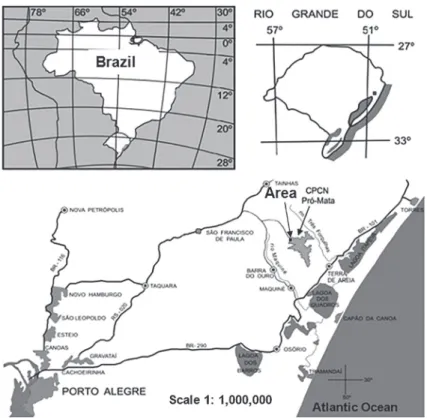
The study was carried out from January 2010,
to January 2011, at Centre for Research and
Conservation of Nature - Catholic University of Rio
Grande do Sul, Brazil, 29°27'-29°35'S and
50°08'-50°15'W (Bertoletti and Teixeira 1995) (Fig. 1).
This area is located on the region of the Araucária
Plateau in the municipality of São Francisco de
Paula, sate of Rio Grande do Sul, Brazil. The
altitude ranges from 600 to 900m, and the climate
is classified as Köppen’s Cfb, temperate maritime
humid with average annual temperature of 14.5°C
and frequent formation of fog, frost, and occasional
snow (Dick et al. 2008, Almeida 2009). Average
annual rainfall is 2252 mm, well distributed over the
year (Bertoletti and Teixeira 1995, Bond-Buckup
2008). The site soil is classified as Bruno Cambisol
soil. The main features being humic and alic
properties (Bertoletti and Teixeira 1995), with high
acidity (pH 4.0) and low in phosphorus (3.1 mg/
dm
3), according to result of soil analysis carried out
in May 2008, by the Department of Lands/UFRGS
(Federal University of Rio Grande do Sul), Brazil,
and supporting vegetation characterized as natural
grasslands
.
The cultivated
A. tristis
population at
the study site harboured 1,800 plants in 450 m
2.
Pollen/ovule relation was studied to cha racterize
the reproductive system of
A. tristis,
(Cruden 1977
2000). In this process, the number of ovules per ovary
and the number of pollen grains per flower were
quantified. Randomly, 30 flower buds at pre-anthesis
stage were collected to determine the average number
of ovules per ovary. Ovules were counted under a
stereoscopic microscope. For the counting of the
pollen grains by flower, the method of exotic marker
with spores of
Lycopodium clavatum
contained in
pellet with 18,584 spores (Stockmarr 1971) was used.
During the process of counting pollen, spores are
also counted, and the latter was used to estimate
the pollen concentration of the analyzed material.
For this process, 10 flower buds in pre-anthesis
stage were collected randomly, whose anthers had
been dismembered.
Pollen grains were separated with stilettos,
tweezers, Petri dish, pipette, and 7.0 mL of distilled
water for washing. After this procedure, the pollen
grains of each flower were placed in an ependdorf
tube of 1.5 mL, adding the pastille of
L. clavatum
previously diluted in water. The 10 ependdorf tubes
were centrifuged at 2,000 rpm for five minutes
and the supernatant discarded. Subsequently, three
slides were prepared per ependdorf tube using
glycerinated gelatin, and stained with fuchsine.
A small amount of gelatin was poured into the
eppendorf tube to collect the precipitate, which
contained the pollen grains. The gelatin with
adhered grains was placed onto a slide heated by
a alcohol lamps, covered with coverslip and sealed
with transparent enamel (Louveaux et al. 1978).
The counting of pollen grains and spores was
performed using an optical microscope, scanning
the whole blade. From the results, the number of
pollen per flower (P) was estimated by the equation
P=18,584 p/L; p and L were the readings of
pollen grains and spores of
L. clavatum
per blade,
respectively. The averages of pollen/ovule relation
were grouped according to classification of Cruden
(1977): “cleistogamy (<5.4); mandatory autogamy
(5.5 to 39); optional autogamy (39.1 to 396.9);
facultative allogamy (397-2,588); and mandatory
allogamy (> 2,588)”.
To study the difference of seed/ovule relation
between the two groups of bees with different
niches in
A. tristis, two strata of the vertical profile
of approximately 70 cm in height were demarcated.
The lower stratum was marked up to about
30 cm in height from the ground level, and the
upper stratum comprised a layer of 30 cm from the
canopy level to downward, leaving an interface
between them of 10 cm (Fig. 2). For each stratum,
10 racemes with average length of 20 cm measured
from the apex were collected. For each raceme, the
number of fl ower buds and the number of fl owers,
and the estimate of future aborted fl owers and
future seeds based on the allogamy rate or effective
pollination, were quantifi ed.
This rate was obtained by demarcating
300 fl ower buds in pre-anthesis stage, with free
pollinators visitation and subsequent counting of
formed hemicraspedious expressed as percentage;
aborted fl owers; ovule per ovary; hemicraspedious
fruits in raceme and already released by the
plant; seeds by hemicraspedious fruits (offspring
potential); estimate of seeds released by plant;
estimate of total seed; estimate of total ovule; and
estimate of seed/ovule (S/O) ratio”.
Regarding the number of ovules, randomly
30 fl ower buds in pre-anthesis stage were
collected from each stratum, following the same
methodology previously described (in pollen/ovule
relation). The values were expressed by mean with
standard errors. The variances of S/O relation of
the two strata were compared by Snedecor F test
to evaluate the homoscedasticity and defi ne the
appropriate statistics for comparing the means by
Student's t test with 1% probability.
Adesmia tristis has a massive fl ourishing
in-volving the entire vertical profi le of the plant, being
composed by a complex structure of interlocking
branches not only from the same plant but also from
its neighbours. In this context, is very important to
observe different levels in the vertical profi le linked
to different kind of pollinators. In order to survey the
frequency, four period of 30 minutes per day were
used (9:00 h, 12:00 h, 14:00 h, 16:00 h) during nine
days. Parallelly to this activity, the time of visiting
per fl ower was recorded during eight hours.
Surveying the seeds and ovules generates
an index when using S/O relation. This index is
inversely proportional to pollination defi cit. The
range extends from 0 to1, which represents a
gradient, from the complete absence of seeds until
the maximum potenctial of seeds production.
RESULTS
Adesmia tristis
showed 5.07 ± 0.58 ovules per ovary
and 30.350 ± 5.511 pollen grains per flower. As a
result, pollen/ovule (P/O) relation was 6,026.6.
The two most common groups of pollinators in
A. tristis
are solitary bees belonging to Megachilidae
and Andrenidae families.
These bees are fundamental
to the reproductive system in
A. tristis; nevertheless,
high incidence of aborted flowers was observed. In
this study, allogamy rate was 37%. Data comprising
the two studied strata showed that there is equivalence
in total of aborted flowers (TAF) and the number
of seeds per hemicraspedious fruits (S/H) in both
strata (Table I). However, statistical differences were
highly significant (p<0.01) in the total number of
hemicraspedious fruits
(TH)
(hemicraspedious fruits
in raceme and hemicraspedious fruits already released
by plant), in the total number of seeds (TS), in the seed/
ovule (S/O) relation, and significant difference in the
total number of ovules (TO) (p<0.05) (Table I). In the
two strata, the number of formed seed (9.5% and 5.2%
in the upper and lower strata, respectively) is less than
the number of available ovules for fertilization, and
the difference is higher in the lower stratum (Fig. 3).
Regarding pollination efficiency in the flower
scope, the two groups of bees are equivalent; hence, the
number of seeds/hemicraspedious fruits is statistically
equal (Table I). However, bees from
Megachile
genus
are more agile (2.5 ± 0.4 seconds/flower) in the flower
blooming phase
when compared with Andrenidae
group (6.4 ± 0.9 seconds/flower), visiting more flowers
per time unit. This fact reflects a higher seed production
on the upper stratum with proportional consequences in
S/O relation (Fig. 4). It is noteworthy that the flowers of
the lower stratum had fewer ovules (4.8/ovary) in rela tion
to the higher stratum (5.3/ovary) and this difference
was statistically significant (p<0.01) (Table I).
Data obtained in
A. tristis
showed the S/O
relation of 0.1 and 0.05 in the upper and lower strata,
respectively, and the offspring potential (S/H) of
3.23 (Table I) show that values are linked to factors
of pollination deficit.
DISCUSSION
The reproductive system that characterizes
A. tristis
is mandatory allogamy (P/O>2,588) according to
Cruden classification (1977). It is similar to results
found in 15 species of
Adesmia
genus with treatment
of mutual pollination and mechanical stimulus
(Tedesco et al. 2000). These authors concluded that
A. tristis
depends on cross-pollination, with possible
occurrence of incompatibility mechanisms. The
same conclusion was obtained with plants of
A.
latifolia
isolated by screens, resulting in the absence
of seed set formation (Camacho and Franke 2008).
Allogamy, case of
A. tristis
, enables hybrid
vigor, facilitating the maintenance of species in the
environment. It is interesting that the number of
viable pollen grains is sufficient for the promotion
of heterozygosity (Souza et al. 2002), avoiding
mitigating effects on pollinator capability (Cruden
2000). Pollinators when conducting the pollen to
the corresponding stigma minimize the loss risks
(Cocucci and Mariath 2004), directly influencing
the plant reproductive system. Therefore, the more
efficiently pollen grains reach the compatible
stigma, the greater the fertilization opportunities
with low P/O relation.
Frequent winds, rainfalls, and fog in the
studied area reduced pollinators’ activity, which,
together with intrinsic plant characteristics affected
allogamy rate, also known as natural crossing
rates with consequent low seed production. It is
necessary to preserve and stimulate the increase
of local pollinator populations using responsible
practices in areas managed by men and establishing
protected environments, thereby preventing the risk
of reducing pollen grain flow and consequently,
production (Lennartsson 2002, Kolb 2005, Freitas
et al. 2010), rendering the species non-viable in the
environment (Nayak and Davidar 2010).
Natural branches arrangement restricts
polli-nators circulation spaces of pollipolli-nators seeking
target flowers descending from the canopy to the
RA TAF O/O S/H TH TS TO S/O
U 134.61a 5.30a 3.23a 24.60a 79.53a 841.57a 0.10a
L 131.37a 4.80b 3.22a 10.90b 35.38b 680.00b 0.05b
Means followed by the same letter vertically are not statistically different from each other by Student's t test at 1% of probability. In TO comparison, the test was 5%.
TABLE I
Means of parameters measured and estimated at 10 racemes of Adesmia tristis for each one of the two strata of the plant
vertical profile, as follows: “RA - raceme; U - upper stratum; L - lower stratum; TAF- total aborted flowers; O/O – ovule per ovary (n=30); S/H – seeds per hemicraspedious fruits; TH - total hemicraspedious fruits; TS - total seeds; TO - total
ovules; S/O - seed/ovule relation. Pró-Mata PUCRS, São Francisco de Paula, RS, January 2010 and 2011”.
Fig. 3 - Average number of seeds and ovules formed in 10 racemes of A. tristis lower and upper strata with standard error bars.
of foraging are formed in plant’s vertical profile.
However, the magnitude of these trophic niches
is subject to temporal and spatial changes (Aguiar
and Santos 2007) because they are linked to the
structure of the surrounding vegetation.
The two most common pollinator groups
in
A. tristis
have distinct characteristics. Bees of
Megachilidae family are robust and fast compared with
bees of Andrenidae family. The first ones preferentially
visit flowers of the plant’s upper stratum near the
canopy with more free space for their evolutions in
searching nectar and pollen. The other ones are more
common in the lower stratum. It is assumed that these
characteristics facilitated the formation of ecological
niches associated with the principle of competitive
exclusion (Odum 1988). These adaptations are selective
and allow the coexistence of organism’s diversity in
habitats (Chesson 1991, 2000, Giacomini 2007).
In
A. tristis
, the competition involves not only
nectar and pollen, but particularly space. Sometimes,
bees belonging to the Andrenidae family were
observed foraging in the upper stratum, and when
bees from Megachilidae family arrived, there was
some disagreement and the smaller ones (Andrenidae)
migrated to the lower stratum. This Behaviour occurs
because bees from both families visit
A. tristis flowers
at the same time of the day. Some studies report the
coexistence of bee species in the same plant, using
different foraging strategies (Morgado et al. 2002, El
Shafie and Mogga 2002, Biesmeijer and Slaa 2006,
Carvalho and Oliveira 2010). This aspect is convenient
in
A. tristis
by pollination complementation, with direct
impact on seed production and species perpetuation.
Thus, a pollinators’ guild is more effective for the
pollination service and system stability than a single
species (Hoehn et al. 2008).
Low seed yield in the two strata below the
ovules to be fertilized means there are pollination
deficit problems.
It is possible that the pollinators’ population
of
A. tristis
were decreased, contributing to the
high incidence of flowers capable of forming
hemicraspedious fruits that aborted. The massive
supply of flowers outside the natural patterns
(plantation) must have exceeded the capacity of
pollinator visits. The massive flowering (in time and
space) should also be considered as adaptive strategy
in reproductive success (Inouye 2008). In nature,
the cross-pollinated plants normally do not reach
the maximum production level of fruit and/or seeds
(Barrett 2002). The pollination deficit with its levels
gradations is an environmental standard. A survey
in Canada with 258 species of angiosperms showed
a maximum limit of 45% of effective pollination in
seed production (Burd 1994). Genetic factors are
possible causes of flowers abortion, according to the
development of homozygous embryos for deleterious
alleles (Charlesworth 1989). Other interferences such
as the limitation of resources affect flowering process
(Weins 1984, Griffin and Barrett 2002). In A. tristis
,
such factors and circumstances may be involved. The
possible occurrence of geitonogamy may cause
self-incompatibility (Tedesco et al. 2000). This induces
the decrease of desirable pollen flow and changes
in the target stigma. Consequences lead to decrease
of crossing process and reduction in female function
with lower seed production (Barrett 2002).
The difference among the amount ovules from
the two strata demonstrates that other factors affect
plant physiology, such as light reception and nutrient
translocation in the drain and source operations, and
hormonal actions (Larcher 2003, Taiz and Zeiger
2009) act synergistically to enhance branch vigor,
increasing the number of seeds in the upper stratum.
The progeny potential of
A. tristis
was 3.23.
It relates to the ovule protection, dispersal, and
r
e
k
strategies of population growth of Pianka
(1970), where
r
represents opportunistic species,
which are usually annual, that most of their energy
upper and lower strata, respectively. In unchanged
environments, S/O relation of annual plants is around
0.85 with offspring potential of 21.70. In perennial
plants, S/O average is 0.50, regardless of the
reproductive system, and the offspring potential is
only 9.90 (Weins 1984). Woody species (k strategy)
have lower S/O (0.30) ratios and offspring potential
(3.30), when compared to perennial herbaceous with
S/O of 0.57 and offspring potential of 13.50 (Weins
1984). In Fabaceae, it is common to find low values
of fruit/flowers ratio and/or seed/ovules (Bawa and
Buckley 1989). Studies on reproductive Biology of
Caesalpinia pyramidalis
(Fabaceae) in the Caatinga
region of Northeastern Brazil showed similar results
(Leite and Machado 2009).
Our results indicate that
A. tristis
presents
compulsory allogamy. The vertical profile of the
plant has different foraging niches for the most
frequent pollinators, where the bees belonging to
Megachile
genus forage preferentially close to the
plant canopy, while bees belonging to Andrenidae
family forage in the lower stratum. The upper
stratum of the plant vertical profile contributes
more to seed production than the lower stratum.
The obtained S/O relation of
A. tristis
suggests
the possibility of pollination deficit. However,
this index should be associated with other
methods of pollination deficit classification, such
as those recommended by Food and Agriculture
Organization od the United Nacions (FAO), as
mentioned by Vaissière et al. (2011), to support
conclusions. These results are important for guiding
management plans aiming at possible corrections
of factors that limit fruits and/or seeds production
in order to obtain the expected results.
RESUMO
A distribuição vertical dos polinizadores é um importante
componente no padrão de forrageamento nos estratos das
plantas e influencia o sistema reprodutivo (relação pólen/
óvulo) e a razão semente/óvulo. Nichos em dois estratos diferentes de Adesmia tristis Vogel foram avaliados quanto
a esses aspectos. Essa planta é um arbusto endêmico dos
campos de Cima da Serra no Sul do Brasil. Os estudos ocorreram de janeiro de 2010 a janeiro de 2011, no Pró-Mata/PUCRS (Pontifícia Universidade Católica do Rio Grande do Sul) (29°27'-29°35'S e 50°08'-50°15'W), São Francisco de Paula, estado do Rio Grande do Sul, Brasil. O sistema reprodutivo de A. tristis é alogamia obrigatória.
O perfil vertical em A. tristis possui diferentes nichos de forrageamento entre os polinizadores mais comuns. Abelhas do gênero Megachile forrageiam no estrato superior e as abelhas representantes da família Andrenidae
exploram o estrato inferior. O estrato superior do perfil vertical contribui mais na produção de sementes. Adesmia tristis apresentou evidências de déficit de polinização.
Palavras-chave: alogamia, abelhas, forrageamento,
nichos, déficit de polinização.
REFERENCES
AGUIAR CML AND SANTOS GMM. 2007. Compartilhamento de recursos florais por vespas sociais (Hymenoptera: Vespidae) e abelhas (Hymenoptera: Apoidae) em uma área de Caatinga. Neotrop Entomol 38:836-842.
ALMEIDA JA. 2009. Fatores abióticos. In: BOLDRINI II (Ed),
Biodiversidade dos Campos do Planalto das Araucárias, Brasília: MMA, p 21-25.
BARRET SCH. 2002. Sexual interference of the floral kind.
Heredity 88: 154-159.
BAWA KS AND BUCKLEY DP. 1989. Seed: ovule rations, selective seed abortation, and mating systems in Leguminosae. In: STIRTON CH AND ZARUCCHI JL(Eds), Advances in legume, St. Louis: Missouri Botanical Garden Press, St. Louis, USA, p.243-262.
BERTOLETTI JJ AND TEXEIRA MB. 1995. Centro de Pesquisa e Conservação da Natureza Pró-Mata: termo de referência. In: BERTOLETTI JJ (Ed), Divulgação do Museu de Ciências e Tecnologia, UBEA/PUCRS, Porto Alegre: PUCRS, Porto Alegre, Brasil, p. 1-47.
BIESMEIJER JC AND SLAA EL. 2006. The structure of eusocial bee assemblages in Brazil. Apidologie 37: 240-258. BOND-BUCKUP G. 2008. Biodiversidade dos Campos de Cima
da Serra, Libretos, Porto Alegre, 403 p.
BURD M. 1994. Bateman’s principle and plant reproduction: the role of pollen limitation in fruit and seed set. Bot Rev 60:83-139.
CAMACHO JCB AND FRANKE LB. 2008. Efeito da polinização
sobre a produção e qualidade de sementes de Adesmia latifólia. Rev Bras Sementes 30:81-90.
CARVALHO AMC AND OLIVEIRA PEAM. 2010. Estrutura de guilda
CHARLESWORTH D. 1989. Evolution of low female fertility in
plants: pollen limitation, resource allocation, and genetic load. Trends Ecol Evol 4:289-292.
CHESSON P. 1991. A need for niches? Tree 6: 26-28.
CHESSON P. 2000. Mechanisms of maintenance of species diversity. Annu Rer Ecol Syst 31: 343-366.
CHIAPPA E, RODRIGUEZ S AND BASCUÑÁN R. 2000. Preferencia y manipulacion floral de Centris rodophthalma Perez (Hymenoptera: Anthophoridae). Gayana 61:133-138. COCUCCI AE AND MARIATH JEA. 2004. Gametogêneses,
fecundação, seleção do gametófito mais apto, embriogênese e diásporo maduro. In: FERREIRA AG AND BORGHETTI F (Eds), Germinação: do básico ao aplicado, Porto Alegre: Artmed Porto Alegre, Brasil, p.15-30.
CRUDEN RW. 1977. Pollen-ovule ratio: a conservative indi cator of breeding systems in flowering plants. Evolution 31: 32-36. CRUDEN RW. 2000. Pollen grains: why so many? Plant Syst
Evol 222:143-165.
DICK DP, SILVA LB, INDA AV AND KNICKER H. 2008. Estudos
comparativos da matéria orgânica de diferentes classes de solos de altitude do sul do Brasil por técnicas convencionais e espectroscópicas. Rev Bras Ciênc Solo 32: 2289-2296. EL SHAFIE HAF AND MOGGA JBB. 2002. Studies on the
possible competition for pollen between the honey bees
Apis florae (Hymenoptera, Apidae) in North-Khartoum (Sudan). J Appl Entomol 126: 557-562.
FORCONE AM AND MUÑOZ M. 2009. Floración de las especies de interés apicola en el nordeste de Santa Cruz, Argentina. Bol Soc Argent Bot44: 393-403.
FREITAS L, WOLOWSKI M AND SIGLIANO MI. 2010. Ocorrência de limitação polínica em plantas de Mata Atlântica. Oecol Aust 14: 251-265.
GIACOMINI HC. 2007. Os mecanismos de coexistência de espécies como vistos pela teoria ecológica. Oecol Bras 11: 521-543. GRIFFIN SR AND BARRETT SCH. 2002. Factors affecting low
seed:ovule e rations in a spring woodland herb, Trillium grandiflorum (Melanthiaceae). Int J Plant Sci 163: 581-590. HAMRICK JL AND GODT MJ. 1990. Allozyme diversity in
plant species. In: BROW AHD, KAHLER MT AND WEIR BS (Eds), Plant populations genetics, breeding and genetics resources, Sunderland: Sinauer Associates Inc., Sunderland, p. 43-63.
HOEHN P, TSCHARNTKE T, TYLIANAKIS JM AND S TEFFAN-DEWENTER I. 2008. Functional group diversity of bee pollinators increases crop yield. Proc R Soc B275: 2283-2291. INOUYE DW. 2008. Effects of climate change on phenology,
frost da mage, and abundance of montane wildflowers. Ecology89: 353-362.
JHA S AND VANDERMEER JH. 2009. Contrasting bee foraging in response to resource scale and local habitat management. Oikos 118: 1174-1180.
KOLB A. 2005. Reduced reproductive success and offspring survival in fragmented populations of the forest herb Phyteuma spicatum. J Ecol 93:1226-1237.
LARCHER W. 2003. Physiological Plant Ecology, Springer,
New York, 513 p.
LENNARTSSON T. 2002. Extinction thresholds and disrupted
plant-pollinator interactions in fragmented plant populations. Ecology83: 3060-3072.
LEITE AV AND MACHADO IC. 2009. Biologia reprodutiva da “catingueira” Caesalpinia pyramidalis Tul. (Leguminosa – Caesalpinioideae), uma espécie endêmica da Caatinga. Rev Bras Bot 32: 79-88.
LOUVEAUX J, MAURIZIO A AND VORWHL G. 1978. Methods of melissopalynology. Bee World59:139-157.
MENEZES C, SILVA CI, SINGER RB AND KERR WE. 2007.
Competição entre abelhas durante forrageamento em
Schefflera arborícola (Hayata) Merr. Biosci J23: 63-69. MIOTTO ST AND LEITÃO FILHO HF. 1993. Leguminosa –
Faboideae gênero Adesmia DC: flora ilustrada do Rio
Grande do Sul, UFRGS, Porto Alegre, 157 p.
MORGADO LN, CARVALHO CF, SOUZA B AND SANTANA MP. 2002. Fauna de abelhas (Hymenoptera Apoidae) nas flores
de girassol Helianthus annus L. em Lavras – MG. Ciên Agrot26: 1167-1177.
NATES-PARRA G, PALÁCIOS E AND PARRA-HA. 2008. Efecto
del cambio del paisaje em la estructura de la comunidad de abejas sin aguijón (Hymenoptera: Apidae) en Meta, Colombia. Rev Biol Trop56: 1295-1308.
NAYAK KG AND DAVIDAR P. 2010. Pollinator limitation and the effect of breeding systems on plant reproduction in forest fragments. Acta Oecol 36:191-196.
ODUM EP. 1988. Ecologia, Guanabara, Rio de Janeiro, 434 p.
OVERBECK E, MÜLLER SC, FIDELIS A, PFADENHAUER J, PILLAR
VD, BLANCO CC, BOLDRINI II, BOTH R AND FORNECK ED. 2007. Brazil’s neglected biome: the South Brazilian Campos. Persp. Plant Ecol Evol Syst 9: 101-116.
PIANKA ER .1970. On r and k selection. Amer Natur104:592-597. ROUBIK DW, INOVE T AND HAMID AA. 1995. Canopy foraging
by two tropical honeybees: bee height fidelity and tree genetic neighborhoods. Tropics 5: 81-93.
SMITH-RAMÍREZ C AND RAMÍREZ KY. 2010. Informe final tecnico
y financero: digitalilizacion de datos de polinizadores de Chile, interacción insecto-planta y distribución de insectos, IABIN, Santiago, 23 p.
SOUZA MM, PEREIRA TNS AND MARTINS EM. 2002.
Microsporogênese e microgametogênese associadas ao tamanho do botão floral e da antera e viabilidade polínica em maracujá-amarelo. Cienc Agrotec 26: 1209-1217. STOCKMARR J. 1971. Tablets with spores used in absolute
pollen analysis. Pollen et Spores 13: 615-621.
TAIZ L AND ZEIGER E. 2009. Fisiologia Vegetal, Artmed, Porto Alegre, 820 p.
TEDESCO SB, DALL’AGNOL M, WITTMANN-SCHIFINO MT AND
VALLS JFM. 2000. Mode of reproduction of brazilian species of Adesmia (Leguminosae). Genet Mol Boil 23: 475-478. VAISSIÈRE BE, FREITAS BM AND GEMMILL-HERREN B. 2011.
Protocol to detect and assess pollination deficits in crops: a handbook for its use, FAO, Rome, 70 p.