http://www.uem.br/acta ISSN printed: 1806-2636 ISSN on-line: 1807-8672
Doi: 10.4025/actascianimsci.v39i2.33122
Underwater structures for periphyton in bioflocs tanks for Nile
tilapia submitted to feed restriction
Davi de Holanda Cavalcante, Francisco Roberto dos Santos Lima, Vanessa Tomaz Rebouças and Marcelo Vinícius do Carmo e Sá*
Laboratório de Ciência e Tecnologia Aquícola, Departamento de Engenharia de Pesca, Centro de Ciências Agrárias, Universidade Federal do Ceará, Avenida Mister Hull, s/n., 60356-000, Fortaleza, Ceará, Brazil. *Author for correspondence. E-mail: [email protected]
ABSTRACT. The objective of the present work was to assess the possible benefits of the installation of underwater structures for periphyton in bioflocs tanks for Nile tilapia, Oreochromis niloticus, submitted to feed restriction (artificial diet). The experimental treatments evaluated were: (1) BFT: bioflocs technology for aquaculture with no feed restriction; (2) BFT-30: the same as (1) but with feed restriction at 30%; (3) BP: biophyton technology for aquaculture, that is, integration between bioflocs and periphyton in the same rearing unit, with no feed restriction; (4) BP-30: the same as (3) but with feed restriction at 30%. The underwater structures for periphyton in the BP and BP-30 tanks were not able to reduce the concentrations of ammonia, nitrite, nitrate and reactive phosphorus in the water to same respective level found in the BFT and BFT-30 tanks. The underwater structures for periphyton in the BP and BP-30 tanks have not significantly affected fish growth performance. No benefits were obtained by the installation of underwater structures for periphyton in bioflocs tanks submitted to feed restriction on water quality, water microbiology and tilapia growth performance.
Keywords: aquaculture, bioflocs, environmental sustainability.
Estruturas submersas para perifíton em tanques com bioflocos no cultivo de juvenis da
tilápia do Nilo submetidos à restrição alimentar
RESUMO. O objetivo do presente trabalho foi avaliar os possíveis benefícios da instalação de estruturas submersas para perifíton em tanques BFT (bioflocos) de juvenis de tilápia do Nilo, Oreochromis niloticus, submetidos à restrição alimentar (ração comercial). Os tratamentos experimentais em avaliação foram os seguintes: (1) BFT: tecnologia bioflocos para aquicultura sem restrição alimentar; (2) BFT-30: o mesmo que em (1), exceto pela restrição alimentar de 30%; (3) BP: tecnologia biofíton para aquicultura, isto é, integração entre bioflocos e perifíton em uma mesma unidade de cultivo, sem restrição alimentar; (4) BP-30: o mesmo que em (3), mas com restrição alimentar de 30%. As estruturas submersas para perifíton nos tanques BP e BP-30 não foram capazes de reduzir as concentrações de amônia, nitrito, nitrato e fósforo reativo da água, além dos respectivos níveis observados nos tanques BFT e BFT-30. As estruturas submersas para perifíton nos tanques BP e BP-30 não afetaram de modo significativo o desempenho animal. A instalação de estruturas submersas para perifíton, em tanques com bioflocos submetidos à restrição alimentar, não trouxe benefícios para qualidade da água, microbiologia da água e desempenho zootécnico da tilápia.
Palavras-chave: aquicultura, bioflocos, sustentabilidade ambiental.
Introduction
In general, fish and shrimp are not able to efficiently use the nutrients present in the artificial diets supplied. Only a minor fraction of the nitrogen and phosphorus contained in the artificial diets is retrieved in the harvested biomass, the majority is lost to the rearing environment (Bauer, Prentice-Hernandez, Tesser, Wasielesky Jr., & Poerch, 2012). One alternative to reduce the waste of nutrients is the bioflocs technology for aquaculture (BFT; Kuhn, Lawrence, Crockett, & Taylor, 2016). BFT
increase the feeding efficiency in aquaculture is the restriction of the daily feed allowances to some level below the animal’s ad libitum intake (Koch, Rawles, Webster, Cummins, & Kobayahi, 2016).
A novel approach is the integration between bioflocs and periphyton in the same rearing unit. Schveitzer et al. (2013) have observed better shrimp performance in BFT tanks with substrates for periphyton. However, in a previous work carried out in our laboratory, the underwater structures for periphyton in BFT tanks were not efficient in removing nitrogen compounds from the water or as a feeding supplement to Nile tilapia, Oreochromis
niloticus, juveniles (Cavalcante, Lima, Rebouças, &
Sá, 2016). In that study, however, regular feed rates were employed and, therefore, a great amount of artificial food was provided to the animals. We hypothesized that the periphyton gains importance as a biological filter and nutritional source in restricted-fed culture tanks. In this sense, the objective was to assess the possible benefits of the installation of underwater structures for periphyton in bioflocs tanks for rearing Nile tilapia submitted to feed restriction on water quality, water microbiology and growth performance.
Material and methods
One-thousand masculinized Nile tilapia juveniles were obtained from a nearby fish farm and transported to the laboratory by road. The study was carried out in twenty 250-L polyethylene outdoor tanks over 10 weeks. Fish (0.99 ± 0.04 g) were stocked in the culture tanks at nine fish per tank (36 fish m-3). The C/N ratio of water in all tanks was
adjusted to 15/1 by daily applications of dry molasses to the water, which were based on the feeding management, i.e., percentage of crude protein in the diet and dietary allowances (Schryver & Verstraete, 2009). All tanks were continuously aerated through air stones, silicone hoses and PVC pipes connected to one 2.5 hp air blower.
The experimental controls and treatments were the following: (1) BFT: bioflocs technology for aquaculture with no feed restriction (control 1); (2) BFT-30: the same as (1) but with feed restriction at 30% (control 2); (3) BP: biophyton technology for aquaculture, that is, integration between bioflocs and periphyton in the same rearing unit, with no feed restriction (treatment 1); (4) BP-30: the same as (3) but with feed restriction at 30% (treatment 2).
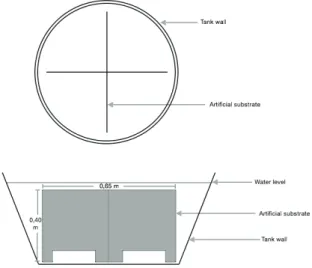
Two transversely interconnected 0.40 x 0.65 m (height x width) polyethylene boards were vertically set out in the water column of the BP and BP-30 tanks as underwater substrates for periphyton
development (Figure 1). Those boards had a useful area of 0.90 m2, which corresponded to 135% of the
total surface water area. The polyethylene boards were thoroughly rubbed with a rough sponge before installation in the tanks. Fish were fed on appropriate commercial diets with crude protein content ranging from 43.4 – 49.4% at 0800, 1100, 1400 and 1700. The feeding rates were similar to those used by Oliveira-Segundo, Lima, Akao, and Sá (2013). No water exchange was performed over the entire study, only the replenishment to compensate for evaporation.
Figure 1. Layout of the Biophyton tank (BP and BP-30).
Water quality of the tanks was monitored by determination of the following variables: (1) pH (pH meter mPA210 - MS Tecnopon), (2) temperature and specific conductance at 0800 and 1500 (conductivity meter CD-4303 – Lutron), (3) dissolved oxygen (0800; dissolved oxygen meter YSI 55), (4) total ammonia nitrogen (TAN; indophenol method), (5) nitrite (sulfanilamide method), (6) nitrate (Cd reduction technique), (7) reactive phosphorus (molybdenum blue method), (8) total alkalinity (titration with H2SO4
standard solution), (9) total hardness (titration with EDTA standard solution), (10) organic matter (consumed KMnO4) and (11) settleable solids
(sedimentation in Imhoff cones). After the determinations of N-NO2- and N-NO3-, the results
quality determinations were carried out according to Clesceri, Greenberg, and Eaton (1998).
The periphyton biomass grown on the underwater structures in BP and BP-30 were sampled at the 20th, 40th and 60th days after the onset
of the experiment. For that, areas of 10 x 10 cm² were scraped in each structure. The wet periphyton biomass was then put on to dry in an oven at 60°C for 12 hours.
Microbiological analyses of the culture water were performed in the beginning and on the 40th
experimental day (soon after the middle of the period), comprising the number of Aeromonas sp. (culture on Agar GSP with ampicillin) and Bacillus
sp. (culture on Agar nutrient). There were five dilutions for each culture medium. The methodology used for the bacteria count was the ‘Pour plate’ (Rall, Bombo, Lopes, Carvalho, & Silva, 2003). The bacteria colonies were counted after 48 hours of incubation at 37°C. The results were expressed in colony-forming units per milliliter (CFU mL-1).
Growth performance variables analyzed were the followings: survival (%), fish final body weight (g), specific growth rate (% day-1; SGR = [Ln (final
weight) - Ln (initial weight)]/days of culture) x 100), fish yield (g m-3 day-1), feed conversion ratio
(FCR = feed consumed/body weight gain), and protein efficiency ratio (PER = weight gain/protein consumed).
The results were tested by one-way ANOVA. When a significant difference was detected between the treatments (p < 0.05), the means were compared two by two with the Tukey’s test for equal-variance variables or Games-Howell’s test for unequal-variance variables. Assumptions of normal distribution (Shapiro-Wilk’s test) and homogeneity of variance (Levene’s test) were checked before
analyses. The SPSS v.15.0 and Windows Excel 2010 software were used for the statistical analyses.
Results and discussion
Water quality
The temperature, specific conductance, and the concentrations of dissolved oxygen and reactive phosphorus in water were not affected neither by the installation of underwater structures for periphyton nor by the feed restriction imposed (p > 0.05; Table 1). Therefore, the rate of phosphorus removal from the water has not increased in any of the periphyton-bioflocs tanks (BP and BP-30), as initially expected. The same was also observed by Haque et al. (2015) with
Macrobrachium rosenbergii and O. niloticus. These
results suggest that is worthless to install underwater structures in BFT tanks aiming to reduce concentrations of phosphorus in the water. Regardless of the treatment, the tanks under feed restriction presented higher pH and total alkalinity. Less organic matter means lower concentrations of free CO2 in water and, consequently, higher
bicarbonate levels (Caldini, Cavalcante, Rocha-Filho, & Sá, 2015). On the other hand, the underwater structures for periphyton have not significantly affected the pH, total alkalinity and total hardness of water (Table 1).
There was a decrease in the concentrations of TAN, nitrite, nitrate and organic matter in the tanks under feed restriction (BFT-30 and BP-30). The same was also reported in the study of Haque et al. (2015), where the installation of underwater structures for periphyton in bioflocs tanks was not able to reduce the concentrations of TAN, nitrite, nitrate and organic matter in the water (Table 1).
Table 1. Water quality in tanks after 10 weeks (mean ± S.D.1
; n = 5).
Variable2 Treatment
3
ANOVA P BFT BFT-30 BP BP-30
Temp 28.0 ± 1.3 27.8 ± 0.8 28.0 ± 0.8 27.8 ± 1.0 NS5
pH 7.77 ± 0.16 b4 8.20 ± 0.19 a 7.64 ± 0.21 b 8.17 ± 0.21 a 0.025
SC 738 ± 268 737 ± 130 740 ± 129 730 ± 127 NS
DO2 7.78 ± 0.56 7.73 ± 0.54 7.77 ± 0.54 7.57 ± 0.52
NS
TA 87.6 ± 26 b 138.9 ± 32 a 90.4 ± 25 b 131.3 ± 24 a < 0.001
TH 229.3 ± 39 a 170.7 ± 41 b 227.4 ± 40 a 171.6 ± 38 b < 0.001
TAN 0.64 ± 0.13 ab 0.41 ± 0.08 c 0.79 ± 0.14 a 0.52 ± 0.12 bc 0.001
NO2
- 0.32 ± 0.11 a 0.22 ± 0.07 b 0.36 ± 0.06 a 0.21 ± 0.05 b < 0.001
NO3
- 2.45 ± 0.23 a 1.33 ± 0.22 b 2.29 ± 0.20 a 1.42 ± 0.58 b < 0.001
P-react 0.39 ± 0.12 0.38 ± 0.19 0.32 ± 0.19 0.34 ± 0.18 NS
Org Mat 246.7 ± 19 a 197.2 ± 12 b 246.1 ± 13 a 195.6 ± 12 b < 0.001
SS 142.9 ± 12 ab 123.6 ± 19 ab 146.2 ± 12 a 120.4 ± 19 b 0.044
1These results were obtained in the last monitoring (10th week); 2Temp: temperature (Celsius), SC: specific conductance (μS cm-1), DO
2: dissolved oxygen (mg L-1), TA: total alkalinity
(mg L-1 CaCO
3), TH: total hardness (mg L-1 CaCO3), TAN: total ammonia nitrogen (mg L-1), NO2-: nitrite (mg L-1), NO3-: nitrate (mg L-1), P-react: reactive phosphorus (mg L-1), Org
Mat: organic matter (mg L-1
) and SS: sett leable solids (mL L-1
); 3
BFT: Bioflocs technology for aquaculture with no feed restriction. BFT-30: Bioflocs technology for aquaculture with feed restriction at 30% in relation to BFT. BP: Biophyton technology (bioflocs + periphyton) with no feed restriction. BP-30: Biophyton technology with feed restriction at 30% in relation to BP; 4For the same variable, means with distinct letters are significantly different by Tukey’s test (p < 0.05); 5Non-significant (p = 0.807, 0.983, 0.230 and 0.113 for
Again, it seems meaningless to install underwater structures for periphyton in bioflocs culture tanks aiming to improve their water quality. Moreover, it is suggested that feed restriction is a better management practice than the installation of underwater structures to obtain a cleaner culture water.
Water microbiology
No significant differences were detected between BP and BP-30 for the periphyton biomass formed onto the surface of underwater structures (p > 0.05). On average, the dry periphyton biomass was 0.24 ± 0.07 and 0.22 ± 0.06 mg cm-2 for BP and
BP-30, respectively (n = 5).
Neither the installation of underwater structures for periphyton nor the feed restriction have affected
the Bacillus count in the water (p > 0.05; Figure 2).
On average, the number of Bacillus sp. in rearing waters increased up from 60 ± 15 CFU mL-1, at the
beginning, to 1155 ± 259 CFU mL-1, in the end of
the study. Anand et al. (2014), studying Penaeus
monodon, have obtained similar results. In that work,
the Bacillus counts increased 2000+ times over a
60 day culture period. Therefore, the installation of underwater structures for periphyton in the culture tanks was not capable to increase the Bacillus counts. The massive presence of Bacillus sp. in healthy and productivity culture tanks qualify that genus of bacteria as a worthy source of probiotics for aquaculture (Nayak, 2010).
There was a reduction in the number of
Aeromonas sp. in water up from 765 ± 93 CFU mL-1,
at the beginning, to 160 ± 30 CFU mL-1, in the end
of the study. The differences between the treatments for the number of Aeronomas in water were not significant (p > 0.05; Figure 2). Probably, the reduction in the number of Aeromonas was due to the competition with other bacterial groups, such as
Bacillus. Crab, Chielens, Wille, Bossier, and
Verstraete (2010) have also observed a reduction in the number of harmful bacteria in water, such as
Vibrio and Aeromonas, and an increase in the number
of beneficial bacteria, such as Bacillus, when they stimulated the development of bioflocs in water. Those results suggest that the bioflocs technology can promote a probiotic effect in aquaculture tanks, preventing the outbreaks of harmful bacteria in the culture.
Fish growth performance
Fish survival was not significantly affected by the treatments, averaging 91.6 ± 6.4%. The feed restriction used in the present work has significantly impaired the fish growth performance, with lower
results of final body weight, specific growth rate and fish yield (Table 2). Therefore, the partial withdrawal of the artificial food was not appropriately compensated for the natural food available in the tanks (bioflocs and periphyton). These results indicate that the level of feeding restriction applied herein, i.e., -30%, was excessive or that the bioflocs concentrations in water were not high enough as expected. Possibly, better growth performance results would have been achieved if the adopted feed restriction level had been moderate (10-15%) instead of high. Yet Burford et al. (2004) were able to reduce the feeding allowances of
Penaeus esculentus post-larvae reared in bioflocs
tanks up to 30% without any growth impairment. Therefore, it is suggested that the maximum level of feeding restriction adopted by the fish producer should be directly proportional to the level of bioflocs in the rearing water.
Figure 2. Initial and 40th day number of Bacillus and Aeromonas in
Table 2. Growth performance of Nile tilapia juveniles (initial body weight = 0.99 ± 0.04 g) submitted to different rearing systems for 10 weeks (mean ± S.D.; n = 5).
Variable1 Treatment
2
ANOVA P BFT BFT-30 BP BP-30
Surv 93.3 ± 6.1 91.1 ± 9.3 93.3 ± 6.1 88.9 ± 13.6 NS3
FBW 36.6 ± 3.9 a4 24.6 ± 2.4 b 37.7 ± 1.4 a 28.1 ± 2.7 b < 0.001
SGR 5.57 ± 0.20 a 4.95 ± 0.18 b 5.57 ± 0.08 a 5.12 ± 0.09 b < 0.001
FY 19.1 ± 1.4 a 12.3 ± 1.0 b 19.7 ± 1.4 a 13.7 ± 1.9 b < 0.001
FCR 0.95 ± 0.08 a 0.86 ± 0.11 b 0.91 ± 0.08 ab 0.78 ± 0.05 b 0.026
PER 2.54 ± 0.20 b 2.83 ± 0.35 ab 2.63 ± 0.22 ab 3.08 ± 0.19 a 0.018
1
Surv: survival (%), FBW: final body weight (g), SGR: specific growth rate (% day-1
) = (ln final body weight – ln initial body weight)/days of culture x 100, FY: fish yield (g m-3
day-1
), FCR: feed conversion ratio = food intake/body weight increase, PER: protein efficiency ratio = body weight gain/protein intake; 2BFT: Bioflocs technology for aquaculture with no
feed restriction. BFT-30: Bioflocs technology for aquaculture with feed restriction at 30% in relation to BFT. BP: Biophyton technology (bioflocs + periphyton) with no feed restriction. BP-30: Biophyton technology with feed restriction at 30% in relation to BP; 3Non-significant (p = 0.852); 4For the same variable, means with distinct letters are
significantly different from each other by Tukey’s test (survival, FBW, SGR, FY and PER) or Games-Howell’s test (FCR; p < 0.05).
The installation of underwater structures for periphyton in BFT tanks has not significantly affected any of the growth performance variables, including FCR and PER (e.g. compare BFT vs. BP and BFT-30 vs. BP-30; Table 2). Arnold, Coman, Jackson, and Groves (2009) have also observed the same lack of response from tiger shrimp, P. monodon. Nevertheless, Schveitzer et al. (2013) found a positive effect of underwater structures for periphyton on L. vannamei growth. Therefore, the benefits of the installation of underwater structures in BFT tanks will depend on the definite technical parameters applied to the culture system, such as the quantity and the quality of the periphyton developed on the structures.
Conclusion
No benefits were achieved by the installation of underwater structures for periphyton in bioflocs tanks under feed restriction on water quality, water microbiology and tilapia growth performance.
Acknowledgements
We would like to thank CNPq (Conselho Nacional de Desenvolvimento Científico e Tecnológico, Brasília, DF, Brazil), Capes (Coordenação de Aperfeiçoamento de Pessoal de Nível Superior, Brasília, DF, Brazil) and Funcap (Fundação Cearense de Apoio ao Desenvolvimento Científico e Tecnológico, Fortaleza, CE, Brazil) for providing scholarship and financial support.
References
Anand, P. S. S., Kohli, M. P. S., Kumar, S., Sundaray, J. K., Roy, S. M., Venkateshwarlu, G., … Pailan, G. H. (2014). Effect of dietary supplementation of biofloc on growth performance and digestive enzyme activities in
Penaeus monodon. Aquaculture, 418-419, 108-115. Arnold, S. J., Coman, F. E., Jackson, C. J., & Groves, S. A.
(2009). High-intensity, zero water- exchange production of juvenile tiger shrimp, Penaeus monodon:
an evaluation of artificial substrates and stocking density. Aquaculture, 293(1-2), 42-48.
Bauer, W., Prentice-Hernandez, C., Tesser, M. B., Wasielesky Jr., W., & Poerch, L. H. S. (2012). Substitution of fishmeal with microbial floc meal and soy protein concentrate in diets for the pacific white shrimp Litopenaeus vannamei. Aquaculture, 342-343, 112-116.
Burford, M. A., Sellars, M. J., Arnold, S. J., Keys, S. J., Crocos, P. J., & Preston, N. P. (2004). Contribution of the natural biota associated with substrates to the nutritional requirements of the post-larval shrimp,
Penaeus esculentus (Haswell), in high-density rearing systems. Aquaculture Research, 35(5), 508-515.
Caldini, N. N., Cavalcante, D. H., Rocha-Filho, P. R. N., & Sá, M. V. C. (2015). Feeding Nile tilápia with artificial diets and dried bioflocs biomass. Acta Scientiarum. Animal Sciences, 37(4), 335-341.
Cavalcante, D. H., Lima, F. R. S., Rebouças, V. T., & Sá, M. V. C. (2016). Association between periphyton and bioflocs systems in intensive culture of juvenile Nile tilapia. Acta Scientiarum. Animal Sciences, 38(2), 119-125. Clesceri, L. S., Greenberg, A. E., & Eaton, A. D. (1998).
Standard methods for the examination of water and wastewater (20th ed.). Washington, DC: American Public Health Association.
Crab, R., Chielens, B., Wille, M., Bossier, P., & Verstraete, W. (2010). The effect of different carbon sources on the nutritional value of bioflocs, a feed for
Macrobrachium rosenbergii postlarvae. Aquaculture Research, 41(4), 559-567.
Haque, M. R., Islam, M. A., Rahman, M. M., Shirin, M. F., Wahab, M. A., & Azim, M. E. (2015). Effects of C/N ratio and periphyton substrates on pond ecology and production performance in giant freshwater prawn Macrobrachium rosenbergii (De Man, 1879) and tilapia Oreochromis niloticus (Linnaeus, 1758) polyculture system. Aquaculture Research, 46(5), 1139-1155.
Koch, J. F., Rawles, S. D., Webster, C. D., Cummins, V. C., & Kobayahi, Y. (2016). Optimizing fish meal-free commercial diets for Nile tilapia, Oreochromis niloticus.
Aquaculture, 452, 357-366.
feed ingredient for fishmeal or soy meal for shrimp.
Aquaculture, 454, 66-71.
Liu, J., Wang, F., Liu, W., Tang, C., & Wu, C. (2016). Nutrient removal by up-scaling a hybrid floating treatment bed (HFTB) using plant and periphyton: From laboratory tank to polluted river. Bioresource Technology, 207, 142-149.
Nayak, S. K. (2010). Probiotics and immunity: A fish perspective. Fish & Shellfish Immunology, 29(1), 2-14. Oliveira-Segundo, J. N., Lima, F. R. S., Akao, M. M. F., &
Sá, M. V. C. (2013). Small crumbled diet versus powdered diet in restricted feeding management of juvenile Nile tilapia. Acta Scientiarum. Animal Sciences, 35(2), 127-131.
Rall, V. L. M., Bombo, A. J., Lopes, T. F., Carvalho, L. R., & Silva, M. G. (2003). Honey consumption in the state of São Paulo: a risk to human health? Anaerobe, 9(6), 299-303.
Schryver, P., & Verstraete, W. (2009). Nitrogen removal from aquaculture pond water by heterotrophic
nitrogen assimilation in lab-scale sequencing batch reactors. Bioresource Technology, 100(3), 1162-1167. Schveitzer, R., Arantes, R., Costódio, P. F. S.,
Espírito-Santo, C. M., Arana, L. V., Seiffert, W. Q., & Andreatta, E. R. (2013). Effect of different biofloc levels on microbial activity, water quality and performance of Litopenaeus vannamei in a tank system operated with no water exchange. Aquacultural Engineering, 56, 59-70.
Wei, Y. F., Liao, S. A., & Wang, A. L. (2016). The effect of different carbon sources on the nutritional composition, microbial community and structure of bioflocs. Aquaculture, 465, 88-93.
Received on August 17, 2016. Accepted on November 8, 2016.