PROMOTION OF BREASTFEEDING IN THE PRISON SYSTEM FROM THE
PERCEPTION OF INCARCERATED NURSING MOTHERS
1Marcelle Lima Guimarães2, Tatiane Gomes Guedes3, Luciane Soares de Lima4, Sheila Coelho Ramalho Vasconcelos Morais5, Marly Javorski6, Francisca Márcia Pereira Linhares7
1 Aticle extracted from thesis Perception of nursing mothers on the promotion of breastfeeding in the prison system in the light of the structure of the open systems of Imogene King, presented to the Programa de Pos-Graduação em Enfermagem of the Univerisdade Federal de Pernambuco (UFPE), in 2015. This study was financed in part by the Coordenação de Aperfeiçoamento de Pessoal de Nível Superior - Brasil (CAPES) - Finance Code 001
2 Master’s Degree in Nursing. Professor Bachelor’s Degree Course in Nursing at the Instituto Federal de Pernambuco (IFPE) - Pesqueira Campus. Pesqueira, Pernambuco, Brazil. E-mail: [email protected]
3 Ph.D. in Nursing. Professor, Nursing Department, UFPE. Recife, Pernambuco, Brazil. E-mail: [email protected] 4 Ph.D. in Nursing. Professor, Nursing Department, UFPE. Recife, Pernambuco, Brazil. E-mail: [email protected] 5 Ph.D. in Fundamental Nursing. Professor, Department, UFPE. Recife, Pernambuco, Brazil. E-mail: [email protected] 6 Ph.D. in Nursing. Professor, Nursing Department, UFPE. Recife, Pernambuco, Brazil. E-mail: [email protected] 7 Ph.D. in Nutrition. Professor, Nursing Department, UFPE. Recife, Pernambuco, Brazil. E-mail: [email protected]
ABSTRACT
Objective: to unveil the promotion of breastfeeding in the prison system from the perception of incarcerated nursing mothers, in the light of the structure of the open systems of Imogene King.
Method: a qualitative study, developed in a female prison unit. Semi-structured interviews were carried out with 14 incarcerated nursing mothers, and the data analysis was guided by the Collective Subject Discourse technique.
Results: seven central ideas grouped into each of King’s three open systems emerged: Personal System - The promotion of breastfeeding with
a focus on the child’s health; Promotion of exclusive breastfeeding in an authoritative way; Interpersonal system - Conflicting interaction
with health professionals; Harmonious and trustful relationship with the Psychosocial Sector; Social System: the rules of the prison system
defining the duration of breastfeeding; Physical structure and confinement as stressors; The prison environment and its rules as generators
of stress and disruption to the practice of breastfeeding.
Conclusion: the promotion of breastfeeding in the prison is authoritative and denies the autonomy of the nursing mother to a conscious decision making. The prison organization has peculiar conditions that interfere both in the practice of breastfeeding and in the care to the
nursing mothers, which leads to an inefficient interaction between women and health professionals, making it difficult to reach the goal
of effective nursing care and satisfaction with the care provided.
DESCRIPTORS: Breastfeeding. Prisons. Nursing. Nursing theory. Health education.
PROMOÇÃO DO ALEITAMENTO MATERNO NO SISTEMA PRISIONAL A
PARTIR DA PERCEPÇÃO DE NUTRIZES ENCARCERADAS
RESUMO
Objetivo: desvelar a promoção do aleitamento materno no sistema prisional a partir da percepção de nutrizes encarceradas, à luz da estrutura dos sistemas abertos de Imogene King.
Método: estudo qualitativo, desenvolvido em unidade prisional feminina. Foram realizadas entrevistas semiestruturadas com 14 nutrizes encarceradas e a análise dos dados foi orientada pela técnica do Discurso do Sujeito Coletivo.
Resultados: emergiram sete ideias centrais agrupadas a cada um dos três sistemas abertos de King: Sistema Pessoal - A promoção do Aleitamento Materno com foco na saúde da criança; Promoção do aleitamento materno exclusivo de forma impositiva; Sistema Interpessoal
- Interação conflituosa com os profissionais da saúde; Relação harmoniosa e de confiança com o Setor Psicossocial; Sistema Social: as regras do sistema prisional definindo a duração do Aleitamento Materno; Estrutura física e confinamento como estressores; O ambiente carcerário
e suas regras como geradores de estresse e perturbação para a prática do aleitamento materno.
Conclusão: a promoção do aleitamento materno no cárcere é impositiva e nega a autonomia da nutriz para a tomada de decisão consciente. A organização prisional possui condições peculiares que interferem tanto na prática da amamentação como na assistência à nutriz, o que
leva a uma interação ineficiente entre mulheres e profissionais de saúde, dificultando, dessa forma, o alcance da meta do cuidado de
enfermagem efetivo e da satisfação com a assistência prestada.
DESCRITORES: Aleitamento materno. Prisões. Enfermagem. Teoria de enfermagem. Educação em saúde.
PROMOCIÓN DE LA LACTANCIA MATERNA EN EL SISTEMA
PENITENCIARIO DESDE LA PERCEPCIÓN DE LAS MADRES LACTANTES
ENCARCERADAS
RESUMEN
Objetivo: desvelar la promoción de la lactancia materna en el sistema penitenciario a partir de la percepción de las madres encarceladas, a la luz de la estructura de los sistemas abiertos de Imogene King.
Método: estudio cualitativo, desarrollado en unidad prisional femenina. Se realizaron entrevistas semiestructuradas con 14 madres lactantes encarceladas y el análisis de los datos se guió por la técnica del Discurso del Sujeto Colectivo.
Resultados: surgieron siete ideas centrales agrupadas a cada uno de los tres sistemas abiertos de King: Sistema Personal - La promoción de la lactancia materna con foco en la salud del niño; Promoción de la lactancia materna Exclusivo de forma impositiva; Sistema Interpersonal
- Interacción conflictiva con los profesionales de la salud; Relación armoniosa y de confianza con el Sector Psicosocial; Sistema Social: las reglas del sistema penitenciario definiendo la duración de la Lactancia Materna; Estructura física y confinamiento como estresores; El
ambiente carcelario y sus reglas como generadores de estrés y perturbación para la práctica de la lactancia materna.
Conclusión: la promoción de la lactancia materna en la prisión es impositiva y niega la autonomía de la madre que amamanta para la toma
de decisión consciente. La organización prisional tiene condiciones peculiares que interfieren tanto en la práctica de la lactancia materna y en la asistencia a las madres lactantes, lo que lleva a una interacción ineficiente entre mujeres y profesionales de salud, dificultando de esa forma el alcance de la meta del cuidado de enfermería efectivo y de la satisfacción con la asistencia prestada.
DESCRIPTORES: Lactancia materna. Prisiones. Enfermería. Teoría de enfermería. Educación en salud.
INTRODUCTION
Brazil has the fourth largest prison population in the world. When considering only the female
imprisonment, the country ranks fifth in the world,
with a total of approximately 37,380 women incar-cerated, which corresponds to 6.4% of the prison population. It should be highlighted that the abso-lute population of women in deprivation of liberty grew 567% between the years 2000 and 2014, while the male prison population growth was 220% in the same period.1
The prison system adopts an androcentric
and sexist model, which disregards the specifici -ties of gender and the diverse reality of men and women in situations of detention. The prison structure and policies were not considered
regard-ing these specificities, but rather by men and for
men. Incarcerated women make up a segment of this invisible population, in which their needs are neglected and their dignity constantly violated. In addition, they are excluded and stigmatized, be-cause they experience the stigma of being women in a macho society and because they are criminals in an exclusionary society.2
In female incarceration, aspects inherent to motherhood need to be evaluated, such as guaran-teeing the presence of the children with the mothers for the period established by law. With the purpose of guaranteeing favorable conditions for the per-manence of these children in the prison system, it
was published the Interministerial Ordinance No.
210, from January 16, 2014, which instituted the National Policy of Care to Women in Situation of Deprivation of Liberty and Leaving the Prison
Sys-tem (PNAMPE). This ratifies, among other issues, that female prison institutions have a specific place
for pregnant and parturient women, nursery (space reserved for the stay of infants with their mothers, in order to promote breastfeeding (BF) and daycare for children over 6 months old and under 7 years old who are destitute. Also, it provides the minimum period of one and a half years for the woman to live with her child and breastfeed.3
In most of the Brazilian states, the pregnant woman is transferred in the third trimester to prison units that are suitable for the presence of mothers with their children, where they can stay with them for a period between 6 months and 6 years (majority between 6 months and 1 year). The children then leave the prison system, usually under the care of a maternal relative, and the mother returns to the prison unit of origin.4
A study carried out in the United Kingdom evidenced an important emotional suffering of the incarcerated women who were separated of their children in the postnatal period.5In contrast, another
study also points to the importance of breastfeeding for these women who report a strong bonding with their child at that time.6
The practice of the BF has important aspects, which include the rights of mother and child, the community and humanity.7 The right to
breastfeed-ing is inherent in women in all circumstances, in-cluding those in deprivation of liberty. For this right to be guaranteed, there is the juridical-constitutional basis that values the effectiveness of this action, even if the reality is incoherent to the guarantee the
A study on the theme points to the scarcity of research and little practical experience on the support for breastfeeding women deprived of their liberty.9 Therefore, it is considered important to
know the perception of incarcerated nursing women about the promotion of BF in order to contribute to their psychosocial well-being and self-esteem. The understanding of the breastfeeding experiences and the perception of these women on the theme is relevant to guide the BF promotion activities for this vulnerable population.10
In order to understand the promotion of BF in prison, considering the particularities of incarcer-ated nursing mothers, this analysis was subsidized by the conceptual framework from which the Imo-gene King’s Goal Achievement Theory was derived. In the development of this framework, based on
the general theory of systems, King identified three
initial concepts: perception, interpersonal relations and organization.11 These would become the main
representatives of each system belonging to the structure of the open systems of King.
In the structure of open systems, individuals are considered as a personal system, being under-stood by an individual in interaction with the envi-ronment. These individuals are able to act in small and large groups, which originates the interpersonal system, represented by individuals interacting with each other. Thesocial system is designated by the
junction of groups with specific interests and needs,
forming organizations and societies.12
Considering that the practice of BF is linked to a diversity of factors other than biological ones, running through economic, social, cultural and emotional dimensions, in addition to the interac-tions experienced by women in the social context in which they are inserted,13 it is understood the
importance of understanding the promotion of BF in the prison from the perception of incarcerated nurs-ing mothers, considernurs-ing them as participants in the open systems structure. In this sense, the objective was to reveal the perception of nursing mothers about the promotion of BF in prison, in the light of the structure of the open systems of Imogene King.
METHOD
This is a descriptive and exploratory study with a qualitative approach. The study was devel-oped in a Female Prison Unit located in Recife/PE,
from July to October 2014. The study included all the
nursing mothers who were deprived of their liberty who were with their children in BF and who were
serving their sentences in a closed regime during the period of data collection, totaling 14 interviews.
The data collection was carried out through semi-structured interviews conducted by the fol-lowing guiding questions: what is done to stimu-late/encourage breastfeeding in prison? How is breastfeeding support in prison (provided)? What are the rules for breastfeeding in prison? What do you think of them? How is the relationship between the professionals and women during breastfeeding? How does the prison system interfere with breast-feeding? The instrument was submitted to a pilot
test that verified its suitability for a satisfactory data
collection, in order to reach the proposed objectives. The interviews were conducted in a private room, inside the prison, in order to guarantee the privacy of the interviewee and reduce noise and
interruptions. Only the nursing mother and the
researcher were present, so that she could freely express her opinions, reducing the risks of break of
confidentiality.
The data analysis was guided by the Discourse of the Collective Subject (DCS) technique, which consists of a strategy that proposes the rescue of collective thought in the investigation of what a group of people thinks about a certain subject. It is developed through the survey of the social repre-sentations and socially shared ideas.14 The
Quali-quantisoft® program was used as a systematizer
resource for the analysis.
After the construction of the DCS, a compre-hensive and interpretative analysis of the meanings emerged from the speeches of the participants, as-sociating them to the explanatory model idealized from the structure of the open systems of Imogene King. Then, the researchers tried to verify if there was a logical correlation between them, corroborat-ing the existcorroborat-ing literature on the subject.
The research was initiated after approval by the Research Ethics Committee of the Federal
Uni-versity of Pernambuco (UFPE), Opinion Number:
674.23 (CAAE: 30982514.0.0000.5208), in accordance with Resolution 466/2012, which deals with the performance of research involving human beings. After clarifying all the doubts, the participants were invited to sign the Free and Informed Consent Term.
RESULTS
A total of 14 nursing mothers aged from 19 to
29 years old participated in the study. Of these, only
and the predominant motive for detention was drug
trafficking. The detention time ranged from 1 month
to 4 years. Two became pregnant in prison and the others were detained when pregnant and one in
the puerperium. Only one of them had previous
experience in breastfeeding in prison. The number of children ranged from 1 to 6, being 4 primiparous. From the analysis of the interviews, seven central ideas (CI) emerged, which were grouped in each of the three open systems of Imogene King.
Although there has been a division from the systems proposed by King, it is important to point out that none of them can be seen in isolation. The charac-ter of mutual incharac-teraction, in which all the systems
influence and are influenced by the others, cannot
be static, there are aspects of all the systems within
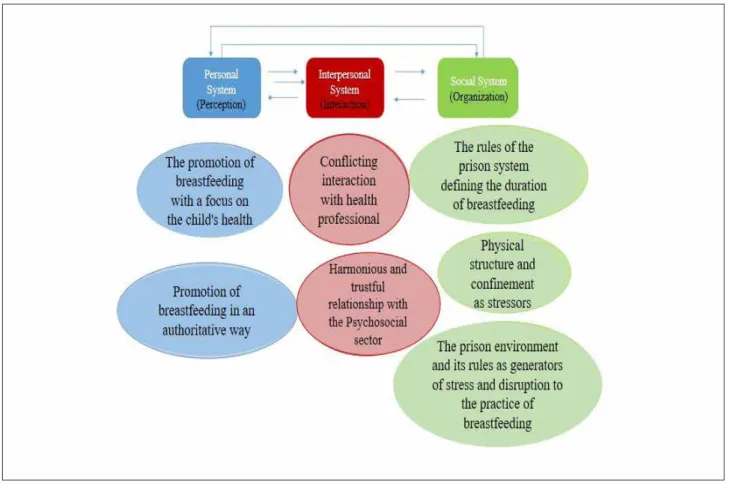
each CI represented here. The flowchart shown in figure 1 represents the CI raised, influencing and being influenced by each other in the understanding
of the promotion of BF in the prison.
Figure 1 - Flowchart of the Central Ideas grouped within the Structure of Open Systems of Imogene King.
Personal System
The promotion of breastfeeding with a focus
on the child’s health
The health of the baby being considered as the main reason for breastfeeding places the child as the core of the maternal behaviors.
Because here in the nursery there is more priority than the pavilion because of the children. For the pe-diatricians, it is necessary to give the breast. For them, children do not need anything else... just the breast. If the child gets sick, they say we should give milk because
it heals a sick child faster... even more in a place like that, closed. Then we have to breastfeed so they do not get any diseases. (DSC1)
Promotion of exclusive breastfeeding in an
authoritative way
breast-feeding. If other milks are introduced without the express authorization of the institution, the child is abruptly withdrawn from the mother.
The collective discourse shown below portrays this imposition:
If you do not breastfeed, the child will go home; it is practically a psychological pressure, that if we cannot take it, the children go home. You cannot give them milk ... if they know they will send the child home. Only if the doctor authorizes and with the prescription. There are mothers who do not have milk, there is the pressure they impose, the mother worries more, then the milk dries more. (DSC2)
Interpersonal System
Conflicting interaction with health
professionals
The approach of health professionals to the in-carcerated nursing mother has been centered on the biomedical model. It values only what is related to the biological body and, once again, to the curative medicine with a focus on children’s health.
They are always in their place and we are in ours. Usually they do not even ask about breastfeeding, only if the baby is well, they listen to the baby and that is it. For breastfeeding there is no one. The relationship they have with us for breastfeeding is to know if we are giving milk or not... just for that. Just the pediatrician comes, looks at the child very quickly and goes. Then we get stressed out. (DSC3)
Harmonious and trustful relationship with the
psychosocial sector
In contrast to the previous central idea, the nursing mothers showed great satisfaction with the care provided by the professionals of the psychosocial sector. This sector is comprised of psychologists and social workers and it is in constant interaction with women to provide psychosocial support in all aspects of the prison situation, including BF.
She does not oblige, but her group never gets empty, because she always talks in a nice manner, she always ex-plains, gives proper attention. She says that breastfeeding is good... teaches how to apply massages, how to nurse a child, she always takes a doll, shows how it is... shows a video, DVD for us to watch. It is othe psychosocial sector that has this proximity to us, that has patience, because inside there is a lot of stress. They never came to measure the distance from us, not at all..(DSC4)
Social System
The rules of the prison system defining the
duration of breastfeeding
This study demonstrated that the prison or-ganization allows the infant to remain with their
mother only during the first 6 months of life.
We can only have the baby breastfeeding until the 6 months. It is a very bad thing to get separated from the child. I do not think it is right so because our kids are paying for something they did not do. I do not know how many months he will breastfeed... And then when he gets out on the street, he will have to have milk, or porridge, because I will not be with him to breastfeed. For me, he would nurse until he wanted to.(DSC5)
Physical structure and confinement as stressors
According to the interviewees, although the referred institution has a space destined for moth-ers with their respective babies, isolated from the other inmates, this is below what is determined by the legislation. Unhealthy facilities, overcrowding and lack of playground denote an inadequacy of this space to the presence of children.We have a lot of trouble to breastfeed here... because here is too bad, locks, confusion, people talking loudly
around you... It is a lot of women... they keep fighting
with each other. Space is getting smaller, because more and more inmates come... We do not have any more visits, sunbathing... you cannot go outside... here we feel more incarcerated than we already are. It has drips, there is no place for the newborn... For a nursery, to support the chil-dren and nursing mothers, it is very precarious. (DSC6)
The prison environment and its rules as
generators of stress and disruption to the
practice of breastfeeding
The prison environment and its rules generate stress among the nursing mothers, in a way that it impairs the practice of BF in these establishments. The collective discourse evidences that the child becomes a tool of punishment and threat within the prison, when their presence is conditioned to the good behavior of the woman.
You have to be nice to be able to stay with the
child... You cannot smoke, you cannot fight... The child
cannot get sick, the son has to breastfeed... otherwise they send the child home... you have to stay away from your
child... all this we think... So, I think all of this influences
breastfeed, she has to be calm, calm... Otherwise the milk will not come out, and then I cannot stress over anything. But, the prison is theirs, you have to accept it. (DSC7)
DISCUSSION
Personal System
Nursing mothers’ perception of the promotion
of breastfeeding in prison
King conceptualizes the personal system as the interaction of the individual with the environment, in which that individual reacts to their expectations, perceptions and needs.12 The perception is selective
for each person, representing that each situation can be perceived differently by each one;15 it involves
the action taken by the individual in the present
moment, besides being influenced by the education,
expectations, self-concept and previous experiences of the individual.12 In their reports, incarcerated
nursing mothers perceive the promotion of the BF carried out in an authoritative way and focused on the health of the babies. In this way, little or no space is given to reveal the subjectivity of the nursing mothers, while their personal desires are subjugated to the needs of the children.16
The World Health Organization (WHO), the
United Nations Children’s Fund (UNICEF) and the Ministry of Health advocate the practice of BF for the promotion of health and satisfactory child development, which needs to be complemented from the 6th month of life and last until the 2 years or more.17 It constitutes inalienable right not only of
the child, but also of the mother,18 and it is linked to
the idea of more health or health guaranteed by the
best scientific evidence, to consider the complexity
of the breastfeeding/weaning process and to value the role of the nursing mother as the protagonist of this experience.16
The supplementation with infant formulas, with no clinical indication, negatively affects the exclusive breastfeeding and is associated with a shorter duration of BF.19 As a strategy to protect
breastfeeding, it is up to the prison unit to priori-tize breast milk, discouraging the implementation
of its substitutes during the first six months of life,
reserving it for exceptional cases.18
However, this decision should be left to the nursing mother, since individuals have the right
to participate in decisions that influence their life,
health, and community services.11 Outside prisons,
this woman retains her decision-making power over the introduction or not of formulas for her child.
The decision-making is an essential factor in the provision of nursing care,15 since the participation in
this process leads to a decrease in the resistance to the implementation of the intervention and learning occurs. By considering also the fact that those who make decisions are seen as having authority and power,12 the possibility for the woman to decide
on the establishment and maintenance of the BF in prison could lead to better adherence to the practice. This would promote BF within the perspective of the nursing mother’s autonomy and empowerment, with respect to the human dignity, giving women the power to decide on their own body.
Although the child-centered health promotion is a reality in life outside the prison, it is seen that it is even more pronounced within it, occurring accord-ing to the stigmatizaccord-ing principle that these women would have lost the right to exercise maternity and, consequently, to breastfeed their children, due to the crime committed. Being reinforced that the
only ones who deserve the benefits of breastfeeding
would be the children who cannot be punished by the error that the mother committed.
Also, when determining mandatory exclusive breastfeeding, promoting the separation of mothers and children when this practice does not occur, the prison institution complies with the legislation that guarantees the child’s stay with the mother in the nursery for at least one year and a half, regardless of whether there is a possibility of breastfeeding or not.3,18
Interpersonal System
Interaction between incarcerated professionals
and nursing mothers to promote breastfeeding
Considering the promotion of breastfeeding as a phenomenon in which the human relations can be determinant for their development,
profession-als and nursing mothers interact influenced by the
perceptions, goals, needs and values of each one. In this process of interaction, health professionals have a responsibility to share information to help individuals make informed decisions about their health care.11
Most prisons in Brazil do not provide full follow-up for the health of pregnant women. Edu-cational activities in sexual and reproductive health should be provided to these women as health pro-motion strategies.4 The absence of the Nursing in the
actions of promotion of the BF in prison could be evidenced from the reports of the nursing mothers and the observation of the researcher in the place of study. Because it represents a profession of health care and education, this gap in the care of the in-carcerated nursing mothers may indicate a denial of basic health rights for this woman and her child. It is misleading to assume that all the nurses provide impartial and judgment-free nursing care.
Their affective responses can be intensified and in
-fluenced by their attitudes and beliefs.21 The belief
that incarcerated people are dangerous, loaded with all the addictions and responsible for the greatest dangers22 may lead to segregation between health
professionals and inmates, among women who would be worthy or not of quality health care.
This fact is worrying, since it is recognized that the nursing performance has the potential to
reduce conflicts between scientific and popular
knowledge through its attentive and comprehensive approach for assessing, directing actions and offer-ing adequate support to the feeloffer-ings of the nursoffer-ing mothers, regarding beliefs, fears and insecurities. The role of the nurse is essential in promoting breastfeeding by adopting interventions that have a positive impact, such as counseling and puerperal visits, recognizing the social context in which the nursing mother is inserted.23
The promotion of BF as described by the in-terviewees when referring to the care provided by the health professionals of the prison institution is centered on the biomedical model, which does not consider other aspects of the breastfeeding process, such as the social and cultural character of this experi-ence. This reductionist model implies an instrumental view on the role of the mother-woman in society.16
Breastfeeding cannot be seen only by a biologi-cal and instinctive prism, since there are several nu-ances involved, which cannot be neglected. Cultural, anthropological, social, family, psycho-emotional, spiritual, among others aspects should be valued for the planning of promotion strategies. In this way, the nursing mother must be considered in her individual complexity, inserted in a certain culture and subject to the interferences of the environment in which she lives.
The adequate psychosocial support of the mul-tidisciplinary team, combined with the quantity and
quality of the information provided, is an essential tool for the reduction of the anxiety of the nursing woman. The creation of bonds, the maintenance of open dialogue, and the encouragement of the active participation of women during the pregnancy-puer-peral cycle should be favored so that the promotion of the BF can be done with a stimulus to the
prac-tice, so that the puerpera feels safe and confident to
breastfeed her child after childbirth. It should also be started during the prenatal care, be stimulated dur-ing hospitalization at the maternity hospital and be promoted during the puerperal follow-up.24
Health education must break with the bio-medical model, of the body perception of a machine, and be directed to the dialogue and the socializa-tion of knowledge and practices among users and professionals. The participation of women as pro-tagonists in the decisions that involve their health has the potential to bring it closer to a proposal to promote BF as a right, in which autonomy and self-responsibility are valued.25
Knowledge about the concept of organization is essential for the professionals inserted in social systems. In order to work professionally and meet
quality standards of care, these should exert influ -ence in an organization.12 When they act in a way
that minimizes the effects that the prison organiza-tion brings to the nursing mothers, as evidenced in the discourses concerning professionals in the psychosocial sector, there is a decrease in stress and a strengthening of their decision-making power. This fact can lead to greater satisfaction with the care provided, having a greater potential to promote BF in the molds proposed by this study.
Social System
Interference of the prison organization in the
promotion of breastfeeding
Organizations shape individuals in different
ways to develop the achievement of organizational goals.12 In the meantime, the prison organization
uses a set of rules that show the main demands regarding the conduct the inmate in order to un-balance their needs and objectives, when they are submitted to sanctions, violating their autonomy.26
least 1 year and 6 months, since the maternal presence is fundamental in the period of development of the
child, specifically regarding the strengthening of the
maternal bond and in establishing trust, optimism and courage. These aspects can be compromised if there is an early separation. It is also in this period that the psychological elaboration must take place for the separation and future re-encounter.3
The power exercised by the prison organization
defines the duration of the BF and the presence of the
child with the mother until the sixth month of life, to the detriment of the woman’s desire, the health of the child and the legislation that protects them. The vulnerability of the nursing mother regarding the prison system forces her to accept this determination and curtails her right to decide about her and her child’s health. In this case, the exercise of institutional
power hampers the promotion of BF and configures
another factor of stress for these women.
In order to ensure that these children remain in the prison environment, the female prisons should ensure a healthy place for child development in addition to a quality relationship between mother and child. To shelter children up to 2 years old, they must guarantee a nursery space, with a limit of up to four beds per room for mothers and their sons and daughters, equipped with bathrooms that support children’s baths, space for recreation area and opening to an outdoor area.3
The incarcerated woman will not satisfactorily exercise her nursing role if there are no adequate physical facilities. It the State’s job to play its role in improving the structure of prisons, especially regarding the construction of nurseries and kin-dergartens that aim at the practice of BF in order to guarantee the rights of women and children.7
The concept of space exists within all cultures, but it is perceived differently by each individual and dependent on the situation. This perception can be distorted by stress, sensory overload, and depriva-tion.12 According to the collective discourse, the feel-ing of confinement intensified by the permanence
in the nursery, the excess of sensorial stimuli, and the inadequacy of the prison space to care for the child, perceived by the nursing mother, negatively interfere with the practice of BF in prison.
In addition, the staggered authority and strictly enforced regulations make the inmates dis-tressed and apprehensive about the consequences of disobeying the rules. Punishments are represented by the temporary or permanent denial of privileges or by the denial of the right to try to obtain them.26
Authority is the legitimate power given to a person by virtue of their role and position in a social system. It results, among other reasons, from a posi-tion that allows an individual to distribute rewards and sanctions, and depends on a reciprocal relation-ship between an individual exercising authority and an individual accepting authority. Power is a characteristic of authority. Through it, one or
more people influence others in a given situation.
In a social relationship, those who exercise power can control groups and organizations.12 The prison
institution has almost total power over detainees.22
The authority and power exercised by the prison
system reflect a denial of the rights of women and
children and hamper the promotion of BF in prison. Depriving women and children of the right to breastfeeding, as well as the right to remain together, because they are incarcerated, is another way of punishing them. This punitive action hurts the principles of reasonableness and proportional-ity by preventing the child from being breastfed to their mother’s breast and receiving the best food, as well as the affection that the moment provides.7
The questions raised here, according to the collective discourses, increase the level of stress among these women. It is known that an increase in stress reduces the ability to perceive events and make rational decisions.12 This should then lead to
a decrease in interactions and goal setting between nurse and client, in addition to the ineffectiveness of the nursing care.15 It configures a great interference
factor in the personal and interpersonal systems of the nursing mother, generating an imbalance be-tween the three dynamic systems proposed by King.
In addition, stress triggered by the prison environment has the potential to interfere with the physiology of breastfeeding. A study developed with Latin women, which explored the association between anxiety, postpartum depression, oxytocin levels, and duration of BF, demonstrated that prena-tal depression, postpartum depression and anxiety
were significantly associated with the early cessation
of breastfeeding, that is, before 2 months of age.27
Nurses can reduce clients’ stress by providing adequate and timely information; assessment of physiological changes; aid so that individuals and groups can articulate their concerns. In this way, it will facilitate the setting of goals as well as the alternative means to achieve them.12
The care provided by professionals and in-stitutional routines have the potential to facilitate the practice of breastfeeding by adopting measures that aim at the continuous support to the nursing mother, in order to consider their particularities in the elaboration of strategies of promotion, protec-tion and support to BF.28
It is considered as a limitation of the study the fact that it portrays the reality of a single Brazilian prison unit. Added to this is the limited number of similar publications, which reinforces the importance of researches with a deepening of the theme in the different prison units, in order to favor the imple-mentation of strategies for their promotion that are consistent with the different national realities.
CONCLUSION
It is possible to verify the adequacy of the explanatory model proposed by King for the un-derstanding of the promotion of BF in the prison from the perception of the incarcerated nursing mothers. It was evidenced that the prison organiza-tion (social system), through its peculiarities, both physical structure and its values, goals and rules, triggers the increase of the stress of the nursing mothers. These stressors interfere in their perception (personal system) and hinder their social interaction (interpersonal system). In addition, the authority ex-ercised by the prison system decreases the power of decision of the nursing mother, and it may cause an increase in the resistance to the implementation of strategies for the promotion of breastfeeding. These facts demonstrate an ineffectiveness of the authori-tative actions to promote BF in prison, since they do not reach the goal of promoting breastfeeding in its broader concept, even if the practice happens.
In contrast, when professionals act to achieve
organizational goals, they can influence the or -ganization in ways that minimize these stressors. In addition, quality and humanized care, free of prejudice, in order to reduce the distances imposed
by stigma, seeking to recognize them as dignified
citizens, regardless of the crime they committed, contributes to the reduction of stress and the break-down of this cycle, rebalancing the systems.
Nursing has as a challenge to promote BF in the prison in an effective way, with a view to equipping the incarcerated nursing mother to make conscious decisions about her health and her child’s, obeying the restrictions imposed by the social system. Thus, there will be effective health care, satisfaction with the care provided and the achievement of the goal of promoting BF, without harming the principle of human dignity, adjusted to the particularities of life in prison.
It is necessary, therefore, the training of health professionals, especially the Nursing ones, in the scope of the promotion of BF in prisons, with a view to welcoming and enhancing women’s autonomy. Sensitizing them to the reality of the woman in deprivation of freedom, it is possible to contribute to the guarantee of the basic human rights and the maintenance of the dignity in prison.
REFERENCES
1. Ministério da Justiça (BR). Levantamento Nacional
de Informações Penitenciárias - Infopen Mulheres 2014. Brasília (DF): Ministério da Justiça; 2015.
2. Colombaroli CM, Braga AG. A cadeia feminina de Franca sob a ótica da visita íntima. Br J Empirical Legal Stud. 2014; 1(2):122-39.
3. Ministério da Justiça (BR) Portaria Interministerial nº. 210, de 16 de janeiro de 2014: institui a Política Nacional de Atenção às Mulheres em Situação de Privação de Liberdade e Egressas do Sistema Prisional e dá outras providências. Diário Oficial da República Federativa do Brasil, 17 Jan 2014. Seção1
4. Leal MC, Ayres BVS, Pereira APE, Sánchez AR, Larouzé B. Birth in prison: pregnancy and birth behind bars in Brazil. Ciênc Saúde Coletiva [Internet]. 2016 [cited 2017 Oct 26]; 21(7). Available from: http:// www.redalyc.org/html/630/63046188008/
5. Abbott L, Scott T. Women’s experiences of breastfeeding in prison. Midwifery Digest. 2017 Jun; 27(2):217-23.
6. Abbott L. Becoming a mother in prison. Practicing Midwife. 2016; 19(9): 1-3
e Direito [Internet].2014[cited 2017 Oct 26]; 11(11). Available from: http://dx.doi.org/10.15603/2176-1094/rcd.v11n11p68-101
8. Soares EMC, Castro AED. Amamentação no cárcere: as entrelinhas para mães e filhos como sujeitos de
Direito. Rev Âmbito Jurídico [Internet]. 2012[cited
2017 Oct 26]; 107(15). Available from: http://www. ambitojuridico.com.br/site/?n_link=revista_artigos_ leitura&artigo id=12515
9. Paynter MJ, Snelgrove-Clark E. Breastfeeding support from criminilized women in Canada. J Hum Lact [Internet]. 2017 Nov [cited 2017 Nov 26]; 33(4):672-6. Available from: https://doi. org/10.1177/0890334417726057
10. Huang K, Atlas R, Parvez F. The significance of breastfeeding to incarcerated pregnant women: an exploratory study. Birth. 2012 Jun;39(2):145-55. 11. King IM. King’s conceptual framework and Theory
of goal atteinment. In: Parker ME. Nursing Theories in Practice. New York (US): National League for Nursing; 1990.
12. King IM. A Theory for nursing: systems, concepts, process. New York: (US) John Wiley; 1981.
13. Santos EM, Agra GFA. Only the breast milk – meanings of mothers on exclusive breastfeeding. Semina Cienc Biol Saúde. 2016; 37(2): 93-106.
14. Lefevre F, Lefevre AM. Curso teórico prático de introdução ao discurso do sujeito coletivo e ao software qualiquantisoft [Internet]. São Paulo (SP): IPDSC; 2012 [cited 2017 Oct 26]. Available from: http:// xa.yimg.com/kq/groups/28001072/1072006145/ n a m e / 2 0 1 2 A P O S T I L A % 2 0 D O % 2 0 1 7 % 2 0 CURSO%20DSC.pdf
15. Evans CLS. Imogene King: A conceptual Framework for Nursing. California (US): SAGE Publications Inc; 1991. 16. Kalil IR, Ferraz LMR, Aguiar AC. Da intenção
ao gesto: aproximações e distanciamentos entre informações oficiais e percepções maternas sobre amamentação. Diálogos de la Comunicación [Internet]. 2014 [cited 2017 Oct 26]; (88). Available from: http://dialogosfelafacs.net/da-intencao-ao-gesto- aproximacoes-e-distanciamentos-entre-informacoes-oficiais-e-percepcoes-maternas-sobre-amamentacao/
17. Bomfim LTM, Novaes TF, Bonanato K, Navarro RS, Tedesco TK, Imparato JCP, Drugowick RM, Reis JB. Factors related to the practice of exclusive breastfeeding in different cities of the States Minas Gerais and Bahia, Brazil. Pesq Bras Odontoped Clin Integr [Internet]. 2017 [cited 2017 Oct 26]; 17(1):e3237.
Available from: http://revista.uepb.edu.br/index. php/pboci/article/view/3237/pdf
18. Ramos LS. Direito à amamentação e à convivência familiar: possibilidade de afeto e ressignificação do cárcere. Revista do Observatório Brasil da Igualdade de Gênero. Brasília (DF): Secretaria Especial de Políticas para as Mulheres; 2009. p.14-16.
19. Niguyen T, Dennison BA, Fan W, Xu C, Birkhead GS. Variation in formula supplementation of breastfed newborn infants in New York Hospitals. Pediatrics [Internet]. 2017 Jul [cited 2017 Oct 26]; 140(1):pii:e20170142. Available from: https://doi. org/10.1542/peds.2017-0142
20. Goffman E. Estigma: notas sobre a manipulação da identidade deteriorada. 4ªed. Rio de Janeiro
(RJ): Livros Técnicos e Científicos; 1988.
21. Hufft AG, Peternelj-Taylor C. Ethical care of pregnant adolescents in correctional settings. J Forensic Nurs [Internet]. 2008[cited 2017 Oct 26];4(2):94-6. Available from: https://doi.org/10.1111/j.1939-3938.2008.00015.x
22. Foucault M. A microfísica do poder. Rio de Janeiro (RJ): Graal; 1979.
23. Carvalho OMC, Silva KR, Andrade LZC, Silva VM, Lopes MVO. Prevalência dos diagnósticos de enfermagem de amamentação no binômio mãe-filho em Unidade Básica de Saúde. Rev Rene. 2014; 15(1):99-107.
24. Rodrigues AP, Padoin SMM, Guido LA, Lopes LFD. Pre-natal and puerperium factors that interfere on self-efficacy in breastfeeding. Esc Anna Nery [Internet]. 2014 [cited 2017 Oct 26]; 18(2). Available from: http:// dx.doi.org/10.5935/1414-8145.20140037
25. Guerreiro EM, Rodrigues DP, Queiroz ABA, Ferreira AM. Educação em saúde no ciclo gravídico-puerperal: sentidos atribuídos por puérperas. Rev Bras Enferm. 2014; 67(1):13-21.
26. Goffman E. Manicômios, prisões e conventos. São Paulo
(SP): Editora Perspectiva; 2001.
27. Lara-Cinisomo S, McKenney K, Di Florio A, Meltzer-Brody S. Associations between postpartum depression, breastfeeding, and oxytocin levels in Latina mothers. Breastfeed Med. 2017 Sep; 12(7):436-42. 28. Pereira LB, Abrão ACFV, Ohara CVS, Ribeiro CA.
Maternal experiences with specificities of prematurity that hinder breastfeeding. Texto Contexto Enferm [Internet]. 2015 Mar [cited 2017 Oct 26]; 24(1):55-63. Available from: http://dx.doi.org/10.1590/0104-07072015000540014
Correspondence: Marcelle Lima Guimarães
Instituto Federal de Pernambuco - Campus Pesqueira. End. BR 232, Km 208,
55200-000 - Loteamento Portal, Pesqueira, PE, Brasil E-mail: [email protected]
Received: May 08, 2017 Approved: December 18, 2017
This is an Open Access article distributed under the terms of