of Chemical
Engineering
www.scielo.br/bjcePrinted in BrazilVol. 35, No. 01, pp. 19 – 26, January – March, 2018
*Corresponding author: Božidar Šantek. E-mail: [email protected]. Phone:+385 1 4605 290, Fax: +385 1 4836 424 dx.doi.org/10.1590/0104-6632.20180351s20160452
HETEROTROPHIC CULTIVATION OF EUGLENA
GRACILIS ON CHEMICALLY PRETREATED
MEDIA
Mladen Pavlečić
1, Dijana Crnić
2, Ena Jurković
3,
Mirela Ivančić Šantek
1, Tonči Rezić
1and Božidar Šantek
1*1Department of Biochemical Engineering, Faculty of Food Technology and Biotechnology, University of Zagreb, Pierottijeva 6, 10000 Zagreb, Croatia
2Ledo d.d., Marijana Čavića 1a, 10000 Zagreb, Croatia 3Primevigilance Zagreb d.o.o., Oreškovićeva 20 A, 10000 Zagreb, Croatia
(Submitted: July 26, 2016; Revised: November 5, 2016; Accepted: December 8, 2016)
Abstract – In this research, the impact of chemical agents on the growth of Euglena gracilis and contaminants (S. cerevisiae and B. subtilis) in different cultivation media was studied. E. gracilis was cultivated on modified Hutner and
complex medium in Erlenmeyer flasks and a stirred tank bioreactor. H2O2 and antimycin were used as suppressors of contaminant growth activities during algae cultivation. The use of antimycin as a chemical suppressor of contaminants is not recommendable because of its significant impact on the E. gracilis growth. At a H2O2 concentration of 5 mg L-1 contaminant growth activities were almost completely suppressed. In these conditions, E. gracilis is capable to grow, but a further increase of H2O2 concentration is related to significant reduction of algae growth. H2O2 as a suppressor of contaminants has great potential for industrial application, but its optimal concentration for a particular bioprocess has to be determined in order to obtain the maximal bioprocess efficiency.
Keywords: Euglena gracilis; heterotrophic cultivation; different cultivation media;H2O2; antimycin
INTRODUCTION
The microalgae Euglena gracilis is a well studied
microorganism. It has great nutritional value because it contains valuable proteins in high concentrations
(Murakami et al., 1998), polyunsaturated fatty acids,
β-carotene, and vitamins C and E (Ogbona et al., 1998) among others. However, this microalgae is mostly
recognized for paramylon (β-1,3-glucan) production.
This compound belongs to a group of biologically active polysaccharides, together with lentinan, fungal glucans, schizophyllan or pachyman, among others. Lentinan and schizophyllan are tumor suppressors and fungal glucans
are well known immunostimulators (Watanabe et al.,
2013). Paramylon as a supplement has several human
health benefits; it has anti-carcinogenic properties, it
lowers blood cholesterol and its sulfonated derivatives can inhibit HIV virus activity (Koizumi et al., 1993). E. gracilis is capable of growing as a strict photoautotroph, a photo-heterotroph or a strict heterotroph utilizing organic
carbon sources (Osafune et al., 1990). Under autotrophic
conditions biomass yield is relatively low, so heterotrophic cultivation is more interesting for industrial application.
E. gracilis is also capable of growing on several carbon sources and it has even been shown that it can grow on potato liquor and corn steep solids based media. The aim of
these studies was to define simple and inexpensive complex
Euglena gracilis and paramylon production (Šantek et al., 2010; Šantek et al., 2012; Ivušić and Šantek, 2015).
Medium type (composition) and medium optimization are highly important parts of any bioprocess as they can substantially reduce time and costs, as well as increase the
bioprocess performance efficiency (Kennedy and Krouse,
1999). Various production modes (e.g., batch, fed-batch,
continuous) or systems (e.g., shake flasks, bioreactors) can differ substantially regarding suitable medium composition due to their specific characteristics. The introduction of
new mutants and strains in the bioprocess is frequently the reason for industrial optimization of medium composition (Kennedy and Krouse, 1999). Traditional or statistically designed approaches for media optimization can be used on numerous bioprocesses involving enzymes (Manivasagan
et al., 2015), microorganisms (Li et al., 2014; Wang et
al., 2014) or cell cultures (Almo and Love, 2014; Farrell
et al., 2014). On the other hand, medium contaminations have to be avoided since their activity leads to lowering
yields and other bioprocess efficiency parameters.
Sterilization of equipment and medium, as well as aseptic manipulation techniques, are procedures usually used to avoid contamination during bioprocesses. In industrial bioprocesses these procedures are expensive, energy- and time-consuming and therefore the use of chemicals could be an alternative. The selection of chemicals for this purpose is a demanding process due to the fact that chemicals with desirable selective toxicity and the exact concentration to be used must be previously determined. An excessive chemical concentration may modify the
performance of the working microorganism or remain in
the product, altering its properties (Oliveira et al., 2000). Chemical agents usually used for this purpose are: acids, basses, organic solvents, antibiotics or oxidants. An example of antibiotics application is the development of a sustainable procedure for controlling contaminant growth during the production of polyhydroxybutyric acid (PHB) by Alcaligenes eutrophus. In this research, erythromycin
did not show a harmful effect on the bacterium growth.
However, nitrofurantoin shows strong and streptomycin
moderate harmful effects on A. eutrophus growth,
respectively. Strongly harmful effect on PHB synthesis
was only observed with nitrofurantoin (Oliveira et
al., 2000). Furthermore, the successful application
of vancomycin for the growth inhibition of Bacillus
cereus in polyhydroxyalkanoate (PHA) production with Hydrogenophaga pseudoflava on whey containing media was also demonstrated (Koller et al., 2011).
The aim of this study was to investigate the effect of
chemical agents (H2O2 and antimycin) on the heterotrophic
cultivation of E. gracilis in different experimental
conditions. This study also shows how to suppress further growth of contaminants during the bioprocess if contamination happens after initial medium and bioreactor sterilization. In this research, heterotrophic cultivation
of E. gracilis was performed in Erlenmeyer flasks and additionally verified in the stirred tank bioreactor.
MATERIALS AND METHODS
Microorganisms and cultivation media
Euglena gracilis strain Z (Klebs SAG 1224-5/25) was obtained from the Algensammlung Göttingen, Germany.
The yeast S. cerevisiae and the bacterium B. subtilis
were from the Culture collection of the Faculty of Food Technology and Biotechnology, University of Zagreb.
Working microorganisms were maintained as follows: E. gracilis on modified Hutner medium (Hutner et al., 1966), S. cerevisiae on malt extract agar and B. subtilis
on standard (containing beef, yeast, peptone and casein
extract) agar, respectively. In this research, modified
Hutner and complex medium [consisting of 20 g L-1 of
glucose and 60 g L-1of corn steep liquor (CSL)] were used
for heterotrophic cultivation of E. gracilis. All media were sterilized at 121°C for 20 min, then cooled down prior to inoculation and addition of chemical agents (with or without contaminants addition). Inocula of E. gracilis and contaminants (S. cerevisiae and B. subtilis) were prepared
separately on the medium (modified Hutner or complex
medium) that was used in further research. Inocula were
propagated on the rotary shaker in 500 mL Erlenmeyer flasks with 200 mL medium at 28°C for 72 hours and
rotation speed of 150 min-1. The cell number concentration
in the E. gracilis inoculum was approx. 107 CFU/mL and
in S. cerevisiae and B. subtilis inocula in the range of 5 .
107- 108 CFU/mL, respectively.
Heterotrophic cultivation of E. gracilis in Erlenmeyer flasks under different conditions
Cultivations of E. gracilis were performed on modified Hutner medium in Erlenmeyer flasks (200 mL of working volume in 500 mL flask; inoculum 10 % v/v) on a rotary shaker during five days at 28°C and rotation speed of
150 min-1. H
2O2 (range of 1.5-15.0mg L
-1) and antimycin
(range of 0.2-1.2g L-1) were selected as suppressors of
contaminants. Prior to inoculation, contaminants and chemicals addition, cultivation media were prepared and sterilized (121°C/20 min). The whole study consisted of
different experimental set-ups that were characterized by different E. gracilis cultivation conditions. The same algae cultivation conditions were present inside a particular
experimental setup (5 flasks).The control setup was the
setup inoculated only with E. gracilis culture. Inoculum
for separate E. gracilis co-cultivation with contaminants contains cell suspension of algae (15 mL) and contaminant
(5 mL). Every 24 hours, one flask (from each experimental setup) was removed from the rotary shaker and used for
During the second part of this research E. gracilis was cultivated on complex (20 g L-1of glucose and 60 g L-1of
CSL) medium in the selected experimental conditions according to the results obtained from research performed
on the modified Hutner medium. In this part of research, E. gracilis was co-cultivated with contaminants and H2O2 addition (5 mg L-1). Inoculum for E. gracilis co-cultivation
with both contaminants consisted of the cell suspension of algae (10 mL), S. cerevisiae (5 mL) and B. subtilis (5 mL).
Every 24 hours, one flask (from each experimental setup) was taken off from the rotary shaker for analytical purposes. During flask cultivations E. gracilis was not exposed to
light. All flask cultivations of E. gracilis were done in triplicate and the standard deviation of experimental data was calculated.
Heterotrophic cultivation of E. gracilis in the stirred tank bioreactor under different conditions
Batch cultivation of E. gracilis in the stirred tank bioreactor on both media (modified Hutner and complex
medium) was done after sterilization (together medium and bioreactor) at 121°C for 20 min. All cultivations were
performed at 28 oC and a bioreactor working volume
of 5 L, respectively. For E. gracilis co-cultivation on
modified Hutner medium the inoculum contained the cell
suspension of E. gracilis (300 mL), S. cerevisiae (150
mL) and B. subtilis (150 mL). Inoculum for separate E.
gracilis co-cultivation with contaminants on complex medium contained cell suspension of algae (400 mL) and contaminant (200 mL). In these cultivations, dissolved
oxygen tension was maintained at 30 % of air saturation by changing the air flow and stirrer speed rate. To ensure
heterotrophic growth, the bioreactor was wrapped in aluminum foil in order to avoid light penetration. The monitoring of bioprocess performance was done by
taking broth samples during E. gracilis cultivations. All algae cultivations in the bioreactor were repeated and the standard deviation of experimental data was determined.
Analytical procedures and bioprocess efficiency
Cell number density of E. gracilis was determined
by microscopic cell counting in a Thoma chamber. Due to high mobility of algae cells, deactivation was done by
addition of 1 % H2SO4 solution. Cell number density of
S. cerevisiae and B. subtilis was determined by standard microbiological methods (medium for maintenance;
Petri dishes at 28°C; 72 h for S. cerevisiae and 96 h for
B. subtilis). Determination of biomass concentration was done gravimetrically. For this purpose, homogenized samples were centrifuged at 3629×g (Sanyo, Harrier
18/80) for 15 minutes and pellets were dried at 75 oC to the
constant mass. Supernatants were used for determination of glucose concentration with a Shimadzu CLASS-VP LC-10AVP chromatograph with RI detector and Supelcogel
C-610H column. Phosphoric acid solution (0.02 mol L-1)
in demineralized water (conductivity <1 µS cm-1) was used
as the mobile phase. Before chromatographic analysis the
prepared supernatant solution was filtered through a nylon filter (0.22 µm) and subsequently degassed in an ultrasonic bath for 20 minutes. Mobile phase flow rate was 0.5 mL
min-1. Hydrogen peroxide concentration was determined
by the CEFIC method (Anonymous 1, 2003).
Bioprocess efficiency parameters [biomass production
(XT), conversion yield (YX/S) and productivity (Pr)] were
calculated by standard procedures (Ivušić and Šantek,
2015).
The production of biomass (XT) was calculated by
following equation:
XT = X-X0 (1)
where X and X0 are biomass concentrations at the end and at the beginning of bioprocess, respectively.
Conversion yield of substrate into biomass (YX/S) was estimated by following equation:
YX/S= XT / (S0 - S) (2)
where S0 and S are substrate concentrations at the
beginning and the end of bioprocess, respectively.
Bioprocess productivity (Pr) was determined by the
following equation:
Pr= XT/ (t-t0) (3)
where t is the end and t0 the start time of cultivation, respectively.
For calculation of YX/S and Pr average values of XT
(without standard deviation) were used. In this investigation, the standard deviation of substrate concentration was in the range of ± 0.1 - 0.6 g L-1 and the average values were used
for YX/S calculation (data presented in Tables 1 - 3).
RESULTS AND DISCUSSION
The main purpose of this study was to examine
the possibility to suppress the growth of different
microorganisms during algae cultivation (or medium
preparation) by using different chemical agents. H2O2 and antimycin were chosen as possible microorganism growth suppressors because of their properties. H2O2 was
selected due to the fact that it can be very effective in
relatively low concentrations because of its high oxidative
properties. These properties are a consequence of H2O2
decomposition on water and nascent oxygen (Finnegan et
al., 2010). Antimycin on the other hand was chosen based
on its ability to inhibit microorganism (bacteria, molds and yeasts) growth even at low concentrations for a longer
E. gracilis was cultivated in different experimental conditions in order to define the effect of chemical agents
on the growth of algae and representative contaminants (S. cerevisiae and B. subtilis). Yeast S. cerevisiae was selected
as a representative of eukaryotic microorganisms (prefer
acidic pH value = 4.5 - 5.0) and B. subtilis as a representative
of prokaryotic microorganisms (prefer a neutral pH
value). During E. gracilis cultivation on modified Hutner
medium, H2O2 concentration was also monitored and it
was observed that its initial concentration was reduced by
25.48 % in Erlenmeyer flasks and 32.56 % in the stirred tank bioreactor after120 hours of bioprocess, respectively.
Furthermore, similar tends of H2O2 concentrations were
also observed during E. gracilis cultivation on complex
medium where the initial H2O2 concentration was reduced
by 29.23 % in Erlenmeyer flasks and 35.64 % in the stirred tank bioreactor after 120 hours of bioprocess, respectively.
Heterotrophic cultivation of E. gracilis on modified
Hutner medium in different conditions
At the beginning of this research, E. gracilis was
cultivated in Erlenmeyer flasks on modified Hutner medium with different concentrations of H2O2 (1.5 - 15 mg L-1) in order to define the impact of H
2O2 concentration
on the algae growth. The control cultivation of E. gracilis
was done without H2O2 addition and, consequently, the
highest bioprocess efficiency parameters were observed.
These parameter values are in agreement with literature
data (Šanteket al., 2009). As can be seen in Table 1, the increase of H2O2 concentration was related to the decrease
of bioprocess efficiency parameters compared to the
control cultivation of E. gracilis.
Considerable suppression of E. gracilis growth was
detected during cultivation on modified Hutner medium
with H2O2 concentration in the range of 1.5 - 7.5 mg L-1. This
phenomenon is most obvious in the biomass production (XT) that was reduced by 42 - 48 % compared to the control
algae cultivation. Furthermore, parameters YX/S and Pr
were also reduced, but to a lower extent compared to the control cultivation. Further increase of H2O2 concentration was related to the almost complete suppression of algae growth, which was the most obvious for the cultivation on
the modified Hutner medium with 15 mg L-1 of H 2O2. In
these experiments, bioprocess efficiency parameters were
considerably reduced compared to the control cultivation.
On the basis of these results it is clear that H2O2 has
considerable impact on the E. gracilis growth. However,
the growth of contaminants during E. gracilis cultivation was also suppressed and therefore for further research the H2O2 concentration of 5 mg L-1 was selected due to the
fact that the highest bioprocess efficiency parameters were
observed in this cultivation.
In our further research E. gracilis was cultivated on
the modified Hutner medium with different antimycin
concentrations (0.2 - 1.2 g L-1) in order to define the impact
of antimycin on the algae growth. The control cultivation of E. gracilis was done on the modified Hutner medium
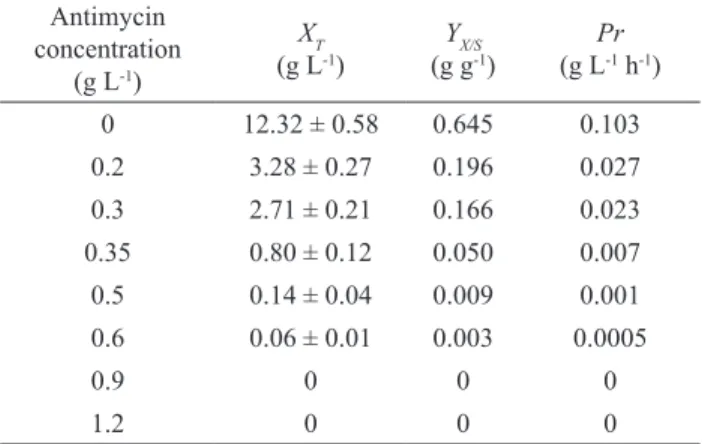
without antimycin addition. As can be seen in Table 2, a
significantly higher impact on the E. gracilis growth was already observed at the lowest antimycin concentration
(0.2 gL-1) compared to the algae cultivation with H
2O2
addition. At the lowest antimycin concentration biomass
production was reduced by 73.4 % compared to the control
cultivation and a similar phenomenon was also detected for
two other bioprocess efficiency parameters. The complete
suppression of E. gracilis growth was detected at antimycin
concentration higher than 0.3 g L-1 where negligible
algae growth was observed. On the basis of these results it was decided that antimycin would not be used in our
further research due to its significant inhibition of the E. gracilis respiratory chain. Furthermore, the application of antimycin on an industrial scale could enlarge antibiotic
resistance in the environment (Franklin and Snow, 1975).
Table 2. Bioprocess efficiency parameters obtained during heterotrophic
cultivation of E. gracilis in Erlenmeyer flask on modified Hutner medium with antimycin addition.
Antimycin concentration
(g L-1)
XT
(g L-1)
YX/S
(g g-1)
Pr
(g L-1 h-1) 0 12.32 ± 0.58 0.645 0.103
0.2 3.28 ± 0.27 0.196 0.027
0.3 2.71 ± 0.21 0.166 0.023
0.35 0.80 ± 0.12 0.050 0.007 0.5 0.14 ± 0.04 0.009 0.001 0.6 0.06 ± 0.01 0.003 0.0005
0.9 0 0 0
1.2 0 0 0
Table 1. Bioprocess efficiency parameters obtained during
heterotrophic cultivation of E. gracilis in Erlenmeyer flasks on modified Hutner medium with H2O2 addition.
H2O2 concentration (mg L-1)
XT
(g L-1)
YX/S
(g g-1)
Pr
(g L-1 h-1)
0 12.87 ± 0.62 0.660 0.107
1.5 6.75 ± 0.42 0.373 0.056
3 6.63 ± 0.32 0.368 0.055
4.5 7.30 ± 0.48 0.405 0.061
5 7.53 ± 0.28 0.560 0.063
6 7.07 ± 0.36 0.413 0.059
7.5 6.86 ± 0.34 0.387 0.057
9 5.97 ± 0.27 0.364 0.050
During E. gracilis co-cultivation with representative contaminants (S. cerevisiae and B. subtilis) on the modified
Hutner medium their growth behavior was studied by H2O2 addition (5 mg L-1). In order to have a clear impact
of H2O2 on S. cerevisiae and B. subtilis their separate co-cultivations with E. gracilis were performed. As can be seen in Figure 1, the cell number of E. gracilis (log N1) and dry biomass concentration were increased during cultivation as a consequence of glucose consumption. In this experiment,
the cell number concentration of S. cerevisiae (log N2)
was very slightly reduced as a consequence of H2O2
concentration decrease during the bioprocess because of its degradation. However, it has to be pointed out that dry biomass concentration represents the biomass of E. gracilis
and S. cerevisiae due to the fact that it was not possible to separate these two microorganisms.
Therefore, it was not possible to determine the
correct bioprocess efficiency parameters for E. gracilis
co-cultivations with contaminants. On the basis of these results it is clear that the H2O2 concentration of 5 mg L-1 is
sufficient to suppress the yeast growth during E. gracilis
cultivation.
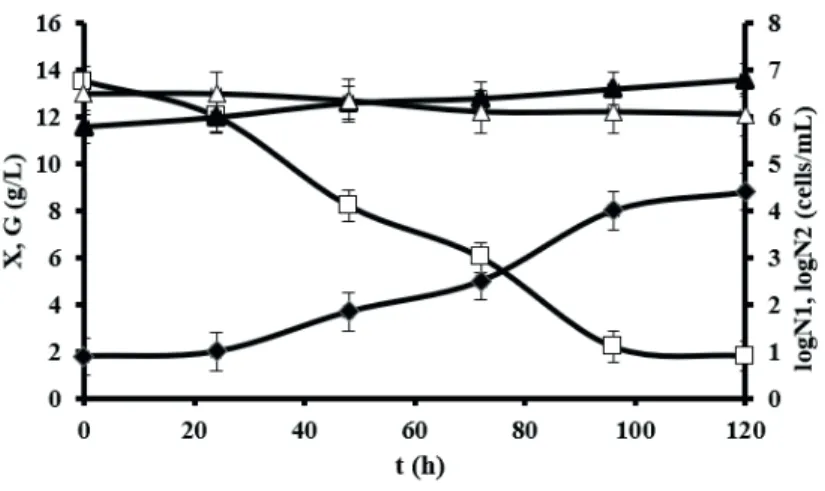
During cultivation of E. gracilis and B. subtilis on
the modified Hutner medium (Figure 2) with 5 mg L-1 of
H2O2 it was observed that the growth of B. subtilis cells was almost completely suppressed. Furthermore, the cell
number concentration of B. subtilis was very slightly
reduced due to the H2O2 activity although its concentration was also reduced during the bioprocess. The growth of
E. gracilis was a consequence of glucose consumption and corresponds with the increase of dry biomass concentration. As mentioned above, the dry biomass concentration contains the dry biomass of E. gracilis and
B. subtilis. Due to the fact that the bacterial cell number concentration was relatively low its portion in the total dry
biomass concentration was also low and can be neglected. In order to verify the results obtained from Erlenmeyer
flasks the cultivation of E. gracilis in co-culture with S. cerevisiae and B. subtilis was performed in the stirred
tank bioreactor on the modified Hutner medium with 5 mg
L-1 of H
2O2. As can be seen in Figure 3, the cell numbers
concentration of S. cerevisiae and B. subtilis were very slightly reduced during the whole heterotrophic cultivation of E. gracilis because of H2O2 activity. In the stirred tank bioreactor similar trends of cell number, dry biomass and
glucose concentration were observed as during E. gracilis
flask cultivation. On the basis of these results it is clear that
the cultivation of E. gracilis in the stirred tank bioreactor confirms the results of algae cultivation in Erlenmeyer flasks.
Heterotrophic cultivation of E. gracilis on complex medium in different conditions
In this study, simple complex medium (20 g L-1 glucose
and 60 g L-1 CSL) was used for E. gracilis cultivation in
heterotrophic conditions in order to define its potential for industrial application as well as to define the capacity of
H2O2 to prevent contaminant activities in these conditions. For E. gracilis cultivation on the complex medium the H2O2 concentration of 5 mg L-1 was selected due to the fact
that this concentration was sufficient to prevent the growth of contaminants during algae cultivation on modified Hutner medium. The flask cultivation of E. gracilis on the
complex medium was performed in different experimental
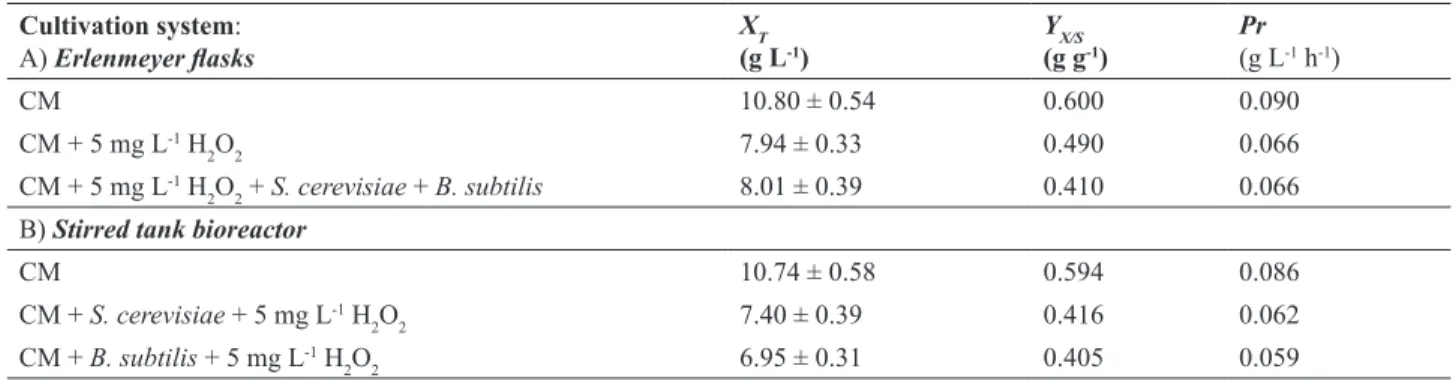
conditions (Table 3; A). The control cultivation of E.
gracilis was done without H2O2 and contaminants addition
and the obtained bioprocess efficiency parameters were in the range of literature data (Šantek et al., 2009; Ivušić and Šantek, 2015).
Figure 1. Changes of dry biomass (X; ♦) and glucose (G; □) concentration and cell number concentration of E. gracilis (log N1; ▲) and S. cerevisiae (log N2; ∆) during cultivation on modified Hutner medium with 5 mg L-1 H
Figure 2. Changes of dry biomass (X; ♦) and glucose (G; □) concentration and cell number concentration of E. gracilis (log N1; ▲) and B. subtilis (log N2; ∆) during cultivation on modified Hutner medium with 5 mg L-1 H
2O2 in Erlenmeyer flasks.
Figure 3: Changes of dry biomass (X; ♦) and glucose (G; □) concentration and cell number concentration of E. gracilis (log N1; ▲), S. cerevisiae (log N2; ∆) and B. subtilis (log N3; ◊) during cultivation on modified Hutner medium with 5 mg L-1H
2O2 in the stirred tank bioreactor.
Table 3. Bioprocess efficiency parameters obtained during heterotrophic cultivation of E. gracilis in Erlenmeyer flask (A) and stirred tank bioreactor (B) on complex medium (CM) in different conditions.
Cultivation system: A) Erlenmeyer flasks
XT
(g L-1)
YX/S
(g g-1)
Pr
(g L-1 h-1)
CM 10.80 ± 0.54 0.600 0.090
CM + 5 mg L-1 H
2O2 7.94 ± 0.33 0.490 0.066
CM + 5 mg L-1 H
2O2 + S. cerevisiae + B. subtilis 8.01 ± 0.39 0.410 0.066
B) Stirred tank bioreactor
CM 10.74 ± 0.58 0.594 0.086
CM + S. cerevisiae + 5 mg L-1 H
2O2 7.40 ± 0.39 0.416 0.062
CM + B. subtilis + 5 mg L-1 H
2O2 6.95 ± 0.31 0.405 0.059
In our further research, E. gracilis was cultivated
on complex medium in the presence of 5 mgL-1 H
2O2
and consequently a reduction of bioprocess efficiency parameters was observed. Bioprocess efficiency parameters
were diminished compared to the control cultivation as follows: XT for 26.5 %, YX/S for 18.3% and Pr for 26.7 %.
However, this reduction of bioprocess efficiency parameters was lower compared to the algae cultivation on the modified
Hutner medium. This phenomenon can be explained as a consequence of higher capacity of complex medium (considerably higher content of compounds that have higher
medium) to neutralize the nascent oxygen activity. During
E. gracilis flask cultivation on complex medium in
co-culture with both contaminants (S. cerevisiae and B. subtilis) and H2O2 addition, similar values of bioprocess efficiency parameters were obtained as in previous experiments. It has to be pointed out that these values are only estimates due to the fact that it was not possible to separate algae and contaminants during dry biomass determination. As
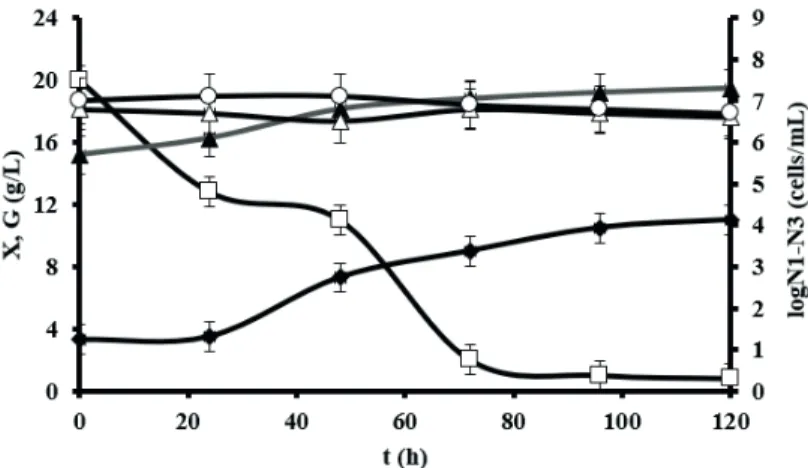
can be seen in Figure 4, the cell numbers of S. cerevisiae
and B. subtilis were very slightly reduced, which clearly
indicates that H2O2 can successfully supress the growth
of both microorganisms. Similar growth suppression of
both contaminants was also observed during E. gracilis
cultivation on the modified Hutner medium.
In our further research, E. gracilis was cultivated in the
stirred tank bioreactor in order to verify results obtained during algae flask cultivation on complex medium. As can
be seen in Table 3 (B), control cultivation of E. gracilis was
done in the stirred tank bioreactor without H2O2 addition.
In these conditions, the range of bioprocess efficiency parameters was similar to the algae flasks cultivation on
complex medium. On the basis of this result it is obvious
that complex medium (consisting of 20 g L-1 glucose and
60 g L-1 CSL) can be successfully used for E. gracilis
cultivation instead of chemically defined Hutner medium. In order to define the impact of H2O2 on the growth of
contaminants, separate co-culture with E. gracilis were
done in the stirred tank bioreactor on complex medium. As
can be seen in Table 3 (B), the similar range of bioprocess
efficiency parameters was observed in these cultivations as during algae flasks cultivations on complex medium. The E. gracilis co-culture with B. subtilis on complex medium was chosen (Figure 5) as an example of algae cultivation in
the stirred tank bioreactor.
As can be seen in Figure 5, similar bioprocess behavior was observed as during E. gracilis flask cultivations on complex medium (Figure 4) and modified Hutner medium in the stirred tank bioreactor (Figure 3), respectively. On
the basis of these results it is clear that E. gracilis flask cultivations on the complex medium are verified during algae cultivations in the stirred tank bioreactor.
Figure 4. Changes of dry biomass (X; ♦) and glucose (G; □) concentration and cell number concentration of E. gracilis (log N1; ▲), S. cerevisiae (log N2; ∆) and B. subtilis (log N3; ○) during cultivation on complex medium with 5 mg L-1 H
2O2 in Erlenmeyer flasks.
Figure 5. Changes of dry biomass (X; ♦) and glucose (G; □) concentration and cell number concentration of E. gracilis (log N1; ▲) and B. subtilis (log N2; ∆) during cultivation on complex medium with 5 mg L-1 H
CONCLUSIONS
On the basis of obtained results it can be concluded
that complex medium (consisting of 20 g L-1 glucose and
60 g L-1 CSL) can be successfully used as a substitute for
chemically defined Hutner medium. This observation is confirmed by the similar values of bioprocess efficiency
parameters for E. gracilis cultivation on both media.
Antimycin as a chemical agent significantly suppresses
the growth of E. gracilis and contaminants already at
relatively low concentrations (below 0.2 gL-1). Therefore,
it is not recommendable to use antimycin as a chemical suppressor of contaminants during E. gracilis cultivation.
H2O2 as a chemical suppressor has lower impact on E.
gracilis and contaminant growth than antimycin. At H2O2 concentrations up to 5 mg L-1, E. gracilis has the capability
to grow, but the growth of representative contaminants was almost completely stopped. However, further increase of H2O2 concentration was related to the complete suppression of E. gracilis growth, especially for H2O2 concentration higher than 9 mg L-1. On the basis of these results it is
obvious that H2O2 has great potential for application as
a chemical suppressor of contaminants during E. gracilis
cultivation (or medium preparation) on an industrial
scale, but it is necessary to determine the optimal H2O2
concentration for particular bioprocess conditions.
REFERENCES
Almo, S.C. and Love, J.D., Better and faster: improvements and optimization for mammalian recombinant protein production. Current Opinion in Structural Biology, 26, 39-43 (2014). Anonymous 1, CEFIC Peroxygens H2O2 AM-7157, Determination
of hydrogen peroxide concentration, Titrimetric method (www.cefic.org/Documents/Other/CEFIC-H2O2-7157.pdf) (2003).
Farrell, A., McLoughin. N., Milne, J.J., Marison, I.W. and Bones, J., Application of multi-omics techniques for bioprocess design and optimization in Chinese hamster ovary cells. Journal of Proteome Research, 13, 3144-3159 (2014). Finnegan, M., Linley, E., Denyer, S.P., McDonnell, G., Simons,
C. and Maillard, J.Y., Mode of action of hydrogen peroxide and other oxidizing agents: differences between liquid and gas forms. ournal of Antimicrobial and Chemotherapy, 65, 2108-2115 (2010).
Franklin, T.J. and Snow, G.A., Biochemistry of antimicrobial action. Chapman and Hall Ltd, London, p. 139-157 (1975). Hutner, S.H., Zahalsky, A.C., Aronson, S.A., Baker, H.and Frank,
O., Culture media for Euglena gracilis. In: D M Prescott (ed.), Methods in Cell Physiology (vol. II; p. 217-228), Academic Press, New York London (1966).
Ivušić, F.and Šantek, B., Optimization of complex medium composition for heterotrophic cultivation of Euglena gracilis and paramylon production. Bioprocess and BiosystemEngineering, 38, 1103-1112 (2015).
Kennedy, M. and Krouse, D., Strategies for improving
fermentation medium performance: a review. Journal of IndustrailMicrobiology and Biotechnology, 23, 456-475 (1999).
Koizumi, N., Sakagami, H., Utsumi, A., Fujinaga, S., Takeda, M., Asano, K., Sugewara, I., Ichikawa, S. and Kondo, H., Anti-HIV (human immunodeficiency virus) activity of sulfated paramylon. Antiviral Research, 21, 1-14 (1993).
Koller, M., Hesse, P., Salerno, A., Reiterer, A. and Braunegg, G. A viable antibiotic strategy against microbial contamination in biotechnological production of polyhydroxyalkanoates from surplus whey. Biomass and Bioenergy, 35, 748-753 (2011). Li, J., Baral, N.R. and Ha, A.K.J., Acetone-butanol-ethanol
fermentation of corn stover by Clostridiumspecies: present status and future perspectives. World Journal of Microbiology and Biotechnology, 30, 1145-1157 (2014).
Manivasagan, P., Venkatesan, J., Kang, K.H., Sivakumar, K., Park, S.J. and Kim, S.K., Production of α-amylase for the biosynthesis of gold nanoparticles using Streptomyces
sp. MBRC-82. International Journal of Biology and Macromolecules, 72, 71-78 (2015).
Murakami, T., Ogawa, H., Hayashi, M. and Yoshizumi, H., Effect of Euglena cells on blood pressure, cerebral peripheral vascular changes and life-span in strokeprone spontaneously hypertensive rats. Journal of Japan Sociaty of Nutritionand Food Sciences, 41, 115-125 (1998).
Ogbona, J.C., Tomiyama, S. and Tanaka, H., Heterotrophic cultivation of Euglenagracilis Z for efficient production
of α-tocopherol. Journal of Applied Phycology, 10, 67-74 (1998).
Oliveira, R. C., Gomez, J. G., Torres, B. B., Bueno Netto, C. L. and Silva, L. F. D. A suitable procedure to choose antimicrobials as controlling agents in fermentations performed by bacteria. Brazilian Journal of Microbiology, 31, 87-89 (2000). Osafune, T., Sumida, S., Ehara, T., Ueno, N., Hase, E. and Schiff,
J.A., Lipid (wax) and paramylon as sources of carbon and energy for the early development of proplastids in dark-grown
Euglena gracilis cells transferred to an inorganic medium. Journal of Electron Microscopy, 39, 372-381 (1990). Šantek, B., Felski, M., Friehs, K., Lotz, M. and Flaschel, E.,
Production of paramylon, a β-1,3-glucan, by heterotrophic cultivation of Euglena gracilis on potato liquor. Engineering in Life Sciences, 10, 165-170 (2010).
Šantek, B., Felski, M., Friehs, K., Lotz, M. and Flaschel, E,. Production of paramylon, a β-1,3-glucan, by heterotrophic cultivation of Euglena gracilis on a synthetic medium. Engineering in Life Sciences, 9, 23-28 (2009).
Šantek, B., Friehs, K., Lotz, M. and Flaschel, E., Production of paramylon, a β-1,3-glucan, by heterotrophic growth of
Euglena gracilis on potato liquor in fed-batch and repeated batch mode of ultivation. Engineering in Life Sciences, 12, 89-94 (2012).
Wang, W., Han, F., Li, Y., Wu, Y., Wang, J., Pan, R. and Shen, G., Medium screening and optimization for photoautotrophic culture of Chlorella pyrenoidosa with high lipid productivity indoors and outdoors. Bioresource Technology, 170, 395-403 (2014).