Management Board Diversity: Accomplishment or Disappointment? –
A pedagogical case study on Norway
Hala Naji Haidar
A project submitted in partial fulfillment of the requirements for the degree
Master in Business Administration
Supervisor:
MSc. Ana Margarida Simaens, Assistant Professor and PhD, ISCTE –Department of Marketing, Operations and General Management
II -Spine- M ana ge ment B oa rd Dive rs it y: Ac compl is hment or Dis appoint ment? – A pe da gogica l ca se s tudy on Nor wa y
Ha
la
N
a
ji
Ha
id
a
r
III
"Women are the largest reservoir of talent in the world."
IV
Acknowledgements
‒ I want to express my special thanks of gratitude to MSc. Ana Margarida Simaens for helping and guiding me through this project within the limited time frame. With her, I attended my first course in my Master's degree, and with her as well, I am finishing my degree.
‒ I would also like to thank my family for believing in me and for their constant care and support throughout the years.
‒ A huge and special thank you to my husband for standing up with me throughout all the phases of writing my Case Study and for reminding me every day that I can.
V
Abstract
The issue of board diversity within firms has been widely debated. Norway was the first European country to mandate obligatory quota within its board of directors followed by several European countries.
This thesis examines the case of Norway as an exemplary in terms of board diversity, exploring existing research on the effects of boardroom diversity on firm value. Since it has been almost 12 years since Norway launched its sole experiment, the case study will seek to draw on the consequences of the Norwegian quota for gender diversity and use the outcomes to assess whether there is indeed a "business case" for diversity in the boardroom and analyze the importance of boardroom diversity in relation to various management frameworks.
It is expected that by analyzing Norway's case, the target audience of this pedagogical case study – undergraduate students in the field of Business Ethics – will have the opportunity to not only gain a profound familiarity about the case of Norway and how it implemented the mandatory quota in its boards, but will also have the opportunity to practice the use of specific management concepts and ethical tools and frameworks, which they will likely find convenient in their university courses and upcoming careers.
Key Words:
Ethics; Board Diversity; Corporate Governance; Norway.
VI
Resumo
A questão da diversidade dos conselhos de administração nas empresas tem sido amplamente debatida. A Noruega foi o primeiro país europeu a impor quotas obrigatórias nos seus conselhos de administração, seguida de vários países europeus.
Esta tese examina o caso pedagógico da Noruega como exemplar em termos de diversidade dos conselhos de administração, explorando a investigação existente sobre os efeitos da diversidade na sala de reuniões do conselho de administração sobre o valor da empresa. Uma vez que já passaram quase 12 anos desde que a Noruega lançou a sua única experiência, o estudo de caso procurará tirar partido das consequências da quota norueguesa para a diversidade de género e utilizar os resultados para avaliar se existe de facto um "business case" para a diversidade na sala de reuniões e analisar a importância da diversidade nas salas de reuniões em relação aos vários quadros de gestão.
Espera-se que, analisando o caso da Noruega, o público-alvo deste caso de estudo pedagógico - estudantes de licenciatura em na área de Ética Empresarial - tenha a oportunidade não só de conhecer profundamente o caso da Noruega e como implementou a quota obrigatória nos seus conselhos, mas também de praticar o uso de conceitos de gestão específicos e ferramentas e quadros éticos, que provavelmente encontrarão conveniência nos seus cursos universitários e futuras carreiras.
Palavras-chave:
Ética; Diversidade do Conselho de Administração; Governança Corporativa; Noruega.
VII
Table of Contents
1. Introduction ... 1
2. The Case Study ... 2
2.1 Problem Identification ... 2
2.2 Historical Frame ... 3
2.2.1 Overview of the Norwegian History ... 3
2.2.2 Norwegian History and Corporate Governance Arena ... 5
2.3 Empirical Evidence Followed by the Norwegian Quota ... 8
2.3.1 Norwegian Quota and Decision-making ... 8
2.3.2 Norwegian Quota and Innovation ... 9
2.3.3 Norwegian Quota and Leadership... 10
2.3.4 Norwegian Quota and Organizational Structure ... 11
2.3.5 Norwegian Quota and Firm Performance ... 12
2.5 Relevant data Followed by the Quota ... 14
Endnotes ... 18
3. Pedagogical Note ... 21
3.1 Intended Audience ... 21
3.2 Pedagogical Objectives ... 21
4. Theoretical Framework - Literature Review ... 23
4.1 Agency Theory ... 23
4.2 Resource Dependence Theory ... 24
4.3 Human Capital Theory ... 25
4.4 Stakeholder Theory ... 26
4.5 Institutional Theory ... 27
4.6 The Concept of Corporate Governance ... 31
4.7 Code of Ethics ... 34
4.8 Corporate Social Responsibility ... 35
4.9 Sustainable Development ... 36
VIII
6. Case Resolution ... 39
6.1 Presentation Plan ... 39
6.2 Proposed Analysis Questions ... 41
6.3 Proposed Resolution ... 41
6.3 Resolution Slides ... 49
7. Conclusion ... 53
Bibliography ... 55
IX
List of Tables
Table 1: Norwegian History, Corporate Governance System and the Effects
Surrounding the Announcement of the Gender Diversity Law ... 6 Table 2: Quota and Soft Law of Female Representation on Boards of Directors and Top Management in Designated EU Countries in Private Sector Firms ... 15 Table 3: The Positive Impact of Board Diversity on the Performance of a Firm
Through the Highlight of Agency theory, Resource Dependence Theory, Human Capital Theory, and Stakeholder Theory ... 28 Table 4: Corporate Governance Models ... 33 Table 5: Presentation Plan Schedule ... 40
List of Figures
Figure 1: Ingunn Yssen, Gender Equality Director’s Words about Women and the Corporate Sector in Norway ... 4 Figure 2: Laila Dåvøy, Ministry of Equality words when the law proposition was debated in the parliament,27 November 2003 ... 14 Figure 3: The Proportion of Female Board Directors in the Largest Listed companies, 2017 ... 17 Figure 4: The Proportion of Women in Publicly Listed Companies in EU for the year 2018 ... 17 Figure 5: Institutional Pillars and Carriers ... 28 Figure 6: Examples of Code of Ethics Applied by Firms ... 35 Figure 7: Sustainable Development Goals (SDGs), Adopted by the Members of the United Nations ... 37
X
List of Abbreviations
ASA– Allmennaksjeselskap CEO– Chief Executive Officer
CSR– Corporate Social Responsibility EU– European Union
EY– Ernst & Young
Ltd.– Private Limited Company
NCGB– The Norwegian Code of Corporate Governance NHO– The Confederation of Norwegian Enterprise Plc.– Public Limited Company
RDT– Resource Dependence Theory UN– United Nation
1
1. Introduction
The world surrounding us is in a state of constant change. Globalization, migration, and economic and political cataclysm have led to a significant demographic disparity across the globe. Hence, business leaders nowadays habitually find themselves opposed to the chore of responding and accommodating to swiftly emerging megatrends.
As firms deal with more various employees, customers, suppliers, and shareholders, corporate boardroom demographic composition becomes a crucial means to signal a corporation's commitment to creating social value (Miller & Triana, 2009; Dowling, 2006; Mahon, 2002). Accordingly, a vast number of companies are aiming for diversity in their leadership as a way to signal their just and ethical portrayal of diverse cultures and align themselves with their key stakeholders (Miller & Triana, 2009; Rindova,1999).
The case of Norway has been very frequently used as a protuberant example whenever the topic Board Diversity is debated. The fact that Norway was the first country in the world to implement quota in its boards makes it a unique social experiment for scholars and researchers to examine its effects on firms.
This case study aims to elaborate a pedagogical case study on the Case of Norway and mainly focuses on how the country has attempted to mandate an obligatory quota in its board of directors.
The management frameworks which students are expected to practice are Corporate Social Responsibility, Sustainable Development, Three Pillars of Institutional Theory, in addition to other critical theoretical frameworks.
The methodology used to conduct this project is based on the suggestions of Eisenhardt (1989), and Hamel (1993) for the comprehension of a case study (detailed in the fifth chapter - Methodology) and the data was collected from secondary sources. The restatement of this project is organized into seven chapters. The following offers a
2
historical overview of Norwegian history and the Norwegian history and the Corporate Governance arena respectively.
2. The Case Study
2.1 Problem Identification
In several countries the number of women in top executive positions is low, and it is still unclear that quotas lead to a larger pool of top female executives, who are the chief pipeline for boards of directors. Consequently, additional supplementary policies may be essential if politicians want to upsurge the number of females in senior management positions.
Arguments for boosting gender diversity on boards of directors by gender quotas vary from guaranteeing an equal opportunity to enhancing firm performance. The overview of gender quotas in several countries has amplified female representation on boards.
In addition to the many positive effects that previous research has proved behind the implementation of women on boards, numerous studies have also found a negative link between women on boards and firm performance.
In 2002, less than 10% of board members in the largest publicly listed Norwegian firms, known in Norway as Allmennaksjeselskap, or ASA companies were women. Laws presented that year provided those firms five years to increase the percentage of women on their boards to 40%. By January 2008, the proportion of women on boards became more than 40% of the board members of ASA companies. 1
Nonetheless, studies had diverse conclusions regarding Norwegian board diversity. Some concluded a negative impact, and some found no significant influence, while others found a positive correlation between board diversity and firm performance.
The issue behind boardroom diversity seems to be debatable between the different researchers and scholars.
3
2.2 Historical Frame
2.2.1 Overview of the Norwegian History
In the case of Norway, the law has been widely accepted. The fact that the law can be seen as successful in Norway is a crucial example when looking at the expansions taking place in other countries. Furthermore, over the last decade, the political and economic backgrounds globally have transformed significantly, affecting the emphasis on diversity, the role of corporate boards, and the meaning of corporate governance.
The case of Norway demonstrates how legal intervention was an example, which can direct international policymakers. Debates regarding gender diversity have taken place for over 30 years on reasons for and how to get women into high positions in enterprises.2
The Confederation of Norwegian Enterprise (NHO) created in the mid-1990s a program called 'Women to the Top' in collaboration with the Norwegian Confederation of Sports. In this enterprise, NHO ran conferences for women who were to prepare themselves to reach higher positions and also included seminars to train women for board ranks.2
The Norwegian Director of Equality, Ingunn Yssen, designed numerous agendas to boost the number of women on boards. Additionally, she created in 1999 along with then Labor and Administration Minister Laila Dåvøy, and Children and Equality Minister Valgerd Svarstad Haugland, lists of women who desired to be in directorships positions. 2
Previous Equality Ministers Valgerd Svarstad Haugland (1997–2000) and Karita Bekkemellom (2000–2001) studied possibilities for a favorable exploit for getting women on boards. 2
From 2001, Equality Minister Laila Dåvøy (2001–2005), with the Minister of Trade and Industry, Ansgar Gabrielsen, sustained efforts to indorse a law suggestion for gender equality in boards. 2
4
The percentage of females on corporate boards in publicly listed companies remained the same between 1990 and 2002. During this period, it averaged about 4% to 7%, with the only rise in 1994 due to the overview of novel kinds of firms on the Oslo Stock Exchange. 2
In 2003, the Norwegian Parliament announced a law that mandated the entire public-limited companies to have a minimum of 40% of female members on their boards of directors.1 At the same time, Norwegian businesses and the business community were opposing the implementation of the gender balance law. They argued that gender balance goals could be rather reached through voluntary actions and soft regulations. Members of the Norwegian Parliament were considerate of such requests, and therefore, the business community got two years to verify that their argument was possible. However, in 2005, the share of women was only 16%. As a result, the law was announced in 2006 with a two-year implementation period ending on January 2008.3
In 2006 the law reformed from voluntary compliance to legal compulsory, and companies that did not conform by January 2008 were endangered to be dissolved. In April 2008, all PLCs were fulfilling with the commandment.1
Figure 1: Ingunn Yssen, Gender Equality Director’s Words about Women and the Corporate Sector in Norway
‘’Corporate sector is not against an increased number of women, but they don’t like to be deprived of the right to choose men.’’
5
Source: How The Quota Law Came About. A brief overview (Presentation at the conference Women on company boards. How Norway Uses Quotas.) 4
2.2.2 Norwegian History and Corporate Governance Arena
The role of women in society is changing. This shift is not only in the public and private sectors but also in the business world. These modifications are found in various regions, but the speed and focus may vary. The speed of the increase of women in the Norwegian corporate boards has boosted rapidly.
Therefore, and due to this rapid growth after the announcement of the quota law by the Norwegian authorities, many scholars and researchers have focused on the case of Norway.
While the Norwegian law had its roots in social concerns regarding gender equality, the following debates in public and behind the scenes also raised explanations based on attendant commercial profits and the individual rights of females.
Thus far, when it comes to the assessment of a political initiative, the case of Norway has mostly been judged upon factors contrary to the achievement of its innovative purpose. The fundamental basis of the announcement of the law is linked with gender balance in society. However, the initiative has mostly been evaluated based on corporate productivity or based on the career growth of individual females.
Consequent effects, both positive and negative, should not be abandoned. However, the main question raised is whether or not the primary focus should be on the financial value. When describing the Norwegian corporate governance arena, it is vital to comprehend the Norwegian history and the main actors. 2
Table 1 will help understand the Norwegian corporate governance system, including the timeframe in which the law was implemented, and the outcomes followed by the implementation of the law. In the case of Norway, the law has been widely accepted. The fact that the law can be seen as successful in Norway is a crucial example when looking at the expansions taking place in other countries. Furthermore, over the last
6
decade, the political and economic backgrounds globally have transformed significantly, affecting the emphasis on diversity, the role of corporate boards, and the meaning of corporate governance.
The case of Norway demonstrates how the legal intervention was an example, which can direct international policymakers. Debates regarding gender diversity have taken place for over 30 years on reasons for and how to get women into high positions in enterprises.2
Table 1: Norwegian History, Corporate Governance System and the Effects Surrounding the Announcement of the Gender Diversity Law
Norwegian History and Main Actors
Norway is a small country with only a few big firms, there are not numerous people with a long history of being rich, and the state and public authorities are crucial performers.2
The Norwegian authorities, in addition to other vital actors, play a crucial role in the corporate governance stadium. The authorities are both law-makers and owners.2
The legal system in Norway is civil law.5
Norwegian Corporate Governance System Norway is regarded amid the most democratic countries in the world.6
Norway is composed of a social-democratic welfare method with state laws aimed around a weak breadwinner model and a sturdy obligation to gender equality.7
Public limited liability firms are obligated to have a board of directors with a minimum of three members, which vote for the CEO, who is not permitted to be part of the board of directors.8
7
The general meeting should additionally choose the directors. Firms that exceed 30 employees must also have employee representation on their board of directors.8
Firms that have more than 200 employees should arrange a corporate assembly containing associates voted by shareholders and employees, which means to act as an association between the board of directors and the general meeting. Nevertheless, the relinquishing of the formation of corporate assembly must be accepted by the firm, employees, and unions.8
The Norwegian Code of Corporate Governance (2014) endorses that the board of directors should not be comprised of executive personnel.9
It is suggested that a more significant number of associates of the board of directors are independent of the firm.9
The Introduction of the Law
Societal motives have been the initial point for much of the devotion paid to the board of diversity law.2
The societal explanations are related to justice in society, democracy, contribution, equality between the genders, human rights and submission with various agreements of the United Nations and the European Economic Area.2
The Consequences that followed and Lessons Learned Norway’s case has spread globally.
Many countries have implemented the same type of gender quota law as in Norway, and some have proposed the legislation several times without success.10
There has been an increase in female directors, from 9% in 2003 to over 40% in 2008.1
From 2003 to 2008, the proportion of women on boards increased by 260%, which corresponds to an upsurge from 165 to 592 board seats.1
8
2.3 Empirical Evidence Followed by the Norwegian Quota 2.3.1 Norwegian Quota and Decision-making
According to the theory of tokenism women minorities in a group are differentiated and henceforth have no influence on group decisions, however, when they (women minorities) gain “critical mass” or exceed the “token” limit, which is 15% representation, they tend to overcome the minority issues that were deterring their involvement in group decisions. 11
Drawing their arguments from this theory, Elstad and Ladegard use the case of Norway to examine whether the “specific ratio” of women truly plays a role in influencing the board’s decision-making dynamics. Using data collected from a questionnaire, the association between women representation on boards and their impact on board decision was established using multiple regression analysis. The outcome shows that women's ratio is unconnected to perceived self-censorship. In other words, the female board directors voiced their debated opinions irrespective of how many women were with them on board. 12
Furthermore, women’s perceived social interaction was positively linked to female board member proportion. Finally, a positive link between perceived women’s effect and the percentage of females on board happens to exist. Still, when there is a singular woman on board she is still expected to be treated as a token.
The examination, which was based on the 15% minimum ratio as labeled by the tokenism theory, exposed that women who were selected to boards as a consequence of the quota are less likely to practice self-censorship, are less subject to tokenism and tend to be more powerful in their decision making process on boards compared to other women directors.
This shows that women appointed to public limited boards as a result of the quota laws, automatically found themselves within the “critical mass” and hereafter were able to make their contributions to firm decision making from the start. Not only do these
9
outcomes validate the case for enhanced decision-making but they also support the decision to have a mandated 40% minimum requirement by the Norwegian authorities.
2.3.2 Norwegian Quota and Innovation
Innovation is considered as one of the most crucial traits to maintain competitive advantage and for seeking sustainable growth in firms. Whether it is via the augmentation of the board with diverse concepts and perspectives or through its significant role between minorities’ involvement and board’s strategic tasks, preceding scholars, have always emphasized the importance of board diversity for firm innovation.
Given that innovation is a chief topic in today’s world, the abrupt upsurge in the female proportion on Norwegian corporate boards generated by the quota mandate makes the Norwegian scene an ideal testing grounds for assessing the influence board gender diversity on firm innovation.
A study conducted by Torchia, Calabro, & Huse seeks to describe whether an increase in the number of women on corporate boards leads to a critical mass that positively donates to a company’s innovation. 13
Using firm-specific Norwegian firm data collected from a questionnaire, the results of multiple linear regressions show that a minimum of three female members are needed on a corporate board to have a substantial influence on firm innovation. Moreover, the results also show a significant and positive association between the critical mass of women directors (at least three women) and board strategic tasks, signifying that the board’s strategic tasks mediate the relationship between the critical mass of female board members and firm organizational innovation. 13
Overall, the number of women on board contributes to a change. Increasing the number of women to a minimum of three members or more improves the probability that women’s voices and ideas are taken into account and therefore lead to a change in the decision-making process as well as firms’ innovation. Lone women on boards have been
10
proved to not being listened to, being excluded from socializing and even from some decision-making discussions, being made to feel their views signify a woman’s point of view, and is subject to unsuitable actions that prove the argument that male directors notice their gender better than their sole contributions.
Therefore, mass theory proves that adding more than a sole woman on board helps overcome this phenomenon. We discover that having three or more women on a board can generate a critical mass in which women are no longer seen as outcasts and are therefore capable of affecting the content and course of board discussions more substantially.14
2.3.3 Norwegian Quota and Leadership
Since women on boards enhance a firm’s presentation and overall value, numerous researchers have examined whether the quota has a direct impact on other leadership positions within firms.
A study conducted by Wang & Kelan aims to uncover how the Norwegian gender quota, the existence of women board members, and the proportion of women on board affects the presence of females in top leadership positions.15
The authors address various economic and behavioral theories to examine the impact of improved female board representation in leadership positions. Arguing from a resource dependency point of view, the research claims that the increase in women board directors could lead to their supremacy of the pool of board chair candidates, which as a result improves the chance of selecting a female chairperson.
Secondly, the study appoints to the critical mass theory to examine whether the critical mass threshold of having at least three women on boards has a promising effect on the sex of both the board chair and the CEO.
The results of the study show that the quota has had a steady and constructive impact on the existence of top female leaders. The proportion of women board members has a positive link with the presence and appointment of a female board chair, and the
11
presence of a critical mass of “at least three” female board members boosts the likelihood of females being selected as board chairs and CEOs.
Lastly, the outcomes also approve that a constructive relationship occurs between the presence and appointments of women board chairs and women CEOs, henceforth demonstrating that female chairs are more likely to appoint a female CEO.
2.3.4 Norwegian Quota and Organizational Structure
The Norwegian quota mandate specified only publicly listed Norwegian Plc. companies to encounter the 40% female representation obligation. This strict and surprising command has inspired several researchers to study whether businesses transformed their organizational structure as a result of the quota or in an attempt to avoid it.
In general, Norwegian firms with limited liability can choose between the ASA & AS organizational structure.17A non-listed Plc. could basically change its organizational structure to a Ltd. if it wanted to avoid the quota, while a listed Plc. had first to delist from the Oslo Stock Exchange (OSE) before it could convert to Ltd. in order to avoid the quota.18
Bøhren & Staubo examine their study to explore how and why the Norwegian quota, with its non-compliance liquidation penalty, stirred a series of transformations in firms’ organizational form. The study as well considers the opposite side by investigating how the quota influenced the tendency of unaffected businesses to transform their structure into the affected form, i.e., switch from Ltd. to Plc. Their study results indicate that less than 50% of the Plc. firms that existed in 2002 were still there in 2008, and the number of non-listed Plc firms declined by half whereas the number of listed Plc. firms on the OSE improved by 11%.17
The results show that the change in organizational form is more mutual for firms that are not-listed, highly profitable, highly leveraged, small in size, owned by powerful owners and have few female directors.
12
Firms that have these features go through high costs of obligatory board restructuring and little costs from leaving the Plc. quota affected form. As the outcomes also indicate that some Ltd. firms became hesitant to get listed, the authors conclude that the quota might lead to firms with an incompetent organizational structure or unqualified boards.17
Additionally, in their study, Ahern & Dittmar1 highlight that firms are more likely to change their organizational structure if the board was younger and has fewer CEO skill. Nygaard also studies whether the Norwegian transformation wave from Plc. to Ltd. is linked with the quota.18
Using regression analysis, the study concludes that there exists a strong negative association between the conversion decision and pre-quota female representation for non-listed Plc. firms. These findings, therefore, show that for the listed Plc. firms, which are less likely to change their structure, the boards are bigger, are older, have more female directors, and are more likely to have employee representatives on boards and have higher book asset values.
The findings of these studies that investigate the change in organizational forms of Norwegian firms in the post-quota era are consistent. The quota activated a flow in altering the organizational form of Norwegian companies, and the decision to convert was highly dependent on pre-quota firm-specific attributes.
2.3.5 Norwegian Quota and Firm Performance
A study conducted by Ahern & Dittmar found a negative effect of the higher percentage of female board members on the financial performance of Norwegian firms. The outcomes of this study were most marked in the firms with the least women on their boards before the law came into effect.1
The results of their study concluded that the quota led to a substantial drop in the stock price at the beginning of the law and a significant decline in Tobin’s Q. They also conclude that the quota led to more inexperienced women on boards, causing a decline
13
in the operating performance of firms. Both researchers define the Norwegian gender quota as an imposed constraint on the affected Norwegian companies.
Another study by Matsa & Miller found a negative impact between women on boards and firm performance in Norwegian firms. The study examined the effects of the Norwegian quota on Norwegian firm performance by comparing the financial data of the affected firms to a sample of other unaffected Scandinavian companies.19
Based on an examination of a panel of Scandinavian firms in the period 1999 to 2009 and a set of 104 listed Norwegian companies in 2006, the conclusions of the study demonstrate that the financial performance deteriorated for Norwegian firms that were affected by the quota. The reduction in short-term profitability was due to a rise in labor costs from fewer dismissals and more employment compared to the unaffected set of Scandinavian firms.
The study also found that firms were slower to adjust employment to recurring rises and declines. However, both studies have been criticized for not being able to convey possible statistical issues in a convincing way.20
The summary of the empirical findings followed by the Norwegian quota is in (Appendix A).
2.4 Criticism of Empirical Studies
According to Daniel Ferreira, empirical studies regarding women on boards have not been clear enough, neither have they been convincing enough with their data in proving that women on boards lead to a decrease in the financial performance in firms.20 In his report, the latter has specifically criticized the research of Ahern & Dittmar1 and Matsa & Miller (2013) respectively.19
The author states that it is difficult to learn from the previous empirical studies regarding board diversity because board directors, as a group of people, do not represent the general population, as female board members might have different traits or characteristics than females in the general population. In the same report, he mentions
14
that in one of his previous research with Renée Adams21 they have found that female directors tend to be more independent as managers than men.
Additionally, female directors who tend to have a more substantial presence at board meetings, are more likely to sit on monitoring committees and are more likely to force CEO exits after poor stock price performance. In short, female directors are more likely to be sturdy monitors of CEOs. Ahern & Dittmar choose 2003 as their event date. Matsa & Miller choose 2006, while full compliance with the quota was not fully achieved until 2008.
Figure 2: Laila Dåvøy, Ministry of Equality words when the law proposition was debated in the parliament,27 November 2003
Source: How the Quota Law Came About. A brief overview (Presentation at the conference Women on company boards. How Norway Uses Quotas.) 4
2.5 Relevant data Followed by the Quota
In 2011, the European Commission called for responsible self-regulation by firms to guarantee better gender balance in corporations' managerial boards. One year later there
15
was no progress in the proportion of women, which is why in November 2012 the Commission announced a law - a legislative initiative aiming to grow the development towards an added equivalent representation of women and men on boards of listed firms. Hence, from 2003 to 2010, the proportion of women on boards rose from 8.5 % to 11.9 %, a growth of 3.4% per year.23
Norway was the first country to present compulsory quotas mandating that the boards of publicly listed firms have at least 40% female representation. After presenting the 40% quota in 2006, to come into force in 2008, Norway went from 9% female representation in 2003 to 40.5% in 2013. Nevertheless, the worldwide percentage of women on boards was only 11% in 2013.24
In April 2016, the average number of women on board of directors within the major companies listed in the EU-28 Member States was 23.3%. This percentage signifies a rise of 0.6% since the previous data records in October 2015.24
The European Commission has considered a compulsory minimum quota for female board members of 30% by 2015 and 40% by 2020, and some EU countries have applied similar quotas on their boards (Table 2)22. The percentage of women on main corporate boards is much lower in many EU countries (Figure 3), so these quotas, if met, would have an enormous impact on gender arrangement.25
Table 2: Quota and Soft Law of Female Representation on Boards of Directors and Top Management in Designated EU Countries in Private Sector Firms
Country Compliance Year
Quota Binding Guidelines or
Other Regulations
16 Belgium 2011-2019 33% Yes GCG 2009 Denmark - - - GCG 2008 Finland 2010 At least 1 woman Yes GCG 2010 France 2011-2017 40% Yes GCG 2010 Germany 2016 30% Yes GCG 2009 Iceland 2013 40% Yes -
Italy 2011-2015 33% Yes Yes
Luxembourg - - - GCG 2009
Netherlands 2015 30% No GCG 2010
Norway 2008 40% Yes GCG 2009
Poland - - - GCG 2010 and
30% as target for the year 2015
Spain 2015 40% No GCG 2006
Sweden - - - GCG 2004
UK - - - GCG 2010 and
25% as target for the year 2015
17
Figure 3: The Proportion of Female Board Directors in the Largest Listed companies, 2017
Source: European Institute of Gender Equality25
According to Eurostat, the quota had tremendous effects on the proportion of women on boards in the EU. The proportion of women in publicly listed companies in 2018 in the EU is 27%, and 17% as senior executives. However, although representing nearly half of all employed individuals in the EU, women continue to be under-represented amongst managers (Figure 4). 26
Figure 4: The Proportion of Women in Publicly Listed Companies in EU for the year 2018
18
Source: Eurostat26
Endnotes
1 Ahern, K. R., & Dittmar, A. K. 2012. The Changing of the Boards: The Impact on Firm Valuation of Mandated Female Board Representation. The Quarterly Journal of Economics, 127(1): 137–197.
2 Rasmussen, J. L., & Huse, M. 2011, January. Corporate governance in Norway: Women and employee-elected board members. Research Gate. https://www.researchgate.net/publication/298533616_Corporate_governance_in_Nor way_Wome n_and_employee-elected_board_members.
3 Machold, S., Huse, M., Hansen, K., & Brogi, M. 2015. Getting women on to corporate boards: a snowball starting in Norway. Cheltenham: Edward Elgar.
4 How the quota law came about. A brief overview ... 2013, January 23. NTNU. https://www.ntnu.no/documents/10265/0/How the quota law came about.pdf.
5 Conyon, M. J., & Thomsen, S. 2012. Corporate governance: mechanisms and systems. Maidenhead: McGraw-Hill Higher Education. 6 Economist (2018).
6 The Economist Intelligence Unit. 2018. EIU Democracy Index 2018 - World Democracy Report. https://www.eiu.com/topic/democracy-index.
19 7 Seierstad, C., & Healy, G. 2012. Women’s equality in the Scandinavian academy: a distant dream? Work, Employment and Society, 26(2): 296–313.
8 Norway Corporate Governance – Getting The Deal Through – GTDT. 2019, July.
Getting The Deal Through.
https://gettingthedealthrough.com/area/8/jurisdiction/53/corporate-governance- norway/.
9 NCGB. 2018. The Norwegian Corporate Governance Board (NCGB). ECGI. https://ecgi.global/sites/default/files/codes/documents/nues_eng_web_okt2018.pdf 10 Nyheter, D. 2017. The government is withdrawing proposals for quotas on corporate boards. Dagens Nyheter. https://www.dn.se/ekonomi/regeringen-drar-tillbaka-forslag-pa-kvotering-i- bolagsstyrelser/
11 Kanter, R. M. 1977. Men and Women of the Corporation. New York, NY: Basic Books.
12 Elstad, B., & Ladegard, G. 2010. Women on corporate boards: key influencers or tokens? Journal of Management & Governance, 16(4): 595–615.
13 Torchia, M., Calabrò, A., & Huse, M. 2011. Women Directors on Corporate Boards: From Tokenism to Critical Mass. Journal of Business Ethics, 102(2): 299–317. 14 Kramer, V., Konrad, A., Erkut, S., & Hooper, M. 2006. Critical Mass on Corporate Boards: Why Three or More Women Enhance Governance. Wellesley Centers for Women. https://www.wcwonline.org/Publications-by-title/critical-mass-on-corporate-boards-why-three-or -more-women-enhance-governance-executive-summary.
15 Wang, M., & Kelan, E. 2012. The Gender Quota and Female Leadership: Effects of the Norwegian Gender Quota on Board Chairs and CEOs. Journal of Business Ethics, 117(3): 449–466.
20 16 Wang, M., & Kelan, E. 2012. The Gender Quota and Female Leadership: Effects of the Norwegian Gender Quota on Board Chairs and CEOs. Journal of Business Ethics, 117(3): 449–466.
17 Bøhren, Ø., & Staubo, S. 2014. Does mandatory gender balance work? Changing organizational form to avoid board upheaval. Journal of Corporate Finance, 28: 152– 168.
18 Nygaard, & Knut. 2011, March 25. Forced Board Changes: Evidence from Norway. SSRN. https://papers.ssrn.com/sol3/papers.cfm?abstract_id=1793227.
19 Matsa, D. A., & Miller, A. (2013). A Female Style in Corporate Leadership? American Economic Journal: Applied Economics, 136–169.
20 Ferreira, D. 2014, November 17. Board Diversity: Should We Trust Research to Inform Policy? Wiley Online Library. John Wiley & Sons, Ltd (10.1111). https://onlinelibrary.wiley.com/doi/abs/10.1111/corg.12092.
21 Ferreira, D., & Adams, R. 2009. Women in the boardroom and their impact on governance and performance☆. Journal of Financial Economics, 94(2): 291–309.
22 Jourová, V. 2016, July. Gender balance on corporate boards. Europe is cracking the
glass ceiling. European Commission.
http://ec.europa.eu/newsroom/document.cfm?doc_id=46280.
23 Women on boards: global approaches to advancing diversity. 2014, July. EY.
https://www.ey.com/Publication/vwLUAssets/ey-women-on-boards-pov-july2014/$FILE/ey-wo men-on-boards-pov-july2014.pdf.
24 Women on Corporate Boards: Quick Take. 2018, December 21. Catalyst. https://www.catalyst.org/research/women-on-corporate-boards/.
25 Smith, N. 2018, December 4. Gender quotas on boards of directors. IZA World of Labor. https://wol.iza.org/articles/gender-quotas-on-boards-of-directors/long.
21 26 Only 1 manager out of 3 in the EU is a woman. 2019, March 8. Eurostat.
https://ec.europa.eu/eurostat/documents/2995521/9643473/3-07032019-BP-EN.pdf/e7f12d4b-fac b-4d3b-984f-bfea6b39bb72.
3. Pedagogical Note 3.1 Intended Audience
Undergraduate students in the field of Business Ethics are the intended audience for this pedagogical case study.
The project aims to describe the relationship between board diversity and firm performance. Diversity can have a negative, positive, or neutral influence on firm performance. The case of Norway is deeply analyzed.
The case study is mainly intended for classroom (academic) study; it portrays a real situation, and students are expected to apply certain ethical management frameworks to analyze and understand Norway’s environment and choices and the vitality of its choice not only on the EU but also on the topic of diversity on board of directors.
3.2 Pedagogical Objectives
Since Norway was the first country to mandate an obligatory quota, the issue of diversity on board of directors has gained considerable attention globally. A gap exists between the lessons fronted by the empirical research that proves a negative link between women and firm performance from one side, and diverse board and positive firm performance from another side.
However, it is not enough for companies to merely link ‘’gender’’ with a firm’s performance and ignore other vital factors that contribute to the blooming of a company’s performance.
22
The case study discussions provide tools for students that help gain new knowledge, deepen their familiarity, and widen their skill set when it comes to ethical behavior within firms.
The case study is specially designed to help students apply particular tools for ethical management in order to analyze and understand the circumstances that allow gender-diverse boards to succeed and the situations that lead to failure within a firm. Additionally, the case study helps students understand how diverse firms should operate ethically to benefit all stakeholders involved.
Thus, by the end of the analysis and discussion of the case study, students should be able to: a) Explain how firms with diverse boards can encourage desired CSR behavior; b) Identify the corporate benefits related to implementing gender equality policies within firms; c) Identify the corporate challenges related to implementing gender equality policies within firms; d) Characterize the roles of the institutional pillars and carriers in the growth of representation of board diversity.
Question 1 – Explain how firms with diverse boards can encourage desired CSR behavior;
Question 2 –Identify the corporate benefits related to implementing gender equality policies within firms;
Question 3 – Identify the corporate challenges related to implementing gender equality
policies within firms;
Question 4 – Characterize the roles of the institutional pillars and carriers in the growth of representation of board diversity on boards;
With the discussion of the pedagogical note settled, the next chapter will be the discussion of the literature review.
23
4. Theoretical Framework - Literature Review 4.1 Agency Theory
The first and foremost theoretical framework used in literature to examine the association between board diversity and firm value is the Agency Theory. Agency theory proposes that a more diverse board may demand improved monitoring of managers because board diversity boosts board independence (Randöy, Thomsen & Oxelheim, 2006; Carter et al., 2007).
The Agency Theory view of Fama & Jensen (1983) thrives on confirming that agency costs, which arise from managers' pursuit of their interests, are minimized to overcome losses in firm value. The monitoring role of the Board in the agency framework is to overlook and compensate top management, represent shareholders, and ensure the proper use of a firm's resources.
Boards can resolve potential agency problems that may arise between management and shareholders. A central element of the Agency Theory is that board members will not collude with the management to sabotage shareholders' interest because they have a strong motive to build a reputation as professional monitors (Hillman & Dalziel, 2003).
In this line, previous literature has demonstrated the positive effects of gender diversity on boards and corporate performance. For example, within US firms, Adler (2001); Carter, Simkins & Simpson,(2003); Adams & Ferreira (2004) find that the percentage of women on boards of director has a positive impact on corporate value - measured by Tobin's Q (Tobin's Q is the ratio between a physical asset's market value and its replacement value), concluding that diversity relates with better financial performance. Carter et al. (2007) emphasize this positive association by highlighting that gender diversity has a positive impact on financial performance, mostly through the Audit function of the Board.
Dewatripont et al. (1999); Westphal & Milton (2000) highlight that women or foreigners frequently carry new views on complex issues in the board room.
24
Accordingly, this might help to cope with bias arising from measurement error or limitation faced by the Board in decision-making.
4.2 Resource Dependence Theory
The theory suggests that in order for a firm not to depend on other parties, it should have control of its critical resources (Salancik, & Wetherell, 1978). Stiles (2001) explicitly proposes that board diversity might increase access to critical resources, which would suggest that diversity on boards can have a constructive effect on performance.
RDT distinguishes the impact of external influences on organizational behavior, and hence, managers can act to lessen the environmental ambiguity and dependence of a firm. Similar to these arguments is the idea of power, which is the governor’s over-vigorous resources (Ulrich & Barney, 1984).
An amplified diversity causes more information sources but at the cost of lower decisiveness (Randöy, Thomsen & Oxelheim, 2006). This means the teams with the best performance are characterized by members that represent variation in terms of skill, background, and gender.
Besides, a decreased presence of females on boards could be viewed as discrimination that is both unethical and suboptimal, because firms that are usually unprejudiced, would select talent from both genders equally (Jimeno & Redondo, 2008).
The balance between gender diversity in firms can become a source of competitive advantage, given that each gender donates to management in a different and harmonizing manner (Watson, Kumar & Michaelsen, 1993; Shrader, Blackburn & Iles, 1997; Farrell & Hersch, 2001). Carter et al. (2010) highlight that gender and ethnic diversity in the Board deliver unique information sets which helps management in better decision making.
Additionally, a diverse board sends positive indicators to the market and brings numerous perspectives to the firm, besides, non-traditional approaches to
problem-25
solving due to the variety in the Board. Similarly, with the growing participation of women in the business world, the standing of female representation on corporate boards is also expanding (Burke, 1997; Burke & Mattis, 2000).
Moreover, several studies have found a positive relationship between the percentage of women on boards and that of increased financial return (Krishnan & Park, 2005; Litz & Folker, 2002; Shrader, Blackburn & Iles, 1997; Smith, Smith & Verner, 2006).
4.3 Human Capital Theory
The third theory used to depict the positive correlation between board diversity and firm performance is the Human Capital Theory. Becker (1964) suggests that Human Capital Theory addresses the characteristics of an individual's education, experience, and skills and the effect of such characteristics on firm performance. Human capital features are skills and experiences that a specific director carries to the decision-making process inside a firm (Johnson, Schnatterly, & Hill, 2012).
Precisely, the function of the board is not only bounded to monitoring managerial performances as Agency Theory states, but also providing vital capitals that help improve firm performance and confirming those capitals through the development of networks with the external environment (Hillman, Cannella, & Paetzold, 2000). In addition to the monitoring function, the board also serves as a resource provider. According to Hillman & Dalziel (2003), the human capital of directors is one of the most critical components in a firm.
Director characters are unique resources that play a role in affecting what directors pay attention to as well as the decisions they make. According to human capital theorists, the board of directors should be selected according to their quality of academic training and experience and not according to their gender and racial traits (Peterson, Philpot, & O' Shaughnessy, 2007).
Sluis, Praag, & Vijverberg, (2008) conducted a review composed of hundreds of studies and came up with the conclusion that human capital (education) has a positive effect on
26
performance. Certo (2003) highlights the characteristics of board directors affect the market value of a firm. Likewise, Hillman & Dalziel (2003) argue that the standing of the board of directors enhances a firm's credibility and performance.
4.4 Stakeholder Theory
According to the Stakeholder Theory, the role of the board of directors is to characterize not only the interests of shareholders but also those of customers, employees, suppliers and other parties that are of importance to the firm (Low et al., 2015; Finegold, Benson & Hecht, 2007).
Because of the fact that stakeholders typically expect from a firm more than just financial outlooks, such as being ethical, fair, socially responsible and an excellent corporate citizen, board composition should be set in a way to meet all those expectations if they were to sustain a positive relationship with all the stakeholders (Low et al., 2015; Huse & Rindova, 2001).
For example, Williams (2003) found that female directors have an advanced awareness of social and environmental matters; henceforth, their presence on boards would advance a firm's presence in this field and enhance its reputation among its stakeholders. Eventually, the more satisfied stakeholders will provide the firm with eased access to the resources that they control, which then has an advantageous outcome on a firm's financial routine and firm value (Low, Roberts, & Whiting, 2015)
The relationship between board demographic diversity and firm financial performance was also examined by (Erhardt, Werbel, & Shrader 2003).
This group of researchers resorts to the corporate board's strategic decision-making function, rather than the management oversight function highlighted in the Agency Theory, to establish the link between board diversity and firm performance.
They hypothesized that because strategic decision-making is an essential function of the board of directors, in a business environment where a firm financial result is being
27
subject to more due-diligence, boardroom diversity may add a new perspective to board decision-making and thus leads to higher organizational performance levels.
4.5 Institutional Theory
According to the Stakeholder Theory, the role of the board of directors is to characterize not only the benefits of shareholders but also those of customers, employees, suppliers and other parties that are of importance to the firm (Low et al., 2015; Finegold, Benson & Hecht, 2007).
Because of the fact that stakeholders typically expect from a firm more than just financial outlooks, such as being ethical, fair, socially responsible and an excellent corporate citizen, board composition should be set in a way to meet all those expectations if they were to sustain a positive relationship with all the stakeholders (Low et al., 2015; Huse & Rindova, 2001).
For example, Williams (2003) found that female directors have an advanced awareness of social and environmental matters; henceforth, their presence on boards would advance a firm's presence in this field and enhance its reputation among its stakeholders. Eventually, the more satisfied stakeholders will provide the firm with eased access to the resources that they control, which then has an advantageous outcome on a firm's financial routine and firm value (Low, Roberts, & Whiting, 2015)
The relationship between board demographic diversity and firm financial performance was also examined by (Erhardt, Werbel, & Shrader 2003). This group of researchers resorts to the corporate board's strategic decision-making function, rather than the management oversight function highlighted in the Agency Theory, to establish the link between board diversity and firm performance. They hypothesized that because strategic decision-making is an essential function of the board of directors, in a business environment where a firm financial result is being subject to more due-diligence, boardroom diversity may add a new perspective to board decision-making and thus leads to higher organizational performance levels.
28
Figure 5 shows the different carriers (cultures, social structures, routines, and artefacts) and how each carrier is influenced by the institutional systems that are composed of a regulative, normative and cultural element to produce meaning, stability, and order.
Figure 5: Institutional Pillars and Carriers
Source: Scott, 2007
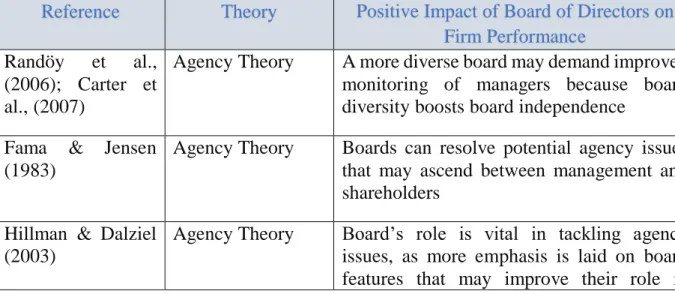
Table 3 summarizes the positive impact of board diversity on firm performance through the highlight of Agency theory, Resource dependence theory, Human capital theory, and Stakeholder Theory.
Table 3: The Positive Impact of Board Diversity on the Performance of a Firm Through the Highlight of Agency theory, Resource Dependence Theory, Human
Capital Theory, and Stakeholder Theory
Reference Theory Positive Impact of Board of Directors on Firm Performance
Randöy et al., (2006); Carter et al., (2007)
Agency Theory A more diverse board may demand improved monitoring of managers because board diversity boosts board independence
Fama & Jensen (1983)
Agency Theory Boards can resolve potential agency issues that may ascend between management and shareholders
Hillman & Dalziel (2003)
Agency Theory Board’s role is vital in tackling agency issues, as more emphasis is laid on board features that may improve their role in
29 aligning the interest of managers with that of shareholders
Adler (2001), Carter et al., (2003); Adams & Ferreira (2004)
Agency Theory Boards of directors with female representation have a positive effect on corporate value. Hence, diversity is linked to better financial performance
Dewatripont et al., (1999); Westphal & Milton (2000)
Agency Theory Women or foreigners frequently carry new views on complex issues in the board room. Accordingly, this might help to cope with bias arising from measurement error or limitation faced by the board in decision-making
Stiles (2001) Resource Dependence Theory
Board diversity might enhance access to critical resources, which would propose that diversity on boards can have a positive effect on performance
Ulrich & Barney, (1984)
Resource Dependence Theory
Managers can act to decrease the environmental uncertainty and dependence of a firm. Similar to these arrangements is the idea of power, which is the governor over-vigorous resources Randöy et al., (2006) Resource Dependence Theory
More information sources are caused by an amplified diversity, but at the cost of lower decisiveness
Jimeno & Redondo (2008)
Resource Dependence Theory
A decreased presence of females on boards could be viewed as discrimination that is both unethical and suboptimal
Watson et al., (1993); Shrader et al., 1997; Farrell & Hersch (2001)
Resource Dependence Theory
The balance between gender diversity in firms can become a source of competitive advantage, given that each gender donates to management in a dissimilar and harmonizing manner
Carter et al. (2010) Resource Dependence Theory
Gender and ethnic diversity in the board deliver inimitable information sets which help management in better decision making
30 Burke (1997);
Burke & Mattis 2000
Resource Dependence Theory
A diverse board sends positive indicators to the market and bring numerous perspectives to the firm in addition non-traditional approaches to problem solving due to the variety in the board
Krishnan & Park (2005) Litz & Folker (2002); Shrader, Blackburn & Iles (1997); Smith, Smith & Verner (2006)
Resource Dependence Theory
There exists a positive relationship between the percentage of women on boards and that of increased financial return
Hillman et al., (2000)
Human Capital Theory
The function of the board is not only bounded to monitoring managerial performances as Agency Theory states, but also providing vital capitals that help improve firm performance and/or confirming those capitals through the development of networks with the external environment
Hillman & Dalziel (2003)
Human Capital Theory
The human capital of directors is one of the most important components in a firm
Van der Sluis et al. (2008)
Human Capital Theory
A review composed of hundreds of studies concluded that human capital (education) has a positive effect on performance
Certo (2003) Human Capital Theory
The characteristics of board of directors affect the market value of a firm
Hillman & Dalziel (2003)
Human Capital Theory
The standing of board of directors enhances a firm’s credibility and performance
Williams (2003) Stakeholder Theory
Female directors have an advanced awareness to social and environmental matters; henceforth, their presence on boards would advance a firm’s presentation in this field and enhance its reputation among its stakeholders
31 Erhardt et al.
(2003)
Stakeholder Theory
Boardroom diversity may add an extra perspective to board decision-making and thus leads to higher organizational performance levels
4.6 The Concept of Corporate Governance
The topic of corporate governance is vital in modern companies due to the division between management and ownership control within the organizations. The interests of shareholders are usually contradictory to that of managers. The main issue is mirrored in the management due to the disparity in the interests of the firm's stakeholders.
Corporate governance definitions are usually broad, and there is no single definition to the term, Shleifer & Vishny (1997) describe corporate governance as the customs in which suppliers of finance to corporations guarantee themselves of receiving a return on their investment.
Decent management of firms is an empirical goal in the European governance ecosystem—and the main topic of corporate governance codes (CFA Institute, 2016). According to Letza et al. (2014), shareholder and stakeholder viewpoints are the most applicable approaches for analyzing the firm's corporate governance.
The former deliberate that the vital goal of corporate governance is the guard of shareholder benefits. The latter states that the key objective of corporate governance is to guarantee the benefits of all of the firm's stakeholders. This method feasts the notion of corporate governance by perceiving shareholders as a type of stakeholder with privileges equal to those held by the others (Money & Schepers, 2007).
Research on board effectiveness has mostly relied on classical theories of corporate governance, such as agency, stewardship, and resource dependence theories (Finegold, Benson, & Hecht, 2007, John & Senbet, 1998, Kiel & Nicholson, 2003, Van den Berghe & Levrau, 2004). These theories fall under the shareholder viewpoint as they believe
32
that the aim of corporate governance instruments, with the board of directors, is to boost shareholder value and guard owner interests (Letza et al., 2004).
Consequently, this line of research claims that board effectiveness is contingent on how well the boards achieve their monitoring and strategic advisory roles (Adams et al., 2010; Forbes & Milliken, 1999; Kroll, Walters, & Wright, 2008; Minichilli et al., 2012). Both of these roles donate to financial performance in response to shareholder interests (Duchin et al., 2010; Forbes & Milliken, 1999; John & Senbet, 1998). Consistent with de Andres et al. (2005), the board features defining board effectiveness under this standpoint can be grouped into three classes: size, composition, and internal functioning.
Regarding board size, de Andres et al. (2005) stated that corporate governance rating systems approve of restricting the maximum number of directors because large boards are suboptimal, while small boards improve participation, contribution and cohesiveness. Nevertheless, they pointed out that a minimum number of members should also be recognized to meet the appropriate arrangement in terms of power and diversity.
Newell & Wilson (2002) anticipated that the ideal size is 5 to 9 members. In regard to the structure of the board of directors, the existence of female directors is a vital driver of board efficiency. Boards with more women contribute to higher financial performance (Daily & Dalton, 2003; Joecks et al., 2013; Smith et al., 2006).
Women are more subtle to the interest of others and typically consider the outlooks of multiple parties (Terjesen, Sealy, & Singh, 2009)
These characteristics donate to the strategic advisory role of boards by considering various strategic options (Daily & Dalton, 2003), improving the fallouts of corporate strategy (Nielsen & Huse, 2010), and improving board dynamics (Kramer et al., 2006).
When it comes to the functioning of boards, directors' profiles are also an essential component of board arrangement (Van den Berghe & Levrau, 2004). Forbes and Milliken (1999) claimed that directors should have functional and firm-specific
33
knowledge and skills to boost board efficiency. Kroll et al. (2008) argued that companies obtain improved results when acquiring other companies if their directors have industry-specific skills.
Likewise, markets react positively to the selection of new directors when they have business experience and involvement (Fich, 2005). Directors' experience also enhances the monitoring and strategic roles of boards. Conger et al. (1998) stated that directors necessitate suitable knowledge to grow their tasks efficiently. Kroll et al. (2008) speculated that directors with no suitable expertise become less involved due to intellectual limitations.
Table 4 explains the Shareholder and Stakeholder models of Corporate Governance.
Table 4: Corporate Governance Models
Shareholder Model Stakeholder Model
Benefits Prospects for diversification Decreased costs of equity
Amplified liquidity
Dominated power to have control over the management Influential in decision-making processes
Limitations Unaccountable boards exposed to CEO who may have "visionary projects" such as immense acquisition actions
Lack of managerial monitoring at the shareholder and the board level
Unaccountable boards
Minority shareholders can be threatened
Lower liquidity and an increased cost of equity
Guidelines Rise independence of the board by engaging self-governing directors Enhance the voting system by methods such as proxy voting, voting by mail/electronic voting
Protection of minority shareholders through strategies such as cumulative voting, among others
34
Parting of CEO and chairman of the board
Upsurge management accountability Marketplace for corporate governance
Source: Based on Becht (2003), and Mejstrik (2005)
4.7 Code of Ethics
The definitions of corporate codes have been numerous. Ethical codes can be defined as "written documents through which corporations hope to shape employee behavior and produce change by making explicit statements as to desired behavior" (Stevens, 1994, p. 64). As Kaptein (2004) states, they explain the objectives that the firm follows, the norms and values it sustains and those belongings for which it may be responsible for.
Kaptein & Schwartz (2008, p. 113) defined a code of ethics as "a distinct and formal document containing a set of prescriptions developed by and for a company to guide present and future behavior on multiple issues for at least its managers and employees toward each other, the company, external stakeholders, and/or society in general."
Codes are essential in firms because they help accomplish a good reputation and avert public criticism (Bondy et al., 2004). Conversely, codes can be practically designed to avoid wrongdoing and to promote honest and ethical behavior; Compliance with appropriate government rules; A growth in social responsibility; and an enhancement in management and corporate culture (Cleek & Leonard, 1998; Fleege & Adrian, 2004).
Figure 6 shows some examples of the code of ethics applied by firms. Ethics among shareholders, partners, directors, and executives are a crucial factor for firms to satisfy their goals appropriately. Ethics guarantees and balances the benefits and interests of all stakeholders involved.
35
Figure 6: Examples of Code of Ethics Applied by Firms
Source: Own Creation 4.8 Corporate Social Responsibility
According to McElhaney (2009), corporate social responsibility is defined as a business strategy that is combined with essential business purposes and vital aptitudes of the company. Furthermore, the author designates that CSR is intended to create business value.
Academics define corporate social responsibility as the voluntary movements a firm or organization implements to follow aims, with a duty to its stakeholders (Chandler & Werther, 2014). Moreover, as the idea of corporate social responsibility has progressed and become more widely inspected, scholars have additionally defined corporate social responsibility into numerous categories such as ethics, diversity, environmental sustainability, and philanthropy (Chandler & Werther, 2014).
The mechanisms that explain strategic CSR is that companies integrate a CSR outlook within their strategic planning process; any activities they take are related to core processes; firms integrate a stakeholder view; and companies move from a short term