ISSN 0104-6632 Printed in Brazil
www.abeq.org.br/bjche
Vol. 32, No. 01, pp. 191 - 199, January - March, 2015 dx.doi.org/10.1590/0104-6632.20150321s00003150
Brazilian Journal
of Chemical
Engineering
PARTICLE NUCLEATION USING DIFFERENT
INITIATORS IN THE MINIEMULSION
POLYMERIZATION OF STYRENE
L. I. Ronco, R. J. Minari and L. M. Gugliotta
*INTEC (Universidad Nacional del Litoral-CONICET), Güemes 3450 - (3000) Santa Fe, Argentina. Phone: + 54-342-4511546, Fax: + 54-342-4511079
E-mail: [email protected]
(Submitted: December 3, 2013 ; Revised: February 23, 2014 ; Accepted: April 15, 2014)
Abstract - In miniemulsion polymerization, droplet nucleation is the key factor to ensure the production of polymer particles with a desired composition. The influence of the initiation on droplet nucleation is conflicting and it has not been completely considered. The result of employing different initiator systems on the nucleation mechanism and kinetics in the polymerization of stable styrene/polystyrene miniemulsions with varied droplet size is discussed here. The initiation systems employed provide all combinations between the phase (aqueous or organic) where initiation mainly occurs and the phase affinity of the produced radicals. Latexes with different contributions of droplet nucleation were synthesized according to the employed initiation system and the droplet size of the miniemulsion. The results presented here could be used as a guide for choosing the initiation system to achieve the required contribution of droplet nucleation.
Keywords: Miniemulsion polymerization; Particle nucleation; Polystyrene.
INTRODUCTION
Miniemulsion (ME) polymerization represents an alternative for the synthesis of hybrid latexes and enables the incorporation of a hydrophobic compo-nent into the polymer particles without requiring its diffusion through the aqueous phase [Asua 2002; El Aasser and Miller 1997; Sudol and El Aasser 1997; Schork et al., 1999]. In fact, in a ME polymerization the nucleation is carried out in previously stabilized submicron droplets (50 - 500 nm), which contain all the components that are desired to incorporate into the material. Therefore, the final properties of a latex synthesized by ME polymerization are mainly de-termined by the droplet nucleation. Although it is accepted that droplet nucleation is affected by the ME stability, droplet size, and the amount of free surfactant in the aqueous phase, the initiation (radical
formation) is an important parameter that has not al-ways been considered.
Both water-soluble and oil-soluble initiators were employed in ME polymerization. Although the for-mer is the most frequently employed, there is an increasing use of oil-soluble initiators. Experimental evidence about the influence of initiation systems in ME polymerization is conflicting and most of the works focus their attention on the polymerization kinetics [Luo and Schork 2002; Tsavalas et al., 2003; Autran et al., 2007; Blythe et al., 1999; Alduncin et al., 1991; Costa et al., 2013].
It was reported that ME polymerization of butyl acrylate (BA) initiated with an oil-soluble initiator (2,2’-azobisisobutyronitrile: AIBN) proceeded slower in the presence of a water-soluble radical scavenger (NaNO2) than in the absence of such scavenger, and
[Luo and Schork 2002]. This was considered as an indication that the radicals formed in the aqueous phase play an important role in the polymerization. In the ME polymerization of acrylic monomers in the presence of alkyd resins, Tsavalas et al. (2003) ob-served a decrease in the methyl methacrylate (MMA) polymerization rate and the final monomer conver-sion from the water-soluble initiator (potassium per-sulfate: KPS) to the oil-soluble initiation system (AIBN or benzoyl peroxide: BPO). It was explained by a reduction in water phase concentration of the oil-phase initiators due to the consumption of a large fraction of the produced radicals in termination reac-tions within the droplets. Based on the results of Luo and Shork (2002) and using a polymer-particle population model, Autran et al. (2007) showed that radical desorption (instead of aqueous-phase radical formation) was the key mechanism in controlling the kinetics of the ME process when AIBN was used as oil-soluble initiator in the polymerization of BA. Similar results had been previously published by Alduncin et al. (1991) in both the seeded emulsion and the ME polymerization of styrene (St) with AIBN, where initiation mainly occurred in the oil-phase, and particles containing a single radical were principally formed by desorption of primary radicals. Also, Blythe et al. (1999) reported that the most likely source of radicals in ME polymerization of St with the oil-soluble initiator 2,2’-azobis(2-methyl-butyronitrile) is the oil phase. Recently, Costa et al.
(2013) investigated experimentally and computation-ally the ME homopolymerization of MMA, St and BA with AIBN as initiator. For each monomer sys-tem, a limiting particle size was determined, above which the effect of compartmentalization became negligible and the polymerization kinetics did not depend on the particle size as in a bulk polymeriza-tion. It is important to remark that previous reported studies assumed that all particles were produced by droplet nucleation.
Differences in the nucleation mechanisms were reported depending on the initiators employed. Chern and Liou (1999a, 1999b) investigated the ef-fect of the initiator type (AIBN vs. KPS) on the ex-tent of droplet nucleation in the styrene (St) ME polymerization by using a water-insoluble dye dis-solved in the monomer droplets. They found that the oil-soluble initiator promoted nucleation in the monomer droplets, whereas micelar and homogene-ous nucleation predominated in the system initiated with water-soluble KPS [Chern and Liou 1999a]. Also, they observed that the higher the AIBN con-centration, the higher the number of particles pro-duced by secondary nucleation, which implies that
the fraction of AIBN dissolved in water played an important role in the particle formation process [Chern and Liou 1999b].
The incorporation of preformed polymer in miniemulsions can affect the droplet size, depending on its concentration and its molecular weight [Lopez
et al., 2008; Blythe et al., 2000]. Colmán et al. (2011) investigated the effect of adding 10-20% of polystyrene (PS) and Poly(methyl methacrylate) on the kinetics and nucleation mechanism of ME ho-mopolymerizations of St and MMA, employing KPS as initiator. They reported that the secondary nuclea-tion mechanism is less important in the ME ho-mopolymerization of MMA than that of St, due to the smaller initial droplet size observed in the for-mer. Similar results were observed by Rodrígues et al. (2007) in the batch ME polymerization of a sili-cone-acrylic system employing KPS as initiator. High silicone contents yielded relatively large drop-lets (177 nm), and hence particle formation by ho-mogeneous nucleation was significant.
Note that the reported effect of initiation systems on ME polymerization is a bit conflicting; not all the initiation alternatives were studied in the same ME system and with varied droplet size, and the contri-bution of droplet nucleation on the particle formation was not always considered. This work investigates the influence of the main variables of the initiation system on both the kinetics and the droplet nuclea-tion in the polymerizanuclea-tion of stable St MEs with varied droplet size. The studied initiator types provide a wide combination between the phase where initia-tion mainly occurs, the phase affinity of the radicals produced and the rate of initiation. The initiators employed were KPS, tert-butyl hydroperoxide/ ascor-bic acid (TBHP/AsAc), tertbutylperoxy 2-ethylhexyl carbonate (TBEC), and BPO. The droplet size of the stable St MEs and the organic phase viscosity were varied with the content and molecular weight of the preformed PS dissolved in the organic phase.
EXPERIMENTAL
Materials
Demineralized water was used throughout the work. The water-soluble initiator, KPS, (Mallinck-rodt, 99% purity), the organic-soluble initiators, BPO (BDH, wet with 30% water) and TBEC (Trigonox 117, AkzoNobel, 95% purity), and the water-soluble redox system TBHP/AsAc (Aldrich/Cicarelli, molar ratio 2/1) were employed. Hexadecane (HD, Merck,
lauryl sulphate (SLS, Cicarelli, 95% purity) as sur-factant, hydroquinone (HQ, Fluka AG, > 99% purity) as polymerization inhibitor, sodium bicarbonate as buffer salt (Anedra, purity 99.7%) and isopropyl alcohol (Cicarelli) as coagulation reagent. St was washed with an aqueous solution of potassium hy-droxide to remove the polymerization inhibitors, and then with demineralized water until reaching the pH of the washing water. Iso-octyl-3-mercaptopropionate (iOMP, Aldrich, isomers mixture > 99%) was used as Chain Transfer Agent (CTA) for controlling the molecular weight of preformed PS. A set of 9 narrow PS (Shodex) standards in the molar mass range 103 -106 g/mol was used for calibration of the size exclu-sion chromatography (SEC) system. Tetrahydrofuran (HPLC Solvent, J.T. Baker) was used as eluent in the SEC runs.
Preformed PS
Three PS produced by conventional emulsion polymerization were employed as preformed poly-mers. These PS were added to the organic phase with the objective of achieving stable MEs with varied droplet size. PS of low molecular weight (PSL) was
synthesized under semicontinuous unseeded starved conditions, feeding a solution containing St and CTA at constant rate in order to obtain a number-average molecular weight (Mn=15000 g mol-1) with low poly-dispersity. PS of intermediate (PSI) and high (PSH)
molecular weights were produced under unseeded batch conditions with the recipes reported in Minari
et al. (2008) The measured average molecular weights (Mn and Mw), determined by SEC, of the preformed PS are summarized in Table 1. The three PS latexes were coagulated with isopropyl alcohol, and the re-maining emulsifier was eliminated by successive cy-cles of centrifugation and redispersion with deminer-alized water until reaching the surface tension and conductivity of the washing water in the supernatant.
Table 1: Molecular weights of the preformed PS.
Nomenclature Mn
(×10-3 g mol-1)
w M (×10-3 g mol-1)
PSL 15.2 33.4
PSI 54.4 380.8
PSH 333.2 1755.0
Miniemulsification
All ME contained 20% wt solids contents, varied content of preformed PS, 2% wbop (weight based on
organic phase) of SLS, 4% wbm (weight based on monomer) of HD, and NaHCO3 at a concentration of
0.024 M in the water phase. The preformed PS was dissolved in the organic phase and maintained under stirring for 12 h before miniemulsification. In order to produce the miniemulsions, the organic and the aqueous phases were strongly mixed by magnetic stirring during 15 min, and the resulting preemulsion (around 200 ml) was sonified with a Sonics VC 750 equipment (power 750 watts) during 25 min, at 100% of amplitude with cycles of 20 seconds on and 5 off. During sonication, miniemulsions were mag-netically stirred and their temperature was main-tained below 30 ºC by means of an ice bath.
Polymerization
Polymerizations were carried out in batch in a 0.3 L jacketed glass reactor equipped with reflux con-denser, stirrer, sampling device, and nitrogen inlet. The reaction temperature (70 or 80 ºC) was controlled by manipulating the temperature of the fluid in the jacket by means of a thermostatic bath. The minie-mulsion was added to the reactor and kept under stirring and nitrogen bubbling. When the oil-soluble BPO or TBEC were used as initiators, they were dissolved in the organic phase before miniemulsifi-cation. The KPS initiator was first dissolved in water and then added into the reactor as a shot. In the ex-periments with TBHP/AsAc, 20% of both reactants were initially loaded to start the polymerization, and the remaining 80% were fed in separate streams at constant flow rates, during 45 min. The total polym-erization time was 2 h for the reactions with KPS or TBHP/AsAc, and it was extended to 3 h when BPO or TBEC were used.
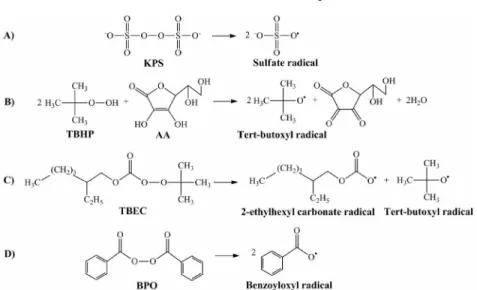
Figure 1 shows the global chemical reactions for the radical formation corresponding to each initiation system. Their main characteristics are: i) KPS pro-duces water soluble SO4- radicals (Figure 1 A), which
Figure 1: Radical formation reactions for the different initiation systems employed.
Characterization
The ME surface tension (γ) was measured with a Krüss K8tensiometer. Stability of MEs was ana-lyzed by scanning the backscattering along the height of a vial every 5 min and for 4 h with a Turbiscan TMA2000. The evolution of the backscattering sig-nal during the measurement time gives an indication of the ME stability, where a smaller change in the backscattering signal indicates a more stable ME.
The following were measured on samples with-drawn during the reactions: i) monomer conversion (x), by gravimetry; ii) average droplet diameter (dd) and particle diameter (dp) by dynamic light
scatter-ing (DLS) at a detection angle of 90º, in a Brook-haven BI-9000 AT photometer; iii) intensity based droplet and particle size distributions by numerical inversion of the DLS autocorrelation measurements [Clementi et al., 2010]; and iv) volume particle size distribution (PSD) by capillary hydrodynamic frac-tionation (CHDF), with a Model 2000 Matec Applied Sciences equipment.
The number of droplets and particles per latex li-ter (Nd and Np) and their ratio (Np/Nd) were obtained
from the x data and the DLS measurements of dd and
p
d . They were calculated by considering the volume
of droplets and particles as the addition of the vol-umes of their components: unreacted monomer and PS (preformed PS and polymerized St). It is note-worthy that both Nd and Np have some uncertainty
because i) droplets and particles were considered to be monodisperse in size; and ii) the third powers of the intensity averages dd and dp were used in their
calculation.
Particle were also observed by transmission elec-tron microscopy (TEM), using a Philips EM 300 (100kV) equipment, and micrographs were taken at different magnifications, depending on the particle size. To avoid destabilization and monomer loss in droplets and particles, the samples were diluted prior to the DLS measurements with a water solution satu-rated with SLS and St.
RESULTS AND DISCUSSION
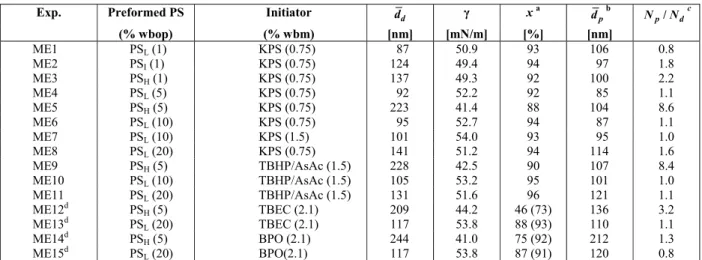
Table 2 summarizes the experiments carried out with different type of initiators, and different amounts of preformed PS exhibiting varied molecular weight. In all the experiments, the measured γ values for the formulated miniemulsions were greater than 41 mN/m, indicating the absence of micelles (γ for the SLS solution at the CMC = 32 mN/m). Figure 2a shows the backscattering profiles along 4 h of a ME (that was not polymerized) containing only 4% wbm of HD, as costabilizer, and without incorporating pre-formed PS. The backscattering flux of this ME along the sample tube showed changes during the assay because the disperse phase was concentrating at the top of the sample, thus producing creaming. Note that the incorporation of 1% wbop of PSL (ME1) was
Table 2: Summary of ME polymerizations. Conditions and results.
Exp. Preformed PS Initiator dd γ x a dpb Np/Nd c
(% wbop) (% wbm) [nm] [mN/m] [%] [nm]
ME1 PSL (1) KPS (0.75) 87 50.9 93 106 0.8
ME2 PSI (1) KPS (0.75) 124 49.4 94 97 1.8
ME3 PSH (1) KPS (0.75) 137 49.3 92 100 2.2
ME4 PSL (5) KPS (0.75) 92 52.2 92 85 1.1
ME5 PSH (5) KPS (0.75) 223 41.4 88 104 8.6
ME6 PSL (10) KPS (0.75) 95 52.7 94 87 1.1
ME7 PSL (10) KPS (1.5) 101 54.0 93 95 1.0
ME8 PSL (20) KPS (0.75) 141 51.2 94 114 1.6
ME9 PSH (5) TBHP/AsAc (1.5) 228 42.5 90 107 8.4
ME10 PSL (10) TBHP/AsAc (1.5) 105 53.2 95 101 1.0 ME11 PSL (20) TBHP/AsAc (1.5) 131 51.6 96 121 1.1
ME12d PSH (5) TBEC (2.1) 209 44.2 46 (73) 136 3.2
ME13d PSL (20) TBEC (2.1) 117 53.8 88 (93) 110 1.1 ME14d PSH (5) BPO (2.1) 244 41.0 75 (92) 212 1.3 ME15d PSL (20) BPO(2.1) 117 53.8 87 (91) 120 0.8
a
Conversion at 2 h of polymerization (with BPO and TBEC x at 3h are also reported between parentheses). b
Final particle diameter. c Ratio between final particles number and initial droplets number. d
Polymerization temperature: 80 ºC
Figure 2: Backscattering data obtained at different times (between 0 and 240 min) and at room tem-perature, to provide information on the colloidal stability of the miniemulsions.
the droplet size and its distribution, where big drop-lets tend to concentrate in the upper part of minie-mulsions as a consequence of the density difference. But the intensity-based droplet size distribution of ME1 was as broad as that obtained from the stable miniemulsions.
Furthermore, in parallel to backscattering meas-urements of ME1 (Figure 2b) dd was also monitored, observing an increment of 8 nm after 240 min. and a broadening of the intensity-based droplet size distri-bution. This could be attributed to droplet coales-cence and/or to monomer diffusion. While droplet coalescence depends strongly on surfactant, mono-mer diffusion is retarded by the costabilizer (Asua 2002). In order to get more insight, an additional
amount of SLS was added to a fresh prepared ME1 to achieve the same fraction of droplet area covered by the emulsifier of ME2, which did not present creaming. However, the incorporation of SLS did not avoid creaming. This could indicate that coalescence was not the main mechanism responsible of cream-ing and that 1% of PSL is not enough to retard
monomer diffusion.
As expected, dd was increased when the pre-formed PS content and/or its molecular weight were incremented. With KPS, differences in both polym-erization rates (Rp) and droplet nucleation
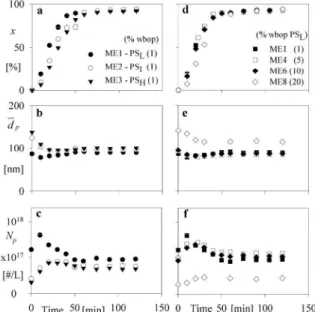
efficien-cies were observed, depending on dd and on the concentration and molecular weight of the preformed PS (Table 2 and Figure 3).
With preformed PSL and with amounts of it ≤
10% wbop, the viscosity of the organic phase was low enough to obtain a low dd (around 100 nm), which increased the droplet area and allowed a high droplet nucleation when employing a water-soluble initiator (Np/Nd≈ 1, Table 2). Due to the fact that Np
was practically the same, no appreciable differences were found in the resulting Rp. Although the final Np/Nd≈ 1 in ME1, ME4, and ME6; the presence of
secondary nucleation was also observed by the evo-lution of dp, with a descendent initial slope, and of
Np (Figure 3). Note that Np increased at the
water-soluble initiators (e.g., KPS) are used, yielding hy-drophilic radicals that promote the formation of new particles by homogeneous or micelar nucleation [Lopez
et al., 2011; Goikoetxea et al., 2009].
On the other hand, high organic phase viscosities limited the droplet diameter reduction and hence the number of droplets able to be nucleated with radicals coming from the aqueous phase. Note that dp
de-creased during the polymerization with respect to dd
when employing PSI, PSH (Figure 3b) or PSL at 20%
wbop (Figure 3e), thus showing the formation of new polymer particles through a secondary nuclea-tion mechanism (Figure 3c,f). It is worth remarking that, in these cases, Np was always lower than that
obtained in the ME polymerization with dd ≈ 100 nm (ME1, ME4 and ME6), and therefore Rp was a bit
reduced (Figure 3a,d). These results are in agreement with those of Costa et al. (2013), where ME polym-erization became slower when the particle diameter was increased, due to the reduction in the compart-mentalization effect.
Figure 3: Comparison of St ME polymerizations with KPS and preformed PS of different molecular weights (a-c) and with different PSL contents (d-f).
Experiments with TBEC and BPO involved higher initiator concentrations, higher temperatures (80 ºC), and extended polymerization times (3 h), because the decomposition rate constants (kd) at 70 ºC for TBEC
(kd(TBPEC) = 3.27x10⁻⁷ s-1 [Brandrup et al., 1999]) and
BPO (kd(BPO) = 1.46x10⁻⁵ s-1 [González et al., 1996])
are lower than for KPS (kd(KPS) = 2.17x10 -5
s-1 [Salazar
et al., 1998]), and a large fraction of the radicals pro-duced inside the droplets and particles are restricted
to a very small volume, thus promoting bimolecular termination [Autran et al., 2007]) Figure 4 compares the evolution of x and dp for the polymerizations that
employed KPS, TBHP/AsAc, TBEC and BPO as initiators, for an organic phase containing the same St/PSL ratio, i.e., similar dd.
In experiments with PSL at 20% wbop (ME8,
ME11, ME13 and ME15), and dd a bit higher than
100 nm (117 nm < dd < 145 nm), droplet nucleation was improved by the hydrophobic tert-butoxyl radicals formed by the TBHP/AsAc system, with respect to the water-soluble SO4- radicals produced by KPS
decomposition, achieving Np/Nd close to the ideal
value of 1 (Np/Nd = 1.1, Table 2). The redox initiator
system (TBHP/AsAc) produced an augment of the radical availability, thus increasing the rate of droplet nucleation and therefore Rp. On the other hand, the
employment of TBEC and BPO at 80 ºC and 2.1% wbm (ME12 and ME14), produced lower Rp than
those obtained with KPS and TBHP/AsAc (ME5, ME8, ME9 and ME11, Figure 4a,d) for similar ME formulations. Also, no significant secondary nuclea-tion was observed when using these oil-soluble initia-tors, giving place to Np/Nd of 1.1 and 0.8, respectively.
Figure 4: Comparison of ME polymerizations of St with different initiators. Polymerization temperature: 70 ºC with KPS and TBHP/AsAc, 80 ºC with TBEC and BPO.
With 5% wbop of PSH, the initial dd was higher
p
d and Np during the polymerization (Figure 4e,f)
gave evidence that most of polymer particles were nucleated by secondary mechanims. In this case, the polymerization proceeded with the monomer diffu-sion from the non-nucleated droplets through the aqueous phase to the particles formed by secondary nucleation. The similar Rp obtained with KPS and
TBHP/AsAc could indicate that, with high secondary nucleation, monomer diffusion controlled Rp instead
of the radical generation.
Secondary nucleation was clearly reduced when employing oil-soluble initiators such as TBEC or BPO (ME12 and ME14), since radicals are formed inside the droplets and their water solubilities are limited (water solubility of TBEC = 2.6x10⁻⁴ g/ 100 g, estimated at 25 ºC with Wskowwin v1.42, and of BPO = 3x10⁻⁴ g/ 100 g [Yalkowsky and Banerjee 1992]). With TBEC (ME12), droplet nucleation was increased with respect to KPS (ME5) and TBHP/ AsAc (ME9), but a large number of particles were still formed by secondary nucleation (Np increased
up to Np/Nd = 3.2). This is probably due to the
de-sorption of tert-butoxyl radicals (formed by TBEC descomposition inside the droplets) to the aqueous phase, which may nucleate new particles by secon-dary mechanims.The radical desorption from the oil phase was previously reported by Alduncin et al. (1991) in the ME polymerization of St using the oil-soluble initiator AIBN. However, when employing BPO as initiator (ME14), the Np is practically
con-stant, achieving a better Np/Nd ratio (Np/Nd = 1.3).
Benzoyloxyl radicals are more hydrophobic than tert-butoxyl radicals and, for this reason, their de-sorption is less probable.
Figure 5 shows the distributions of the droplets and the final latexes for the experiments ME5, ME9, ME12 and ME14. Note that in all cases the intensity-based droplet-size distributions were broad. In ME5 and ME9 (Figure 5a,b) the big droplets disappeared as the polymerization proceeded, thus producing narrow size distributions for the final latexes, con-taining a high fraction of small particles formed by secondary nucleation. Clearly, big droplets were not nucleated by radicals produced in the aqueous phase. Also, the presence of secondary nucleation, probably by desorption of tert-butoxyl radical formed during the TBEC decomposition inside the droplets, gener-ates narrow size distributions compared to the ME droplet size distribution (Figure 5c). Finally, when BPO was used, the intensity-based size distributions of droplets and particles were similar and the volume PSD measured by CHDF clearly showed the pres-ence of big particles (Figure 5d), thus indicating that
droplet nucleation was the predominant site of parti-cle formation. TEM image for the final latex of ME14 (Figure 6) shows a broad particle size distri-bution with the presence of big particles, that can be only formed by droplet nucleation.
Figure 5: Volume PSD (measured by CHDF) and intensity-based size distributions (measured by DLS) for the experiments with 5% wbop of PSH and
differ-ent initiator systems.
Figure 6: TEM micrography of the final latex parti-cles obtained in ME14 with 5% wbop of PSH and
BPO as initiator.
CONCLUSIONS
favor their nucleation when the radicals are formed in the aqueous phase. However, the use of the oil-soluble initiators TBEC or BPO improved droplet nucleation. But with TBEC even significant secon-dary nucleation was still observed, promoted by de-sorption from the polymer particles of the tert-butoxyl radical, which is less hydrophobic than the other radical, 2-ethylhexyl carbonate. Finally, droplet nucleation could be strongly favoured with the oil-soluble initiator BPO that produces highly hydro-phobic radicals.
The results presented in this work could be used as a guide for choosing the phase affinity of the ini-tiator and the radicals produced to achieve the re-quired contribution of droplet nucleation, which in turn depends on the droplet size of the ME. Finally, it should be remarked that the results may differ if the organic phase (monomers and preformed materials) and/or solids content are varied.
ACKNOWLEDGEMENTS
To CONICET, ANPCyT, Universidad Nacional del Litoral, and Secretary of Science, Technology and Reserch of Santa Fe State from Argentina, for their financial support.
REFERENCES
Alduncin, J. A., Forcada, J., Barandiaran, J. M. and Asua, J. M., On the main locus of radical forma-tion in emulsion polymerizaforma-tion initiated by oil-soluble initiators. Polym. Sci. Part. A: Polym. Chem., 29(9), p. 1265-1270 (1991).
Asua, J. M., Miniemulsion polymerization. Prog. Polym. Sci., 27(7), p. 1283-1346 (2002).
Autran, C., de la Cal, J. C. and Asua, J. M., (Mini) emulsion polymerization kinetics using oil-soluble initiators. Macromolecules, 40(17), p. 6233-6238 (2007).
Blythe, P. J., Klein, A., Philips, J. A., Sudol, E. D. and El-Aasser, M. S., Miniemulsion polymeriza-tion of styrene using the oil-soluble initiator AMBN. J. Polym. Sci. Part. A: Polym. Chem., 37 (23), p. 4449-4457 (1999).
Blythe, P. J., Morrison, B. R., Mathauer, K. A., Sudol, E. D. and El-Asser, M. S., Polymerization of miniemulsions containing predissolved polysty-rene and using hexadecane as costabilizer. Lang-muir, 16(3), p. 898-904 (2000).
Brandrup, J., Immergut, E. H. and Grulke, E. A., Polymer Handbook Ch. II. John Wiley & Sons,
New York (1999).
Chern, C-S. and Liou, Y-C., Styrene miniemulsion polymerization initiated by 2,2'-azobisisobuty-ronitrile. J. Polym. Sci. Part. A: Polym. Chem., 37(14), p. 2537-2550 (1999a).
Chern, C-S. and Liou, Y-C., Kinetics of styrene miniemulsion polymerization stabilized by non-ionic surfactant/alkyl methacrylate. Polymer, 40(1), p. 3763-3772 (1999b).
Clementi, L. A., Vega, J. R. and Gugliotta, L. M., Particle size distribution of multimodal polymer dispersions by multiangle dynamic light scatter-ing. Solution of the inverse problem on the basis of a genetic algorithm. Particle and Particle Sys-tems Characterization, 27(5-6), p. 146-157 (2010). Colmán, M. M. E., Muniz Moreira, R. P., Amaral,
M., Araújo, P. H. H. and Sayer, C., Incorporation of PMMA and PS in styrene and methyl methacrylate miniemulsion homopolymerization. Macromolecular Symposia, 299/300(1), p. 41-47 (2011).
Costa, C., Timmermann, S. A. S., Pinto, J. C., Araujo, H. H. and Sayer, C., Compartmentalization effects on miniemulsion polymerization with oil-soluble initiator. Macromol. React. Eng., 7(5), p. 221-231 (2013).
El Aasser, M. S. and Miller, C. M., In: Polymeric Dispersions. Principles and Applications. Asua, J. M., (Ed.), Kluwer Academic Publishers, p. 109-126 (1997).
Goikoetxea, M., Minari, R. J., Beristain, I., Paulis, M., Barandiaran, M. J. and Asua, J. M., Polymeri-zation kinetics and microstructure of waterborne acrylic/alkyd nanocomposites synthesized by mini-emulsion. J. Polym. Sci., Part A: Polym. Chem., 47(19), p. 4871-4885 (2009).
González, I. M., Meira, G. R. and Oliva, H. M., Syn-thesis of polystyrene with mixtures of mono- and bifunctional initiators. J. Appl. Polym. Sci., 59(6), p. 1015-1026 (1996).
Lopez, A., Chemtob, A., Milton, J. L., Manea, M., Paulis, M., Barandiaran, M. J., Theisinger, S., Landfester, K., Hergeth, W. D., Udagama, R., McKenna, T., Simal, F. and Asua, J. M., Minie-mulsification of monomer-resin hybrid systems. Ind. Eng. Chem. Res., 47(16), p. 6289-6297 (2008). Lopez, A., Degrandi-Contraires, E., Canetta, E., Creton, C., Keddie, J. L. and Asua, J. M., Waterborne poly-urethane-acrylic hybrid nanoparticles by mini-emulsion polymerization: Applications in pressure-sensitive adhesives. Langmuir, 27(7), p. 3878-3888 (2011).
the presence and absence of an aqueous-phase radical scavenger. J. Polym. Sci. Part A: Polym. Chem., 40(19), p. 3200-3211 (2002).
Minari, R. J., Vega, J. R., Gonzáles-Sierra, M., Meira, G. R. and Gugliotta, L. M., Emulsion polymeriza-tion of styrene with iso-octyl-3- mercaptopropi-onate as chain transfer agent. J. Appl. Polym. Sci., 109(6), p. 3944 (2008).
Reimers, J. L., Shork, F. J., Predominant droplet nu-cleation in emulsion polymerization. J. Appl. Polym. Sci., 60(2), p. 251-262 (1996).
Rodríguez, R., Barandiaran, M. J. and Asua, J. M., Particle nucleation in high solids miniemulsion polymerization. Macromolecules, 40(16), p. 5735-5742 (2007).
Salazar, A., Gugliotta, L. M., Vega, J. R. and Meira,
G. R., Molecular weight control in a starved emulsion polymerization of styrene. Ind. Eng. Chem. Res., 37(9), p. 3582-3591 (1998).
Schork, F. J., Poehlein, G. W., Wang, S., Reimers, J., Rodrigues, J. and Samer, C., Miniemulsion poly-merization. Coll. Surf. A, 153(1-3), p. 39-45 (1999). Sudol, E. D. and El Aasser, M. S., In: Emulsion Poly-merization and Emulsion Polymers. Lovell, P. A. and El Aasser, M. S., (Ed.), Wiley, p. 699-722 (1997). Tsavalas, J. G., Luo, Y. and Shork, F. J., Grafting
mechanisms in hybrid miniemulsion polymeri-zation. J. Appl. Poly. Sci., 87(11), p. 1825-1836 (2003).