Brazilian Journal of Physics, vol. 36, no. 3B, September, 2006 913
Quantum Transport of Electrons Through a Parallel–Coupled
Triple Quantum–Dot Molecule
M. L. Ladr´on de Guevara and P. A. Orellana
Departamento de F´ısica, Universidad Cat´olica del Norte, Angamos 0610, Antofagasta, Chile
Received on 8 December, 2005
In this article we study the electronic transport through a triple quantum–dot molecule parallel–coupled to leads under a magnetic field. Analytical expressions are obtained for both the conductance and total density of states for the molecule in equilibrium at zero temperature. As a result of quantum interference of resonances belonging to different channels, this configuration exhibits bound states in the continuum (BICs). We examine the broadenings of the molecular states around the conditions under which BICs occur, finding long–lived states extremely robust under variations of the magnetic flux.
Keywords: Electronic transport; Quantum dots; Quantum interference
I. INTRODUCTION
A distinctive feature of electron tunneling through quan-tum dots is the retention of the quanquan-tum phase coherence. For this reason, multiple connected geometries involving quan-tum dots exhibit quanquan-tum interference effects. Several works have been concerned with the study of transmission through a double quantum dot molecule embedded in an Aharonov– Bohm interferometer[1–5]. This system is characterized by the formation of a tunable Fano resonance in the conductance spectrum. This resonance is associated to a long–lived mole-cular state, where the lifetime is controlled by the magnetic field. For specific values of the magnetic flux, this molecular state becomes totally uncoupled from the leads[3, 6], and a “bound state in the continuum” (BIC) is formed. This state immersed in a continuum is the result of the interference of resonances belonging to different channels. These states were early predicted by von Neumann and Wigner[7]. Much later, BICs were studied in the context of atomic and molecular physics[8] and more recently in mesoscopic systems[9].
In this article we study the electronic transport through a parallel triple quantum–dot molecule embedded in an Aharonov–Bohm interferometer connected symmetrically to leads. We focus our analysis in a particular set of values of the dot–lead couplings, where two BICs can occur simultane-ously. We obtain analytical expressions for the conductance and total density of states, and we explore them as a function of the magnetic flux to demonstrate that different regimes of transmission can be reached. The conductance displays one Breit–Wigner and two Fano resonances at the energies of the molecular states, and with a period of two flux quanta, the roles of the antibonding and bonding states are interchanged in the transmission spectrum. The simultaneous BICs occur when the magnetic flux is a multiple of 2Φ0, but in a wide range around this value the pair of states keeps very weakly coupled to the leads. Approximate expressions of the line broadenings of the molecular states are given, as functions of the Aharonov–Bohm phase.
II. MODEL
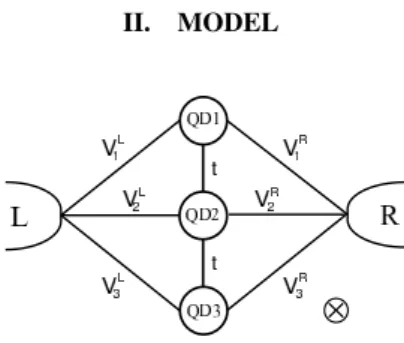
FIG. 1: Triple quantum dot molecule coupled in parallel to leads.
We consider three single–level quantum dots forming a triple quantum dot molecule coupled in parallel to two leads, as shown in Fig.1. The system is modeled by a noninteracting Anderson Hamiltonian, which can be written as
H=Hm+Hl+HI, (1)
whereHmdescribes the dynamics of the isolate molecule,
Hm=
3
∑
i=1εidi†di−t(d1†d2+d2†d1)−t(d2†d3+d3†d2), (2)
whereεiis the level energy of doti,di(d†i)annihilates (cre-ates) an electron in doti, andtis the interdot tunneling cou-pling. Hl is the Hamiltonian for the noninteracting electrons in the left and right leads
Hl=
∑
k∈L,Rεkc†kck, (3)
whereck(c†k)is the annihilation (creation) operator of an elec-tron of quantum numberkand energyεk in the contactLor R. The termHIaccounts for the tunneling between dots and leads,
HI =
3
∑
i=1k∑
∈LViLdi†ck+h. c.+
3
∑
i=1k∑
∈R914 M. L. Ladr´on de Guevara and P. A. Orellana
withViL(R) the tunneling matrix element connecting the i− thdot with the left (right) lead, assumed independent of k. For simplicity, we assume that the magnitudes of these matrix elements are such as|V1L|=|V1R| ≡V1,|V2L|=|V2R| ≡V2, and |V3L|=|V3R| ≡V3. In presence of a magnetic field, and in the symmetric gauge, the tunnel matrix elements can be written in the form
V1L = V1e−iφ/4, V1R=V1eiφ/4,
V2L = V2R=V2,
V3L = V3eiφ/4, V3R=V3e−iφ/4, (5) withφ=2πΦ/Φ0, the Aharonov–Bohm phase, whereΦ0=
h/eis the flux quantum.
The linear conductance at zero temperature is given by the Landauer formula
G=2e 2
h T(εF), (6)
where T(ε) is the total transmission. To obtain G explic-itly we use the equation of motion approach for the Green’s functions[10]. The transmission can be expressed in terms of the retarded and advanced Green’s functionsGr/a(ε)as
T(ε) =tr{Ga(ε)ΓRGr(ε)ΓL}, (7) whereGr(ε)is defined by
Gri j(t) =−iθ(t)h{di(t),d†j(0)}i, i,j=1,2,3, (8) withθ(t)the step function. Ga(ε)is given byGai j= [Grji]∗, and ΓL,R are matrices describing the coupling between the quantum dots and the left and right leads, the matrix elements of which are
ΓLi j(R)=2π
∑
kVikL(R)[VLjk(R)]∗δ(ε−εk), i,j=1,2,3. (9) With the use of Eq. (5),ΓL,Rcan be written as
ΓL,R=
γ11 e∓iφ/4γ12 e∓iφ/2γ13
e±iφ/4γ21 γ22 e∓iφ/4γ23
e±iφ/2γ31 e±iφ/4γ32 γ33
, (10)
withγi j≡ΓLi j=ΓRi j, whereΓ L,R
i j are obtained from (9) for zero magnetic flux.
The electronic properties of the configuration can be stud-ied from the total density of states, given by
ρ(ε) = 3
∑
i=1ρi(ε) =− 1 π
3
∑
i=1ImGrii(ε), i=1,2,3, (11) whereGr(ε)is the retarded Green’s function.
Hereafter we assumeε1=ε2=ε3≡ε0. We make the fol-lowing transformation of the quantum-dot operators
¯ d1 =
1 2(d1+
√
2d2+d3), ¯
d2 = 1 √
2(d1−d3), ¯
d3 = 1 2(d1−
√
2d2+d3), (12)
so that the Hamiltonian of the isolated molecule becomes di-agonal
¯
Hm= (ε0+ √
2t)d¯†1d¯1+ε0d¯2†d¯2+ (ε0− √
2t)d¯3†d¯3, (13) and the Hamiltonian describing the coupling between the molecule and the leads takes the form
¯ HI =
3
∑
i=1k∑
∈L¯
ViLd¯i†ck+h. c.+
3
∑
i=1k∑
∈R¯
ViRd¯i†ck+h. c., (14)
where
¯
V1L,R = 1 2(V
L,R
1 +
√
2V2L,R+V3L,R),
¯
V2L,R = √1 2(V
L,R
1 −V
L,R
3 ),
¯
V3L,R = 1 2(V
L,R
1 −
√
2V2L,R+V3L,R). (15) Eqs. (5)-(15) give us interesting insight into the transmission properties of the molecule. It is observed that for some spe-cific values of the magnetic flux and the dot–lead matrix el-ements, the coupling between one or more molecular states with the leads may vanish, giving rise to the formation of a BIC. In particular, ifV1=V3,
¯
V1L,R = 2V1cos φ 4+
√ 2V2, ¯
V2L,R = ∓i√2V1sin φ 4, ¯
V3L,R = 2V1cos φ 4−
√
2V2. (16)
So that whenφ=4nπ(ninteger), the matrix elements between the molecular state 2 and the left and right leads, ¯V2L,R, cancel and such a state becomes a BIC. If it also occurs thatV1=V2, andnis an odd multiple ofπ, ¯V2L,R6=0 but either ¯V1L,Ror ¯V3L,R vanish, occurring again a bound state in the continuum. On the other hand, we can see of Eq. (16) that ifV1=V3 and
V2= √
2V1, two BIC’s are simultaneously formed whenφ= 4nπ: one in the state 2 (ε=ε0), and other either in state 1 (ε= ε0−
√
2t) or 3 (ε=ε0+ √
2t), depending on the parity ofn. In a parallel double quantum dot molecule, a seemingly simpler condition gives rise to one BIC, which is formed whenever φis a even multiple ofπ(that is,Φ=nΦ0,n integer)[3, 6]. Notice that BICs occur for an infinite number of combinations of dot–lead couplings and Aharonov–Bohm phases, but for simplicity in what follows we focus in the case in thatV1=
V3≡V andV2= √
2V.
III. CONDUCTANCE AND DENSITY OF STATES
WhenV1=V3=V andV2= √
2V the linear conductance reduces to
G=2e 2
h
4γ2[(t+√2εcosφ
4)2−t2cos φ 2]2
D1(ε)D2(ε)
Brazilian Journal of Physics, vol. 36, no. 3B, September, 2006 915
where
D1(ε) =ε2+γ2(1−cos φ 2)
2
(18)
and
D2(ε) = (2t2−ε2)2+γ2[4 √
2tcosφ
4+ε(3+cos φ 2)]
2 (19)
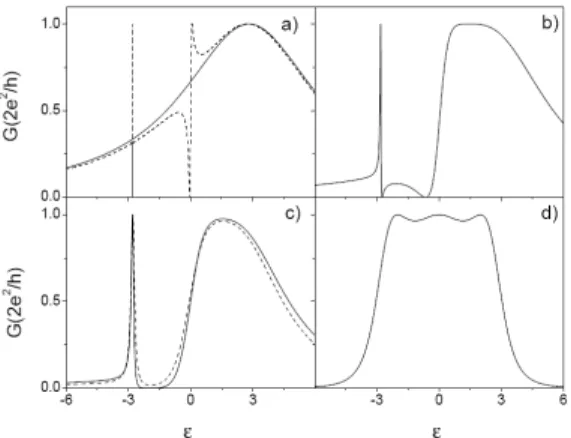
Figure 2 shows the conductance spectrum for different val-ues of the Aharonov–Bohm phase. For φ=0 (Fig.2(a)) the conductance exhibits a single resonance around the an-tibonding energy, which indicates that transmission through the other two molecular states has been suppressed, and such states are bound states in the continuum. This is consistent with Ecs. (16), which show that both ¯V2L,R and ¯V3L,R can-cel wheneverφ=8nπ(ninteger). The equations show also that the roles of the bonding and antibonding states are in-verted every 4π, and that the antibonding and the molecu-lar state of intermediate energy both collapse to BIC’s when φ=4π(2n−1)(ninteger).
FIG. 2: Dimensionless conductance versus Fermi energy, in units ofγ, forV1=V3=V,V2=
√
2V,t=2, a) φ=0 (solid line) and
φ=π/5 (dash line), b)φ=3π/4, c)φ=π(solid line) andφ=6π/5 (dash line), d)φ=2π, andε0=0.
For arbitrary values of the Aharonov–Bohm phase the spec-trum presents three resonances, and a number of Fano antires-onances that oscillates between two and zero. From Eq. (17) we note that the conductance is zero at
ε=− √
2t[1±p
cos(φ/2)]
2 cosφ/4 , (20)
where we see that when(4n−1)π<φ<(4n+1)π(ninteger) there are two antiresonaces, as shown by Fig. 2(b) whereφ= 3π/4. Whenφ=nπ(nodd) only one point of zero conduc-tance exists, as observed in (c). For(4n−3)π<φ<(4n−1)π (ninteger) the numerator of Eq. (17) is complex and the con-ductance does not exhibit antiresonances (Figs. (c), dashed line, and (d)). In (d)G(ε)is symmetrical aroundε=0, and has the form
G=2e 2
h
16γ2t4
(4γ2+ε2)(4t4−4(t+γ)(t−γ)ε2+ε4),
FIG. 3: Density of state versus Fermi energy, in units ofγ, forV1= V3=V,V2=
√
2V,t=2, a)φ=0, b)φ=3π/4, c)φ=πand d)
φ=2π, forε0=0.
FIG. 4: Broadenings of the molecular statesΓ−, Γ0 and Γ+ as a
function ofφ, forV1=V3=V,V2=
√
2V andt=2.
which corresponds exactly to the conductance of a triple quan-tum dot molecule connected in series. It is interesting to note that if the dots are not coupled directly, that is,t=0, the trans-mission is suppressed for all energies (perfect reflector). An analogous result is found in two parallel quantum dots in pres-ence of a magnetic field. This situation never occurs in the triple molecule when the dot–lead couplings are equal.
The total density of states is given by
ρT = γ π
[8√2tεcosφ4+ (2t2+ε2)(3+cosφ 2)] (2t2−ε2)2+γ2[4√2tcosφ
4+ε(3+cos φ 2)]2
+γ π
2 sin2φ4 ε2+4γ2sin4φ
4
. (21)
916 M. L. Ladr´on de Guevara and P. A. Orellana
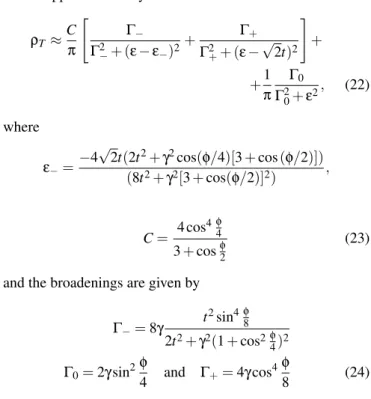
can be approximated by a sum of Lorentzians of the form
ρT≈ C
π "
Γ− Γ2
−+ (ε−ε−)2
+ Γ+
Γ2
++ (ε−
√ 2t)2
# +
+1 π
Γ0 Γ2
0+ε2
, (22)
where
ε−=−4 √
2t(2t2+γ2cos(φ/4)[3+cos(φ/2)]) (8t2+γ2[3+cos(φ/2)]2) ,
C= 4 cos 4φ
4
3+cosφ2 (23)
and the broadenings are given by
Γ−=8γ t 2sin4φ
8 2t2+γ2(1+cos2φ
4)2
Γ0=2γsin2 φ
4 and Γ+=4γcos 4φ
8 (24)
Figure 3 showsρT for the same parameters of Fig.2. In figure Fig.3(a), whereφ=0, the density of states is the su-perposition of two Dirac delta’s localized atε=ε−andε=0 (corresponding to the BIC’s) plus a Lorentzian atε=ε+with width 4γ. Whenφ=2π, as in (d), the density of states corre-spond to that of a triple molecule connected in series.
Figure 4 displays the broadeningsΓ−,Γ0andΓ+as a func-tion ofφ, fort=2, in the range of validity of Eqs. (24).
The top plot shows the BIC formed at the bonding state when φ=0 and the robustness of such a long–lived state against variations of the magnetic field. Notice thatΓ− re-mains smaller than 0.02 in all the range ofφ, and that is very close to zero in a wide interval aroundφ=0. For instance, for φ∈(−π/3,π/3),Γ−keeps smaller than 8×10⁻⁴, that is, less than 0.08 per cent of the level broadening of a single quantum dot. The broadeningΓ0is more sensitive to variations of the magnetic field thanΓ−, as shown in the middle figure.
IV. CONCLUSIONS
We have investigated the electron transport through a parallel–coupled triple quantum dot molecule in presence of a magnetic field. For the studied case, whereV1=V3=V and
V2= √
2V, different regimes of transmission are possible as the magnetic flux is varied; if this is a multiple of 2Φ0two BICs simultaneous are formed, and in a wide range around this value the two resonances keep extremely narrow.
Acknowledgments
The authors would like to thank financial support from FONDECYT under grants 1040385 and 1020269. M. L. L. de G. receives financial support from Milenio ICM P02-049-F and P. A. O. from Milenio ICM P02-054-P02-049-F.
[1] Kicheon Kang and Sam Young Cho, J. Phys: Condens. Matter 16, 117 (2004).
[2] Zhi-Ming Bai, Min-Fong Yang, and Yung-Chung Chen, J. Phys.: Condens. Matter16, 2053 (2004).
[3] Pedro A. Orellana, M. L. Ladr´on de Guevara, and F. Claro Phys. Rev. B70, 233315 (2004).
[4] Guo-Hui Ding, Chul Koo Kim, and Kyun Nahm, Phys. Rev. B, 71205313 (2005).
[5] Haizhou Lu, Rong L¨u, and Bang-fen Zhu, Phys. Rev. B71, 235320 (2005).
[6] M. L. Ladr´on de Guevara, F. Claro, and Pedro A. Orellana, Phys. Rev. B67, 195335 (2003).
[7] J. von Neumann and E. Wigner, Phys. Z. 30, 465 (1929); Frank H. Stillinger and David R. Herrick, Phys. Rev. A11, 446
(1975).
[8] H. Friedrich and D. Wintgen, Phys. Rev. A32, 3231 (1985); S. L. Haan and G. S. Agarwal, Phys. Rev. A35, 4592 (1987); P. R. Levstein, H. M. Pastawskit, J. L. D’Amato, J. Phys.: Condens. Matter,2, 1781 (1990).
[9] J. U. N¨ockel, Phys. Rev. B4615348 (1992); O. Olendski and L. Mikhailovska, Phys. Rev B67, 035310 (2003); F. Guinea and J. A. Verg´es Phys. Rev. B35, 979 (1987); J. L. D’Amato, H. M. Pastawski, and J. F. Weisz, Phys. Rev. B39, 3554 (1989); I. Rotter and F. Sadreev, Phys. Rev. E71, 046204 (2005). [10] Supriyo Datta, “Electronic transport in mesoscopic systems”