Lattice Models of Disorder with Order
Alberto Petri
CNR, Istituto “O.M. Corbino”, via del Fosso del Cavaliere 100, 00133 Roma, Italy
Unit`a INFM, Universit`a La Sapienza, p.le Aldo Moro 2, 00185 Roma, Italy
Received on 17 April, 2003
This paper describes the use of simple lattice models for studying the properties of structurally disordered systems like glasses and granulates. The models considered have crystalline states as ground states, finite connectivity, and are not subject to constrained evolution rules. After a short review of some of these models, the paper discusses how two particularly simple kinds of models, the Potts model and the exclusion models, evolve after a quench at low temperature to glassy states rather than to crystalline states.
I
Introduction
In recent years, there is growing interest in systems com-monly found in disordered structural configurations such as glasses and dense granulates. Clearly different in many respects, these two classes of materials share in common the property of displaying stable states which are very far from what would be expected from equilibrium considera-tions [1, 2]. As a consequence of this property other features emerge, like slow relaxation and response functions.
Models of disorder are generally based on the presence of quenched, ora priori, disorder which takes the system far from ordered configurations. Only recently it has been ob-served that lattice models capable of ordering can also well reproduce many properties of disordered systems. On the other hand glass formers in nature usually have crystalline states as ground states, but this does not prevent them from being frequently found in some glassy state. The situation for a granular system is in general different, insofar as ir-regular grains inhibit the evolution of ordered states. Nev-ertheless even in the case of identical beads it is practically impossible to arrange them into an ordered fashion merely by supplying the energy to them.
The aim of this paper is to briefly review some lattice models employed in the description of the slow dynamics of glasses and dense granular matter, which do not possess any a prioridisorder nor long range interactions. We shall not discuss in detail the models, but just recall some of the main results, addressing the interested reader to the bibliography. More attention will be drawn to some recent observations regarding the condition for the emergence of glassy phases in some models of this kind.
The paper is structured as follows: in Section II ex-clusion models and hard particle models are briefly intro-duced together with their employment in irreversible dy-namics; Section III is devoted to their use in the descrip-tion of dense granular matter and related results; Secdescrip-tion IV describes spin models which have been recently shown to
exhibit glassy states and associated slow dynamics; finally in Sec. V some new ideas are illustrated on when and why glassy states are generated in the place of crystalline states in some lattice models.
II
Exclusion and hard particle
models
Flory [3] modeled the irreversible deposition of dimers on a one-dimensional surface by the random sequential adsorp-tion (RSA) of particles on a lattice. In this model, particles are placed one at time at randomly chosen positions of a lin-ear chain of sites (“hard particles”). Each particle occupies two lattice sites and cannot overlap other particles. Flory was able to show that, despite its stochastic nature, this pro-cess leads, in the limit of an infinite lattice, to a well defined percentage of covering which he computed exactly. Soon after the same model was extended to two-dimensional sys-tems and to a variety of particles, also including desorption and cooperative processes (see [4, 5] for review). The con-tinuous version of RSA is sometimes called the car parking problem.
Diffusivity, which accounts for particle rearrangement and relaxation, was also introduced in RSA models giving rise to the so called RSAD models (see [6, 7]). In addi-tion, multilayer deposition has been investigated [7]. RSAD multilayer models are the base of the most common lattice models for dense granular materials, as will be explained below.
Exclusion models have been extensively investigated in relation to equilibrium phase transitions [8]. There iden-tical particles are randomly deposited or retired from ad -dimensional lattice at a rate determined by the value of a chemical potential; in addition particles can diffuse along the lattice (in accordance with the exclusion rules), allow-ing the system to look for configurations of the maximum density compatible with the imposed value of the chemical potentialµ. When µis taken to infinity the maximum al-lowed density in reached with particles arranged in an or-dered phase. A remarkable result of these models is that they are able to describe both first and second order phase transitions as a function of the space dimensionality and of the number of excluded sites [8]. On the contrary, when the chemical potential in RSAD processes is changed abruptly, diffusion is not always sufficient to drive the system into an ordered phase. When this happens the ordering process is generally very slow, with density evolving algebraically in time.
III
Models for granulars
A process widely investigated in the physics of granular ma-terials is the compaction, that is the decrease of the vol-ume fraction (the ratio between the total volvol-ume of the con-stituent grains and the volume macroscopically occupied by the system) of a spatially limited system, subject to grav-ity, under the action of an external perturbation. The energy supplied by the perturbation (e.g. a mechanical perturbation like tapping or shaking) must be comparable with the vari-ation in potential energy required to rearrange the system structure. The process exhibits rather a rich behaviour with reversible and irreversible cycles as a function of the per-turbation amplitude [9], and logarithmic [10] or stretched exponential laws [11] in the number of tapping.
Lattice models with only the excluded volume constraint have proven to be good models for dense granular systems. They are all essentially based on multilayer sequential de-position [12], and have been so far investigated in 1 + 1
dimensions. The lattice is considered to lay in the vertical position. It is initially prepared by sequentially dropping extended hard particles from the top. Each particle proceeds downwards until it hits the bottom of the lattice or a previ-ously deposited particle. Excluded volume effects prevent the process from generating ordered configurations and an initial state with many defects and low volume fractionρ
is usually obtained. Then an external mechanical perturba-tion is activated by turning on upwards diffusion along the lattice meshes for a finite time (the duration of the tapping) and then allowing only downwards and horizontal diffusion in order to mimic the relaxation process under the effect of the gravity field. By periodically turning upwards diffusiv-ity on and off the effect of multiple tapping cycles can be investigated, modulating their intensity by changing the ra-tio between upwards and downwards-horizontal diffusion.
The so called “Tetris” model introduced by Caglioti et
al. [13] in its original version is based on dimers placed on a lattice with meshes tilted of45◦
and, when tapped, shows a logarithmic increase of the volume fraction, in agree-ment with [9]. More generally, “T” shaped particles have also been considered, showing that the model possesses a thermodynamic-like temperature which is numerically mea-surable through the fluctuation-dissipation relations [14] and which coincides with a configurational pseudo-temperature proposed for granular matter [15]. The latter has also been measured in a system of monodisperse hard spheres on lat-tice [16].
Dimers placed on lattice with non tilted meshes also ex-hibit very well defined scaling laws [17] but with stretched exponential (the so called Kohlrausch-Williams-Watts law) rather than logarithmic compaction:
ρ(t) =ρ∞−∆ρexp(−t/τ0)
β.
(1) A similar behaviour has been found in recent extensive ex-periments [11] and in a generalization of the model which includes friction [18].
IV
Models for glasses
Lattice gas models with constrained dynamics [19] exhibit many of the properties of glass dynamics, such as slow re-laxation, two step rere-laxation, vanishing diffusivity, ageing, etc. Other kinds of models with constrained dynamics have also been introduced and investigated yielding similar re-sults [20-24].
A class of lattice models exhibiting glassy behaviour with neither quenched disorder nor constrained dynamics are the spin models with many spin interaction whose en-ergy can be written as:
E=− X
<i,j,...,k>
sisj. . . sk, (2)
where the sum is extended to a finite number of Ising spins:
si=±1. A single spin flip Monte Carlo algorithm is gener-ally used for numerical simulation of the dynamics. The four spin model [25] exhibits a discontinuous equilibrium transi-tion in three dimensions, but if quenched quickly enough below the transition temperature, it enters a very long living metastable state with many of the features of glassy systems [26, 27]. More recently [28] the existence of a dynamic glass transition has been proved for a three spin model on a Bethe lattice that also has a first order transition to a ferromagnetic phase.
Some kind of glassy states can also be observed in two dimensional exclusion models. It has been found by nu-merical simulations [32] that a monolayer RSAD of parti-cles with the exclusion of the first three shells of neighbours (N3 model) is not able to generate a periodic arrangement. The dynamics leads asymptotically to states in which many locally ordered domains of particles are formed, while at the domain boundaries many sites remain empty. Analo-gous behaviour has been observed in the RSAD of dimers [33, 34], whereas in models with exclusion of only two shells of neighbours (N2model) the density of empty sites vanishes in the thermodynamic limit [35]. In the next sec-tion the properties of these models will be discussed more extensively.
The many spin interaction models, theN3 model and the other models referred to above show that glassy states are generated also in models with no quenched disorder or long range interaction and with stable crystalline states. On the other hand, glass formers in general also have crystalline phases; this point deserves consideration and in the next sec-tion some ideas on the emergence of glassy vs crystalline states in some lattice models are discussed.
V
Emergence of glassy states in
lattice models
In this section some properties are reported that have re-cently emerged [36-39] in the coarsening of the Potts model following a quench and in RSAD dynamics of some exclu-sion models.
In the Potts model [40] each lattice site can stay in one out ofq distinct states, or colours. To each site one asso-ciates a variableηi that takes the values1,2, . . . , q. Let us write the energy of theqstate Potts model as:
U =X
(ij)
(1−δηiηj), (3)
whereηi= 1,2, . . . qand the sum is over the nearest neigh-bour sites. There are q degenerate system ground states with zero energy corresponding to having all sites the same colour.
Starting from an initial disordered configuration a quench of the system can be numerically simulated by let-ting the system evolve according to the Metropolis dynamics [41] at a temperatureT below the temperature at which the model is known to have a phase transition. ForT = 0, large
qand periodic boundary conditions, the dynamics leads the system into some frozen state [42] that represents a local minimum in the energy landscape of the finite system with energy higher than the ground state energy. This is not the case for lowq. In the two-dimensional Ising model, corre-sponding toq = 2, the fraction of blocked configurations tends to zero in the thermodynamic limit.
0.0 2.0 4.0 6.0
log(t)
−3.0 −2.0 −1.0 0.0 1.0
log(E) q=2q=3
q=4 q=5 q=6 q=7
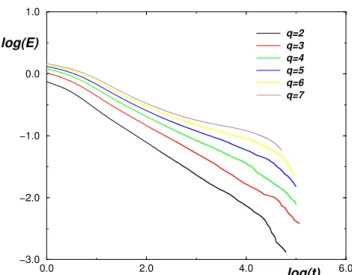
Figure 1. Energy decay in a two dimensional Potts model af-ter a quench atT = 0. For increasingqlarger deviations from
t∝1/p(t)are displayed.
A first important consideration concerns such a different behaviour exhibited for different values ofq. Fig. 1 shows the decrease in time of the energy per site,E =U/N, in a system withN= 106sites for some different values ofq af-ter a quench atT = 0. In this case fixed boundary conditions have been used, that is a prefixed colour has been assigned at the beginning to the sites at the system boundary, and can-not change during the simulation. This breaks the symmetry among the different ground states and makes the system con-verge to the preselected ground state. Since it is expected to follow an algebraic decay of the typeE(t)∝t−α
[42, 43], the curves have been plotted on a double logarithmic scale. The figure shows that the lines, which are straight forq= 2
andq = 3, decrease their slope and develop a bump as q
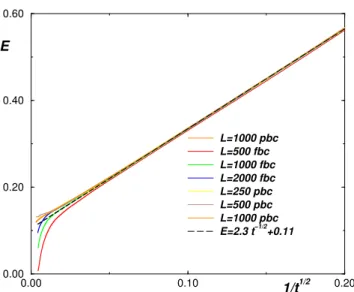
increases. This suggests at first sight a deviation from the algebraic behaviour. However if the same curves are plot-ted as functions of1/√ta linear behavior is observed for all times up to the final relaxation for every value ofq, showing that the energy decrease in this regime is correctly described by
E(t)∝t−1/2
+const (4)
as shown in Fig. 2 for the caseq= 7. It is the constant term, which depends onq, that accounts for the bump and bending observed in log-log scale. After the1/√tregime the system performs a fast relaxation towards the prefixed ground state. The second important point is that the time at which the final relaxation occurs increases with lattice sizeN. The same happens for the freezing when periodic boundary con-ditions are used, but in this case fluctuations of the final en-ergy from sample to sample are larger. Extrapolation of the energy curves leads to conclude that in the thermodynamic limit:
lim
t→∞E(t) =E ∗
(q). (5)
It can be useful to point out that here the thermodynamic limit is taken before the infinite time limit. This is the rea-son for which the thermodynamical equilibrium state with
0.00 0.10 0.20
1/t1/2
0.00 0.20 0.40 0.60
E
L=1000 pbc L=500 fbc L=1000 fbc L=2000 fbc L=250 pbc L=500 pbc L=1000 pbc E=2.3 t−1/2+0.11
Figure 2. E(t) vs1/√tfor the Potts model withq= 7and differ-ent size and boundary conditions:fbc= fixed boundary conditions;
pbc= periodic boundary conditions. A common regime is shown whose duration increases with the system size.
The residual energy term (5) is due to interfaces sepa-rating homogeneous domains with different values ofqthat do not disappear whent→ ∞. Moreover, since forqlarge enough this term does not vanish whenN → ∞, it can be concluded that the total length of the interfaces is of order
N. This property can be used to define the glassy state in this kind of model, and is observed for any q > 4. For
q < 4 the residual energy vanishes in the thermodynamic limit, showing absence of interfaces (crystalline state for
q = 2) or at most a total length of order √N (polycrys-talline state forq= 3). The caseq= 4is critical insofar as relaxation is not1/√t; by including a logarithmic correction
E(t)∝√lnt/t+E∗
it is compatible withE∗
= 0.
0 5 10 15 q 20 0.0
0.1 0.2 0.3
E*
Figure 3. Residual energies in the Potts model after a quench at
T = 0as a function of the number of statesq.
Simulations demonstrate that the residual energyE∗
(q)
is a monotonic function ofq. This is shown for some val-ues of qin Fig. 3 together with the fitting curveE∗
(q) = (q−qc)0.5 for q
≥ qc = 4. This suggests a relationship between a non zero residual energy and the discontinuous transition in the equilibrium phase diagram of the model
dis-played whenq >4. Such a conjecture is made stronger by the observation of an analogous behaviour in the case of ex-clusion models. They are predicted to belong to the same universality class as the Potts model [44], with a correspon-dence between the numberpof excluded sites per particle andq. In theN1 modelp= 2, whereasp= 4andp= 5 in theN2andN3models respectively. In these systems the density of deposited particles plays a role similar to that of energy in the Potts model; in fact one can associate an en-ergy to the density by means of the chemical potentialµ. In particular, the density is maximum, and the energy is minimum, in the state with the closest allowed packing of particles, corresponding to a periodic arrangement (ground state). Any deviation from this value signals the presence of residual empty sites (defects). By assumingE = 0for the state with the closest packing, an energyE = µρd corre-sponds to a density of defectsρd. The equilibrium diagrams of these systems exhibit continuous transition forp= 2and
p = 4and discontinuous transition forp = 5[8, 45, 44]. Thus zero density of defects is expected forp = 2 (crys-talline states), a vanishing one forp= 3,4(polycrystalline states) and glassy states with a number of defectsO(N)for
p = 5. This has indeed been observed [32, 35, 37] and has been confirmed by further numerical simulations to be largely independent on the chosen parameters [38, 39]. On a triangular latticeN1shows an equilibrium first order transi-tion, whereas the transition is discontinuous for theN1and theN2models. Numerical simulations confirm the predic-tion of crystalline states forN1but are not yet conclusive for
N2andN3[38]. It can be interesting to mention that a kind of polycrystalline state, in the sense defined above, has also been observed in the quench of the three-dimensional Ising model [46].
VI
Summary
The work done in recent years has shown that lattice models with crystalline states and finite connectivity are capable of reproducing many properties of structurally disordered sys-tems like granulates and glasses. This is of relevance for the understanding of the underlying mechanisms, also in view of similar behaviours exhibited by other kinds of models whose features can however be traced back to different ori-gin [47].
transi-tion which is generallly also a feature of the other models described in this paper.
Many thanks are due to T. Tom´e and M. J. de Oliveira, with whom most of the work described in Sec. V has been developed, and to F. Dalton for revising the manuscript.
References
[1] P. G. Debenedetti and F. H. Stillinger, Nature 410, 259 (2001).
[2] H.M. Jaeger, S.R. Nagel and R.P Behringer, Rev. Mod. Phys.68, 1259 (1996).
[3] P.J. Flory, J. Am. Chem. Soc.611528 (1939). [4] J. W. Evans, Rev. Mod. Phys.65, 1281 (1993).
[5] J. W. Evans, inNonequilibrium Satistical Mechanics in One Dimension, edited by V. Privman (Cambridge University Press, Cambridge, 1997), p. 205.
[6] M. C. Bartelt and V. Privman, J. Mod. Phys.B5, 2883 (1991). [7] P. Nielaba, inNonequilibrium Satistical Mechanics in One Dimension, edited by V. Privman (Cambridge University Press, Cambridge, 1997), p. 229.
[8] L. K. Runnels, inPhase Transitions and Critical Phenomena, edited by C. Domb and M. S. Green, Vol. 2, (Academic Press, London, 1972), p. 305.
[9] E. R. Nowak, J. B. Knight, E. Ben-Naim, H. M. Jeaeger and S. R. Nagel, Phys, Rev. E57, 1971 (1998).
[10] J. B. Knight, C. G. Fandrich, C. N. Lau, H. M. Jeaeger and S. R. Nagel, Phys, Rev. E51, 3957 (1995).
[11] P. Philippe and D. Bideau, Europhys. Lett.60, 677 (2002). [12] M. J. de Oliveira and A. Petri, J. Phys. A31, L425 (1998). [13] E. Caglioti, V. Loreto, H. J. Herrmann and M. Nicodemi,
Phys. Rev. Lett.79, 1575 (1997).
[14] A. Barrat, V. Colizza and V. Loreto, Phys. Rev. E66, 111310 (2002).
[15] S. F. Edwards inGranular Matter: An Interdisciplinary Ap-proach edited by A. Mehta, (Springer, New York, 1994), p.121.
[16] A. Fierro, M. Nicodemi and A. Coniiglio, Europhys. Lett.59, 642 (2002).
[17] C. Fusco, P. Gallo, A. Petri and M. Rovere, Phys. Rev. E65, 26127 (2002).
[18] C. Fusco, A. Fasolino, P. Gallo, A. Petri and M. Rovere, Phys. Rev. E66, 31301 (2002).
[19] W. Kob and H. C. Andersen, Phys. Rev. E48, 4364 (1993). [20] L. Peliti and M. Sellitto, J. Phys. IV (France)8, 49 (1998). [21] G. H. Fredrickson and H. C. Andersen, Phys. Rev. Lett.53,
1244 (1984).
[22] M.E.J. Newman and C. Moore, Phys. Rev. E60, 5068 (1999). [23] A. Buhot and J. P. Garrahan Phys. Rev. E64, 021505 (2001)
and references therein.
[24] L. Davison, D. Sherrington, J. P. Garrahan and A. Buhot, J. Phys. A34, 5147 (2001).
[25] A. Lipowski, J. Phys. A30, 7365 (1997).
[26] A. Lipowski and D. Johnston, J. Phys. A33, 4451 (2000). [27] M. R. Swift, H. Bokil, R. D. M. Travasso and A. J. Bray,
Phys. Rev. B62, 11494 (2000).
[28] S. Franz, M. Mezard, F. Ricci-Tersenghi, M. Weigt, R. Zecchina, Europhys. Lett.55, 465 (2001).
[29] G. Biroli and M. Mezard, Phys. Rev. Lett.88, 025501 (2002). [30] M. Weigt, A. K. Hartmann, cond-mat/0210054.
[31] M. Pica Ciamarra, M. Tarzia, A. de Candia and A. Coniglio cond-mat/0210144.
[32] E. Eisenberg and A. Baram, J. Phys. A33, 1729 (2000). [33] S. A. Grigera, T. S. Grigera and J. R. Grigera, Phys. Lett. A
226, 124 (1997).
[34] C. Fusco, P. Gallo, A. Petri and M. Rovere, J. Chem. Phys.
114, 7563 (2001).
[35] E. Eisenberg and A. Baram, Europhys. Lett.44, 168 (1998). [36] M. J. de Oliveira and A. Petri, Phil. Mag. B82, 617 (2002). [37] J. S. Wang, P. Nielaba and V. Privman, Physica A199, 527
(1993).
[38] M. J. de Oliveira, A. Petri and T. Tom´e, inModeling of Com-plex Systems: Seventh Granada Lecturesedited by P. L. Gar-rido and J. Marro, (American Institute of Physics, 2003), p. 139.
[39] M. J. de Oliveira, A. Petri and T. Tom´e, submitted for publi-cation.
[40] F. Y. Wu, Rev. Mod. Phys.54, 235 (1982).
[41] N. Metropolis, A. W. Rosenbluth, M. N. Rosenbluth, A. H. Teller and E. Teller, J. Chem. Phys.21, 1087 (1953). [42] M. P. Anderson, G. S. Grest and D. J. Srolovitz, Phil. Mag. B
59, 293 (1989),
[43] B. Derrida, P. M. C. de Oliveira and D. Stauffer, Physica A
224, 604 (1996).
[44] E. Domany, M. Schick and J. S. Walker, Phys. Rev. Lett.38, 1148 (1977).
[45] J. Orban, J. D. Van Belle, J. Phys. A15, L501 (1982). [46] V. Spirin, P. L. Krapivsky, and S. Redner, Phys. Rev. E65,
016119 (2002).