Article
J. Braz. Chem. Soc., Vol. 24, No. 5, 865-872, 2013. Printed in Brazil - ©2013 Sociedade Brasileira de Química 0103 - 5053 $6.00+0.00
A
*e-mail: [email protected]
Removal of Mercury, Antimony, Cadmium and Lead from Aqueous Solution using
1,3,5-Trithiane as an Adsorbent
Özgen Ercan*,a and Adnan Aydınb
aTUBITAK Marmara Research Center, Environment Institute, 41470 Kocaeli, Turkey
bChemistry Department, Faculty of Art and Science, Marmara University, 34722 Istanbul, Turkey
Neste trabalho, utilizou-se 1,3,5-tritiano (TT) na remoção dos íons Hg(II), Sb(III), Cd(II) e Pb(II) em soluções aquosas. A influência das condições de remoção tais como pH, tempo de contato e concentração inicial de TT na capacidade de ligação dos íons foi testada. As capacidades de adsorção máxima para os íons Hg(II), Sb(III), Cd(II) e Pb(II) foram 35,5 ± 0,6, 16,9 ± 0,4, 12,1 ± 0,1 e 9,5 ± 0,1 mg g-1 em pH 5,0, respectivamente. A seletividade do tritiano para os íons
foi determinada como tendo a seguinte ordem decrescente: Hg(II) > Sb(III) > Cd(II) > Pb(II). Os modelos de isotermas de adsorção foram aplicados aos dados experimentais, e o de Langmuir apresentou-se como sendo o melhor ajuste para a adsorção dos íons Hg(II) em TT. Os íons dos metais tóxicos podem ser efetivamente dessorvidos por lixiviação ácida e o tritiano regenerado por pelo menos cinco vezes sem qualquer perda na capacidade de adsorção.
In this work, 1,3,5-trithiane (TT) was used for removal of Hg(II), Sb(III), Cd(II) and Pb(II) ions from aqueous solutions. The influence of the uptake conditions such as pH, contact time and initial TT feed concentration on the ion binding capacity of TT was tested. Maximum adsorption capacities for Hg(II), Sb(III), Cd(II) and Pb(II) were 35.5 ± 0.6, 16.9 ± 0.4, 12.1 ± 0.1 and 9.5 ± 0.1 mg g-1 at pH 5.0, respectively. Selectivity of TT for the ions was determined as having
the following decreasing order: Hg(II) > Sb(III) > Cd(II) > Pb(II). Adsorption isotherm models were applied to the experimental data, and the Langmuir model presented as the best fit for the adsorption of Hg(II) ions on TT. Adsorbed toxic metal ions can be effectively desorbed by acid leaching and the regenerated TT can be reused at least five times without any significant loss in adsorption capacity.
Keywords:adsorption, 1,3,5-trithiane, metal-preconcentration, Langmuir model
Introduction
As a result of industrialization and urbanization, the presence of metal ions in water streams has been increased in the past five decades. The metals are released into the environment by coal combustion, sewage wastewaters, automobile emissions, battery industry, mining activities, tanneries, alloy industries and the utilization of fossile fuels. The metal ions are prioritized among all pollutants due to
their toxicity and mobility in natural water ecosystem.1-4
Solvent extraction, ion exchange, chemical precipitation, membrane filtration (reverse osmosis, nanofiltration, etc.), coagulation, photoreduction and adsorption are commonly
used methods for removal of metal ions.5-8 However, most
of these techniques have some disadvantages such as
complicated treatment process, high cost and energy use. Although the main disadvantage is the high price of the adsorbents, the adsorption is the most preferred technique due to its high efficiency, easy handling and availability of different adsorbents. Some adsorbents such as active
carbon,9,10 alumina,11 ferric oxides,12 fly ash,13,14 lignite,15
phosphate rock16 and kaolinite-based clays17 are preferably
used in wastewater treatment due to their large specific
surface areas and high metal adsorption capacities.18,19
The adsorbent containing one or more electron donor atoms such as N, S, O and P can form coordinate bonds
with most of the toxic metals.20,21 Superior reactivity of
the sulfur compounds toward some metal ions is the key
principle for using thiol anchor groups.22 Other sulfur
containing polymer-supported ligands such as xanthate,23
thiourea,24 pyridine-based thiols and dithiozone25 are also
In this work, the use of 1,3,5-trithiane (TT) containing S electron donor atom for removal of the toxic metals such as
Hg(II), Sb(III), Cd(II) and Pb(II) is presented. TT (CH2S)3
is the cyclic trimer of the otherwise unstable species thioformaldehyde, showing insolubility in water, low molecular weight, flexible structure and the presence of three donating sulfur atoms. It consists of a six-membered ring with alternating methylene and thioether groups. Cyclic thioethers are important ligands for the complexation of toxic metal ions. Extraction by means of complexation to thioethers may have important medicinal perspectives
for treating toxic metal poisoning.26 It is also used in the
determination of Ce(III) and preparation of poly(methyl
methacrylate) polymer with low polydispersity.27,28
The adsorption kinetics and the adsorption capacity of the metals along with the effect of pH on the adsorption were investigated in this study. Reusability under competitive and non-competitive conditions was also examined. Langmuir and Freundlich adsorption isotherms were determined and the mechanism for the formation of metal-TT was discussed. The preconcentration factor, limits of detection (LOD) and of quantification (LOQ) and relative uncertainty values were calculated. The adsorption isotherm models determined were used to validate the experimental data.
Experimental
Materials
1,3,5-Trithiane was obtained from Sigma-Aldrich and used as adsorbent. All water used in the experiments was purified using Milli Q-Water purification system (Millipore).
1000 mg L-1 Hg(II), Sb(III), Cd(II) and Pb(II) standard
solutions and all other chemicals were of reagent-grade and purchased from Merck. All metal analyses were measured by using Analytik Jena AG ZEEnit 700 AAS atomic absorption spectrometer. An acetate buffer solution was prepared from acetic acid and sodium acetate. Nitric acid was used as a desorption agent in the desorption study. For the evaluation of the measurement precision and accuracy, SPS-WW1 Batch 110 wastewater reference material was used. Working standard solutions were prepared fresh from these stock solutions on a daily basis. The resulting purified water (deionized water) has a specific conductivity
of 18.2 mΩ cm.
Single-component toxic metal adsorption studies
The adsorption properties of TT for metal ions Hg(II), Sb(III), Cd(II) and Pb(II) were investigated in the batch experiments. To find optimum pH for maximum adsorption,
0.1 g TT samples were immersed in 50 mg L-1 ionic
solutions at room temperature for 24 h. The pH of the initial solutions was adjusted with HCl and NaOH to cover range of 2.0 to 6.0.
The effects of initial toxic metal ion concentration and of the adsorption capacity were also examined. 0.1 g TT samples were contacted with different concentration of
metal ion solutions (1-1000 mg L-1) in acetate buffer at
pH 5.0. The sample solutions were stirred magnetically at 200 rpm at room temperature. The solutions were then centrifuged, and filtered through a Millipore filter of pore size of 0.45 µm. The toxic metal concentrations were determined by atomic absorption spectroscopy. Each value reported in this work is an average of at least three separate
measurements. Metal ion concentrations adsorbed per unit
mass of TT (mg metal ion g-1 dry TT) were calculated by
using the following expression:
(1)
where Co and C are the concentrations of the metal ions
in the aqueous phase before and after the adsorption,
respectively, (mg L-1), V is the volume of the aqueous phase
(mL) and m is the amount of dry TT used (g).
Adsorption kinetics
The adsorbent dosage was 0.25 mg and the initial toxic
metal concentrations (C0) were 500 mg L
-1 for Hg(II), and
600 mg L-1 for Sb(III), Cd(II) and Pb(II). To determine the
effect of contact time, TTs were immersed into 10 mL of the solution containing a metal ion concentration at pH 5.0 for several time periods up to 8 h. Samples were taken out from the adsorption medium periodically and metal ion concentrations were measured by AAS, after samples were filtered through a Millipore filter.
Multi-component toxic metal adsorption
Adsorption of the toxic metal ions from synthetic wastewaters and reference material (SPS-WW1 Batch 110) was carried out in a batch system. To determine possible interferences on the toxic-metal uptake originating from foreign ions, two different synthetic wastewater solutions (called as A-representing some cation effect, and B-representing some cation, anion and organic effect, from this point on) were prepared using NaAc-AcOH buffer solution (pH 5.0). The concentration of metal ions in the synthetic wastewater solution A was as follows:
Sn(II) and Ag(I), and 500 mg L-1 Hg(II), 600 mg L-1 Sb(III),
600 mg L-1 Cd(II) and 600 mg L-1 Pb(II). In order to adjust
salinity, 700 mg L-1 NaCl was added to the composition
of A.29 The concentration of metal ions in synthetic
wastewater solution B is as follows: 0.5 mg L-1 MnCl 2•4H2O,
83.6 mg L-1 MgCl
2•6H2O, 20.6 mg L-1 (NH4)2SO4, 83 mg L-1
NH4Cl, 66.6 mg L-1 (NH4)2CO3, 133.7 mg L-1 Na2CO3,
49.9 mg L-1 CaCO
3, 3.1 mg L-1 FeCl3•6H2O, 74.7 mg L-1
KH2PO4, 21.4 mg L-1 urea, 277 mg L-1 glucose and
500 mg L-1 Hg(II), 600 mg L-1 Sb(III), 600 mg L-1 Cd(II) and
600 mg L-1 Pb(II).30 SPS-WW1 Batch 110 reference
wastewater solution (called SPS from this point on) was also used to check for the additional effect of foreign ions on the adsorption. The concentration of metal ions in SPS is 2000 µg L-1 Al, 100 µg L-1 As, 20 µg L-1 Cd, 60 µg L-1 Co,
200 µg L-1 Cr, 400 µg L-1 Cu, 1000 µg L-1 Fe, 400 µg L-1 Mn,
1000 µg L-1 Ni, 1000 µg L-1 P, 100 µg L-1 Pb, 100 µg L-1 V,
600 µg L-1 Zn and 500 mg L-1 Hg(II), 600 mg L-1 Sb(III),
600 mg L-1 Cd(II) and 600 mg L-1 Pb(II). 0.25 g of TT
sample was transferred into 25 mL of each wastewater solution A, B and SPS, then, they were stirred and incubated at room temperature (pH 5.0). After adsorption, the concentration of the metal ions in the remaining solution was determined by AAS as described above.
Adsorption isotherms of metals
The adsorption isotherms of toxic metals on TT were studied using batch tests at room temperature and a pH value of 5.0. The adsorbent dosage was 0.25 mg and the initial toxic metal concentrations ranged from 1 to 1000 mg L-1.
Metal adsorption-desorption studies
The toxic metals adsorbed on TT can be eluted repeatedly by treating with 0.1 mol L-1 HNO
3 to obtain
metal-free TT. Thus, flask containing toxic metal-loaded
TT sample (0.25 g) and 25 mL of 0.1 mol L-1 HNO
3
were put into a constant temperature bath oscillating at 200 rpm, at room temperature for 1 h. The solutions were then centrifuged and filtered through a Millipore filter (pore size 0.45 µm). The toxic metal concentrations were measured by AAS. The desorption ratio was calculated by the following equation:
(2)
Used TT was then neutralized with dilute NaOH, washed with deionized water and subjected again to
adsorption processes to determine its reusability. This adsorption-desorption cycle was repeated five times by using the same TT.
Preconcentration factor
Hg(II), Sb(II), Cd(II) and Pb(II) ion solutions were used for the preconcentration of the metal ions on TT. In order to investigate the adsorption efficiency of TT, enriched Hg(II), Sb(III), Cd(II) and Pb(II) ion solutions were
prepared with various concentrations (1-0.1 mg L-1) and
volumes (50-500 mL), and 0.1 g TTs was immersed in the solutions and stirred at room temperature for 24 h at 200 rpm. Then, TTs were separated from the adsorption medium and transferred into a flask containing 5 mL
of 0.1 mol L-1 HNO
3 solution and stirred at 200 rpm at
room temperature for 24 h. After, the concentrations of the desorption solutions were measured by AAS, the preconcentration factor was calculated by the ratio of the highest sample volume and the desorption agent volume (5 mL). Each value reported is an average of at least three separate measurements.
Results and Discussion
Effect of pH
The toxic metal adsorption on both non-specific and specific adsorbents is pH dependent. In the absence of complexing agents, the hydrolysis and precipitation of the metal ion are affected by the concentration and form of soluble metal species. In addition to using a specific ligand, selective adsorption could be achieved by adjusting the pH of the medium. In this study, the effect of pH on metal uptake capacity of TT was examined at different pH values ranging from 2.0 to 6.0 for Hg(II), Sb(III), Cd(II) and Pb(II) ions.
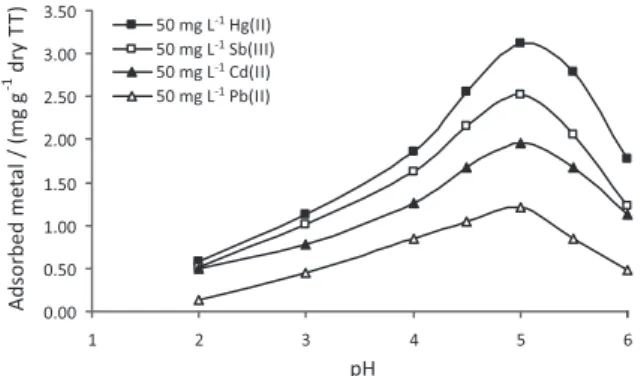
As seen in Figure 1, the metal ion adsorption capacity between pH 4.5-5.0 increased extremely and then decreased very dramatically at pH higher than 5.0. This may be attributed to the presence of free lone pair of electron on sulfur atom (or deprotonation of –SH group) suitable for coordination with the metal ion to give the corresponding resin-metal complex. At low pH, the
surface of the adsorbent is surrounded by H+ ions, which
prevent the metal ions from approaching the adsorptive sites of the adsorbent. However, with the increasing pH
value, the competitive adsorption of H+ ions decreases and
the TT surface becomes more negatively charged. Thus, the positively charged metal ions can be readily adsorbed
maximum adsorption values of the metal ions are obtained at pH 5.0 for Hg(II), Sb(III), Cd(II) and Pb(II). This is assumed to be optimal since these metals precipitate as metal hydroxides at pH values of 5.5 to 10.0. The pK values are 25.4 for Hg(OH)2, 49.1 for Sb(OH)3, 13.6 for
Cd(OH)2 and 16.1 for Pb(OH)2.33
The adsorption capacities of TT at the optimum pH are 3.12 mg g-1 for 50 mg L-1 Hg(II), 2.52 mg g-1 for 50 mg L-1
Sb(III), 1.95 mg g-1 for 50 mg L-1 Cd(II) and 1.21 mg g-1
for Pb(II) ion solution. The increasing order of affinity of the metal ions at initial concentration of 50 mg L-1 is found
as Hg(II) > Sb(III) > Cd(II) > Pb(II).
Initial metal ion concentration effect
The dependence of adsorption capacity of TT on the initial concentrations of metal ions was determined by equilibrating the fixed amount of TT with the metal ion solutions by gradually increasing their concentration. Adsorption capability of TT for Hg(II), Sb(III), Cd(II) and Pb(II) ions using solution concentrations varying from 1 to 1000 mg L-1 is given in Figure 2. All measurements were
performed at optimum pH 5.0. The metal uptake increases
rapidly with the increasing initial metal ion concentration (Figure 2). After reaching a maximum at 500 mg L-1 for
Hg(II), 600 mg L-1 for Sb(III), 600 mg L-1 for Cd(II) and
600 mg L-1 for Pb(II), the metal uptake levels off. From
these plateau values, the maximum load capacities are estimated as 35.5 ± 0.6, 16.9 ± 0.4, 12.1 ± 0.1 and 9.5 ± 0.1 mg g-1 dry TT for Hg(II), Sb(III), Cd(II) and
Pb(II) ion, respectively, indicating that the removal of such metals from wastewater by using TT may find potential applications in industry.
Adsorption isotherms
Adsorption isotherms are important for the description of molecules or ions of adsorbate interaction with adsorbent surface sites and also, are critical in optimizing the use of adsorbent. When an adsorbent is in contact with the surrounding solution with a certain composition, both the adsorbent and the surrounding fluid reach equilibrium after a sufficiently long time. The correlation of equilibrium data is necessary for the practical design and operation
of adsorption systems.34 Langmuir and Freundlich
adsorption models were fitted to the data obtained from the adsorption isotherm. The Langmuir equation was originally developed to describe individual chemical adsorbents, and is applicable to physical adsorption (monolayer) within a low concentration range. The Freundlich equation is an empirical approach for adsorbents with very uneven adsorbing surfaces. The Freundlich model is applicable for adsorption of a single solute system within a fixed range of
concentration.35 The equations of the above two types of
sorption isotherms are expressed as follows:
(3)
(4)
where qe is equilibrium uptake capacity of TT, Ce is
the concentration of metal ions in the supernatant after
sorption, n and KFare empirical constants, Qm and kL are
Langmuir constants related to the capacity and energy of the adsorption, respectively. In order to investigate the effect of the initial metal ion concentration on the adsorption capacity of TT, the experiments were carried out from
1 to 1000 mg L-1 concentrations at room temperature for
24 h. The adsorptions of metal ions from aqueous solution by TT are presented in Figures 3 and 4, and the constants of adsorption isotherms are summarized in Table 1. The Langmuir equation fits well for metal ion adsorption on TT (Table 1).
Figure 1. Effect of pH on the metal uptake capacity of TT. Conditions:
50 mg L-1 Hg(II), 50 mg L-1 Sb(III), 50 mg L-1 Cd(II) and 50 mg L-1 Pb(II).
Figure 2. Effect of the initial metal ion concentration on the metal uptake capacity of TT Conditions: 1-1000 mg L-1 Hg(II), 1-1000 mg L-1 Sb(III),
Adsorption kinetic studies
The equilibration time is an important parameter for economical wastewater treatment plant applications. For the feasible removal, recovery and pre-concentration of the metal ions from different sources, the adsorption time should be short enough for the time consuming in the experiments in the laboratories and for the industrial applications. Therefore, adsorption kinetics of the toxic metal ions onto TT were examined at 500 mg L-1 for
Hg(II) and 600 mg L-1 for Sb(III), Cd(II), Pb(II) metal
ion solutions with the time at pH 5.0 and the results are given in Figure 5. It can be seen that, the adsorption of Sb(III), Cd(II) and Pb(II) sharply increased as a function of time up to 60 min at initial 600 mg L-1 and kept slow
increase thereafter. The rate of adsorption of Hg(II) on TT was more rapid than the others. The maximum binding of
Hg (II) ion occured about 35.5 mg g-1 within 45 min and
reached equilibrium after 60 min. These results suggest that adsorption time onto TT is really short and feasible for the metal ion adsorption processes.
Multi-component toxic metal chelation
It is hoped that in the presence of different metal ions, one metal ion could be selectively adsorbed by a chelating agent. Adsorption capacity of a ligand toward the different metal ions, effect of pH of the feed metal solutions and adsorption equilibrium time are important factors over the selectivity properties of ligands in competitive adsorption.36,37 To investigate such items, chelating of
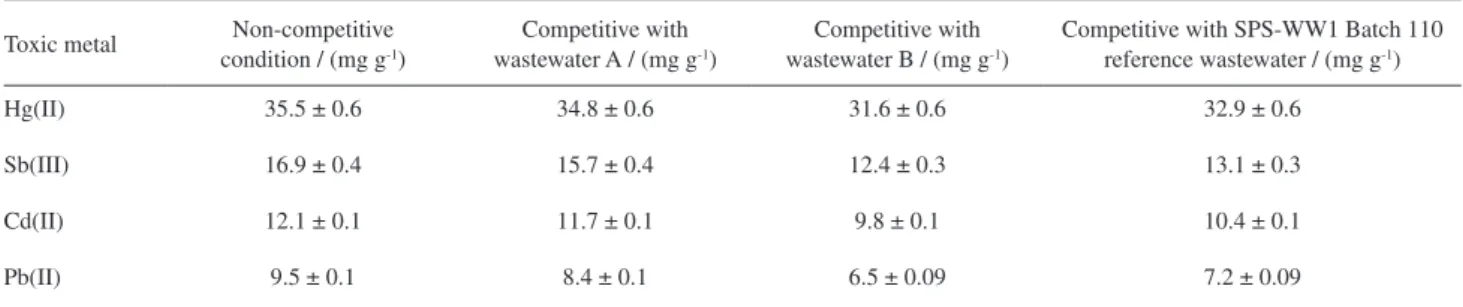
toxic metals from synthetic and reference wastewater were carried out in a batch system. The averages of three measurements are provided in Table 2 for each metal. The results show that the binding capacities of all ions were decreased under the competitive conditions. The competitive adsorption of metal ions was found to be Hg(II) > Sb(III) > Cd(II) > Pb(II) for TT as adsorbent.
Desorption and repeated use
The adsorption and desorption processes were repeated to examine the potential toxic metal uptake of TT for practical applications. The desorption behavior of TT was studied with acidic solutions, and the results are summarized Figure 4. Freundlich isotherm plots for the adsorption of Hg(II), Sb(III),
Cd(II) and Pb(II) ions on TT.
Figure 3. Langmuir isotherm plots for the adsorption of Hg(II), Sb(III),
Cd(II) and Pb(II) ions on TT.
Table 1. Equations of adsorption isotherms of TT
Adsorbed metal ion
Freundlich Langmuir
Model R2 Model R2 Q
m kL
Hg(II) lnqe = 0.660lnCe – 0.161 0.917 Ce/qe = 0.027Ce + 0.777 0.997 37.03 0.035
Sb(III) lnqe = 0.501lnCe – 0.379 0.948 Ce/qe = 0.054 Ce + 2.970 0.991 18.52 0.018
Cd(II) lnqe = 0.484lnCe – 0.673 0.964 Ce/qe = 0.077 Ce + 5.373 0.990 12.99 0.014
Pb(II) lnqe = 0.560lnCe – 1.433 0.945 Ce/qe = 0.085 Ce + 15.32 0.981 11.76 0.006
Qm and kL: Langmuir constants related to the capacity and energy of the adsorption, respectively. R
2: correlation coefficient.
Figure 5. Effect of contact time on the toxic metal adsorption on TT.
in Table 3. In this experiment, TT was completely saturated with the metal ions at the optimum pH, initial metal ion concentration and contact time. Then, the adsorbed metal ions were desorbed by using 0.1 mol L-1 HNO
3. In order
to obtain the reusability of TT, the adsorption-desorption cycles were repeated at least 5 times by using the same TT for determination of adsorption capacity. Table 3 represents the regeneration procedure by treatment with 0.1 mol L-1
HNO3 solution, and the desorption efficiency was generally
high and TT could be used five times due to the slight loss of their adsorption capacities.
The enrichment factor was studied by a recommended procedure using an increasing volume of metal ion solution. Contact time of 60 min and pH value of 5.0 for all metals were used in this part. The total amount of loaded metal ions were kept constant at 10 mg L-1 concentration level
for Hg(II), Sb(III), Cd(II) and Pb(II). The preconcentration factors were calculated from experimental results. As can be seen in Table 4, the results demonstrated that the recoveries were quantitative (≥ 93) up to 250 mL initial volume for Hg(II) and Cd(II), except Sb(III) and Pb(II). The recoveries changed between 90.1 and 94.2% for Sb(III), 89.7 and 94.7% for Pb(II) at different spike levels. The recoveries decreased with the increase of the initial sample volume. Preconcentration factors of TT were found as 50 for Hg(II) and Cd(II). It was found to be 20 for Sb(III) and Pb(II).
Limits of detection, quantification and relative uncertainty
Standard solutions of toxic metals were prepared at seven different concentration levels for Hg(II), Sb(III), Pb(II) (0.50, 1.00, 1.50, 2.00, 2.50, 3.00 and 5.00 mg L-1) and for
Cd(II) (0.05, 0.10, 0.20, 0.40, 0.60, 0.80 and 1.0 mg L-1).
LOD and LOQ values were calculated using the standard deviation values of the replicate measurements of the lowest concentration in the linear calibration plot (n = 13). The relative standard deviations (RSD) and relative uncertainty values for the toxic metals were also calculated using uncertainty factors such as volumetric flask, pipets and standard solutions. LOD was calculated by the following equation:
(5)
where, Sd is standard deviation of solutions and m is the
slope. LOD, LOQ and relative uncertainty values were summarized in Table 5.
Comparison with other methods
A comparison of the proposed systems with other systems is given in Table 6. Some parameters obtained were comparable to those presented by other methods described in the literature. As seen from the data in Table 6, the
Table 3. The results of adsorption and desorption capacities of TT
Cycle
Hg(II) Sb(III) Cd(II) Pb(II)
Adsorption / (mg g-1)
Desorption / %
Adsorption / (mg g-1)
Desorption / %
Adsorption / (mg g-1)
Desorption / %
Adsorption / (mg g-1)
Desorption / %
1 35.5 97.2 16.9 94.5 12.1 93.7 9.5 94.7
2 35.1 96.8 15.4 93.1 11.8 93.1 8.8 94.2
3 34.8 96.2 14.7 92.4 11.4 92.5 8.3 93.6
4 34.4 95.7 14.1 91.2 10.9 92.2 7.8 93.1
5 33.9 95.1 13.2 90.5 10.3 91.7 7.4 92.6
Table 2. Adsorption amount of toxic metals under competitive conditions
Toxic metal Non-competitive condition / (mg g-1)
Competitive with wastewater A / (mg g-1)
Competitive with wastewater B / (mg g-1)
Competitive with SPS-WW1 Batch 110 reference wastewater / (mg g-1)
Hg(II) 35.5 ± 0.6 34.8 ± 0.6 31.6 ± 0.6 32.9 ± 0.6
Sb(III) 16.9 ± 0.4 15.7 ± 0.4 12.4 ± 0.3 13.1 ± 0.3
Cd(II) 12.1 ± 0.1 11.7 ± 0.1 9.8 ± 0.1 10.4 ± 0.1
proposed method by using TT system has relatively high adsorption capacities and high pH values in comparison with other methods.
Conclusions
In this study, toxic metal ion binding properties of TT were investigated. Toxic metal ion adsorption capacity and
adsorption time onto TT were found to be very suitable for the removal, recovery and preconcentration of the metal ions. The adsorption studies showed that pH, contact time and initial metal ion concentration are the basic parameters affecting the maximum metal uptake capacity of TT. The effects of pH, time and initial metal ion concentration were investigated. The optimum conditions obtained for studied toxic metal ions were: pH value = 5.0, contact time = 45
Table 4. The recovery results and enrichment factors (ER) of the toxic metals with TT
Toxic metal Spike / (mg L-1) Initial volume / mL Enrichment factor Found / (mg L-1) Recovery / %a,b
Hg(II) 1.0 50 10 (9.71 ± 0.17) 97.1 0.5 100 20 (9.70 ± 0.17) 97.0 0.2 250 50 (9.68 ± 0.17) 96.8 0.1 500 100 (9.24 ± 0.16) 92.4 Sb(III) 1.0 50 10 (9.42 ± 0.21) 94.2 0.5 100 20 (9.11 ± 0.21) 93.7 0.2 250 50 (9.07 ± 0.20) 90.7 0.1 500 100 (9.01 ± 0.20) 90.1 Cd(II) 1.0 50 10 (9.38 ± 0.11) 93.8 0.5 100 20 (9.34 ± 0.10) 93.4 0.2 250 50 (9.32 ± 0.10) 93.2 0.1 500 100 (8.91 ± 0.10) 89.1 Pb(II) 1.0 50 10 (9.47 ± 0.13) 94.7 0.5 100 20 (9.14 ± 0.13) 93.4 0.2 250 50 (9.06 ± 0.12) 90.6 0.1 500 100 (8.97 ± 0.12) 89.7
aFinal volume: 5.0 mL. bn = 3.
Table 5. Analytical characteristic of the method
Element range / (mg LConcentration -1)
Regression
equation R2
LOD / (mg L-1)
LOQ / (mg L-1)
RSD / %
Relative uncertainty / % Hg(II) 0.50-5.00 y = 0.0115x + 0.0021 0.9986 0.10 0.33 2.7 1.75 Sb(III) 0.50-5.00 y = 0.0276x + 0.0011 0.9966 0.15 0.45 3.2 2.26 Cd(II) 0.05-1.00 y = 0.0084x + 0.0005 0.9994 0.01 0.03 2.9 1.12 Pb(II) 0.50-5.00 y = 0.0098x + 0.0009 0.9991 0.12 0.36 2.8 1.37 R2: correlation coefficient. LOD and LOQ: limits of detection and of quantification, respectively. RSD: relative standard deviation.
Table 6. Comparative data from some recent studies for adsorption of toxic metals by using TT system
System Studied metal pH Adsorption capacity /
(mg g-1) PF
LOD /
(mg L-1) Reference
1 Cr(III), Cd(II), Hg(II), Pb(II) 5.0 5.9-2.2 500 − 38
2 Hg(II) 8.0 38.4 − − 39
3 Hg(II) 4.0 54.7 − − 40
4 Cr(III), Hg(II), Pb(II) 4.0 38.8-55.5 − − 41
min for Hg(II) and 60 min for Sb(III), Cd(II), Pb(II), initial concentration = 500 mg L-1 for Hg(II) and 600 mg L-1 for
other toxic metals in the adsorption experiments.
Adsorption-desorption cycle studies showed TT could be used five times due to the slight loss of their adsorption capacities. The desorption ratios were achieved up to 90% for all the toxic metals ions. The results indicate that the Langmuir equation fits well to the experimental data obtained for the sorption of metal ions onto TT. It also shows that the theoretical maximum adsorption capacities are nearly equal to the values which were found empirically. Moreover, the limits of detection, the quantification and relative uncertainty values demonstrate that TT shows a promising application potential for wastewater treatment.
Acknowledgements
The authors would like to thank the Marmara University Faculty of Science and Art Department of Chemistry for all the analyses.
References
1. Brajter, K.; Dabek-Zlotorzynska, E.; Talanta1990, 37, 613. 2. Volesky, B.; Holan, Z. R.; Biotechnol. Prog. 1995, 11, 235. 3. Qaiser, S.; Saleemi, A. R.; Ahmad, M. M.; Environ. Biotechnol.
2007, 10, 409.
4. Peternele, W. S.; Winkler-Hechenleitner, A. A.; Gomez Pineda, E. A.; Bioresour. Technol. 1999, 68, 95.
5. Yetimoğlu, E. K.; Kahraman, M. V.; Ercan, Ö.; Akdemir, Z. S.; Apohan, N. K.; React. Funct. Polym. 2007, 67, 451.
6. Fırlak, M.; Yetimoğlu, E. K.; Kahraman, M. V.; Apohan, N. K.; Deniz, S.; Sep. Sci. Technol. 2010, 45, 116.
7. Essawy, H. A., Ibrahim, H. S.; React. Funct. Polym. 2004, 61, 421.
8. Rousseau, R. W.; Handbook of Separation Process Technology, 1st ed.; Wiley: New York, USA, 1987.
9. Srivastava, V. C.; Mall, I. D.; Mishra, I. M.; Chem. Eng. Process. 2008, 47, 1269.
10. Dias, J. M.; Alvim-Ferraz, M. C. M.; Almedia, M. F.; Rivera-Utrilla, J.; Sanchez-Polo, M.; J. Environ. Manage.2007,
85, 833.
11. Manceau, A.; Charlet, L.; Boisset, M. C.; Didier, B.; Spadini, L.;
Appl. Clay Sci. 1992, 7, 201.
12. Nascimento, M.; Soares, P. S. M.; Souza, V. P. D.; Fuel 2009,
88, 1714.
13. Gupta, V. K.; Jain, C. K.; Ali, I.; Sharma, M.; Saini, V. K.; Water Res.2003, 37, 4038.
14. Ucurum, M.; Fuel 2009, 88, 1460.
15. Saxena, S.; D’Souza, S. F.; Environ. Int. 2006, 32, 199.
16. Hizal, J.; Apak, R.; Appl. Clay Sci. 2006, 32, 232.
17. Holan, Z. R.; Volesky, B.; Biotechnol. Bioeng.1994, 43, 1001. 18. Lee, H. S.; Volesky, B.; Water Res. 1997,31, 3082.
19. Ali, A. E. H.; Shawky, H. A.; Abd El Rehim, H. A.; Hegazy, E. A.; Eur. Polym. J.2003, 39, 2337.
20. Bellu, S.; Hure, E.; Trape, M.; Rizzotto, M.; Quim. Nova2003,
26, 188.
21. Dujardin, M. C.; Caze, C.; Vroman, I.; React. Funct. Polym. 2000, 61, 421.
22. Tiravanti, G.; Petruzzelli, D.; Passino, R.; Waste Manage. 1996,
16, 597.
23. Zuo, G.; Muhammed, M.; React. Funct. Polym. 1995, 27, 187. 24. Matlock, M. M.; Howerton, B. S.; Henke, K. R.; Atwood, D. A.;
J. Hazard. Mater. 2001, 82, 55.
25. Shah, R.; Devi, S.; React. Funct. Polym. 1996, 31, 1. 26. Edema, J. J. H.; Hoogenraad, M.; Kellogg, R. M.; Kooijman, H.;
Spek, A. L.; J. Org. Chem. 1993, 58, 5282.
27. Shamsipur, M.; Yousefi, M.; Hosseini, M.; Gazjali, M. R.; Anal. Lett. 2001, 34, 2249.
28. Yarmukhamedova, E. I.; Puzin, Y. I.; Ionova, I. A.; Monakov, Y. B.; Russ. J. Appl.Chem.2011, 84, 873.
29. Kara, A.; Uzun, L.; Beşirli, N.; Denizli, A.; J. Hazard. Mater. 2004, 106, 93.
30. Marjorie, E. B.; Edgar, T. M.; Roll, R.; J. Environ. Qual. 2005,
34, 936.
31. Atia, A. A.; Donia, A. M; Elwakell, K. Z.; React. Funct. Polym.
2005, 65, 267.
32. Xing, S.; Zhao, M.; Ma, Z.; J. Environ. Sci. 2011, 23, 1497. 33. Blais, J. F.; Djedidi, Z.; Cheikh, R. B.; Tyagi, R. D.; Mercier, G.;
Pract. Period. Hazard. Toxic Radioact. Waste Manage. 2008,
12, 135.
34. Wong, Y. C.; Szeto, Y. S.; Cheung, W. H.; McKay, G.; Langmuir 2003, 19, 7888.
35. Meghea, A.; Rehner, H. H.; Peleanu, I.; Mihalache, R.;
J. Radioanal. Nucl. Chem. 1998, 229, 105. 36. Sag, Y.; Sep. Purif. Methods2001, 30, 1.
37. Zhang, F. S.; Nriagu, J. O.; Itoh, H.; Water Res. 2005, 39, 389. 38. Malcı, S.; Kavaklı, C.; Tuncel, A.; Salih, B.; Anal. Chim. Acta
2005, 550, 24.
39. Ghasemi, Z.; Seif, A.; Ahmadi, T. S.; Zargar, B.; Rashidi, F.; Rouzbahani, G. M.; Adv. Powder Technol.2012, 23, 148. 40. Phothitontimongkol, T.; Siebers, N.; Sukpirom, N.; Unob, F.;
Appl. Clay Sci.2009, 43, 343.
41. Wang, Q.; Chang, X.; Li, D.; Hu, Z.; Li, R.; He, Q.; J. Hazard. Mater.2011, 186, 1076.
Submitted: September 14, 2012