BGD
10, 13399–13426, 2013
Why productive upwelling areas are often sources rather
than sinks of CO2?
N. Jiao et al.
Title Page
Abstract Introduction
Conclusions References
Tables Figures
◭ ◮
◭ ◮
Back Close
Full Screen / Esc
Printer-friendly Version
Interactive Discussion
Discussion
P
a
per
|
D
iscussion
P
a
per
|
Discussion
P
a
per
|
Discuss
ion
P
a
per
|
Biogeosciences Discuss., 10, 13399–13426, 2013 www.biogeosciences-discuss.net/10/13399/2013/ doi:10.5194/bgd-10-13399-2013
© Author(s) 2013. CC Attribution 3.0 License.
Open Access
Biogeosciences
Discussions
Geoscientiic Geoscientiic
Geoscientiic Geoscientiic
This discussion paper is/has been under review for the journal Biogeosciences (BG). Please refer to the corresponding final paper in BG if available.
Why productive upwelling areas are often
sources rather than sinks of CO
2
?
– a comparative study on eddy upwellings
in the South China Sea
N. Jiao1,2, Y. Zhang1,2, K. Zhou1, Q. Li1, M. Dai1, J. Liu1,2, J. Guo1,2, and B. Huang1
1
State Key Laboratory of Marine Environmental Sciences, Xiamen University, Xiamen 361005, China
2
Institute of Marine Microbes and Ecospheres, Xiamen University, Xiamen 361005, China
Received: 31 July 2013 – Accepted: 1 August 2013 – Published: 13 August 2013
Correspondence to: N. Jiao ([email protected])
BGD
10, 13399–13426, 2013
Why productive upwelling areas are often sources rather
than sinks of CO2?
N. Jiao et al.
Title Page
Abstract Introduction
Conclusions References
Tables Figures
◭ ◮
◭ ◮
Back Close
Full Screen / Esc
Printer-friendly Version
Interactive Discussion
Discussion
P
a
per
|
D
iscussion
P
a
per
|
Discussion
P
a
per
|
Discuss
ion
P
a
per
|
Abstract
Marine upwelling regions are known to be productive in carbon fixation and thus thought to be sinks of CO2, whereas many upwelling areas in the ocean are actually sources rather than sinks of CO2. To address this paradox, multiple biogeochemical pa-rameters were investigated at two cyclonic-eddy-induced upwelling sites CE1 and CE2 5
in the western South China Sea. The results showed that upwelling can exert significant influences on biological activities in the euphotic zone and can either increase or de-crease particulate organic carbon (POC) export flux depending on upwelling conditions such as the magnitude, timing, and duration of nutrient input and consequent microbial activities. At CE2 the increase of phytoplankton biomass caused by the upwelled nu-10
trients resulted in increase of POC export flux compared to non-eddy reference sites, while at CE1 the microbial respiration of organic carbon stimulated by the upwelled nutrients significantly contributed to the attenuation of POC export flux, aggravating outgassing of CO2. These results suggest that on top of upwelled dissolved inorganic carbon release, microbial activities stimulated by upwelled nutrients and phytoplankton 15
labile organic carbon can play a critical role for a marine upwelling area to be a source rather than a sink of CO2. Meanwhile, we point out that even though an upwelling region is outgassing, carbon sequestration still takes place through the POC-based biological pump as well as the refractory dissolved organic carbon (RDOC)-based microbial car-bon pump.
20
1 Introduction
Upwelling is an oceanographic phenomenon that can bring nutrient-rich deep water upwards and thus can enhance phytoplankton carbon fixation in the euphotic zone (Mann and Lazier, 2006). Cyclonic eddies elevate isopycnals in the upper ocean and can form upwelling at different extents (Sweeney et al., 2003), and thus provide di-25
BGD
10, 13399–13426, 2013
Why productive upwelling areas are often sources rather
than sinks of CO2?
N. Jiao et al.
Title Page
Abstract Introduction
Conclusions References
Tables Figures
◭ ◮
◭ ◮
Back Close
Full Screen / Esc
Printer-friendly Version
Interactive Discussion
Discussion
P
a
per
|
D
iscussion
P
a
per
|
Discussion
P
a
per
|
Discuss
ion
P
a
per
|
reported eddy-induced upwelling areas to be sinks of CO2due to enhanced particulate organic carbon (POC) export flux (Beaulieu, 2002; Honjo et al., 1999; McGillicuddy et al., 1998, 2003; Newton et al., 1994; Siegel et al., 1999; Benitez-Nelson et al., 2007; O’Brien et al., 2013), while other studies suggest that eddies make a minor contribu-tion to regional biogeochemical budgets (Oschlies and Garçon, 1998; Oschlies, 2002), 5
and upwelling areas can be source rather than sinks of CO2(Rosón et al., 1999; Chen et al., 2007). Phytoplanktonic community structure shifts were reported to be of great importance in controlling POC-based biological pump (BP) carbon export from the sur-face ocean (Archer, 1995; Michaels and Silver, 1988; Boyd and Newton, 1999). When small-sized phytoplankton (e.g. Prochlorococcus and Synechocccus) dominates the 10
community, the BP would not be distinct because picoplankton POC sinking rates are extremely low (Takahashi and Bienfang, 1983) unless they are aggregated (Richardson and Jackson, 2007), instead, they are effectively grazed by protozoa within the micro-bial loop (Azam et al., 1983; Glover et al., 1988). Eddy age is another interpretation of the extents of biological response and associated export flux since nutrient injection 15
would subside as the eddy begins to decay (Sweeney et al., 2003). Despite these sig-nificant recognitions, one issue is still under wraps: While eddy-induced nutrient supply to surface waters increases primary production, elevated nutrients and consequently enhanced primary production could also stimulate microbial heterotrophic metabolisms that influence carbon respiration (Jiao et al., 2011) as well as carbon sequestration 20
through the microbial carbon pump (MCP) (Jiao et al., 2010). Given that microbes are major contributors to both community respiration (CO2 source) (∼50 to>90 %; Rivkin and Legendre, 2001; Robinson and Williams, 2005) and refractory dissolved organic carbon (RDOC) (CO2 sink) as the output of the MCP (Benner and Herndl, 2011), mi-crobial activities remain the key aspect to be addressed in this regard. Based on the 25
obser-BGD
10, 13399–13426, 2013
Why productive upwelling areas are often sources rather
than sinks of CO2?
N. Jiao et al.
Title Page
Abstract Introduction
Conclusions References
Tables Figures
◭ ◮
◭ ◮
Back Close
Full Screen / Esc
Printer-friendly Version
Interactive Discussion
Discussion
P
a
per
|
D
iscussion
P
a
per
|
Discussion
P
a
per
|
Discuss
ion
P
a
per
|
vations at two comparable cyclonic eddies in the South China Sea (SCS) at the same time. This paper aimed at linking microbial activities under different environmental con-ditions to the POC export through the BP, RDOC production by the MCP as well as CO2 outgassing in upwelling areas toward a better understanding of the mechanisms and variability of the marine carbon sink.
5
2 Material and methods
2.1 Study sites
In the study area of the western SCS, two well-developed cold-core cyclonic eddies (CE1 and CE2) were identified and documented by Doppler Current Profiler (ADCP) data and negative sea-level anomaly during the GOE-2 cruise (on board RV Dong-10
fanghong #2, 14 August to 14 September 2007) (Zhang et al., 2009, 2011a; Hu et al., 2011). The satellite altimetric history (http://argo.colorado.edu/~realtime/gsfc_global-real-time_ssh/) suggested intensification of CE1 (decaying) and CE2 (young) during our sampling. Biogeochemical surveys (Fig. 1) were carried out to localize the ed-dies. For particle flux analysis, thirty-seven sites were sampled. Biological measure-15
ments and incubations were conducted at four representative sites: TS1, Y12, Y56 and SEATS. TS1 and Y12 were located in the center of CE1 and CE2 respectively, and Y56 site at the CE1 boundary. SEATS site is the Southeast Asia Time-Series Study station, which is an outside-eddy site indicating background levels (Zhang et al., 2009) (Fig. 1).
20
2.2 Hydrographic parameters
BGD
10, 13399–13426, 2013
Why productive upwelling areas are often sources rather
than sinks of CO2?
N. Jiao et al.
Title Page
Abstract Introduction
Conclusions References
Tables Figures
◭ ◮
◭ ◮
Back Close
Full Screen / Esc
Printer-friendly Version
Interactive Discussion
Discussion
P
a
per
|
D
iscussion
P
a
per
|
Discussion
P
a
per
|
Discuss
ion
P
a
per
|
using a flow injection analyzer (Tri-223 autoanalyzer) and standard spectrophotometric methods (Su-Cheng et al., 1990). Oxygen concentrations were determined on board using the Winkler method (Carpenter, 1965). Apparent oxygen utilization (AOU) and oxygen saturation (OS2) were estimated based on in situ O2, temperature and salin-ity (Garcia et al., 2006). The fluorescence of dissolved organic matter (FDOM) was 5
measured on board using a Turner Designs (Model 10-AU, USA) fluorometer equipped with the FDOM optical kit at 310–390 nm excitation and at 400–600 nm emission after seawater was filtered through pre-cleaned 0.22 µm pore size polycarbonate membrane filters (Millipore). The fluorescence of the samples is expressed in quinine sulfate units (QSU) where 1 QSU is equivalent to the fluorescence of 1 µg L−1 quinine sulfate solu-10
tion.
2.3 Phytoplankton analysis
Samples for photosynthetic pigments analysis were collected on 0.7 µm pore-size GF/F filters (Whatman). Photosynthetic pigments were extracted in N,N-dimethylformamide (Furuya et al., 1998) and analyzed using reverse phase HPLC on a C8 column and 15
a modification of the method of Mantoura and Llewellyn (1983) and Van Heukelem et al. (2001), including peridinin, fucoxanthin, 19′-but-fucoxanthin, 19′-hex-fucoxanthin, neoxanthin, prasinoxanthin, violaxanthin, alloxanthin, lutein, zeaxanthin, chlorophyllb, divinyl-chlorophylla and total chlorophylla. Based on the pigment data, phytoplankton community composition was analyzed using CHEMTAX, including dinoflagellates, di-20
atoms, haptophytes_4, haptophytes_3, chlorophytes, cryptophytes, Prochlorococcus,
Synechococcusand prasinophytes (Mackey et al., 1996).
2.4 234Th analysis and particle flux estimation
High resolution sampling for total thorium-234 was conducted using recently devel-oped small volume (2 or 4 L) MnO2 co-precipitation method (Benitez-Nelson et al., 25
BGD
10, 13399–13426, 2013
Why productive upwelling areas are often sources rather
than sinks of CO2?
N. Jiao et al.
Title Page
Abstract Introduction
Conclusions References
Tables Figures
◭ ◮
◭ ◮
Back Close
Full Screen / Esc
Printer-friendly Version
Interactive Discussion
Discussion
P
a
per
|
D
iscussion
P
a
per
|
Discussion
P
a
per
|
Discuss
ion
P
a
per
|
out using a gas-flow proportional low-level beta counter (Model GM-25-5, RISØ Na-tional Laboratory, Denmark). Total234Th activity was calculated after recovery calibra-tion and correccalibra-tions from decay and234Th ingrowth from dissolved238U according to Cai et al. (2006).238U activity was calculated from the equation of
238U (dpm L−1)=0.07081
×salinity (Chen et al., 1986). (1)
5
Export flux of234Th was determined through 234Th/238U disequilibria under the as-sumptions of steady state and no physical transport. Particle organic carbon (POC) export flux was determined according to the ratio of POC to 234Th (Buesseler et al., 2006; Savoye et al., 2006), using the following equation:
POC flux=234Th flux×(POC/234Th) (Buesseler et al., 2006). (2) 10
2.5 Heterotrophic microbial abundance, production and respiration estimates
Microbial abundance was determined by epifluorescence microscopy. Samples were stained with 4′,6′-diamidino-2-phenylindole (DAPI) and counted under a Zeiss Axioplan 2 epifluorescence microscope. To determine heterotrophic microbial production, wa-ter samples were incubated with [3H]leucine (10 nM final concentration; 65 Ci mmol−1, 15
Amersham) at in situ temperature. The disintegrations per minute (DPM) were counted in a liquid scintillation counter and converted into leucine incorporation rates (Kirchman and Wheeler, 1998).
Microbial respiration rates were estimated indirectly. Since the term “bacterial piration (BR)” is more commonly used in the literature, we used BR as microbial res-20
piration here. Likewise terms “bacterial growth rate (BG)”, “bacterial growth efficiency (BGE)” are used in correspondence.
BR=(BG×ICF×CCF) (1/BGE – 1) (Mourinõ-Carballido, 2009). (3)
BGD
10, 13399–13426, 2013
Why productive upwelling areas are often sources rather
than sinks of CO2?
N. Jiao et al.
Title Page
Abstract Introduction
Conclusions References
Tables Figures
◭ ◮
◭ ◮
Back Close
Full Screen / Esc
Printer-friendly Version
Interactive Discussion
Discussion
P
a
per
|
D
iscussion
P
a
per
|
Discussion
P
a
per
|
Discuss
ion
P
a
per
|
by Kirchman (1992) (0.108×10¹⁸cells mol−1of incorporated leucine), the CCF of 20 fg
C cell−1(Lee and Fuhrman, 1987) and the BGE reported for open ocean regions (0.08; Robinson, 2008).
2.6 pCO2determination and air–sea CO2flux estimation
Surface water xCO2 (the mole fraction concentration of CO2 in the dried sample gas 5
flow) was measured using a LI-COR 7000 infrared gas analyzer coupled to a gas-water equilibrator according to Zhai et al. (2005). The gas-water temperature right before the equilibration chamber was recorded with an YSI® temperature sensor. The partial pressure of CO2 of the surface water at the temperature of equilibration [pCO2 (eq), units: µatm], the partial pressure of CO2at the in-situ temperature [pCO2(water), units: 10
µatm], the partial pressure of CO2 in the air [pCO2 (air), units: µatm] and the air–sea CO2 flux on pixel i of a 0.1◦ longitude
×0.1◦ latitude grid were estimated according
to Zhai et al. (2005). A positive value indicates a transfer of CO2 from water to the atmosphere. Gas transfer velocity was calculated from wind speeds. Relationship of gas transfer velocity with wind speed proposed by Sweeney (2007) was used to provide 15
the value of air–sea CO2flux.
3 Results and discussion
3.1 Upwelling nutrient supply to the euphotic zone and biological responses
The surface waters (upper 200 m) of both CE1 and CE2 exhibited lower temperature, higher salinity and higher nutrient levels as compared to the surrounding waters (Ta-20
BGD
10, 13399–13426, 2013
Why productive upwelling areas are often sources rather
than sinks of CO2?
N. Jiao et al.
Title Page
Abstract Introduction
Conclusions References
Tables Figures
◭ ◮
◭ ◮
Back Close
Full Screen / Esc
Printer-friendly Version
Interactive Discussion
Discussion
P
a
per
|
D
iscussion
P
a
per
|
Discussion
P
a
per
|
Discuss
ion
P
a
per
|
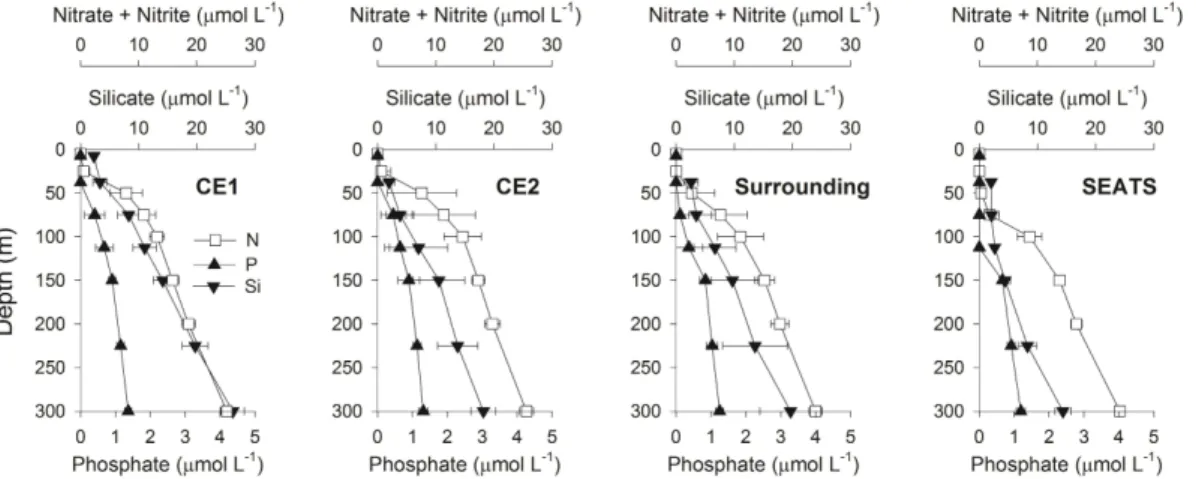
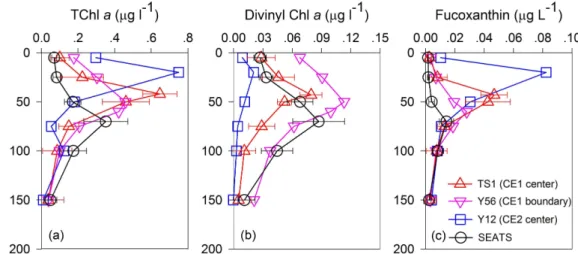
maximum values at the eddy central sites of CE1 (TS1) and CE2 (Y12) were 0.65 and 0.75 µg L−1, respectively, while only 0.46 and 0.35 µg L−1at the CE1 periphery site Y56 and the reference site SEATS, respectively. Interestingly, while nitrogen and phospho-rus were used up in the surface 50 m at both CE1 and CE2, silicate at CE1 seemed to be extra compared to CE2 (Fig. 2). Photosynthetic pigments analysis indicated that 5
the dominant autotrophs at CE1 were cyanobacteria rather than diatoms as occurred at CE2 (Table 1, Fig. 3b and c), suggesting that diatoms in CE1 were surpassed by cyanobacteria and not well developed, allowing extra silicate left over in the environ-ment. The less intense upwelling and consequently higher temperature (which favors cyanobacteria) at CE1 than CE2 could be responsible for the corresponding diff er-10
ences between their community structures. A clear pattern in the depth profiles of phy-toplankton pigments was demonstrated: the maximum chlorophylladepth (MCD) was the shallowest in the strongest upwelling area (CE2) where diatoms were dominant, but deeper in weak- or non-upwelling areas where Prochlorococcus were prevailing (Fig. 3a). As a result of biological interactions under upwelling impacts, heterotrophic 15
microbes in the middle euphotic zone (50 m) got an abundance order among different sites (CE1 boundary>CE1 center>CE2 center) (Table 1) similar toProchlorococcus (Fig. 3b), rather than to diatoms (Fig. 3c) (also see Sect. 3.3).
3.2 Responses of POC export flux
Total 234Th activities varied with depth ranging from 0.42±0.06 dpm L−1 at 2 m to
20
2.78±0.08 dpm L−1 at 100 m in the whole study area. The mean values of 234Th
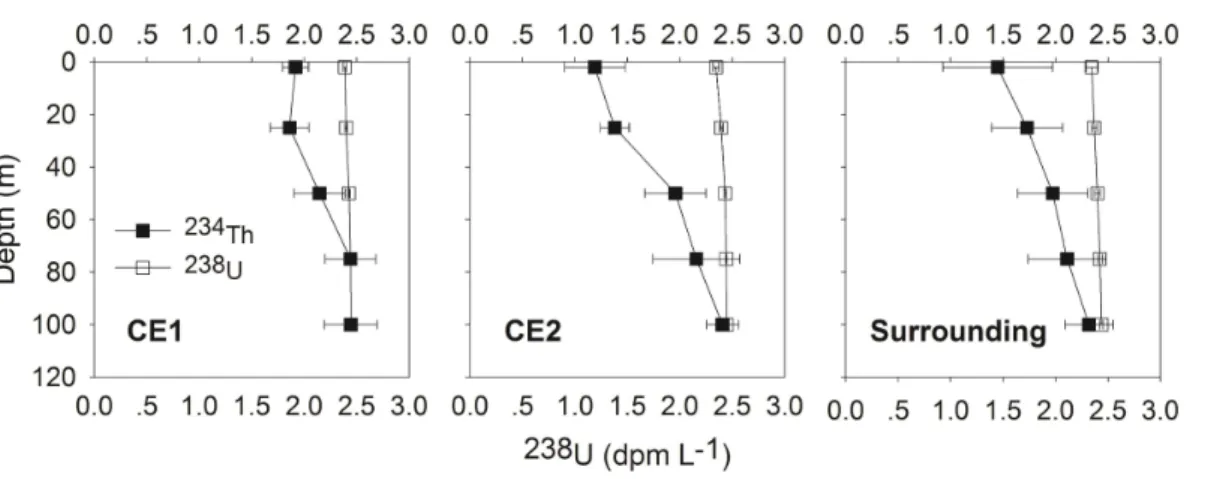
activities at 100 m of CE1, CE2 and surrounding non-eddy sites were 2.45, 2.41 and 2.32 dpm L−1, respectively (Fig. 4). The largest disequilibrium between 234Th and its parent238U occurred at the upper euphotic zone of CE2, indicating the highest particle export there. In contrast, the smallest export signals were observed in CE1 (Fig. 4). The 25
POC fluxes at 100 m estimated through the234Th activity showed a similar pattern that the highest and lowest POC fluxes occurred in CE2 (6.16±3.74 mmol C m−2d−1) and
CE1 (2.50±2.03 mmol C m−2d−1) respectively. Independent-samples
BGD
10, 13399–13426, 2013
Why productive upwelling areas are often sources rather
than sinks of CO2?
N. Jiao et al.
Title Page
Abstract Introduction
Conclusions References
Tables Figures
◭ ◮
◭ ◮
Back Close
Full Screen / Esc
Printer-friendly Version
Interactive Discussion
Discussion
P
a
per
|
D
iscussion
P
a
per
|
Discussion
P
a
per
|
Discuss
ion
P
a
per
|
analysis suggests that the difference in POC flux between CE1 and CE2 is significant (Table 1). Such difference is consistent to the difference in phytoplankton community structure that diatoms could contribute more POC export fluxes at CE2 than CE1.
3.3 Microbial respiration contributing to attenuation of POC export and CO2outgassing
5
In order to test whether microbial activity significantly influenced POC export flux in the two eddy-induced upwelling ecosystems, microbial abundance and activity were investigated at two representative stations of CE1, one station of CE2, as well as at St. SEATS (Fig. 1). Generally, microbial abundance decreased dramatically with depth, but showed distinct differences between the four sites. At 50 m where upwelling im-10
pacts were significant, the highest abundance was observed in CE1, while the lowest abundance occurred in the center of CE2 (Table 1). Leucine uptatke, as a measure of microbial activity, decreased with depth by two orders of magnitude within 200 m (Fig. 5). Like abundance, microbial activities at 50 m depth were also higher at the two stations in CE1 (17.08 and 18.62 pmol L−1h−1at sites TS1 and Y56 respectively) than 15
that in the center of CE2 (13.95 pmol L−1h−1at site Y12). However, when
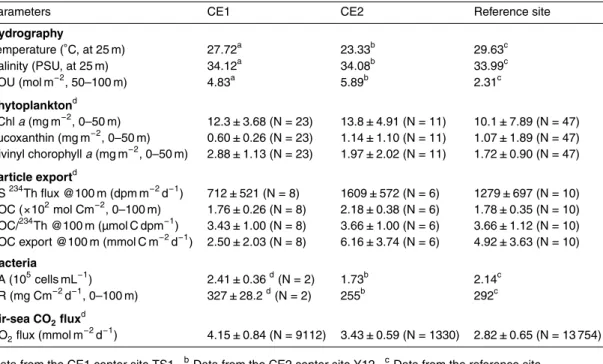
abundance-specific (unicellular) leucine uptake rate is considered, the highest value was observed at the center of CE2 (Fig. 5). CE2 has been diagnosed to be more intense as the ADCP data documented counterclockwise currents of higher speed in CE2 (1.1 m s−1at
max-imum) than in CE1 (0.7 m s−1) (Zhang et al., 2011b), and the age of CE2 was younger 20
than CE1 as seen from the satellite altimetric history. Thus, the microbial abundance in the shallow water of CE2 was likely diluted by the deep water with low microbial abundance, but the cell activity could be stimulated by labile organic carbon which was released from enhanced phytoplankton biomass. In CE1, POC export flux was the lowest whereas BR was the highest, corresponding to the highest air–sea CO2 flux 25
(4.15±0.84 mmol m−2d−1) among all the investigation sites, which obviously can not
BGD
10, 13399–13426, 2013
Why productive upwelling areas are often sources rather
than sinks of CO2?
N. Jiao et al.
Title Page
Abstract Introduction
Conclusions References
Tables Figures
◭ ◮
◭ ◮
Back Close
Full Screen / Esc
Printer-friendly Version
Interactive Discussion
Discussion
P
a
per
|
D
iscussion
P
a
per
|
Discussion
P
a
per
|
Discuss
ion
P
a
per
|
but the total CO2 outgassing in CE2 is actually lower (3.43±0.59 mmol m−2d−1) than
CE1 (4.15±0.84 mmol m−2d−1). That is, it was microbial activity who did matter for the
upwelling area to be a source or sink of CO2. As a matter of fact, in CE1, the aver-age carbon loss by microbial respiration is about fifteen-fold the averaver-age POC export flux at 100 m (Table 1). The enhanced total microbial activity could have consumed 5
more organic carbon leading to lower POC export flux and higher CO2 outgassing in CE1 than the other sites (Table 1). The satellite altimetric and chlorophyll data se-ries (http://gdata1.sci.gsfc.nasa.gov/daac-bin/G3/batchDownload.cgi) suggested that the primary production at the initial stages of CE1 could be a little bit lower than that of CE2, but this difference was not enough to cause the large difference in POC export 10
between CE1 and CE2. It is most likely that upwelling induced nutrient input enhanced phytoplankton biomass and labile organic carbon release which then stimulated bacte-rial growth and respiration. Then bacteria became more competent in attaching to and consumption of POC, consequently exacerbating the attenuation of the POC export flux. As for the case of CE2, a diatom-dominated community (Table 1) induced by nutri-15
ents supply would be the main reason for the high POC export flux. Taken together, the intensity and age of the two eddies and the different responses in phytoplankton com-munity and microbial activity suggest that phytoplankton rapidly responded to upwelled nutrients, accumulating biomass and causing high POC export at the initial intensifica-tion period (such as the case of the of CE2); bacteria were subsequently stimulated by 20
nutrients and labile DOC produced by phytoplankton resulting in high respiration rates during the later intensification period (such as the case of of CE1).
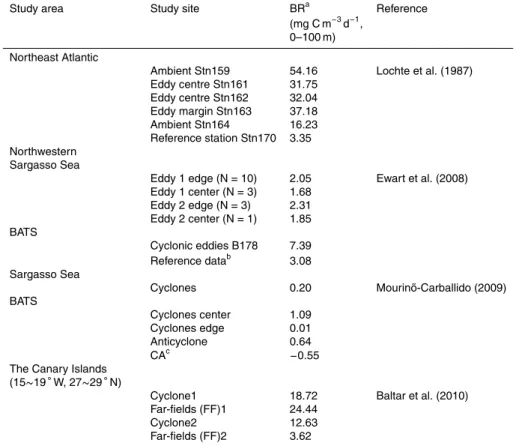
In literature, it is also reported in the northwestern subtropical Atlantic (Mouriño-Carballido, 2009) that centers of cyclonic eddies were associated with low net com-munity production as the result of a noticeable increase in BR, although several ob-25
BGD
10, 13399–13426, 2013
Why productive upwelling areas are often sources rather
than sinks of CO2?
N. Jiao et al.
Title Page
Abstract Introduction
Conclusions References
Tables Figures
◭ ◮
◭ ◮
Back Close
Full Screen / Esc
Printer-friendly Version
Interactive Discussion
Discussion
P
a
per
|
D
iscussion
P
a
per
|
Discussion
P
a
per
|
Discuss
ion
P
a
per
|
Although low BR could occur at certain upwelling stages as we observed in CE2 which was due to the low bacterial abundance diluted by deep water, enhancing of BR might be the prevailing feature of the cyclonic eddies (Table 2).
3.4 Microbial oxygen consumption and organic carbon transformation
AOU has been demonstrated as a useful indicator for microbial consumption of oxy-5
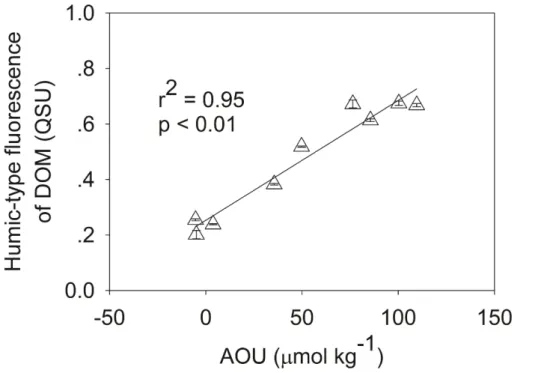
gen in the water column (Hayase and Shinozuka, 1995; Yamashita and Tanoue, 2008). In our study, both CE1 and CE2 had higher AOU values than the reference site (Ta-ble 1). The effects of oxygen consumption is also verified by the microbial metabolic output, the fluorescence of humic-type dissolved organic matter (FDOM), which was measured as an indicator of RDOC (Yamashita and Tanoue, 2008). Our earlier studies 10
have showed that humic-type FDOM and the ratio of humic-like FDOM to bulk DOC concentrations was generally higher in the cyclonic eddy centers than the reference site St. SEATS, especially at 35 to75 m depths (Zhang et al., 2009). Here humic-type FDOM in the euphotic zone also displayed higher fluorescence intensity in the up-welling areas than the reference site. Furthermore, a significant positive correlation 15
(p < 0.01) between AOU and FDOM was observed in the euphotic zone of CE1 where microbial respiration was strong (Fig. 6), suggesting that FDOM was associated with microbial decomposition of organic matter which consuming oxygen.
3.5 About CO2outgassing and carbon sequestration in upwelling areas
Our results suggest that when nutrient-rich deep water with low-abundance of microbes 20
BGD
10, 13399–13426, 2013
Why productive upwelling areas are often sources rather
than sinks of CO2?
N. Jiao et al.
Title Page
Abstract Introduction
Conclusions References
Tables Figures
◭ ◮
◭ ◮
Back Close
Full Screen / Esc
Printer-friendly Version
Interactive Discussion
Discussion
P
a
per
|
D
iscussion
P
a
per
|
Discussion
P
a
per
|
Discuss
ion
P
a
per
|
attenuation of POC flux and could play a critical role for a marine upwelling area to be a source rather than a sink of CO2.
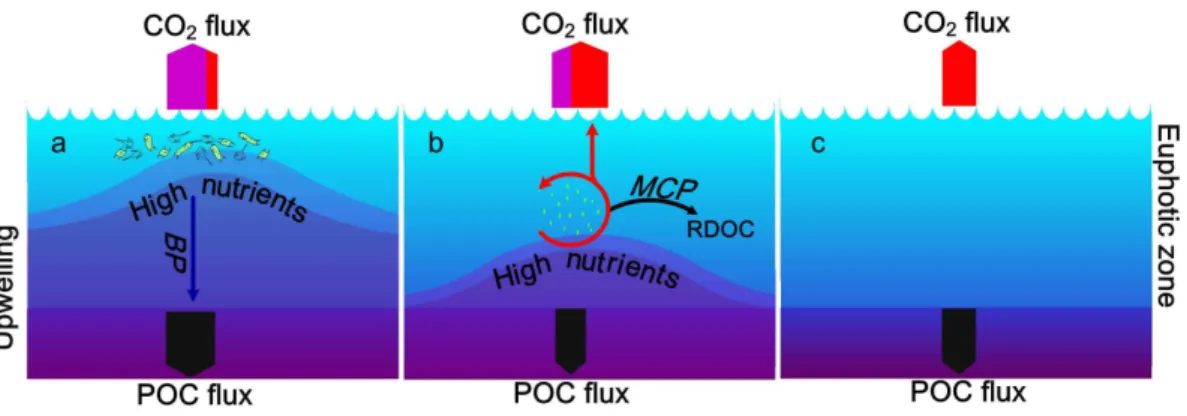
Based on the above consideration, two scenario models are established (Fig. 7). When an upwelling bring nutrients to the upper layer of the euphotic zone where light is replete, diatoms respond and bloom enhancing POC export; meanwhile, total microbial 5
respiration would be slowed down due to diluted abundance and low temperature by the deep water. As a result, export flux exceeds respiration flux (Fig. 7a; instance: CE2). If the upwelled nutrients can reach only the lower layer of the euphotic zone where picoplankton especiallyProchlorococcusare dominant, diatoms do not respond much to the upwelling due to lack of enough light down there, instead, microbial loop 10
could be very active (Hagström et al., 1988; Azam et al., 1993). As a result, microbial respiration flux would exceed POC export flux (Fig. 7b; instance: CE1).
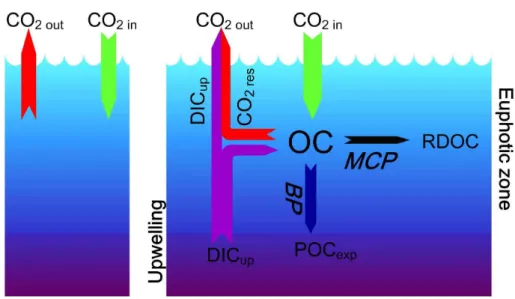
In addition, a common sense that “outgassing areas are carbon sources” needs to be revised for the case of marine upwelling regions. As shown in Fig. 8, for a non-upwelling system, if CO2 in < CO2 out, it is a CO2 source; whereas for a steady up-15
welling system, CO2 released from DIC-rich deep water (DICup) has to be taken into consideration. Even if CO2 in <(CO
2 res + DICup), it dose not mean no massive
car-bon sequestration in the system, and the sequestrated carcar-bon dose not have to be all exported out as POC (POCexp), it can be stored in the dissolved form as RDOC through the MCP approach (Jiao et al., 2010). Therefore, as long as it meets the con-20
dition (CO2 in +DICup +POCexp + RDOC)>CO2 out, there is carbon sequestration, even if it is outgassing. Therefore, the adjudgement of a marine region to be a carbon sink or source should be carefully made on the long-term balance between the amount of outgassing carbon and the sum of the outputs of the BP and the MCP, rather than simply according to momentary CO2partial pressures.
BGD
10, 13399–13426, 2013
Why productive upwelling areas are often sources rather
than sinks of CO2?
N. Jiao et al.
Title Page
Abstract Introduction
Conclusions References
Tables Figures
◭ ◮
◭ ◮
Back Close
Full Screen / Esc
Printer-friendly Version
Interactive Discussion
Discussion
P
a
per
|
D
iscussion
P
a
per
|
Discussion
P
a
per
|
Discuss
ion
P
a
per
|
4 Summary
The results from the present study suggest that while upwelling usually enhances pri-mary production through nutrients injection to the euphotic zone, upwelled DIC-rich deep water could release CO2 and ultimately result in outgassing. On top of that, microbial respiration could be stimulated and accelerated by enhanced nutrients and 5
subsequent phytoplankton labile DOC, and thus turn a productive upwelling area to be source rather than sink of CO2. In terms of carbon sequestration, upwelling usually strengthen the POC-based BP. However, if picoplankton (e.g.Prochlorococcus) rather than net phytoplankton (e.g., diatoms) dominate the system, their non-sinking POC favor the microbial loop rather than the BP. Nevertheless, even if the BP is severely 10
weaken, RDOC formation by the MCP can still work well, and carbon sequestration takes place while an upwelling area is outgassing. Given the tremendous complex-ity of the biological and biogeochemical responses to upwelling events, further high-frequency sampling and simultaneous observations of the BP and the MCP in the field is essential for a better understanding of carbon sequestration in the ocean.
15
Acknowledgements. We acknowledge financial support from the MOST 973 program 2013CB955700, the NSFC Projects 91028001, 41121091, 41176095 and 41023007. We thank the captain and crew of the RV Dongfanghong #2 and our colleagues who participated in the GOE-2 cruise.
References
20
Archer, D.: Upper ocean physics as relevant to ecosystem dynamics: a tutorial, Ecol. Appl., 5, 724–739, 1995.
Azam, F., Fenchel, T., Field, J. G., Gray, J., Meyer-Reil, L., and Thingstad, F.: The ecological role of water-column microbes in the sea, Mar. Ecol.-Prog. Ser., 10, 257–263, 1983.
Azam, F., Smith, D., Steward, G., and Hagström, Å.: Bacteria-organic matter coupling and its
25
BGD
10, 13399–13426, 2013
Why productive upwelling areas are often sources rather
than sinks of CO2?
N. Jiao et al.
Title Page
Abstract Introduction
Conclusions References
Tables Figures
◭ ◮
◭ ◮
Back Close
Full Screen / Esc
Printer-friendly Version
Interactive Discussion
Discussion
P
a
per
|
D
iscussion
P
a
per
|
Discussion
P
a
per
|
Discuss
ion
P
a
per
|
Beaulieu, S. E.: Accumulation and fate of phytodetritus on the sea floor, Oceanogr. Mar. Biol., 40, 171–232, 2002.
Benitez-Nelson, C., Buesseler, K., Van der Loeff, M. R., Andrews, J., Ball, L., Crossin, G., and Charette, M.: Testing a new small-volume technique for determining 234Th in seawater, J. Radioan. Nucl. Ch., 248, 795–799, 2001.
5
Benitez-Nelson, C. R., Bidigare, R. R., Dickey, T. D., Landry, M. R., Leonard, C. L., Brown, S. L., Nencioli, F., Rii, Y. M., Maiti, K., Becker, J. W., Bibby, T. S., Black, W., Cai, W. J., Carlson, C. A., Chen, F., Kuwahara, V. S., Mahaffey, C., McAndrew, P. M., Quay, P. D., Rappe, M. S., Selph, K. E., Simmons, M. P., and Yang, E. J.: Mesoscale eddies drive increased silica export in the subtropical Pacific Ocean, Science, 316, 1017–1021, 2007.
10
Benner, R. and Herndl, G. J.: Bacterially derived dissolved organic matter in the microbial carbon pump, in: Microbial Carbon Pump in the Ocean, edited by: Jiao, N., Azam, F., and Sanders, S., Science/AAAS, Washington, D.C., 46–48, 2011.
Boyd, P. and Newton, P.: Does planktonic community structure determine downward particulate organic carbon flux in different oceanic provinces?, Deep-Sea Res. Pt. I, 46, 63–91, 1999.
15
Buesseler, K., Ball, L., Andrews, J., Cochran, J., Hirschberg, D., Bacon, M., Fleer, A., and Brzezinski, M.: Upper ocean export of particulate organic carbon and biogenic silica in the Southern Ocean along 170◦W, Deep-Sea Res. Pt. I, 48, 4275–4297, 2001.
Buesseler, K., Benitez-Nelson, C., Moran, S., Burd, A., Charette, M., Cochran, J. K., Cop-pola, L., Fisher, N., Fowler, S., and Gardner, W.: An assessment of particulate organic
car-20
bon to thorium-234 ratios in the ocean and their impact on the application of234Th as a POC flux proxy, Mar. Chem., 100, 213–233, 2006.
Cai, P., Dai, M., Lv, D., and Chen, W.: An improvement in the small-volume technique for deter-mining thorium-234 in seawater, Mar. Chem., 100, 282–288, 2006.
Carpenter, J. H.: The Chesapeake Bay Institute technique for the Winkler dissolved oxygen
25
method, Limnol. Oceanogr., 10, 141–143, 1965.
Chen, F., Cai, W. J., Benitez-Nelson, C., and Wang, Y.: Sea surfacepCO2–SST relationships across a cold-core cyclonic eddy: implications for understanding regional variability and air– sea gas exchange, Geophys. Res. Lett., 34, L10603, doi:10.1029/2006GL028058, 2007. Chen, J., Lawrence Edwards, R., and Wasserburg, G.:238U,234U and232Th in seawater, Earth.
30
Planet. Sc. Lett., 80, 241–251, 1986.
BGD
10, 13399–13426, 2013
Why productive upwelling areas are often sources rather
than sinks of CO2?
N. Jiao et al.
Title Page
Abstract Introduction
Conclusions References
Tables Figures
◭ ◮
◭ ◮
Back Close
Full Screen / Esc
Printer-friendly Version
Interactive Discussion
Discussion
P
a
per
|
D
iscussion
P
a
per
|
Discussion
P
a
per
|
Discuss
ion
P
a
per
|
Garcia, H., Locarnini, R., Boyer, T., and Antonov, J.: World Ocean Atlas 2005, vol. 3, Dissolved Oxygen, Apparent Oxygen Utilization, and Oxygen Saturation, edited by: S. Levitus, NOAA Atlas NESDIS 63, US Government Printing Office, Washington, D. C., 342 pp., 2006. Glover, H. E., Prézelin, B. B., Campbell, L., Wyman, M., and Garside, C.: A nitrate-dependent
Synechococcus bloom in surface Sargasso Sea water, Nature, 331, 161–163, 1988.
5
Gonzalez, N., Anadón, R., Mouriño, B., Fernández, E., SINHA, B., Escánez, J., and de Ar-mas, D.: The metabolic balance of the planktonic community in the North Atlantic Subtropical Gyre: the role of mesoscale instabilities, Limnol. Oceanogr., 46, 946–952, 2001.
Hagström, A., Azam, F., Andersson, A., Wikner, J., and Rassoulzadegan, F.: Microbial loop in an oligotrophic pelagic marine ecosystem: possible roles of cyanobacteria and nanoflagellates
10
in the organic fluxes, Mar. Ecol.-Prog. Ser., 49, 171–178, 1988.
Hayase, K. and Shinozuka, N.: Vertical distribution of fluorescent organic matter along with AOU and nutrients in the equatorial Central Pacific, Mar. Chem., 48, 283–290, 1995. Honjo, S., Dymond, J., Prell, W., and Ittekkot, V.: Monsoon-controlled export fluxes to the interior
of the Arabian Sea, Deep-Sea Res. Pt. I, 46, 1859–1902, 1999.
15
Hu, J., Gan, J., Sun, Z., Zhu, J., and Dai, M.: Observed three-dimensional structure of a cold eddy in the southwestern South China Sea, J. Geophys. Res., 116, C05016, doi:10.1029/2010JC006810, 2011.
Jiao, N., Herndl, G. J., Hansell, D. A., Benner, R., Kattner, G., Wilhelm, S. W., Kirchman, D. L., Weinbauer, M. G., Luo, T., Chen, F., and Azam, F.: Microbial production of recalcitrant
dis-20
solved organic matter: long-term carbon storage in the global ocean, Nat. Rev. Microbiol., 8, 593–599, 2010.
Jiao, N., Tang, K., Cai, H., and Mao, Y.: Increasing the microbial carbon sink in the sea by reducing chemical fertilization on the land, Nat. Rev. Microbiol., 9, 75–75, 2011.
Kirchman, D.: Incorporation of thymidine and leucine in the subarctic Pacific: application to
25
estimating bacterial production, Mar. Ecol.-Prog. Ser., 82, 301–309, 1992.
Kirchman, D. L. and Wheeler, P. A.: Uptake of ammonium and nitrate by heterotrophic bacteria and phytoplankton in the sub-Arctic Pacific, Deep-Sea Res. Pt. I, 45, 347–365, 1998. Lee, S. and Fuhrman, J. A.: Relationships between biovolume and biomass of naturally derived
marine bacterioplankton, Appl. Environ. Microb., 53, 1298–1303, 1987.
30
BGD
10, 13399–13426, 2013
Why productive upwelling areas are often sources rather
than sinks of CO2?
N. Jiao et al.
Title Page
Abstract Introduction
Conclusions References
Tables Figures
◭ ◮
◭ ◮
Back Close
Full Screen / Esc
Printer-friendly Version
Interactive Discussion
Discussion
P
a
per
|
D
iscussion
P
a
per
|
Discussion
P
a
per
|
Discuss
ion
P
a
per
|
Maixandeau, A., Lefèvre, D., Karayanni, H., Christaki, U., Van Wambeke, F., Thyssen, M., De-nis, M., Fernández, C. I., Uitz, J., and Leblanc, K.: Microbial community production, respi-ration, and structure of the microbial food web of an ecosystem in the northeastern Atlantic Ocean, J. Geophys. Res., 110, C07S17, doi:10.1029/2004JC002694, 2005.
Mann, K. H. and Lazier, J.: Biological–physical interactions in the ocean, in: Dynamics of Marine
5
Ecosystems, 3rd edn., Blackwell Science, Cambridge, Massachusetts, 2006.
Mantoura, R. and Llewellyn, C.: The rapid determination of algal chlorophyll and carotenoid pigments and their breakdown products in natural waters by reverse-phase high-performance liquid chromatography, Anal. Chim. Acta., 151, 297–314, 1983.
McGillicuddy, D., Robinson, A., Siegel, D., Jannasch, H., Johnson, R., Dickey, T., McNeil, J.,
10
Michaels, A., and Knap, A.: Influence of mesoscale eddies on new production in the Sar-gasso Sea, Nature, 394, 263–266, 1998.
McGillicuddy, D., Anderson, L., Doney, S., and Maltrud, M.: Eddy-driven sources and sinks of nutrients in the upper ocean: results from a 0.1 resolution model of the North Atlantic, Global Biogeochem. Cy., 17, 1035, doi:10.1029/2002GB001987, 2003.
15
Michaels, A. F. and Silver, M. W.: Primary production, sinking fluxes and the microbial food web, Deep-Sea Res., 35, 473–490, 1988.
Mouriño-Carballido, B.: Eddy-driven pulses of respiration in the Sargasso Sea, Deep-Sea Res. Pt. I, 56, 1242–1250, 2009.
Newton, P. P., Lampitt, R. S., Jickells, T. D., King, P., and Boutle, C.: Temporal and spatial
20
variability of biogenic particles fluxes during the JGOFS northeast Atlantic process studies at 47◦N, 20◦W, Deep-Sea Res. Pt. I, 41, 1617–1642, 1994.
O’Brien, M. C., Melling, H., Pedersen, T. F., and Macdonald, R. W.: The role of eddies on particle flux in the Canada Basin of the Arctic Ocean, Deep-Sea Res. Pt. I, 71, 1–20, 2013.
Oschlies, A.: Can eddies make ocean deserts bloom?, Global Biogeochem. Cy., 16,
53–1-53-25
11, 2002.
Oschlies, A. and Garçon, V.: Eddy-induced enhancement of primary production in a model of the North Atlantic Ocean, Nature, 394, 266–269, 1998.
Richardson, T. L. and Jackson, G. A.: Small phytoplankton and carbon export from the surface ocean, Science, 315, 838–840, 2007.
30
BGD
10, 13399–13426, 2013
Why productive upwelling areas are often sources rather
than sinks of CO2?
N. Jiao et al.
Title Page
Abstract Introduction
Conclusions References
Tables Figures
◭ ◮
◭ ◮
Back Close
Full Screen / Esc
Printer-friendly Version
Interactive Discussion
Discussion
P
a
per
|
D
iscussion
P
a
per
|
Discussion
P
a
per
|
Discuss
ion
P
a
per
|
Robinson, C.: Heterotrophic bacterial respiration, in: Microbial Ecology of the Oceans, 2nd edn., edited by: Kirchman, D., Wiley, New York, 299–334, 2008.
Robinson, C. and Williams, P. J. le B.: Respiration and its measurement in surface ma-rine waters, in: Respiration in Aquatic Ecosystems, edited by: del Giorgio, P. A. and Williams, P. J. le B., Oxford University Press, New York, 148–181, 2005.
5
Rosón, G., Álvarez-Salgado, X. A., and Pérez, F. F.: Carbon cycling in a large coastal embay-ment, affected by wind-driven upwelling: short-time-scale variability and spatial differences, Mar. Ecol.-Prog. Ser., 176, 215–230, 1999.
Savoye, N., Benitez-Nelson, C., Burd, A. B., Cochran, J. K., Charette, M., Buesseler, K. O., Jackson, G. A., Roy-Barman, M., Schmidt, S., and Elskens, M.:234Th sorption and export
10
models in the water column: a review, Mar. Chem., 100, 234–249, 2006.
Siegel, D. A., McGillicuddy, D. J., and Fields, E. A.: Mesoscale eddies, satellite altimetry, and new production in the Sargasso Sea, J. Geophys. Res., 104, 13359–13379, 1999.
Su-Cheng, P., Chung-Cheng, Y., and Riley, J.: Effects of acidity and molybdate concentration on the kinetics of the formation of the phosphoantimonylmolybdenum blue complex, Anal.
15
Chim. Acta, 229, 115–120, 1990.
Sweeney, C., Gloor, E., Jacobson, A. R., Key, R. M., McKinley, G., Sarmiento, J. L., and Wan-ninkhof, R.: Constraining global air–sea gas exchange for CO2with recent bomb
14
C mea-surements, Global Biogeochem. Cy., 21, GB2015, doi:10.1029/2006GB002784, 2007. Sweeney, E. N., McGillicuddy, D. J., and Buesseler, K. O.: Biogeochemical impacts due to
20
mesoscale eddy activity in the Sargasso Sea as measured at the Bermuda Atlantic Time-series Study (BATS), Deep-Sea Res. Pt. I, 50, 3017–3039, 2003.
Takahashi, M. and Bienfang, P.: Size structure of phytoplankton biomass and photosynthesis in subtropical Hawaiian waters, Mar. Biol., 76, 203–211, 1983.
Van Heukelem, L. and Thomas, C. S.: Computer-assisted high-performance liquid
chromatog-25
raphy method development with applications to the isolation and analysis of phytoplankton pigments, J. Chromatogr. A, 910, 31–49, 2001.
Yamashita, Y. and Tanoue, E.: Production of bio-refractory fluorescent dissolved organic matter in the ocean interior, Nat. Geosci., 1, 579–582, 2008.
Zhai, W., Dai, M., Cai, W., Wang, Y., and Wang, Z.: High partial pressure of carbon dioxide and
30
BGD
10, 13399–13426, 2013
Why productive upwelling areas are often sources rather
than sinks of CO2?
N. Jiao et al.
Title Page
Abstract Introduction
Conclusions References
Tables Figures
◭ ◮
◭ ◮
Back Close
Full Screen / Esc
Printer-friendly Version
Interactive Discussion
Discussion
P
a
per
|
D
iscussion
P
a
per
|
Discussion
P
a
per
|
Discuss
ion
P
a
per
|
Zhang, Y., Sintes, E., Chen, M., Zhang, Y., Dai, M., and Jiao, N.: Role of mesoscale cyclonic eddies in the distribution and activity of archaea and bacteria in the South China Sea, Aquat. Microb. Ecol., 56, 65–79, 2009.
Zhang, Y., Jiao, N., Sun, Z., Hu, A., and Zheng, Q.: Phylogenetic diversity of bacterial com-munities in South China Sea mesoscale cyclonic eddy perturbations, Res. Microbiol., 162,
5
320–329, 2011a.
BGD
10, 13399–13426, 2013
Why productive upwelling areas are often sources rather
than sinks of CO2?
N. Jiao et al.
Title Page
Abstract Introduction
Conclusions References
Tables Figures
◭ ◮
◭ ◮
Back Close
Full Screen / Esc
Printer-friendly Version
Interactive Discussion
Discussion
P
a
per
|
D
iscussion
P
a
per
|
Discussion
P
a
per
|
Discuss
ion
P
a
per
|
Table 1. Hydrographic characteristics, phytoplankton, particle export parameters, bacterial abundance and respiration and air–sea CO2 flux in CE1, CE2 and surrounding waters. CE1: cyclonic eddy #1; CE2: cyclonic eddy #2. Error bars indicate standard deviation. TChla: total chlorophylla; SS: stable state; POC: particle organic carbon; BA: bacterial abundance; BR: bacterial respiration rate.
Parameters CE1 CE2 Reference site
Hydrography
Temperature (◦C, at 25 m) 27.72a
23.33b 29.63c Salinity (PSU, at 25 m) 34.12a 34.08b 33.99c AOU (mol m−2
, 50–100 m) 4.83a 5.89b 2.31c
Phytoplanktond
TChla(mg m−2
, 0–50 m) 12.3±3.68 (N=23) 13.8±4.91 (N=11) 10.1±7.89 (N=47) Fucoxanthin (mg m−2
, 0–50 m) 0.60±0.26 (N=23) 1.14±1.10 (N=11) 1.07±1.89 (N=47) Divinyl chorophylla(mg m−2, 0–50 m) 2.88±1.13 (N=23) 1.97±2.02 (N=11) 1.72±0.90 (N=47)
Particle exportd
SS234Th flux @100 m (dpm m−2
d−1
) 712±521 (N=8) 1609±572 (N=6) 1279±697 (N=10) POC (×102mol Cm−2, 0–100 m) 1.76±0.26 (N=8) 2.18±0.38 (N=6) 1.78±0.35 (N=10) POC/234Th @100 m (µmol C dpm−1
) 3.43±1.00 (N=8) 3.66±1.00 (N=6) 3.66±1.12 (N=10) POC export @100 m (mmol C m−2
d−1
) 2.50±2.03 (N=8) 6.16±3.74 (N=6) 4.92±3.63 (N=10)
Bacteria
BA (105cells mL−1
) 2.41±0.36d(N=2) 1.73b 2.14c BR (mg Cm−2
d−1
, 0–100 m) 327±28.2d(N=2) 255b 292c
Air-sea CO2flux d
CO2flux (mmol m− 2
d−1
) 4.15±0.84 (N=9112) 3.43±0.59 (N=1330) 2.82±0.65 (N=13 754)
aData from the CE1 center site TS1. bData from the CE2 center site Y12. cData from the reference site
SEATS. dData were mean±SD (standard deviation) from the CE1 and CE2 regions and the reference sites of
BGD
10, 13399–13426, 2013
Why productive upwelling areas are often sources rather
than sinks of CO2?
N. Jiao et al.
Title Page
Abstract Introduction
Conclusions References
Tables Figures
◭ ◮
◭ ◮
Back Close
Full Screen / Esc
Printer-friendly Version
Interactive Discussion
Discussion
P
a
per
|
D
iscussion
P
a
per
|
Discussion
P
a
per
|
Discuss
ion
P
a
per
|
Table 2.Bacterial respiration inside and outside the mesoscale features in the Atlantic.
Study area Study site BRa Reference (mg C m−3d−1,
0–100 m)
Northeast Atlantic
Ambient Stn159 54.16 Lochte et al. (1987) Eddy centre Stn161 31.75
Eddy centre Stn162 32.04 Eddy margin Stn163 37.18 Ambient Stn164 16.23 Reference station Stn170 3.35 Northwestern
Sargasso Sea
Eddy 1 edge (N=10) 2.05 Ewart et al. (2008) Eddy 1 center (N=3) 1.68
Eddy 2 edge (N=3) 2.31 Eddy 2 center (N=1) 1.85 BATS
Cyclonic eddies B178 7.39 Reference datab 3.08 Sargasso Sea
Cyclones 0.20 Mourinõ-Carballido (2009) BATS
Cyclones center 1.09 Cyclones edge 0.01 Anticyclone 0.64
CAc −0.55
The Canary Islands (15∼19◦W, 27∼29◦N)
Cyclone1 18.72 Baltar et al. (2010) Far-fields (FF)1 24.44
Cyclone2 12.63 Far-fields (FF)2 3.62
a
Bacterial respiration rate (BR) was calculated using BR=(BG×ICF×CCF) (1/BGE – 1)
according to the bacterial production derived from the references.
b
Reference data from the BATS summer climatology (1999–2002).
c
BGD
10, 13399–13426, 2013
Why productive upwelling areas are often sources rather
than sinks of CO2?
N. Jiao et al.
Title Page
Abstract Introduction
Conclusions References
Tables Figures
◭ ◮
◭ ◮
Back Close
Full Screen / Esc
Printer-friendly Version
Interactive Discussion
Discussion
P
a
per
|
D
iscussion
P
a
per
|
Discussion
P
a
per
|
Discuss
ion
P
a
per
|
BGD
10, 13399–13426, 2013
Why productive upwelling areas are often sources rather
than sinks of CO2?
N. Jiao et al.
Title Page
Abstract Introduction
Conclusions References
Tables Figures
◭ ◮
◭ ◮
Back Close
Full Screen / Esc
Printer-friendly Version
Interactive Discussion
Discussion
P
a
per
|
D
iscussion
P
a
per
|
Discussion
P
a
per
|
Discuss
ion
P
a
per
|
BGD
10, 13399–13426, 2013
Why productive upwelling areas are often sources rather
than sinks of CO2?
N. Jiao et al.
Title Page
Abstract Introduction
Conclusions References
Tables Figures
◭ ◮
◭ ◮
Back Close
Full Screen / Esc
Printer-friendly Version
Interactive Discussion
Discussion
P
a
per
|
D
iscussion
P
a
per
|
Discussion
P
a
per
|
Discuss
ion
P
a
per
|
BGD
10, 13399–13426, 2013
Why productive upwelling areas are often sources rather
than sinks of CO2?
N. Jiao et al.
Title Page
Abstract Introduction
Conclusions References
Tables Figures
◭ ◮
◭ ◮
Back Close
Full Screen / Esc
Printer-friendly Version
Interactive Discussion
Discussion
P
a
per
|
D
iscussion
P
a
per
|
Discussion
P
a
per
|
Discuss
ion
P
a
per
|
BGD
10, 13399–13426, 2013
Why productive upwelling areas are often sources rather
than sinks of CO2?
N. Jiao et al.
Title Page
Abstract Introduction
Conclusions References
Tables Figures
◭ ◮
◭ ◮
Back Close
Full Screen / Esc
Printer-friendly Version
Interactive Discussion
Discussion
P
a
per
|
D
iscussion
P
a
per
|
Discussion
P
a
per
|
Discuss
ion
P
a
per
|
BGD
10, 13399–13426, 2013
Why productive upwelling areas are often sources rather
than sinks of CO2?
N. Jiao et al.
Title Page
Abstract Introduction
Conclusions References
Tables Figures
◭ ◮
◭ ◮
Back Close
Full Screen / Esc
Printer-friendly Version
Interactive Discussion
Discussion
P
a
per
|
D
iscussion
P
a
per
|
Discussion
P
a
per
|
Discuss
ion
P
a
per
|
BGD
10, 13399–13426, 2013
Why productive upwelling areas are often sources rather
than sinks of CO2?
N. Jiao et al.
Title Page
Abstract Introduction
Conclusions References
Tables Figures
◭ ◮
◭ ◮
Back Close
Full Screen / Esc
Printer-friendly Version
Interactive Discussion
Discussion
P
a
per
|
D
iscussion
P
a
per
|
Discussion
P
a
per
|
Discuss
ion
P
a
per
|
BGD
10, 13399–13426, 2013
Why productive upwelling areas are often sources rather
than sinks of CO2?
N. Jiao et al.
Title Page
Abstract Introduction
Conclusions References
Tables Figures
◭ ◮
◭ ◮
Back Close
Full Screen / Esc
Printer-friendly Version
Interactive Discussion
Discussion
P
a
per
|
D
iscussion
P
a
per
|
Discussion
P
a
per
|
Discuss
ion
P
a
per
|