J. Serb. Chem. Soc. 75 (2) 165–173 (2010) UDC 547.458.6+66.095.11+547.292–312
JSCS–3949 Original scientific paper
doi: 10.2298/JSC1002165H
An efficient acetylation of dextran using
in situ
activated acetic anhydride with iodine
MUHAMMAD A. HUSSAIN1*, DURE SHAHWAR1, MUHAMMAD N. TAHIR2, MUHAMMAD SHER1, MUHAMMAD N. HASSAN1 and ZAKIA AFZAL1
1Department of Chemistry, University of Sargodha, Sargodha 40100, Pakistan and 2Institute
of Inorganic and Analytical Chemistry, Johannes Guttenberg University, Duesbergweg 10–14, 55099, Mainz, Germany
(Received 7 April, revised 2 June 2009)
Abstract: A facile, efficient, cost-effective and solvent-free acetylation method has been developed for the acetylation of dextran. Dextran acetates were suc-cessfully synthesized using different molar ratios of acetic anhydride in the presence of iodine as a catalyst without the use of any solvent. The reactions were realized at 50 °C for 3 h under stirring and nitrogen. This efficient method yielded highly pure and organosoluble dextran esters. The reaction appears highly effective for obtaining higher degrees of substitution (DS) with great ef-ficiency. Under solvent-free conditions, dextran triacetates were efficiently synthesized. It was also observed that the molar ratio can easily control the DS of pendant groups onto the polymer backbone. Hence, a range of products with varying DS were successfully designed, purified and characterized. Covalent attachment of the pendant groups onto the polymer backbone was verified by spectroscopic techniques. Thermogravimetric analysis indicated that the ob-tained dextran esters were thermally as stable as dextran. The DS of the pen-dant groups onto the polymer backbone was calculated using standard acid base titration after saponification. Furthermore, all products were thoroughly characterized by thermal analysis (TG and DTG), and FTIR and 1H-NMR spectroscopic analysis.
Keywords:acetic anhydride; acetylation; dextran; iodine; polysaccharide. INTRODUCTION
Dextran1,2 is a very important polysaccharide commonly used in routine medical, microsurgical and laboratory procedures.3,4 Dextran derivatives are
used for reducing platelet adhesiveness,5,6 wound healing,7 tumor targeting of gene expression8 and osmotic pressure control in biological molecules9 and
hu-man enzyme regulation.10 Dextran derivatives have well reported
rative and anti-tumor properties.11 Dextran is receiving attention in the
formu-lation of macromolecular prodrugs of acid sensitive drugs to target them to the colon and in this way, highly sensitive anticancer drugs, such as mitomycin C, can be safely targeted to its site of action.12 Nowadays, dextran is being used for sustained release studies of several sensitive drug molecules after their covalent attachment (mostly esters) onto polymer backbone.13 From these research areas, it is clear that esterification of dextran is a very important reaction in drug design. Hence, it is of high importance to develop highly efficient and soft esterification methods.
Regarding the esterification of polysaccharides, a few methods are reported in the literature, such as using acetyl chloride with pyridine,14 acetic anhydride
with pyridine and 4-(dimethylamino)pyridine,15,16 carboxylic acids in situ acti-vated with tosyl chloride,17–19 iminium chloride20 and
1,1’-carbonyldiimida-zole17,21,22 and acetic anhydride activated with strong acids or metal catalysts. In present study, our interests were focused on the search for efficient reac-tion methodologies for the esterificareac-tion of the biologically important polysac-charide dextran. Hence, the value of the conventional reagent acetic anhydride was explored using iodine as the catalyst.23 This esterification method appeared more advantageous regarding cost effectiveness because the other esterification methods available until now need expensive acylation reagents, i.e., p-toluene-sulfonyl chloride,19 1,1’-carbonyldiimidazole,20 etc. Secondly, the esterification
of polysaccharides under homogeneous reaction conditions is a current area of research. However, the fact that solvent systems used to dissolve polysaccharides are quite expensive cannot be neglected; therefore, such methods cannot be readi-ly commercialized. Another important aspect of commercial synthesis of poreadi-ly- poly-saccharide acetates is that an acidic catalyst is employed, which significantly de-stroys glycosidic linkages of polysaccharides. Hence, the aim of this study was to exploit the use of a mild catalyst, i.e., iodine. Being a cheap, commercially avail-able, environment friendly and most importantly powerful reagent, iodine is cur-rently being extensively explored regarding its catalytic properties on various substrates in different low molecular weight organic transformations.24,25
Like-wise, the focus of this investigation was to examine the possibility of employing the acid anhydride/iodine system for the acetylation of dextran.
EXPERIMENTAL Reagents and chemicals
Dextran (Mw 40000, Fluka) was dried under vacuum at 110 °C for 8 h prior to use. Ana-lytical grade organic solvents and other reagents obtained from Fluka were used without further purification.
Measurements
Bruker 400 MHz instrument in suitable deuterated solvents. Thermogravimetric (TG) analysis and derivative thermogravimetric (DTG) analysis were realized on a SDT Q600 (USA) ther-mal analyzer. Therther-mal decomposition temperatures (td) of the dextran esters were determined from the DTG curves. The td is reported as the onset of significant weight loss from a heated sample. Samples (10 mg) were measured under air at heating rate of 10 °C/min from 35 up to 600 °C.
Esterification of dextran using acetic anhydride and iodine under solvent-free conditions, a typical example (sample 4)
Iodine (0.50 g, 0.0041 mol) was filled into a pre-dried round bottom flask. Acetic an-hydride (4.0 mL, 0.038 mol) was added and the reaction mixture was kept under stirring for 15 min. Pdried dextran (1.0 g, 0.0062 mol) was added and the resulting mixture was re-fluxed for 4 h. The excess of iodine (catalyst) was removed by adding a saturated aqueous so-dium thiosulfate solution to the reaction mixture. The thus formed white precipitates of dex-tran acetate were filtered off, washed thrice with cold water and then reprecipitated from acetone into cold water. The precipitate of sample 4 was then dried under vacuum at 50 °C for 24 h.
Yield: 77 %; DS (degree of substitution): 2.90 (the DS was calculated by acid base titra-tion after saponificatitra-tion). FTIR (KBr, cm-1): 2931 (C–H stretching of sugar units), 1751 (C=O stretching ester), 1246 (C–O–C stretching of ester), 1431 (CH2 stretching of sugar units). 1H- -NMR (400 MHz, acetone-d6, δ / ppm): 3.15–4.93 (anhydroglucose unit–H), 2.02 (acetyl–H). Calculation of degree of substitution, a typical procedure
For the purpose of DS calculation, 100 mg of sample was dissolved in 50 mL aqueous 1.0 M NaOH solution , stirred overnight and its pH was registered using a pH meter. HCl (0.010 M) was added to achieve pH 7, followed by a known quantity (20 mL) of 1.0 M NaOH solution. The excess base was finally titrated with 0.10 M HCl until neutralization. The DS of the free acid moieties was then calculated. The DS of acetyl moiety was calculated by 1
H-NMR spectrum15 from spectral integral ratios of the protons of the AGU and methyl of the acetyl moiety.
RESULTS AND DISCUSSION
An acid anhydride and an alcohol react together in the presence of iodine as a catalyst. The general mechanism is outlined in Fig. 1 using acetic anhydride as the example.24,25 Iodine first activates acetic anhydride in the presence of
al-coholic groups, as the oxygen of R–OH attacks the carbonyl carbon resulting in sp3 hybridization. The acetic ester of the respective alcohol is formed by reaction
of the iodide ion with the iodine atom that was attached to the oxygen of the carbonyl group, resulting in free iodine. Acetic acid is formed as a by-product. At the end of the reaction, addition of a saturated aqueous solution of sodium thiosulfate removes all the free iodine.
were performed at 50 °C for 3 h under a nitrogen atmosphere. The reaction con-ditions and the results of dextran acetylation are summarized in Table I.
(a)
(b)
Fig. 1. a) Dextran acetylation with acetic anhydride catalyzed by iodine under solvent-free conditions and b) the generalized mechanism for alcohol (dextran) acetylation.
TABLE I. Conditions and results of acetylation of dextran with acetic anhydride in situ acti-vated with iodine under solvent-free conditions
Sample Mole ratioa Yield, % DSb DSc
1 1:3 50 1.75 1.72
2 1:4 53 1.88 1.83
3 1:5 70 2.69 2.71
4 1:6 77 2.90 2.85
5 1:8 83 3.00 2.98
6 1:10 85 3.00 2.99
a
Anhydroglucose unit (AGU):acetic anhydride; bDS calculated by acid-base titration after saponification; cDS
calculated by 1H-NMR spectroscopy
purified by re-precipitation and their purity was verified by spectroscopic tech-niques. It was found that on increasing the molar ratio of acetic anhydride to dex-tran, the degree of substitution (DS) also increased, which means that in this way, the DS can be controlled. This observation is obvious from the results given in Table I. The products were obtained with excellent yields.
The results significantly indicated that this method is highly efficient for the synthesis of dextran acetates as samples 4–6 were obtained with almost complete substitution under solvent free-conditions. As dextran is a 1–6-linked polymer, a primary hydroxyl, which is generally more reactive toward acetylation, is absent in dextran. In addition, even dextran triacetate was achieved by using less than 1:8 anhydroglucose unit, AGU:acetic anhydride. Therefore, this method has the potential to be exploited for acetylation of polysaccharides in industry. All dex-tran acetates were thoroughly characterized by means of thermal analyses, and FTIR and 1H-NMR spectroscopy.
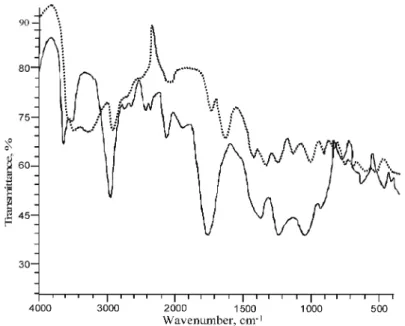
FTIR spectroscopic studies were performed using the KBr pellet technique to observe the ester peaks and hydroxyl group absorptions. A distinct ester peak appeared at 1747 cm–1 for sample 5 (Fig. 2). The spectrum did not display
hydro-xyl group absorption at about 3500 cm–1, which is indicative of complete substi-tution of the hydroxyl functions with acetate moieties. This shows the purity of the product and the success of the reaction. No peak was observed for any kind of possible impurity. For reference, the spectrum of the unsubstituted dextran poly-mer is being also provided in Fig. 2.
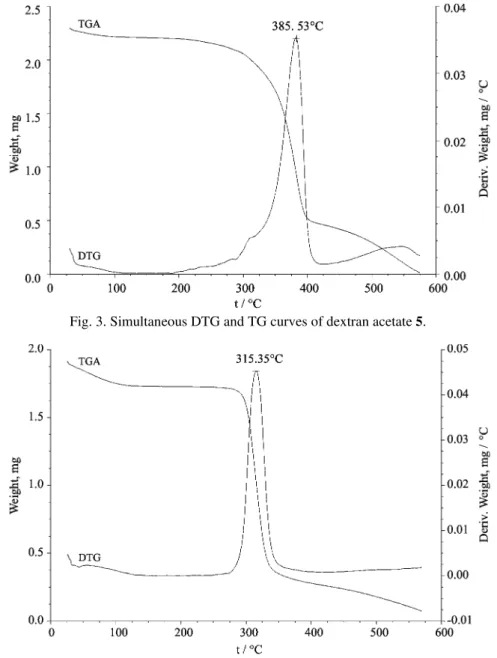
From DTG analysis, a thermal decomposition temperature (td) of 385.5 °C
was obtained for dextran acetate 5. Typical TG and DTG curves of sample 5 are shown in Fig. 3. Dextran acetate 5 showed increased stability when compared to the unsubstituted dextran polymer (td = 315.35 °C, Fig. 4).
Fig. 3. Simultaneous DTG and TG curves of dextran acetate 5.
1H-NMR spectroscopy was thoroughly performed to check the success of
the reaction and purity of the samples. A typical 1H-NMR spectrum of dextran acetate 1 recorded in CDCl3 is shown in Fig. 5. The spectrum revealed the
suc-cess of the reaction as methyl protons of the acetyl moiety appeared at 2.05 ppm. The signals of AGU-H appeared well resolved at about 3.15–4.90 ppm. 1H-NMR
spectroscopy was also performed to calculate the DS of pendant acetyl groups onto dextran. The DS was successfully calculated from the ratios of the integra-ted peak areas. The results of the DS calculaintegra-ted from the 1H-NMR results were
found to be comparable with the DS values obtained by acid base titration after saponification (see Table I).
Fig. 5. 400 MHz 1H-NMR spectrum (CDCl3) of dextran acetate 1.
CONCLUSIONS
Acknowledgement. Financial support of the Higher Education Commission of Pakistan under the scheme entitled “International linkages of Pakistani Universities with Foreign Universities” is greatly acknowledged.
В
А А А ВА E А А А А В А
А А Ј
MUHAMMAD A. HUSSAIN1, DURE SHAHWAR1, MUHAMMAD N. TAHIR2, MUHAMMAD SHER1, MUHAMMAD N. HASSAN1 ZAKIA AFZAL1
1
Department of Chemistry, University of Sargodha, Sargodha 40100, Pakistan и2Institute of Inorganic and Analytical Chemistry, Johannes Guttenberg University, Duesbergweg 10–14, 55099, Mainz, Germany
,
. . А
.
ђ 50 °C 3 h .
.
. ђ
(DS) . ,
, , . ђ -. , . ђ .
(TGA DTG), FTIR 1H-NMR -.
( 7. , 2. 2009)
REFERENCES
1. E. Khalikova, P. Susi, T. Korpela,Microb. Mol. Biol. Rev.69 (2005) 306
2. S. S. Dhaneshwar, M. Kandpal, N. Gairola, S. S. Kadam, Indian J. Pharm. Sci.68 (2006) 705 3. E. Rotureau, M. Leonard, E. Dellacherie, A. Durand, J. Colloid Interface Sci. 279 (2004) 68 4. D. Carvalho, H. Dorigo, D. Bouskela, Shock15 (2001) 157
5. N. Siddika, E. Mbemba, D. Letourneur, L. Ylisastigui, A. Benjouad, L. Saffar, J. C. Gluckman, J. Jozefonvicz, L. Gattegno. Biochim. Biophys. Acta1362 (1997) 47
6. R. Huynh, F. Chaubet, J. Jozefonvicz, Carbohydr. Res.332 (2001) 75
7. D. L. Avramoglou, R. Huynh, F. Chaubet, L. Sedel, A. Meunier, Biochem. Pharmacol.63 (2002) 129
8. H. Hosseinkhani, T. Aoyama, O. Ogawa, Y. Tabata, J. Controlled Release88 (2003) 297 9. E. Rotureau, M. Leonard, E. Marie, D. Dellacherie, T. A. Camesano, A. Durand, Colloids
Surf., A. 288 (2006) 131
11. P. Bittoun, T. Avramoglou, J. Vassy, M. Crepin, F. Chaubet, S. Fermandjian, Carbohydr. Res322 (1999) 247
12. R. Y. Cheung, Y. Ying, M. Andrew, A. M. Rauth, N. Marcon, X. Y. Wu, Biomaterials26 (2005) 5375
13. Y. Miyazaki, K. Ogihara, S. Yakou, T. Nagai, K. Takayama, Int. J. Pharm.258 (2003) 21 14. N. Teramoto, M. Shibata, Carbohydr. Polym.63 (2006) 476
15. T. F. Liebert, M. A. Hussain, T. Heinze, Macromol. Symp.223 (2005)79 16. Y. Tezuka, Carbohydr. Res. 305 (1998) 155
17. M. A. Hussain, J. Polym. Sci., Part A: Polym. Chem.46 (2008) 747
18. T. F. Liebert, M. A. Hussain, M. N. Tahir, T. Heinze, Polym. Bull.57 (2006)857 19. T. Heinze, T. F. Liebert, K. S. Pfeiffer, M. A. Hussain, Cellulose 10 (2003) 283 20. M. A. Hussain, T. F. Liebert, T. Heinze, Macromol. Rapid Commun. 25 (2004)916 21. M. A. Hussain, T. F. Liebert, T. Heinze, Polym. News 29 (2004) 14
22. M. A. Hussain, T. Heinze, Polym. Bull.60 (2008) 775
23. A. Memmi, R. Granet, Y. Champavier, P. Krausz, E-Polym.83 (2005) 401