Journal of Evolution of Medical and Dental Sciences/Volume1/ Issue4/October - 2012 Page 538
DIAGNOSTIC ACCURACY OF SQUASH SMEAR TECHNIQUE IN BRAIN
TUMORS
Sanjay Kumar Nigam, Nilam Nigam, Anand Mishra
1. Associate Professor, Department of Pathology, Rama Medical College Hospital & Research Centre, Mandhana Kanpur, U.P.
2. Associate Professor, Department of Pharmacology, Rama Medical College Hospital & Research Centre, Mandhana Kanpur, U.P.
3. Associate Professor, Department of Biochemistry, Rama Medical College Hospital & Research Centre, Mandhana Kanpur, U.P.
CORRESPONDING AUTHOR
Dr. Sanjay Kumar Nigam,
House no. 308, Rama Medical College, Mandhana, Kanpur, 209217.
E-mail: [email protected], Ph: 0091 9411918206.
ABSTRACT: Background & Objectives: Primary tumors of central nervous system constitute
less than 2% of overall human cancers in adults however; they constitute second most common frequently encountered tumors in children after leukaemia. Use of smear technique has been described for many years on specimens obtained with stereotactic devices, which allow multiple sampling for the diagnosis of deep seated lesions. Squash smear technique saves time and amount of tissue needed. METHODS: A total of 75 cases of intracranial space occupying lesions were studied. The squash smear technique was used to diagnose the brain Tumors and was compared with histopathological examination of same tumor. RESULTS: Out of 75 cases in 8 (10.7%) cases discordance was observed between squash smear diagnosis and histologic diagnosis. In 67 (89.3%) cases squash smear diagnosis was in accordance with the final histologic diagnosis. Thus the diagnostic accuracy of squash smear technique in this study is 89.3%. INTERPRETATION & CONCLUSIONS: Thus the value of squash smear technique in rapid preoperative diagnosis of neurosurgical biopsies is corroborated by above study and the accuracy of this study matched with the other studies done in the past on squash smear technique and it should be used regularly for rapid intra-operative diagnosis of intracranial space occupying lesion.
KEY WORDS: squash smear technique, intracranial space occupying lesions, histopathological
examination.
INTRODUCTION: Primary tumors of central nervous system constitute less than 2% of overall
human cancers in adults however; they constitute second most common frequently encountered Tumors in children after leukaemia. (1)
As the biological behaviour or prognosis is partly dependent on the constituent cell type, it is of utmost important to classify these tumors. Equally important is to recognize certain primary brain tumors, which respond to aggressive radiotherapy or chemotherapy. Rapid preoperative diagnosis is of immense value to select treatment options. (2, 3)
Journal of Evolution of Medical and Dental Sciences/Volume1/ Issue4/October - 2012 Page 539 of deep seated lesions. The technique is also helpful to identify various non neoplastic space occupying lesions and radiation induced necrosis versus recurrent Tumors. (4)
ADVANTAGES OF SQUASH SMEAR PREPARATIONS –
The economy of time and amount of tissue needed. (5) There is better preservation of cellular details.
The background of smear may contribute valuable information about the nature of a tumour.
DISADVANTAGES OF SMEAR PREPARATION –
Loss of cyto-architectural details.
Vascular tumors where stromal componen resist squashing. Difficulties in grading the tumors.
AIMS AND OBJECTIVES-
To provide rapid diagnosis of central nervous system tumors. To evaluate the diagnostic accuracy of squash smear technique.
MATERIAL AND METHODS: Present study was conducted in the pathology department of
Rama Medical College and Hospital Research Centre Mandhana Kanpur on patients admitted in the department of surgery. A total of 75 cases of intracranial space occupying lesions were studied.
In every case age, sex, clinical history, duration of illness, findings on smear examination, radiological findings (CT/MRI) and operative notes were recorded.
METHODS OF PREPARING SQUASH SMEARS: Unfixed tissue in normal saline was taken from
O.T. Small bits of tissue about 1-2 mm in size were selected and squashed between the two glass slides and smears prepared. (6)
Smears were fixed in absolute alcohol for 2 minutes, washed in water for one minute and stained with Harri’s hematoxylin for five minutes. Smears were kept in 0.5% aqueous hydrochloride for ten to twenty seconds and rinsed in water for two minutes. Finally smears were stained with eosin and washed in absolute alcohol, dried and then mounted in DPX.
Depending upon the cyto-morphological features, in squash smears, the cyto-diagnosis of all cases was recorded in a predesigned proforma.
Histological sections were evaluated and final histological diagnosis was recorded in a predesigned proforma. Both cytologic (squash smears) diagnosis and final histopathologic diagnosis were compared to assess the diagnostic accuracy of squash smears in central nervous system Tumors. Special stains were used as and when required. During the entire study need for Immunohistochemical stains or cytogenetics study was not felt.
OBSERVATIONS AND RESULTS: In the present study role of the squash smear technique in the
Journal of Evolution of Medical and Dental Sciences/Volume1/ Issue4/October - 2012 Page 540 U.P. were selected for this study. Of these cases, 72 (96%) were intracranial space occupying lesions and 3 (4%) were spinal lesions.
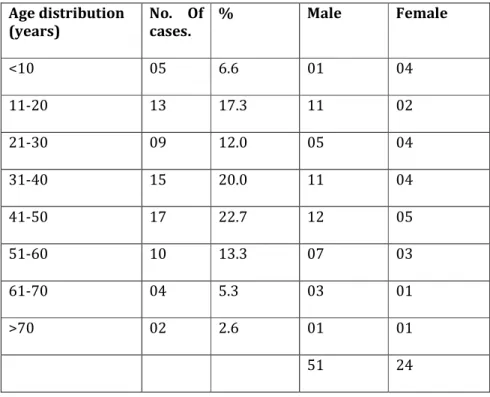
AGE AND SEX DISTRIBUTION- (TABLE 1): Peak incidence of brain Tumors was observed in
middle life and they comprised 17 (22.7%) of tumors examined. Second peak was observed in second decade of life and male / female ratio was 5.5:1. Male/female ratio of all patients irrespective of age group was 2.12:1. Age of youngest patient was 5 months. Age of the oldest patient was 75 years.
Table-1 age and sex distribution of patients (n=75)
Age distribution (years)
No. Of cases.
% Male Female
<10 05 6.6 01 04
11-20 13 17.3 11 02
21-30 09 12.0 05 04
31-40 15 20.0 11 04
41-50 17 22.7 12 05
51-60 10 13.3 07 03
61-70 04 5.3 03 01
>70 02 2.6 01 01
51 24
Following lesions were diagnosed by examining morphology of individual lesion on squash smears – as shown in table No. 2
Astrocytoma, Oligodendroglioma, Ependymoma, Pituitary adenoma, Medullobalstoma, Meningioma, Schwannoma, Neurocytoma, Craniopharyngioma, Lymphoma, Metastatic carcinoma and Epidermoid cyst. Though heamangioblastomas were difficult to squash because of hemorrhage and fibrosis hence on squash smears a diagnosis of benign mesenchymal tumor was given.
Journal of Evolution of Medical and Dental Sciences/Volume1/ Issue4/October - 2012 Page 541
Diagnosis of squash smears No. Of cases %
Astrocytoma low grade 12 16.0
Malignant glioma 13 17.3
Oligodendroglioma 01 1.3
Ependymoma 01 1.3
Pituitary adenoma 03 4.0
Medullobalstoma 08 10.7
Neurocytoma 01 1.3
Meningioma 16 21.3
Schwannoma 09 12.0
Craniopharyngioma 02 2.6
Benign mesenchymal tumor O3 4.0
Small round cell tumor 01 1.3
Lymphoma 01 1.3
Metastasis 01 1.3
Epidermoid cyst 03 4.0
Journal of Evolution of Medical and Dental Sciences/Volume1/ Issue4/October - 2012 Page 542
Table – 3 Histopathological evaluation of lesions (n = 75) -
Histopathological diagnosis No. Of cases %
Astrocytoma grade II 08 10.7
Astrocytoma grade III 02 2.6
Glioblastoma 11 14.7
Mixed oligo astrocytoma 01 1.3
Oligodendroglioma 02 2.6
Anaplastic oligodendroglioma 01 1.3
Ependymoma 02 2.6
Neurocytoma 01 1.3
Pituitary adenoma 03 04
Medullobalstoma 08 10.7
Meningioma 16 21.3
Schwannoma 09 12.0
Craniopharyngioma 02 2.6
Paraganglioma 01 1.3
Hemangioblastoma 03 4.0
Lymphoma 01 1.3
Metastatic carcinoma 01 1.3
Epidermoid cyst 03 4.0
Of these 75 cases, 8 (10.7%) cases showed discordant findings on cytologic and histological examination. Of these, 3 cases were diagnosed as low grade astrocytoma on squash smears, were subsequently diagnosed as ependymoma, mixed oligoastrocytoma and oligo dendroglioma on histological examination where as one case was diagnosed as malignant glioma on squash smears and was subsequently diagnosed as anaplastic oligodendroglioma on histologic examination.
In three cases diagnosis of benign mesenchymal tumor was given on squash smears and final histologic diagnosis of hemangioblastoma was given in all 3 cases.
Journal of Evolution of Medical and Dental Sciences/Volume1/ Issue4/October - 2012 Page 543 In rest of the other tumors like pituitary adenoma, medulloblastoma, meningioma, schwannoma, craniopharyngioma, neurocytoma, lymphoma, and metastatic carcinoma cytologic (squash smear diagnosis) was in accordance with the final histologic diagnosis.
In 8 (10.7%) cases discordance was observed between squash smear diagnosis and histologic diagnosis. In 67 (89.3%) cases squash smear diagnosis was in accordance with the final histologic diagnosis. Thus the diagnostic accuracy of squash smear technique in this study is 89.3%.
Table – 4 comparative analysis of cytologic and histologic diagnosis
Diagnosis Squash smear
diagnosis
Histopathologica l diagnosis
% accuracy
Astrocytoma 25 21 84
Oligodendroglioma 01 03 33.3
Ependymoma 01 02 50
Oligoastrocytoma - 01 -
Neurocytoma 01 01 100
Pituitary adenoma 03 03 100
Medulloblastoma 08 08 100
Meningioma 16 16 100
Schwannoma 09 09 100
Craniopharyngioma 02 02 100
Paraganglioma - 01 -
Hemangioblastoma - 03 -
Lymphoma 01 01 100
Metastatic carcinoma 01 01 100
Epidermoid cyst 03 03 100
Table –5 discordant results (8 cases)
Journal of Evolution of Medical and Dental Sciences/Volume1/ Issue4/October - 2012 Page 544
Low grade astrocytoma Ependymoma
Low grade astrocytoma Mixed oligoastrocytoma
Low grade astrocytoma Oligodendroglioma
Malignant glioma Anaplastic oligodendroglioma
Small round cell tumor Paraganglioma
Benign mesenchymal tumor (3 cases) hemangioblastoma
DISCUSSION: The intra-operative cytology preparation was first introduced by Eisenhardt L in
1930 and by Badt in 1937. (7)
Present work has been undertaken to study the diagnostic accuracy of squash smear technique for rapid per-operative diagnosis of neurosurgical biopsies. A total of 75 lesions were examined in this study. In all cases history, laboratory investigations, radiological findings and previous investigation if any were recorded. Biopsy material was obtained by craniotomy from these cases intra-operatively and was subjected to squash smear technique followed by subsequent histopathological examination of the remaining material. (8)
This study showed that peak incidence of brain Tumors was in the middle life and they constituted 17 (22.7%) of all the Tumors examined with Second peak in 2nd decade of life and
male/female ratio was 5.5:1 in this age group. Age of the youngest patient was 5 months old baby and age of the oldest was 75 years. Male/female ratio of all patients irrespective of age group was 2.12:1. Thus male showed a greater incidence of brain Tumors as compared to females. (9)
In the present study, accuracy rate of 89.3% is comparable to the other studies conducted in the past. (10, 11, 12, 13, 14, 15)
CONCLUSION: Thus the value of squash smear technique in rapid preoperative diagnosis of
neurosurgical biopsies is corroborated by above study. The accuracy of this study (89.3%) matched with the other studies done in the past on squash smear technique. So we recommend using this technique regularly for rapid intra-operative diagnosis of intracranial space occupying lesion. (10, 11, 12, 13, 14, 15)
BIBLIOGRAPHY:
1. Lannering B, Sandström PE, Holm S, Lundgren J, Pfeifer S, Samuelsson U, Strömberg B,
Gustafsson G; Swedish Childhood CNS Tumor Working Group Classification, incidence
and survival analyses of children with CNS Tumors diagnosed in Sweden 1984-2005.
Acta Paediatr. 2009 Oct;98(10):1620-7. Epub 2009 Jul 7.
2. (2). Asha T, Shankar SK, Rao TV, Das S. Role of squash-smear technique for rapid
diagnosis of neurosurgical biopsies--a cytomorphological evaluation. Indian J Pathol
Microbiol. 1989 Jul;32(3):152-60.
Journal of Evolution of Medical and Dental Sciences/Volume1/ Issue4/October - 2012 Page 545 central nervous system Tumors Cytopathology. 2011 Aug 15. doi: 10.1111/j.1365-2303.2011.00905.x.
4. Collaço LM, Tani E, Lindblom I, Skoog L. Stereotactic biopsy and cytological diagnosis in solid and cystic intracranial lesions. Cytopathology. 2003;14:131–5.
5. Olasode BJ, Ironside JW. The brain smear, a rapid affordable intraoperative diagnostic technique for brain Tumors appropriate for Africa. Trop Doct. 2004;34:223–5.
6. Silverberg SG, Delellis RA, Frable WJ: Principle and practice of surgical pathology and cytopathology, vol.3, 3rd edn.1997.
7. Eisenhardt L, Cushing H. Diagnosis of Intracranial Tumors by Supravital Technique. Am J
Pathol. 1930 Sep;6(5):541-552.7.
8. Nandita Ghosal, A S Hegde, Ganesh Murthy, Sunil V Furtado Smear preparation of
intracranial lesions: a retrospective study of 306 cases Diagnostic Cytopathology
(impact factor: 1.3). 08/2011; 39(8):582-92.
9. Shibui S. The present status and trend of brain tumors based on the data of the Brain
Tumor Registry of Japan. Brain Nerve. 2012 Mar;64(3):286-90.
10. Willems JG, Alva-Willems JM. Accuracy of cytologic diagnosis of central nervous system
neoplasms in sterotactic biopsies.Acta Cytol. 1984 May-Jun;28(3):243-9.
11. Mc Mennemey WH: An appraisal of smear diagnosis in neurosurgery. Am. J. Clin. Pathol. 33:471,1960
12. Berkeley BB, Adams JH, Doyle D, Graham DI, Harper CG. The smear technique in the diagnosis of neurosurgical biopsies. N Z Med J. 1978 Jan 11;87(603):12-5.
13. Iqbal M, Shah A, Wani MA, Kirmani A, Ramzan A. Utility of Crush Smear Cytology in Intraoperative Diagnosis of Central Nervous System lesions. Acta Cytol 2006; 50(6): 608-16.