Lactate-Utilizing Strain
Pseudomonas stutzeri
SDM
Chao Gao1, Jianhua Qiu1, Cuiqing Ma1*, Ping Xu2,1
1State Key Laboratory of Microbial Technology, Shandong University, Jinan, People’s Republic of China,2State Key Laboratory of Microbial Metabolism, Shanghai Jiao Tong University, Shanghai, People’s Republic of China
Abstract
Background:The platform chemical lactate is currently produced mainly through the fermentation of sugars presented in
biomass. Besides the synthesis of biodegradable polylactate, lactate is also viewed as a feedstock for the green chemistry of the future. Pyruvate, another important platform chemical, can be produced from lactate through biocatalysis.
Methodology/Principal Findings:It was established that whole cells ofPseudomonas stutzeriSDM catalyze lactate oxidation with lactate-induced NAD-independent lactate dehydrogenases (iLDHs) through the inherent electron transfer chain. Unlike the lactate oxidation processes observed in previous reports, the mechanism underlying lactate oxidation described in the present study excluded the costliness of the cofactor regeneration step and production of the byproduct hydrogen peroxide.
Conclusions/Significance:Biocatalysis conditions were optimized by using the cheapDL-lactate as the substrate and whole cells of the lactate-utilizingP. stutzeriSDM as catalyst. Under optimal conditions, the biocatalytic process produced pyruvate at a high concentration (48.4 g l21) and a high yield (98%). The bioconversion system provides a promising alternative for
the green production of pyruvate.
Citation:Gao C, Qiu J, Ma C, Xu P (2012) Efficient Production of Pyruvate fromDL-Lactate by the Lactate-Utilizing StrainPseudomonas stutzeriSDM. PLoS ONE 7(7): e40755. doi:10.1371/journal.pone.0040755
Editor:Shuguang Zhang, Massachusetts Institute of Technology, United States of America
ReceivedApril 1, 2012;AcceptedJune 12, 2012;PublishedJuly 9, 2012
Copyright:ß2012 Gao et al. This is an open-access article distributed under the terms of the Creative Commons Attribution License, which permits unrestricted use, distribution, and reproduction in any medium, provided the original author and source are credited.
Funding:The work was supported by the National Natural Science Foundation of China (31000014 and 31170052), and by the Research Fund for the Doctoral Program of Higher Education of China (Grant no. 20090131110036). The funders had no role in study design, data collection and analysis, decision to publish, or preparation of the manuscript.
Competing Interests:The authors have declared that no competing interests exist.
* E-mail: [email protected]
Introduction
Lactic acid, the most important hydroxycarboxylic acid, is currently commercially produced by the fermentation of sugars present in biomass [1–3]. In addition to its use in the synthesis of biodegradable polymers [4], lactic acid can also be regarded as a feedstock for the green chemistry of the future [1]. For example, pyruvate, another important platform chemical, can be produced from lactate through direct oxidation [5–7]. Considering the significant difference in their prices, the production of pyruvate from lactate by catalysis is a valuable process.
Most of the reported chemical catalysts convert a major part of lactate to acetaldehyde and CO2rather than pyruvate [7]. Indeed, there have been very few attempts to bring about the oxidative dehydrogenation of lactate through chemical catalysis [5,6]. Biocatalysts could catalyze lactate to pyruvate under relatively mild conditions [1,6]. Different enzymes, such as NAD-dependent lactate dehydrogenases (nLDHs) and lactate oxidase, have been employed in the biotechnological production of pyruvate from lactate. However, the costliness of cofactor NAD or the production of the byproduct hydrogen peroxide restricted the industrial application of nLDHs and lactate oxidase, respectively [1,7].
In a previous report,Pseudomonas stutzeriSDM was reported to have the ability to produce pyruvate from lactate with oxygen as the terminal electron acceptor [8]. No hydrogen peroxide was
produced duringP. stutzeriSDM catalyzed lactate oxidation, which made the strain a promising biocatalyst for the commercial pyruvate production. NAD-independent lactate dehydrogenases (iLDHs) were reported to be involved in the lactate oxidation process [8–12]. However, iLDHs could not directly use the oxygen as the electron acceptor, which made the lactate oxidation process in strain SDM rather confusing. To further explore the strain with regard to pyruvate production, the aim of the present study is to determine how iLDHs are involved in the oxidation of lactate. After illustrating the pyruvate-producing mechanism, optimal conditions for the production of pyruvate from a cheap substrate, DL-lactate, by the lactate-utilizing strain SDM were also developed.
Results
Pyruvate-producing Mechanism inP. stutzeriSDM
extract were studied. As shown in Table 1, the cytochrome c
reductase inhibitor antimycin A distinctly inhibited the pyruvate-producing activity. This implied that iLDHs in P. stutzeri SDM might use quinone as the natural electron acceptor. The electron acquired by quinone would be transferred to cytochrome (by cytochromecreductase) and then terminally transferred to oxygen (by cytochrome oxidase). In addition to the traditionally cytochrome oxidase,Pseudonomasstrains also have some alternative cytochrome oxidase, such as cytochrome cbb3 oxidase [16]. Although the cytochrome oxidase inhibitors (diphenylamine, NaN3, and salicylhydroxamic acid) exhibited different inhibition effects on theL- andD-lactate oxidation activities ofP. stutzeriSDM due to the complexity of the cytochrome oxidase system in
Pseudonomasstrains, those results implied the roles of cytochrome in the lactate oxidation process.
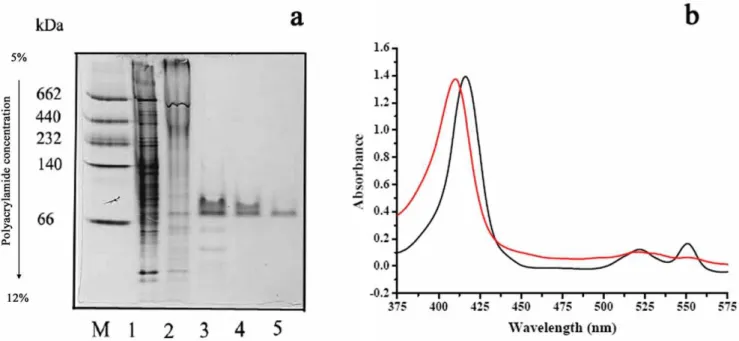
Next, a cytochromecfraction was purified fromP. stutzeriSDM (Figure 1a). After oxidizing cytochrome c with ferricyanide, a crude extract of P. stutzeriSDM and DL-lactate were added. As shown in Figure 1b, the addition of DL-lactate to the reaction system produced a characteristic of reduced cytochrome c. The reduction of cytochrome c by DL-lactate further supported the
participation of cytochrome in the lactate oxidation process. On the basis of the results mentioned above, it is concluded that iLDHs and the electron transport chain account for the observed oxidation of lactate inP. stutzeriSDM.
Effect of Dissolved Oxygen on Biotransformation Activity In the case of the lactate oxidation mechanism in P. stutzeri
SDM, the components of the respiratory chain may influence biotransformation activity distinctly. Because the components of the respiratory chain are different under various dissolved oxygen (DO) concentrations, the effect of DO on the biotransformation activity ofP. stutzeriSDM was studied in a 5-l reactor. As shown in Figure 2, when 15% DO was employed in the culture, the highest biotransformation activity was obtained.
D-Lactate orL-lactate has been employed in pyruvate produc-tion [1,5,7]. Because of the low price and large sources of racemic lactate compared to optical lactate, DL-lactate was used as the substrate for pyruvate production in this work.
Figure 1. Involvement of cytochromecin lactate oxidation ofP. stutzeriSDM.(a) Native-PAGE of cytochromecinP. stutzeriSDM. Lane M: molecular mass standards in kilodaltons (kDa) (GE Healthcare); lane 1: cell extract ofP. stutzeriSDM; lane 2: membrane fractions ofP. stutzeriSDM; lane 3: pooled fraction containing cytochromecafter DEAE-Sepharose; lanes 4 and 5: pooled fraction containing cytochromecafter DEAE-A25. (b) The absorption spectrum of cytochromecinP. stutzeriSDM. Black line: reaction mixtures consisting of cytochromec, crude extract ofP. stutzeriSDM and
DL-lactate. Red line: reaction mixtures consisting of cytochromecand crude extract ofP. stutzeriSDM. doi:10.1371/journal.pone.0040755.g001
Table 1.Effects of different respiratory chain depressors on the lactate oxidation activities.
Depressor L-Lactate oxidation activity (U mg21) D-Lactate oxidation activity (U mg21)
No inhibitor 0.17060.004 0.09160.004
Salicylhydroxamic acid (0.5 mM) 0.11260.007 0.06960.001
Diphenylamine (0.5 mM) 0.14960.020 0.08860.002
NaN3(0.5 mM) 0.11060.008 0.08660.001
Antimycin A (0.1 mM) 0.02260.002 0.03660.001
doi:10.1371/journal.pone.0040755.t001
Optimal Range of pH
Influence of reaction pH on pyruvate production was determined in 100 mM phosphate buffer containing 6 g dry cell weight (DCW) l21of cell biomass ofP. stutzeriSDM and 0.4 M
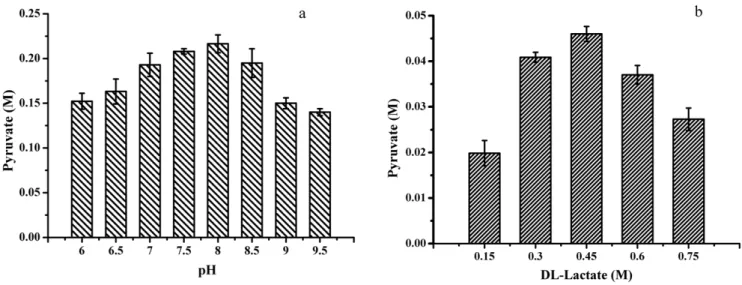
DL -lactate at 30uC. As shown in Figure 3a, after biocatalysis for 24 h, the highest pyruvate production was detected at pH 8.0.
Effect ofDL-lactate Concentration on Biocatalysis Substrate concentration was also important for the conversion of DL-lactate to pyruvate. Effect of the concentration ofDL-lactate on biocatalysis was investigated to determine its optimal range. TheDL-lactate concentration was varied from 0.15 to 0.75 M. As shown in Figure 3b, after 2 h of biocatalysis, the highest pyruvate production was detected when the concentration ofDL-lactate was 0.45 M. High DL-lactate concentration (more than 0.6 M) would lead to substrate inhibition and resulted in lower pyruvate concentrations.
Optimal Reaction Temperature
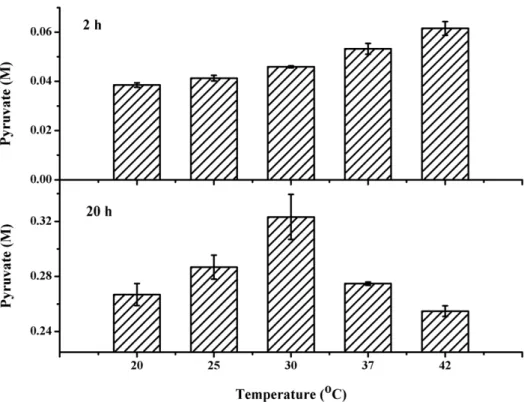
To investigate the influence of reaction temperature on pyruvate production, the reaction was carried out at different temperatures at pH 8.0. As shown in Figure 4, the highest pyruvate production was detected at 30uC after 24 h. Although high pyruvate production could be detected at 42uC after 2 h, because of biocatalyst instability under high temperature, the optimal reaction temperature was determined to be 30uC.
Optimal Range of Cell Biomass
Biocatalysis was carried out with 2–16 g DCW l–1ofP. stutzeri
SDM as the biocatalyst. As shown in Figure 5, 10 g DCW l–1ofP. stutzeri SDM was optimal and produced the highest pyruvate concentration and relatively high specific biotransformation activity.
Optimal Range of DO
The biocatalysis production of pyruvate from lactate was a bio-oxidation process. Oxygen would be the terminal electron acceptor. Thus, oxygen was also the substrate of the biocatalysis process and the effect of DO on pyruvate production should be investigated. As shown in Table 2, 0.39 M pyruvate was produced after 39 h with a low amount of DO (5%). Pyruvate production was improved by increasing the DO content to 15%. However, with higher DO (30%), the lactate oxidation decreased, and only 0.19 M pyruvate was produced. This might be due to the substrate inhibition effect of oxygen. The optimal DO content was then determined to be 15%. This result was consistent with our previous report which related to the production of pyruvate from L-lactate [17].
Combining these results, an optimal biotransformation system for the production of pyruvate fromDL-lactate was developed. The biocatalysis was conducted at 30uC in distilled water (pH was adjusted to 8.0) with 10 g DCW l21 of P. stutzeri SDM as the biocatalyst. The DO saturation was controlled at 15%. TheDL -lactate concentration in the 5-l reactor was about 0.45 M. As shown in Figure 6, 0.44 M pyruvate was obtained from 0.45 M DL-lactate after 29 h of biotransformation.
Discussion
Pyruvate is an important starting material widely applied in chemical, pharmaceutical, and agrochemical industries [6,18]. Commercial pyruvate is produced by dehydration and decarbox-ylation of tartaric acid. This classical chemical route is energy-intensive and controversial with issues of environmental protection and sustainable process development [6,7]. Novel systems which produce pyruvate by biotechnological methods have been the research focus [19–22]. Microbial fermentation currently plays a dominant role in biotechnological production of pyruvate [23–26]. High concentration (135 g l21) and high volumetric productivity (6 g l21h21) of pyruvate have been obtained through
fermenta-Figure 2. Time course ofP. stutzeriSDM growth in the media with different dissolved oxygen.(a) 5%; (b) 15%; (c) 30%. (&) OD620nm; (
N
)Biotransformation activity; (m)DL-Lactate. Data are the average6SD of three separate experiments.
doi:10.1371/journal.pone.0040755.g002
Figure 3. Optimization of biocatalysis conditions.(a) Effect of pH on pyruvate production; (b) Effect of lactate concentrations on pyruvate production.
doi:10.1371/journal.pone.0040755.g003
tion [25,26]. However, biocatalysis processes, due to their simple composition of reaction mixture, high conversion rate of substrate, and convenience of recovery, are also promising in the biotech-nological production of pyruvate [6].
Lactate, which can be easily produced from biomass, is the most promising substrate in the biocatalysis production of pyruvate [1,7]. Of the enzymes employed in the lactate-based pyruvate production, lactate oxidase has been studied extensively [1,7].
Figure 5. Effect of concentration ofP. stutzeriSDM on the production of pyruvate fromDL-lactate.BTA: biotransformation activity.
doi:10.1371/journal.pone.0040755.g005
Figure 4. Effect of temperature on the production of pyruvate fromDL-lactate.
Lactate oxidase catalyzes pyruvate formation fromL-lactate with oxygen as the second substrate, giving hydrogen peroxide as a byproduct. Hydrogen peroxide decomposes pyruvate to acetate, carbon dioxide, and water, lowering the production yield. If the problem of further oxidation of pyruvate by hydrogen peroxide can be solved, the biocatalysis production of pyruvate from lactate has the potential to be commercialized because of the low price of lactate [1,6,7].P. stutzeriSDM was confirmed to have the ability to produce pyruvate from lactate with the merit of no hydrogen peroxide production. iLDHs inP. stutzeriSDM firstly acquired the electron from the lactate and then the electron would be terminally transferred to oxygen. However, the electron transfer process has never been clarified in previous works.
Pyruvate production by (2R )-hydroxycarboxylate-viologen-oxi-doreductase (HVOR) inProteus vulgarisorProteus mirabiliswith the addition of artificial redox mediators was studied in previous reports [27,28]. The regeneration of artificial redox mediators was achieved by chemical or electrochemical methods. However, in the case ofP. stutzeri SDM, pyruvate was produced without the addition of an artificial redox mediator. The reduction of cytochrome c inP. stutzeri SDM by DL-lactate implied that the electron transfer components of respiratory chain might play an important role in lactate oxidation. Effects of different respiratory chain inhibitors on the pyruvate production further identified the involvement of the electron transfer chain in the lactate oxidation process. UnlikeProteusstrains, the cofactor regeneration of iLDHs in P. stutzeri SDM may employ the inherent electron transfer system of the strain. This process, which excludes the expensive cofactor regeneration step, makes P. stutzeri SDM a rather
practicable alternative for the biocatalytic production of pyruvate. Under the optimal conditions, with biocatalyst prepared from 10 g DCW l21ofP. stutzeriSDM, 0.44 M pyruvate was obtained after 29 h.
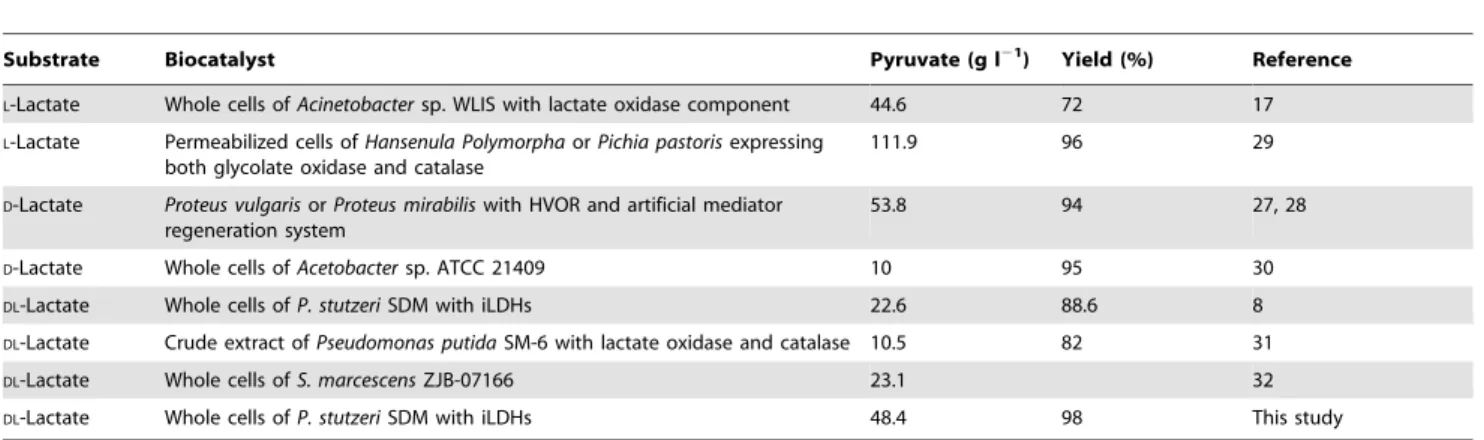
As shown in Table 3, pyruvate production from D-lactate,L -lactate, andDL-lactate has been studied in previous works [29–32]. Genetically modifiedHansenula polymorpha and Pichia pastoris cells expressing glycolate oxidase could catalyzeL-lactate into pyruvate with rather high yield [29]. For the decomposition of the byproduct hydrogen peroxide, co-expression of catalase with glycolate oxidase in genetically modified yeasts was needed [1,7]. Whole cells ofP. stutzeriSDM catalyzed lactate oxidation without the production of hydrogen peroxide. On the other hand, the glycolate oxidase could only utilizeL-lactate as the substrate but a large amount of lactate produced today is a racemic mixture of both stereospecific forms. P. stutzeri SDM possesses 2 inducible iLDHs which give the strain the ability to useDL-lactate, a much cheaper substrate than the optical lactate, as the substrate to produce pyruvate.
Recently,Serratia marcescensZJB-07166 has been applied in the biotransformation of DL-lactate to pyruvate. The pyruvate concentration of 0.21 M was achieved under an optimum condition [32]. The newly isolated S. marcescens ZJB-07166 was regarded as a promising strain for pyruvate production at an industrial scale [32]. Under the conditions optimized in the present study, a much higher concentration of pyruvate (0.44 M) was obtained from the cheap substrateDL-lactate than in previous reports.
In conclusion, the lactate-utilizing P. stutzeri strain SDM was confirmed to catalyze lactate oxidation through iLDHs and the inherent electron transfer chain. Preparation of pyruvate fromDL -lactate was carried out under the following optimal conditions: DCW, 10 g l21; pH 8.0; temperature, 30
uC; DO saturation, 15%; and DL-lactate concentration, 0.45 M. After 29 h of biotransfor-mation, pyruvate was obtained at a high concentration (48.4 g l21) and a high yield (98%). The biocatalysis process introduced in this study provides not only a rather feasible method for pyruvate production but also a green pathway for the utilization of lactate produced from biomass.
Materials and Methods
Chemicals
L-Lactate and bovine serum albumin were purchased from Sigma. D-Lactate was purchased from Fluka. DL-Lactate was purchased from Wujiang Ciyun Flavor & Fragrance Co. Ltd. (P. R. China). Diphenylamine, antimycin A, and salicylhydroxamic acid were purchased from Sigma. All other chemicals were of reagent grade.
Microorganism and Biocatalyst Preparation
P.stutzeri SDM (China Center for Type Culture Collection No. M 206010) isolated from soil was used [9]. The minimal salt
Table 2.Effect of DO on the pyruvate production.
DO Pyruvate concentration (M) Reaction time (h) Productivity (mM h21)
5% 0.387 39 9.92
15% 0.44 29 15.17
30% 0.186 25 7.44
doi:10.1371/journal.pone.0040755.t002
Figure 6. Time course of pyruvate production by P. stutzeri
SDM. 10 mM EDTA was added in the biocatalysis system to inhibit pyruvate degradation. (&) Pyruvate; (
N
) DL-lactate. Data are theaverage6SD of three separate experiments. doi:10.1371/journal.pone.0040755.g006
medium (MSM) supplemented with 10.0 g 121 DL-lactate was used as the fermentation medium [9]. For biocatalyst preparation, cells of the SDM strain cultivated at 30uC were harvested from MSM by centrifugation, washed twice with 0.85% (w/v) sterile salt water, and then resuspended in various concentrations with distilled water.
Preparation of Crude Cell Extract
Cells of the SDM strain grown in MSM containingDL-lactate as the sole carbon source were resuspended in 50 mM Tris-HCl (pH 8.0) and disrupted by sonication (Sonics 500 W/20 KHz, USA) in an ice bath. The disrupted cells were subjected to centrifugation for 20 min at 12,000g, and the supernatant was used as crude cell extract.
Purification of Cytochrome in P. stutzeriSDM
The membrane fraction ofP. stutzeriSDM was prepared from the crude cell extract by centrifugation at 147,000gfor 180 min. Triton X-100 (10%, w/v) was added to the membrane fraction to a final concentration of 1 mg mg21of protein. The supernatant (detergent extract) was applied to a column of DEAE Sepharose Fast Flow equilibrated with Buffer A: 50 mM Tris-HCl (pH 8.0) containing 1 mM dithiothreitol (DTT), 5 mM MgSO4, 0.1% Triton X-100, and 1 mM EDTA. The column was washed with Buffer B: 50 mM Tris-HCl (pH 8.0) containing 1 mM DTT, 200 mM KCl, 5 mM MgSO4, 0.1% Triton X-100, and 1 mM EDTA at a flow rate of 5 ml min21. Cytochrome from column effluents was monitored by measuring the absorbance at 410 nm. The fractions containing cytochrome were concentrated by ultrafiltration and desalted with gel G-25. The cytochrome pool after desalting was then applied to a column of DEAE A-25 pre-equilibrated with Buffer A. The column was washed with a linear gradient of 0–100% Buffer B at a flow rate of 0.5 ml min21. The
fractions containing cytochrome were concentrated and stored at 0 to 4uC. Native polyacrylamide gel electrophoresis (native-PAGE) was performed on a 5–12% native polyacrylamide gradient gel with a Mini-Protean III system (Bio-Rad) according to the protocol by Davis [33]. After electrophoresis, the gel was stained for the protein with Coomassie Brilliant Blue R-250.
Pyruvate-producing Activity Assay
Pyruvate-producing activity was determined in 1 ml of 67 mM phosphate buffer (pH 7.4) containing 20 mM L-lactate or D -lactate. The reaction was initiated by the addition of whole cells or crude cell extract of SDM at 37uC for 10 min. The reaction was stopped by adding 0.05 ml of 1 M NaOH. The mixture was subjected to centrifugation for 1 min at 16,000g, and a 0.5-ml portion of the supernatant was used for pyruvate detection. One unit was defined as the amount of enzyme that converted lactate to 1.0mM pyruvate per minute under the test conditions.
Analytical Methods
Accurate concentrations of lactate and pyruvate were analyzed by HPLC (Agilent 1100 series, Hewlett-Packard, USA) using an Aminex HPX-87H column (Bio-Rad), which was running at 0.4 ml min21with 10 mM H
2SO4as eluent at 55uC [34]. UV and visible absorption spectra of the cytochrome were measured by an UltrospecTM2100proUV/visible spectrophotometer (GE Health-care). Protein was determined by the Markwell variation of the Lowry method, with bovine serum albumin as the standard [35].
Author Contributions
Conceived and designed the experiments: PX CM. Performed the experiments: CG JQ. Analyzed the data: CG JQ. Contributed reagents/ materials/analysis tools: PX CM. Wrote the paper: CG CM PX.
References
1. Gao C, Ma C, Xu P (2011) Biotechnological routes based on lactic acid production from biomass. Biotechnol Adv 29: 930–939.
2. John RP, Nampoothiri KM, Pandey A (2007) Fermentative production of lactic acid from biomass: an overview on process developments and future perspectives. Appl Microbiol Biotechnol 74: 524–534.
3. Qin J, Wang X, Zheng Z, Ma C, Tang H, et al. (2010) Production ofL-lactic acid by a thermophilicBacillusmutant using sodium hydroxide as neutralizing agent. Bioresour Technol 101: 7570–7576.
4. Distel KA, Zhu G, Wang P (2005) Biocatalysis using an organic-soluble enzyme for the preparation of poly(lactic acid) in organic solvents. Bioresour Technol 96: 617–623.
5. Ai M, Ohdan K (1997) Oxidative dehydrogenation of lactic acid to pyruvic acid over iron phosphate catalyst. Appl Catal A: Gen 150: 13–20.
6. Li Y, Chen J, Lun SY (2001) Biotechnological production of pyruvic acid. Appl Microbiol Biotechnol 57: 451–459.
7. Xu P, Qiu JH, Gao C, Ma CQ (2008) Biotechnological routes to pyruvate production. J Biosci Bioeng 105: 169–175.
8. Hao J, Ma C, Gao C, Qiu J, Wang M, et al. (2007)Pseudomonas stutzerias a novel biocatalyst for pyruvate production fromDL-lactate, Biotechnol Lett 29: 105– 110.
9. Ma C, Gao C, Qiu J, Hao J, Liu W, et al. (2007) Membrane-boundL- andD -lactate dehydrogenase activities of a newly isolatedPseudomonas stutzeristrain. Appl Microbiol Biotechnol 77: 91–98.
10. Gao C, Hu CH, Zheng ZJ, Ma CQ, Jiang TY, et al. (2012) Lactate utilization is regulated by the FadR-type regulator LldR inPseudomonas aeruginosa. J Bacteriol 194: 2687–2692.
Table 3.Overview of literature on the enzymatic synthesis of pyruvate from lactate.
Substrate Biocatalyst Pyruvate (g l21) Yield (%) Reference
L-Lactate Whole cells ofAcinetobactersp. WLIS with lactate oxidase component 44.6 72 17
L-Lactate Permeabilized cells ofHansenula PolymorphaorPichia pastorisexpressing both glycolate oxidase and catalase
111.9 96 29
D-Lactate Proteus vulgarisorProteus mirabiliswith HVOR and artificial mediator regeneration system
53.8 94 27, 28
D-Lactate Whole cells ofAcetobactersp. ATCC 21409 10 95 30
DL-Lactate Whole cells ofP. stutzeriSDM with iLDHs 22.6 88.6 8
DL-Lactate Crude extract ofPseudomonas putidaSM-6 with lactate oxidase and catalase 10.5 82 31
DL-Lactate Whole cells ofS. marcescensZJB-07166 23.1 32
DL-Lactate Whole cells ofP. stutzeriSDM with iLDHs 48.4 98 This study
11. Gao C, Jiang TY, Dou PP, Ma CQ, Li LX, et al. (2012) NAD-IndependentL -lactate dehydrogenase is required forL-lactate utilization inPseudomonas stutzeri SDM PLoS ONE 7: e36519.
12. Jiang TY, Gao C, Su F, Zhang W, Hu CH, et al. (2012) Genome sequence of Pseudomonas stutzeri SDM-LAC, a typical strain for studying the molecular mechanism of lactate utilization. J Bacteriol 194: 894–895.
13. Gao C, Qiu JH, Li JC, Ma CQ, Tang HZ, et al. (2009) Enantioselective oxidation of racemic lactic acid toD-lactic acid and pyruvic acid byPseudomonas stutzeriSDM. Bioresour. Technol 100: 1878–1880.
14. Gao C, Zhang W, Lv CJ, Li LX, Ma CQ, et al. (2010) Efficient production of 2-oxobutyrate from 2-hydroxybutyrate by using whole cells ofPseudomonas stutzeri strain SDM. Appl Environ Microbiol 76: 1679–1682.
15. Gao C, Zhang W, Ma CQ, Liu P, Xu P (2011) Kinetic resolution of 2-hydroxybutanoate racemic mixtures by NAD-independentL-lactate dehydroge-nase. Bioresour Technol 102: 4595–4599.
16. Buschmann S, Warkentin E, Xie H, Langer JD, Ermler U, et al. (2010) The structure ofcbb3cytochrome oxidase provides insights into proton pumping.
Science 329: 327–330.
17. Ma CQ, Xu P, Qiu JH, Zhang ZJ, Wang KW, et al. (2004) An enzymatic route to produce pyruvate from lactate. Appl Microbiol Biotechnol 66: 34–39. 18. Stottmeister U, Aurich A, Wilde H, Andersch J, Schmidt S, et al. (2005) White
biotechnology for green chemistry: fermentative 2-oxocarboxylic acids as novel building blocks for subsequent chemical syntheses. J Ind Microbiol Biotechnol 32: 651–664.
19. Miyazaki M, Shibue M, Ogino K, Nakamura H, Maeda H (2001) Enzymatic synthesis of pyruvic acid from acetaldehyde and carbon dioxide. Chem Commun 18: 1800–1801.
20. Ogawa J, Soong CL, Masashi I, Shimizu S (2001) Enzymatic production of pyruvate from fumarate–an application of microbial cyclic–imide transforming pathway. J Mol Catal B: Enzym 11: 355–359.
21. Buto S, Pollegioni L, Angiurl L, Pilone MS (1994) Evaluation ofD-amino-acid oxidase fromRhodotorula gracilisfor the production of alpha-keto acids. Biotechnol Bioeng 44: 1288–1294.
22. Dixon NM, James EW, Lovitt RW, Kell DB (1989) Electromicrobial transformation using the pyruvate synthase system of Clostridium sporagenes. Bioelectrochem Bioenerg 21: 245–259.
23. Causey TB, Shanmugam KT, Yomano LP, Ingram LO (2003) Engineering Escherichia colifor efficient conversion of glucose to pyruvate. Proc Nat Acad Sci USA 101: 2235–2240.
24. Li Y, Hugenholtz J, Chen J, Lun SY (2002) Enhancement of pyruvate production byTorulopsis glabratausing a two-stage oxygen supply control strategy. Appl Microbiol Biotechnol 60: 101–106.
25. van Maris AJ, Geertman JM, Vermeulen A, Groothuizen MK, Winkler AA, et al. (2004) Directed evolution of pyruvate decarboxylase-negativeSaccharomyces cerevisiae, yielding a C2-independent, glucose-tolerant, and pyruvate-hyperpro-ducing yeast. Appl Environ Microbiol 70: 159–166.
26. Zelic´ B, Gostovic S, Vuorilehto K, Vasic´-Racki D, Takors R (2004) Process strategies to enhance pyruvate production with recombinantEscherichia coli: from repetitive fed-batch to in situ product recovery with fully integrated electrodialysis. Biotechnol Bioeng 85: 638–646.
27. Hekmat D, Danninger J, Simon H, Vortmeyer D (1999) Production of pyruvate from (R)-lactate in an enzyme-membrane reactor with coupled electrochemical regeneration of the artificial mediator anthraquinone-2,6-disulfonate. Enzyme Microb Technol 24: 471–479.
28. Schinschel C, Simon H (1993) Preparation of pyruvate from (R)-lactate with Proteusspecies. J Biotechnol 31: 191–203.
29. Eisenberg A, Seip JE, Gavagan JE, Payne MS, Anton DL, et al. (1997) Pyruvic acid production using methylotrophic yeast transformants as catalyst. J Mol Catal B: Enzym 2: 223–232.
30. Cooper B (1989) Microbial manufacture of pyruvic acid fromD-(–)-lactic acid. DE patent 3733157.
31. Gu JS, Xu P, Qu YB (2002) A biocatalyst for pyruvate preparation fromDL -lactate: lactate oxidase in aPseudomonassp. J Mol Catal B: Enzym 18: 299–305. 32. Liu ZQ, Jia LZ, Zheng YG (2010) Biotransformation ofDL-lactate to pyruvate by a newly isolatedSerratia marcescensZJB-07166. Process Biochem 45: 1632– 1637.
33. Davis BJ (1964) Disc electrophoresis II. Method and application to human serum proteins. Ann NY Acad Sci 121: 404–427.
34. Gao C, Xu XX, Hu CH, Zhang W, Zhang Y, et al. (2010) Pyruvate producing biocatalyst with constitutive NAD-independent lactate dehydrogenases. Process Biochem 45: 1912–1915.
35. Markwell MAK, Haas SM, Bieber LL, Tolbert NE (1978) A modification of the Lowry procedure to simplify protein determination in membrane and lipoprotein samples. Anal Biochem 87: 206–210.