FREE THEMES
1 Departamento de Enfermagem, Centro de Ciências da Saúde, Universidade Federal do Ceará. R. Alexandre Baraúna 1115, Rodolfo Teófilo. 60430-160 Fortaleza CE Brasil. [email protected] 2 Prefeitura Municipal de Fortaleza.
3 Departamento de Saúde Coletiva, Centro de Ciências da Saúde, Universidade Federal do Ceará. 4 Universidade Federal de Pernambuco.
The historic data series on AIDS in the state of Ceará, Brazil
Abstract This study describes the historic re-cords on AIDS in the Brazilian state of Ceará, with analysis by gender, age group and race. It is a descriptive, retrospective, ecological study, an-alyzing 7,896 notifications of cases of AIDS, of people aged 13 and above, resident in the Ceará, over the period 2001 through 2011. Percentage oc-currences and other data were calculated based on the variables gender, age group and race. Average and comparison tests were made, considering p < 0.05 and the trend line. There is a progressive increase in the number of cases. The majority of cases are in men. The ratio between the sexes falls from 2003 through 2007, but the number of wom-en is still lower overall in the period. Higher rates of occurrence were found between the ages of 30 and 39, and of those with black-white mixed-race skin color (80%). Based on the variables studied in the series that was analyzed, the results indicate a need for differentiated strategies in prevention and control of the disease in the state.
Key words Acquired immune deficiency
syndro-me, Epidemiology, Epidemiological monitoring Nathália Lima Pedrosa 1
Simone de Sousa Paiva 2
Rosa Lívia Freitas de Almeida 3
Eliane Rolim de Holanda 4
Ligia Regina Franco Sansigolo Kerr 3
P
e
dr
osa NL
Introduction
The world response to AIDS has achieved signifi-cant gains in terms of prevention and treatment. There continues to be a strong global effort to reach targets, aiming for zero occurrence of new infections, elimination of the stigma related to HIV all over the world, and considerable reduc-tion in the number of deaths related to the
dis-ease1.
After 30 years of the disease in Brazil, there is an increase in survival time of people with HIV/ AIDS, in detriment to the high degree of lethality when the epidemic started. Knowledge of the ep-idemiology of HIV/AIDS in Brazil is fundamen-tal for an understanding of this recent dynamic, providing support in the strategies of prevention and treatment, as well as evaluation of the impact
of universal therapy2.
It is found that numbers of cases of AIDS are increasing among females, younger people, people from the interior of the state, and poorer people. As a result, to achieve the global targets that have been established requires a new look at the epidemiological patterns that emerge in the context of AIDS, to establish health intervention actions that are effective in control of the disease. In Brazil, more than 39,185 cases of the dis-ease were recorded in 2012 – or 20.2 cases of AIDS per 100,000 people in the country. Approx-imately 253,000 deaths in the country were re-lated to AIDS, concentrated in the Southeastern region, which had 56% of the total accumulated number of cases. Over the years 2003 through 2012, the number of cases detected annually in the Northeastern Region of Brazil increased by 62.6%, while in the same period it decreased by 18.6% in the Southeastern Region, and 0.3% in
the South3.
Approximately 800 cases of AIDS were noti-fied in Ceará, in 2012, of which 53.7% were of people living in the state’s capital city, Fortaleza. Since the first records were made of the disease, in the 1980s, a total of 12,246 cases were recorded
up to the year 2012, 70% of them in males4. In
terms of distribution in the interior of the state, 96% of the municipalities of Ceará have had at least one case of AIDS. However, sub-notifica-tion may be the factor responsible for there being some municipalities that have not yet reported once case of the disease.
Ceará is in a region that has severe disparities in relation to AIDS. In a study on the spread of mortality from the disease in Brazil from 1998 through 2008, it was found to have expanded in
the Northeast and North, while declining in the rest of the country, principally in the Southeast – indicating that apparent overall stability of the figures for mortality from AIDS in the country
masks regional differences5.
To establish significant strategies for reduc-ing the risk and vulnerability of individuals and communities, a broad understanding of the re-gional reality is essential. This understanding be-comes an instrument for transformation of the environment where one lives, through adapta-tion of the current public policies in the context of local epidemiology, strengthening of commu-nity capacities, and stimulus to creation of social networks of support for vulnerable people.
This study has all this in mind while describ-ing the historic series of data on AIDS in Ceará in relation to gender, age group and race, over the years 2001-2011.
Methods
This was an ecological, descriptive, retrospective study constituted on the basis of analyses of time series for the rate of occurrence of AIDS in the state of Ceará, for the period 2001 through 2011. Cases of AIDS that had been notified on the compulsory Notification Report of the Reports Notification Information System (Sistema de In-formação de Agravos de Notificação, or Sinan), ob-tained from the State Health Department of the State of Ceará (SESA), were studied.
The category adopted for inclusion was: cas-es of AIDS in people aged 13 or over, rcas-esident in the state of Ceará, notified over the years 2001 through 2011.
A total of 8,003 notifications of cases of AIDS were collected; 38 of these were found to be du-plications, and 69 were for people living outside the state. Thus, 107 were excluded, resulting in a total universe of 7,896 cases for the study.
The rate of occurrence was calculated, by gender and by age group (13-19; 20-24; 25-29; 30-34; 35-39; 40-49; 50-59; and over 60), per 100,000 (using the estimated population of the state for each year). Percentages of cases of AIDS, by race, and their rates of change, by gender and age group, for the period, were also calculated.
aúd
e C
ole
tiv
a,
20(4):1177-1184,
2015
for rejection of the null hypothesis. The prede-termined p-value was 0.05. The trend analysis was established using Pearson’s R test, and all the data distribution functions were tested. Version 20.0 of the Statistical Package for Social Sciences (SPSS) program was used.
The study was approved by the Research Eth-ics Committee of SESA.
Results
Of the 7,896 cases of AIDS, over the period 2001-2011, there was fast growth in rates of occurrence among individuals aged 13 or over, seen in the trend line with potential adjustment, with R² = 0.397 (Graphic 1). In 2001, this rate was 7.69 cas-es of AIDS per 100,000 population, and in 2011 it was 14.14; there were however oscillations between 2004 and 2011, with a fall in the years 2005-7 (from 10.59 to 8.16 cases per 100,000 pop-ulation), and with a maximum of 15.48 in 2010.
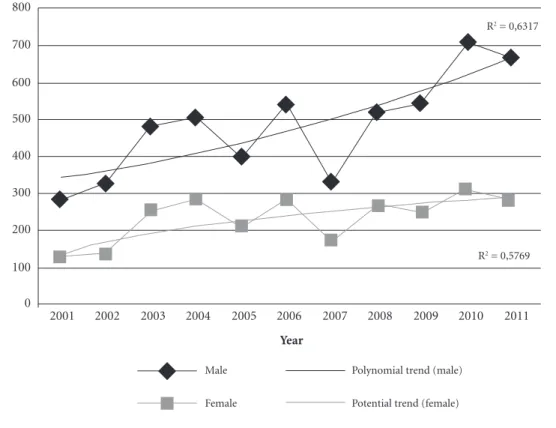
In relation to gender, the majority of the no-tifications of AIDS in the state of Ceará over the period were males – increasing from 11.01 cases per 100,000 population in 2001 to 20.7 in 2011. (Graphic 2). Here, too, there were fluctuations in rates of occurrence, with peaks in the
even-num-ber years 2004, 2006 and 2010, and adjustment following a polynomial trend (R² = 0.6317).
In the female population, cases of AIDS in-creased from 4.62 per 100,000 population, in 2001, to 8.06 per 100,000 in 2011. There was fast growth in the period studied, with adjustment of the potential trend line (R² = 0.577). In the pe-riod 2003-7, there was a fall in the ratio between the sexes, with the proportions varying from 2.4 to 1.8. Even so, women continued to have the lower percentage incidence. There was one case in which the gender was unknown (Graphic 2).
The average age in the diagnosis of cases of AIDS was 36.3 for males and 34.8 for females. The average age for diagnosis in men is statisti-cally higher (p < 0.01) than that of women, sug-gesting that diagnosis of AIDS in the male popu-lation occurs later (Table 1).
In the consideration by age group: Rates of occurrence of the disease showed an upward trend in all the age ranges. (Table 1). There was a rapid increase, adjusted to the potential trend line, in the age ranges 30-34, 35-39, 40-49 and 60 years (with R2 = 0.310, 0.250, 0.360 and 0.476, respectively). There was an adjusted rise in the polynomial trendline in the age range 13-19, with a peak in the years 2003, 2005 and 2009, present-ing the highest R2 of all the age groups (0.646).
Graph 1. Incidence rate of AIDS by year, Ceará, Brazil, 2001-2011. 18
16
14
12
10
8
6
4
2
0
Incid
enc
e (100.000hab
.)
2001 2002 2003 2004 2005 2006 2007 2008 2009 2010 2011
R2 = 0,397 Year
7,69
8,45
13,39 14,12
10,59 14,08
12,49
8,16
12,33 15,48
P
e
dr
osa NL
In the period under study growth was linear in the age range 25-29, with R2 = 0.525.
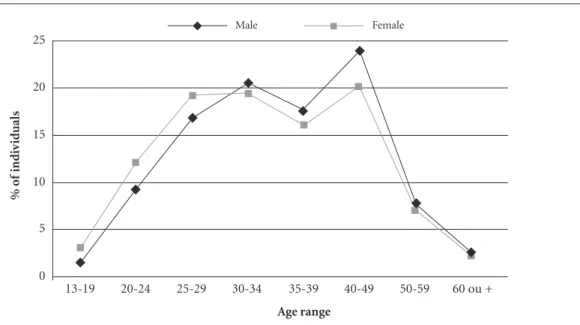
The highest rate of occurrence was in the age groups 30 to 34 and 35 to 39. Among young peo-ple (in the 13-19 age group) notifications of cases grew from less than one case per 100,000 popu-lation, in 2001, to 2.1 in 2011. Among the elder-ly (above age 60), there was a peak in 2010 (4.2 cases per 100,000), which was approximately five times the rate of occurrence in 2001 (Table 1).
Among people in the 13-29 age group, occur-rence of AIDS was greater among females than males, and the difference between the sexes was statistically significant (p < 0.01). Among people of adult age and the elderly, occurrence contin-ues to be greater among males (Graphic 3). In terms of distribution by race, the majority (80%) of cases were in people of mixed race (“pardo” in the Portuguese), followed by white, and then black, individuals. Those described as Asian or Graph 2. Incidence rate of AIDS by sex, Ceará, Brazil, 2001-2011.
800 700 500 400 600 300 200 100 0
2001 2002 2003 2004 2005 2006 2007 2008 2009 2010 2011 R2 = 0,6317
Year
R2 = 0,5769
Male
Female
Polynomial trend (male)
Potential trend (female)
aúd
e C
ole
tiv
a,
20(4):1177-1184,
2015
indigenous South Americans had the lowest pro-portion of cases of AIDS in the period (Table 2).
Discussion
In other studies, the literature has pointed to sec-ondary data, ecological studies and gaps in the historical series as limiting quality of records, and weakness of explanatory hypotheses at the
individual level6-8. In the present work, due to
the scale of the epidemiological indicators used, neither the analyses nor the contraposition of in-formation between variables have suffered as the result of the lack of some information.
Accompanying the trend in the Northeast, in the state of Ceará the rate of occurrence doubled during the period, although it remained below the figures for the whole of Brazil. In the North-east, the rate of occurrence of AIDS has grown
vertiginously in comparison to other regions of the country. Although the largest proportion of notification of AIDS is in the Brazilian Southeast, the proportion of occurrence in the Northeast-ern region of the country doubled over 10 years
(2001 to 2011)9.
As can be seen, AIDS in Ceará does not ac-company the overall Brazilian trend of increasing its occurrence in women, in spite of the acceler-ation of growth, and in this Ceará is similar to
the state of Santa Catarina10. In Brazil there is an
increase in the occurrence of AIDS among wom-en, associated with greater transmission through heterosexual contact, and also progressive incur-sion of the disease among the poor, with expan-sion to regions further away from the large
met-ropolitan centers11.
Studies point to male vulnerability in terms of access to actions for prevention and promo-tion of health, increasing the risk of infecpromo-tion by
Graph 3. Distribution of cases of AIDS by sex and age, Ceará, Brazil, 2001-2011. 20
15 25
10
5
0
13-19 20-24 25-29 30-34 35-39 40-49 50-59 60 ou + Male
% o
f indi
v
id
uals
Age range
Female
Race
Mixed*
White Black Asian Indigenous
Table 2. Percentage of cases of Aids by race, Ceará, Brazil, 2001–2011.
2001
87.5 6.2 0 0 6.2
2002
97.8 6.1 2 0 0
2003
76.8 16 6.2 1 0
2004
60.3 30.3 7.9 1.3 0.3
2005
81.3 14 4.5 0.2 0
2006
86.1 10.3 3.3 0.1 0.1
2007
86.5 9.5 3.5 0.4 0
2008
88.4 7.9 3.2 0.2 0.3
2009
85.6 9.7 4.1 0.4 0.3
2010
83.7 10.2 4.7 0.7 0.6
2011
84.7 9.8 4.4 0.9 0.2
P
e
dr
osa NL
HIV/AIDS. The male population has difficulty in access to healthcare, diagnostic tests and drug therapies, because they are not seen as primary
users of the health services12,13.
However, male individuals report sexual rela-tions at a precocious age, as well as having more sexual partners and more occasional relation-ships than women, which tends to lead them into a category of risk behaviors, and delay in
diagno-sis of serious diseases14. As observed in the survey,
the average age of diagnosis of AIDS is higher among men than women, that is to say diagnosis has occurred later in the masculine population.
In terms of age, a highlight is the increase in cases of the disease among adolescents and young adults, especially females. The ratio be-tween the sexes, among adolescents, has dimin-ished. In people of age 15 to 24 an inversion of the ratio between the sexes took place over the years 2000-2004, reaching 0.9 cases in males for
each case notified in a female2.
Young individuals tend to have sexual experi-ences without the means of prevention and
pro-tection of their health and wellbeing12. Also, few
health units offer individual assistance in sexual and reproductive health to adolescents with HIV that obey the principles of privacy and
confiden-tiality15.
The situation is exacerbated by the high in-dices of advanced immune deficiency among adolescents who have been infected via sexual
contract16. To the fact of the young person having
acquired HIV/AIDS is added the severity with which the virus manifests itself when contagion is by sex at a young age.
Also on the subject of precocious diagnosis in females, a study in the shantytowns (‘favelas’) of Rio de Janeiro found that young females start sexual activity due to perception of a need to
adapt to society17.
In spite of the increased incidence of AIDS among young people in Ceará, occurrence of the disease among adults, above all in the 30-39 age range, continues to be in line with the figures for
the country3. From 1983 to 2012, people in the
20-49 age range accounted for more than 80% of
the notifications in the state of Ceará4. In other
words the disease has affected economically ac-tive individuals, pointing to AIDS also being a problem of the other economic and social sectors of the country. Men who work, and live with HIV, suffer situations of prejudice, fear of discovery of the disease, as well as the treatment interfering with their work performance and generating a
risk of dismissal18.
The study indicates the highest rates, in Ceará, over the period studied, as being in the black/white mixed-race population, followed by white people. Similar rates of occurrence can be
found in the Center-West Region of Brazil19; on
the other hand, in the state of Santa Catarina, the highest rate was among white people, since the population profile of that state is more
predom-inantly white9. It is important to consider the
difficulties of defining ethnic groups in a highly mixed-race country such as Brazil. However, the racial question becomes important because, as systematic review reveals, almost half of the in-vestigations carried out point to the relationship between inequalities in social-economic
indica-tors and in ethnic-racial groups20.
According to the 2010 Census, the majority of people in Ceará state themselves to be mixed-race (black/white), or white – respectively 61.9% and 32% of the state’s population. The data are similar for ethnic groups across Brazil as a whole, in which white and mixed-race (black/white) together comprise more than 90% of all
Bra-zilians21. This pattern would be in line with the
greater occurrence of AIDS in the state of Ceará in people from one of these two racial groups.
aúd
e C
ole
tiv
a,
20(4):1177-1184,
2015
Collaborations
SS Paiva, MTG Galvão and RLF Almeida worked in the design, drafting and approval of the article. ER Holanda, LRFS Kerr and NL Pedrosa worked in the writing of the article.
Referências
Joint United Nations Programme on HIV/Aids. Global AIDS response progress reporting 2013: Construction of core indicators for monitoring the 2011 UN Political De-claration on HIV/AIDS. Genebra: WHO; 2013. Szwarcwald CL, Castilho EA. A epidemia de HIV/ AIDS no Brasil: três décadas. Cad Saude Publica 2011; 27(Supl.1):4-5.
Brasil. Ministério da Saúde (MS). Boletim epidemio-lógico: Aids e DST. Ano II - nº 01 - 01ª a 26ª semanas epidemiológicas - janeiro a dezembro de 2013. Brasília: MS; 2013.
Ceará. Secretaria de Saúde (SESA). Informe Epidemio-lógico. Fortaleza: SESA; 2013.
Teixeira TRA, Gracie R, Malta MS, Bastos FI. Social geography of AIDS in Brazil: identifying patterns of re-gional inequalities. Cad Saude Publica 2014; 30(2):259-271.
Gonçalves VF, Kerr LRFS, Mota RMS, Mota JMA. Esti-mativa de subnotificação de casos de AIDS em uma ca-pital do Nordeste. Rev bras epidemiol 2008; 11(3):356-364.
Duarte EC, Garcia LP, Freitas LRS, Mansano NH, Mon-teiro RA, Ramalho WM. Associação ecológica entre características dos municípios e o risco de homicídios em homens adultos de 20-39 anos de idade no Brasil, 1999-2010. Cien Saude Colet 2012; 17(9): 2259-2268. Peres MFT, Almeida JF, Vicentin D, Ruotti C, Nery MB, Cerda M. Evolução dos homicídios e indicadores de se-gurança pública no Município de São Paulo entre 1996 e 2008: um estudo ecológico de séries temporais. Cien Saude Colet 2012; 17(12):3249-3257.
Brasil. Ministério da Saúde (MS). Boletim epidemioló-gico: Aids e DST. Versão Preliminar. Ano IX - nº 01 - 01ª a 26ª semanas epidemiológicas - junho de 2012. Brasí-lia: MS; 2012.
Schuelter-Trevisol F, Pucci P, Justino AZ, Pucci N, Sil-va ACB. Perfil epidemiológico dos pacientes com HIV atendidos no sul do Estado de Santa Catarina, Brasil, em 2010. Epidemiol Serv Saude 2013; 22(1):87-94. Maliska ICA, Padilha MICS, Vieira M, Bastiani J. Per-cepções e significados do diagnóstico e convívio com o HIV/AIDS. Rev gauch enferm 2009; 30(1):85-91. Marques Junior JS, Gomes R, Nascimento EF. Mascu-linidade hegemônica, vulnerabilidade e prevenção ao HIV/AIDS. Cien Saude Colet 2012; 17(2):511-520. Brasil. Ministério da Saúde (MS). Política Nacional de Atenção Integral à Saúde do Homem. Brasília: MS; 2008. Couto MCPP, Prati LE, Koller SH. Características so-ciocomportamentais de homens e mulheres portadores de HIV/AIDS com 50 anos ou mais do sul do Brasil.
Rev psicol saúde 2012; 4(2):143-151.
Taquette SR, Matos HJ, Rodrigues AO, Bortolotti LR, Amorim E. A epidemia de AIDS em adolescentes de 13 a 19 anos, no município do Rio de Janeiro: des-crição espaço-temporal. Rev Soc Bras Med Trop 2011; 44(4):467-470.
Cruz MLS, Hance LF, Korelitz J, Aguilar A, Byrne J, Ser-chuk LK, Hazra R, Worrel C. Characteristics of HIV In-fected Adolescents in Latin America: Results from the NISDI Pediatric Study. J Trop Pediatr 2011; 57(3):165-172.
1.
2.
3.
4. 5.
6.
7.
8.
9.
10.
11.
12.
13. 14.
15.
P
e
dr
osa NL
Taquette SR, Meirelles ZV. Convenções de gênero e se-xualidade na vulnerabilidade às DSTs/AIDS de adoles-centes femininas. Adolesc Saude 2012; 9(3):56-64. Freitas JG, Galvão MTG, Araujo MFM, Costa E, Lima ICV. Coping experiences in the work enviroment of men living with HIV/AIDS. Rev Esc Enferm USP 2012; 46(3):720-726.
Pereira JA, Marques RH, Fonseca LVL, Eleutério AM, Bonfim MLC, Dias OV. Infecção pelo HIV e AIDS em município do norte de Minas Gerais. Revista de APS
2011; 14(1):39-49.
Kabad JF, Bastos JL, Santos RV. Raça, cor e etnia em estudos epidemiológicos sobre populações brasilei-ras: revisão sistemática na base PubMed. Physis 2012; 22(3):895-918.
Instituto Brasileiro de Geografia e Estatística (IBGE).
Base de Informações do Censo Demográfico 2010: resul-tados do Universo por setor censitário. Rio de Janeiro: MPOG; 2011.
Article submitted 05/26/2014 Approved 07/23/2014
Final version submitted 08/11/2014 17.
18.
19.
20.