J of Evolution of Med and Dent Sci/ eISSN- 2278-4802, pISSN- 2278-4748/ Vol. 4/ Issue 82/ Oct. 12, 2015 Page 14366
ADULT ONSET IDIOPATHIC LOWER BACK PAIN: A STUDY OF CAUSATIVE
FACTORS
Arpan Bijyal1, Prince Raina2, Mohinder Singh3, Omeshwar Singh4
HOW TO CITE THIS ARTICLE:
Arpan Bijyal, Prince Raina, Mohinder Singh, Omeshwar Singh. Adult Onset Idiopathic Lower Back Pain: A Study of Causative Factors. Journal of Evolution of Medical and Dental Sciences ; Vol. , Issue 82, October 12; Page: 14366-14370, DOI: 10.14260/jemds/2015/2043
ABSTRACT: Orthopedic practice involves a major burden of patients presenting with back pain which may involve upper or cervical region, mid back or thoracic region and lower back or lumbosacral region. The pain may remain restricted to specific region or radiate downwards depending on the specific root involved. The causes of pain vary depending on various parameters like age of patient, lifestyle habits, occupation, gender related, geographical distribution and pathology involved. A study is being conducted to analyse the various factors involved in generation of symptomatic pain in adult population. Both male and female patients are being involved in study. The age group being studied includes ages between 20 years to 45 years. Both developmental and degenerative pathologies are being excluded from the study. The results are analysed in terms of average age at presentation, sex distribution of patients, occupational distribution and primary treatment modalities being used.
KEYWORDS: Idiopathic, LBA.
INTRODUCTION: Back pain in adults is one of the most common complain increasing day by day.[1] The incidence appears to have increased with time and treatment costs have a direct impact on patients.[2] It can be short lasting or persists for a long time. With the advent of present lifestyles the problem appears to have progressed with time.[3] A wide variety of causes may be involved in generation of LBA. Pediatric causes are chiefly contributed due to various congenital and developmental problems.[4] In elderly age group the chief cause being degenerative changes involving axial skeleton. Adult population contributes a major burden of problem but pathology is still not fully clear. Due to this the treatment modalities remains unclear. The increased load of cases reported now a days in developing countries like India is due to improved healthcare facilities among the rural areas and also increased awareness among population towards the healthcare facilities. Increasing number of specialist services is also one of the contributory factor in increased reporting of LBA burden.
J of Evolution of Med and Dent Sci/ eISSN- 2278-4802, pISSN- 2278-4748/ Vol. 4/ Issue 82/ Oct. 12, 2015 Page 14367
All cases are recorded and various treatment modalities are used to control the pain and response rates are analysed. MRI study was done in about 164 case due to severe symptoms and long duration of pain to rule out soft tissue pathologies.[6] Treatment modalities for all cases included in study are purely non-operative consisting of patient counseling about disease, posture control, short period of bed rest in acute attacks, drug therapy and physiotherapy in long period.[7]
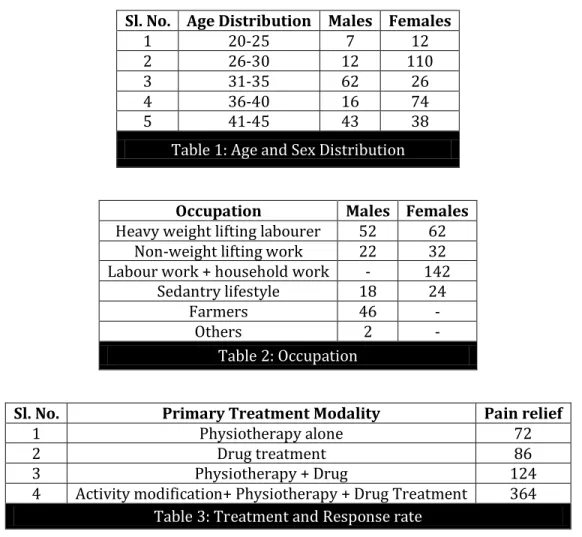
RESULTS: On analysis of various factors, results are interpreted and grouped. The various parameters analysed involves sex distribution, average age at presentation, occupation.[8] treatment modalities taken and response rates.
Sl. No. Age Distribution Males Females
1 20-25 7 12
2 26-30 12 110
3 31-35 62 26
4 36-40 16 74
5 41-45 43 38
Table 1: Age and Sex Distribution
Occupation Males Females Heavy weight lifting labourer 52 62
Non-weight lifting work 22 32 Labour work + household work - 142
Sedantry lifestyle 18 24
Farmers 46 -
Others 2 -
Table 2: Occupation
Sl. No. Primary Treatment Modality Pain relief
1 Physiotherapy alone 72
2 Drug treatment 86
3 Physiotherapy + Drug 124
4 Activity modification+ Physiotherapy + Drug Treatment 364
Table 3: Treatment and Response rate
DISCUSSION: On analysis of results, numerous inferences are drawn. It is seen that number of female (240/60%) affected are more as compared to number of male (160/40%) patient affected. Our study shows two peaks in progression of symptoms. In males it involves a) age between 31-35 b) age between 41-45 but in females it shows different trend with affected cases belong to a) age between 26-30 b) age between 36-40. We can see that both females and males shows two peaks of progression but females shows a trend towards early age of onset of symptom progression.
J of Evolution of Med and Dent Sci/ eISSN- 2278-4802, pISSN- 2278-4748/ Vol. 4/ Issue 82/ Oct. 12, 2015 Page 14368
as compared to other ones. Among the females the maximum affected ones are those engaged in heavy labour work in addition to routine household work. All factors contributes to continuous abnormal postures and abnormal loading of spine.
The vertebral column may respond by adaptive changes but in low socioeconomic strata group due to added dietery deficiencies the degenerative changes supervene. It results in lower weight lifting capacity and thus adaptive changes in soft tissues like spasmodic contractions of paraspinal muscles.
Table 3 shows the various treatment modalities taken with time and their response rates. Like every other pathology the table shows same trends of maximum relief in cases in which the chief cause of symptoms is controlled. As our study deals with idiopathic nature of lower back pain in which all routine blood investigations and radiographs shows normal study. All cases with associated systemic, metabolic or neurological are excluded from study.
The chief cause common to maximum affected cases being routine abnormal posture and heavy loading of vertebral column. The relief rate is found to be better in cases where modifications in activity is performed.
CONCLUSION: Back pain is one of the orthopedic problem growing day by day and unpleasant to both patient and doctor. Complexity of contributory factors leads to variable outcomes. Causative factors vary with age. Both extremes of age including pediatric and elderly shows a defined trend towards the disease but middle age group shows a different pattern of presentation with no apparent cause seen. The problem appears to be increasing with time more due to increased number of cases reporting due to improved healthcare facilities in developing countries. Our study shows a analysis of about 400 cases with ages between 20 to 45 years. Various parameters are studied including sex distribution, occupation and treatment measures taken.
J of Evolution of Med and Dent Sci/ eISSN- 2278-4802, pISSN- 2278-4748/ Vol. 4/ Issue 82/ Oct. 12, 2015 Page 14369
BIBLIOGRAPHY:
1. Dillane et al., 1966. Dillane JB, Fry J, Kalton G: Acute back syndrome: a study from general practice. BMJ 1966; 2:82.
2. Frymoyer and Cats-Baril, 1991. Frymoyer JW, Cats-Baril WL: An overview of the incidences and costs of low back pain. Orthop Clin North Am 1991; 22:263.
3. Deyo and Bass, 1989. Deyo RA, Bass JE: Lifestyle and low-back pain: the influence of smoking and obesity. Spine 1989; 14:501.
4. Frymoyer et al., 1983. Frymoyer JW, Pope MT, Clements JH, et al: Risk factors in low-back pain: an epidemiological survey. J Bone Joint Surg 1983; 65A:213.
5. Svensson and Andersson, 1989. Svensson HO, Andersson GBJ: The relationship of low-back pain, work history, work environment and stress: a retrospective cross-sectional study of 38- to 64-year-old women. Spine 1989; 14:517.
6. Modic MT, Ross JS. Magnetic Resonance Imaging in the Evaluation of Low Back Pain. Orthop Clin North Am 1991; 22:283.
7. Malmivaara et al., 1995. Malmivaara A, Hakkinen U, Aro T, et al: The treatment of acute low back pain—bed rest, exercises, or ordinary activity?. N Engl J Med 1995; 332:1786.
8. Videman and Battié, 1999. Videman T, Battié MC: The influence of occupation on lumbar degeneration. Spine 1999; 24:1164.
J of Evolution of Med and Dent Sci/ eISSN- 2278-4802, pISSN- 2278-4748/ Vol. 4/ Issue 82/ Oct. 12, 2015 Page 14370
AUTHORS:
1. Arpan Bijyal 2. Prince Raina 3. Mohinder Singh 4. Omeshwar Singh
PARTICULARS OF CONTRIBUTORS:
1. Resident, Department of Orthopedics, Government Medical College, Jammu. 2. Resident, Department of Orthopedics,
Government Medical College, Jammu. 3. Resident, Department of Orthopedics,
Government Medical College, Jammu.
FINANCIAL OR OTHER
COMPETING INTERESTS: None
4. Resident, Department of Orthopedics, Government Medical College, Jammu.
NAME ADDRESS EMAIL ID OF THE CORRESPONDING AUTHOR:
Dr. Prince Raina, Shiv Nagar, Miran Sahib, Jammu-181101.
E-mail: [email protected]