RESUmo
A coinfecção tuberculose (TB) e HIV afeta
negaivamente a vida dos indivíduos, tanto nos aspectos biológicos como nos psicos
-sociais. Com o objeivo de descrever a qua
-lidade de vida de indivíduos com coinfec
-ção HIV/TB, foi realizado este estudo des
-criivo, de corte transversal, no município de Ribeirão Preto-SP. Foram entrevistados indivíduos soroposiivos para o HIV, com e sem TB, por meio do instrumento WHO
-QOL-HIV bref. Pariciparam 115 indivíduos soroposiivos para o HIV – 57 coinfectados e 58 não coinfectados; a maioria do sexo masculino, heterossexuais, faixa etária pre
-dominante de 40-49 anos, com os coinfec
-tados apresentando baixas escolaridade e renda; na avaliação da qualidade de vida os coinfectados apresentaram resultados mais baixos em todos os domínios, com di
-ferença importante no Físico, Psicológico, Nível de Independência e Relações Sociais. TB e HIV/aids são doenças esigmaizadas historicamente e a sobreposição das duas pode ter consequências graves na saúde ísica e psicossocial do indivíduo.
dEScRitoRES Tuberculose
Síndrome de Imunodeiciência Adquirida
HIV
Qualidade de vida
Aids and tuberculosis:
coinfection from the perspective
of the quality of life of patients
*O
riginal
a
r
ticle
AbStRAct
Tuberculosis (TB) and HIV coinfecion ad
-versely afects the lives of individuals in both the biological and psychosocial as
-pects. Aiming to describe the quality of life of individuals with HIV/TB coinfecion, this descripive cross-secional study was con
-ducted in Ribeirão Preto-SP. Paricipants were HIV-seroposiive individuals with and without TB, using the WHOQOL HIV BREF. 115 individuals who were HIV-posiive paricipated: 57 were coinfected and 58 were not; most were male heterosexuals, predominantly aged 40-49 years. Of those coinfected, most had lower educaion and income. In assessing the quality of life the coinfected individuals showed lower re
-sults in all areas, with signiicant diferenc
-es in the Physical, Psychological, Level of Independence and Social Relaions areas. TB and HIV / AIDS are sigmaized diseases, and overlap of the two may have severe consequences on the physical and psycho
-social health of the individual.
dEScRiPtoRS Tuberculosis
Acquired Immunodeiciency Syndrome
HIV
Quality of life
RESUmEn
La coinfección tuberculosis (TB) y HIV afec
-ta negaivamente la vida del individuo, -tan
-to en los aspec-tos biológicos como en los psicosociales. Objeivando describir la ca
-lidad de vida de individuos con coinfección HIV/TB se realizó este estudio descripivo, de corte transversal, en el municipio de Ri
-beirão Preto-SP. Fueron entrevistados indi
-viduos seroposiivos para HIV, con o sin TB, mediante instrumento WHOQOL-HIV bref. Pariciparon 115 individuos seroposiivos para HIV, 57 coinfectados y 58 no coinfec
-tados, la mayoría de sexo masculino, he
-terosexuales, faja etaria predominante de 40-49 años, los coinfectados presentando escolaridad e ingresos inferiores; en la eva
-luación de calidad de vida los coinfectados presentaron resultados más bajos en todos los dominios, con diferencias importantes en el Físico, Psicológico, Nivel de Indepen
-dencia y Relaciones Sociales. TB y HIV/SIDA son enfermedades históricamente esig
-maizadas, la superposición de ambas pue
-de tener graves consecuencias en la salud ísica y psicosocial del individuo.
dEScRiPtoRES Tuberculosis
Síndrome de Inmunodeiciencia Adquirida
VIH
Calidad de vida
Lis Aparecida de Souza neves1, Sílvia Rita marin canini2, Renata Karina Reis3,
cláudia benedita dos Santos4, Elucir Gir5
Aids e tuberculose: A coinfecção vistA pelA perspectivA dA quAlidAde de vidA dos indivíduos
sidA y tuberculosis: lA coinfección vistA según lA perspectivA de lA cAlidAd de vidA de los individuos.
*extracted from the thesis “qualidade de vida de indivíduos com a coinfecção Hiv/tuberculose no município de ribeirão preto – sp”, nursing school of ribeirão preto, university of são paulo, 2010. . ribeirão preto, sp, brazil. 1rb. ph.d. in sciences.university of são paulo at ribeirãopreto college of
nursing.rn of the ribeirãopreto Municipal Health department.ribeirãopreto, sp, brazil. [email protected] 2rn. doctor professor, university of
são paulo at ribeirãopreto college of nursing. ribeirãopreto, sp, brazil. [email protected] 3rn. ph.d. doctor professor university of são paulo at
ribeirão preto college of nursing, ribeirão preto, brazil. [email protected] 4ph.d. in statistics.Associate professor, university of são paulo at
intRodUction
Infecion with HIV signiicantly increases the risk of developing acive tuberculosis (TB): an individual infect
-ed with HIV is 25 imes more vulnerable to TB in contrast to non-infected individuals, and the risk of death in pa
-ients who are coinfected with HIV and Koch’s bacillus is
twice as high than in an HIV-seroposiive individual with -out TB(1).
The associaion of this coinfecion is synergeic, inter
-acive andreciprocal, with signiicant impact on the course of the two pathologies. Coinfecion is responsible for the increase in mortality rates, becoming a challenge for pub
-lic health(2).
Prior to the1990’s, there were poor therapeuic solu
-ions to reduce the efects of HIV on the individual. The arrival of aniretroviral therapy (ART) for the treatment of individuals with HIV/Aids led to an increase in survival ime; however, infecion with HIV assumed
chronic-degeneraive characterisics, with efects related to the long-term experience of living with the virus, its comorbidiies and the adverse efects of the treatment(3).
The clinical improvement of paients infected with HIV under ART was assessed several imes through the reducion in mor
-tality, opportunisic infecion rates and/or severe symptoms related to Aids. The as
-sessment of the quality of life (QoL) may be used to monitor the impact of the dis
-ease, and may be clinically useful to idenify which aspects are more greatly afected by direct intervenions, in addiion to measur
-ing treatment results(4).
The growing interest in the assessment of the quality of life (QoL) also includes paients with TB. Although TB is a curable
disease, it presents the need for long-term therapy, with great impact on the life of the paients infected with the disease(5), and lower results in terms of QoL than in the general populaion(6).
In order to assess QoL, two types of instruments are used: the generic types, which comprise common and important aspects of health and may be used to assess and compare QoL in individuals sufering from diferent health condiions and sub-populaions; or the speciic types, which are designed to assess QoL in certain chronic diseases(5).
Several speciic instruments for individuals with HIV were found in the internaional literature, but only HAT-QoL and WHOQOL HIV were validated for use in Brazil. As for TB, the internaional studies found by the authors used ge
-neric instruments, such as SF-36 and MOS, and a speciic instrument created and used only in India, the DR-12(5).
The present study used the instrument of the World Health Organizaion (WHO), in its brief version – WHO-QOL-HIV BREF, and adopted the concept of quality of life
deined by the Quality of Life Group of the WHO:
an individual’s perception of their position in life in the con-text of the culture and value systems in which they live and in relation to their goals, expectations, standards and concerns(7).
It is worth highlighing that, despite the epidemio
-logical importance of TB in Brazil, there were no naional studies found regarding QoL in paients with TB and in paients coinfected with HIV/Aids. There is sill a need for studies to idenify the variables related to QoL in local populaions, aimed not only at proposing intervenions in the physical and mental healthcare areas, but also at con
-tribuing to public health policies that will lead to the bet
-terment of the quality of life of these paients.
obJEctiVE
The present study aimed at describing the quality of life of individuals with HIV/ TB coinfecion and at comparing it to the quality of life of HIV-seroposiive individuals without TB.
mEtHod
This is a descripive cross-secional study, developed through individual inter
-views with HIV-seroposiive individuals with and without TB.
The study populaion comprised all of the HIV/TB coinfected paients of both genders enrolled in follow-up at the outpaient clinic of specialized units in RibeirãoPreto-SP, who agreed to paricipate in the study and com
-plied with the inclusion criteria: having a posiive reagent serological test for HIV; atending follow-up at an outpa
-ient clinic for the treatment of HIV/Aids; aged 18 years or older; having a conirmed diagnosis of TB; and having the physical, mental and psychological stamina to paricipate in the interview.
The exclusion criterion included those individuals un
-der coninement (prisoners).
In order to idenify coinfected individuals, the authors requested monthly that the coordinator of the TB program of the Municipal Health Department send a list of the pa
-ients noiied in the municipality, according to the results of the HIV exam, as well as the outpaient clinic that noi
-ied the paient. Interviews were then scheduled and per
-formed according to the availability of the paient.
For the composiion of the group of non-coinfected HIV-seroposiive individuals, the authors selected indi
-the growing interest in the assessment of the quality of life (qol)
also includes patients with tb. Although tb is a curable disease, it
presents the need for long-term therapy, with great impact on the life of the patients infected with the disease, and lower results in terms
viduals who atended the follow-up appointments at the outpaient clinic during the period of data collecion, considering the same inclusion and exclusion criteria, in a proporion of 1:1 to the group of coinfected paients. A pairing of these groups was performed according to gen
-der in or-der to reduce the possibility of gen-der bias. A quesionnaire was used to gather the socioeconom
-ic, epidemiologic and clinical characterizaions, as well as the instrument WHOQOL-HIVBREF. WHOQOL-HIV BREF presents 31quesions, divided into six categories: physical, psychological, level of independence, social relaions, en
-vironment and spirituality(7).
The physical area includes the items: pain and discom
-fort, energy and faigue, sleep and rest and symptoms; the psychological area involves posiive and negaive feelings, cogniion, self-esteem and body image and appearance; the area of level of independence relates to mobility, ac
-iviies of daily living, treatment dependence and ability to work; the social relaions area includes personal relaion
-ships, social support, sexual acivity and social inclusion; the environmental area involves physical security, hous
-ing, inances, health and social care, informaion, leisure, physical environment and transportaion; and the area of spirituality includes the items spirituality, religion, forgive
-ness and guilt, concerns regarding the future and death. The global calculaion of each area, which varies be
-tween four and 20, was performed with the equaion sug
-gested by WHO(7). Data were described in means and stan -dard deviaions. The Kolmogorov-Smirnov test was used to assess the normality of the distribuions. Student’s
t-test was used to analyze possible diferences between the mean scores of quality of life. The level of staisical signiicance adopted was 5% (α = 0.05).
Data were collected in the period from February of 2008 to February of 2010. All coinfected paients were un
-der supervised treatment.
The study was approved by the Commitee of Ethics in Research of the Nursing School of Ribeirão Preto – USP, protocol 0858/2007. Interviews were performed ater the clariicaion and agreement of the subjects, and only ater the Free and Clariied Consent Forms were signed.
RESULtS
In the years 2008 and 2009, in the municipality of Ri
-beirão Preto, 391 paients with TB were noiied, 84 (21.5%) of whom presented posiive serology for HIV. Interviews were performed with 57 HIV/TB coinfected paients who met the inclusion criteria and 58 HIV-seroposiive individu
-als without TB who were being followed up by the outpa
-ient clinic, totaling 115 paricipants in the study.
Among all paricipants, 86 (74.8%) were male, with an av
-erage age of 40 years, varying between 18 and 62 years; the prevalent age range fell between 40 and 49 years (40.9%).
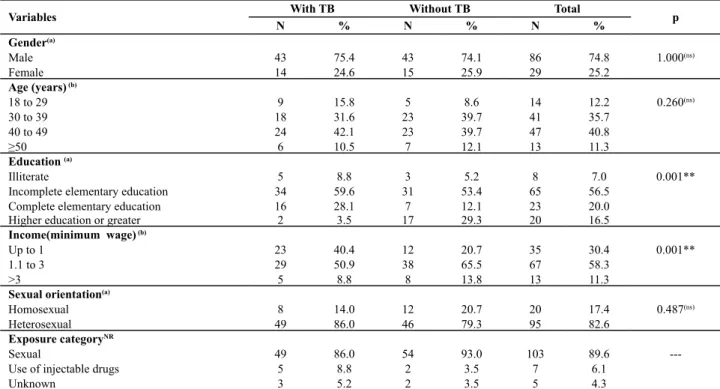
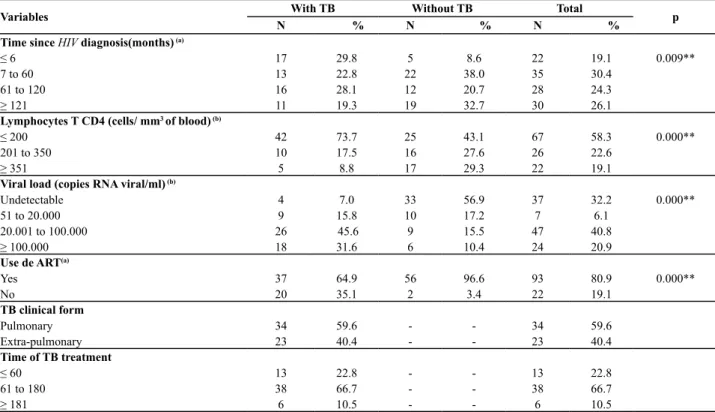
The socioeconomic and epidemiological characteris
-ics of the study populaion are presented in Table 1. Table 2 presents the clinical characterisics of the interviewees.
Table 1 – Distribution of individuals with HIV/Aids, according to tuberculosis coinfection, socioeconomic variables and values of probabilities associated with the statistics tests – Ribeirão Preto, SP - 2008/2009
Variables With TB Without TB Total p
N % N % N %
Gender(a)
Male 43 75.4 43 74.1 86 74.8 1.000(ns)
Female 14 24.6 15 25.9 29 25.2
Age (years) (b)
18 to 29 9 15.8 5 8.6 14 12.2 0.260(ns)
30 to 39 18 31.6 23 39.7 41 35.7
40 to 49 24 42.1 23 39.7 47 40.8
≥50 6 10.5 7 12.1 13 11.3
Education (a)
Illiterate 5 8.8 3 5.2 8 7.0 0.001**
Incomplete elementary education 34 59.6 31 53.4 65 56.5
Complete elementary education 16 28.1 7 12.1 23 20.0
Higher education or greater 2 3.5 17 29.3 20 16.5
Income(minimum wage) (b)
Up to 1 23 40.4 12 20.7 35 30.4 0.001**
1.1 to 3 29 50.9 38 65.5 67 58.3
>3 5 8.8 8 13.8 13 11.3
Sexual orientation(a)
Homosexual 8 14.0 12 20.7 20 17.4 0.487(ns)
Heterosexual 49 86.0 46 79.3 95 82.6
Exposure categoryNR
Sexual 49 86.0 54 93.0 103 89.6
---Use of injectable drugs 5 8.8 2 3.5 7 6.1
Unknown 3 5.2 2 3.5 5 4.3
current minimum wage at the time of study: r$ 415.00 in 2008 and r$ 465.00 in 2009; (a) chi-square test; (b) student’s t-test ; *0.01 < p < 0.05; **p< 0.01;
Table 2 – Distribution of the individuals with HIV/Aids, according to tuberculosis coinfection, clinical variables and values of proba-bilities associated with the statistics tests – Ribeirão Preto, SP – 2008/2009
Variables With TB Without TB Total p
N % N % N %
Time since HIV diagnosis(months) (a)
≤ 6 17 29.8 5 8.6 22 19.1 0.009**
7 to 60 13 22.8 22 38.0 35 30.4
61 to 120 16 28.1 12 20.7 28 24.3
≥ 121 11 19.3 19 32.7 30 26.1
Lymphocytes T CD4 (cells/ mm3 of blood) (b)
≤ 200 42 73.7 25 43.1 67 58.3 0.000**
201 to 350 10 17.5 16 27.6 26 22.6
≥ 351 5 8.8 17 29.3 22 19.1
Viral load (copies RNA viral/ml) (b)
Undetectable 4 7.0 33 56.9 37 32.2 0.000**
51 to 20.000 9 15.8 10 17.2 7 6.1
20.001 to 100.000 26 45.6 9 15.5 47 40.8
≥ 100.000 18 31.6 6 10.4 24 20.9
Use de ART(a)
Yes 37 64.9 56 96.6 93 80.9 0.000**
No 20 35.1 2 3.4 22 19.1
TB clinical form
Pulmonary 34 59.6 - - 34 59.6
Extra-pulmonary 23 40.4 - - 23 40.4
Time of TB treatment
≤ 60 13 22.8 - - 13 22.8
61 to 180 38 66.7 - - 38 66.7
≥ 181 6 10.5 - - 6 10.5
Table 3 – Mean scores, respective standard deviations and values of probabilities associated with Student’s t-test for each of the areas of WHOQOL-HIV BREF of the individuals with HIV/Aids, accor-ding to tuberculosis coinfection – Ribeirão Preto, SP – 2008/2009
Areas Mean SD p*
Physical
With TB 12.07 3.67 0.000**
Without TB 14.82 3.34
Psychological
With TB 13.57 2.99 0.027*
Without TB 14.80 2.86
Level of Independence
With TB 11.42 2.96 0.000**
Without TB 13.60 2.64
Social Relations
With TB 13.14 2.79 0.028*
Without TB 14.39 3.22
Environment
With TB 13.05 1.91 0.189
Without TB 13.65 2.87
Spirituality
With TB 14.80 3.51 0.585
Without TB 15.17 3.64
WHOQOL-HIV BREFwas submited to the assessment
of reliability through Cronbach’s coeicient alpha, pre
-sening values that varied from 0.69 to 0.74, which dem
-onstrates good internal consistency of the instrument. Regarding the QoL, the results obtained are presented
in Table 3.
A staisically signiicant diference was ideniied between the two groups in the physical (p < 0.01), psy
-chological (p = 0.027), level of independence (p < 0.01) and social relaions (p = 0.028) areas, with the group of coinfected paients presening lower mean scores than the group without coinfecion. The area of level of inde
-pendence presented the lowest mean for both groups and spirituality had the highest mean in both.
diScUSSion
Among the paricipants in the coinfecion group, 75.4% were male. The prevalence of the male gender, both in TB and in Aids, has also been described by other studies in diferent locaions from Brazil since the early 1990’s, conirming the male populaion as more vulner
-able and having a higher prevalence rate for coinfecion with Mtb and HIV(8).
As for educaion and income, data agree with the so
-cial proile of the epidemic of Aids and TB, which in Brazil strike mainly the less economically favored classes of the populaion (3, 9-10). Even so, in the group of coinfected indi -viduals, these indicators were even lower than the others. Lower levels of educaion lead to social vulnerability, since it inluences the individuals regarding their ability to ob
-tain informaion in general, and more speciically for the paricular disease(11).
p< 0.01; ns: not signiicant; Values of WHOQOL:from 4 to 20
Nearly a third of the coinfected paients became aware of their seroposiivity almost at the same ime that TB was diagnosed, which emphasizes the importance of perform
-ing HIV tes-ing in these paients(12). On the other hand, the fact that 27 (47.4%) individuals knew they were HIV-sero
-posiive for more than ive years reinforces the need to study and prevent TB among paients with HIV/Aids.
In the individuals of the present study, it was observed that the coinfected paients presented lower levels of CD4T-cell counts and higher viral loads than those with HIV/Aids alone, which agrees with the literature and in
-dicates that TB is an opportunisic infecion highly associ
-ated with the deterioraion of the immune system(8,13). Regarding the use of ART, the higher percentage of non-coinfected individuals using this drug therapy could be jusiied by the fact that the individuals had only re
-cently become aware of their HIV diagnosis and had yet to begin taking AR drugs; another factor to be considered is that the coinfected paients who were aware of their se
-rologic condiion for a longer period of ime did not have good compliance with the treatment, increasing their risk of developing TB.
The QoL areas with staisically signiicant diferences between the individuals with and without coinfecion were the physical, psychological, independence level and social relaions areas.
Regarding the physical area, individuals with TB have
both their physical and emoional well-being afected, since they experience symptoms of discomfort, using medicaions that may cause adverse reacions during the enire period of treatment(14).
The clinical variables of CD4T-cell counts, viral load and use of ART, which did not show homogeneity between the groups, were factors associated with the worst scores in the physical area(15). Immunosuppression causes aggravaion of clinical condiions, intensifying the symptoms and increas
-ing the possibility of hospitalizaion. Therefore, the low scores of QoL in the physical area of individuals with HIV/ TB coinfecion may be associated with the TB symptomatol
-ogy, immunosuppression and the non-use of AR drugs. The psychological area also presented a staisically
signiicant diference in the QoL means of the groups. The therapeuic advances obtained with ART resulted in an im
-portant impact on the physical and psychological health of people who live with HIV/Aids, considering the increase in survival, reducion of mortality and decrease in the num
-ber of hospitalizaions. However, at the onset of diagnosis and during the iniial period of treatment, the paients’ fear is constant, since the associaion between Aids and imminent death sill persists in popular representaions.
In addiion to the sufering it causes, in terms of social living Aids is emphasized by sigma and prejudice, con
-tribuing to the social death of the person and triggering
states of emoional instability, depressive episodes and psychic sufering(16), which oten occur immediately ater the individual becomes aware of his/her diagnosis.
On the other hand, the social sigma associated with the diagnosis of TB is signiicant in some cultures. Indi
-viduals with TB may feel isolated from their family and friends and experience fear and anxiety regarding the dis
-closure of their diagnosis to others(5).
Currently, the importance of non-biological factors de
-termining morbidity and mortality in some diseases is em
-phasized, for instance in TB. The simple presence of Koch’s bacillus is not enough to cause the disease. Frequently,
social, economic and cultural factors come into play so that the disease develops(17).
A review performed on studies of QoL in paients with TB showed that tuberculostaic drugs had a posiive ef
-fect on the improvement of QoL of the paients, inferring that physical health was quite afected by the disease, but improved quickly during treatment, whereas the compro
-mised state of psychological well-being tended to persist for longer periods, even ater the treatment had ended(5).
The area of social relaionsalso presented a staisi
-cally signiicant diference between the two groups. In general terms, the processes of sigma and discriminaion associated with the revelaion of diagnosis in social areas such as work, family and friends, both of HIV and TB, may negaively afect this area.
Health sigmaizaion may be deined as a social pro
-cess characterized by exclusion, rejecion and guilt, or the devaluaion resuling from the experience of unfavorable social judgment due to a paricular health condiion(18).
Regarding TB, a study developed in Santa Catarina (19)
observed that prejudice contributed to social isolaion, even within close relaionships, such as spouses and chil
-dren. Prejudice does not come only from others towards in their aitudes towards the person with TB, but also from the paient, rooted in his/her (mis)concepion of the disease.
Paients with TB are afraid of transmiing the disease, mainly to their partner. Feeling guilty, they distance them
-selves from everyone, including their family and partners, which leads to isolaion and, consequently, to loneliness. In the case of a sigmaizing disease, fraught with preju
-dice as TB is, it is observed that the negaive reacions may overlap the close feelings and bonds involving family and friends.
In the context of double infecion with HIV/TB, the TB sigma is considered less signiicant than that of Aids, since at the beginning of the HIV/Aids epidemic the dis
-ease was associated with speciic populaion groups, iden
-iied as engaging in transgressing behaviors. The trajec
-tory of the epidemic shows that there have been many changes, mainly in the way AIDS is viewed by society; however, a great number of HIV-seroposiive individuals hide the fact that they are infected for as long as they can, entering into a pact of secrecy, which may lead to social isolaion, restricion of social relaionships and diiculies in the emoional-sexual ield.
The results of this study show that TB may be related to the worst QoL in the area of social relaions among the coinfected individuals, both due to the sigma and preju
-dice associated with the disease and its clinical manifesta
-ions, which results in social isolaion.
The area of level of independencepresented a sta
-tistically significant difference between the individuals with and without coinfection. The authors searched the literature and found studies that relate low education and income to lower QoL means in this area in individu
-als with HIV(3)and HIV/TB coinfection(13). Income relates to material and nutritional resources, and its lack re
-sults in poor nutrition and, subsequently, poor immune
function.
Beter QoL means in the level of independence area were also highly associated with treatment with ART(9). Drug therapy provided the percepion of global improve
-ment in energy, ability to walk, physical appearance, self-esteem, personal relaions and sexual life, relecing higher QoL means(9). TB demands the regular ingesion of drugs, signiicantly improving clinical symptoms ater treatment has begun.
Although the areas of environment and spiritual
-ity presented lower mean scores in the coinfected group than in the individuals with TB, no staisically signiicant diference was found between the groups.
However, in the environment area, studies relate
better socioeconomic and educational levels to high
-er QoL means(3,13), and this association also occurs with patients who have other diseases or chronic conditions(21).
Educaion and income may be related to emoional and material aspects, as individuals present beter life condiions to cope with the disease, and greater intellec
-tual resources for the emoional adaptaion required as a consequence of the disease(22).
The QoL means found in the environment area em
-phasize the character of poverty associated with the HIV/ Aids epidemic and relate QoL to socioeconomic quesions. Although there was a staisically signiicant diference between the groups in the variables of educaion and
income, the same diference was not veriied in the QoL means of this area between individuals with and without acive TB, even though they were slightly lower in the group of coinfected individuals.
In the assessment of the QoL areas, it was observed that the spirituality area presented the highest mean
score among all individuals; however, there was no stais
-ically signiicant diference between the groups.
Spirituality has a deinite relaionship to the improve
-ment of QoL of paients with chronic diseases. Studies in
-dicate that religiosity and spirituality in people with HIV/ Aids may help in the psychological adjustment and in cop
-ing with the disease(22).
Living with a serious disease leads to readjustments in the daily life, as well as to the redeiniion of the self and relaionships with others. The threat of death may generate the need to ind a meaning in one’s life, which is oten found in associaion with spirituality(15). Spiritual well-being may be highlighted as one of the variables present in resiliency and health protecion(15); it may help people who live with HIV/Aids to reduce symptoms in the health-disease process, contribuing to the beterment of the QoL.
The reality of the people who live in less favored situ
-aions, which is the case of most of the individuals in this study, is characterized by constant struggle for survival, oten mobilizing feelings of ailiaion towards a religious belief. Moreover, spirituality may provide great help in coping with HIV, assising in the adaptaion to the new reality and in coping with the deprivaions and anxieies imposed by the disease.
concLUSion
Several biopsychosocial factors may be altered in HIV/TB coinfection. Among them, it is important to mention physical-organic, psychoemotional and behav
-ioral consequences. These consequences, which are quite evident in the case of stigmatized diseases such as TB and Aids, change the different dimensions of QoL significantly.
In the assessment of the quality of life (QoL), the coinfected individuals presented lower mean scores than non-coinfected individuals in all areas, with important dif
-ferences in the physical, psychological, level of indepen
-dence and social relaions areas.
It becomes evident that there is a need to develop strategies of policies aimed at reducing the epidemiologi
REFEREncES
1. Rodrigues-Júnior AL, Ruino-Neto A, Casilho EA. Distri
-buição espacial da coinfecção M.tuberculosis/HIV no Estado de São Paulo. Rev Saúde Pública. 2006;40(2):265-70.
2. Neves LA, Reis RK, Gir E. Compliance with the treatment by paients with the co-infecion HIV/tuberculosis: integraive literature review. Rev Esc Enferm USP [Internet]. 2010 [cited
2011 Jan 17];44(4):1135-41. Available from: htp://www.sci
-elo.br/pdf/reeusp/v44n4/en_41.pdf
3. Reis RK, Santos CB, Dantas RAS, Gir E. Qualidade de vida, as
-pectos sociodemográicos e de sexualidade de pessoas viven
-do com HIV/AIDS. Texto Contexto Enferm. 2011;20(3):565-75.
4. O’Connell K, Skevington S, Saxena S. Preliminary development
of the World Health Organizaion’s Quality of Life HIV instru
-ment: analisys. Soc Sci. Med. 2003;57(7):1259-75.
5. Guo N, Marra F, Marra CA. Measuring health-related quality of life in tuberculosis: a systemaic review. Health Qual Life Outcomes. 2009;18(1):7-14.
6. Muniyandi M, Rajeswari R, Balasubramanian R, Nirupa C,
Gopi PG, Jaggarajamma K, et al. Evaluaion of post-treatment
health-related quality life (HRQoL) among tuberculosis pa
-ients. Int J Tuberc Lung Dis. 2007;11(8):887-92.
7. World Health Organizaion (WHO). Country protocol for de
-veloping the WHO quality of life (WHOQOL): HIV/aids mod
-ule. Geneva; 1997.
8. Miranda AE, Golub JE, Lucena FF, Maciel EN, Gurgel MF, Di
-etze R. Tuberculosis and AIDS co-morbidity in Brazil: linkage of the tuberculosis and AIDS databases. Braz J Infect Dis. 2009;13(2):137-41.
9. Campos LN, César CC, Guimarães MD. Quality life among HIV-infected paients in Brazil ater iniiaion of treatment. Clinics. 2009;64(9):867-75.
10. Neto LMS, Oliveira RVC, Toino PR, Sant’Anna FM, Coelho VO, Rolla VC, et al. Enteroparasitosis prevalence and parasiism inluence in clinical outcomes of tuberculosis paients with or without HIV co-infecion in a reference hospital in Rio de Janeiro (2000-2006). Braz J Infect Dis. 2009;13(6):427-32.
11. Bowkalowski C, Bertolozzi MR. Vulnerabilidades em paci
-entes com tuberculose no Distrito Sanitário de Santa Felici
-dade. Cogitare Enferm. 2010;15(1):92-9
12. Conde MB, Melo FAF, Marques AMC, Cardoso NC, Pinheiro
VGF, Dalcin PTR, et al. III Diretrizes para Tuberculose da So
-ciedade Brasileira de Pneumologia e Tisiologia. J Bras Pneu
-mol. 2009;35(10):1018-48.
13. Deribew A, Tesfaye M, Hailmichael Y, Negussu N, Daba S, Wogi A, et al. Tuberculosis and HIV co-infecion: its impact on quality of life.Health Qual Life Outcomes. 2009;7:105.
14. Maciel ELN, Guidoni LM, Favero JL, Hadad DJ, Molino LP,
Jonhson JL, et al . Efeitos adversos causados pelo novo esque
-ma de tratamento da tuberculose preconizado pelo Ministé
-rio da Saúde do Brasil. J Bras Pneumol. 2010;36(2):232-8.
15. Calvei PÜ, Muller MC, Nunes MLT. Qualidade de vida e
bem-estar espiritual em pessoas vivendo com HIV/aids. Psi
-col Estudo. 2008;13(3):523-30.
16. Silva J, Saldanha AAW, Azevedo RLW.Variáveis de impacto na qualidade de vida de pessoas acima de 50 anos HIV+. Psicol Relex Crit. 2010;23(1):56-63.
17. Severo NPF, Leite CQF, Capela MV, Simões MJS. Caracterísi
-cas clínico-demográi-cas de pacientes hospitalizados com tuberculose no Brasil. J Bras Pneumol. 2007;33(5): 565-71.
18. Weiss MG, Ramakrishna J. Sigma intervenions and research for internaional health. Lancet. 2006;367(9509):536-8.
19. Souza SS, Silva DMGV, Meirelles BHS. Representações soci
-ais sobre a tuberculose. Acta Paul Enferm. 2010;23(1):23-8.
20. Pungrassami P, Kipp AM, Stewart PW, Chongsuvivatwong V, Strauss RP, Van Rie A. Tuberculosis and aids sigma among paients who delay seeking care for tuberculosis symptoms. Int J Tuberc Lung Dis. 2010;14(2):181-7.
21. Alexandre TS, Cordeiro RC, Ramos LR. Fatores associados à qualidade de vida em idosos aivos. Rev Saúde Pública. 2009;43(4):613-21.
22. Seidl EMF. Enfrentamento, aspectos clínicos e sociodemo
-gráicos de pessoas vivendo com HIV/aids. Psicol Estudo. 2005;10(3):421-29.