Correspondence address:
Amanda Brait Zerbeto
R.dos Carangueijos, 143, Perequê, Ilhabela (SP), Brasil. CEP: 11630-000. Email: [email protected]
Received: 4/7/2012
Accepted: 10/19/2012
Study carried out at the Speech-Language Pathology and Audiology Department, Universidade Estadual de Campinas – UNICAMP – Campinas (SP), Brazil.
(1) Graduate Program (Master’s degree) in Health, Interdisciplinarity and Rehabilitation, Universidade Estadual de Campinas – UNICAMP – Campinas (SP), Brazil.
(2) Speech-Language Pathology and Audiology Department, Universidade Estadual de Campinas – UNICAMP – Campinas (SP), Brazil.
Conlict of interests: nothing to declare.
Original Article
Amanda Brait Zerbeto1
Regina YuShon Chun2
Keywords
Quality of life Caregivers Child Adolescent Language disorders Stuttering
Speech-language and hearing sciences
with speech and language disorders
Qualidade de vida dos cuidadores de crianças e
adolescentes com alterações de fala e linguagem
ABSTRACT
Purpose: To investigate the quality of life of caregivers of children and adolescents presenting speech and
language disorders from their own perspective. Methods: Two groups participated, adding up to 40 subjects.
Group 1 was composed by 20 caregivers of 4 to 17 years-old children or adolescents with speech and language disorders, paired by age with the Control Group or 2 that included 20 caregivers of children or adolescents with no speech and language complaints. Data collection was done using: two open questions and the World Health Organization instrument, which was translated and adapted to Portuguese language – the World Health Organization Quality of Life Scale (WHOQOL-BREF). The results were submitted to statistical analysis and the open questions were qualitatively analyzed. Results: The language disorders distribution showed:
stutter-ing (35%), non-neurological (35%), and neurological oral language disorders (30%). In the analysis of the WHOQOL-BREF scores, there were quality of life differences regarding the physical (1.1%), psychological (0.5%), and social relationships (1.8%) domains. Group 1 presented the most dissatisfying quality of life. Concerning the open questions, it presented good and reasonable characteristics and Group 2, good and very good. The clinical routine and children were mentioned as factors that hamper self-care in Group 1. Conclu-sions: The lowest score of Group 1 in the WHOQOL-BREF was consistent with the open questions results,
showing that aspects such as clinical attendance routine and comprehension dificulties inluence caregivers’ quality of life. The results corroborate that they should be assisted, since they are a group that deserves healthy actions directed to them.
RESUMO
Objetivo: Investigar a qualidade de vida dos cuidadores de crianças ou adolescentes com alterações de fala e linguagem de acordo com a perspectiva deles. Métodos: Participaram dois grupos, totalizando 40 sujeitos. O Grupo 1 foi composto por 20 cuidadores de crianças ou adolescentes com alterações de fala e linguagem entre 4 e 17 anos, pareados por idade com o Grupo Controle ou 2, que incluiu 20 de crianças ou adolescentes sem queixas de fala e linguagem. Para a coleta de dados, foram aplicadas duas questões abertas e um instrumento da Organização Mundial de Saúde, traduzido e adaptado para o português – World Health Organization Quality of Life Scale (WHOQOL) Abreviado. Os resultados de tal instrumento foram submetidos à análise estatística, e as perguntas abertas estavam sendo analisadas qualitativamente. Resultados: Na distribuição das mudanças de fala e linguagem, havia: gagueira (35%), alterações de linguagem oral sem (35%) e com causas neurológicas (30%). Na análise dos escores do WHOQOL-abreviado, encontraram-se diferenças da qualidade de vida nos domínios físico (1,1%), psicológico (0,5%) e relações sociais (1,8%). O Grupo 1 apresentou qualidade de vida mais insatisfatória; e nas abertas, boa e razoável. Já o Grupo 2 mostrou ótima e boa. A rotina clínica e os ilhos foram mencionados como fatores que diicultam o autocuidado no Grupo 1. Conclusões: O menor escore do Grupo 1 no WHOQOL-abreviado foi compatível com achados das questões abertas, mostrando que aspectos como rotina de atendimentos clínicos e diiculdades de compreensão inluenciam a qualidade de vida dos cuidadores. Os resultados reairmam a necessidade de que, além de cuidadores, sejam cuidados, entendendo-os como um grupo digno de ações de saúde direcionadas aos mesmos.
Descritores
and adolescents, as found in studies on Down syndrome(11), autism(12,13), aphasia(14), and cerebral palsy(15,16). One of these studies that compared the QoL of parents of autistic children to those with children without this condition showed that the QoL of caregivers of autistic children was most affected with regard to the physical and social relationship domains and that the QoL of those responsible for people who need specialized care may be impaired(12).
The caregiver is the closest person who spends most of his time with the individual and plays an active role in the speech-language therapy(14). In many situations, it is a family member of the individual who is in need of a special care. In several health areas, QoL has been the target of various studies. How-ever, in the context of Speech-Language Pathology, there are few studies with this purpose. The interest of such investi-gation arises from the requirement for health attention of caregivers and the creation of new public policies to provide training and support(17).
Information on the new model of health should be present in the training of health professionals. This new model is used in different government proposals in Brazil, such as the Family Health Program (FHP), which focuses not only on the disease, but also on all contexts surrounding the indi-vidual, including family(18). In this sense, there is a tendency to value family and all the people involved in the health/ disease process, which reiterates the importance of studies like the one proposed here.
One of the concepts based on this new health conceptual-ization is the Extended Clinic, which provides service that “focus on the individual, disease, family, and on the context, aiming to produce health and increase the autonomy of the individual, the family, and the community. This concept uti-lizes the integration of the multidisciplinary team, customer assignment and relationship building, development of thera-peutic project according to the vulnerability of each case, and the expansion of intervention resources on the health/ disease process(19).”
Thus, not only the disease of the individual should be con-sidered but the context of the individual should also be tak-en into account. To guarantee the health and well-being of everyone involved in the process, national and international health policies — such as those from WHO — recommend and emphasize the importance of comprehensive care of the individual, which also includes the family and caregiv-ers. In this perspective, both the individual and the family, comprehended in their environment, will have a space to be treated.
Considering that there is still little research being conducted fo-cusing on caregivers of individuals with speech and language disorders; the importance of self-care; and their cucial role in the rehabilitation process and social integration of children and adolescents with speech and language, the research on this topic is relevant.
Thus, this study aims to investigate the QoL of caregivers of children and adolescents with speech and language disorders to enhance ways to completely accommodate them sin the Speech-Language Pathology clinic.
INTRODUCTION
The quality of life (QoL) of caregivers of children and ado-lescents with speech and language disorders may have a direct inluence on their participation and involvement in the therapeutic practice. A family member who requires special care may also inluence the emotional, environ-mental, and physical aspects of others, especially the main responsible for that child or adolescent(1).
According to the World Health Organization Quality of Life Assessment (WHOQOL Group), QoL is deined as the “indi-vidual’s perception of his position in life, in the context of his culture and value systems in which he lives, and in relation to his goals, expectations, standards and concerns”(2). In this per-spective, QoL covers both basic material needs (food, housing, work, education, health, and leisure) and non-material needs (happiness, freedom, personal and professional satisfaction, education, and social inclusion)(3). When considering the scope of the term QoL, it is possible to directly relate it to health. Because of its large territory and regional differences, Brazil is known for social inequalities that are also relected in the popu-lation health(4). An important milestone for the development of healthcare in the country was the creation of the Uniied Health System (SUS), which was established by the 1988 Constitu-tion and ensured that health was considered a general right and duty of the State. Since then, actions of promotion and health prevention, gained prominence, which previously were not in the focus(4).
The development of the health sector can be observed in the data presented by the Brazilian Institute of Geography and Statistics (IBGE) in the 2010 Census, which, among other information, included increased life expectancy and reduced infantile mor-tality(5). Investment in research and hospital equipment, as well as the State’s duty to ensure health to all, are some of the factors that inluenced the reduction of child mortality and survival of children in need of continuous care and specialized rehabilita-tion services(6). With increased life expectancy, the number of caregivers responsible for children also increased, thus being necessary actions directed not only to the children but also to their parents.
The health condition of the individual inluences his QoL. To investigate this effect, several studies have been conduct-ed, and instruments to assess QoL not only of people with a health problem, but also for their caregivers have been de-veloped and tested(7,8).
After application of the WHOQOL-BRIEF, the calculation of standardized domains of the questionnaire and the average of the four domains (physical, psychological, social relationships, and environment) were calculated. A QoL proile was traced for each group, the data were compared, and the statistical signii-cance was veriied with the Breslow Wilcoxontest.
RESULTS
Demographic proile of caregivers and distribution of speech and language disorders of children and adolescents
The proile of the participants was similar in both groups (Table 1).
METHODS
Research design and location
This study is a cross-sectional study conducted in the Speech-Language Pathology clinic at Universidade Estadual de Campinas (UNICAMP). The study was approved under protocol number 379/2010 by the Committee of Ethics in Research of UNICAMP, in accordance with Resolution 196/96 of the National Health Council (CONEP).
Corpus
The study consisted of two groups of caregivers with 40 partici-pants, including 20 participants in each group. Group 1 consisted of caregivers of 20 children and adolescents between the age group 4 years and 17 years, with speech and language disorders, who are treated in a Speech-Language Pathology school clinic. Group 2 included 20 caregivers of children and adolescents with-out speech and language complaints.
Data collection procedure
Data were collected with the use of WHOQOL-BREF and two open questions: “tell us a little about your QoL” and “the action of the people regarding the speech or language dificulties of your child or adolescent” — the second question applied only to Group 1. Information regarding the general identiication of participants (age, income, or occupation) was collected by proile consultation. Open questions, answered in writing by caregivers, were ap-plied before the WHOQOL-BREF questionnaire, to prevent inluence on the responses.
The WHOQOL-BREF, in its translated and Brazilian Portuguese adapted version(9), is composed of 26 questions. Of these, two questions are related to the assessment of QoL and the remaining 24 questions covers four domains of physical relationships (pain, energy, sleep, and mobility), psychological relationships (feelings, self-esteem, and concentration), social relationships (personal re-lationships, social support, and sexual activity), and environment (safety, inancial resources, healthcare, home, and transportation). Each question is answered on a scale from one to ive points. The values of one and two equals negative aspects of dissatisfaction with the question that was assessed. The score of three reveals an aspect of intermediate satisfaction. The values of four and ive cor-respond to positive satisfaction with the domain being assessed. The application of both the open questions and the WHOQOL-BREF occurred in two ways. First, the caregivers in Group 1 were gathered, mostly in small groups, where they were given instructions to complete the questionnaire, and everyone an-swered the questions at the same time. The same procedure was applied in Group 2, but the application was carried out in-dividually in some cases.
Data analysis
Written statements by the participants were analyzed qualitatively. The responses were then compared by analyzing the QoL aspects.
Table 1. Profile of caregivers regarding age and monthly income.
Variables Group 1 Group 2
Mean age 40.1 years 36.2 years
Mean monthly income R$1616.15 R$1990.75
The average age in Group 1 was 40.1 years, with ages ranging between 20 years and 66 years. In Group 2, the ages ranged from 19 to 60 years.
The marital status of the caregivers in Group 1 included 65% married, 15% single, 15% divorced, and 5% widowed caregivers. Group 2 included 60% married, 30% single, and 10% divorced caregivers.
The professions in Group 1 included 11 home-based (such as seamstress) caregivers and 9 caregivers who worked outside the home. In Group 2, 18 caregivers worked outside the home and 2 caregivers performed their duties at the residence.
Group 1 consisted of 8 girls and 12 boys, and Group 2 included 10 girls and 10 boys.
The speech and language disorders of children and adolescents in Group 1 included stuttering (35%), oral language without neurological cases (35%), and oral language with neurological causes (30%). The average time of speech and language therapy was two years.
WHOQOL-BREF results
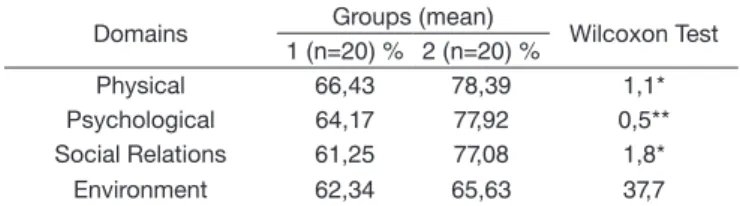
The results of the WHOQOL-BREF (Table 2) showed signii-cant differences in QoL between Group 1 and Group 2 in the physical (p=1.1), psychological (p=0.5), and social relationship (p=1.8) domains, and Group 1 exhibited more unsatis factory QoL. The environment domain showed a higher ratio of equal-ity between the two groups.
the reasons why caregivers reported that although they are satis-ied with their QoL, it could still be better.
The responses of Group 1 showed that although the themes that emerged were similar to those of the caregivers in Group 2, they were addressed differently, always associating QoL to individ-ual disorders of children and adolescents. For example, for the question “Tell me about your quality of life,” in all responses, the routine of children and adolescents appears as an issue that directly inluences the family routine. This is negative response in most cases, because caregivers use the time they would have for themselves to care for the demands of their children. Thus, the dif-iculties of children and adolescents are affected besides the QoL of their caregivers.
The parents of children and adolescents with speech and lan-guage disorders (Group 1) rated their QoL as good and reasonable. They reported that the routine of their children directly interferes with their own routine because the commitments, in addition to school, involve specialized care with other professionals, such as Speech-Language Pathologist, Physical Therapist, Neurologist, Occupational Therapist, Psychologist, and oth-ers. It was reported that the commitment to take children or adolescents to these appointments is the main factor in the lack of time to take care of their own needs, as illustrated by the testimony of participant number 3 (mother):
I work a lot! Daughters to school, ballet, Speech-Lan-guage Pathologist, Physical Therapy, Dentist, cateches is; I work in the morning at the commerce; all house-hold work related to ive people; all administrative and inancial work (pay bills etc.); two Saturdays a month I volunteer at the ministry. I am care taker of the pilgrim chapel; I take my mother to the doctor. That is enough, I am tired.
Financial aspects were cited by three participants as impedi-ments to the realization of family activities and also as possible limiting factors for faster development of the child because they had no inancial means to provide form or especialized care. Another item addressed in the responses of Group 1 was the im-portance of the support provided by the marital partner, family, and friends. On the other hand, in cases which the participants were divorced or did not received satisfactory support from the partner, a constant complaint was the overload brought by care, especially of younger children, as shown by there port of a par-ticipant (father):
I have not enough money to do what I like. I have two children, I have to take them to the doctor, Speech-Lan-guage Pathologist, Sobrapar, Dentist, Santa Casaand daycare. My life would improve if the mother helped me to take care of him.
The results showed that the topic “children or adolescents,” for whom the participants were responsible for, was constantly brought up in the responses of Group 1. Because of the fact that they require specialized care, unlike those without speech and
Table 2. Average scores of quality of life domains (WHOQOL-BREF)
and between-groups comparison using the Wilcoxon test
Domains Groups (mean) Wilcoxon Test
1 (n=20) % 2 (n=20) %
Physical 66,43 78,39 1,1*
Psychological 64,17 77,92 0,5**
Social Relations 61,25 77,08 1,8*
Environment 62,34 65,63 37,7
Significant values (p≤0.05); *significant at the 5% level; **significant at the 1% level.
Domains
Gender of children and
adolescents Statistical test Female
(n=8) %
Male (n=12) %
Physical 59,37 71,13 6,8
Psychological 54,68 70,48 3,3*
Social Relations 43,75 72,91 0,8**
Environment 57,81 65,36 38,4
Significant values (p≤0.05); *significant at the 5% level; **significant at the 1% level.
Table 3. Comparison of quality of life according to the gender of
children and adolescents of Group I and between-groups comparison using the Wilcoxon test.
Testimonials from caregivers about their QoL and language of their children
In the open questions, caregivers of children and adolescents from both the groups addressed similar points when asked to talk about their QoL. Aspects related to food, housing, material goods (clothes and transportation), work, social relations, leisure, physical activity, health, family structure, inancial aspects, reli-gion, and the absence of vices like drinking and smoking were raised. Such participants associated satisfaction or dissatisfaction in relation to these aspects to characterize their QoL.
In Group 2, in most cases, the caregivers of children and adolescents without language complaints considered their QoL good or excellent, with the focus of the responses, be-ing the caregivers themselves. These related the fact of havbe-ing a house — owned or rented available, food for family, and health as major items responsible for QoL.
Job was treated as an activity that provides a higher income for the family, but also restricts the time that caregivers spend with their children or adolescents. Many participants reported that pe-riods that are spent together are quality time, even being reported as not much, it was not addressed as being entirely negative as illustrated by the testimony of participant number 34 (mother):
We are always able to have breakfast and dinner to-gether. Our environment is very harmonious. During the evening we talk about our day (everyone talks). I help children with homework. We organize our home, dinner, backpacks, and uniforms and pray before going to bed.
At irst, my daughter suffered a lot because people even laughed ather lack of luency. Friends from school mis-treated, mocked her. We ourselves did not like her dif-iculty in expressing herself in the beginning and we used to tell her to breath, to be calm, and to speak slowly. Error. Then we were told to stop with this con-duct. That was a mistake; we were just reinforcing her dificulty. Now she is superluent.
DISCUSSION
Signiicant differences between both the groups (Group 1 and Group 2) were found in three domains of the WHOQOL-BREF, namely physical, psychological, and social relationships, with lower scores in Group 1, demonstrating lower QoL in the group of caregivers of children and adolescents with speech and lan-guage disorders.
In the physical domain, caregivers from Group 1 presented an average of 66.43%, which is considered regular. The most affected aspects were sleep and energy necessary in daily ac-tivities. These are similar results to those found in caregivers of children with different conditions, such as cerebral palsy(15,16) and Down syndrome(11).
The indings of the WHOQOL-BREF were consistent with the responses obtained in the open questions, in which caregivers reported overhead in daily activities and lack of time to devote for themselves.
Aspects, such as self-esteem, body image and appearance, negative and positive feelings, memory, and concentration were part of the psychological domain. In the present study, this was the domain of the WHOQOL-BREF in which the dif-ference between the groups was more signiicant. In a study with 30 parents of children with Down syndrome (in which the WHOQOL-BREF was used to analyze the QoL), the au-thors also found that the most affected domain for these car-egivers was the psychological relationships(11). Some aspects that can be associated to this low score are the psychological, inancial, and child care burdens, which can generate feelings of uncertainty and anxiety(20).
The domain of social relationships (satisfaction with personal relationships, sex life and support of caregivers, friends, and work colleagues) proved to be a negative aspect of QoL in Group 1. Factors, such as the aid of a social support network, identiication with a group, acceptance of own appearance, and attributing meaning to their own lives are important to avoid mental overload and stress(11,21). Taking into account that social relationships were considered prejudiced in caregivers of this study, it is important to be aware of these aspects and highlight the importance of family in the lives of children/adolescents at-tending the Speech-Language Pathology clinic.
The results of the WHOQOL-BREF, with lower scores in the psychological and physical domains of caregivers of children and adolescents, with speech and language disorders, were sim-ilar to some studies that speciically focused on autism. A study that compared the QoL (WHOQOL-BREF) of parents and car-egivers of autistic children to parents of children with different language disorders, caregivers need to devote longer periods
to accompany their children on these commitments, taking up time that could be dedicated to themselves. Thus, there were complaints of tiredness, lack of time to devote to indi-vidual needs, and activity overload — factors that relect on their QoL.
Regarding the second question asked only to caregivers in Group 1, “Tell me about the reaction of people to the language disor-ders,” the participants reported dificulty in communicating with the child or adolescent and negative reaction from people who do not know them, besides negative reactions in adolescence, especially of people of the same age. As reported, changes in the reaction of family and acquaintances after speech and lan-guage therapy were mentioned; they began to better understand the child or adolescent, which stimulated their potential.
Caregivers of children and adolescents with speech and language dificulties reported problems of their children in communicating with those people, with whom they do not maintain constant contact. This was not only reported with unknown people, but also with their own caregivers, especial-ly with children and adolescents with limited oral language and/or using gestures to communicate.
Regarding the reaction of people who do not know the child or adolescent, differences between the people who know and who do not know their children, was reported by the car-egivers. According to statements by the participants, family members and acquaintances seem to understand the situa-tions, who try to understand their speech and gestures. How-ever, caregivers reported that those who do not know their children have greater dificulty understanding their speech, asking to repeat or asking their companions for assistance. The dificulties of children or adolescents were initially identiied and, in many situations, the feelings of sadness and compassion transpired in their speech, as illustrated by the testimony of participant number 18 (stepmother). Such caregiver reported that this situation bothered not only the parents but also the child:
When one does not know about the stroke, she is criti-cized for wearing a bib because she is already a big girl. But when I explain, they feel sorry and I feel that she does not like this situation.
However, as some participants mentioned, with spending more time together, the strategies to improve communication are discovered and the children or adolescents are seen not only experiencing their dificulties, but are also observed for their capabilities.
language disorders(11,16), but these were rarely addressed in Group 2. Although lack of time has appeared in some responses from Group 2, the main cause cited was over working and not the fact that they had to accompany the children and adolescents in appointments or other commitments, as observed in Group 1. As for there action of people before dificulties of speech and language, one of the most discusse dissues was the complexity of communication with people with whom the child/adolescent had less contact. This is found in several pathologies that can interfere especially in the eficacy of oral language, as in cases of Down syndrome(26) and cerebral palsy(27). By not knowing the child/adolescent and often not understanding how commu-nication occurs, strangers have dificulty understanding what the child/adolescent wants to say. Given the dialogic charac-teristic of language(28), there may be dificulty in maintaining a dialogue where one party does not understand the other. Thus, the conversation will often not have continuity.
This can also happen with caregivers, especially for children/ adolescents, who use gestures to communicate or those with reduced oral language(29). Even if it occurs less frequently, it is important to signal the dificulty of communication in the fam-ily due to its impact on the dafam-ily dynamics and inluence on the QoL of residents of the house, who, many times, do not under-stand the desires and requirement of children/adolescents and may feel powerless in face of such a situation.
The reports of negative reactions, especially among adoles-cents, can lead to social isolation and longer periods at home and restriction in participation in social activities. Additionally, there may be times when caregivers leave their social commit-ments to be with their children, thus also deprecating their QoL. Studies on the possible effects of the presence of a disabled child in the family highlight the importance of knowledge on environmental conditions(30). The need for the professional, who not only knows the patients, but also the different domains that pervade them, with emphasis on their parents and caregiv-ers, is discussed. Therefore, caregivers want and deserve to be treated with sensitivity by professionals, who serve their children as active partners in the therapeutic process and who also require care(13).
In the present study, the lowest score in the WHOQOL-BREF was consistent with the responses presented in open ques-tions, where aspects, such as routine health was not always responded in a positive way as the QoL of caregivers. There-fore, the results shows, the need for health actions directed to the caregivers who also need to be seen and considered in their entirety.
CONCLUSIONS
QoL was considered good or excellent by most caregivers of children and adolescents with no speech and language altera-tions. Caregivers of children and adolescents with speech or language disorders characterized their QoL as good or regular, revealing the different conditions of the two groups.
The lowest score of Group 1 on the WHOQOL-BREF was consistent with the responses on open questions, which exhib-ited that routine of health care appointments, comprehension conditions showed that the areas withlower scores in the group
of parents of autistic children were the domains of physical and social relations(12).
It is evident, therefore, that in families of children with devel-opmental dificulties and in which there are interaction and lan-guage dificulties, the QoL of the caregivers may be affected. Understanding that QoL inluences the lives of children with speech and language disorders makes clear that actions and health care are needed, as SUS establishes complete care of the patient, therefore, including the caregivers(4).
In studies in which the psychological domain was shown to be affected(11,22–24), the importance of specialized treatment for parents was highlighted, especially in the domain of psy-chological relationships — to promote positive attitudes to-ward the children.
In the current study, the gender of the children proved to be a factor that inluences the QoL of their caregivers. The results indicated that caregivers of girls from Group 1 had their lives most affected, especially in the psychological and social rela-tionships domains (Table 3). One hypothesis that could explain this inding lies in the fact that children with more severe prob-lems, especially of neurological causes involving physical and mental limitations, were girls.
“Children” were mentioned in all responses from Group 1, but this was not found in the responses from Group 2. This fact evidences the differences in demand due to the speech and lan-guage disorders of children and adolescents who require special care and more dedication of parents. The specialized care rou-tines and activities of the children were constantly addressed and, in some cases, were presented as a justiication for the lack of time for leisure and self-care activities by the caregivers that did not involve the participation of their child or adolescent(22,24). Caregivers of Group 1 cited the children telling how the daily routine inluences their personal expectations and QoL. Similar results were found in caregivers of children with diagnoses that may affect speech and language(11). With the aim to verify formal and informal social supports received by parents and character-ize QoL, the perception of 150 caregivers through WHOQOL-BREF and a speciic questionnaire regarding social support was evaluated. Regarding the formal support being received, 70% of children attended at least three professionals—a situation that demonstrated the availability required by the caregiver. Dur-ing this time, the priority was the child or adolescent, and not the caregiver. In 68% of the cases, parents reported deprivation of leisure and social relationships because of the fact that they have dificulty in having a life that is independent of their chil-dren, always thinking of who would care for their children(25). Furthermore, it appears that the condition of the child/ad-olescent inluenced the profession of their caregivers. The occupations of those caregivers with children/adolescents with no language disorders are carried mostly outside the home environment. In the other group, more than 50% of the participants performed their duties at home as housewife and seamstress. This shows the inluence of care in different areas of life, including the choice of occupation.
10. Craig A, Blumgart E, Tran Y. The impact of stuttering on the quality of life in adults who stutter. J Fluency Disord. 2009;34(2):61-71.
11. Buzzato LL, Beresin R. Qualidade de vida dos pais de crianças portadoras da síndrome de Down. Einstein. 2008;6(2):175-81.
12. Fernandes FDM. Sugestões de procedimentos terapêuticos de linguagem em distúrbios do espectro autístico. In: Limongi SCO (org). Fonoaudiologia: informação para formação. Rio de Janeiro: Guanabara Koogan; 2003. p. 55-65.
13. Brobst JB, Clopton JR, Hendrick SS. Parenting children with autism spectrum disorders. Focus Autism Other Dev Disabl. 2009;24(1):38-49. 14. Panhoca I, Rodrigues AN. Avaliação da qualidade de vida de cuidadores
de afásicos. Rev Soc Bras Fonoaudiol. 2009;14(3):394-401.
15. Carvalho JTM, Rodrigues NM, Silva LVC, Oliveira DA. Qualidade de vida das mães de crianças e adolescentes com paralisia cerebral. Fisioter Mov. 2010;23(3):389-97.
16. Prudente COM, Barbosa MA, Porto CC. Relation between quality of life of mothers of children with cerebral palsy and the children’s motor functioning, after ten months of rehabilitation. Rev Latino-Am Enfermagem. 2010;18(2):149-55.
17. Bookman A, Harrington M. Family caregivers: a shadow workforce in the geriatric health care system? J Health Polit Policy Law. 2007;32(6):1005-41.
18. Gabardo RM, Junges JR, Selli L. Arranjos familiares e implicações à saúde na visão dos proissionais do Programa Saúde da Família. Rev Saúde Pública. 2009;43(1):91-7.
19. Brasil. Ministério da Saúde do Brasil. Secretaria de Atenção à Saúde. Núcleo Técnico da Política Nacional de Humanização. HumanizaSUS: documento base para gestores e trabalhadores do SUS. 3a ed. Brasília: Editora do Ministério da Saúde; 2006.
20. Sloper P, Knussen C, Turner S, Cunningham C. Factors related to stress and satisfaction with life in families of children with Down’s syndrome. J Child Psychol Psychiatry. 1991;32(4):655-76.
21. Shu BC. Quality of life of family caregivers of children with autism: The mother’s perspective. Autism. 2009;13(1):81-91.
22. Schieve LA, Stephen JB, Catherine RSN, Coleen B. The relationship between autism and pareting stress. Pediatrics. 2007;119(Suppl 1):114-21. 23. Eker L, Tüzün EH. An evaluation of quality of life of mothers of children
with cerebral palsy. Disabil Rehabil. 2004;26(23):1354-9.
24. Tuna H, Ünalan H, Tuna F, Kokino S. Quality of life of primary of children with cerebral palsy: a controlled study with Short Form-36 questionnaire. Dev Med Child Neurol. 2004;46(9):646-8.
25. Barbosa MRP. Suporte Social e qualidade de vida em familiares de crianças do espectro autista [dissertação de mestrado]. São Paulo (SP): Faculdade de Medicina da Universidade de São Paulo; 2010. 93 p.
26. Flabiano-Almeida FC, Limongi SCO. O papel dos gestos no desenvolvimento da linguagem oral de crianças com desenvolvimento típico e crianças com síndrome de Down. Rev Soc Bras Fonoaudiol. 2010;15(3):458-64.
27. Chun RYS. O desenvolvimento da comunicação não verbal através dos símbolos Bliss em indivíduo não falante portador de paralisia cerebral. Distúrb Comun. 1991;4(2):121-36.
28. Bakhtin M. Estética da Criação Verbal. 4 ed. São Paulo: Martins Fontes; 2003. 29. Sprovieri MHS, Assumpção Jr FB. Dinâmica familiar de crianças autistas.
Arqu Neuro-psiquiatr. 2001;59(2-A):230-7.
30. Fiamenghi Jr GAJ, Messa AA. Pais, ilhos e deiciência: estudos sobre as relações familiares. Psicol Cienc Prof. 2007;27(2):236-45.
dificulties, and reaction of people to face dificulties of their children and adolescents, are aspects that inluence the QoL of caregivers.
Considering the results in the WHOQOL-BREF and the differ-ence on QoL between the groups, it is necessary to reafirm that caregivers also need care and need to be seen as subjects and not only as guardians of children and adolescents with disorders in some developmental aspect.
Given current national and international health policy — that emphasizes aspects such as humanization, hosting, and propos-als as the Extended Clinic and advocate complete attention to the patient, implying the inclusion of family and other caregiv-ers — the indings of this study reinforce the need and impor-tance of a special approach directed to caregivers of children/ adolescents at the Speech-Language Pathology clinic. There-fore, this approach will certainly have repercussions on the de-velopment and QoL of all social factors involved, then these actors can be children, adolescents, or caregivers.
* ABZ performed the research as a inal paper, counseled by RYSC, and both participated in the development of the article.
REFERENCES
1. Greenberg JS, Seltzer MM, Krauss MW, Chou RJ, Hong J. The effect of quality of the relationship between mothers and adult children with schizophrenia, autism, or Down syndrome on maternal well-being: the mediating role of optimism. Am J Orthopsychiatry. 2004;74(1):14-25.
2. The WHOQOL GROUP. Development of the WHOQOL: Rationale and Current Status. Int J Mental Health. 1994;23(3):24-56.
3. Minayo MCS, Hartz ZMA, Buss PM. Qualidade de vida e saúde: um debate necessário. Cienc Saúde Coletiva. 2000;5(1):7-18.
4. Paim J, Travassos C, Almeida C, Bahia L, Macinko J. The Brazilian health system: history, advances, and challenges. Lancet. 2011;377(9779):1778-97. 5. Brasil. Instituto Brasileiro de Geograia e Estatística [Internet]. Censo
2010. [cited 2011 Nov 30]. Available from: http://www.ibge.gov.br. 6. Santos HG, Andrade SM, Birolim MM, Carvalho WO, Silva AMR.
Mortalidade infantil no Brasil: uma revisão de literatura antes e após a implantação do Sistema Único de Saúde. Pediatria (São Paulo). 2010;32(2):131-43.
7. Wayne DO, Krishnagiri S. Parent’s leisure: the impact of raising a child with Down syndrome. Occup Ther Int. 2005;12(3):180-94.
8. Stoneman Z. Examining the Down syndrome advantage: mothers and fathers of young children with disabilities. J Intellect Disabil Res. 2007;51(Pt 12):1006-17.