RESUmo
Estudo exploratório-descriivo desenvol
-vido com o objeivo de criar, a parir do Banco de Termos da Linguagem Especial de Enfermagem da clínica de doenças in
-fectocontagiosas de um hospital-escola e na CIPE®, airmaivas de diagnósicos de enfermagem para clientes hospitalizados e validá-las com a paricipação de enfermei
-ras assistenciais e docentes de enfermagem que atuam na referida clínica. Foram cons
-truídas 88 airmaivas de diagnósicos de enfermagem; no entanto, somente foram validadas aquelas que alcançaram um índi
-ce de concordância ≥ 0,80 entre os peritos paricipantes do estudo, o que resultou em 70 airmaivas diagnósicas. Os resultados do estudo evidenciam que os objeivos foram alcançados, uma vez que tais air
-maivas, construídas a parir de termos da realidade da clínica, facilitarão o processo de comunicação entre os proissionais da área de enfermagem. Além disso, viabili
-zam uma assistência pautada em princípios metodológicos, proporcionando assistência de maior resoluividade para o cliente.
dEScRitoRES
Diagnósico de enfermagem Processos de enfermagem Doenças transmissíveis Classiicação
Nursing diagnoses for clients hospitalized in an
infectious disease clinic
*O
r
i
g
i
n
a
l
a
r
ti
c
le
AbStRAct
The aim of this exploratory descripive study was to create nursing diagnosis state
-ments for hospitalized clients based on the Database of Special Nursing Language Terms of the Infecious Diseases Clinic of a teaching hospital and on the ICNP®. Further, we aimed to validate the diagno
-sis statements with the paricipaion of clinical nurses and nursing teachers who worked at the clinic. Eighty-eight nursing diagnosis statements were constructed. However, only those that achieved a cor
-relaion index (CI) ≥ 0.80, as determined by the experts paricipaing in the study, were validated, resuling in seventy diagnosis statements. The study results showed that the aims were achieved, and the statements will facilitate communicaion processes among nursing professionals. Furthermore, they will ensure that care is guided by methodological principles, thus providing client care with greater resolv
-ability power.
dEScRiPtoRS
Nursing diagnosics Nursing process Communicable diseases Classiicaion
RESUmEN
Estudio exploratorio-descripivo, objei
-vando crear, a parir del Banco de Términos del Lenguaje Especial de Enfermería de la clínica de enfermedades infectocontagio
-sas de un hospital escuela y en la CIPE®, de
-claraciones de diagnósicos de enfermería para pacientes hospitalizados y validarlas con la paricipación de enfermeras asisten
-ciales y docentes de enfermería actuantes en la referida clínica. Fueron construidas 88 declaraciones de diagnósico de enfer
-mería; sin embargo, sólo fueron validadas aquellas que alcanzaron un índice de con
-cordancia ≥0,80 entre los peritos parici
-pantes del estudio, resultando un total de 70 declaraciones de diagnósicos. Los re
-sultados del estudio expresan que fueron alcanzados los objeivos, toda vez que tales declaraciones, construidas según termino
-logía de la realidad de la clínica, facilitarán el proceso de comunicación entre los pro
-fesionales del área de enfermería. Además, posibilitan una atención pautada en princi
-pios metodológicos, proporcionando aten
-ción más resoluiva para el paciente.
dEScRiPtoRES
Diagnósico de enfermería Procesos de enfermería Enfermedades transmisibles Clasiicación
Lidiane Lima de Andrade1, maria miriam Lima da Nóbrega2, maria Eliane moreira Freire3,
Renata Valeria Nóbrega4
Diagnósticos De enfermagem para clientes hospitalizaDos em uma clínica De Doenças infectocontagiosas
Diagnósticos De enfermería para pacientes hospitalizaDos en una clínica De enfermeDaDes infectocontagiosas
*extracted from the conclusion of course work “Diagnósticos, resultados e intervenções de enfermagem para clientes hospitalizados na clínica de Doenças infectocontagiosas do hospital universitário lauro Wanderley, da ufpB”, center of health sciences of the federal university of the paraíba, 2010.
1registered nurse. msc. in nursing from the postgraduate program of the federal university of paraíba. assistant professor of the federal university of
campina grande. campina grande, pB, Brazil. [email protected] 2registered nurse. phD in nursing. associate professor of the Department of
public health and psychiatric nursing. professor of the postgraduate nursing program of the center for health sciences of the federal university of paraíba. CNPq Researcher. Director of the Center for Research and Development for the International Classiication for Nursing Practice (ICNP®) of the Postgraduate nursing program of the federal university of paraíba. João pessoa, pB, Brazil. [email protected] 3phD student of the postgraduate nursing program
of the ribeirão preto college of nursing of the university of são paulo. registered nurse of the infectious Disease clinic of the lauro Wanderley university hospital of the federal university of paraíba. João pessoa, pB, Brazil. [email protected] 4registered nurse. msc. in nursing from the
iNtRodUctioN
New technologies resuling from industrializaion have greatly inluenced the improvement and reorganizaion of healthcare quality. They have progressively contributed to soluions for complicated problems, oten revering serious situaions or disease risks into improved health by streamlining the decision process and providing secu
-rity for client care(1). Importantly, nursing has progressed
with advances that underlie the empirical knowledge corresponding to the various services of the profession. The efort behind these achievements stemmed from the pursuit of professional autonomy, as evidenced by the de
-velopment of a body of knowledge that has given nursing the status of a science(2). This was realized through the de
-velopment of theoreical models and the creaion of a sys
-temaic scieniic method speciic to nursing. This method supports the care pracice and enables the organizaion of care so that clients receive quality care in the shortest ime and with maximum eiciency(3-4).
This scieniic method is called the Nursing Process. It was introduced in Bra
-zil through the theory of Wanda Horta and was conceptualized as a dynamic of the
sys-temaized and interrelated acions aimed at caring for the human being(5). It consists
of a range of scieniic reasoning, which helps nurses to organize, systemaize and conceptualize the nursing pracice(6). The
standardizaion of language is a problem sill faced by the Nursing Process, especially with regards to the development of a com
-mon vocabulary for classifying, naming and deining diagnoses, outcomes and nursing intervenions. Standardizaion will create the possibility of an internaional dialogue, even for difering cultural, social and health contexts(7).
Given the problems in the literature and
in our daily lives and considering that nursing profession
-als carry out the majority of client care, it is necessary to highlight that the aciviies performed by the nursing team are not adequately documented. This documenta
-ion should include the reporing of data collec-ion, anal
-ysis using clinical judgment, the planning of acions and the implementaion of these acions, followed by evalu
-aions to verify whether or not the expected results were achieved. Among the elements cited, nursing diagnoses should be highlighted, as they are proof of the ability of the nurse to idenify problems that are subject to nursing intervenions by means of diagnosic reasoning.
As a result of the unrest in the scieniic nursing com
-munity, several studies have already been developed in support of a universal parameter to encourage commu
-nicaion by language standardizaion in the professional pracice. However, there is insuicient scieniic data re
lated to nursing care for paients with infecious diseases. Therefore, it is of fundamental importance that studies are designed to demonstrate the autonomy of the nursing professional to efecively evaluate and perform paient care with the appropriate pracices.
A study was previously carried out in this clinic to con
-struct a Database of Special Nursing Language Terms for infecious disease clinics, and they ideniied 327 terms. A total of 205 were included in the Internaional Classii
-caion for Nursing Pracice (ICNP®) Version 1.0(8), and 122
terms were not included. This classiicaion system en
-abled the standardizaion of a global language by consid
-ering the cultures and pariculariies of each region when deining the technical terms(9). Given the present situa
-ion, we invesigated the possibility of preparing nursing diagnosis statements for paients hospitalized in this clinic from the constructed database and from the ICNP® Ver
-sion 1.0.
This study aimed to develop nursing di
-agnosis statements for hospitalized paients based on the Database of Special Nursing Language Terms of the Infecious Disease Clinic and the ICNP® Version 1.0. Further
-more, this study aimed to validate the di
-agnosis statements with the paricipaion of clinical nurses and nursing teachers who work in the clinic.
mEtHod
The methodological approach to con
-duct the research was exploratory and de
-scripive. The project was submited to and approved by the Scieniic Commitee of the Department of Public Health and Psychiatric Nursing and the Research Ethics Commitee of the Lauro Wanderley University Hospital (HULW) of the Federal University of Paraíba under protocol No. 361/10. The study was conducted in the infecious disease clinic of a teach
-ing hospital in which the clientele came from the state capital, the ciies of the interior of Paraíba State and the surrounding municipaliies of other states. The primary reasons for hospitalizaions were diseases, such as viral hepaiis, dengue fever, measles, meningiis, tetanus and tuberculosis.
The Internaional Council of Nurses recommends adoping the following guidelines to construct nursing diagnoses and outcomes: the compulsory inclusion of a term of the Focus axis and a term of the Judgmentaxis
and addiional terms as needed. For the composiion of the nursing diagnosis statements in this study, the Data
-base of Special Nursing Language Terms of the Infecious Disease Clinic was used. Ater construcion, the nursing diagnosis statements were submited to a process of con
-tent validaion. For this, an instrument was designed with
...several studies have already been developed
in support of a universal parameter
to encourage communication
by language standardization in the professional practice.
however, there is
insuficient scientiic
data related to nursing care for patients with
nursing diagnosis statements for the clients hospitalized in the infecious disease clinic. A collaboraion of ten nurs
-es and three nursing teachers working at the clinic was requested. These professionals were included in the vali
-daion given their experience and specialies in the clinic. Their task was to evaluate whether the proposed state
-ments were applicable to the area of infecious diseases and whether they used them efecively in the evaluaion of hospitalized paients. In cases of disagreement regard
-ing the statements, suggesions for improvement were re
-quested from the professionals.
For the data analysis, the instruments were numbered, and the variables were coded and entered into an Excel for Windows database. The data were analyzed using descrip
-ive staisics. The nursing diagnosis statements were consid
-ered validated when they achieved a correlaion index (CI) ≥ 0.80 as determined by the experts paricipaing in the study.
RESULtS
Based on the terms in the Focus axis of the Database of Special Language Terms of the Infecious Diseases Clinic and the ICNP® Version 1. 0, 88 diagnosis statements were
prepared and submited for validaion. Of the 88, 81 were validated and considered applicable to infecious diseases based on a CI score ≥ 0.80. The seven invalidated nursing diagnosis statements were interrupted breasfeeding, de
-creased appeite, excessive crying, in-creased food intake, menstruaion absent, interrupted menstruaion and ex
-cessive nutriion.
In this stage, terms such as sleep and rest were also uniied. Other uniied terms were those considered as a single diagnosis or that presented diferent names while represening the same meaning, as few of the study paricipants perceived this synonymy. Among the syn
-onymous statements, the following were highlighted: in
-creased volume of luid (or edema of limbs/generalized), decreased liquid volume (or dehydraion), impaired swal
-lowing (or dysphagia), elevated intesinal eliminaion (or diarrhea), reduced intesinal eliminaion (or consipaion), spontaneous urinary eliminaion (or spontaneous mictu
-riion), bodily hygiene self-care deicit (or impaired body hygiene) and decreased skin hydraion (or dry skin).
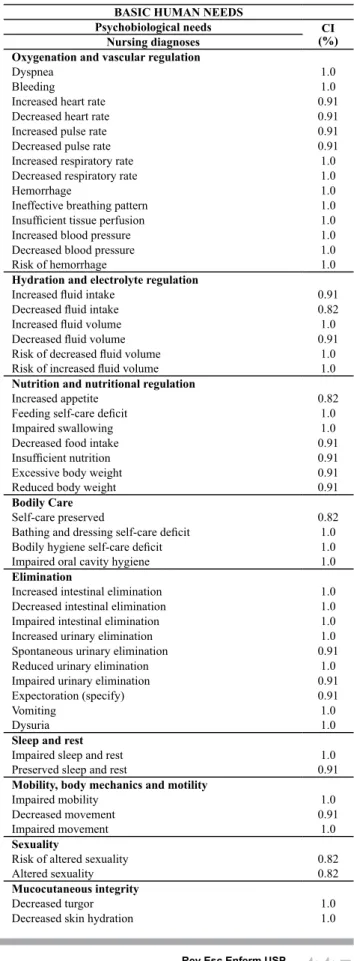
Ater the validaion and uniicaion of synonymous diagnoses, 70 statements were established and clas
-siied according to the Basic Human Needs of Horta. These statements were subdivided into psychobiological
(oxygenaion and vascular regulaion, hydraion and elec
-trolyte regulaion, nutriion and nutriional regulaion, eliminaion, sleep and rest, mobility, body mechanics and moility, sexuality, body care, skin and mucosal integrity, thermal regulaion, and pain percepion), psychosocial
(safety, communicaion, learning and acceptance, orienta
-ion in ime and space, and aten-ion) andpsychospiritual
(religion or philosophy of life) as shown in Table 1.
BASIC HUMAN NEEDS
Psychobiological needs CI
(%) Nursing diagnoses
Oxygenation and vascular regulation
Dyspnea 1.0
Bleeding 1.0
Increased heart rate 0.91
Decreased heart rate 0.91
Increased pulse rate 0.91
Decreased pulse rate 0.91
Increased respiratory rate 1.0
Decreased respiratory rate 1.0
Hemorrhage 1.0
Ineffective breathing pattern 1.0
Insuficient tissue perfusion 1.0
Increased blood pressure 1.0
Decreased blood pressure 1.0
Risk of hemorrhage 1.0
Hydration and electrolyte regulation
Increased luid intake 0.91
Decreased luid intake 0.82
Increased luid volume 1.0
Decreased luid volume 0.91
Risk of decreased luid volume 1.0
Risk of increased luid volume 1.0
Nutrition and nutritional regulation
Increased appetite 0.82
Feeding self-care deicit 1.0
Impaired swallowing 1.0
Decreased food intake 0.91
Insuficient nutrition 0.91
Excessive body weight 0.91
Reduced body weight 0.91
Bodily Care
Self-care preserved 0.82
Bathing and dressing self-care deicit 1.0
Bodily hygiene self-care deicit 1.0
Impaired oral cavity hygiene 1.0
Elimination
Increased intestinal elimination 1.0
Decreased intestinal elimination 1.0
Impaired intestinal elimination 1.0
Increased urinary elimination 1.0
Spontaneous urinary elimination 0.91
Reduced urinary elimination 1.0
Impaired urinary elimination 0.91
Expectoration (specify) 0.91
Vomiting 1.0
Dysuria 1.0
Sleep and rest
Impaired sleep and rest 1.0
Preserved sleep and rest 0.91
Mobility, body mechanics and motility
Impaired mobility 1.0
Decreased movement 0.91
Impaired movement 1.0
Sexuality
Risk of altered sexuality 0.82
Altered sexuality 0.82
Mucocutaneous integrity
Decreased turgor 1.0
Table 1 - Distribution of the nursing diagnoses constructed from the Database of Special Nursing Language Terms of the
Infec-tious Disease Clinic of HULW/UFPB and from the ICNP®
ratory center sends impulses to contract the diaphragm. In contrast, the second process involves relaxaion of the diaphragm, during which the abdominal organs return to their normal posiion(11). Thus, the diagnosis of increased respiratory rate is determined by breaths per minute (bpm) above normal parameters, i.e., over twenty breaths per minute in adults(11-12). The parameters in other phases
of development are infants = 30-40 bpm, preschool chil
-dren = 20-25 bpm, school chil-dren =18-24 bpm and ado
-lescents = 12-20 bpm(13). The diagnosis of decreased respi -ratory rate is determined by the number of bpm below normal limits. The diagnosis of dyspnea is deined as the
forced entry and exit of air from the lungs with increasing discomfort and efort(14).
For vascular regulaion, the diagnosis of insuicient is
-sue perfusion is characterized by insuicient blood circu
-laion through peripheral issues at the capillary level(12).
Blood pressure corresponds to the force exerted on the walls of the arteries during ventricular systoles and dias
-toles and can be afected by cardiac output, distension of the arteries, blood volume, velocity and viscosity(15). The
diagnoses increased blood pressure and decreased blood pressure are characterized by the pressure exerted by the circulaing blood on the walls of the vessels of the sys
-temic circulaion, lungs and heart, and 120/80 mmHg is considered normal in adults (11-12). The parameters in other
phases of development are 0-3 months = 75/50 mmHg, 3-9 months = 85/65 mmHg, 9-12 months = 90/70 mmHg, 1-3 years = 90/65 mmHg, 3-9 years = 95/60 mmHg, 9-11 years = 100/60 mmHg, 11-13 years = 105/65 mmHg and 13-14 years = 110/70 mmHg(13).
Other diagnoses seen in the clinic are risk of hemor
-rhage, hemorrhage and bleeding, which are primarily seen in clients with dengue hemorrhagic fever. These pa
-ients have symptoms of thrombocytopenia and bleeding as evidenced by one or more of the following signs: posi
-ive tourniquet test, petechiae, bruising and bleeding of the mucous membranes(16).
For hydraion and electrolyte regulaion, it was ob
-served that increasing the liquid nutrient and water sup
-ply could result in a risk of increased luid volumeor
in-creased luid volume due to the infusion of intravenous luids, sodium retenion, failures in regulatory mecha
-nisms or venous stasis. In the infecious disease clinic, the diagnosis of increased luid volume is primarily seen in the form of edema. Edema of the limbs is observed as a condiion of excessive accumulaion of luid in the issue spaces, and it is commonly seen in poisonous animal bite vicims, usually by the genus Bothrops. This is character
-ized by inlammaion at the site of the bite and can ex
-tend to the enire afected area(16). Edema in other areas,
paricularly the face, is oten a complicaion of pertussis in lactaing infants who are prone to severe forms of the
disease(17). There is a diagnosis of generalized edema (or
anasarca) that results from luid accumulaion in cell is
-sues and in body caviies(18). The reducion of luid supple
-Impaired skin integrity 1.0
Traumatic wound 0.91
Pressure ulcer (location) 1.0
Thermoregulation
Increased body temperature 1.0
Decreased body temperature 1.0
Excessive Sweating 1.0
Pain perception
Acute pain 1.0
Chronic Pain 1.0
Cutaneous pain 0.91
Musculoskeletal pain 0.91
Psychosocial needs IC
(%) Nursing diagnoses
Security
Deicient immunization 0.91
Risk of transmitting infection 1.0
Risk of secondary infection 1.0
Communication
Impaired communication 0.91
Reduced communication 0.91
Learning and acceptance
Low health knowledge 1.0
Impaired acceptance of the therapeutic regimen 1.0
Orientation in time and space
Reduced level of consciousness 1.0
Attention
Constant crying 0.82
Psychospiritual needs CI
(%) Nursing diagnoses
Religion or life philosophy
Spiritual distress 0.91
diScUSSioN
Infecious disease control remains a challenge because it requires interruping the epidemiological chain of hu
-man disease causing agents. The intervenions are based on the nursing diagnosis, which is the responsibility of the nurse, and they are constructed based on data from the nursing history, the physical examinaion and laboratory results. Thus, the nursing professional should recognize the responses of the paient in order to provide care for their basic human needs(5). In this discussion, the focus is
only on the diagnoses that obtained a CI equal to 1.0 dur
-ing the validaion process. Several normality parameters of human development will be discussed, with atenion to the proile of the clientele of the infecious disease clinic.
Psychobiological and psychosocial needs are common to all living beings, whereas psychospiritual needs are unique to humans(5). Included in psychobiological needs is
oxygenaion, which is the movement of air into and out of the lung in order to replenish oxygen and remove carbon dioxide from the airways. When this process is impaired,
inefecive breathing patern is diagnosed, which is con
-ceptualized as inhalaion or exhalaion that does not pro
-vide adequate venilaion(10).
-ments can trigger risk factors for the loss of body luids and electrolytes, highlighing the diagnosis of the risk of decreased luid volume. This is a relevant nursing diagno
-sis since water is needed for growth, normal funcioning and the maintenance of life.
For nutriion and nutriional regulaion, a decrease or absence of appeite is very common as a result of either physiological or nerve causes. It is manifested by the
feed-ing self-care deicit diagnosis, in which the client presents an impaired ability to perform aciviies related to feed
-ing(19), or the impaired swallowing (or dysphagia) diagno
-sis, in which the clients exhibit diiculty in the passage of luids and decomposed food via muscle movement from the mouth to the stomach(12).
For eliminaion needs, the eliminaion of waste in the urine is dependent on the kidneys, ureters, bladder and urethra. The diagnoses found here characterize alteraions in the volume and quanity of urine, such as increased uri
-nary eliminaion, which is deined as micturiion greater than four to six imes daily and with urine output exceed
-ing the values of 1000 to 2000 ml in 24 hours, and reduced urinary eliminaion, which is characterized by reduced uri
-naion according to the parameters cited.The diagnosis of
dysuria, deined as pain and diiculty in urinaion, both at
the beginning and at the end, is primarily found in clients with urinary tract infecions(18).
Intesinal eliminaion consists of undigested food, in
-organic materials, water and bacteria, with light or dark brownish color due to the cleavage of bile by intesinal bacteria. However, many condiions can alter the ap
-pearance and coloraion of the stool, including the use of medicaions or the consumpion of certain foods(15).
Hepatocellular problems also generate the diagnosis of
impaired intesinal eliminaion. Other changes in bowel habits can be represented by the diagnosis of increased intesinal eliminaion (or diarrhea), which is the passage of fecal material with an increased frequency of excre
-ion and increased intesinal sounds(12). Reduced intesi -nal eliminaion (or consipaion) is characterized by de
-creased eliminaion of fecal material over the long term or by diiculty in evacuaing(18). Among other nursing
diagnoses related to the eliminaion needs, vomiing is highlighted, and this is deined as the expulsion of trans
-formed food or gastric contents from the mouth or their return to the mouth(12).
Sleep and rest facilitate cellular growth and the repair of aging body issues. It is known that blood pressure and metabolic, cardiac and respiratory rates reduce to baseline levels during sleep, favoring the normal biological func
-ions of the body(19). However, there are untreated condi
-ions that cause disrup-ions in normal sleep and rest pat
-terns, and these can generate three situaions: insomnia, abnormal movements or sensaions during sleep or waking up during the night and excessive dayime sleepiness. This nursing diagnosis for these is impaired sleep and rest(11).
Body mechanics involve a set of aciviies of the mus
-culoskeletal and nervous systems in order to maintain balance, posture and body alignment. Appropriate use of body mechanics reduces the risk of damage to the mus
-culoskeletal system(11). Damage can cause impaired move
-ment, which is a limitaion of the musculoskeletal system
that impairs movement(12). The diagnosis of impaired mo -bility expresses diiculty in walking(18).
Bodily care involves aciviies that provide comfort, safety and well-being to the individual. There are clients with certain types of cogniive and motor limitaions, and the nurse must idenify these and intervene to provide hy
-giene pracices. It is important to communicate in order to promote a more therapeuic relaionship(11). The client
may present the following nursing diagnoses: bathing and dressing self-care deicit and hygiene self-care deicit(or impaired body hygiene). The irst is represented by the impaired ability to perform aciviies, such as bathing and dressing appropriately, and the second, by the inability to maintain a coninuous hygiene standard or to keep the body clean and odorless(14,19).
Oral cavity hygiene consists of maintaining mucosal integrity, monitoring for fungal infecions, primarily in immunocompromised clients, and examining deniion, which is responsible for food masicaion. However, dii
-culies can arise due to impaired oral cavity hygiene, lead
-ing to inlammaion or infecion, which can cause a loss or sotening of the teeth(11).
The skin is the main protecive barrier against disease-causing organisms. It also protects against trauma, espe
-cially in the palm and sole. It is richly innervated, which makes it sensiive to temperature, pain and pressure. Fur
-thermore, the skin regulates temperature by radiaion, conducion and convecion of heat, and it is able to syn
-thesize vitamin D upon exposure to ultraviolet radiaion(15).
The diagnosis of impaired skin integrity characterizes the state of alteraion of the external surface of the body(14).
This can be seen in chickenpox and herpes zoster by the ap
-pearance of a maculopapular rash that assumes a vesicu
-lar appearance. The erupions develop into pustules and scabs. It is important to evaluate the thermal, painful and tacile sensiiviies of disorders due to dermatoneurological impairment(20). The diagnosis of pressure ulcer represents
an area of injury due to prolonged and intense pressure, which afects cellular metabolism by reducing or obstruct
-ing the blood low and resul-ing in issue ischemia(11).
Skin also undergoes modiicaions due to aging. The primary nursing diagnoses associated with these changes
are decreased turgor and decreased skin hydraion (or dry
skin), in which dryness, wrinkles and pigmentaion are highlighted. Drying occurs due to decreases in sweat and sebaceous glands, and wrinkling is due to thinning of the epidermis and dermis, which promotes the appearance of wrinkles and decreased turgor. The appearance of pig
use of protecion(15). However, a decrease in skin turgor
during old age is normal, unlike a decrease in turgor due to electrolyte disturbances, such as dehydraion.
Thermal regulaion corresponds to the balance be
-tween the heat lost and the heat produced. It is con
-trolled by physiological and behavioral mechanisms(15).
Changes in temperature occur due to failures in heat loss and producion. Therefore, increased body temperature is
observed when body heat increases relaive to body me
-tabolism. During the day, there is a slight increase in body temperature compared to during sleep or rest. The re
-verse occurs in decreased body temperature(12). Sweaing
is a process in which the body loses heat through evapora
-ion. This can increase during emoional or mental stress situaions or when exercising. Excess sweaing can cause drying of the skin and mucous membranes as well as itch
-ing. This is evidenced by the diagnosis of excessive sweat
-ing, which relects the loss of too much water through the evaporaion of moisture on the skin surface(12).
Pain percepion is an unpleasant sensory and emoion
-al experience. It is the most common reason for seeking healthcare. Thus, nurses must comprehend the patho
-physiology of pain, its physiological and psychological con
-sequences and the methods used to treat it(15). Pain can
be classiied by its duraion and locaion. Thus, diagnoses of acute pain relect increased sensory percepion of body parts over a short ime interval or of sudden onset, and this is interpreted by reports of pain, facial expressions of pain, altered muscle tone, self-protecive behavior, reduced at
-tenion span, altered percepion of ime, withdrawal from social contact, impaired thought processes, distracted behavior, agitaion, and loss of appeite. The diagnosis of
chronic pain is conceptualized in the same way, but it takes place over a longer ime period(12).
For psychosocial needs, safety in the hospital, commu
-nity or home decreases the incidence of health problems and injuries, reduces the duraion of treatment and gives the client a feeling of well-being(11). In this context, the di
-agnosis of risk of transmission of infecion is emphasized. This is the risk of transmiing or triggering the invasion of pathogenic microorganisms that reproduce and muliply, causing disease due to local cellular injury, secreion of toxins or anigen-anibody reacions(12). The diagnosis risk of secondary infecion relects the possibility of contract
-ing another infecion dur-ing or at the end of the treat
-ment for a primary infecion.
Health education is important for preventing and promoting health, as it brings awareness to the client
and their family members regarding their health dys
-function, the use of drugs or the performance of pro
-cedures. In cases of low health knowledge, translated
as the inadequate understanding of their pathological condition or how to deal with health problems, educa
-tion may facilitate adherence to the treatment plan. Education could also improve cases of impaired ac
-ceptance of the therapeutic regimen, which considers
difficulties in adhering to the pharmacological or non-pharmacological treatment plan. The lack of adherence to the therapeutic regimen has been the subject of var
-ious studies. Among the most important factors are the complex therapeutic regimens of long duration, side effects, financial restrictions, forgetfulness and self-treatment habits, such as purchasing medicine without a medical prescription(15).
The neurological system is responsible for maintain
-ing consciousness and controll-ing memory, thought processes, sensations, emotions and voluntary move
-ments(19). The client can present a reduced level of consciousness, represented by significantly reduced mental response capabilities(12). Such cases are seen
primarily during bacterial meningitis, where the bacte
-ria are distributed throughout the central nervous sys
-tem and the walls of the cerebral venous sinuses, and they eventually penetrate the dura mater to reach the subarachnoid space. If the body does not develop de
-fense mechanisms, the infection spreads, causing neu
-rological alterations(20).
coNcLUSioNS
The results of this study are clinically relevant, and the creaion of diagnosic nomenclature will facilitate com
-municaion between nursing professionals. Importantly, the statements were constructed from clinical terms used in an infecious disease clinic, enabling the use of method
-ological principles, improved scieniic visualizaion by the professionals and providing care with greater resoluive power for the client.
One of the major challenges encountered throughout this study was synthesizing a cohesive list of diagnoses for clients of diferent age groups. Another diiculty was re
-laing the clinical aspects of diferent infecious diseases using tools such as clinical reasoning, academic experi
-ence and technical and scieniic knowledge and subse
-quently grouping the signs and symptoms to create the diagnoses.
REFERENcES
1. Barra DCC, Dal Sasso GTM, Monicelli M. Processo de enfer
-magem informaizado em unidade de terapia intensiva: uma práica educaiva com enfermeiros. Rev Eletr Enferm [inter
-net]. 2009 [citado 2010 set. 7];11(3):579-89. Disponível em: htp://www.fen.ufg.br/revista/v11/n3/v11n3a15.htm
2. Lucena ICD, Barreira IA. Revista Enfermagem em Novas Di
-mensões: Wanda Horta e sua contribuição para a construção de um novo saber da enfermagem (1975-1979). Texto Con
3. Souza APMA, Soares MGO, Nóbrega MML. Indicadores empíricos para a estruturação de um instrumento de coleta de dados em unidade cirúrgica. Rev Eletr Enferm [internet]. 2009 [citado em 2010 ago. 21];11(3):501-8. Disponível em: www.fen.ufg.br/revista/v11/n3/pdf/v11n3a06.pdf
4. Amante LN, Rosseto AP, Schneider DG. Nursing care system
-aizaion at the Intensive Care Unit (ICU) based on Wanda Horta’s theory. Rev Esc Enferm USP [Internet]. 2009 [cited 2012 Mar 14];43(1):54-64. Available from: htp://www.scielo. br/pdf/reeusp/v43n1/en_07.pdf
5. Horta WA. Processo de enfermagem. Rio de Janeiro: Guana
-bara Koogan; 2011.
6. Teixeira CRS, Becker TAC, Citro R, Zanei ML, Landim CAP. Valida
-ion of nursing interven-ions in people with diabetes mellitus. Rev Esc Enferm USP [Internet]. 2011 [cited 2012 Mar 14];45(1):173-9. Avialble from: htp://www.scielo.br/pdf/reeusp/v45n1/en_24.pdf
7. Nichiata LYI, Padoveze MC, Ciosak SI, Gryschek ALFPL, Costa AA, Takahashi RF, et al. The Internaional Classiicaion of Pub
-lic Health Nursing Pracices - CIPESC®: a pedagogical tool for epidemiological studies. Rev Esc Enferm USP [Internet]. 2012 [cited 2012 July 27];46(3):766-71. Available from: htp:// www.scielo.br/pdf/reeusp/v46n3/en_32.pdf
8. Sobreira IAP. Construção de banco de termos da linguagem especial de enfermagem da clínica de doenças infecto-conta
-giosas do HULW/UFPB [monograia]. João Pessoa: Universi
-dade Federal da Paraíba; 2009.
9. Nóbrega MML, Garcia TR, Coler MS. Centro CIPE® do Pro
-grama de Pós-Graduação em Enfermagem da UFPB. Rev Bras Enferm. 2008;61(6):888-91.
10. North American Nursing Diagnosis Associaion (NANDA). Di
-agnósicos de Enfermagem da Nanda: deinições e classiica
-ção 2009-2010. Porto Alegre: Artmed; 2010.
11. Poter PA, Perry AG. Fundamentos de enfermagem: concei
-tos, processos e práica. 7ª ed. Rio de Janeiro: Guanabara Koogan; 2009.
12. Conselho Internacional de Enfermeiros (CIE). Classiicação Internacional para a Práica de Enfermagem versão 1.0. São Paulo: Algol; 2007.
13. Collet N, Oliveira BRG, Viera CS. Manual de enfermagem em pediatria. Goiânia: AB; 2010.
14. Furtado LG, Nóbrega MML. Construção de banco de ter
-mos ideniicados em registros de enfermagem uilizando a CIPE®. Rev Eletr Enferm [internet]. 2007 [citado 2010 ago. 21];9(3):630-55. Disponível em: htp://www.fen.ufg.br/re
-vista/v9/n3/v9n3a06.htm
15. Smeltzer SC, Bare BG. Tratado de enfermagem médico-cirúr
-gica. 10ª ed. Rio de Janeiro: Guanabara Koogan; 2005.
16. Brasil. Ministério da Saúde; Secretaria de Vigilância em Saúde. Doenças infecciosas e parasitárias: guia de bolso. 8ª ed. Brasília; 2010.
17. Brasil. Ministério da Saúde; Secretaria de Vigilância em Saúde. Guia de vigilância epidemiológica. 6ª ed. Brasília; 2005.
18. Silva CRL, Silva RCL, Viana DL. Compacto dicionário ilustrado de saúde. 4ª ed. São Caetano do Sul: Yendis; 2009.
19. Carpenito-Moyet LJ. Manual de diagnósicos de enferma
-gem. Porto Alegre: Artmed; 2008.