Ligia G FedeliI Pedro G VidigalII Claudia Mendes LeiteIII Cristina D CastilhosIV Robércia Anjos PimentelV Viviane C ManieroVI Jose Geraldo MillIV Paulo A LotufoVII Alexandre C PereiraVII Isabela M BensenorVIII
I Laboratório Clínico. Hospital Universitário. Universidade de São Paulo. São Paulo, SP, Brasil
II Departamento de Propedêutica Complementar. Faculdade de Medicina. Universidade Federal de Minas Gerais. Belo Horizonte, MG, Brasil
III Departamento de Ciências Fisiológicas. Centro de Ciências da Saúde. Universidade Federal do Espírito Santo. Vitória, ES, Brasil IV Departamento de Medicina Social.
Programa de Pós-Graduação em
Epidemiologia. Universidade Federal do Rio Grande do Sul. Porto Alegre, RS, Brasil
V Instituto de Ciências da Saúde. Universidade Federal da Bahia. Salvador, BA, Brasil
VI Departamento de Epidemiologia e Métodos Quantitativos em Saúde. Escola Nacional de Saúde Pública. Fundação Oswaldo Cruz. Rio de Janeiro, RJ, Brasil
VII Laboratório de Genética e Cardiologia Molecular. Instituto do Coração da Faculdade de Medicina. Universidade do Estado de São Paulo. São Paulo, SP, Brasil VIII Centro de Pesquisa Clínica e
Epidemiológica. Hospital Universitário. Universidade de São Paulo. São Paulo, SP, Brasil
Correspondence: Isabela Martins Bensenor
Centro de Pesquisa Clínica e Epidemiológica Hospital Universitário
Av. Lineu Prestes, 2565 - 3ºandar Cidade Universitária - Butantã 05508-900 São Paulo, SP, Brasil E-mail: [email protected]
Received: 10/5/2011 Aproved: 6/5/2012
Article available from: www.scielo.br/rsp
Logistics of collection and
transportation of biological samples
and the organization of the central
laboratory in the ELSA-Brasil
ABSTRACT
The ELSA (Estudo Longitudinal de Saúde do Adulto – Brazilian Longitudinal Study for Adult Health) is a multicenter cohort study which aims at the identifi cation of risk factors associated with type 2 diabetes and cardiovascular diseases in the Brazilian population. The paper describes the strategies for the collection, processing, transportation, and quality control of blood and urine tests in the ELSA. The study decided to centralize the tests at one single laboratory. The processing of the samples was performed at the local laboratories, reducing the weight of the material to be transported, and diminishing the costs of transportation to the central laboratory at the Universidade de São Paulo Hospital. The study included tests for the evaluation of diabetes, insulin resistance, dyslipidemia, electrolyte abnormalities, thyroid hormones, uric acid, hepatic enzyme abnormalities, infl ammation, and total blood cell count. In addition, leukocyte DNA, urine, plasma and serum samples were stored. The central laboratory performed approximately 375,000 tests.
DESCRIPTORS: Clinical Laboratory Information Systems. Diagnostic
Among the exposure variables in epidemiological studies of chronic diseases, physiological, biochemical, hormonal and infl ammatory data are included. The determination of these variables was legitimated in the Framingham Heart Study, initiated in 1948, when fi ve thousand volunteers attended the project’s investigation center (IC) to be submitted to a clinical assessment and tests.12 The most important result was the iden-tifi cation of elevated serum cholesterol as a higher risk factor for coronary heart disease, which triggered the “cholesterol theory”. Subsequently, other cohorts, like the Atherosclerosis Risk in Communities (ARIC) study33 and the Multi-ethnic Study of Atherosclerosis (MESA),5 used a similar methodology, with collection of biological material at the ICs. Contrasting to these results, cohorts like the Nurses’ Health Study,4 the Physicians’ Health Study19 and the Women’s Health Study8 decided to include a larger number of partici-pants by means of correspondence. The collection of biological material was performed by the volunteer (always a health professional), using a collection kit sent by mail and picked up by a transportation company after the collection. Blood collection by the participant enables it to be performed after the baseline of studies of the type case-cohort and nested case-control, using frozen samples. A signifi cant example of this strategy was the identifi cation of the association of the ultrasen-sitive C-reactive protein with coronary heart disease in the Physicians’ Health Study, with 22,071 participants, but in which only 1,086 analyses were performed: 543 participants with myocardial infarction and 543 without the disease.27
Cohort studies on chronic diseases enable the identifi ca-tion of risk markers in primary cohorts and prognostic markers in the survival cohorts of active diseases. Both the risk markers and the prognostic markers can be classifi ed according to physiopathology as: metabolic, lipid, of renal function, of vascular function, oxida-tive stress, angiogenesis, and of tissue necrosis.6 It is possible to identify, in urine samples, metabolites that are products of the interaction among several factors: diet-related, environmental, drug-related, of the intes-tinal microbiota and genetic factors.21
Independently of the strategy for biological material collection, the tests are usually performed at one or more central laboratories or by specifi c groups of tests, accor-ding to the technical sophistication that is required.5,33 However, all the analyses referring to a specifi c test are always centralized at the same laboratory.
The Estudo Longitudinal de Saúde do Adulto (ELSA-Brasil - Brazilian Longitudinal Study for Adult Health) aims to identify the risk fo cardiovascular diseases and diabetes in a population that is apparently healthy, focu-sing on the identifi cation of biomarkers at the initial stage
INTRODUCTION
of the atherosclerotic process. The ELSA-Brasil also aims to identify biomarkers involved in the process of the causal network that starts with body weight gain and is crystallized with the development of type 2 diabetes.3 From the operational point of view, the ELSA-Brasil decided, since its beginning, that the volunteer would visit the IC to undergo all the measurements and collec-tion of biological material, following the model of cohorts like Framinghan12 and ARIC.33 The ELSA-Brasil is the fi rst multicenter study in the country with a single protocol executed uniformly at the six centers. To achieve this, a central laboratory was constituted for the perfor-mance of all the blood and urine tests of the study; in addition, it was responsible for the standardization of the DNA extraction methodology.
In a study with the characteristics of the ELSA-Brasil, the performance of tests at one single laboratory provides many advantages, like the reduction in inter--laboratory variability and the utilization of the same inputs and consumables in the performance of bioche-mical dosages. Nevertheless, this does not reduce the need of great caution concerning the pre-analytical aspects, described in this paper. The pre-analytical variables contribute to reduce the accuracy of a labo-ratory test, and are responsible for between 32% and 75% of the total variance of results attributed to errors (excluding biological variability). This paper focuses on the following pre-analytical aspects: collection place, identifi cation of participants, preparation of partici-pants, collection site(s), tourniquet application and time, venipuncture technique, order of tubes collection, collection volume, handling of tubes and processing of biological samples, centrifugation, freezing and transportation of biological material.
DESCRIPTION OF THE PROCEDURES
Since the beginning of the organization of the study, the researchers discussed about the need of centralizing or not the performance of the tests. Two models were possible: decentralized collection and performance of the tests or decentralized collection with transporta-tion of the collected material to a central laboratory, common to the entire study.
The Laboratory of the University Hospital has imple-mented a Quality Management System and received the ISO 9001/2000 certifi cation on 04/11/2006. It was accredited by the Clinical Laboratories Accreditation Program on 12/18/2009 (2005), and participates in an Inter-laboratory Profi ciency program. In addition, it has an Internal Quality Control Program with at least two levels of control to each analyte, with high-performance automated equipment and a team of qualifi ed personnel that assure the quality of the performed tests. The study’s fi nal decision was to centralize the tests, except for the blood cell count, which would be carried out locally for technical reasons. The blood cell count in the ELSA-Brasil was performed with automated equi-pment, at laboratories with internal and external quality controls, which participate in laboratory profi ciency programs, like the National Quality Control Programa, the Program of Profi ciency in Laboratory Testsb and the Laboratory Accreditation Program of the College of the American Pathologists.c
Fasting blood glucose and after the ingestion of a glucose solution are the key points of the study, as they represent one of the criteria that will defi ne the presence of diabetes in a study that focuses on cardio-vascular disease and on diabetes itself. Decentralizing the glucose tests would introduce an important error factor in the determination of one of the main variables of the study. Recent studies have shown that blood collection, with subsequent centrifugation and freezing of the plasma, has proved to be quite stable for future dosage of glucose.7,11 Recently, the Study of Latinos (SOL) also decided to centralize the performance of the tests, including glucose.32
The procedures for the collection of biological samples were standardized to assure uniformity at all the ELSA ICs and followed the recommendations of the Brazilian Society of Clinical Pathology/Laboratory Medicine for blood collection (2005).d Blood collection was divided into two stages: after a 12-hour fasting and 2 hours after the ingestion of a glucose solution.2 In the participants with diabetes, the oral glucose tolerance test was replaced by a standardized food load. Besides the tests performed two hours after the ingestion of the glucose solution or food load, the study established that biological material for storage must be collected on the second blood collection. Few studies will have the same conditions as ELSA’s of evaluating biochemical and infl ammatory markers in the serum after ingestion of a glucose solution.
Another highlight was the standardization of the food load in the form of a snack composed of industrialized food, including four toasts (15 g each), four processed cheese cubes and orange juice (200 ml), totaling 435 kcal (including 24 g of fat, of which 14 g of saturated fat and 47 g of fast absorbing carbohydrates). The option for industrialized food was due to the fact that it does not need refrigeration, it presents a long validity, it is not necessary to prepare it at the IC and it can be bought with the same facility at all the centers. The idea of testing a food load in the diabetics was based on recent evidence according to which the alterations of the post-prandial period are important factors in the development of atherosclerosis.9,10,13
A sequence for collection in tubes was established, so that the fi rst three enabled the performance of all the tests. The following tubes ensured the variety of the materials necessary to compose the ELSA biobank. In addition to the tests of each participant, 42 samples of 0.5 ml were stored locally and at the central biobank.
Urine collection in the ELSA was planned to evaluate glomerular fi ltration by creatinine clearance and to estimate the ingestion of electrolytes (Na, K) by renal excretion. Therefore, in the ELSA, urine collection was performed during 12 hours in the nightly period, when the majority of people are at home, thus reducing collection errors and increasing adherence. At night the temperature is lower, and this reduces the loss of electrolytes via sweat. A parallel study conducted with a population that was similar to ELSA’s analyzed the correlation between urine collected over 24 h and over 12 h (7p.m. to 7 a.m.), and it was found that the creatinine clearance was similar in the two periods.31
Thirty minutes after the end of blood collection, at the most, all tubes were centrifuged under refrigeration during 15 minutes. Then, the aliquots were separated for tests in an ice bath, using cryotubes previously identifi ed with barcodes.
To enable the implementation of the central laboratory, it was necessary to create a structure for transportation and short-term storage of samples at the centers, so that they could be subsequently sent to São Paulo on a monthly basis. The aliquots for the performance of the tests were stored in freezers at -80ºC until the date of transportation to the Central Laboratory. The samples collected at the University Hospital of USP were also stored in a freezer at -80ºC for up to 30 days for the subsequent performance of the tests, in the same way as in the other ELSA ICs.
a Programa Nacional de Controle da Qualidade. [cited Mar 4, 2013]. Available from: http://www.pncq.org.br/ b Profi ciência em Ensaios Laboratoriais. [cited Mar 4, 2013]. Available from: http://www.sbpc.org.br/?C=133
c College of the American Pathologists. Laboratory Accreditation Program. Northfi eld (IL): CAP; 2012 [cited Mar 28, 2011]. Available from: http://www.cap.org/apps/cap.portal?_nfpb=true&cntvwrPtlt_actionOverride=%2Fportlets%2FcontentViewer%2Fshow&cntvwrPtlt%7BactionF orm.contentReference%7D=laboratory_accreditation%2Faboutlap.html&_pageLabel=cntvwr
The transportation of biological material to the central laboratory also required the defi nition of a strategy. One of the options was the transportation of biological material in the primary tubes after centrifugation. This strategy would have the advantage that the local labo-ratory team at each center would be composed of few members, with the function of collecting and centri-fuging the material. The largest part of the procedures would be performed at São Paulo. The negative aspect is that the weight of the sent material would increase very much with the transportation of the primary tubes to São Paulo, and the costs would become unfeasible. The second option was that each IC would have a team for the collection and processing of the biological mate-rial, which would be stored in cryotubes at -80ºC for subsequent transportation. The negative aspect of this strategy would be the need of centralized training and certifi cation of the IC teams, and the positive aspect, the lower costs. Finally, it was decided that local teams would be hired and trained to perform the processing of the biological material.
The method chosen to perform the DNA extraction was salting-out, due to the lower cost and larger amount of extracted DNA. The solutions necessary for the extraction were prepared in São Paulo and sent by a transportation company.24
To control the quality of the collection and processing of biological samples in the ELSA, 10% of the parti-cipants’ identifi cation codes were randomly drawn. The drawn participants had a duplicate collection tube that generated an extra test aliquot which was used as blind control.
After it was decided to centralize the tests, a specifi c room was created for the processing of biological mate-rials of research projects. The study renovated a room
of the laboratory in the University Hospital to install the equipment, which, besides facilitating the study’s logistics, qualifi ed the hospital to receive other large research projects.
The strategy of performing the tests at a central labo-ratory aimed to ensure the uniformity of the utilized methodology, avoiding the variations between labo-ratories that would inevitably happen if the tests had been decentralized. All the defi ned procedures were described in detail in specifi c manuals for each stage of the process: (1) “Collection of biological samples”; (2) Processing of biological samples”; (3) “Tests and methodology” and (4) “Storage and transportation of biological samples”.
Another important result was the centralized training of all the laboratory professionals. The entire team that worked at the six centers was trained in São Paulo by the Central Laboratory team. After the training and before the beginning of the fi eldwork, the central laboratory team made a certifi cation visit to each ELSA IC to check the adherence to the study’s protocols. Periodically and whenever necessary, visits of the central laboratory team were scheduled to the ELSA centers. Furthermore, during data collection, and whenever necessary, the central laboratory received new team members from all the centers for training or retraining.
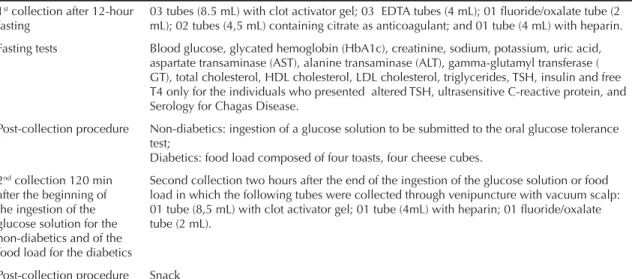
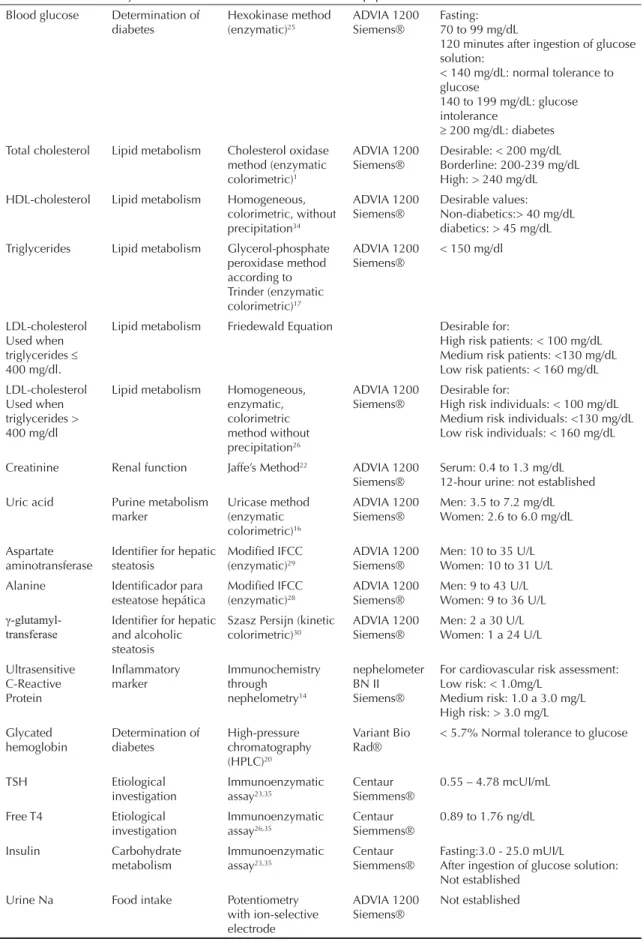
Table 1 lists the fasting tests and those performed after 2 h. Table 2 describes the methodology and the equi-pment used to perform the tests, with their reference values. The blood cell counts were carried out locally at each center. Slide reading was not performed, due to the diffi culty in the inter-laboratory standardization of this procedure.
All the study’s centers started with one or two partici-pants scheduled per day until the maximum capacity of
Table 1. Fasting collection and collection after ingestion of a glucose solution or food load.
1st collection after 12-hour fasting
03 tubes (8.5 mL) with clot activator gel; 03 EDTA tubes (4 mL); 01 fl uoride/oxalate tube (2 mL); 02 tubes (4,5 mL) containing citrate as anticoagulant; and 01 tube (4 mL) with heparin.
Fasting tests Blood glucose, glycated hemoglobin (HbA1c), creatinine, sodium, potassium, uric acid, aspartate transaminase (AST), alanine transaminase (ALT), gamma-glutamyl transferase ( GT), total cholesterol, HDL cholesterol, LDL cholesterol, triglycerides, TSH, insulin and free T4 only for the individuals who presented altered TSH, ultrasensitive C-reactive protein, and Serology for Chagas Disease.
Post-collection procedure Non-diabetics: ingestion of a glucose solution to be submitted to the oral glucose tolerance test;
Diabetics: food load composed of four toasts, four cheese cubes.
2nd collection 120 min after the beginning of the ingestion of the glucose solution for the non-diabetics and of the food load for the diabetics
Second collection two hours after the end of the ingestion of the glucose solution or food load in which the following tubes were collected through venipuncture with vacuum scalp: 01 tube (8,5 mL) with clot activator gel; 01 tube (4mL) with heparin; 01 fl uoride/oxalate tube (2 mL).
Table 2. Types of performed tests, their purpose, utilized methodology and reference values.
Test Objective Method Equipment Reference value
Blood glucose Determination of diabetes Hexokinase method (enzymatic)25 ADVIA 1200 Siemens® Fasting: 70 to 99 mg/dL
120 minutes after ingestion of glucose solution:
< 140 mg/dL: normal tolerance to glucose
140 to 199 mg/dL: glucose intolerance
200 mg/dL: diabetes Total cholesterol Lipid metabolism Cholesterol oxidase
method (enzymatic colorimetric)1
ADVIA 1200 Siemens®
Desirable: < 200 mg/dL Borderline: 200-239 mg/dL High: > 240 mg/dL HDL-cholesterol Lipid metabolism Homogeneous,
colorimetric, without precipitation34
ADVIA 1200 Siemens®
Desirable values: Non-diabetics:> 40 mg/dL diabetics: > 45 mg/dL Triglycerides Lipid metabolism Glycerol-phosphate
peroxidase method according to Trinder (enzymatic colorimetric)17 ADVIA 1200 Siemens®
< 150 mg/dl
LDL-cholesterol Used when triglycerides 400 mg/dl.
Lipid metabolism Friedewald Equation Desirable for:
High risk patients: < 100 mg/dL Medium risk patients: <130 mg/dL Low risk patients: < 160 mg/dL
LDL-cholesterol Used when triglycerides > 400 mg/dl
Lipid metabolism Homogeneous, enzymatic, colorimetric method without precipitation26 ADVIA 1200 Siemens® Desirable for:
High risk individuals: < 100 mg/dL Medium risk individuals: <130 mg/dL Low risk individuals: < 160 mg/dL
Creatinine Renal function Jaffe’s Method22 ADVIA 1200 Siemens®
Serum: 0.4 to 1.3 mg/dL 12-hour urine: not established Uric acid Purine metabolism
marker Uricase method (enzymatic colorimetric)16 ADVIA 1200 Siemens®
Men: 3.5 to 7.2 mg/dL Women: 2.6 to 6.0 mg/dL
Aspartate aminotransferase
Identifi er for hepatic steatosis
Modifi ed IFCC (enzymatic)29
ADVIA 1200 Siemens®
Men: 10 to 35 U/L Women: 10 to 31 U/L
Alanine Identifi cador para esteatose hepática
Modifi ed IFCC (enzymatic)28
ADVIA 1200 Siemens®
Men: 9 to 43 U/L Women: 9 to 36 U/L
γ -glutamyl-transferase
Identifi er for hepatic and alcoholic steatosis
Szasz Persijn (kinetic colorimetric)30
ADVIA 1200 Siemens®
Men: 2 a 30 U/L Women: 1 a 24 U/L
Ultrasensitive C-Reactive Protein Infl ammatory marker Immunochemistry through nephelometry14 nephelometer BN II Siemens®
For cardiovascular risk assessment: Low risk: < 1.0mg/L
Medium risk: 1.0 a 3.0 mg/L High risk: > 3.0 mg/L
Glycated hemoglobin Determination of diabetes High-pressure chromatography (HPLC)20 Variant Bio Rad®
< 5.7% Normal tolerance to glucose
TSH Etiological investigation Immunoenzymatic assay23,35 Centaur Siemmens®
0.55 – 4.78 mcUI/mL
Free T4 Etiological
investigation
Immunoenzymatic assay26,35
Centaur Siemmens®
0.89 to 1.76 ng/dL
Insulin Carbohydrate metabolism Immunoenzymatic assay23,35 Centaur Siemmens®
Fasting:3.0 - 25.0 mUI/L
After ingestion of glucose solution: Not established
Urine Na Food intake Potentiometry
each center was achieved, which varied from four to 20 participants per day. This number increased only when the team was totally capable of performing the task. In the case of problems, the instruction was to decrease the number of participants; it would only be increased again when the team was ready. This extended the period of data collection, but ensured the quality of the procedures.
In relation to the tests, the delivery of the 24-hour urine sample was the most complex point. Approximately 10% of the participants did not deliver it on the day of the tests. This occurred at the six centers in a similar way. Among the women, the most common cause was menstruation. In these cases, the participant was instructed to return on another day to deliver the material, but this sometimes did not occur. In the cases of diffi culty in collecting blood, the protocol followed by the team guaranteed that the samples for the tests were always the fi rst to be collected; therefore, there was always material to perform the tests. What was compromised, in these cases, were the samples that would be stored.
In relation to transportation, although the study used a company specialized in transportation of biological material, the few options of fl ights constituted a diffi -culty over time. To minimize these problems, it was necessary to create a distance support to the laboratory. A network of four cell phones with rotation of the team worked 24 h at a distance to solve problems related to transportation, like a delay in the delivery of the samples by the transportation company due to traffi c problems in São Paulo, among others. This network contributed to solve problems and, with it, there was always a member of the team to receive the material and process it as soon as possible. The network, which had not been planned at the beginning of the study, was fundamental and brought tranquility during the
fi eldwork. A local problem experienced by some centers was diffi culties in the supply of dry ice, which many times delayed the sending of the material.
During the 26 months of data collection, the laboratory received and processed 375,295 blood and urine tests of the participants included in the study, in the six centers. There was no loss of biological material due to transportation and no samples had to be discarded due to inadequate transportation.
CONCLUSIONS
The ELSA-Brasil is a multicenter cohort composed of six research and higher education institutions that aims at searching for new associations of diabetes and cardiovascular disease in the Brazilian population. The option to have one central laboratory ensured the uniformity of the methodology that was used to perform the tests, avoiding the inevitable variations among laboratories. Only the blood cell count was performed locally, with automatic readings, due to the impossibi-lity of standardizing slide reading in the six centers. The centralization of glucose dosage was successful. The ELSA-Brasil is one of the few studies that, in the next years, will be able to make the diagnosis of diabetes based on the glucose tolerance test and on glycated hemoglobin, which will open a new perspective for research into diabetes in long-term studies.
The calculations made before the beginning of the study showed that the most cost-effective procedure proved to be the processing of the biological material locally at each center, with subsequent transportation to São Paulo. Sending the material already processed reduced the weight, which was fundamental to reduce transportation costs. However, the chosen strategy also required the formation of local teams at each center to collect and process the samples. The formation of local teams, in turn, implied the creation of a strategy of centralized training of these teams, increasing the expenses with transportation and stay in São Paulo. Comparing the costs related to the need of centra-lized training to the reduction in the volume of the
Continuation
Test Objective Method Equipment Reference value
Urine K Food intake Potentiometry
with ion-selective electrode
ADVIA 1200 Siemens®
Not established
Urine calcium Food intake Potentiometry with ion-selective electrode)18
ADVIA 1200 Siemens®
Not established
Microalbuminuria Endothelial function Immunochemistry through
nephelometry
nephelometer BN II Siemens®
Normal: < 20 µg/m in
Microalbuminuria: 20 to 200 µg/min Macroalbuminuria: > 200 µg/min Serology for
Chagas Disease
Differential diagnosis in cardiomyopathies
ELISA with solid-phase microplates – reagent WIENER (CHAGASTEST)15
Microplate incubator/ reader
Not reactive
transported material, it was evident that processing the samples locally was much more cost-effective.
There were many bureaucratic restraints to hire the transportation companies and this jeopardized the transportation of biological material. Successful trans-portation depended more on bureaucratic restraints and on the traffi c in São Paulo than on technical issues related to the collection and processing of biological samples. It is important to highlight that there is no insurance policy for loss of biological material, as it is considered irreparable and irreplaceable loss, which hinders, from the juridical point of view, the writing of the transportation agreement. Another important point is that there are no airlines with tradition in the transportation of this material. During the initial stage of the study, the company that concentrated a large part of this transportation stopped operating on trade routes. In addition, the reduction in the number of fl ights also affected the logistics, a problem that was minimized with the creation of a distance support network to the laboratory, based on cell phones, available 24 hours a day, seven days a week. The justifi cation for its need,
which was questioned many times, is that without it, the conduction of the study could have been negatively affected. This network also supported the local labo-ratories at each investigation center, 24 h per day. The diffi culty in the supply of dry ice was another problem that many times delayed the sending of the material, changing the routine of the central laboratory.
In the planning of the study, many needs were underes-timated, implying new costs. Although clinical research has advanced a lot in recent years in Brazil, the trans-portation of biological material is performed in small amounts and on specifi c dates. The ELSA-Brasil, for the fi rst time, planned the transportation of material for a period of two and a half years. The absence of loss of material shows that the solutions that were found were successful and open good perspectives for long-term studies with transportation of biological material.
1. Allain CC, Poon LS, Chan CSG, Richmond W, Fu PC, et al. Enzimatic determination of total cholesterol in serum. Clin Chemistry. 1974;20(4):470-5.
2. American Diabetes Association. Diagnosis and classifi cation of diabetes mellitus. Diabetes Care. 2010;33(Suppl 1):S62-9. DOI:10.2337/dc10-S062
3. Aquino EM, Barreto SM, Benseñor IM, Carvalho MS, Chor D, Duncan BB, et al. Brazilian Longitudinal Study of Adult Health (ELSA-Brasil): objectives and design. Am J Epidemiol. 2012;175(4):315-24. DOI:10.1093/aje/kw
4. Belanger CF, Hennekens CH, Rosner B, Speizer FE. The Nurses’ Health Study. Am J Nurs. 1978;78(6):1039-40.
5. Bild DE, Bluemke DA, Burke GL, Detrano R, Diez Roux AV, Folsom AR, et al. Multi-Ethnic Study of Atherosclerosis: objectives and design. Am J Epidemiol. 2002;156(9):871-81. DOI:10.1093/aje/kwf113
6. Blankenberg S, Zeller T, Saarela O, Havulinna AS, Kee F, Tunstall-Pedoe H, et al. Contribution of 30 biomarkers to 10-year cardiovascular risk estimation in 2 population Cohorts. The MONICA, Risk, Genetics, Archiving, and Monograph (MORGAM) Biomarker Project. Circulation. 2010;121(22):2388-97. DOI:10.1161/CIRCULATIONAHA.109.901413
7. Boyanton Jr BL, Blick KE. Stability studies of 24 analytes in human plasma and serum. Clin Chem. 2002;48(12):2242-7.
8. Buring JE, Hennekens CH. The Women´s Health Study: rationale and background. J Myocardial Ischemia. 1992;4:30-40.
9. Ceriello A. The possible role of postprandial hyperglycaemia in the pathogenesis of diabetic complications. Diabetologia. 2003;46(Suppl 1):M9-16. DOI:10.1007/s00125-002-0931-5
10. Ceriello A, Davidson J, Hanefeld M, Leiter L, Monnier L, Owens D, et al. Postprandial hyperglycaemia and cardiovascular complications of diabetes: an update. Nutr Metab Cardiovasc Dis. 2006;16(7):453-6. DOI:10.1016/j.numecd.2006.05.006
11. Clark ML, Humphreys SM, Frayn KN. Stability of plasma glucose during storage. Ann Clin Biochem. 1990;27(Pt 4):373-7.
12. Dawber TR, Meadors GF, Moore Jr FE. Epidemiological approaches to heart disease: the Framingham Study. Am J Public Health Nations Health. 1951;41(3):79-81.
13. Ebenbichler CF, Kirchmair R, Egger C, Patsch JR. Postprandial state and atherosclerosis. Curr Opin Lipidol. 1995;6(5):286-290.
14. Férard G, Goester C, Klumpp T, Métais P. Evaluation of immunonephelometry of C-reative protein in serum [letter]. Clin Chem. 1980; 26(6):782-83.
15. Ferreira AW, Belem ZR, Moura MEG, Camargo ME. Aspectos da padronização de testes sorológicos para doença de Chagas: um teste imunoenzimático para triagem de doadores de sangue. Rev Inst MedTrop S Paulo.1991;33(2):123-8. DOI:10.1590/S0036-46651991000200006
16. Fossati P, Prencipe L, Berti G. Use of 3,5-dihidro-2-hydroxybenzenesulfonic acid/4 aminophenazone chromogenic system in direct enzymatic assay of uric acid in serum and urine. Clin Chem. 1980;26(2):227-31.
17. Fossati P, Prencipe L. Serum triglycerides determined colorimetrically with an enzime that produces hydrogen peroxide. Clin Chem. 1982;28(10):2077-80.
18. Gieltman HJ. An improved procedure for the determination of calcium in biochemical specimens. Anal Biochem. 1967;18(3):521-31. DOI:10.1016/0003-2697(67)90110-8.
19. Hennekens CH, Buring JE. Methodologic considerations in the design and conduct of randomized trials: the U.S. Physicians’ Health Study. Control Clin Trials. 1989;10(4 Suppl):142S-50S.
20. Hoelzel W, Weykamp C, Jeppsson JO, Miedema K, Barr JR, Goodall I, et al. IFCC reference system for measurement of hemoglobin A1C in human blood and national standardization schemes in the United States, Japan, and Sweden: a method-comparison study. Clin Chem. 2004;50(1):166-74. DOI:10.1373/clinchem.2003.024802
21. Holmes E, Loo RL, Stamler J, Bictash M, Yap IKS, Queenie C, et al. Human metabolic phenotype diversity and its association with diet and blood pressure. Nature. 2008;453(7193):396-400. DOI:10.1038/nature06882
22. Jaffe MZ. Ueber den Niederschlag, welchen Pikrinsäure in normalem Harn erzeugt and über eine neue Reaction des Kreatinins. Z Physiol Chem. 1886;10:391-400.
23. Kricka LJ. Cheluminescent and bioluminescent techniques. Clin Chem. 1991;37(9):1472-81.
24. Miller SA, Dykes DD, Polesky HF A simple salting out procedure for extracting DNA from human nucleated cells. Nucleic Acids Res. 1988;16(3):1215.
25. Neeley WE. Simple automated determination of serum or plasma glucose by a hexokinase/glucose-6-phosphate dehydrogenase method. Clin Chem. 1972;18(6):509-15.
26. Okada M, Matsui H, Ito Y, Fujiwara A, Inano K. Low-density lipoprotein cholesterol can be chemically measured: a new superior method. J Lab Clin Med. 1998;132(3):195-201.
27. Ridker PM, Cushman M, Stampfer MJ, Tracy RP, Hennekens CH.Infl ammation, aspirin, and the risk of cardiovascular disease in apparently healthy men. N Engl J Med. 1997;336(14):973-9. DOI:10.1056/NEJM199704033361401
Research funded by Financiadora de Estudos e Projetos (FINEP – Funding Agency for Studies and Projects – Process n. 01 05469).
The Brazilian Longitudinal Study for Adult Health (ELSA-Brasil) was fi nanced by the Ministry of Health (DECIT – Departamento de Ciência e Tecnologia – Science and Technology Department) and by the Ministry of Science and Technology (FINEP and CNPq – Conselho Nacional de Desenvolvimento Científi co e Tecnológico (National Council for Scientifi c and Technological Development) (Processes N. 01 06 0010.00 RS, 01 06 0212.00 BA, 01 06 0300.00 ES, 01 06 0278.00 MG, 01 06 0115.00 SP, 01 06 0071.00 RJ).
The authors declare that there are no confl icts of interest.
This manuscript was submitted for publication and underwent a peer review process as any other manuscripts submitted to this publication, and anonymity was guaranteed for authors and reviewers. Editors and reviewers declare no confl icts of interest that may affect the peer-review process.
29. Schumann G, Bonora R, Ceriotti F, Ferard G, Ferrero CA, Franck PF, et al. IFCC primary reference procedures for the measurement of catalytic activity concentrations of enzymes at 37 degrees C. International Federation of Clinical Chemistry and Laboratory Medicine. Part 5. Reference procedure for the measurement of catalytic concentration of aspartate aminotransferase. Clin Chem Lab Med. 2002;40(7):725-33. DOI:10.1515/CCLM.2002.125
30.Shaw LM, Stromme JH, London JL, Theodosen L. IFCC methods for the measurement of catalytic concentration of enzymes. Part 4. IFCC method for gamma-glutamyltransferase [(gamma-glutamyl)-peptide: amino acid gamma-glutamyltransferase, EC 2.3.2.2]. J Clin Chem Biochem. 1983;21(10):633-46.
31. Silva ABT, Molina MCB, Rodrigues SL, Pimentel EB, Baldo MP, Mill JG. Correlação entre depuração plasmática de creatinina utilizando urina coletada durante 24 horas e
12 horas. J Bras Nefrol. 2010;32(2):165-72. DOI:10.1590/S0101-28002010000200005
32. Sorlie PD, Avilés-Santa LM, Wassertheil-Smoller S, Kaplan RC, Daviglus ML, Giachello AL, Schneiderman N, et al. Design and implementation of the Hispanic Community Health Study/Study of Latinos. Ann Epidemiol. 2010;20(8):629-41. DOI:10.1016/j.annepidem.2010.03.015
33. The ARIC Investigators. The Atherosclerosis Risk in Communities (ARIC) Study: design and objectives. Am J Epidemiol. 1989;129(4):687-702.
34. Warnick GR, Nauck M, Rifai N. Evolution of methods for measurement of HDL-cholesterol: from ultracentrifugation to homogeneous assays. Clin Chem. 2001;47(9):1579-96.