http://dx.doi.org/10.1590/0104-07072017001420017
THEORETICAL AND METHODOLOGICAL REFLECTIONS FOR THE
CONSTRUCTION OF MIDDLE-RANGE NURSING THEORIES
Marcos Antônio Gomes Brandão1, Jaqueline Santos de Andrade Martins2, Mauricio de Abreu Pinto Peixoto3, Rafael Oliveira Pitta Lopes4, Cândida Caniçali Primo5
1 Ph.D. in Nursing. Professor, Nursing Undergraduate and Graduate Programs, Universidade Federal do Rio de Janeiro (UFRJ). Rio
de Janeiro, Rio de Janeiro, Brazil. E-mail: [email protected]
2 Ph.D. in Nursing. Coordinator, Nursing Undergraduate Course, Associacao Brasileira de Ensino Universitario – Centro Universitário.
Rio de Janeiro, Rio de Janeiro, Brazil. E-mail: [email protected]
3 Ph.D. in medicine. Professor, Educational Technology Center for Health, UFRJ. Rio de Janeiro, Rio de Janeiro, Brazil. E-mail:
4 Doctoral student, Nursing Graduate Program, Escola de Enfermagem Anna Nery. Professor, Undergraduate Course, Universidade Estácio de Sá. Rio de Janeiro, Rio de Janeiro, Brazil. E-mail: [email protected]
5 Ph.D. in Nursing. Professor, Nursing Undergraduate and Professional Master’s Degree, Universidade Federal do Espírito Santo.
Vitória, Espírito Santo, Brazil. E-mail: [email protected]
ABSTRACT
Objective: to relect on strategies and procedures for the development of middle-range theories and these theories’ contributions to connect abstract and empirical levels of the discipline to nursing pratice.
Method: analytic relection study.
Results: considerations on the development of middle-range nursing theories are presented, exempliied by the Interactive Breastfeeding Theory, derived from the Conceptual Model of Open Systems, by Imogene King. Some subjects addressed are the relexive aspects of lack of use of theoretical elements contained in the scientiic literature of Brazilian nursing, especially in doctoral theses. The relevance of the debate on strategies for expanding the development of middle-range nursing theories in Brazil is defended.
Conclusion: middle-range theories, which are located at the mid-point between grand theories and practice, present characteristics of theoretical and methodological references. They enable a practical way for nurses to connect philosophical perspectives to the real world and make applications of the theory to the clinical practice, and are thus a highly relevant subject.
DESCRIPTORS: Theoretical models. Nursing theory. Nursing methodological research. Concept formation. Evidence-based nursing.
REFLEXÕES TEÓRICAS E METODOLÓGICAS PARA A CONSTRUÇÃO DE
TEORIAS DE MÉDIO ALCANCE DE ENFERMAGEM
RESUMO
Objetivo: reletir sobre estratégias e procedimentos para o desenvolvimento de teorias de médio alcance e as contribuições dessas teorias em conectar níveis abstratos e empíricos da disciplina à prática da enfermagem.
Método: estudo de relexão com característica analítica.
Resultados: são apresentadas considerações sobre o desenvolvimento de teorias de médio alcance de enfermagem, tendo por ilustração a Teoria Interativa de Amamentação derivada do Modelo Conceitual de Sistemas Abertos de Imogene King. São tratados aspectos relexivos do não aproveitamento dos elementos teóricos contidos na produção de enfermagem brasileira, especialmente em teses de doutorado. Defende-se a relevância do debate sobre estratégias para a expansão do deDefende-senvolvimento de teorias de médio alcance de enfermagem no Brasil. Conclusão: as teorias de médio alcance, por estarem a meio caminho das grandes teorias e da prática, guardam características de referenciais teóricos e também metodológicos. Fornecem uma maneira prática para os enfermeiros conectarem as perspectivas ilosóicas da disciplina com o mundo real e as aplicações da teoria à prática clínica, sendo assunto de alta relevância.
REFLEXIONES TEÓRICAS Y METODOLÓGICAS PARA LA CONSTRUCCIÓN
DE TEORÍAS DE MEDIO ALCANCE DE ENFERMERÍA
RESUMEN
Objetivo: relexionar sobre estrategias y procedimientos para el desarrollo de teorías de medio alcance y las contribuciones de esas teorías en conectar niveles abstractos y empíricos de la disciplina en la práctica de la enfermería.
Método: estudio de relexión con característica analítica.
Resultados: se presentan consideraciones sobre el desarrollo de teorías de mediano alcance de Enfermería, teniendo por ejemplo la Teoría Interactiva de Lactancia derivada del Modelo Conceptual de Sistemas Abiertos de Imogene King. Se tratan aspectos relexivos del no aprovechamiento de los elementos teóricos contenidos en la producción de enfermería brasileña, especialmente en tesis de doctorado. Se deiende la relevancia del debate sobre estrategias para la expansión del desarrollo de teorías de medio alcance de enfermería en Brasil. Conclusión: las teorías de medio alcance, por estar a medio camino de las grandes teorías y de la práctica, guardan características de referenciales teóricos y también metodológicos. Proporcionan una manera práctica para que los enfermeros conecten las perspectivas ilosóicas de la disciplina con el mundo real y las aplicaciones de la teoría a la práctica clínica, siendo asunto de alta relevancia.
DESCRIPTORES: Modelos teóricos. Teoría de enfermería. Investigación metodológica en enfermería. Formación de concepto. Enfermería basada en evidencias.
INTRODUCTION
In the classiication of nursing knowledge ar -eas as proposed to the National Council for Scientiic and Technological Development, the axis of theories and methodologies is recognized by the capacity to make the products of knowledge better adapted for dissemination and with wider-ranging validity. Models and theories belonging to the discipline are necessary, as well as those retranslated from other disciplines.1 The value of conceptual models and nursing theories is a point of defense among aca-demics, with some claiming that a profession is le-gitimized by its ability to create and apply theories.2
Even when one recognizes that nursing, as a discipline, produces new and original knowledge, one should also recognize the existence of a certain gap between theory and practice, which is com-monly attributed to the failure to apply in practice the models and grand theories produced in the pe-riod of 1970 to 1980.2 Facing this, deining strategies to create bridges between nursing theory, research, and practice is required. Among the different possi -bilities to reduce that gap, the production of nursing theories closer to the empirical level, especially those classiied as middle-range or mid-range theories, has received increased relevance.
Middle-range theories are those that are limited in their application, fulilling an intermediary theoreti -cal role among the speciic work hypothesis and all speculation involving a larger conceptual scheme.3
Thus, they have been considered to have high ap -plicability to research and clinical practice. However, there are numerous and complex strategies and meth-odological bases for their development, demanding the availability of more content on the theme.
A relevant review study4 based on important international nursing journals demonstrated that
even with the signiicant increase in nursing re -search, the proportion of articles employing nursing theories published in the periods of 1986-1990 and 2002-2006 remained close to 20%.4
Also mentioned are: the interest in and increas -ing necessity for nurs-ing theories, especially middle-range and practice theories, that is observed in some countries;5 as well as the variety and imprecision
of terms employed in the theoretical ield and the methodological complexity and multiplicity. Recog-nizing the aforementioned necessities and possibili-ties, this article has the objective of relecting on the strategies and procedures for the development of middle-range theories and the contributions of these theories in connecting the abstract and empirical levels of the discipline to nursing practice.
NURSING THEORIES: CONCEPTS AND
GENERAL DEVELOPMENT STRATEGIES
In concept, theory is a symbolic representation of aspects of reality that are discovered or invented to describe, explain, predict, or prescribe responses, occurrences, situations, conditions, or relationship. Theory is generally constructed to express a new idea or new view on the nature of a phenomenon of interest, and is the main method to construct a body of knowledge speciic to nursing.6 Theory is deined
as one or more relatively concrete and speciic con -ceptualizations that derive from a conceptual model and its propositions, with concrete afirmations and speciic relations between two or more concepts.7
views of the professionals and have the objective of consolidating nursing as science and art in the health ield.8
The levels of theoretical abstraction and scope vary. The metatheory has the highest abstraction, fol -lowed by grand theories, middle-range theories and, inally, nursing practice theories or speciic-situation theories, considered the least abstract.9 Since they are more concrete than grand theories – consequently having more applicable elements – middle-range theories have received more attention in research.7
In a way, the interest in middle-range theories is a counterweight to the discomfort disseminated in the academia-service dialog of considering grand nursing theories too far-reaching or abstract to di-rectly orient nursing interventions.10
Regarding development, middle-range theo -ries can commonly follow inductive or deductive orientations. Sometimes they can have aspects of both. Deductive strategies are based on grand theories or theoretical models, while the inductive perspective begins with data to organize and con -struct a new theory. The choice of one or the other orientations impacts strategy selection and proce-dures for the development of a theory.
The general procedures for the creation of a middle-range theory can be: induction through research and practice; a combination of nursing and non-nursing theories; derivation from other disciplines’ theories that are related to nursing; or derivation from practical guidelines and standards based on research; and deduction from research and practice or from the application of grand theo-ries.10-11 Other authors classify procedures as such: induction from practice; induction from research; construction of concepts followed by testing in research and practice; deduction from theories of higher abstraction levels; and derived of theories from other disciplines.12
The Conceptual-Theoretical-Empirical struc-ture (C-T-E) is useful when relecting on the two types of research: one focused on creating theories and another on testing middle-range theories.13
The procedures for creating theories tend to consider research results (particular facts) to pro-duce generalizing conclusions that would become the theories themselves.14 From this perspective, induction is applied in order to create theories that are minimally linked or not linked or derived from preexisting models, basically employing data to theorize (example: Grounded Theory); or adopt conceptual models (component C) only to guide a descriptive theory that creates a theory, generating
a C-E-T type orientation;13 alternatively, they may only utilize concepts or constructs that are more general to create middle-range or speciic situation theories; for example, as in the adoption of the con-cept of “transition.”15
Otherwise, procedures for testing middle-range theories demand that middle-middle-range theory concepts and propositions be initially linked to a conceptual model, so that the theoretical test can be conducted. This low follows the C-T-E acronym in their original order, with the research (component E) being descriptive, correlational or experimental.13 The deduction method tends to be the most pre-dominant. Theories produced by deduction from a conceptual model or grand theory or by employing both deduction and induction, while following the C-T-E logic, demand future testing (validation). In fact, the most classic science model (received vision) recognizes that theory testing should be pursued, based on scientiic experiences.
GENERAL CHARACTERISTICS AND
REFLECTIONS ON THE INDUCTIVE
METHOD FOR THEORY PRODUCTION
The inductive method, starts from research and practice, Grounded Theory, Phenomenology, and other qualitative and quali-quantitative re -search designs that theorize from data create ele-ments for middle-range theories.
It is understood that Care Convergent Re -search has characteristics that would make it bet -ter for elaborating theories for speciic situations;16
however, it also has elements that could possibly generate middle-range theories by induction.
In the international sphere, there are many theories developed by induction: Meleis’ transition theory is linked to the concept of transition observed in various research by the author and collaborators;17
the theory of family vigilance offers guidelines for nursing interventions for family members when accompanying their hospitalized relatives;18 and
the gate control theory, which was developed from clinical guidelines,19 among others.
Nursing doctoral theses can provide direc -tion for the produc-tion of middle-range theories.10
already compatible with middle-range theories. Thus, a growing production of middle-range theo-ries could be contained in the production of nursing graduate programs in Brazil, and yet they remain hidden, demanding relection and investigation.
Considering the impossibility of exhausting the theme, the authors of this article chose to ad-dress and relect on issues related to the deductive methodology strategy for the theoretical deduction of grand nursing theories, because middle-range theories are still rarely produced in Brazil, while respecting the higher familiarity with the process of producing theories through this procedure.
THE METHODOLOGICAL STRATEGY
FOR DEDUCTION OR THEORETICAL
D E R I V A T I O N O F M I D D L E - R A N G E
THEORIES FROM GRAND THEORIES
Deduction applies analysis, synthesis, and derivation strategies to the development of middle-range theories for nursing. In the analysis, the theo -rist must “dissect the whole into parts,” so it can be better understood. In synthesis, information based on observation is used to construct a new concept, a new afirmation, and a new theory. Derivation consists of transposing or redeining a concept, af -irmation, and theory from one context or ield to another.9 These strategies are aligned for the
con-struction of a theory through deductive reasoning or by uniting deductive and inductive methods.
To illustrate middle-range theory deduction strategies derived from the conceptual model, the procedures developed in interactive breastfeeding theory are presented here. The aforementioned theory, developed in Brazil, is based on evidence from the scientiic literature on the theme of breast -feeding, derived from Imogene King’s Conceptual Model of Open Systems,20 which was adopted to
propose a systemic and interactionist vision of real -ity, which seemed to the authors to it the attributes of breastfeeding. Its aim is to describe, explain, pre -dict, and prescribe breastfeeding, examining factors that come before, inluence, and are a consequence of the breastfeeding process.21
The point where the construction of the breastfeeding interactive theory started was the selection of the conceptual model (component C), which would guide the theory creation model, spe-ciically the Conceptual Model of Open Systems. The conceptual component is relevant for present -ing the widest-reach-ing framework, system, or paradigm for the theory. Although it cannot be
tested, the conceptual model guides research by offering a reference framework, limiting the ques -tions used in research, the subject of the research, obtained responses, and which interpretation rules should be applied.13
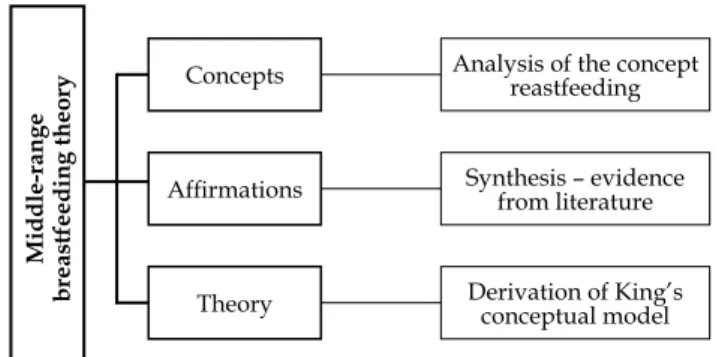
For the development of this theory, three methodological strategies were employed: concept analysis; synthesis of scientiic literature; and theo -retical derivation;9 as shown in igure 1.
Middle-range
breastfeeding theory
Concepts Analysis of the concept reastfeeding
Afirmations Synthesis – evidence from literature
Theory Derivation of King’s conceptual model
Figure 1 - Flowchart of the creation of a middle-range breastfeeding theory, following the Walker and Avant model20
Concept analysis as strategy for theory
development
Analysis of the concept of breastfeeding was the methodological route chosen to describe the breastfeeding phenomenon and identify the con-cepts related to the process. Concept analysis is a research strategy frequently applied to middle-range theory development as one of its early phases. However, in Brazilian nursing, concept analysis seems to currently be more frequently explored in the validation of nursing diagnoses or to clarify con -cepts relevant for professional practice, without go -ing further into the other phases of theorization.22-25
In the example study, breastfeeding was the concept chosen for analysis. The author searched the literature for concepts of breastfeeding, employing six stages of analysis: concept selection; deinition of objectives for conceptual analysis; identiication of possible uses of the concept; deinition of deining or critical attributes; identiication of antecedents and consequences of the concept and, deinition of empirical indicators.9 An integrative review of the literature was conducted to guide this analysis.
more compatible with theory-generating research, while numbers and quantitative research data are more aligned with theory validation.
In this theory, a synthesis product or breast -feeding deinition was obtained. It aligned with the reference conceptual model (component C). The conceptual model that, in the example, presumes concepts such as system, interaction, and dynamism guided data processing and analysis, generating a deinition that was compatible with the theoretical reference.
Conceptual data analysis found 11 central concepts that were employed in the construction of the middle-range theory (component T).21
Theoretical synthesis as theory creation
strategy
With the analyzed empirical data at hand (component E), the synthesis strategy that em-ployed the evidence found in the literature to pro -duce theoretical afirmations was developed. The synthesis speciied the relationships among two or more concepts based on evidence that derived from qualitative and quantitative research based on the literature review conducted by the author. The obtained theoretical statements were of the non-relational (theoretical or operational deinition of concept) and relational types (the type that deines some kind of relationship among two or more con -cepts and can evidence association or causality).9
The synthesis analysis is allocated to the C-T-E logic as the component T. It is precisely in this phase that the middle-range theory begins its formation guided by the conceptual model (component C) employing data from the reviewed research (com -ponent E). The central elements of delimitation and connection of concepts are created through theoreti-cal afirmations.
In Breastfeeding Interactive Theory, an ex -ample of non-relational statement is the presented concept of breastfeeding stress as a dynamic state that is augmented or diminished by the action of stressful factors resulting from interactions between women, children, and the environment. It involves exchanges of energy and information between women, children, and the environment for the regulation and control of stressful factors in breastfeeding, which can be internal or external to the mother-child binomial. As an example of rela -tional afirmation, there is the relationship between the concepts of the dynamic interaction of mother and child, time, and stress: the dynamic interaction
between mother and child modulates the length of time of breastfeeding and stress.21
Theoretical derivation in middle-range
construction
The development of Breastfeeding Interac -tive Theory applied theoretical derivation from the discipline’s most far-reaching conceptual model. Derivation is a creative path, focused on developing theories in a new ield in which it is required: the ability to see the analogic dimension of the phenom-enon in two different contexts or ields of interest; and the skill to redeine and transpose content and/ or structures from one context or ield to another.9
The derivation was conducted based on Imogene King’s conceptual model.20-21
Utilizing general procedures for middle-range theory formulation, what was labeled theory deri-vation in the example would be better expressed as deduction from theories of higher abstraction levels.5,10 This is because, in this classification,
derivation refers to the process of adopting a parent theory from another discipline or ield for deriva -tion. However, through the deductive method, a middle-range theory will be derived from more abstract elements contained in grand theories and conceptual models. For example, the theory of goal attainment was derived from King’s conceptual system, according to the logic contained in the C-T-E model (conceptual-theoretical-empirical),7 and represents the element “T” in the structure. Thus it is correct to understand that interactive breastfeeding theory21 (Component T) was a theoretical derivation from a conceptual model (component C).
It is worth emphasizing that component C had already been used to guide the concept analysis of the phenomenon (component E). However, since the middle-range theory was intentionally aligned with the conceptual model, it was repeatedly applied as a guide for the construction of the theory elements during the generation process of the theory itself.
R E F L E C T I O N S O N T H E U S E O F
C O N C E P T U A L T H E O R E T I C A L
-EMPIRICAL LOGIC AND OTHERS IN
THE STRATEGY FOR THE EXPANSION OF
THE DEVELOPMENT OF MIDDLE-RANGE
NURSING THEORIES IN BRAZIL
of a signiicant number of middle-range theories or speciic situation theories. In a way, this has conse -quences that deserve relection.
First, much of what we currently know of nursing theories in Brazil refers exclusively to knowledge of the grand theories (the “C” of the C-T-E model). They are, by nature, focused on produc-ing more generic statements, abstract and, in a way, philosophical or even speculative about the nature of the nursing discipline. Because of that, arguments that are contrary to the impossibility of applying theories to clinical practice would be products of an inappropriate attempt to use theories that are too general or transversal to treat speciic hypotheses that address pragmatic problems with particular characteristics. Despite all the value in the grand theories, their relevance is located in the sphere of the most elevated abstractions and generalizations.
Concerning the application of the theories to Brazilian nursing practice, one review study analyzed the production of knowledge on nursing theories published in periodicals between 1998 and 2007, and results point to the fact that Brazilian publications on the theme focused especially on the grand nursing theories, with almost no middle-range or practical theories.8 The opposite case is observed in the United
States of America, with the theoretical disciplines of professional master’s degree and Doctor of Nursing Practice (DNP) degree programs addressing the ap-plication of theories to practice.10 In the American experience, middle-range theories (component T) are among the goals of these programs, especially DNP. Although there are few publications address -ing theoretical formation in graduate courses in Brazil, what seems to occur is that the teaching of the practical applications of nursing theories still tends to be especially directed toward conceptual models and grand nursing theories, which can be a complicating factor.
Even if it is already possible to notice changes in the increase of publications of middle-range theories in Brazilian nursing, there is still a relection on the possibility of this being the moment to establish new inductive strategies. Among the possibilities is the creation of institutional initiatives that could lever -age the production and testing of theories. Examples would the publication of public notices for research incentives, debates on researchers, in the national Seminar for Nursing Research; and collaboration among graduate programs, especially focusing on the inductive possibilities of the C-T-E logic.
Secondly, the possibility to deduce less ab-stract theories from conceptual models from nursing
itself would preserve the wide range of knowledge derived from grand theories and conceptual models, guaranteeing advances in the discipline. Efforts to maintain the rich knowledge inherent to nursing seems to be both a challenge and a necessity in a society with an exponential growth of information.
For many in the social body of nursing, care has a central role, both for the discipline and for the profession. Nursing theories are justiied by what knowledge they offer relating to the concepts, rules, and criteria of truth for science investigations. These would include explanatory contributions that satisfy the need for epistemological relection on the part of those interested in the concept of nursing care.26 This is its contribution for a nursing care epistemology.
Finally, when deriving knowledge from the grand theories to middle-range theories, the C-T-E structure contributes to the deinition of research designs that will bring nursing research and nursing theories closer together both for development goals and for testing, because descriptive research produces and tests descriptive middle-range theories, whereas correlational designs test explanatory theories, and experimental designs test predictive theories.13
CONCLUSION
Middle-range theories, located at the mid-point between grand and practice theories, have characteristics of theoretical references and also methodological references. They provide a practical way for nurses to connect the discipline’s philosoph-ical perspectives to the real world and applications of theory to clinical practice.
An increase in the development of these theo -ries in order to ill the gaps between grand theo-ries and professional practice can be observed.
It is crucial to advance the study of these theories and all of their components, because they are essential for the development of nursing. Their use in practice is capable of promoting knowledge as the basis of a structure that guides the profes-sion’s actions.
REFERENCES
1. Oliveira DC, Ramos FRS, Barros ALBL, Nóbrega
MML. Classiication of the CNPq areas of knowledge and the nursing ield: possibilities and limits. Rev Bras Enferm [Internet]. 2013 [cited 2016 Nov 29]; 66(SPE):60-5. Available from: http://www.scielo. br/scielo.php?script=sci_abstract&pid=S0034-71672013000700008&lng=en&nrm=iso&tlng=pt
2. McCrae N. Whither Nursing Models? The value
of nursing theory in the context of evidence-based practice and multidisciplinary health care. J AdvNurs [Internet]. 2011 [cited 2016 Nov 27]; 68(1):222-9. Available from: http://onlinelibrary.wiley.com/ wol1/doi/10.1111/j.1365-2648.2011.05821.x/full
3. Davidoff F, Dixon-Woods M, Leviton L, Michie S.
Demystifying theory and its use in improvement. BMJ QualSaf [Internet]. 2015 [cited 2017Mar 01]; 24(3):228-38. Available from: http://qualitysafety.bmj.com/ content/early/2015/01/23/bmjqs-2014-003627
4. Bond AE, Eshah NF, Bani-Khaled M, Hamad AO,
Habashneh S, Kataua’H, et al. Who uses nursing theory? A univariate descriptive analysis of five years’ research articles. Scand J Caring Sci [Internet]. 2011 [cited 2016 Nov 27]; 25(2):404-9.Available from: http://onlinelibrary.wiley.com/doi/10.1111/j.1471-6712.2010.00835.x/full
5. Smith M, McCarthy MP. Disciplinary knowledge in
nursing education: going beyond the blueprints. Nurs Outl. 2010; 58(1):44-51.
6. Meleis AI. Theoretical nursing: development and
progress. 5ª ed. Philadelphia (US): Lippincott William e Wilkins; 2012.
7. Fawcett J. Contemporary Nursing Knowledge:
analysis and evaluation of nursing models and theories. 2ª ed. Philadelphia (US): F.A. Davis Company; 2005.
8. Schaurich D, Crossetti MGO. Produção do
conhecimento sobre teorias de Enfermagem: análise de periódicos da área, 1998-2007. Esc Anna Nery. 2010; 14(1):182-8.
9. Walker LO, Avant KC. Strategies for theory
construction in nursing. 4ª ed. Austin (US): Pearson; 2005.
10. Alligood MR. Nursing theory: utilization and application. St Louis (US): Elsevier Mosby; 2013. 11. McEwen M, Wills EM. Bases teóricas para enfermagem.
2ª ed. Porto Alegre (RS): Artmed; 2009.
12. Liehr P, Smith MJ. Middle Range Theory: a perspective on development and use. Adv Nurs Sci [Internet]. 2017
[cited 2017 Jan 29]; 40(1):51-63. Available from: http:// journals.lww.com/advancesinnursingscience/ Abstract/publishahead/Middle_Range_Theory__A_ Perspective_on_Development.99922.aspx
13. Fawcett J, Garity J. Evaluating research for evidence-based nursing practice. Philadelphia (US): F.A. Davis; 2009.
14. Tappen RM. Advanced nursing research: from theory to practice. 2ª ed. Burlington (US): Jones; Bartlett Learning; 2015.
15. Meleis, AI. Transitions Theory: middle range and situation speciic theories in nursing research and practice. Springer Publishing Company; 2010. 16. Im E. Situation-speciic theories from the middle-range
transitions theory. AdvNursSci [Internet]. 2014 [cited 2016 Nov 20]; 37(1):19-31. Available from: http:// journals.lww.com/advancesinnursingscience/ Abstract/2014/01000/Situation_Speciic_Theories_ From_the_Middle_Range.5.aspx
17. Meleis AI, Sawyer LM, ImEun-Ok, Hilinger Messias DK, Schumacher K. Experiencing transitions: an emerging middle-range theory. Adv Nurs Sci. 2000; 23(1):12-28.
18. Carr JM. A middle range theory of family vigilance. Medsurg Nurs. 2014; 23(4):251-5.
19. Good M. A middle-range theory of acute pain management: use in research. Nurs Outl. 1998; 46(3):120-4.
20. King IM. Toward a theory for nursing: systems, concepts, process. New York (US): Delmar Publishers Inc.; 1981.
21. Primo CC. Teoria de médio alcance de amamentação: tecnologia para o cuidado. [tese]. Rio de Janeiro (RJ): Universidade Federal do Rio de Janeiro, Escola de Enfermagem Anna Nery; 2015.
22. Lopes MVO, Silva VM, Araujo TL. Validation of nursing diagnosis: challenges and alternatives. Rev Bras Enferm [Internet]. 2013 [cited 2016 Nov 29]; 66(5):649-55. Available from: http://www.scielo. br/scielo.php?script=sci_abstract&pid=S0034-71672013000500002&lng=en&nrm=iso&tlng=pt 23. Lopes MSV, Saraiva KRO, Fernandes AFC, Ximenes
LB. Analysis of the concept of health promotion. Texto Contexto Enferm [Internet]. 2010 [cited 2016 Nov 29]; 19(3):461-8. Available from: http://www. scielo.br/scielo.php?script=sci_abstract&pid=S0104-07072010000300007&lng=en&nrm=iso&tlng=pt 24. Mangueira SO, Lopes MVO. Dysfunctional family
67(1):149-54. Available from: http://www.scielo. br/scielo.php?script=sci_abstract&pid=S0034-71672014000100149&lng=en&nrm=iso&tlng=pt 25. Monteiro FPM, Araújo TL, Cavalcante TF, Leandro, TA,
Sampaio Filho SPC. Child Growth: concept analysis. Texto Contexto Enferm [Internet]. 2016 Jul [cited 2017 jul 28]; 25(2):e3300014. Available from: http://dx.doi. org/10.1590/0104-07072016003300014
26. Carvalho V. For an epistemology of nursing care and the educational development of the subjects of knowledge in nursing area - a philosophical point of view. Esc Anna Nery [Internet]. 2009 [cited 2016 Apr 23]; 13(2):406-14. Available from: http://www. scielo.br/scielo.php?script=sci_abstract&pid=S1414-81452009000200024&lng=en&nrm=iso&tlng=pt
Corresponding author: Marcos Antônio Gomes Brandão Departamento de Enfermagem Fundamental. Escola de Enfer-magem Anna Nery. Universidade Federal do Rio de Janeiro Rua Afonso Cavalcanti 275. Cidade Nova,
20211-110 – Centro, Rio de Janeiro, RJ, Brasil. Email: [email protected]