RESUMEN
Objeivo: Analizar la inluencia de los fac
-tores de estrés y de las caracterísicas so
-ciodemográicas en la calidad del sueño de estudiantes de enfermería. Método:
Estudio analíico, transversal y cuanitai
-vo, realizado con 151 alumnos de pregrado en enfermería de São Paulo entre marzo y abril del año 2012. Los instrumentos uili
-zados fueron: un formulario para la carac
-terización sociodemográica, el instrumen
-to de Evaluación del Estrés en Estudiantes de Enfermería y el Índice de Calidad del Sueño de Pitsburgh. Resultados: Se verii
-có predominio de estrés de nivel muy alto en la Gesión del Tiempo (27,8%) y en la Formación Profesional (30,5%), y de baja calidad de Sueño (78,8%). La Comunica
-ción Profesional, la Forma-ción Profesional y la Acividad Teórica se correlacionaron posiivamente con la calidad del sueño. La acividad laboral, el año académico y el iempo diario de estudio contribuyeron para la disminución de la calidad del sue
-ño. Conclusión: Algunos factores de estrés del ambiente académico y algunas carac
-terísicas sociodemográicas contribuyen a la disminución de la calidad del sueño del estudiante de enfermería.
DESCRIPTORES
Estudiantes de enfermería Estrés psicológico Privación de sueño Trastornos del sueño Educación en enfermería
RESUMO
Objeivo: Analisar a inluência dos fatores de estresse e das caracterísicas sociode
-mográicas na qualidade do sono de dis
-centes de enfermagem. Método: Estudo analíico, transversal e quanitaivo, rea
-lizado com 151 discentes de enfermagem de São Paulo entre março e abril de 2012. Aplicaram-se um Formulário para caracte
-rização sociodemográica, o Instrumento Avaliação de Estresse em Estudantes de Enfermagem e o Índice de Qualidade de Sono de Pitsburgh. Resultados: Veriicou-se predomínio de muito alto estresVeriicou-se no Gerenciamento do Tempo (27,8%) e For
-mação Proissional (30,5%) e de baixa qua
-lidade do sono (78,8%). A Comunicação Proissional, a Formação Proissional e a Aividade Teórica correlacionaram-se posi
-ivamente à qualidade do sono. A aividade de trabalho, o ano acadêmico e o tempo de estudos diários contribuíram para a baixa qualidade do sono. Conclusão: Alguns fa
-tores de estresse do ambiente acadêmico e algumas caracterísicas sociodemográicas contribuem para a redução da qualidade do sono do estudante.
DESCRITORES
Estudantes de enfermagem Estresse psicológico Privação do sono Transtornos do sono Educação em enfermagem
ABSTRACT
Objecive: To analyze the inluence of stress factors and socio-demographic char
-acterisics on the sleep quality of nursing students. Method: An analyical cross-sec
-ional and quanitaive study, conducted with 151 nursing students in São Paulo between March and April of 2012. A form for socio-demographic characterisics, the Instrument to Evaluate Stress in Nursing Students and the Pitsburgh Sleep Index were applied. Results: High levels of stress was predominant for Time Management (27.8%) and Professional Training (30.5%) and low sleep quality (78.8%). The Profes
-sional Communicaion, Profes-sional Train
-ing and Theoreical Acivity are posiively correlated to sleep quality. Work acivity, academic year and ime for daily studies contributed to a low quality of sleep. Conclusion: Few stress factors from the academic environment and some socio-demographic characterisics contributed to the reducion of sleep quality in students.
DESCRIPTORS
Students, nursing Stress, psychological Sleep deprivaion Sleep disorders Educaion, nursing
Influence of stress factors and
socio-demographic characteristics on the sleep
quality of nursing students
Sonia Betzabeth Ticona Benavente1, Rodrigo Marques da Silva2, Aline Baraldi Higashi3,
Laura de Azevedo Guido4, Ana Lucia Siqueira Costa5
INFLUÊNCIA DE FATORES DE ESTRESSE E CARACTERÍSTICAS SOCIODEMOGRÁFICAS NA QUALIDADE DO SONO DE ESTUDANTES DE ENFERMAGEM
INFLUENCIA DE LOS FACTORES DE ESTRÉS Y DE LAS CARACTERÍSTICAS
SOCIODEMOGRAFICAS EN LA CALIDAD DEL SUEÑO DE ESTUDIANTES DE ENFERMERÍA
1 Doctor in Nursing, Nursing School, Universidade de São Paulo, São Paulo, SP, Brazil. 2 Master in Nursing at the Universidade Federal de Santa Maria, Santa
Maria, RS, Brazil. 3 Nurse graduated at the Nursing School, Universidade de São Paulo, São Paulo, SP, Brazil. 4 Associate Professor, Nursing Department,
DOI: 10.1590/S0080-623420140000300018
O
riginal
a
INTRODUCTION
Nursing students face diferent stressful factors along the university life, including those which simulate the de -velopment and professional maturing(1) and those which threaten the well-being(2), health and quality of life(3).
Thus, in the literature diferent relaive situaions to academic, clinical, interpersonal, inancial and personal scopes are ideniied as stressors(4-10). In the academic scope, stressors are pointed as exams, overload of aca -demic work, the delivery of reports and the excess of responsibility(4-6). In the clinical aspect, the fear for un -known situaions, the use of medical terms, the diagnosis and treatment of paients, the care ofer, the possibility of mistakes in assistance, the management of equipment and the lack of knowledge and professional abiliies are highlighted(4-7). In the interpersonal aspect, the relaion -ship with friends, professors and health professionals are punctuated(4-5). In the personal scope, there is the diicul -ty to control emoions, the low self-esteem, the diicul-ty to manage ime and the fear to give opinions(7-9). In the i -nancial scope, the lack of economic resources is a stressor factor ideniied by diferent researchers(7,10).
Added to that, it is noteworthy the socio-demographic characterisics from those students, as gender, age, relaion -ship status, presence of children and ways of transportaion, are factors which can lead to the occurrence of stress(11).
Therefore, disinct research showed that nursing stu -dents present high levels of stress(12-17). In result of this phenomenon, it is possible the occurrence of physical and psychological manifestaions(18-19), within those, headache, depression and anxiety can compromise the academic performance(20) and the relaionship with friends and fam -ily members(4,20). Thus, it is expected an impact in the qual -ity of life(21) and in the sleep quality(22) of nursing students. About sleep, in a cross-secional study with 364 Italian nursing students, it was observed a frequent alteraion in the sleep patern, being insomnia prevalent in 26.7% of students and occurring increase of this alteraion as their age advanced(23). Moreover, the imposed demand from university aciviies favors the increase of occurrence of sleep quality alteraions(23-24). About that, a descripive exploratory study done with students from the irst year of nursing found that ater the beginning of classes, there was a predominance of bad sleep quality and dayime in -disposiion(24). Besides, in a longitudinal study conducted in Sweden that analyzed the sleeping patern of students in transiion between the last year of nursing and the three irst years of their inserion in the professional acivity, it was observed a bad quality of sleep staring at the last semester of graduaion and coninued during all analyzed years during their work lives(22). Thus, there is evidence of bad sleep quality also happening in the transiion phase between the nursing academic and professional life.
About the relaionship between stress and sleep, a re -search with nursing students from Taiwan, it was veriied a signiicant correlaion between stress in clinical pracice and sleep quality(25). Sill, the sleep duraion from students were in average 5 hours per day, with a report of bad sleep quality by 80.9% of paricipants(25).
However, in a broad search in the literature, it was ver -iied lack of studies that associate stress factors in nursing academic scenario with sleep quality. Those factors are essenial to understand the impact of the academic life in the sleep quality. Those factors are essenial to com -prehend the academic life impact in the sleep quality of nursing students, considering their peculiariies as indi -viduals in academic training. Based on that knowledge, it will be possible to reorganize the educaion dynamics and to propose intervenions aimed to modify the context ex -perienced by the nursing student with focus on the most stressful factors.
With base on the exposed, we analyzed the inluence of stress factors and socio-demographic characterisics in the sleep quality from nursing students.
In this context, we defend the hypothesis that stu -dents who experience higher stress present worsening in sleep quality and that some socio-demographic variables characterisic from this sample inluenced the decrease in sleep quality.
METHOD
This was an analyical cross-secional study with a quanitaive approach, conducted during March to April of 2012 in the Nursing School from the Universidade de São Paulo. All students enrolled in the nursing bachelor program, excluding those who were doing exchange pro -grams in other countries and those under 18 years old.
To deine the sample size, the proporion criteria was used, considering the relaionship between the number of students in each semester and the total of students enrolled in the current year, being the arbitrary coeicient for a risk of α ≤ 0.05 and risk of β ≤ 0.20 and above 0.9 as predicion power. Therefore, 151 students composed the study sample, as follows: 40 from the irst year, 37 from the second year, 36 from the third year and 38 from the fourth year.
The data collecion instruments were: a form with so -cio-demographic characterisics, an instrument to Assess Stress of Nursing Students (AEEE) and the Pitsburgh Sleep Quality Index (PSQI).
The socio-demographic form was built to character -ize the study sample. Therefore, it involved the following informaion: gender, age, school semester, relaionship status, presence of kid(s), inancial support (scholarship), ime to travel home-university and home-internships, paricipaion in study groups, with who do they live, work aciviies, ways of transportaion used and weekly ime dedicated to studies.
The instrument to Assess the Stress in Nursing Stu -dents (AEEE), built and validated to the Brazilian reality in 2009, allows to evaluate the intensity of stressing factors in nursing students(26). It is composed by 30 items in a Lik -ert Scale, distributed in six domains: Realizaion of Praci -cal Aciviies (RAP), referred to aciviies involving instru -mental knowledge to perform procedures and feelings related to the care of paients; Environment (AMB), which involves the level of diiculty to access the internship lo -caions or university, as well as the ways of transportaion; Professional Communicaion (CP), that relects the dif -iculty related to communicaion, professional socializing and conlicing situaions; Time Management (GT), which involve the diiculies to conciliate academic aciviies with personal responsibiliies; Professional Training (FP), which contemplates worrying with the acquired knowl -edge and its impact on the professional development; and Theoreical Acivity (AT), which incorporates the level of diiculty in relaion to the programmaic content in dis -ciplines and adopted methodology. The original instru -ment had its internal consistency evaluated by the Cron -bach’s Alpha varying from 0.71 to 0.87(26). In the current research, the Cronbach’s Alpha from domains varied from 0.68 to 0.81 and for the 30 items in the scale, it was 0.88.
The Pitsburgh Sleep Quality Index (PSQI) evaluate the sleep quality in individuals of diferent samples and it was validated in Brazil by Bertolazi(27). This instrument is composed by 10 quesions, distributed in seven com -ponents, as follows: Sleep duraion, Subject sleep quality, Sleep latency, Habitual sleep eiciency, Sleep disorders, Use of medicaion to sleep, and Dayime somnolence and disorders. The instrument total scoring varies from 0 to 21 points, and as higher the scoring, the lowest the sleep quality. Scoring higher than ive points indicate low sleep quality. In the Brazilian version validaion, the instrument presented an Alpha of 0.82(27). In the current research, the Cronbach’s Alpha was 0.65.
Data was organized and stored in an electronic spread -sheet in the Excel 2007 program for Windows XP. The staisical analysis was conducted on the R staisical pro -gram, version 3.0.0. The qualitaive variables were pre -sented in absolute and relaive values. The quanitaive
and standard deviaion. Internal consistency analysis of the instrument was calculated by the Cronbach’s Alpha. To evaluate the relaionship between stress and quality of sleep, a Person’s correlaion test was calculated. For the analysis of the socio-demographic variables inluence on the sleep quality, a linear muliple regression was con -ducted. Values of p<0.05 were considered staisically sig -niicant, with a conidence interval of 95%.
RESULTS
From the 151 students paricipaing in the study, there was a female predominance (94.7%), with an average age of 20.93 years (SD = 2.71) living with their families (79.5%). The students spend an average of 63 minutes (DP = 32.29) to go house-school. As ways of transportaion, 80.8% used buses and 73.5% the subway to go to the University. Also, it is observed that students dedicate an average of 2.14 hours (DP = 1.58) for studying and 13.3% menioned to do extracurricular internships.
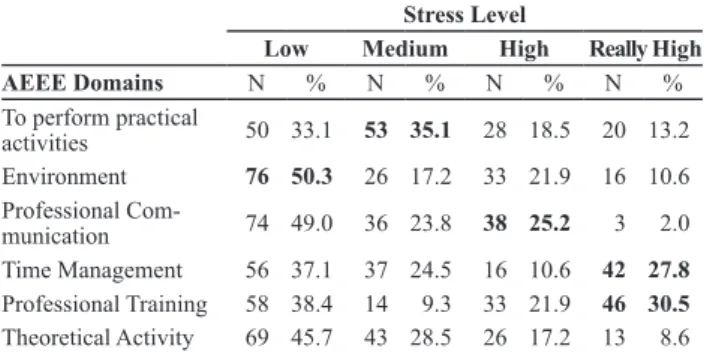
Table 1 shows the domains represented with higher frequency a higher level of stress in the students are: Pro-fessional Training (30.5%) and Time Management (27.8%). Sill, Professional Communicaion represents high level of stress for 25.2% of students.
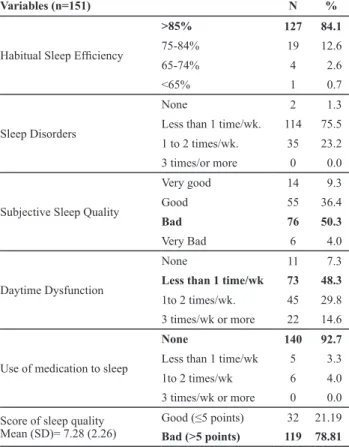
In Table 2, it is observed that students sleep an aver -age of 6.07 hours (SD = 1.09), 92.7% do not need medica -ion to sleep and 84% men-ioned to have a sleep eicien -cy higher than 85%. On the other hand, 50.3% evaluate a subject sleep quality as bad. Sill, there was a predomi -nance of bad sleep quality (78.8%).
Table 1 – Distribution of stress levels in accordance with stress factors from AEEE among nursing students – São Paulo, SP, 2012
Stress Level
Low Medium High Really High
AEEE Domains N % N % N % N %
To perform practical
activities 50 33.1 53 35.1 28 18.5 20 13.2
Environment 76 50.3 26 17.2 33 21.9 16 10.6
Professional
Com-munication 74 49.0 36 23.8 38 25.2 3 2.0
Time Management 56 37.1 37 24.5 16 10.6 42 27.8
Professional Training 58 38.4 14 9.3 33 21.9 46 30.5
Theoretical Activity 69 45.7 43 28.5 26 17.2 13 8.6
Table 2 – Distribution of nursing students in accordance with sle-ep quality and slesle-ep components – São Paulo, 2012
Variables (n=151) N %
Sleep duration Mean (SD)=6.07 (1.09)
More than 7 hours 14 9.3
6-7 hours 93 61.6
5-6 hours 30 19.9
Less than 5 hours 14 9.3
Sleep Latency
≤15 min. 40 26.5
16-30 min. 66 43.7
31-60 min. 36 23.8
In Table 3, it is observed a posiive correlaion of the quality of sleep with the domain Professional
Commu-nicaion (PC) (r=0.21, p<0.01), Professional Training (PT) (r=0.21, p<0.01), and Theoreical Acivity (TA) (r=0.23, p<0.01), that is, as higher the academic stress, less is the sleep quality. Other domains (PAR – Pracical Aciviies Realizaion; ENV – Environment; and TM – Time Manage -ment) did not present signiicant correlaion with PSQI.
DISCUSSION
In the present research, Professional Training and Time Management represented with higher frequency, a very high level of stress for nursing students, as well as Profes -sional Communicaion represented high level of stress for those individuals.
Professional Training, understood as the preoccupa -ion with the acquired knowledge at this phase of aca -demic training and its impact in professional life is also perceived as stressing for nursing students of diferent socio-cultural contexts. An invesigaion with 373 nursing students from Egypt found fear of the professional future as a stressor for 82.6% of students and the academic load for 59.8% of the sample(18). Another invesigaion conduct -ed between 130 nursing students from Rio Grande do Sul ideniied Professional Training represening high level of stress for 20% of students and medium level for 40.77% of that populaion(11).
Regarding ime management, students have diicul -ies to conciliate curriculum acivi-ies with other personal, emoional and social demands. This way, when staring Table 3 – Correlation between sleep quality and stress factors of
AEEE between nursing students – São Paulo, 2012
PSQI PAR ENV PC TM PT TA
PSQI 1
PAR 0.13 1
ENV 0.06 0.69*** 0.18*
PC 0.21** 0.16* 0.26*** 1
TM 0.09 0.23* 0.65*** 0.29*** 1
PT 0.21** 0.73*** 0.18* 0.26*** 0.15 1
TA 0.23** 0.23** 0.18* 0.43*** 0.2** 0.32*** 1
Pearson’s Correlation; ***p<0.0001; **p<0.01; *p<0.05.
Table 4 – Inluence of stress factors and socio-demographic va -riables in the sleep quality of nursing students (Multiple Linear Regression) – São Paulo, 2012
β EP** t-Value p-Value
(Intercept) 2.97 2.66 1.12 0.27
Age (years) -0.13 0.08 -1.65 0.10
Relationship Status
Married Reference
Single 0.48 1.15 0.42 0.68
Stable relationship -3.26 1.77 -1.84 0.07
Academic year
Second Reference
First 2.75 0.78 3.51 0.00*
Third 0.15 0.63 0.23 0.82
Fourth -0.02 0.65 -0.04 0.97
Stress domains Domain 5 – Professional
Training 0.27 0.08 3.37 0.00*
Types of transportation Bus
No Reference
Yes 1.03 0.56 1.85 0.07
Mobility
Home-Internship location
(minutes) 0.00 0.01 0.08 0.93
Work
No Reference
Yes 1.86 0.67 2.75 0.01*
Research Group
Do not participate Reference
Participate 0.91 0.49 1.87 0.06
Study time (h/week) 0.67 0.25 2.69 0.01*
*Statistically signiicant value (p<0.05).
** SE= Standard Error.
Variables (n=151) N %
Habitual Sleep Eficiency
>85% 127 84.1
75-84% 19 12.6
65-74% 4 2.6
<65% 1 0.7
Sleep Disorders
None 2 1.3
Less than 1 time/wk. 114 75.5
1 to 2 times/wk. 35 23.2
3 times/or more 0 0.0
Subjective Sleep Quality
Very good 14 9.3
Good 55 36.4
Bad 76 50.3
Very Bad 6 4.0
Daytime Dysfunction
None 11 7.3
Less than 1 time/wk 73 48.3
1to 2 times/wk. 45 29.8
3 times/wk or more 22 14.6
Use of medication to sleep
None 140 92.7
Less than 1 time/wk 5 3.3
1to 2 times/wk 6 4.0
3 times/wk or more 0 0.0
Score of sleep quality Mean (SD)= 7.28 (2.26)
Good (≤5 points) 32 21.19
Bad (>5 points) 119 78.81
Note: Absolute (N) and relative (%) frequency.
...Continuation
superior educaion, students experience the intensiica -ion of academic requirements, diferent opportuniies in research and teaching, the need to work to their own maintenance and, many imes, the mobility to the univer -sity campus. In this context, students need to manage the disinct daily demands and to conciliate those with family and social conviviality, which contributes to the elevaion of stress level of students. In a research conducted with 100 nursing students from Saudi Arabia, the excess of aca -demic responsibiliies was the most frequent stressor fac -tor within those individuals(5). In another study, involving students from the 4th year of nursing bachelor’s in Campi -nas, to conciliate work and studies (63.6%) and diiculty
to conciliate study and leisure (40.9) were considered the most stressful aciviies(27).
In addiion, communicaion and relaionship with peers and health professionals represent a high level of stress among students. Considering nursing students be -ing in general young, it is possible for them to present less experience dealing directly with people and more diiculty to deal with assistance quesions with the health team. Be -sides that, it is possible that compeiion in the search for knowledge and personal diferences among peers from the course to cause conlicts in the assistencial environment. Thus, a research with 343 nursing students in Egypt found conlicing relaionships among course colleagues was one of most frequent stressors(18). An invesigaion conducted with 366 nursing students in Iran, conlicts with colleagues was observed (52.2%), relaionship problems with parents (20.2%) and partners (31.1%) and experiences with new situaions and non-familiar (64.2%) were considered the stressors most punctuated by subjects(20).
Considering this context, the occurrence of stress in nursing students is possible when inserted in academic environment and the inluence of this phenomenon in the sleep quality of students. Thus, 78.8% of students pre -sented low sleep quality and the stress level interferes in the sleep quality (p=0.016), in a certain way that as high -er the stress level, less is the sleep quality. About that, it should be highlighted that many imes, the student use part of their sleep period to atend academic (study and readings) and social demands (meeings with friends and family events). As consequence, the student sleep later and wake up early to get to the academic locaion, which implicates in less sleeping ime during the night, gener -ally below the necessary for the organic reestablishment. About that, a research with 234 nursing student in Peru ideniied 62% of students presented changes in sleeping habits ater staring the course(14).
In the present research, a posiive correlaion was found between the stress factors Professional Communi -caion, Professional Training and Theoreical Acivity and sleep quality. Sill, in the linear regression (Table 4), it was atested that Professional Training posiively impacted sleep quality. About that, the present conlicts in relaion
-lighted. Their preoccupaion with acquisiion of knowl -edge, their inserion in the work market as well as the diiculies related to learned contents and methodologies exceed their cogniive resources. As consequence, many imes, the student takes longer to fall sleep, sleep for a shorter total ime or cannot sleep during the night, which diminishes the sleep quality. In a research with 44 univer -sity students in Brazil, the reducion in sleeping ime was associated with the increase of subjects with points indi -caing bad sleep quality and moderate or severe indisposi -ion for daily aciviies development. Sill, the start ime of academic aciviies contributed to anicipate the wake up ime, which seemed to aggravate the bad sleep quality(24).
Besides the stress factors presented, it is important to consider that few socio-demographic characterisics can inluence the sleep quality. Thus, to be enrolled in the irst academic year, to perform work aciviies and to spend more ime studying contributes to the reducion on the sleep quality. The fact of being enrolled in the irst year implicates a considerable volume in theoreical subjects and in the need to adapt to a new environment, with re -quirements and acivity load higher than high school(26). It requires more daily studying ime, subsituing part of the sleeping ime for this task, relecing on sleep quality, a veriied fact in 50.3% of students with bad subjecive sleep quality. About that, a research conducted with 44 univer -sity students in São Paulo ideniied that ater the start of classes, there was a higher number of students with bad sleep quality and daily indisposiion when compared to va -caion period(24). The authors believe that it happens due to the subjecion of students of rigid imetables adopted to start academic aciviies or the adopion of irregular sleep -ing habits incorporated by students dur-ing school period(24). Sill, to perform work aciviies together with the bachelor degree course requires the student to atend beyond academic demands, the work ime requirements, which can lead to an over load and afect the sleep qual -ity and duraion. About this fact, an invesigaion with 30 nursing students in São Paulo who worked during night shits, it was veriied the presence of excessive daily som -nolence(28). The authors concluded that night worker, who sufer sleep deprivaion, have addiional ime in vigil due to studies. It causes higher levels of somnolence, which can damage their academic and work performance(28).
CONCLUSION
Thus, academic environment factors and some socio-demographic characterisics interfere on the nursing student rouine, contribuing to the sleep quality reduc -ion, which conirms the hypothesis of the present study. Thereater, there is possible impact in learning and the quality of nursing care when there is their inserion in the clinical care environment.
In this perspecive, the reorganizaion of the teaching dynamics and the proposal of acions focused in high stress factors and in those contribuing to bad sleep quality to as -sist students in their academic aciviies development.
The present invesigaion presented a panorama which allows to re think the nursing training aimed to minimize stress and to improve sleep quality in students.
13. Huaquín Mora VR, Loaíza Herrera R. Exigencias académicas
y estrés en las carreras de la Facultad de Medicina de la Uni
-versidad Austral de Chile. Estud Pedagog. 2004; (30):39-59.
14. Ticona Benavente SB, Paucar Quispe G, Llerena Callata G. Niv
-el de estrés y estratégias de afrontamiento en estudiantes de la facultad de Enfermería-UNSA Arequipa. 2006. Enferm Glob [Internet]. 2010 [citado 2013 nov. 10];(19):1-18. Disponible en: htp://scielo.isciii.es/pdf/eg/n19/docencia1.pdf
15. Watson R, Deary I, Thompson D, Li G. A study of stress and burnout in nursing students in Hong Kong: a quesionnaire survey. Int J Nurs Stud. 2008;45(10):1534-42.
16. Edwards D, Burnard P, Bennet K, Hebden U. A longitudinal study of stress and self-esteem in student nurses. Nurse Educ Today. 2010;30(1):78-84.
17. Maville JA, Kranz PL, Tucker BA. Perceived stress reported by nurse praciioner students. J Am Acad Nurse Pract. 2004;16 (6):257-62.
18. Amr A, El-Gilany AH, El-Moafee H, Salama L, Jimenez C. Stress among Mansoura (Egypt) baccalaureate nursing students. Pan Afr Med J [Internet]. 2011[cited 2013 Nov 12];8:26. Available from: htp://www.ncbi.nlm.nih.gov/ pmc/aricles/PMC3201591/pdf/pamj-8-26.pdf
19. Benavente SBT, Costa ALS. Respostas isiológicas e emocio
-nais ao estresse em estudantes de enfermagem: revisão in
-tegraiva da literatura. Acta Paul Enferm [Internet]. 2011[cit
-ed 2013 Nov 12];24(4):571-6. Available from: htp://www. scielo.br/pdf/ape/v24n4/a19v24n4.pdf
20. Seyedfatemi N, Tafreshi M, Hagani H. Experienced stressors and coping strategies among Iranian nursing students. BMC Nurs [Internet]. 2007 [cited 2013 Nov 17];6:11. Available from: htp://www.biomedcentral.com/content/pdf/1472-6955-6-11.pdf
21. Yeoungsuk S. Stressful life events and quality of life in nursing students. J Korean Acad Soc Nurs Edu. 2012;18(1):71-80.
22. Hasson D, Gustavsson P. Declining sleep quality among nurs
-es: a populaion-based four-year longitudinal study on the transiion from nursing educaion to working life. PLoS One. 2010;5(12):e14265.
REFERENCES
1. Gibbons C, Dempster M, Moutray M. Stress and eustress in nursing students. J Adv Nurs. 2007;61(3):282-90.
2. Gibbons C, Dempster M, Moutray M. Stress, coping and sat
-isfacion in nursing students. J Adv Nurs. 2011;67(3):621-32.
3. Moreira DP, Furegato ARF. Stress and depression among stu
-dents of the last semester in two nursing courses. Rev La
-ino Am Enferm [Internet]. 2013[cited 2013 Nov 10]; 21(n. spe):155-62. Available from: htp://www.scielo.br/pdf/rlae/ v21nspe/pt_20.pdf
4. Yamashita K, Saito M, Takao T. Stress and coping styles in Jap
-anese nursing students. Int J Nurs Pract. 2012;18(5):489-96. 5. Eswi AS, Radi S, Youssri H. Stress/stressors as perceived by
baccalaureate Saudi nursing students. Middle East J Sci Res. 2013;14(2):193-202.
6. Chan CKL, So WKW, Fong DYT. Hong Kong baccalaureate nurs
-ing students’ stress and their cop-ing strategies in clinical prac
-ice. J Prof Nurs. 2009;25(5):307-13.
7. Bowden J. Why do nursing students who consider leaving stay on their courses? Nurse Res. 2008;15(3):45-58.
8. Pacheco S. Stress e mecanismos de coping nos estudantes de enfermagem. Referência Rev Enferm. 2008;2(7):89-95. 9. Aliok HO, Üstün B. The stress sources of nursing students.
Educ Sci Theory Pract [Internet]. 2013;13(2):760-6. Available from: htp://www.edam.com.tr/kuyeb/pdf/en/646273c229b b2a936c877a2470ca8e4aokeng.pdf
10. Timmins F, Kaliszer M. Aspects of nurse educaion pro
-grammes that frequently cause stress to nursing stu
-dents: fact-inding sample survey. Nurse Educ Today. 2002; 22(3):203-11.
11. Freitas EO. Estresse, coping, burnout: sintomas depressivos e hardiness entre discentes de Enfermagem [dissertação]. Santa Maria: Universidade Federal de Santa Maria; 2012. 12. Reeve KL, Shumaker CJ, Yearwood EL, Crowell NA, Riley JB.
Perceived stress and social support in undergraduate nurs
23. Angelone AM, Matei A, Sbarbai M, Di Orio F. Prevalence
and correlates for self-reported sleep problems among nurs
-ing students. J Prev Med Hyg. 2011;52(4):201-8.
24. Furlani R, Ceolim MF. Padrões de sono de estudantes ingres
-santes na Graduação em Enfermagem. Rev Bras Enferm [In
-ternet]. 2005 [citado 2013 out. 23];58(3):320-4. Disponível em: htp://www.scielo.br/pdf/reben/v58n3/a13v58n3.pdf
25. Huang YW, Yang CH, Ho SL, Hwu YJ. The relaionship be
-tween pracicum-related stress and sleep quality in nursing students. J Nurs Health Res. 2011;7(1):14-25.
26. Costa ALS, Polak C. Construcion and validaion of an instru
-ment for the assess-mentof stress among nursing students (AEEE). Rev Esc Enferm USP [Internet]. 2009 [cited 23 Oct
2012];43(n.spe):1017-26. Available from: htp://www.sci
-elo.br/pdf/reeusp/v43nspe/en_a05v43ns.pdf
27. Bertolazi AN. Tradução, adaptação cultural e validação de
dois instrumentos de avaliação do sono: escala de sonolên
-cia de Epworth e índice de qualidade de sono de Pitsburgh
[dissertação]. Porto Alegre: Faculdade de Medicina, Univer
-sidade Federal do Rio Grande do Sul; 2008.