Contents lists available at ScienceDirect
Phytomedicine
journal homepage: www.elsevier.com/locate/phymed
Original
article
The
anti-inflammatory
effects
of
N-methyl-(2S,4R)-
trans
-4-hydroxy-l
-proline
from
Syderoxylon
obtusifolium
are
related
to
its
inhibition
of
TNF-alpha
and
inflammatory
enzymes
Pedro
Everson
Alexandre
de
Aquino
a,
Talita
Rocha
Magalhães
a,
Lucas
Antônio
Duarte
Nicolau
a,
Luzia
Kalyne
A.
Moreira
Leal
a,
Nayara
Coriolano
de
Aquino
b,
Sabrina
Matias
dos
Santos
b,
Kelly
Rose
Tavares
Neves
a,
Edilberto
Rocha
Silveira
b,
Glauce
Socorro
de
Barros
Viana
a,c,∗aFaculty of Medicine of the Federal University of Ceará (UFC), Ceará, Brazil
bDepartment of Organic and Inorganic Chemistry of the Federal University of Ceará, Ceará, Brazil
cFaculty of Medicine Estácio of Juazeiro do Norte (FMJ), Ceará, Brazil
a
r
t
i
c
l
e
i
n
f
o
Article history: Received7April2016 Revised10September2016 Accepted13November2016
Keywords:
Sideroxylon obtusifolium Inflammation Cytokines Oxidativestress
a
b
s
t
r
a
c
t
Background: Sideroxylon obtusifolium (Roem. & Schult.) T.D. Penn., Sapotaceae family, is a medicinal speciesnativetotheBrazilianNortheasternregion.Theplantispopularlyusedasananti-inflammatory andhypoglycemic.
Purpose: Toevaluatetheanti-inflammatorypropertiesoftheN-methyl-(2S,4R)-trans-4-hydroxy-l-proline
(NMP)fromS.obtusifoliumleavesinmodelsofinflammationandtoclarifyitsactionmechanisms.
Methods: Male Swissmice were distributed intocontrols and groups treatedwith NMP (25, 50 and 100mg/kg,p.o.),indomethacinormorphine(reference drugs). Theanimals weresubjectedtothe for-malin,carrageenan-inducededemaandperitonitis tests.Furthermore,peritoneallavageand slicesfrom edematouspawswereusedforhistologicalandimmunohistochemical(iNOS,TNF-alpha,COX-2and NF-kB)assays.
Results: Decreases inlickingtime, inthe 1stand mainlyinthe2ndphasesofthe formalintest,were shownafterNMPtreatments.Inaddition,decreases(around50%)inpawedemawerenoticedatthe3rd h.TheHEstainingofpawslicesdemonstratedacompletereversionoftheincreasedPMNcell number-afterNMPtreatment.Similarly,decreaseshigherthan70%werealsodemonstratedinPMNcells,inthe peritonealfluid.Furthermore,NMPsignificantlydecreasediNOS,TNF-alpha,COX-2andNF-kB immunore-activities.
Conclusions: WeshowedthatS.obtusifoliumpresentsapotentanti-inflammatoryactivity,duetothe pres-enceoftheN-methyl-(2S,4R)-trans-4-hydroxy-l-proline(NMP)intheplantextract.Thisactionisrelated
totheinhibitionbyNMPofTNF-alphaandinflammatoryenzymes.
© 2016ElsevierGmbH.Allrightsreserved.
Introduction
ThespeciesSideroxylonobtusifolium(Roem.&Schult.)T.D.Penn. belongsto the Sapotaceae family and is a tree native to Central
Abbreviations: NMP,N-methyl-(2S,4R)-trans-4-hydroxy-L-proline;MPO, myelo-peroxidase; PMA, phorbol myristate acetate; COX-2, cyclooxygenase 2; INDO, indomethacin; DEXA, dexamethasone; PBS, phosphate buffered saline; HE, hematoxylin-eosin;TNF-alpha,tumornecrosisfactoralpha;iNOS,inducibleisoform ofnitricoxidesynthase;PMN,polymorphonuclearcells;NO,nitricoxide.
∗ Correspondingauthorat:RuaBarbosadeFreitas,130/1100,Fortaleza60170-020, Brazil.
E-mail address: [email protected](G.S.d.B.Viana).
andSouth America. In Brazil, it is found in the “caatinga” (xeric shrubland and thorn forest), an eco region characteristic of the BrazilianNortheasternregion.S.obtusifolium ispopularlyusedfor its antinociceptive, anti-inflammatory and hypoglycemic proper-ties,amongothers(Araujo-Netoetal.,2010).Forthispurpose, sev-eralpartsofthetree,astheinnerbarkandleaves,areused.
ChemicalandpharmacologicalstudiesonS.obtusifoliumarefew and,until someyearsago,onlycommonpentacyclictriterpenoids had been reported. Lately (Passos-Oliveira et al. 2012), saponins and flavonoids were shown to be the main constituents of the leavesofS.obtusifolium.Thus,foursaponinsandtenflavonol gly-cosides wereisolated, by thoseauthors, fromthebutanol-soluble fraction of an ethanolic extract. The compounds include a new
P.E.A. de Aquino et al. / Phytomedicine 24 (2017) 14–23 15
triterpeneglycoside,aswellasnewflavonolglycosides.Inaddition, catechin and a glycerogalactolipid were obtained from the ethyl acetate-solublefraction.
In the present work, N-methyl-(2S,4R)-trans-4-hydroxy-l -proline (NMP) was isolated from the methanolic extract of S. obtusifolium leaves, as its main chemical component. This com-pound was evaluated in experimental models of nociception and inflammation, as well as in vitro assays (measurement of myeloperoxidase, MPO, activity in human neutrophils). In ad-dition, the inflamed mouse paw was processed for histological andimmunohistochemical studies,inordertoclarifythepossible mechanismofactioninvolvedwiththeobservedeffects.
Materialsandmethods
Drugsandreagents
Lambda carrageenan, phorbol myristate acetate (PMA)and in-domethacin were purchased from Sigma-Aldrich (Mo, USA). The antibodies: COX-2 (M-19), sc-1747, goat polyclonal; TNF (52B83), sc-52746,mousemonoclonal;NOS-2(H-174),sc-8310,rabbit poly-clonal;NF-kBp50(NLS),sc-114,rabbitpolyclonalwerefromSanta CruzBiotechnologyInc.(CA,USA).Allotherdrugswereof analyti-calgrade.
Plantmaterial
Leaves from the species S. obtusifolium were collected at the municipality of Mauriti, Ceará State, in August 2014. A voucher specimen (number 10,648) representing the field collection has beenstoredatthe“HerbárioCaririenseDárdanodeAndradeLima”, RegionalUniversity ofCariri(URCA),Ceará,Brazil,after identifica-tion by Dr.Maria Arlene Pessoa da Silva. One hundred gramsof grounddry leaveswere conditioned into a cottonfabric bag and then boiled, for15 min, with500mldistilledwater. The process wasrepeatedoncemore.Bothwatersolublematerialswerepooled together andlyophilizedtoyield 34.86g ofalightbrownresidue, designated SOL-dec (decoction from S.obtusifolium leaves). Then, 10.0g SOL-decwerepouredintoaWhatman® celluloseextraction timbleand,then,extractedwithmethanolonaglasssohxlet appa-ratus.The methanolsolution wasrotoevaporatedunderlow pres-suretoyield6.76g ofayellowishamorphouspowder,designated SOL-decM.One gramaliquots(6×) ofthisSOL-decM,dilutedinto 3.5ml distilled water, were chromatographed on a Phenomenex solid-phase-extraction (SPE),Strata® C-18 reverse phase gigatube (20g/60ml), previously conditioned with MeOH andequilibrated withdistilledwater.Fractions(20ml)ofthischromatographed ma-terialwerecollected,initiallyusingwateraseluent,followedbya gradientmixtureofH2O/MeOH(varyingfrom10to50%,andthen to MeOH)andfinally washed witha THF/MeOH1:1solution. Af-terTLCanalysisofallfractions,theH2Ofractionswerepooled to-getherandlyophilizedtoafford1.7gofcompound1.
Structuredetermination
Compound 1, a dark brown resin, [
α
]21D=−31° (c. 0.1, H2O), showedonitspositiveionmodeHR-ESImassspectrumthe proto-nated molecule ionpeak at246.0872(C6H11NO3,),168.0655(Na+ adduct) and 184.0586 (K+ adduct). Its IR, 1H and13C NMR datawerecompatiblewiththestructureofa4-hydroxy-proline deriva-tive (Fig. 1). The suggested structure wasconfirmed by analyses of the COSY and HMBC NMR spectra. The relative stereochem-istry of all stereogenic centers was suggested based on the ob-servedJvaluesforthescalarcouplingsplittingpatternandbythe NOESY spectrum analysis.The final structure,including the abso-lute stereochemistry,wasaccomplishedfromthenegativespecific
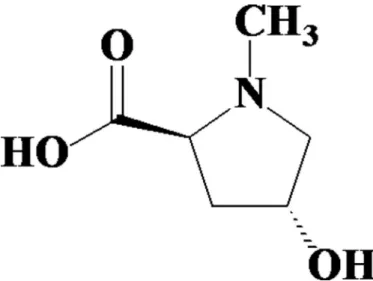
Fig. 1. Chemical Structure of N-methyl-(2S,4R)-trans -4-hydroxy-l-proline (NMP) isolatedfromtheleavesof Sideroxylon obtusifolium .
rotationofcompound1(seesupplementarymaterial),andby com-parisontodataavailablefromtheliterature(Winkler,2006).Thus, compound 1 was characterized as the N-methyl-(2S,4R)-trans -4-hydroxy-l-proline (Fig. 1), otherwise designated hydroxylhygrinic acid or (2R,4S)-4-hydroxy-1-methyl-2-pyrrolidine carboxylic acid
(KrebsandRamiarantsoa,1996;Dekeboetal.,2007).
Animals
MaleSwissmice(25– 30g)wereprovidedbytheAnimalHouse oftheFederalUniversity ofCeará (UFC),Brazil. Theanimalswere housed into plastic cages with sawdust as beddings and kept in a room with controlled temperature (25±2°C), under a 12h light/12h dark cycle and food and water supplied ad libitum. Theexperiments were carriedout accordingtothe Guideforthe Care and Use of Laboratory Animals, of the U.S. Department of Health and Human Services (USA, 2011). The project was previ-ously approvedby the Animal’sEthics Committee, of theFaculty ofMedicineoftheFederalUniversityofCeará.Inalltests,thedrug wasdissolvedindistilledwaterpriortouse.
Formalintestinmice
Twenty microliters 2% formalin were administered s.c. to the mouse’srighthindpaw,andthelickingtimewasrecordedfrom0 to5min(phase1,neurogenic)andfrom20to25min(phase2, in-flammatory)aftertheformalininjection.The animals(6to17per group)weretreatedwithdistilledwater(Control,0.1ml/100g,i.p.), morphine(MOR,5mg/kg,i.p.)orNMP(25,50and100mg/kg,p.o.). Morphinewasused asreference. The treatmentswere performed 30minbeforetheformalininjection.
Carrageenan-inducedmousepawedema
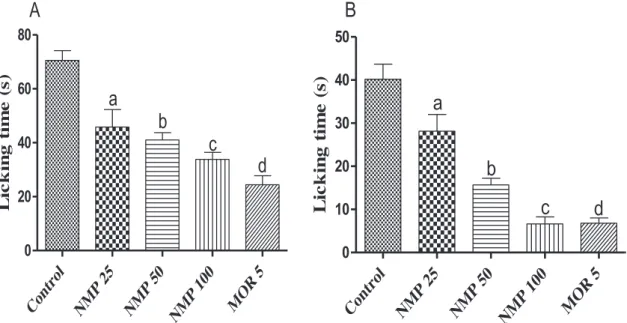
Fig.2. N-methyl-(2S,4R)-trans -4-hydroxy-l-proline(NMP)isolatedfromthemethanolicextractof S. obtusifolium leavesreducesthe1st(neurogenic,A)andmainlythe2nd (inflammatory,B)phasesoftheformalintest.Left,1stphase:a.vs.control,q=6.034∗ ∗;b.vs.control,q=7.626∗ ∗ ∗;c.vs.control,q=9.467∗ ∗ ∗;d.vs.control,q=11.90∗ ∗ ∗. Right,2ndphase:a.vs.control,q=4.337∗
;b.vs.control,q=8.422∗ ∗ ∗
;c.vs.control,q=12.58∗ ∗ ∗
;d.vs.control,q=10.84∗ ∗ ∗
(ANOVAandTukeyasthepost hoc test).
wasdeterminedbythedifferencebetweenthefinalandinitial vol-umes.
Invivocarrageenan-inducedneutrophilmigrationintomice peritonealcavities
Groups of 6animals were treated withNMP (100mg/kg, p.o.), dexamethasone(DEXA, 4mg/kg,i.p.) or distilled water (Control), 60minbeforetheinductionofinflammationby meansof1% car-rageenan (250μl). All drugs were administered at a volume of 10ml/kg.Then, theanimals werereturned totheir cagesandleft withfree accesstowater. After4h,the animalswere euthanized and3mlPBS containingheparin (5 IU/ml) were interjected into their peritoneal cavities. Then, the peritoneal fluid was collected with a Pasteur pipette, through abdominal laparoscopy. A sam-pleof the peritoneal lavage fluid was diluted (1:20) inTurk liq-uid,forquantificationofcellnumbers,usingaNeubauerchamber. Thecellswere stained by a conventional fastpigment (panoptic-stainedblood smears)andthe resultswere expressedin number ofcells/mm3.
Myeloperoxidase(MPO)releasefromhumanneutrophils
Polymorphonuclear cells, predominantly neutrophils (80–90%) presentinga90%viabilitywereobtainedfromtheHematologyand HemotherapyCenteroftheCeará State(HEMOCE,Fortaleza,Brazil) andisolatedaccordingtoapreviouslydescribedmethod(Lucisano
andMantovani,1984).Thebloodwascentrifuged,theplasma
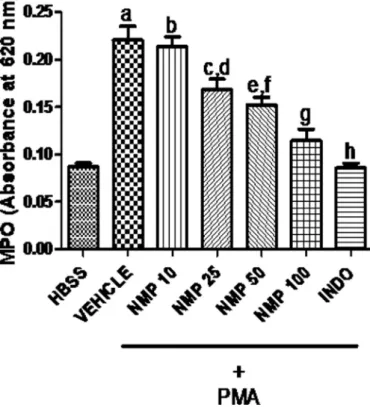
dis-carded andthe serumwashed several timeswith saline, usinga 2.5%gelatinsolutionasaseparationgradientofbloodcells.Then, a suspension of neutrophils (5×10⁶ cells/ml) was incubated for 15min withHBSS(Hanks’ balanced saltsolution), distilled water (vehicle,control),NMP(10–100μg/ml)orindomethacin (INDO,as reference),at37°C.Additionally,exceptfortheHBSS,allother as-saytubes receivedphorbol12-miristate13-acetate(PMA,0.1μM), for 15min at 37°C. This was followed by centrifugation (800g, 4°C),thenPBS(100μl),phosphatebuffer(50μl)andH2O2(0.012%) wereadded tothe supernatant(50μl).After 5min at37°C, 20μl tetramethylbenzidine(TMB, 1.5mM)wereaddedandthereaction
stopped by the addition of 30μl sodium acetate (1.5M, pH 3.0). Theabsorbancewasdeterminedat620nm.
HistologicalanalysesofHEstainedsectionsfrompawswith carrageenan-inducededemainNMP-treatedmice
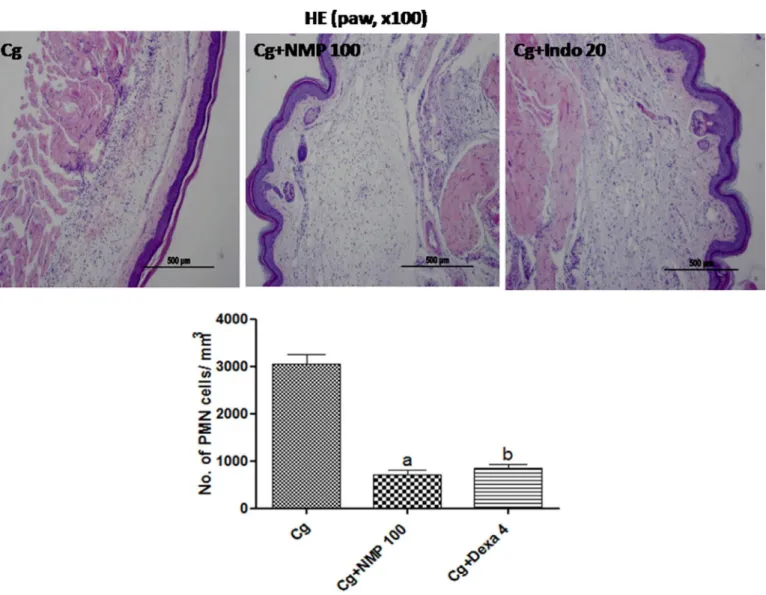
Sections (10μm) from mice paws submitted to carrageenan-inducededemawereusedforHEstaining.Theedematouspawwas cut,sagittallydissectedandfixedinbufferedformalinfor24h, fol-lowedby dehydrationin a 70% ethanolsolution forparaffin em-bedding and sectioning. The slices were analyzed by optic mi-croscopyforimagescaptureandcellcounting.
ImmunohistochemistryanalysesforTNF-alpha,iNOS,COX-2and NF-kBonedematouspawsectionsfromcarrageenan-inducededema inNMP-treatedmice
Vec-P.E.A. de Aquino et al. / Phytomedicine 24 (2017) 14–23 17
Fig. 3. N-methyl-(2S,4R)-trans -4-hydroxy-l-proline (NMP) isolated from the methanolicextractof S. obtusifolium leavesdecreasesthecarrageenan-inducedpaw edemaatthe3rdh,similarlytoindomethacin(INDO,20mg/kg)usedasreference. a.vs.control,q=6.682∗ ∗ ∗;b.vs.control,q=7.836∗ ∗ ∗;c.vs.control,q=11.29∗ ∗ ∗;d. vs.Control,q=10.54∗ ∗ ∗(ANOVAandTukeyasthe post hoc test).
torLaboratories,Burlingame,CA,USA).Afteranotherwashingwith PBS,thesectionswerestainedwith3,3′diaminobenzidine-peroxide (DAB) cromophore, counter-stained with Mayer hematoxylin, de-hydrated andmountedin microscopeslides foranalyses,andthe datawere semiquantified(asrelativeopticdensitiy)withthe Im-ageJ(NIH,USA)software.
Statisticalanalysis
All results are presented as mean ± S.E.M. One-way ANOVA andTukeyasaposthoc testwere usedforcomparingtheresults amongtreatments.Thesignificancelevelwassetatp<0.05.
Results
EffectsofNMPontheformalintestinmice
This is a tonic model of continuous pain, particularly useful fortheevaluationofinflammatory,neurogenic andcentral mech-anismsof nociception.The formalin-inducednociceptivebehavior showsan earlyphase, startingimmediatelyafter theformalin in-jection and lasting for5min,and a late phase, lasting for20 to 40minandstarting15to20minaftertheformalin injection.The 1stphase(Fig.2A)isduetoadirectchemicalstimulationof noci-ceptors,andthe2ndphase involvesperipheralinflammatory pro-cesses (Haley etal., 1989;Meunieretal., 1998).NMP(25,50and 100mg/kg)reducedthelickingtime(s)inthe1stphaseofthetest by35,42and52%,respectively.MOR(5mg/kg)decreasedthis no-ciceptive behaviorby 65%. A similar butmoreintense effect was observed in the 2nd phase (Fig. 2B) of the formalin test, where NMP atthesame dosesdecreased by 30,61 and78% the licking time,asrelatedtocontrols.MORshowedan83%reductionofthis nociceptivebehavior.Thus,ourresultsindicated thatNMPis effec-tive inboth neurogenic andinflammatory phasesofthe formalin test(Fig.2AandB).
Fig. 4. N-methyl-(2S,4R)-trans -4-hydroxy-l-proline (NMP) isolated from the methanolic extract of S. obtusifolium leaves decreases the carrageenan-induced PMNcellmigrationtothemouseperitonealcavity.a.vs.control,q=17.44∗ ∗ ∗;b. vs.control,q=16.37∗ ∗ ∗.Thecontrolwasinjectedwithcarrageenan(Cg)only,and dexamethasone(Dexa)wasusedasreference.Forstatisticalanalyses,ANOVAand Tukeyasthepost hoc testwereused.
Fig.6. N-methyl-(2S,4R)-trans -4-hydroxy-l-proline(NMP)isolatedfromthemethanolicextractof S. obtusifolium leavesdecreasesthePMNcellnumberinthe carrageenan-inducededematouspaws.Control=normalpaw;carrageenan=Cg.Indomethacin(Indo)wasusedasreference.a.vs.control,q=10.75∗ ∗ ∗;b.vs.Cg,q=12.45∗ ∗ ∗;c.vs.Cg, q=10.76∗ ∗ ∗
(ANOVAandTukeyasthe post hoc test).
EffectsofNMPonthecarrageenan-inducedpawedemainmice
This test is widely used to test new anti-inflammatory drugs, aswellastostudythemechanismsinvolvedininflammation. Car-rageenancausedaprogressiveincreaseinthepawedema, present-ing a peak between 3 and4h anddecreasing towards the basal levelafterwards.Inthepresentwork,edemameasurements were performed 3h after the carrageenan injection. We showed that NMP,atthedosesof25,50and100mg/kg,reducedby30,37and 51%theedemavolume,respectively,inrelationtocontrols.The re-ductionwasof48%afterINDO(20mg/kg)injection(Fig.3).
EffectsofNMPonthecarrageenan-inducedperitonitisinmice
The intraperitoneal administration of carrageenan produces a sustained increase in post-capillary venule permeability, thereby leading to increased infiltration of PMN cells, particularly neu-trophils.NMP atthe doseof100mg/kg reducedby77% thePMN cells(predominantlyneutrophils)infiltration,asrelatedtocontrols, whilethereductionwasof72%afterDEXA(4mg/kg)injection(Fig. 4).
InvitroeffectofNMPonmyeloperoxidase(MPO)activityinhuman neutrophils
MPOisanenzymelargelyexpressedinneutrophils.Ithasbeen demonstratedtobe involvedincellularhomeostasisandplaysan importantrole inthe initiationandprogression ofacute, aswell aschronicinflammatory diseases (vanetal., 2009).NMP, at con-centrationsof25,50and100μg/ml,decreasedby24, 31and40%, respectively,theabsorbancemeasurements, inrelationtocontrols (Fig.5).
EffectofNMPonPMNcellmigration(HEstaining)inmice edemateouspawsfromcarrageenan-inducededema
P.E.A. de Aquino et al. / Phytomedicine 24 (2017) 14–23 19
Fig.7. N-methyl-(2S,4R)-trans -4-hydroxy-l-proline(NMP)isolatedfromthemethanolicextractof S. obtusifolium leavesdecreasestheimmunoreactivityfor iNOSinthe carrageenan(Cg)inducedpawedema.ThecontrolsrepresentnormalpawsandCgrepresentspawsfromanimalsinjectedwithcarrageenanonly,andwithcarrageenan plusNMP(100mg/kg)orcarrageenanplusindomethacin(Indo,20mg/kg).ThedatawerequantifiedbyImageJsoftware(NIH,USA).a.vs.control,q=35.82∗ ∗ ∗;b.vs.Cg, q=31.03∗ ∗ ∗;c.vs.Cg,q=25.84∗ ∗ ∗;d.vs.control,q=7.088∗ ∗;e.vs.Cg+NMP100(ANOVAandTukeyasthe post hoc test).
EffectsofNMPoniNOS,COX-2,TNF-alphaandNF-kB immunohistochemicalassaysinedematousmicepawsfrom carrageenan-inducededema
The objectives were to demonstrate, in mice paws from carrageenan-induced edema, attenuation or reversion of the in-flammatory changes after NMPtreatments. For that, immunosto-chemistry assays for iNOS and COX-2 (inflammation-related en-zymes), TNF-alpha(apro-inflammatorycytokine)andthenuclear factor NF-kB(a transcription factor) were performed. NF-
κ
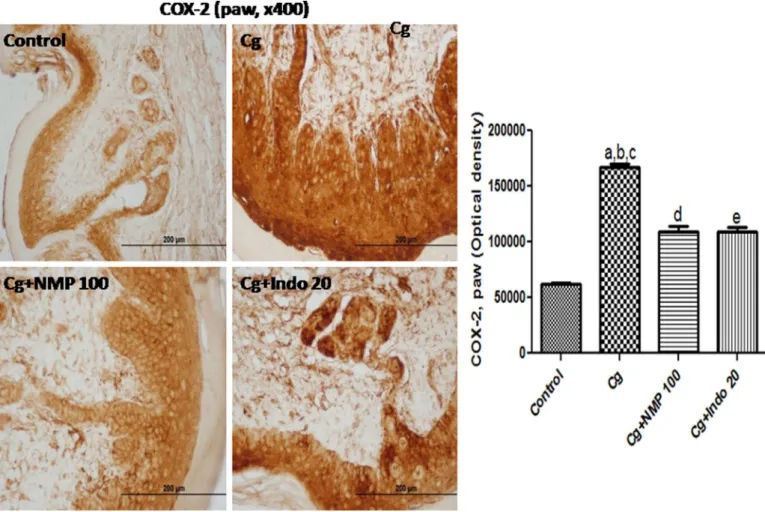
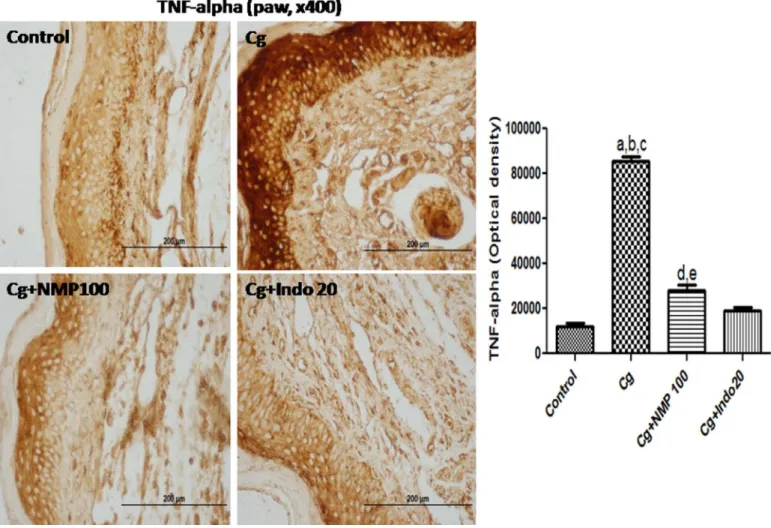
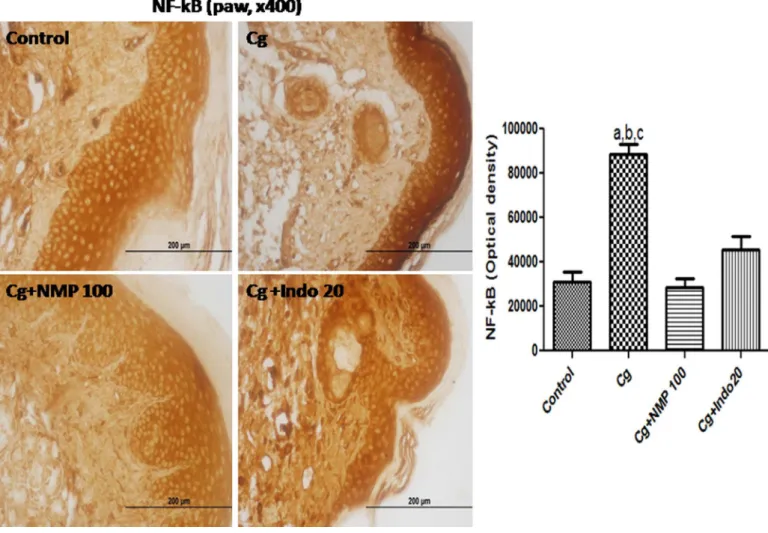
B has long been considered a prototypical proinflammatory signaling pathway, largely based on its activation by proinflammatory cy-tokines, such as interleukin 1 (IL-1) and tumor necrosis factor-alpha (TNF-alpha) (Lawrence, 2009). The assaysperformed with-thecarrageenangroup (Cg)revealedanalmost17-foldincreasein iNOS immunoreactivity, as related to the normal control. Lower increases (4-fold) were observed after treatments with NMP100 (Cg+NMP100),andalsoINDO20(6-fold),usedasareferencedrug (Fig.7). A7-fold increase inimmunoreactivityforTNF-alpha was seen in the Cggroup,as relatedto normal controls. However, in-creasesoftheorderof2-fold,approximately,wereobservedinthe Cg groups after the same treatments with NMP100 and INDO20 (Fig. 8). A 2.7-fold increase was demonstrated for COX-2 im-munoreactivityintheCg-inducededematouspaw,ascomparedto thenormalpaw,whileonlyaround1.8-foldwasobservedforpaws after bothNMP100andINDO 20treatments (Fig. 9).A similarin-creaseof2.8-foldintheNF-kBimmunostainingwasdemonstrated intheCggroup,asrelatedtonormalcontrols.Immunostaining val-ues in the Cg+NMP100 group were similar to those of controls, whilea 1.5-foldincrease wasseen inthe Cg+INDO20 group(Fig.
10).
Discussion
N-methyl-(2S,4R)-trans-4-hydroxy-l-proline (NMP) isolated fromS.obtusifolium leavescausedsignificantanddose-dependent decreases in the 1st (neurogenic) and mainly in the 2nd phase (inflammatory) of the formalin test. Acute nociceptive, inflam-matory and neuropathic pains depend, insome degree, on the peripheral activation of primary sensory afferent neurons. These neurons can be activated by a range of inflammatory mediators, such as prostanoids, bradykinin, ATP, histamine, and serotonin
(Sawynok, 2003). Furthermore, the inhibition of their actions
represents a strategy for the development of new analgesic and anti-inflammatorydrugs.
Fig.8. N-methyl-(2S,4R)-trans -4-hydroxy-l-proline(NMP)isolatedfromthemethanolicextractof S. obtusifolium leavesdecreasestheimmunoreactivityforCOX-2inthe carrageenan(Cg)inducedpawedema.ThecontrolsrepresentnormalpawsandCgrepresentpawsfromanimalsinjectedwith carrageenanonly,andwith carrageenan plusNMP(100mg/kg)orcarrageenanplusindomethacin(Indo,20mg/kg).ThedatawerequantifiedbyImageJsoftware(NIH,USA).a.vs.normal,q=27.80∗ ∗ ∗
;b.vs.Cg, q=16.56∗ ∗ ∗;c.vs.Cg,q=16.53∗ ∗ ∗;d.vs.normal,q=12.46∗ ∗ ∗;e.vs.normal,q=12.49∗ ∗ ∗(ANOVAandTukeyasthe post hoc test).
ofinflammation, such as edema, hyperalgesia,and erythema de-velopimmediatelyafterthe intraplantarinjectionofcarrageenan, resultingfromtheactionoftheaboveproinflammatorymediators that can be generated at the site of the insult and by infiltrat-ingcells.Rapidmigrationanddegranulationofneutrophilsprovide highMPOcontents,attheinflammationsites.
Others (Araujo-Neto etal., 2010) reported that the oral treat-mentwiththeethanolextract fromS.obtusifoliumelicitedan in-hibitory activity on acetic acid writhings, aswell as on the 2nd phase of the formalin test, but with no effect on the hot plate test.Theseauthorsalsofoundthat theethanolicextractinhibited thecarrageenan-inducededemaandleukocyte migrationintothe peritonealcavity.However,alltheseeffectswererecordedatdose intervals(100to400mg/kg)much higherthanthose usedin the presentstudy.Itisimportanttomentionthat100mg/kgwere the highest dose used by us, which would correspond to a human equivalentdose (HED) of19mg/kg, fora 70kg person(Nair and Jacob, 2016).Besides, the recommended doseof oxaceprol, an l -proline derivative, as NMP, is 200 or 400mg three times a day, corresponding to 600 or 1200mg/day, respectively (HED=8.5 or 17.0mg/kg,fora70kgperson).
Ourresults indicatethat NMPattenuatedcarrageenan-induced inflammation, by reducing neutrophil migration and MPO re-lease. The injection of carrageenan into the pleural space leads to pleurisy and PMN infiltration. Models of carrageenan-induced pleurisyhave beenwidely employed forinvestigating the patho-physiology of acute inflammation and evaluating the efficacy of
drugsin inflammation(Cuzzocreaetal., 1999). Weobserved that thecarrageenan-inducedinfiltrationofneutrophilsintothemouse peritonealcavitywas,ingreatpart,inhibitedbyprevious NMPor INDOtreatments. Furthermore,NMP andINDOsignificantly inhib-ited MPO release from human neutrophils. MPO is considered a hallmark of neutrophils infiltration in inflammation. Neutrophils are highly found ininflammatory diseases where they cause tis-sue damage through antigen presentation and secretion of cy-tokines, chemokines, prostaglandins and leucotrienes (Wright et al.,2010).Importantly,althoughneutrophilsare majoreffectorsof acuteinflammation,thesecellsalso contribute tochronic inflam-matoryconditionsandadaptiveimmuneresponses(Kolaczkowska
andKubes,2013).Thus,bydecreasingneutrophilsinfiltration,NMP
could beapotential candidateforbothacuteandchronic inflam-matoryconditions.
P.E.A. de Aquino et al. / Phytomedicine 24 (2017) 14–23 21
Fig.9. N-methyl-(2S,4R)-trans -4-hydroxy-l-proline(NMP)isolatedfromthemethanolicextractofS. obtusifolium leavesdecreasestheimmunoreactivityforTNF-alphainthe carrageenan(Cg)inducedpawedema.ThecontrolsrepresentnormalpawsandCgrepresentspawsfromanimalsinjectedwithcarrageenanonly,andwithcarrageenan plusNMP(100mg/kg)orcarrageenanplusindomethacin(Indo,20mg/kg).ThedatawerequantifiedbyImageJsoftware(NIH,USA).a.vs.control,q=37.79∗ ∗ ∗;b.vs.Cg, q=29.51∗ ∗ ∗;c.vs.Cg,q=34.35∗ ∗ ∗;d.vs.control,q=8287∗ ∗ ∗;e.vs.Cg+NMP100,q=4.841∗(ANOVAandTukeyasthepost hoc test).
ortreatmentofinflammatoryconditionsasthe cyclophosphamide-inducedcystitis.
In the present study, we demonstrated that NMP treatments significantlyattenuatediNOSandCOX-2immunoreactivitiesinthe carrageenan-induced edematouspaw. Evidencesindicate that NO actsasapro-nociceptivemediatorininflammation,in experimen-tal models, including carrageenan-induced inflammation.PGs are also well established inflammatory mediators. Furthermore, COX enzymescatalyzethebisoxygenationofarachidonicacidtoPGH2, thecommitedstepinPGformation(Toriyabeetal.,2004).Several
invivoandinvitrostudieshavesuggestedaninteractionofNOand PG,inwhich theproductionofPGE2isaugmentedfurtherinthe presenceofNO.InhibitionofNOproductionbyiNOSinhibitorshas been found todecrease theproduction ofPGE2 (Salvemini etal.,
1995; ChenandLevine,1999).It isthoughtthat thisNOeffectis
duetoitsabilitytoactivatetheCOXenzyme.Ininflammation,the functional relation between NO andCOX pathways suggests that NO exacerbatestheinflammatoryprocess, throughthegeneration ofadditionalPGproduction(Salveminietal.,1993).
Furthermore, evidences indicate that the administration of a NOS-nonselective inhibitor suppresses COX-2 expression in carrageenan-induced inflammation, and iNOS induces a massive NO production at the inflammatory site, contributing to COX-2 upregulation (Toriyabe et al., 2004). Others (Chun et al., 2004) demonstrated NO-induced COX-2 upregulation, through the tran-scription factor NF-kB, a known regulator of both COX-2 and
iNOS expressions. The nuclear factor NF-kB pathway is consid-ered a proinflammatory signaling pathway, based on its role in the expression of proinflammatory genes, including cytokines, chemokinesandadhesionmolecules(Lawrence,2009).
In the present study, we observed that NMPdecreased NF-kB andTNF-alphaimmunoreactivities.Ithasbeenpreviously demon-strated (Cuzzocrea et al., 1999) that iNOS andCOX-2 expressions are mediated by TNF-alpha and IL-1. NF-kB is known to upreg-ulate signaling proteins, such as inducible nitric oxide synthase (iNOS). Consequently, under normal conditions, NF-kB activation willpreventTNF-alphainducedcelldeathinhepatocytesandother primary cells, and NF-kB–regulated signaling pathways become the predominant biologic response to TNF-alpha. Key regulators ofTNF-alphasignalingpathwaysareROS,whichcanregulateboth apoptoticsignalingandNF-kBtranscription(Hanetal.,2009). Fur-thermore,evidences(Saudetal.,2005;Nandietal.,2010)indicate that TNF-alphamodulatesiNOS expressionin some inflammation modelsinvivo.
Previously(Ionacetal., 1996;Baueretal., 1999; Herrmannet
al.,2000;Veihelmannetal.,2001;Krüger etal., 2007), oxaceprol,
Fig.10. N-methyl-(2S,4R)-trans -4-hydroxy-l-proline(NMP)isolatedfromthemethanolicextractof S. obtusifolium leavesdecreasestheimmunoreactivityforNF-kBinthe carrageenan(Cg)inducedpawedema.ThecontrolsrepresentnormalpawsandCgrepresentspawsfromanimalsinjectedwithcarrageenanonly,andwith carrageenan plusNMP(100mg/kg)orcarrageenanplusindomethacin(Indo,20mg/kg).ThedatawerequantifiedbyImageJsoftware(NIH,USA).a.vs.control,q=12.07∗ ∗ ∗
;b.vs.Cg, q=12.57∗ ∗ ∗;c.vs.Cg,q=8.998∗ ∗ ∗(ANOVAandTukeyasthepost hoc test).
potential candidate for the therapy of osteoarthritis,with efficacy equivalent to that of diclofenac. However, the oxaceprol action mechanism,although similarto thatofNMP, differs, inthesense thatwhileoxaceproldoesnotinhibitprostaglandinsynthesis,NMP does,asdemonstratedbythedecreaseinCOX-2immunoreactivity. In conclusion, in the present study we showed, for the first time,theantinociceptive andmainlythe anti-inflammatory prop-erties of a natural l-proline derivative, isolated from S.
obtusi-folium. This compound inhibited the increased immunoreactivi-tiesforiNOS,COX-2,TNF-alphaandNF-kB,observedinedematous pawsfromuntreatedmice,inhibitionswhicharecertainly related tothedrugeffect.Furthermore,additionalstudies,asthose involv-ingpharmacokineticandtoxicokineticprofiles,wouldbeimportant inordertoincludeNMPintranslationalstudies,asapotentialnew anti-inflammatorydrug.
Contributionsofauthors
PedroEversonAlexandre deAquino andLucas AntônioDuarte Nicolau performed the in vivo experiments. Edilberto Rocha Sil-veiradidthe plantcollection,andadvised thechemicalstudy, in-cludingspectralanalyses.NayaraCoriolanodeAquinoandSabrina Matiasdos Santos carried out all the isolationandpurificationof thecompound.TalitaRocha MagalhãesandLuziaKalyne Almeida Moreira Lealwere responbsiblefor thein vitro experiment. Kelly RoseTavaresNevesperformed theimmunohiostochemical assays.
GlauceSocorrodeBarrosVianacarriedoutthestatisticalanalyses, coordinatedandwrotethemanuscript.
Conflictofinterest
Theauthorsdeclarenoconflictofinterest.
Acknowledgments
The authors are grateful for the financial supports from the Brazilian NationalResearchCouncil(CNPq)andfromthe Founda-tionforResearchandDevelopmentoftheStateofCeará (FUNCAP), Brazil,andtothetechnicalassistanceofMs.MariaVilaniRodrigues Bastos. They also thank the manuscript orthographic revision by Prof.M.O.L.Viana.
Supplementarymaterials
Supplementary material associated with this article can be found,intheonlineversion,atdoi:10.1016/j.phymed.2016.11.010.
References
P.E.A. de Aquino et al. / Phytomedicine 24 (2017) 14–23 23
Bauer,H.W.,Klasser,M.,vonHanstein,K.L.,Rolinger,H.,Schladitz,G.,Henke,H.D., Gimbel,W.,Steinbach,K.,1999.Oxaceprolisaseffectiveasdiclofenacinthe therapyofosteoarthritisofthekneeandhip.Clin.Rheumatol.18,4–9. Chen,X.,Levine,J.D.,1999.NOSinhibitorantagonismofPG2-inducedmechanical
sensitizationofcutaneousCfibernociceptorsinthe rat.J. Neurophysiol.81, 963–966.
Chun,K.S.,Cha,H.H.,Shin,J.W.,Na,H.K.,Park,K.K.,Chung,W.Y.,Surh,Y.J.,2004. Nitricoxideinducesexpressionofcyclooxygenase-2inmouseskin,through ac-tivationofNF-kB.Carcinogenesis25,445–454.
Cuzzocrea, S., Sautebin,L.,DeSarro, G., Costantino,G.,Rombolà, L.,Mazzon, E., Ialenti,A.,DeSarro,A.,Ciliberto,G.,DiRosa,M.,Caputi,A.P.,Thiemermann,C., 1999.RoleofIL-6inthepleurisyandlunginjurycausedbycarrageenan.J. Im-munol.163,5094–5104.
Dekebo, A., Kashiwagi, T., Tebayashi, S.-I., Kim, C-S., 2007.Nitrogenous oviposi-tionaldeterrentsintheleavesofsweetpepper(Capsicumannuum)atthe ma-ture stageagainst the burgessleafminer,Liriomyza trifolii.Biosc.Biotechnol. Biochem.71,421–426.
Figueiredo,F.J.,Lima,V.L.A.G.,2015.Antioxidantactivityfromquixabeira (Sideroxy-lonobtusifolium)fruits.Rev.Bras.Pl.Med.Campinas,Brazil17,473–479. Haley,J.E.,Dickenson,A.H., Schachter,M., 1989.Electrophysiological evidencefor
a role of bradykininin chemical nociception inthe rat.Neurosci. Lett. 97, 198–202.
Han,D.,Ybanez,M.D.,Ahmadi,S.,Yeh,K.,Kaplowitz,N.,2009.Redoxregulationof tumornecrosisfactorsignaling.Antioxid.RedoxSignal11,2245–2263. Herrmann, G., Steeger, D., Klasser, M., Wirbitzky, J., Fürst, M., Venbrocks, R.,
Rohde, H., Jungmichel, D., Hildebrandt, H.D., Parnham, M.J., Gimbel, W., Dirschedl,H.,2000.Oxaceprolisawell-toleratedtherapyforosteoarthritiswith efficacyequivalenttodiclofenac.Clin.Rheumatol.19,99–104.
Hsu,S.M.,Raine,L.,Fanger,H.,1981.Useofavidin-biotin-peroxidasecomplex(ABC) inimmunoperoxidasetechniques: acomparisonbetweenABCandunlabeled antibody(PAP)procedures.J.Histochem.Cytochem.29,577–580.
Ionac,M.,Parnham,M.J.,Plauchithiu,M.,Brune,K.,1996.Oxaceprol,anatypical in-hibitorofinflammationandjointdamage.PharmacolRes33,367–373. Kolaczkowska,E.,Kubes,P.,2013.Neutrophilrecruitmentandfunctioninhealthand
inflammation.NatureRev.Immunol.13,159–175.
Korkmaz, A., Topal, T., Oter, S., 2007. Pathophysiological aspects of cyclophos-phamideandifosfamideinducedhemorrhagiccystitis:implicationofreactive oxygenandnitrogenspeciesaswellasPARPactivation.CellBiol.Toxicol.23, 303–312.
Krebs,H.C.,Ramiarantsoa,H.,1996.Clerodanediterpenesandotherconstituentsof Crotonhovarum.Phytochemistry41,561–563.
Krüger, K., Klasser, M., Mössinger, J., Becker, U., 2007. Oxaceprol- a random-ized,placebo-controlledclinicalstudyinosteoarthritiswithanon-conventional non-steroidalanti-inflammatorydrug.Clin.Exp.Rheumatol.25,29–34. Lawrence,T.,2009.ThenuclearfactorNF-kBpathwayininflammation.ColdSpring
Harb.Perspect.Biol.1(6),a001651.
Lucisano,Y.M.,Mantovani,B.,1984.Lysosomalenzymereleasefrom polymorphonu-clearleukocytesinducedbyimmunecomplexesofIgMandofIgG.J.Immunol. 132,2015–2020.
Meunier,C.J.,Burton,J.,Cumps,J.,Verbeeck,RK.,1998.Evaluationoftheformalin testtoassesstheanalgesicactivityofdiflunisalintherat.Eur.J.Pharmac.Sci. 6,307–312.
Nandi,J.,Saud,B.,Zinkievich,J.M.,Yang,Z.J.,Levine,R.A.,2010.TNF-alpha modu-latesiNOSexpressioninanexperimentalmodelofindomethacin-induced je-junoileitis.MolCellBiochem336,17–24.
Parnham,M.J.,1999.Antirheumaticagentsandleukocyterecruitment:newlighton themechanismofactionofoxaceprol.Biochem.Pharmacol.68,209–215. Passos-Oliveira,A.,Raith,M.,Kuster,R.M.,Rocha,L.M.,Hamburger,M.,Potterat,O.,
2012.MetaboliteprofilingoftheleavesoftheBrazilianfolkmedicine Sideroxy-lonobtusifolium.Planta.Med.78,703–710.
Pereira,D.S.,Morais,J.P.,Santana,D.G.,Santos,C.A.,Thomazzi,S.M.,Santos,C.E., An-toniolli,A.R.,Bezerra,D.P.,Camargo,E.A., 2013.Effectsoftheethanolextract oftheinnerbarkofSideroxylonobtusifoliuminthecyclophosphamide-induced cystitisinrats.J.Med.PlantsRes.7,1411–1417.
Salvemini,D.,Misko,T.P., Masferrer,J.L., Seibert,K.,Currie,M.G.,Needleman,P., 1993.Nitricoxideactivatescyclooxygenasesenzymes.Proc.Natl.Acad.Sci.USA 90,7240–7244.
Salvemini,D.,Wang,Z.Q.,Wyatt,P.S.,Bourdon,D.M.,Marino,M.H.,Manning,P.T., Currie,M.G.,1995.Nitricoxide:akeymediatorintheearlyandlatephaseof carrageenan-inducedpawinflammation.Brit.J.Pharmacol.118,829–838. Saud,B.,Nandi,J.,Ong,G.,Finocchiaro,B.S.,Levine,R.A.,2005.Inhibitionof
TNF-al-phaimprovesenteropathyinratsbymodulatingiNOSexpression.DigestDis. Sci.50,1677–1683.
Sawynok,J.,2003.Topicalandperipherallyactinganalgesics.Pharmacol.Rev.55, 1–20.
Toriyabe,M.,Omote,K.,Kawamata,T.,Namiki,A.,2004.Contributionofinteraction betweennitricoxideandcyclooxygenasestotheproductionofprostaglandins incarrageenan-inducedinflammation.Anesthesiology101,983–990.
VanderVeen,B.S.,deWinther,M.P.,Heeringa,P.,2009.Myeloperoxidase:molecular mechanismofactionandtheirrelevancetohumanhealthanddisease.Antioxid. RedoxSignal11,2899–2937.
Veihelmann,A.,Hofbauer,A.,Refior,H.J.,Messmer,K.,2001.Oxaceprol,naatypical inhibitorofinflammation,reducesleukocyteadherenceinmouse antigen-in-ducedarthritis.Acta.Orthop.Scand.72,293–298.
Winkler,T.,2006.CommentsonPiperidonederivativefromDalbergiasympathetica. MagneticReson.Chem.44,571–572.
Wright,H.L.,Moots,R.J.,Bucknall,R.C.,Edwards,S.W.,2010.Neutrophilfunctionin inflammationandinflammatorydiseases.Rheumatology49,1618–1631. Yildrim,I.,Korkmaz,A.,Oter,S.,Ozcan,A.,Oztas,E.,2004.Contributionof