w w w. s b f g n o s i a . o r g . b r / r e v i s t a
Original
Article
Oleanane-type
triterpenoid:
an
anti-inflammatory
compound
of
the
roots
Arrabidaea
brachypoda
Cláudia
Q.
da
Rocha
a,
Fabiana
C.
Vilela
b,c,
Flávia
V.
Santa-Cecília
b,
Gustavo
P.
Cavalcante
b,
Wagner
Vilegas
a,
Alexandre
Giusti-Paiva
b,c,
Marcelo
H.
dos
Santos
d,∗aDepartmentodeQuímicaOrgânica,InstitutodeQuímica,UniversidadeEstadualPaulista“JúliodeMesquitaFilho”,Araraquara,SP,Brazil bDepartamentodeCiênciasFisiológicas,InstitutodeCiênciasBiomédicas,UniversidadeFederaldeAlfenas,Alfenas,MG,Brazil
cProgramaMulticêntricodePós-graduac¸ãoemCiênciasFisiológicas,SociedadeBrasileiradeFisiologia,SãoPaulo,SP,Brazil dDepartamentodeQuímica,UniversidadeFederaldeVic¸osa,Vic¸osa,MG,Brazil
a
r
t
i
c
l
e
i
n
f
o
Articlehistory: Received6June2014 Accepted4March2015 Availableonline31March2015
Keywords:
Arrabidaeabrachypoda Inflammation Naturalproduct Pain
Triterpene
a
b
s
t
r
a
c
t
ArrabidaeabrachypodaBureau,Bignoniaceae,knownas“cipó-una”,iswidelyusedintraditionalmedicine inSoutheasternandNortheasternBrazilforkidneystonesandpainfuljoints.Thisstudywasaimedat evaluatingtheanti-inflammatoryproprietiesoftheoleanane-typetriterpenoid3 -estearioxy-olean-12-eneisolatedfromtherootsofA.brachypoda.Carrageenan-inducedpawoedema,formalintestand hotplatetestwereusedtoinvestigatetheantiinflammatoryactivityof3-estearioxy-olean-12-enein animals.Weobservedthat3-estearioxy-olean-12-eneatdosesof5,10and15mg/kgp.o.demonstrated anti-inflammatoryeffects,byreduced(p<0.05)pawoedemainducedbycarrageenanandbydecreased (p<0.05)lickingtimecausedbyasubplantarinjectionofformalin.Inconclusion,3 -estearioxy-olean-12-ene,atriterpeneisolatedfromtherootsofA.brachypoda,demonstrateanti-inflammatoryeffectin differenttests.Thus,itmaybeusefulinthetreatmentofinflammatorydisorders,whichsupportsprevious claimsofitstraditionaluse.
©2015SociedadeBrasileiradeFarmacognosia.PublishedbyElsevierEditoraLtda.Allrightsreserved.
Introduction
ThebiodiversityofBrazilianisbroadandseveralnative Brazil-ianplantspecieshavealonghistoryofuseintraditionalmedicine. Thesetraditionalmedicinalplantscontaincompoundsthatmay not only exhibit a broad range of therapeutic efficacybut also beusefulinmodernmedicine.TheBrazilianCerrado (Neotropi-calSavanna)isoneofthemostbiogeographicallydiverseregions ofthe world(deMedeiros etal., 2013; Agra et al.,2008; Blatt et al., 1998; Mendonc¸a et al., 1998).Many of these plants are commonly used in traditional medicine for the treatment of several ailments (de Medeiros et al., 2013; Blatt et al., 1998; Mendonc¸a et al., 1998), including infectious and inflammatory diseases.
∗ Correspondingauthor.
E-mail:[email protected](M.H.dosSantos).
ThegenusArrabidaeaoccursintropicalAmericafromMexico toArgentina,includingBrazilianCerrado.Speciesfromthegenus
Arrabidaeahavebeenusedintraditionalmedicineforastringent,
antioxidant, anti-inflammatory, antimicrobial, antitumor and healingpurposes(Zornetal.,2001;Bolzanietal.,2003;Leiteetal., 2006; Martin et al., 2008). The Arrabidaea brachypoda Bureau, Bignoniaceae,knownas“cipó-una”,iswidelyusedintraditional medicine in Southeastern and Northeastern Brazil for kidney stonesand painfuljoints (Alceritoet al.,2002;Rodrigues etal., 2006). Previous study reported that ethanolic extract from A.
brachypoda roots possess significant anti-inflammatory effects
in laboratory animals (da Rocha et al., 2011), supporting the traditional use of this plant in somepainful and inflammatory conditions.Inaddition,becausechemicalprofileofA.brachypoda rootsextractisestablishedinwhichflavonoidsandtriterpenesare themajorconstituents(daRochaetal.,2011,2014).
BasedonethnopharmacologicalinformationoftheArrabidaea
brachypoda, the aim of this work was to evaluate the
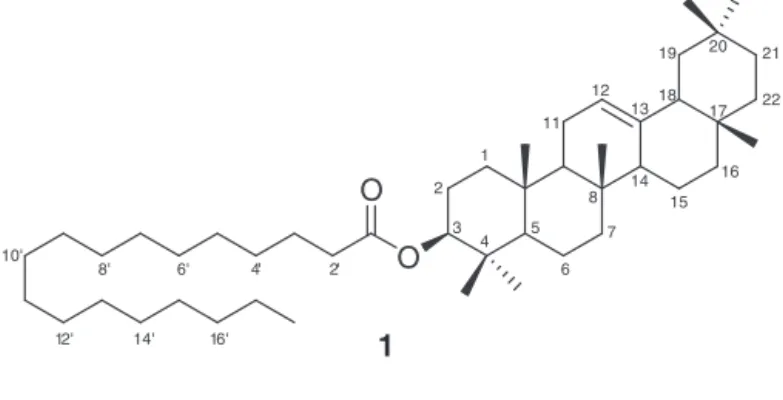
anti-inflammatory proprieties of 3-estearioxy-olean-12-ene (1), an oleanane-type triterpenoid, isolated from A. brachypoda roots ethanolicextract.
http://dx.doi.org/10.1016/j.bjp.2015.03.005
1
Materialandmethods
Plantmaterial
Arrabidaea brachypodaBureau,Bignoniaceae,roots were
col-lectedinSant’AnadaSerra-JoãoPinheiro,MinasGerais,Brazil.Dra. AnaMariaCristinaTeixeiraBraga,DepartmentofBotanicof Fed-eralUniversityofOuroPreto,identifiedtheplant,andavoucher specimenwasdepositedattheHerbariumofFederalUniversityof OuroPreto(vouchernumber17935).
Preparationofplantextract,isolationofcompoundandreference
drugs
Toobtaintheextract,therootsweredried,powdered(685g)and extractedwithethanolinSoxhletequipmentfor24h.Thesolvent wasremovedunderreducedpressureandthendriedwithaspray dryer(BüchiMiniSprayDryerB-290).TheyieldoftheA.brachypoda ethanolic extract (AbE)was 11%. To isolatethe bioactive com-pound,AbEwaschromatographedonasilicagel(230–400mesh) column (8cm×100cm) and eluted withcrescentpolarity mix-turesofn-hexane/ethyl-acetateandethyl-acetate/ethanoltogive 39fractions.Thesefractionswerepooledintofourgroupsaccording to their similarities after the analysis using thin layer chro-matography (TLC). Fractions 3–8 were rechromatographed on a silica gel (230–400mesh)column (8cm×100cm) and eluted with crescent polarity mixtures of n-hexane/ethyl-acetate and ethyl-acetate/ethanoltopurifythetriterpene3 -stearyloxy-olean-12-ene (1). Its structure was determined using spectroscopic techniques(Table1).Thedatawerecomparedtothoseverified in apreviousstudy investigatingthechemical structure of this compound(Vieira-Filhoetal.,2003).
3-Estearioxy-olean-12-ene(1,AbE-01) wasadministeredin 5,10, and15mg/kgdosesafter beingsuspendedin vehicle(1% sodium carboxymethylcellulose suspension in distilled water). Indomethacin (10mg/kg, p.o.) and morphine (10mg/kg, i.p.) in vehicle(saline)wereusedasreferencedrugs.Testdrugswereorally administeredinanequivalentvolumeof10ml/kgbodyweightof theanimal.
Pharmacologicalactivities
Animals
Adultmale Wistar ratsweighing180–220g(n=8)andadult maleSwissmiceweighing28–32g(n=10)animals,obtainedfrom theCentralAnimal Facilityof theFederalUniversity ofAlfenas, werehousedundercontrolledlight(12:12hlight–darkcycle;lights onat6am)andtemperatureconditions(23±1◦C)withaccessto waterandfoodadlibitum.Theanimalswereallowedtohabituate tothe housingfacilities for at least1 week beforethe experi-mentsbegan.Allexperimentswerecarriedoutbetween8amand 2pminaquietroomandtestswereperformedbythesamevisual observerinadouble-blindstudy.Theexperimentswereconducted
inaccordancewiththeDeclarationofHelsinkionthewelfareof experimentalanimalsandwiththeapprovaloftheEthics Commit-teeoftheFederalUniversityofAlfenas(109/2009).
Carrageenan-inducedratpawoedema
Pedal inflammationin ratwas producedas described previ-ously(Vinegar etal., 1969;daRochaetal.,2011), followingan eighto’clockfastwithfreeaccesstowater.Pawoedemawas mea-suredwithaplethysmometer(Model7140,UgoBasile,Italy).The basal volumeoftherighthindpawwasdeterminedbeforethe administrationofanydrug.Afterdeterminationofthebasal vol-ume,theanimalsweredividedintotheexperimentalgroupsin suchawaythatthemeanvolumesofthedifferentgroupswere similar.Vehicle(10ml/kg),3-estearioxy-olean-12-ene(dosesof 5,10,and15mg/kg)orindomethacin(10mg/kg)wasorally admin-istered1hbeforethei.pl.injectionofcarrageenan(1mg,100l). Thepawvolumewasmeasured1,2,3and4hafterinjectionof theinflammatorystimulus.Theresultsarepresentedasthepaw volume(ml)variationinrelationtothebasalvalues.
Formalintest
Aformalinsolution(5%in0.9%saline;20l/paw)wasinjected intothehindpawplantarsurface(i.pl.),andthemicewere indi-viduallyplacedintransparentobservationchambers,aspreviously described (Santos and Calixto, 1997; Vilela et al., 2010). Oral treatments (p.o.) with vehicle, indomethacin or 3 -estearioxy-olean-12-eneweregiven1hpriortoformalininjection.Morphine wasadministrated(i.p.)30minbeforethetest.Thetimespentin lickingtheinjectedpawwasrecordedandexpressedasthetotal lickingtimeintheearlyphase(0–5min)andlatephase(20–30min) afterformalininjection.
Hotplatetest
Thehotplatewasanelectricallyheatedsurfacekeptata con-stant temperature of 50.0±0.5◦C. Mice (n=8 per group) were placed ontheheated surfacewithinthePlexiglas wallsto con-straintheirlocomotionontheplate,andthelatencytoadiscomfort reaction (licking of thepaws or jumping) was recorded 0, 30, 60, and 120min after3-estearioxy-olean-12-ene or morphine (10mg/kg),whereuponthereactiontimeof0ministhestartof thetest.Acut-offtime of20swaschosentoindicatecomplete analgesiaandtoavoidtissueinjury.Thelatenciesforpawlicking orjumpingwererecordedforeachanimal(Yamamotoetal.,2002).
Statisticalanalysis
The data obtained were analysed using GraphPad software programmeversion6.0 andexpressedasthemean±S.E.M. Sta-tisticallysignificantdifferences betweengroupswerecalculated bytheapplicationofananalysisofvariance(ANOVA)followedby theTukeytest.p-Valueslessthan0.05(p<0.05)wereconsidered significant.
Results
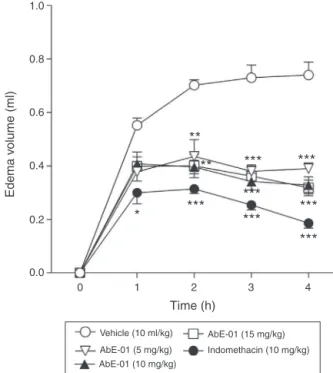
Fig.1showsthatcarrageenaninducedratpawoedemawith compared with the vehicle administration. The 3 -stearyloxy-olean-12-enesignificantlyinhibitedcarrageenan-inducedratpaw oedema(F4,20=30.2;p<0.001).Theinhibitoryvalues ofoedema
Table1
NMRspectraldataof3-(stearyloxy)olean-12-ene(AbE-01).
Carbonnumber AbE-01(␦C) AbE-01(␦H) HMBC Carbonnumber AbE-01(␦C) AbE-01(␦H) HMBC
1 37.74 1.13and1.61 1′
173.55 –
2 22.69 1.64 3 2′ 34.87 2.30 1′,3′,4′
3 80.51 4.52 1′,1,2,4,23,24 3′ 25.17 1.63
4 36.83 – 4′ 29.26 1.29
5 55.26 0.80 5′ 29.27 1.29
6 18.35 1.43and1.56 6′ 29.48 1.26
7 32.47 1.36and1.52 7′ 29.59 1.26
8 41.51 – 8′ 29.65 1.26
9 47.55 1.60 9′ 29.68 1.28
10 36.94 – 10′ 29.72 1.28
11 23.61 1.86 12 11′ 29.72 1.26
12 121.65 5.19 9,11,14,18 12′ 29.93 1.26
13 145.16 – 13′
29.72 1.26
14 41.69 – 14′
29.59 1.26
15 26.24 0.96 15′
29.48 1.26
16 27.04 2.20 28 16′
31.93 1.26
17 32.54 – 17′
22.69 1.26
18 47.36 1.94 12 18′
14.12 0.88 17′,16′
19 46.90 1.03and1.76
20 31.10 –
21 34.83 1.10and1.39
22 37.24 1.22and1.46
23 28.13 0.88 3,4,5,24
24 16.82 0.88 3,4,5,23
25 15.57 0.96 1,5,9,10
26 16.90 0.97 7,8,9,14
27 26.00 1.14 8,13,14,15
28 28.43 0.84 16,17,18,22
29 33.35 0.88 19,20,21,30
30 23.75 0.88 19,20,21,29
Theintrapodal administration formalin induced an nocicep-tivebehaviourof lickingthepawduring thetest (Fig.2B).The 3-stearyloxy-olean-12-ene at doses of 5–15mg/kg p.o. had a significant activity compared to the control in both the early (F5,60=34.3; p<0.001; Fig. 2A) and late phases (F5,60=25.4;
p<0.001, Fig. 2B) of the formalin test. The reference drug,
Time (h)
*
***
***
***
***
***
***
***
**
**
Edema v
olume (ml)
0 0.0 0.2 0.4 0.6 0.8 1.0
Vehicle (10 ml/kg)
AbE-01 (5 mg/kg) AbE-01 (10 mg/kg)
AbE-01 (15 mg/kg) Indomethacin (10 mg/kg)
4 3
2 1
Fig.1.Effectsoftheadministrationofthe3--stearyloxy-olean-12-ene(AbE-01; 5,10and 15mg/kg,p.o.)orindomethacin(5mg/kg, p.o.)onratpawoedema inducedbyintraplantarcarrageenaninjection(1mg/paw).Eachpointrepresents themean±S.E.M.Theasterisksdenotethesignificancelevelswhencomparedwith thecontrolgroup:*p<0.05,**p<<0.01,***p<0.001.
indomethacin,suppressedonlythelatephaseoftheformalintest, whilemorphineinhibitedbothphasesofthepainfulstimulus.
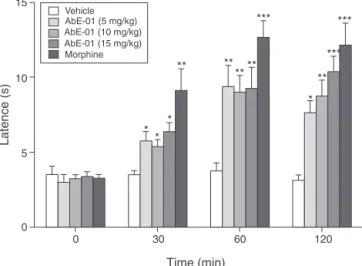
In the hot plate test, treatment with 3 -stearyloxy-olean-12-ene at doses of 5–15mg/kg increased the latency time as compared tothecontrolgroup at30 (F4,39=6.60; p<0.001), 60
(F4,39=7.36; p<0.001) and 120min (F4,39=11.22; p<0.001). As
expected,administrationofthevehicledidnotinduceany antinoci-ceptiveeffect.Morphinesignificantlyincreasedthelatencytime (Fig.3).
Discussion
Traditional medicine for the treatment of various diseases is becoming more popular. Therefore, the present study was aimedatevaluatingthescientificbasisforthetraditionaluseof
A. brachypodaBureau, Bignoniaceae,usinginvivo inflammatory
models. The results of this investigation demonstrate that the triterpene3-estearioxy-olean-12-enefromA.brachypodaexerts anti-inflammatoryeffectsinanimals.
Forthescreeningofcompoundspossessinganti-inflammatory activity, carrageenan-induced paw oedema is a model widely employed and has frequently been used to assess the anti-oedematogeniceffectofnatural products(Mendeset al.,2010). Thedevelopmentofoedemainducedbycarrageenanisabiphasic event.Theearlyphase(1–2h)ismainlymediatedbyhistamine, serotoninandbradykinin.Thelatephaseissustainedbytherelease ofprostaglandinsandnitricoxide,withapeakat3h,andis pro-ducedbyinducibleisoformsofcyclooxygenase(COX-2)andnitric oxidesynthase(iNOS)(BritoandAntonio,1998;Seibertetal.,1994). Previousoraltreatmentwiththis3-stearyloxy-olean-12-enewas effectiveinreducingtheoedematogenicresponseevokedby car-rageenaninlatephase.Thisreductionmaybecausedbyinhibition ofoneormoreintracellularsignallingpathwaysinvolvedin medi-atingtheinflammatoryresponse(Thomazzietal.,2010).
Vehicle 5 10 15 MORP
AbE-01 (mg/kg)
Time lic
king (s)
First phase 60
A
B
40
20
0
Time lic
king (s)
60
40
20
0
Seconde phase
***
**
*
*
***
***
**
**
**
INDO
Vehicle 5 10 15 MORP
AbE-01 (mg/kg)
INDO
Fig.2.Effectsof3--stearyloxy-olean-12-ene(AbE-01)givenbyoralrouteonthe lickinginducedbyformalininmice.Animalswerepretreatedorallywithvehicle, AbE-01(doses5,10,and15mg/kg),indomethacin(INDO;5mg/kg)ormorphine (MORP;10mg/kg)priortoformalin.Thetotaltimespentlickingthehindpaw wasmeasuredinthefirst(PanelA)andsecond(PanelB)phasesafterintraplantar injectionofformalin.Eachpointrepresentsthemean±S.E.M.Theasterisksdenote thesignificancelevelswhencomparedwiththecontrolgroup:*p<0.05,**p<0.01, ***p<0.001.
Vehicle AbE-01 (5 mg/kg) AbE-01 (10 mg/kg) AbE-01 (15 mg/kg) Morphine
Time (min) *
* *
**
** **
*** ***
***
**
* **
Latence (s)
0 0 5 10 15
30 60 120
Fig.3. Effectsof3--stearyloxy-olean-12-ene(AbE-01)administeredorallyinthe hotplatetest. Animalswere pretreatedorallywith vehicle,morphine(Morp; 10mg/kg),AbE-01(doses5,10,and15mg/kg),priortothetestsat50◦C.Each
pointrepresentsthemean±S.E.M.Theasterisksdenotethesignificancelevelswhen comparedwiththecontrolgroup:*p<0.05,**p<0.01,***p<0.001.
formalin injection), seems to be caused by the direct effect of formalinonsensoryC-fibres.Thesecondphase,orinflammatory phase (starting approximately20minafter injection),is associ-atedwiththedevelopmentofaninflammatoryresponseandthe releaseofnociceptivemediators(Abbottetal.,1995;Davidsonand Carlton,1998)Areductionofthelatephasebehaviouralresponse toani.p.formalininjectionwasobserved,demonstratingthe anti-inflammatory activity produced by3-stearyloxy-olean-12-ene. Theresultsobtainedfromcarrageenan-inducedratpawoedema also confirmed this effect. Similarto other substances that act onthecentralnervoussystem(CNS),3-stearyloxy-olean-12-ene inhibitedbothphasesoftheformalintestinamannersimilarto thatofmorphine.Moreover,theresultsofthistestarein agree-mentwiththoseobtainedfromthehotplatetest,confirmingthe centralantinociceptiveeffectofthecompound.
Phytochemical analysesofthe rootsofA. brachypodaextract indicatedthatthelargemajorityofitsconstituentsweretriterpenes (daRochaetal.,2011).Inthisregard,theanti-inflammatory activ-ityisacommonpropertyofmanytriterpenoids(SafayhiandSailer, 1997).Theanti-inflammatoryeffectsoftriterpenes(i.e.oleanolic and ursolicacids) have beenattributedto various mechanisms including:inhibitionoflipoxygenaseand cyclooxygenase activi-ties,inhibitionofelastaseandinhibitionofcomplementactivity, possiblythroughtheinhibitiononC3-convertaseoftheclassical complement pathway(Singhet al.,1992).In addition,previous worksshownthatthebasiccarbonskeletonhasnoinfluenceon theanti-inflammatoryactivity,andthepresenceofaC-28or C-30carboxylicgroupandanalcoholicgroupatC-28increasesthe activityincarrageenan-inducesoedema(Recioetal.,1995), how-ever,themechanismofactionofthe3-stearyloxy-olean-12-ene isunknown.
In the present study, we demonstrated the efficacy of 3 -estearioxy-olean-12-ene,atriterpeneisolatedfromtherootsofA.
brachypoda,indifferentanti-inflammatorytests.Thus,itmaybe
usefulinthetreatmentofinflammatorydisorders,whichsupports previousclaimsofitstraditionaluse.
Authorcontributions
CQR, FCV,FVS-Cand GPC participated in studyconcept and design, acquisition of data, analysisand interpretationof data, draftingofthemanuscript,criticalrevisionofthemanuscriptfor importantintellectualcontent.WV,AG-PandMHSparticipatedin studyconceptanddesign,acquisitionofdata,analysisand inter-pretationofdata,draftingofthemanuscript,criticalrevisionof themanuscriptforimportantintellectualcontent,administrative, technical,ormaterialsupport,andstudysupervision.
Conflictsofinterest
Theauthorsdeclarenoconflictsofinterest.
Acknowledgements
The authors acknowledge financial support from FAPESP, FAPEMIGandCAPES.
References
Abbott,F.V.,Franklin,K.B.,Westbrook,R.F.,1995.Theformalintest:scoring proper-tiesofthefirstandsecondphaseofthepainresponseinrats.Pain60,91–102. Agra,M.D.,Silva,K.N.,Basílio,I.J.,deFreitas,P.F.,Barbosa-Filho,J.M.,2008.Survey
ofmedicinalplantsusedintheregionNortheastofBrazil.Rev.Bras.Farmacogn. 18,472–508.
Blatt,C.T.,dosSantos,M.D.,Salatino,A.,1998.FlavonoidsofBignoniaceaefrom the“cerrado”andtheirpossibletaxonomicsignificance.PlantSyst.Evol.210, 289–292.
Bolzani,V.S.,Pauleti,P.M.,Young,M.C.,2003.ChemicalconstituentsofArrabidaea samydoides(Bignoniaceae).Quim.Nova26,641–643.
Brito,A.R.M.S.,Antonio,M.A.,1998.Oralanti-inflammatoryandantiulcerogenic activitiesofahydroalcoholicextractandpartitionedfractionsofTurnera ulmi-folia(Turneraceae).J.Ethnopharmacol.61,215–228.
daRocha,C.Q.,Queiroz,E.F.,Meira,C.S.,Moreira,D.R.,Soares,M.B.,Marcourt,L., Vilegas,W.,Wolfender,J.L.,2014.DimericflavonoidsfromArrabidaea brachy-podaandassessmentoftheiranti-Trypanosomacruziactivity.J.Nat.Prod.77, 1345–1350.
daRocha,C.Q.,Vilela,F.C.,Cavalcante,G.P.,Santa-Cecília,F.V.,Santos-e-Silva,L., dosSantos,M.H.,Giusti-Paiva,A.,2011.Anti-inflammatoryandantinociceptive effectsofArrabidaeabrachypoda(DC.)Bureauroots.J.Ethnopharmacol.133, 396–401.
deMedeiros,P.M.,Ladio,A.H.,Albuquerque,U.P.,2013.Patternsofmedicinalplant usebyinhabitantsofBrazilianurbanandruralareas:amacroscaleinvestigation basedonavailableliterature.J.Ethnopharmacol.150,729–746.
Davidson,E.M.,Carlton,S.M.,1998.Intraplantarinjectionofdextrorphan,ketamine ormematineattenuatesformalin-inducedbehaviors.BrainRes.785,136–142. Leite,J.P.,Oliveira,A.B.,Lombardi,J.A.,Souza-FilhoChiari,J.D.,2006.Trypanocidal activityoftriterpenesfromArrabidaeatriplinerviaandderivatives.Biol.Pharm. Bull.29,2307–2309.
Martin,F.,Hay,A.E.,Cressend,D.,Reist,M.,Vivas,L.,Gupta,M.P.,Carrupt,P.A., Hostettmann,K.,2008.AntioxidantC-glucosylxanthonesfromtheleavesof Arrabidaeapatellifera.J.Nat.Prod.71,1887–1890.
Mendes,S.S., Bomfim,R.R.,Jesus,H.C.R.,Alves,P.B.,Blank, A.F.,Estevam, C.S., Antoniolli, A.R., Thomazzi, S.M., 2010. Evaluation of the analgesic and anti-inflammatory effects of the essential oil of Lippia gracilis leaves. J. Ethnopharmacol.129,391–397.
Mendonc¸a,R.C.,Felfili,J.M.,Walter,B.M.,Silva,M.C.,Rezende,A.R.,Filguieras,T.S., Nogueira,P.E.,1998.FloravasculardoCerrado.In:Sano,S.M.,Almeida,S.P.(Eds.), Cerradoambienteeflora.EMBRAPA,PlanaltinaDistritoFederal,pp.286–556.
Recio,M.C.,Giner,R.M.,Má ˜nez,S.,Ríos,J.L.,1995.Structuralrequirementsforthe anti-inflammatoryactivityofnaturaltriterpenoids.PlantaMed.61,182–185. Rodrigues,E.,Mendes,F.R.,Negri,G.,2006.PlantsindicatedbyBrazilianIndiansto
CentralNervousSystemdisturbances:abibliographicalapproach.Curr.Med. Chem.:Cent.Nerv.Syst.Agents6,211–244.
Safayhi,H.,Sailer,E.R.,1997.Anti-inflammatoryactionsofpentacyclictriterpenes. PlantaMed.63,487–493.
Santos,A.R.,Calixto,J.B.,1997.Furtherevidencefortheinvolvementoftachykinin receptorsubtypesinformalinandcapsaicinmodelsofpaininmice. Neuro-peptides31,381–389.
Seibert,K.,Zhang,Y.,Leahy,K.,Hauser,S.,Masferrer,J.,Perkins,W.,Lee,L., Isak-son,P.,1994.Pharmacologicalandbiochemicaldemonstrationoftheroleof cyclooxygenase2ininflammationandpain.Proc.Natl.Acad.Sci.U.S.A.91, 12013–12017.
Singh,G.B.,Singh,S.,Bani,S.,Gupta,B.D.,Banerjee,S.K.,1992.Anti-inflammatory activityofoleanolicacidinratsandmice.J.Pharm.Pharmacol.44,456–458. Thomazzi, S.M., Silva, C.B., Silveira, D.C.R., Vasconcellos, C.L.C., Lira, A.F.,
Cambui,E.V.F.,Estevam,C.S.,Antoniolli,A.R.,2010.Antinociceptiveand anti-inflammatoryactivitiesofBowdichiavirgilioides(sucupira).J.Ethnopharmacol. 127,451–456.
Vieira-Filho, S.A., Duarte,L.P., Silva, G.D.F.,Howart, O.W., Lula, I.S., 2003. 3-(Stearyloxy)olean-12-enefromAustroplenckiapopulnea:structureelucidation by2D-NMRandquantitative13CNMRspectroscopy. Helv.Chim.Acta86,
3445–3449.
Vilela,F.C.,Bitencourt,A.D.,Cabral,L.D.,Franqui,L.S.,Soncini,R.,Giusti-Paiva,A., 2010.Anti-inflammatoryandantipyreticeffectsofSonchusoleraceusinrats.J. Ethnopharmacol.127,737–741.
Vinegar,R.,Schreiber,W.,Hugo,R.,1969.Biphasicdevelopmentofcarrageenan edemainrats.J.Pharmacol.Exp.Ther.166,96–103.
Yamamoto,T.,Nozaki-Taguchi,N.,Chiba,T.,2002.Analgesiceffectofintrathecally administeredorexin-Aintheratformalintestandintherathotplatetest.Br.J. Pharmacol.137,170–176.