Article
Establishment of the Volatile Signature of
Wine-Based Aromatic Vinegars Subjected
to Maceration
Rosa Perestrelo1, Catarina L. Silva1, Pedro Silva1ID and JoséS. Câmara1,2,*
1 CQM—Centro de Química da Madeira, Universidade da Madeira, Campus da Penteada,
9020-105 Funchal, Portugal; [email protected] (R.P.); [email protected] (C.L.S.); [email protected] (P.S.) 2 Departamento de Química, Faculdade de Ciências Exatas e Engenharia, Universidade da Madeira,
Campus da Penteada, 9020-105 Funchal, Portugal * Correspondence: [email protected]; Tel.: +351–291705112
Received: 17 January 2018; Accepted: 18 February 2018; Published: 23 February 2018
Abstract: The flavoring of vinegars with aromatic fruits and medicinal herbs is a practice with increasing trend mostly in countries with oenological tradition, resulting in a product of improved quality and consumer attractiveness. This study was directed towards the evaluation of the impact of the maceration process on the volatile signature of wine-based aromatic vinegars (WBAVs). The evaluation was performed using solid phase microextraction (SPME) combined with gas chromatography combined with mass spectrometry (GC-MS). Experimental parameters influencing headspace solid (HS)-SPME extraction efficiency, were optimized using an univariate experimental design. The best results were achieved using a polydimethylsiloxane (PDMS) fiber, 10 mL of vinegar sample, at 50◦C for 30 min of extraction. This way One hundred and three volatile organic compounds (VOCs), belonging to different chemical families including ethyl esters (37), higher alcohols (20), fatty acids (10), terpenoids (23), carbonyl compounds (six), lactones (five) and volatile phenols (two), were identified in wine vinegar (control) and WBAV. As far as we know, 34 of these VOCs are reported for the first time in macerated vinegars. Higher alcohols and lactones are the major chemical families in WBAV macerated with apple, whereas terpenoids are predominant in WBAV macerated with banana. The obtained data represent a suitable tool to guarantee the authenticity and genuineness of WBAV, as well as to promote the production of WBAV with improved sensorial and organoleptic properties. To the best of our knowledge, there are no reported studies dealing with the volatile signature of WBAV enriched with banana, passion fruit, apple and pennyroyal.
Keywords:vinegars; volatile signature; HS-SPME/GC-MS; PCA; authenticity
1. Introduction
Vinegar is a traditional food product with a high reputation throughout the world, used not only as a condiment, but also as preserving agent for a wide range of foods [1]. It is produced from raw materials containing mainly carbohydrates in two-stage fermentation processes, where the first one involves ethanol formation by yeasts (usuallySaccharomycesspecies) through the conversion of fermentable sugars (alcoholic fermentation) and subsequently the oxidation of ethanol to acetic acid (acetification). From a technological point of view, there are mainly two defined vinegar making methods (Figure1): (i) the traditional method, in which the culture of acetic acid bacteria is placed on the surface of a barrel in a direct contact with oxygen; and (ii) the industrial method, a quick process involving a submerged culture where the oxygenation has been greatly improved [2–4].
The market is turning towards the diversity of food and ingredients that prevent several diseases, such as those showing antibacterial, anti-inflammatory, blood glucose control, lipid metabolism
regulation, weight loss, anticancer and cardiovascular disease prevention activity [2,5–7]. Taking into account these reasons, the agri-food market is focused on the development of novel products based on traditional processes with higher nutritional and organoleptic properties. Following the research line of development of products with increased value from a nutritional point of view, a new sherry vinegar-derived product enriched with dietary fiber has been developed by Marrufo-Curtido et al. [8]. Venturi et al. [9] developed a phenol-enriched refined olive oil with its own phenolic compounds extracted from wastewater produced during physical processing in order to improve the nutraceutical value, as well as the antioxidant capacity of olive oil. On the other hand, marine sources (e.g., macroalgae, microalgae), food by-products and plant-derived natural products can be used to extract bioactive compounds, such as polyunsaturated fatty acids (PUFAs) and phenolics, among others, that are widely recognized as important nutritional components that may help prevent various cardiac disorders [10–13].
Figure 1.Flowchart showing the general production methods for vinegar [2–4].
to different chemical families (e.g., mono- and sesquiterpenes, esters, higher alcohols, carbonyl and sulphur compounds) encompassing a wide range of volatilities and polarities. These VOCs may come from the raw materials (e.g., red wines, fruits, cider, malted barley, honey, among others), and/or may be formed during production and storage processes [1,4,6,14–18]. VOCs are present, to a large extent, in fruits and aromatic/medicinal herbs influencing positively the final quality of vinegars by the addition of new compounds derived from them. In addition, fruits are rich in vitamins, minerals, phytochemicals, and contain potentially bioactive compounds including polyphenols (e.g., flavonoids and non-flavonoids) which have been shown to prevent oxidative processes. These compounds confer to fruits a significant antioxidant capacity related to numerous healthy properties [2,5–7].
Due to the diversity of commercially available vinegars and vinegar-based products and its increasing demand trend, the development of reliable and high throughput analytical methodologies able to establish criteria for determining its quality and origin are crucial to achieve this purpose [19]. Several extraction techniques, such as steam distillation [20], liquid-liquid extraction [21], stir bar sorptive extraction [5], solid-phase extraction [22], and solid-phase microextraction (SPME) [23] have been applied to isolate the volatiles from vinegars and vinegar-derived products. Compared to other extraction processes SPME offers several advantages such as the fact it eliminates the use of extraction solvent and allows the extraction and the concentration steps to be performed simultaneously [23]. The vinegar volatile signature is usually established using chromatographic techniques, in particular gas chromatography combined with mass spectrometry (GC-MS) [24].
The characterization and discrimination of vinegars have been widely investigated through the integration of chromatographic data with chemometric tools, such as principal component analysis (PCA) and hierarchical cluster analysis (HCA). PCA and HCA are among the most used chemometric tools to view, analyze and explore the large information provided by the analytical instrumentation. These two pattern recognition tools complement one another and have been widely applied to solve classification problems [25,26].
Following the research line of novel aromatic vinegars, with improved nutritional and sensorial properties, the aim of the current work was the establishment of he volatile signature of a wine vinegar (control) and wine-based aromatic vinegars (WBAVs) macerated with different fruits (e.g., banana, passion fruit and apple) and a medicinal herb (e.g., pennyroyal) using headspace solid-phase microextraction (HS-SPME) combined with gas chromatography-mass spectrometry (GC–MS). In addition, chemometric tools, namely PCA and HCA, were applied to obtain deep insights into variations on the volatile signature of target vinegars, and to identify the VOCs responsible for the discrimination among vinegars. Our study’s findings could provide to “home-made” producers new opportunities to promote the production of wine vinegars with enhanced levels of odoriferous VOCs, to guarantee the vinegars typicality and to expand the oenological market. To the best of authors’ knowledge, there has not been any report on the volatile signatures of WBAV macerated with banana, passion fruit, apple and pennyroyal.
2. Results and Discussion
2.1. HS-SPME Optimization
2.1.1. Fiber Coating
The selection of the most suitable SPME fiber depends on the composition of the sample material under study [27]. Five fiber coatings, including carboxen/polydimethylsiloxane (CAR/PDMS, 75 µm), divinylbenzene/carboxen on polydimethylsiloxane (DBV/CAR/PDMS; StableFlex, 50/30 µm), polyacrylate (PA, 85 µm), polydimethylsiloxane (PDMS, 75 µm) and polydimethylsiloxane/divinylbenzene (PDMS/DVB, 65 µm), were used to evaluate the effect of fiber coating on the extraction efficiency of VOCs from wine vinegar samples. Figure S1 shows the typical total ion chromatograms (TIC) obtained using different fiber coatings with 5 mL of vinegar sample during 15 min at 40◦C under constant magnetic stirring (700 rpm).
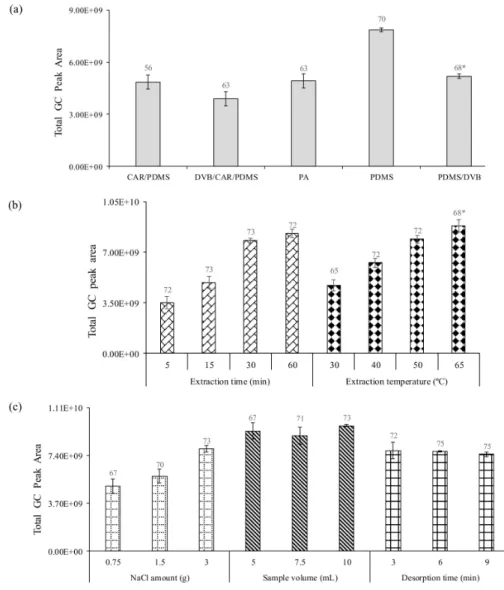
A total of 70 VOCs were identified using a PDMS fiber, while with the PDMS/DVB, CAR/PDMS, DVB/CAR/PDMS and PA fibers, were detected 68, 56, 63 and 63, respectively (Figure2a). Each extraction was performed in triplicate and the precision (% RSD) was lower than 15%. According to the total GC peak area and obtained reproducibility, the most suitable fiber for the extraction of VOCs was the PDMS followed by the PDMS/DVB, CAR/PDMS, PA and DVB/CAR/PDMS. Therefore, the PDMS fiber was selected for further assays.
2.1.2. Extraction Time
Time affects the mass transfer of the analytes between the three system phases in HS-SPME technique, mainly determined by the agitation rate and the partition coefficient of the analyte between fiber coating and sample matrix [28]. SPME has a maximum sensitivity at the equilibrium state, however full equilibration is not necessary for accurate and precise analysis. The extraction time for the PDMS fiber was assayed by plotting the GC response vs. the extraction time to obtain the partition equilibrium profile (Figure2b). The HS-SPME extraction efficiency increase with extraction time. After 30 min no remarkable differences were observed in terms of GC response as well as number of identified VOCs. The highest % RSD values, were observed at 5 and 15 min. These extraction times are too short to allow the system reach the equilibrium. Hence, an extraction time of 30 min was selected, since in terms of total GC peak areas, number of identified VOCs and precision, achieved the best performance.
2.1.3. Extraction Temperature
Temperature has a significant effect on the extraction kinetics by HS-SPME. An increase in extraction temperature causes an increase in extraction rate and a simultaneously decrease in the distribution constant. Therefore, an adequate temperature which provides suitable sensitivity and extraction rate should be used [27,28]. The extraction temperature effect was investigated by sampling wine vinegar at different temperatures, 30, 40, 50 and 65◦C using the PDMS fiber, 5 mL of vinegar sample for 30 min under constant magnetic stirring (800 rpm). As can be seen in Figure2b, the best extraction efficiency was obtained at 65◦C in terms of total GC peak area. In comparison with 50◦C,
the obtained results showed higher % RSD whilst the number of VOCs identified was lower (68 VOCs). This decrease could be explained by VOCs degradation due to the higher temperature applied in the extraction procedure [29]. Taking into account the obtained results, 50◦C was selected as extraction
temperature for further experiments.
2.1.4. Ionic Strength
The suitability of the HS-SPME for the extraction of VOCs depends on the transfer of the analyte from sample to the gaseous phase and therefore to the fiber. This process can be optimized by the increase of the ionic strength [28]. Different NaCl amounts (0.75, 1.5 and 3 g) were evaluated using a PDMS fiber with 5 mL of wine vinegar for 30 min at 50◦C under constant magnetic stirring (800 rpm).
As can be seen in Figure2c, the total GC peak area as well as the number of identified VOCs increased as the NaCl amount increase, from 0.75 to 3g. Based on the obtained results, 3 g of NaCl was used to optimize the medium ionic strength and therefore promoting the “salting-out” effect, maximizing the extraction efficiency.
2.1.5. Sample Volume
2.1.6. Desorption Time
Efficient thermal desorption of analytes in a GC injection port depends on the analytes volatility, the thickness of the fiber coating, injection depth, injection temperature and extraction time. Desorption time was evaluated in the range of 3 to 9 min. As can be seen in Figure2c, no remarkable differences in terms of GC peak area were observed for all tested desorption times using a PDMS fiber with 10 mL of vinegar sample and 3 g of NaCl for 30 min at 50◦C under constant magnetic stirring (800 rpm).
Moreover, 75 VOCs were identified using 6 and 9 min of desorption time. Hence, 6 min was chosen for desorption of the VOCs from vinegar samples.
2.2. Characterization of Volatile Signature of WBAV by Maceration Using HS-SPME/GC-MS
Table 1.Volatile organic compounds (VOCs) identified in wine-based aromatic vinegars (WBAVs) by headspace solid-phase microextraction (HS-SPME)PDMS/GC-MS.
Peak Number
RT1
(min) KIcal
2 KI
lit3 Chemical Families
GC Peak Area×106(RSD)
Wine Vinegar Control
Macerated Vinegars
Banana Passion Fruit Apple Pennyroyal
Ethyl esters
1 2.91 925 907 Ethyl acetate 300.22 (8) 197.65 (9) 122.23 (13) 113.89 (9) 247.35 (3)
4 4.68 1055 1028 Ethyl butanoate 16.03 (6) -5 9.93 (14) 3.29 (4)
-5 5.29 1081 1050 Ethyl 3-methylbutanoate 15.18 (6) 16.36 (17) 3.31 (13) 8.12 (4)
-7 6.51 1125 1120 Isoamyl acetate 163.77 (15) 169.1 (9) 71.31 (3) 80.64 (2) 124.8 (16)
12 10.04 1222 1220 Ethyl hexanoate 227.53 (9) 113.51 (8) 195.43 (12) 84.73 (20) 128.32 (14)
16 12.41 1285 1304 Ethyl 3-ethoxypropanoate4 - 9.98 (8) - 0.58 (11) 2.16 (18)
17 12.67 1291 1292 Ethyl 3-hexenoate4 - 6.44 (12) 1.06 (7) 0.87 (9) 4.62 (6)
18 13.23 1305 1300 3-Hexen-1-ol acetate isomer 3.14 (4) 0.94 (15) - 2.17 (11)
-21 13.87 1320 1305 Ethyl 2-hexenoate 14.86 (6) 0.87 (9) 1.27 (19) 1.10 (4) 2.81 (5)
22 14.67 1339 1358 Ethyl lactate 21.95 (14) 42.24 (16) 36.08 (4) 28.80 (14) 51.13 (1)
25 15.53 1343 1350 Hexyl acetate 22.48 (17) 29.76 (11) 18.26 (9) 16.00 (2) 12.48 (13)
26 15.58 1359 - Heptyl acetate4 0.52 (15) - - -
-29 16.13 1370 - 2-Ethylhexyl acetate4 2.99 (9) 2.40 (3) - -
-30 16.16 1372 1389 Methyl octanoate - 1.84 (7) 0.54 (8) -
-34 17.82 1405 1394 Ethyl 2-hydroxyisovalerate - 2.46 (11) - 0.13 (13)
-35 18.16 1416 1414 Ethyl octanoate 296.15 (4) 182.15 (3) 181.16 (10) 194.75 (2) 208.86 (11)
37 19.19 1441 - Isopentyl hexanoate - - 77.49 (8) - 82.04 (4)
47 22.33 1518 1483 Ethyl 3-hydroxybutanoate 2.65 (13) - 3.09 (1) 1.32 (4)
-49 22.61 1526 1551 2-Ethyl hydroxycaproate4 6.45 (19) 8.08 (6) 2.62 (14) 0.42 (11) 6.02 (8)
51 23.04 1536 1533 Hexyl butanoate4 1.21 (7) - - 1.74 (3)
-64 26.58 1617 1636 Ethyl decanoate 112.62 (3) 132.17 (14) 110.55 (5) 211.67 (4) 138.31 (2)
65 26.85 1625 1610 Butyl octanoate4 - 0.27 (20) - 1.47 (16)
-66 27.35 1639 1648 Ethyl benzoate 6.63 (15) 6.26 (8) 5.83 (11) 6.65 (1) 9.15 (4)
68 28.07 1659 1680 Diethyl succinate 25.99 (5) 23.95 (15) 15.49 (4) 18.84 (2) 23.72 (5)
71 29.34 1693 1664 Ethyl 3-hydroxyhexanoate 1.27 (4) 1.02 (9) 0.20 (12) 0.21 (20) 0.98 (5)
75 31.42 1754 1755 Phenylmethyl acetate 2.78 (6) - - 0.27 (12)
-76 32.07 1773 1775 Ethyl benzeneacetate 11.12 (14) 7.44 (8) 4.61 (8) 3.95 (7) 11.51 (7)
77 32.47 1784 - Dibuthyl succinate4 0.31 (3) - - 1.41 (2)
-78 32.73 1791 1798 Methyl 2-hydroxybenzoate 0.63 (17) 6.07 (10) - - 4.23 (2)
80 34.32 1838 1837 Ethyl dodecanoate 10.17 (11) 12.15 (16) 13.26 (12) 8.75 (3) 12.55 (15)
82 34.99 1857 1821 Benzyl propanoate4 7.54 (4) 1.32 (14) 9.26 (8) 11.71 (15) 5.61 (2)
83 35.58 1873 1849 Benzyl butanoate4 0.48 (13) - 1.37 (11) 0.58 (16)
-84 35.87 1880 1883 2-Phenylethyl acetate 1.00 (11) 5.73 (5) 1.19 (8) - 6.34 (13)
Table 1.Cont.
Peak Number
RT1
(min) KIcal
2 KI
lit3 Chemical Families
GC Peak Area×106(RSD)
Wine Vinegar Control
Macerated Vinegars
Banana Passion Fruit Apple Pennyroyal
90 39.66 1970 1974 Methyl jasmonate4 0.98 (2) 0.81 (4) - 0.26 (12)
-95 43.13 2193 2189 Phenylethyl benzoate4 1.82 (3) 3.52 (13) 1.81 (18) 0.82 (4) 2.20 (11)
100 48.08 2308 2301 Methyl hexadecanoate 0.41 (6) 1.99 (12) 0.45 (6) - 0.53 (14)
Alcohols
2 3.15 968 972 Ethanol 773.10 (10) 845.14 (11) 1040.94 (16) 1099.28 (12) 946.25 (6)
3 4.66 1074 1099 2-Butanol 12.75 (6) 11.75 (19) - - 14.45 (2)
6 6.12 1113 1112 2-Methyl-1-propanol 23.13 (12) 13.42 (9) 9.14 (12) 14.55 (17) 19.72 (8)
8 7.87 1165 1176 2-Hexanol 2.75 (7) 3.25 (10) 1.86 (12) 2.19 (15)
-11 9.51 1206 1206 3-Methylbutanol 436.65 (8) 262.37 (13) 209.63 (9) 301.03 (7) 399.42 (3)
20 13.51 1312 1332 2-Heptanol4 0.23 (4) 1.23 (6) 1.01 (3) 1.61 (8)
-23 15.15 1350 1360 1-Hexanol 23.03 (10) 33.89 (13) 69.49 (3) 55.64 (10) 63.41 (3)
24 15.23 1352 1386 3-Hexenol isomer 0.22 (18) 0.47 (9) 0.26 (2) 0.77 (19) 0.41 (15)
27 15.81 1364 1379 3-Ethoxypropanol4 0.14 (10) 1.82 (6) 1.29 (14) -
-28 16.11 1371 1391 3-Hexenol isomer 5.78 (3) 1.83 (16) 2.01 (11) 8.56 (13) 6.49 (4)
33 17.69 1383 1388 1-Octanol 10.25 (4) 6.01 (16) 10.23 (1) 5.63 (2)
-42 20.48 1475 1465 1-Octen-3-ol 7.12 (1) 7.91 (2) 9.67 (9) 0.32 (3)
-46 21.71 1503 1487 2-Ethylhexanol 2.56 (5) 2.54 (13) - 8.17 (9)
-48 22.43 1521 1546 2,3-Butanediol isomer 5.06 (3) 14.92 (12) 1.79 (4) 0.29 (13) 10.03 (1)
52 23.23 1540 1535 2-Nonanol4 0.53 (8) 1.91 (3) 4.37 (7) 3.13 (8)
-56 23.93 1556 1583 2,3-Butanediol isomer 9.44 (11) 5.73 (15) 1.52 (8) 0.27 (11)
-72 29.65 1701 1723 Methionol 1.21 (2) 1.39 (19) 1.35 (5) 1.66 (8)
-73 31.28 1750 1765 1-Decanol4 1.60 (12) 5.82 (12) 1.08 (17) 2.22 (17) 8.32 (9)
87 37.94 1898 1925 2-Phenylethanol 124.77 (5) 78.46 (12) 27.58 (7) 63.08 (6) 68.75 (6)
89 39.24 1956 1952 Tridecanol4 0.67 (7) 2.14 (12) 6.68 (10) 0.99 (12) 4.35 (2)
Terpenoids
9 8.38 1178 1182 Limonene 101.05 (1) 82.77 (6) 79.66 (12) 78.23 (3) 104.46 (8)
10 8.76 1187 1214 Eucalyptol 1.11 (4) 4.21 (21) 2.13 (2) - 2.15 (4)
13 11.18 1254 1233 Sabinene 2.22 (15) 6.03 (2) 1.19 (15) -
-19 13.38 1308 1337 Rose oxide isomer4 8.25 (3) 8.31 (2) 9.78 (12) 9.23 (1) 9.77 (4)
32 16.74 1392 1421 Linalool oxide isomer - - 1.45 (12) 0.33 (10) 8.76 (6)
38 19.22 1443 1449 Dihydrolinalool4 1.32 (8) 9.83 (14) 1.37 (20) 2.61 (12)
-39 19.4 1448 1467 Linalool oxide isomer - 3.32 (14) 0.96 (7) 0.18 (6)
-40 19.97 1462 1474 Menthone4 - 8.42 (9) 4.19 (2) - 14.19 (14)
Table 1.Cont.
Peak Number
RT1
(min) KIcal
2 KI
lit3 Chemical Families
GC Peak Area×106(RSD)
Wine Vinegar Control
Macerated Vinegars
Banana Passion Fruit Apple Pennyroyal
44 21.47 1498 1531 Vitispirane I 5.61 (8) 6.21 (15) 3.95 (1) 4.95 (5) 6.57 (5)
45 21.57 1501 1534 Vitispirane II 12.14 (18) 4.25 (16) 4.31 (2) 3.13 (11) 3.36 (9)
50 22.88 1530 1537 Linalool 1.02 (8) 3.35 (7) 6.15 (4) 2.15 (4) 1.98 (4)
53 23.28 1541 1538 Dihydrocarveol4 - 11.61 (3) 14.14 (5) - 21.68 (14)
55 23.72 1551 1580 Bornyl acetate4 - 4.89 (4) 1.38 (5) 2.81 (8) 1.18 (15)
58 24.44 1559 1569 Linalyl acetate - 26.39 (7) 28.71 (11) -
-59 24.83 1575 1574 Fenchyl alcohol4 0.58 (2) 0.73 (8) 0.42 (9) 0.78 (4) 1.91 (20)
62 26.27 1610 1626 Menthol4 - 5.94 (16) 5.66 (7) 5.40 (2) 7.62 (6)
63 26.34 1618 1632 Pulegone4 2.84 (13) - 2.75 (12) -
-69 28.58 1673 1669 α-Terpeniol 49.62 (12) 60.22 (9) 64.55 (9) 65.23 (2) 67.71 (3)
74 31.38 1753 1762 Citronellol 0.94 (13) 2.73 (4) - - 1.72 (12)
81 34.59 1844 1840 Geranylacetone 4.16 (15) 15.36 (19) 10.45 (5) 4.24 (8) 12.76 (13)
91 39.86 1981 2009 Nerolidol 0.76 (8) 0.82 (3) 1.21 (4) - 2.43 (4)
93 41.16 2125 2134 α-Cadinol 4.23 (9) 0.20 (13) 0.37 (2) 1.09 (7) 2.06 (15)
Carbonyl compounds
14 12.05 1276 1276 Octanal - - 0.52 (7) -
-25 12.18 1278 1272 3-Hydroxybutan-2-one 3.01 (8) 2.71 (5) 0.75 (2) -
-31 16.29 1374 1378 Nonanal 1.22 (7) 1.58 (7) 1.99 (10) 1.27 (7)
-43 20.81 1483 1484 Decanal 1.69 (8) 2.19 (13) 1.90 (2) 1.47 (8)
-57 24.08 1571 1543 Undecanone4 2.72 (12) - 0.21 (3) -
-70 29.21 1689 1700 Dodecanal4 5.99 (3) - 0.94 (6) -
-Acids
36 18.51 1425 1407 Acetic acid 422.11 (18) 347.48 (12) 139.85 (9) 136.06 (11) 122.36 (14)
54 23.52 1547 1572 2-Methylpropanoic acid 1.52 (14) 2.66 (7) - -
-61 25.97 1600 1619 Butanoic acid 3.77 (1) 8.09 (15) 0.92 (4) 0.44 (9) 1.25 (7)
67 27.56 1645 1665 Isovaleric acid 19.86 (13) 9.15 (12) 2.61 (7) 6.63 (11) 16.27 (5)
79 34.29 1837 1850 Hexanoic acid 37.85 (11) 32.83 (4) 17.25 (8) 15.06 (5) 21.49 (10)
86 36.69 1937 1962 2-Hexenoic acid isomer4 0.23 (4) 0.68 (16) 0.92 (13) - 1.68 (7)
94 41.82 2098 2083 Octanoic acid 83.66 (7) 41.12 (13) 34.35 (3) 53.22 (2) 76.83 (12)
101 48.56 2321 2317 Decanoic acid 71.71 (6) 65.85 (15) 70.36 (5) 42.58 (2) 45.52 (19)
102 54.81 2340 2310 Hydrocinnamic acid 10.63 (10) 1.02 (16) 0.81 (7) 2.43 (5)
-103 67.81 2392 2407 Undecylic acid4 7.18 (8) 0.91 (15) - 0.56 (8) 0.62 (9)
Lactones
60 25.71 1594 1618 Butyrolactone 0.94 (5) - - 0.19 (19)
-Table 1.Cont.
Peak Number
RT1
(min) KIcal
2 KI
lit3 Chemical Families
GC Peak Area×106(RSD)
Wine Vinegar Control
Macerated Vinegars
Banana Passion Fruit Apple Pennyroyal
92 40.63 2107 2103 γ–Decalactone4 2.28 (17) 0.95 (8) 2.28 (2) 14.59 (2) 4.23 (4)
96 43.92 2218 2209 Wine lactone4 3.99 (2) - - 1.27 (7) 2.60 (12)
99 45.44 2267 2241 γ-Decenolactone4 11.22 (6) 4.43 (8) 7.34 (13) 15.90 (2) 7.75 (1)
Volatile phenols
97 44.22 2228 2205 4-Ethylphenol 1.82 (4) 1.71 (14) 1.22 (3) - 0.79 (3)
98 45.13 2257 2250 Eugenol 0.39 (8) 1.68 (10) 3.73 (10) 1.35 (4) 2.83 (4)
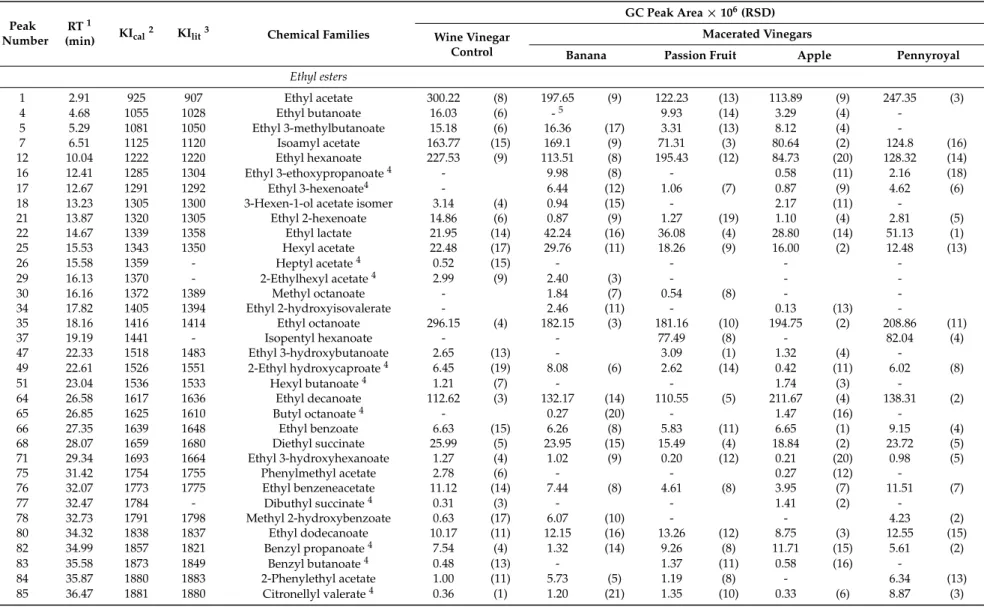
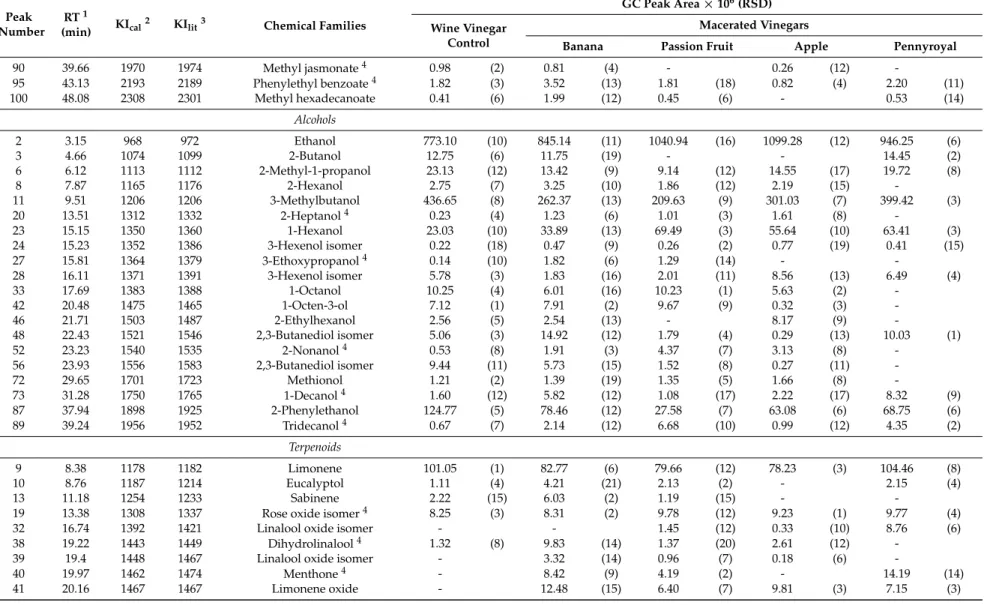
Ethyl esters are qualitatively the main chemical family (37 VOCs), and represent the second major contribution to the WBAV volatile signature (from 28.18 (apple vinegar) to 35.48% (wine vinegar)). This chemical family contribute positively to the general quality of WBAV being responsible for their fruity and floral sensory properties. Among the ethyl esters, Table1, ethyl hexanoate, ethyl octanoate, ethyl decanoate, isoamyl acetate and ethyl acetate are the most abundant, accounting 86.01% and 80.82% of total volatile profile of wine vinegar (control) and WBAV, respectively. Heptyl acetate (0.04%) was only detected in wine-based vinegar (control), whereas, methyl octanoate (banana and passion fruit vinegars), ethyl 2-hydroxyisovalerate (banana and apple vinegars), isopentyl hexanoate (passion fruit and pennyroyal vinegars) and butyl octanoate (banana and apple vinegars) were detected only in WBAV. This fact suggest that these compounds come from raw material contributing to the flavor enrichment of macerated vinegars.
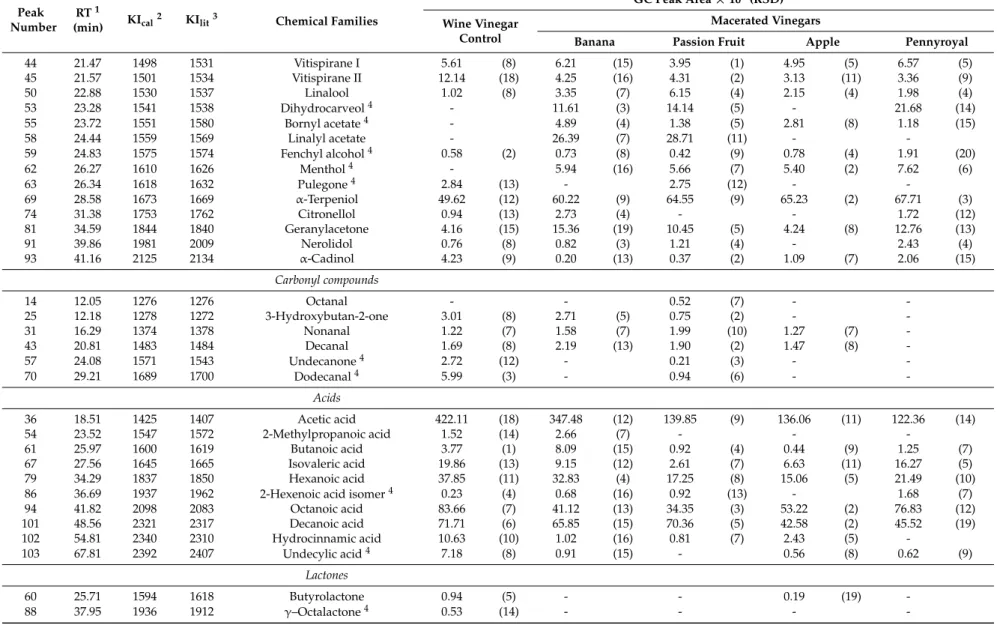
Fatty acids contributed with 18.26% and 10.95% for total volatile signature of wine vinegar and wine-based macerated vinegars, respectively. The lowest contribution was observed in pennyroyal (8.89%), followed by apple (8.99%), passion fruit (9.44%), banana (16.48%) and wine (18.26%) vinegar. Acetic, octanoic and decanoic acids were predominant in the studied vinegar samples. Its contribution to the total volatile profile was highest in wine vinegar (16.02%), followed by macerated wine vinegars, banana (14.69%), passion fruit (8.65%), apple (8.11%) and pennyroyal (7.60%).
Figure 3.Total GC-MS peak area of chemical families identified in wine (control) and WBAV (banana, passion fruit, apple, pennyroyal) vinegars.
Terpenoids represent an excellent example of aromatic compounds from varietal origin, which may be used for authentication and/or typicality of food matrices. The WBAV macerated with banana seems to be richest in terpenoids (8.99%), followed by passion fruit (8.88%), pennyroyal (8.62%), apple (6.65%) and control (5.29%). Moreover, linalool oxide isomer, menthone, limonene oxide, dihydrocarveol, bornyl acetate, linalyl acetate and menthol, were only detected in WBAVs (Table1) suggesting the contribution of the maceration to the enrichment of wine vinegars. Limonene and
α-terpeniol were the predominant terpenoids accounting 78.95%, 51.42%, 57.41%, 75.44% and 62.05% for the total terpenoids in wine vinegar (control), and macerated vinegars with banana, passion fruit, apple and pennyroyal, respectively. From a healthy point of view, several studies demonstrated the effectiveness of limonene andα-terpineol against some types of cancer including gastric, mammary, pulmonary adenoma and liver, as well as effective in relieving gastroesophageal reflux disorder and occasional heartburn [34,35].
group contribute with 0.41% for total volatile profile of wine vinegar (control), whereas in macerated vinegars its contribution ranged from 0.10 (apple) to 0.21% (banana).
In wine vinegar, the lactones contribute with 0.53% for the total volatile profile, whereas in vinegars macerated with banana, passion fruit, apple and pennyroyal, its contribution was 0.17%, 0.34%, 1.12% and 0.45%, respectively. γ-Octalactone was only detected in wine vinegar (control), whereasγ-decalactone andδ-decenolactone were detected in all WBAV. From a sensorial point of view, lactones showed a positive contribution to aroma, with caramel, fruity, sweet and coconut-like notes [36].
2.3. Multivariate Analysis
The GC peak area of 103 VOCs (GC–MS data set) identified in wine vinegar (control) and WBAV were auto-scaled and submitted to PCA and HCA to search for the main sources of variability as well as to characterize and differentiate the vinegars based on their volatile signature.
Figure 4. (a) Principal components (PC) PC1 ×PC2 of scores scatter plot of wine (control) and WBAV vinegars; (b) Loading plot of the main source of variability between volatile profile and wine vinegars—derived products by maceration with fruits and plant (attribution of the peak number shown in Table1).
According to results obtained by PCA, apple vinegar (PC1 and PC2 positive) is mainly characterized by the presence of ethyl decanoate (64), whereas banana vinegar (PC1 and PC2 negative) is essentially characterized by acetic acid (36). Wine vinegar (control) and pennyroyal vinegars were projected in PC1 negative and PC2 positive being essentially characterized by ethyl acetate (1) and 3-methylbutanol (11), respectively. The passion fruit vinegar (PC1 positive and PC2 negative) is described by ethanol (2).
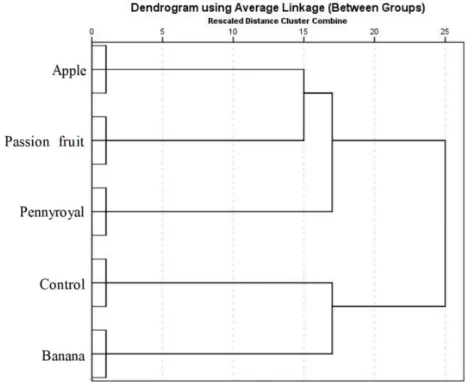
The results of HCA for vinegar samples based on the GC–qMS data set is shown in Figure5. The horizontal lines in the obtained dendrogram represent the similarity values between pairs of samples, between a sample and a group of samples and between sample groups, and the vertical lines the studied samples. The vinegar samples were firstly grouped into two clusters, i.e., cluster A (wine vinegar and banana vinegars) and cluster B (passion fruit, apple and pennyroyal vinegars). Moreover, cluster A could also be further grouped into sub-clusters, such as A1 (wine vinegar) and A2 (banana vinegar). These results are in agreement with those obtained by PCA, and it is possible to find that these clusters were evidently related to vinegar sample as well as to volatile signature.
Figure 5. Dendrogram for the HCA results using Ward’s cluster algorithm of the volatile profile obtained from wine (control) and WBAV vinegars. The Square Euclidean distances are shown on the x-axis.
3. Materials and Methods
3.1. Chemicals and Materials
All chemicals used in this study were of analytical quality. Sodium chloride (NaCl, 99.5%) used to adjust the ionic strength, was purchased from Panreac (Barcelona, Spain). VOCs standards used for identification of target compounds with purity >98% were purchased from Sigma-Aldrich (Madrid, Spain), Acros Organics (Geel, Belgium) and Fluka (Buchs, Switzerland). The individual stock solutions were prepared in ethanol (concentration of 1000 mg/L) and stored at 4◦C. Helium (Air Liquide,
3.2. Vinegar Samples
The WBAVs were obtained according to Procedure I in Figure1. For this purpose, individual maceration of wine vinegar with different fruits and the medicinal herb was carried out. The vinegar used to perform the maceration was supplied by a local winery. The fruits used for maceration, banana (Musa sapientumL.), passion fruit (Passiflora edulisL.), apple (Malus domesticaBorkh.) and the medicinal herb (pennyroyal (Mentha pulegiumL.)), were purchased from a local market at optimal maturity and health stage. Samples were washed and dried to remove possible contaminants.
To promote the enrichment of volatile profile through maceration process, dark glass containers (1000 mL) were filled with 750 mL of wine vinegar, to which small pieces (50 g) of banana, passion fruit, apple and pennyroyal were added. All dark glass containers were continuously stirred during 7 days at room temperature (25±1◦C). The wine vinegar without maceration was used as control vinegar. Each assay was performed in triplicate.
3.3. HS-SPME Procedure
To improve the extraction efficiency of HS-SPME several parameters such as: fiber coating, extraction time (5, 15, 30, 60 min), extraction temperature (30, 40, 50, 60◦C), sample volume (5, 7.5,
10 mL), ionic strength (0.75, 1.5, 3 g) and desorption time (3, 6, 9 min) were tested and optimized using an univariate experimental design.
For fiber screening, five commercial fibers, namely carboxen/polydimethylsiloxane (CAR/PDMS, 75µm), divinylbenzene/carboxen/polydimethylsiloxane (DVB/CAR/PDMS, 50/30µm), polyacrylate (PA, 85 µm), polydimethysiloxane (PDMS, 100 µm) and polydimethylsiloxane/divinylbenzene (PDMS/DVB, 65µm) were evaluated. Before daily analyses each fiber was conditioned for 15 min at 250◦C.
For HS-SPME optimization, a wine-based vinegar (Control) was used. For each extraction, 10 mL of sample was transferred to a 20 mL amber glass vial with 3 g of NaCl. A magnetic stirrer bar was added. The vial, tightly capped with a PTFE-faced silicone septum, was placed in a thermostatic block with a constant magnetic stirring (800 rpm). The SPME fiber was exposed into the headspace during 30 min at 50◦C. Subsequently, after extraction the fiber was withdrawn into the holder needle,
removed from the vial and immediately introduced into the GC injector port for 6 min at 250◦C for thermal desorption of the analytes. All assays were performed in triplicate.
3.4. GC-MS Conditions
An Agilent 6890N gas chromatograph system (Palo Alto, CA, USA) combined with an Agilent 5975 quadrupole inert mass selective detector and a splitless injector was used. Chromatographic separations were performed using a BP-20 (30 m×0.25 mm i.d.×0.25µm film thickness) fused silica capillary column supplied by SGE (Darmstadt, Germany) with helium (Helium N60, Air Liquide) as carrier gas at a flow rate of 1 mL/min (column-head pressure: 13 psi). An insert of 0.75 mm i.d. was used and the injector temperature was fixed to 250◦C. The temperature program was programmed
as follows: initial temperature 40◦C and a ramp of 3◦C min−1to 220◦C and maintaining a constant
temperature for 10 min until the end. The manifold, GC-MS interface and quadrupole temperatures were held at 180, 220 and 180◦C, respectively. MS detection was performed in full scan, the ion energy
used for the electron impact (EI) was 70 eV and the source temperature was 180◦C. The electron
multiplier was set to the auto tune procedure. The mass acquisition range, made in full scan mode, was 30–300 m/z, 1.9 spectra s−1. VOCs identification was achieved by the following ways:
(i) comparison the GC retention times and mass spectra with those of the standard, when available; (ii) all mass spectra were also compared with the data system library (NIST Mass Spectral Search
Program v.2.0d software; NIST: Washington, DC, USA, 2005);
For the determination of the KI, a C8–C20n-alkanes series was used, and the values were compared, when available, with values reported in the literature for similar columns [5,27,32,33].
3.5. Statistical Analysis
Chemometric tools, namely PCA and HCA, were applied to the auto-scaled areas of the identified VOCs in wine-based aromatic vinegars (WBAV), using SPSS version 23 Statistical Package for Windows (SPSS Inc., Chicago, IL, USA). Auto-scaling is a data pre-treatment process that makes variables of different scales comparable. Each variable is autoscaled separately by subtracting its mean value and dividing by its standard deviation. The HCA was processed employing Ward’s minimum variance algorithm method, and the distance was determined using squared Euclidean distances. The Ward’s algorithm consists in aggregating two clusters such that the growth of within-inertia is minimum, i.e., minimizing the reduction of the between-inertia, at each step of the algorithm. The within inertia characterizes the homogeneous of a cluster. The goal was to extract the main sources of variability and hence to help on the characterization of the dataset [38].
4. Conclusions
The optimized method based on the HS-SPME/GC-MS was revealed as a suitable tool to establish the volatile signature of WBAVs obtained by maceration with fruits and a medicinal herb. A total of 103 VOCs, belonging to different chemical families, were identified. In terms of % RPA values and VOCs identified differences were observed between wine vinegar and WBAV, as well as among WBAV. In the case of WBAV, the different contribution for total volatile profile could be explained by the fruit volatile signature used to macerate the wine vinegar (control). The fruit volatile signature can be affected by climatic conditions, sun exposition and agronomic practices. Higher alcohols, ethyl esters and fatty acids were the predominant chemical families found in all investigated vinegar samples. On the other hand, in qualitative terms, carbonyl compounds were not detected in pennyroyal vinegar, whereas ethyl 3-ethoxypropanoate, ethyl 3-hexenoate, methyl octanoate, ethyl 2-hydroxyisovalerate, isopentyl hexanoate, butyl octanoate, linalool oxide isomer, menthone, limonene oxide, dihydrocarveol, bornyl acetate, linalyl acetate, menthol and octanal were only detected in some WBAVs. From a sensorial point of view, the ethyl esters and terpenoids only detected in some WBAV showed a positive contribution to aroma with fruity, sweet, green, fresh, anise and berry notes to WBAV aroma, since they have low odor threshold (in order ofµg/L). However, a future work will be done related to sensorial analysis of WBAV using HS-SPME/GC-O in order to define its odor descriptors and provide their distinct patterns based on their volatile signature depending on the raw material used in the maceration process. As far as we known, no studies are available related to sensorial analysis of WBAV and therefore it will be subject of a future publication.
The HS-SPME/GC-MS data combined with PCA and HCA provided a powerful tool to differentiate vinegar from WBAV based on volatile signature. This knowledge represents a suitable tool to guarantee the authenticity and genuineness of wine as well wine-based aromatic vinegars, to promote the production of vinegars with enhanced levels of volatile compounds. As far as we know, 34 VOCs were identified for the first time in vinegars.
Supplementary Materials:Supplementary materials are available online.
Acknowledgments: The authors acknowledge the FCT-Fundação para a Ciência e a Tecnologia through the pos-Doc grant (SFRH/BPD/97387/2013), PhD grant (SFRH/BD/97039/2013), MS Portuguese Networks (REDE/1508/RNEM/2010) and CQM grant, PEst-UID/QUI/00674/2013 (CQM is a FCT—National Research Unit). Funding through the project M1420-01-0145-FEDER-000005—Centro de Química da Madeira-CQM+(Madeira 14-20), is also acknowledged.
Author Contributions:R.P. performed the design of experiments, optimization experimental parameters, and data analysis; C.L.S. and P.S. performed the support to the experiments, GC-MS and data analysis. J.S.C. performed the conception of study, and manuscript preparation and editing.
References
1. Ubeda, C.; Callejón, R.M.; Hidalgo, C.; Torija, M.J.; Mas, A.; Troncoso, A.M.; Morales, M.L. Determination of major volatile compounds during the production of fruit vinegars by static headspace gas chromatography–mass spectrometry method.Food Res. Int.2011,44, 259–268. [CrossRef]
2. Budak, N.; Aykin, .; Seydim, A.; Greene, A.K.; Guzel-Seydim, Z.B. Functional properties of vinegar.J. Food Sci.
2014,79, R757–R764. [CrossRef] [PubMed]
3. Budak, H.; Guzel-Seydim, Z. Antioxidant activity and phenolic content of wine vinegars produced by two different techniques.J. Sci. Food Agric.2010,90, 2021–2026. [CrossRef] [PubMed]
4. Jo, D.; Kim, G.-R.; Yeo, S.-H.; Jeong, Y.-J.; Noh, B.S.; Kwon, J.-H. Analysis of aroma compounds of commercial cider vinegars with different acidities using SPME/GC-MS, electronic nose, and sensory evaluation. Food Sci. Biotechnol.2013,22, 1559–1565. [CrossRef]
5. Cejudo-Bastante, M.J.; Rodríguez Dodero, M.C.; Durán Guerrero, E.; Castro Mejías, R.; Natera Marín, R.; García Barroso, C. Development and optimisation by means of sensory analysis of new beverages based on different fruit juices and sherry wine vinegar.J. Sci. Food Agric.2013,93, 741–748. [CrossRef] [PubMed] 6. Cejudo-Bastante, C.; Castro-Mejías, R.; Natera-Marín, R.; García-Barroso, C.; Durán-Guerrero, E. Chemical
and sensory characteristics of orange based vinegar.J. Food Sci. Technol. 2016,53, 3147–3156. [CrossRef] [PubMed]
7. Chen, H.; Chen, T.; Giudici, P.; Chen, F. Vinegar Functions on Health: Constituents, Sources, and Formation Mechanisms.Compr. Rev. Food Sci. Food Saf.2016,15, 1124–1138. [CrossRef]
8. Marrufo-Curtido, A.; Cejudo-Bastante, M.J.; Rodríguez-Dodero, M.C.; Natera-Marín, R.; Castro-Mejías, R.; García-Barroso, C.; Durán-Guerrero, E. Novel vinegar-derived product enriched with dietary fiber: Effect on polyphenolic profile, volatile composition and sensory analysis.J. Food Sci. Technol.2015,52, 7608–7624. [CrossRef] [PubMed]
9. Venturi, F.; Sanmartin, C.; Taglieri, I.; Nari, A.; Andrich, G.; Terzuoli, E.; Donnini, S.; Nicolella, C.; Zinnai, A. Development of phenol-enriched olive oil with phenolic compounds extracted from wastewater produced by physical refining.Nutrients2017,9, 916. [CrossRef] [PubMed]
10. Lorenzen, J.; Igl, N.; Tippelt, M.; Stege, A.; Qoura, F.; Sohling, U.; Brück, T. Extraction of microalgae derived lipids with supercritical carbon dioxide in an industrial relevant pilot plant.Bioprocess Biosyst. Eng.2017,40, 911–918. [CrossRef] [PubMed]
11. Zinnai, A.; Sanmartin, C.; Taglieri, I.; Andrich, G.; Venturi, F. Supercritical fluid extraction from microalgae with high content of LC-PUFAs. A case of study: Sc-CO2 oil extraction from Schizochytrium sp.
J. Supercrit. Fluids2016,116, 126–131. [CrossRef]
12. Ghitescu, R.-E.; Volf, I.; Carausu, C.; Bühlmann, A.-M.; Gilca, I.A.; Popa, V.I. Optimization of ultrasound-assisted extraction of polyphenols from spruce wood bark. Ultrason. Sonochem. 2015, 22, 535–541. [CrossRef] [PubMed]
13. Wang, Y.-Z.; Fu, S.-G.; Wang, S.-Y.; Yang, D.-J.; Wu, Y.-H. S.; Chen, Y.-C. Effects of a natural antioxidant, polyphenol-rich rosemary (Rosmarinus officinalis L.) extract, on lipid stability of plant-derived omega-3 fatty-acid rich oil.LWT2018,89, 210–216. [CrossRef]
14. Chinnici, F.; Durán Guerrero, E.; Sonni, F.; Natali, N.; Natera Marín, R.; Riponi, C. Gas Chromatography−Mass Spectrometry (GC−MS) Characterization of Volatile Compounds in Quality Vinegars with Protected European Geographical Indication. J. Agric. Food Chem. 2009, 57, 4784–4792. [CrossRef] [PubMed]
15. Yu, Y.-J.; Lu, Z.-M.; Yu, N.-H.; Xu, W.; Li, G.-Q.; Shi, J.-S.; Xu, Z.-H. HS-SPME/GC-MS and chemometrics for volatile composition of Chinese traditional aromatic vinegar in the Zhenjiang region.J. Inst. Brew.2012,118, 133–141. [CrossRef]
16. Shu, X.; Jiang, X.-W.; Cheng, B.C.-Y.; Ma, S.-C.; Chen, G.-Y.; Yu, Z.-L. Ultra-performance liquid chromatography-quadrupole/time-of-flight mass spectrometry analysis of the impact of processing on toxic components of Kansui Radix.BMC Complement. Altern. Med.2016,16, 73. [CrossRef] [PubMed] 17. Pinu, F.; de Carvalho-Silva, S.; Trovatti Uetanabaro, A.; Villas-Boas, S. Vinegar Metabolomics: An Explorative
18. Roberto, R.M.; García, N.P.; Hevia, A.G.; Valles, B.S. Application of purge and trap extraction and gas chromatography for determination of minor esters in cider.J. Chromatogr. A2005,1069, 245–251. [CrossRef] 19. Guerrero, E.D.; Marín, R.N.; Mejías, R.C.; Barroso, C.G. Stir bar sorptive extraction of volatile compounds in vinegar: Validation study and comparison with solid phase microextraction.J. Chromatogr. A2007,1167, 18–26. [CrossRef] [PubMed]
20. Xing, J.; Sun, H.-M.; Li, Z.-Y.; Qin, X.-M. Comparison of volatile components between raw and vinegar baked radix bupleuri by GC-MS based metabolic fingerprinting approach.Evid.-Based Complement. Alternat. Med. eCAM2015,2015, 653791. [CrossRef] [PubMed]
21. Fernández de Simón, B.; Martínez, J.; Sanz, M.; Cadahía, E.; Esteruelas, E.; Muñoz, A.M. Volatile compounds and sensorial characterisation of red wine aged in cherry, chestnut, false acacia, ash and oak wood barrels. Food Chem.2014,147, 346–356. [CrossRef] [PubMed]
22. Barnaba, C.; Dellacassa, E.; Nicolini, G.; Nardin, T.; Malacarne, M.; Larcher, R. Identification and quantification of 56 targeted phenols in wines, spirits, and vinegars by online solid-phase extraction—Ultrahigh-performance liquid chromatography—Quadrupole-orbitrap mass spectrometry. J. Chromatogr. A2015,1423, 124–135. [CrossRef] [PubMed]
23. Xiao, Z.; Dai, S.; Niu, Y.; Yu, H.; Zhu, J.; Tian, H.; Gu, Y. Discrimination of chinese vinegars based on headspace solid-phase microextraction-gas chromatography mass spectrometry of volatile compounds and multivariate analysis.J. Food Sci.2011,76, C1125–C1135. [CrossRef] [PubMed]
24. Durán Guerrero, E.; Chinnici, F.; Natali, N.; Marín, R.N.; Riponi, C. Solid-phase extraction method for determination of volatile compounds in traditional balsamic vinegar. J. Sep. Sci. 2008, 31, 3030–3036. [CrossRef] [PubMed]
25. Pereira, A.C.; Reis, M.S.; Saraiva, P.M.; Marques, J.C. Analysis and assessment of Madeira wine ageing over an extended time period through GC-MS and chemometric analysis.Anal. Chim. Acta2010,660, 8–21. [CrossRef] [PubMed]
26. Perestrelo, R.; Barros, A.S.; Rocha, S.M.; Câmara, J.S. Establishment of the varietal profile of Vitis vinifera L. grape varieties from different geographical regions based on HS-SPME/GC-qMS combined with chemometric tools.Microchem. J.2014,116, 107–117. [CrossRef]
27. Spínola, V.; Perestrelo, R.; Câmara, J.S.; Castilho, P.C. Establishment of Monstera deliciosa fruit volatile metabolomic profile at different ripening stages using solid-phase microextraction combined with gas chromatography–mass spectrometry.Food Res. Int.2015,67, 409–417. [CrossRef]
28. Ferreira, L.; Perestrelo, R.; Câmara, J.S. Comparative analysis of the volatile fraction from Annona cherimola Mill. cultivars by solid-phase microextraction and gas chromatography-quadrupole mass spectrometry detection.Talanta2009,77, 1087–1096. [CrossRef] [PubMed]
29. Sánchez-Palomo, E.; Díaz-Maroto, M.C.; Pérez-Coello, M.S. Rapid determination of volatile compounds in grapes by HS-SPME coupled with GC-MS.Talanta2005,66, 1152–1157. [CrossRef] [PubMed]
30. Ferreira, L.; Perestrelo, R.; Caldeira, M.; Câmara, J.S. Characterization of volatile substances in apples from Rosaceae family by headspace solid-phase microextraction followed by GC-qMS.J. Sep. Sci. 2009, 32, 1875–1888. [CrossRef] [PubMed]
31. Zhang, C.; Qi, M.; Shao, Q.; Zhou, S.; Fu, R. Analysis of the volatile compounds in Ligusticum chuanxiong Hort. using HS-SPME-GC-MS.J. Pharm. Biomed. Anal.2007,44, 464–470. [CrossRef] [PubMed]
32. Varming, C.; Petersen, M.A.; Poll, L. Comparison of isolation methods for the determination of important aroma compounds in black currant (Ribes nigrumL.) juice, using nasal impact frequency profiling.J. Agric. Food Chem.2004,52, 1647–1652. [CrossRef] [PubMed]
33. Lee, S.-J.; Noble, A.C. Characterization of odor-active compounds in Californian chardonnay wines using GC-olfactometry and GC-mass spectrometry.J. Agric. Food Chem.2003,51, 8036–8044. [CrossRef] [PubMed] 34. Sun, J. D-Limonene: Safety and Clinical Applications.Alternat. Med. Rev. A J. Clin. Ther.2007,1212, 259–264. 35. Gautam, N.; Mantha, A.K.; Mittal, S. Essential oils and their constituents as anticancer agents: A mechanistic
view.BioMed Res. Int.2014,2014, 154106. [CrossRef] [PubMed]
36. El Hadi, M.; Zhang, F.-J.; Wu, F.-F.; Zhou, C.-H.; Tao, J. Advances in fruit aroma volatile research.Molecules
37. Van Den Dool, H.; Dec. Kratz, P. A generalization of the retention index system including linear temperature programmed gas—Liquid partition chromatography.J. Chromatogr. A1963,11, 463–471. [CrossRef] 38. Vidal, R.; Ma, Y.; Sastry, S.S.Generalized Principal Component Analysis; Springer: New York, NY, USA, 2016;
pp. 25–62. ISBN 978-0-387-87811-9.
Sample Availability:Samples of the compounds are available from the authors.
![Figure 1. Flowchart showing the general production methods for vinegar [2–4].](https://thumb-eu.123doks.com/thumbv2/123dok_br/15692535.627527/2.892.164.733.396.989/figure-flowchart-showing-general-production-methods-vinegar.webp)