Synthesis of Star-Shaped Lead Sulide (PbS) Nanomaterials and theirs Gas-Sensing Properties
Chengwen Songa*, Menghan Suna, Yanyan Yina, Jingkun Xiaoa, Wei Donga, Chen Lia, Li Zhanga
Received: November 12, 2015; Revised: August 11, 2016; Accepted: September 04, 2016
Star-shaped PbS nanomaterials are synthesized by a hydrothermal method. Morphology and structure of the PbS nanomaterials are analyzed by SEM, HRTEM and XRD. Gas-sensing properties of the as-prepared PbS sensor are also systematically investigated. The results show star-shaped PbS nanostructure consists of four symmetric arms in the same plane and demonstrate good crystallinity.
With the increase of ethanol concentration, the sensitivity of the PbS sensor signiicantly increases and
demonstrates an almost linear relationship at the optimal operating temperature of 400 oC. Moreover, the fast response-recovery towards ethanol is also observed, which indicates its great potential on ethanol detection.
Keywords: Preparation; Nanomaterials; Ethanol; Gas sensor
* e-mail: [email protected]
1. Introduction
The leak of lammable, toxic and explosive gases in
industrial processes will cause serious environmental and safety problems1. Many traditional detection methods, such as gas chromatography, mass spectrometers, and optical spectroscopy etc., have been used for the accurate
quantiication of these gases. However, the use of these techniques often requires expensive and bulky instruments,
skilled operators and tedious sample preparation processes. Therefore, the design of miniaturized smart sensors for fast and real-time detection has become an important and urgent strategy in the modern industrial production2,3.
Up to date, several types of gas sensors, including semiconductor gas sensors, liquid electrolyte gas sensors, solid electrolyte gas sensors and catalytic combustion gas sensors etc., have been developed for commercial applications4. A number of gas-sensing materials, such as semiconductor, intrinsically conducting polymer, conducting polymer composite etc. have been adopted in these sensors based
on various transduction units, for example, chemiresistive,
surface acoustic wave, quartz crystal microbalance, optical
transducers and metal-oxide-semiconductor ield-efect transistor
(MOSFET)5. Among them, chemiresistive gas sensors based
on semiconductor have been subjected to extensive research
and development due to their advantageous features such as low cost, high sensitivity, fast response/ recovery time, and simplicity in device structure and circuitry6.
With the fast development of nanotechnology, many nanosized semiconductors, including SnO2, ZnO, ZnS, WO3, TiO2 etc., have been fabricated and employed as gas sensors7.
Lead sulide (PbS) is an important IV–VI semiconductor with a narrow band gap energy (0.41eV) and large excition
Bohr radius (18 nm), And it has been widely studied in many
ields, such as solar cells, IR photodetectors and display
devices etc.8. As previous report, nanosized semiconducting
materials usually exhibit a wide range of electrical and optical
properties that depend sensitively on both morphologies and sizes9. Hence, much attentions have been paid on synthesis of a variety of PbS nanostructures, such as nanoparticles10, quantum dots11, nanorods12, nanobelts13 nanowires14, cubes15, dendrites16, star-like17 and hierarchical structures18 etc. Although we always stress that the morphology and size of
nanomaterials signiicantly afect their properties, the internal
relationship is not yet clear and still needs to be investigated for the further development of high-performance electrical and optical devices19. Recently, PbS nanomaterials have been successfully applied as promising candidates for fabricating gas sensors by a few research groups. Markov and Maskaeva
reported their works on PbS ilms used for nitrogen oxides
detection20. Shimizu et al. fabricated the metal-mono sulide based (NiS, CdS, SnS and PbS) solid electrolyte sensors, and found their good SO2 sensitivity21,22. Kaci et al. synthesized
PbS thin ilms by modiied polyol process on amorphous a-SiC and p-Si(100) substrates, which exhibited highly
sensitive with fast response to H223. Fu obtained PbS sensors with high responses to NO2 and NH324.
Ethanol detection are great important in many ields
including control of fermentation processes, safety testing of food packaging, and monitoring drunken driving etc.25. However, to the best of our knowledge, there is not any study
about the detection of ethanol gas using PbS gas sensors. In
this work, we synthesized star-shaped PbS nanomaterials using a simple hydrothermal method, investigated their morphologies and structure characteristics, and further assess their gas sensing properties and potential in ethanol detection.
2. Experimental
2.1. Preparation of PbS nanomaterials
3.2 mmol of Pb(Ac)2·3H2O (CAS number: 6080-56-4 ) and 80 mmol thiourea (CAS number: 62-56-6) were added
to 80 mL of deionized water under stirring. The mixture was sealed in a Telon-lined stainless steel autoclave of 100
mL capacity and heat at 170 °C for 12 h, and then cooled to room temperature. The resulting precipitates were collected by centrifugation and washed three times by deionized water and ethanol (CAS number: 64-17-5) to remove possible impurities, and subsequently dried at 60 oC for 10 h.
2.2. Characterizations
X-ray difraction (XRD) patterns of PbS nanomaterials were recorded using a D/Max-2400 difractometer (Cu Kα radiation, λ =1.54055Å) in a range of difraction angle 2θ
from 10o to 80o to analyze the difraction peaks of PbS. The morphologies of PbS nanomaterials were observed by a scanning electron microscope (SEM) (Philips XL30 FEG) and a high-resolution transmission electron microscopy
(HRTEM) (FEI/Philips Techal 12 BioTWIN).
2.3. Fabrication and measurement of PbS gas sensor
PbS nanomaterials were mixed with several drops of
ethanol to form a slurry, and then the slurry was brush-coated onto the surfaces of an alumina tube with two Au electrodes
and four Pt wires. A Ni–Cr heating wire was inserted into
the alumina tube and used as a heater. The alumina tube
was then welded onto a pedestal with six probes to obtain the inal sensor unit. Gas sensing tests were performed on
a WS-30A static gas-sensing system (HanWei Electronics Co., Ltd., Henan, China) using ambient air as the dilute and reference gas, which is operated at the controllable ambient temperature (25 ± 1 oC) and relative humidity ( ~ 30 ± 5 % RH). A typical testing procedure is presented as follows:
Firstly, the PbS sensor is put into the test chamber (18 L in volume). After the resistance of the PbS sensor is stable, the calculated amount of tested solution is manually injected into the test chamber by a microsyringe, and then, the tested
solution is evaporated by a quick evaporator and mixed with
air immediately by two installed fans, which constitutes the measurement atmosphere. Afterwards, the test chamber is opened and the PbS sensor begins to recover in air26,27.
The sensor sensitivity is deined as follows,
3. Results and discussion
3.1. Morphology and Structure of PbS
nanomaterials
The phase composition and structure of the synthesized product are investigated by XRD. Figure 1 demonstrates the representative XRD pattern of the as-prepared product,
which show the difraction peaks at 2θ values 26.090, 30.190, 43.170, 51.090, 53.520, 62.640, 68.980, 71.040 and 79.270. All
the difraction peaks are assigned to (111), (200), (220),
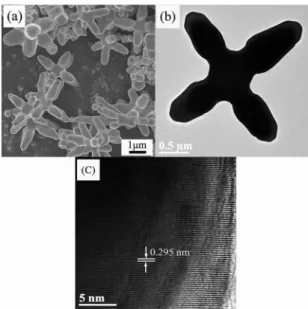
(311), (222), (400), (331), (420), and (422) planes of a face-centered-cubic structured PbS (JCPDS No. 05-592), and no other peaks are observed, suggesting pure PbS is obtained28. The sharp and strong intensity of XRD peaks suggest that the samples have high crystallinity. The morphology of the PbS nanomaterials are observed by SEM and TEM images. As shown in Figure 2a. The PbS nanomaterials show the morphology of star-shaped nanostructures. All the products
observed exhibit similarities in shape and morphology but
slightly varied in size. TEM image reveals that individual star-shaped PbS nanostructure consists of four symmetric
arms in the same plane extend radially from the center (Figure
2b). From the HRTEM image of the PbS sample (Figure 2c), it can be seen that the fringe spacing of pure PbS is about 0.295 nm, which corresponding to the interplanar spacing of (200) planes of the face-centered-cubic structured PbS9.
Sensitivity
R
R
g a
=
where Ra and Rg are the electrical resistance of the sensor in air and in test gas, respectively.
Figure1: XRD patterns of PbS sample.
3.2. Gas sensing properties of PbS nanomaterials
Operating temperature plays an important role in determining the response of the sensor to ethanol. Figure 3 present the sensitivity of the PbS sensor towards 100 ppm
ethanol at various operating temperature. It is obvious
Figure 2: (a) SEM, (b) TEM, and (c) HRTEM images of PbS.
Figure 3: Sensitivity of the PbS sensor at diferent operating
temperatures
a maximum of 3.04 at 400 oC, and then decreases. The
phenomenon can be explained by the fact that it is hard for ethanol molecules to react with adsorbed oxygen species (O-, O2-, O2-) at lower operating temperature due to insuicient thermal energy, while higher operating temperature makes
the adsorbed oxygen species (O-, O 2
-, O2-) reduce and thus
limits gas response towards ethanol molecules29. Therefore, the optimal operating temperature is 400 0C for the PbS sensor. Figure 4 displays a variation between the sensitivity of the PbS sensor and ethanol concentration from 10 ppm to 300 ppm at operating temperature of 400 oC. As observed, the detection limit of the PbS sensor toward ethanol is 10 ppm. With the increase of ethanol concentration, the sensitivity of
the PbS sensor signiicantly increases and demonstrates an
almost linear relationship between them. The response and recovery times are also an important parameter to assess the gas-sensing property of the PbS sensor. Figure 5 provides
Figure 4: Sensitivity of PbS sensor to diferent ethanol concentrations.
Figure 5: Response-recovery curves of the PbS sensors to diferent
ethanol concentrations.
the response-recovery curves of the PbS sensor towards
ethanol with diferent concentrations at operating temperature
of 400 oC. Generally, the times to reach 90 % variation in
resistance upon exposure to ethanol and air are deined as
the 90 % response time (tresponse) and the 90 % recovery time (trecovery), respectively. As observed, the PbS sensor exhibits
fast response and recovery to 20, 50, 100, 200, and 300 ppm ethanol. The response times are all less than 1 s and the
recovery time upon exposure to 20, 50, 100, 200, and 300
ppm ethanol are 6 s, 7 s, 9 s, 10 s and 11 s, respectively. The
fast response and recovery speed suggests that the difusion of ethanol and its oxidation by oxygen species (O-, O
2 -, O2-)
are very rapid in the star-shaped structure.
3.3. Gas-sensing mechanism of PbS sensor
The gas-sensing mechanism of the PbS sensor towards ethanol can be interpreted by the interaction between ethanol
molecules and the absorbed oxygen species (O-, O 2
-, O2-)
absorbed oxygen species is determined by the operating
temperature, and O2− becomes the main form of oxygen species at the operating temperature of 400 °C31. When the
PbS sensor contacts with the air, oxygen molecules in the
air will adsorb on the surfaces of the PbS sensor and trap electrons from the conduction band of the PbS sensor, forming
oxygen species (O-, O 2
-, O2-) (Eqs.(1)-(4)), which results in
the formation of the electron depletion layer on the surface of the PbS sensor and makes the resistance of the PbS sensor increase. As ethanol is introduced into the system, ethanol
molecules will react with the oxygen species (O-, O 2
-, O2-)
adsorbed on the surface of the PbS sensor, thus the captured electrons are released back to conduction band of the PbS sensor, which leads to a decreased resistance (Eqs.(5)-(7)).
Scholars, Ministry of Human Resources and Social Security of China, and the National Natural Science Foundation of China (21276035, 21476034).
6. References
1. Samerjai T, Tamaekong N, Wetchakun K, Kruefu V, Liewhiran C,
Siriwong C, et al. Flame-spray-made metal-loaded semiconducting
metal oxides thick ilms for lammable gas sensing. Sensors
and Actuators B: Chemical. 2012;171-172:43-61.
2. Fan F, Tang P, Wang Y, Feng Y, Chen A, Luo R, et al. Facile synthesis and gas sensing properties of tubular hierarchical ZnO self-assembled by porous nanosheets. Sensors and Actuators B: Chemical. 2015;215:231-240.
3. Wei F, Zhang H, Nguyen M, Ying M, Gao R, Jiao Z. Template-free
synthesis of lower-like SnO2 hierarchical nanostructures with improved gas sensing performance. Sensors and Actuators B: Chemical.2015;215:15-23.
4. Hsu C, Tsai J, Hsueh TJ. Ethanol gas and humidity sensors of CuO/ Cu2O composite nanowires based on a Cu through-silicon via approach. Sensors and Actuators B: Chemical. 2016;224:95-102.
5. Wetchakun K, Samerjai T, Tamaekong N, Liewhiran C, Siriwong
C, Kruefu V, et al. Semiconducting metal oxides as sensors for
environmentally hazardous gases. Sensors and Actuators B: Chemical. 2011;160(1):580-591.
6. Yamazoe N, Shimanoe K. New perspectives of gas sensor technology.
Sensors and Actuators B: Chemical. 2009;138(1):100-107.
7. Comini E. Metal oxide nano-crystals for gas sensing. Analytica Chimica Acta. 2006;568(1-2):28-40.
8. Salavati-Niasari M, Ghanbari D, Loghman-Estarki MR. Star-shaped PbS nanocrystals prepared by hydrothermal process in the presence of thioglycolic acid. Polyhedron. 2012;35(1):149-153.
9. Ao D, Ichimura M. UV irradiation efects on hydrogen sensors
based on SnO2 thin ilms fabricated by the photochemical deposition. Solid-State Electronics. 2012;69:1-3.
10. Mamiyev ZQ, Balayeva NO. Preparation and optical studies of PbS nanoparticles. Optical Materials. 2015;46:522-525.
11. Yang Y, Wang W. Efects of incorporating PbS quantum dots in
perovskite solar cells based on CH3NH3PbI3. Journal of Power Sources. 2015;293:577-584.
12. Yousei R, Cheraghizade M, Jamali-Sheini F, Basirun WJ, Huang NM. Efect of hydrogen gas on the growth process of PbS
nanorods grown by a CVD method. Current Applied Physics.
2014;14(8):1031-1035.
13. Zhou SM, Zhang XH, Meng XM, Fan X, Lee ST, Wu SK. Sonochemical synthesis of mass single-crystal PbS nanobelts.
Journal of Solid State Chemistry. 2005;178(1):399-403.
14. Wang Z, Zhao B, Zhang F, Mao W, Qian G, Fan X. Novel single-crystal PbS nanowires directed by [200]. Materials Letters. 2007;61(17):3733-3735.
15. Sun SS, Han QF, Wu XD, Zhu JW, Wang X. The facile synthesis of PbS cubes and Bi2S3 nanolowers from molecular precursors at room temperature. Materials Letters. 2011;65(21-22):3344-3347.
( ) O gas2R W"O ads2Q V 1
( )
O ads
2Q
V
+
e
-"
O
2-Q
ads
V
2
( )
O
2-Q
ads
V
+
e
-"
2
O ads
-Q
V
3
( )
O ads e O2 ads 4
" +
-
Q
V
- -Q
V
( )
C H OH gas
2 5 R W"
C H OH ads
2 5Q
V
5
( )
C H OH ads
O ads
CO gas
H O gas
e
6
2
3
6
6
2 5 2 2
"
+
+
+
-RQ
RQ
WV
WV
( )
C H OH ads
O
ads
CO gas
H O gas
e
6
2
3
12
7
2 5 2
2 2
"
+
+
+
-RQ
RQ
WV
WV
4. Conclusions
In summary, we have synthesized star-shaped PbS
nanomaterials using a simple hydrothermal method. The sensitivities of the as-prepared PbS sensor towards 100 ppm ethanol increase with operating temperature and then reach a
maximum, The PbS sensor reveals fast response and recovery
time for the detection of ethanol concentration in the range
of 10–300 ppm at the optimal operating temperature of 400
oC. The gas-sensing mechanism of the PbS sensor towards
ethanol can be interpreted by the interaction between ethanol
molecules and the absorbed oxygen species (O-, O 2
-, O2-) on
the surface of the PbS sensor.
5. Acknowledgement
This work was supported by the Scientiic Research
Project of Education Department of Liaoning Province (L2013203), The Natural Science Foundation of Liaoning Province (2014025014), the Fundamental Research Funds for
the Central Universities (3132016327), the Scientiic Public
16. Devi PI, Sivabharathy M, Ramachandran K. Enhancement of dielectric constant in PVDF polymer using dendrite-shaped
PbS nanostructures. Optik - International Journal for Light and Electron Optics. 2013;124(19):3872-3875.
17. Salavati-Niasari M, Ghanbari D. Hydrothermal synthesis of star-like and dendritic PbS nanoparticles from new precursors.
Particuology. 2012;10(5):628-633.
18. Mocanu A, Rusen E, Diacon A, Dinescu A. Hierarchical nanostructures of PbS obtained in the presence of water soluble polymers. Powder Technology. 2014;253:237-241.
19. Li G, Li C, Tang H, Cao K, Chen J. Controlled self-assembly of PbS nanoparticles into macrostar-like hierarchical structures.
Materials Research Bulletin. 2011;46(7):1072-1079.
20. Markov VF, Maskaeva LN. Lead Sulide Semiconductor
Sensing Element for Nitrogen Oxide Gas Analyzers. Journal
of Analytical Chemistry. 2001;56(8):754-757.
21. Souda N, Shimizu Y. Sensing properties of solid electrolyte SO2 sensor using metal-sulide electrode. Journal of Materials Science. 2003;38(21):4301-4305.
22. Shimizu Y, Okimoto M, Souda N. Solid-State SO2 Sensor Using
a Sodium-Ionic Conductor and a Metal–Sulide Electrode.
International Journal of Applied Ceramic Technology. 2006;3(3):193-199.
23. Kaci S, Kefous A, Hakoum S, Mansri A. Hydrogen sensitivity of the sensors based on nanostructured lead sulide thin ilms
deposited on a-SiC:H and p-Si(100) substrates. Vacuum. 2015;116:27-30.
24. Fu T. Research on gas-sensing properties of lead sulide-based
sensor for detection of NO2 and NH3 at room temperature.
Sensors and Actuators B: Chemical. 2009;140(1):116-121.
25. Rao P, Godbole RV, Bhagwat S. Nanocrystalline Pd:NiFe2O4
thin ilms: A selective ethanol gas sensor. Journal of Magnetism and Magnetic Materials. 2016;416:292-298.
26. Tan W, Yu Q, Ruan X, Huang X. Design of SnO2-based highly sensitive ethanol gas sensor based on quasi molecular-cluster imprinting mechanism. Sensors and Actuators B: Chemical. 2015;212:47-54.
27. Han B, Liu X, Xing X, Chen N, Xiao X, Liu S, et al. A high response butanol gas sensor based on ZnO hollow spheres.
Sensors and Actuators B: Chemical. 2016;237:423-430.
28. Phuruangrat A, Thongtem T, Kuntalue B, Thongtem S. Characterization of cubic and star-shaped dendritic PbS structures synthesized by a solvothermal method. Materials Letters. 2012;81:55-58.
29. Chen W, Zhou Q, Wan F, Gao T. Gas Sensing Properties and Mechanism of Nano-SnO2-Based Sensor for Hydrogen and
Carbon Monoxide. Journal of Nanomaterials. 2012;2012:612420.
30. Jin W, Yan S, An L, Chen W, Yang S, Zhao C, et al. Enhancement
of ethanol gas sensing response based on ordered V2O5 nanowire microyarns. Sensors and Actuators B: Chemical. 2015;206:284-290.