DOI: http://dx.doi.org/10.1590/1980-5373-MR-2016-0824
Nitrogen Oxide (NO) Gas-Sensing Properties of Bi
2MoO
6Nanosheets Synthesized by a
Hydrothermal Method
Ping Taoa, Yuanlu Xua, Yichen Zhoua, Chengwen Songa*, Yinghua Qiub, Wei Donga, Meihan Zhanga,
Mihua Shaoa
Received: November 5, 2016; Revised: February 15, 2017; Accepted: April 5, 2017
Bi2MoO6 nanosheets were synthesized by a hydrothermal method. Morphology and structure of the Bi2MoO6 nanosheets were analyzed by SEM, XRD, N2 adsorption techniques and XPS. Gas-sensing properties of the as-prepared Bi2MoO6 sensors were also systematically investigated. The
results showed the reaction temperature greatly afected the morphology and structure of as-prepared
Bi2MoO6 nanosheets. When the reaction temperature reached 170 ºC, the morphology of the Bi2MoO6 nanosheets tended to regular, and pure Bi2MoO6 nanosheets were obtained. The operating temperature determined the gas-sensing properties of the Bi2MoO6 sensor. At this optimal operating temperature of 300 ºC, the sensitivity of the Bi2MoO6 sensor towards 20 ppm nitrogen oxide (NO) reached a maximum of 3.13. With the increase of the nitrogen oxide (NO) concentration, the sensitivity of the Bi2MoO6 sensor also rapidly increased, and displayed an almost linear relationship between them. Additionally, the Bi2MoO6 sensor demonstrated excellent selectivity with respect to several typical interfering gases.
Keywords: Preparation, Bi2MoO6, Nitrogen oxide (NO), Gas-sensing
* e-mail: [email protected]
1. Introduction
In the last several years, with the increasing concerns about public safety and human health, there are great demands on precise detection and early warning for environmentally hazardous gases such as NO, NO2, N2O, NH3, H2S, SO2, CO, CO2, and CH4.1 Among them, nitrogen oxide (NO) is a typical
hazardous gas produced from combustion chemical plants and automobiles, and can cause acid rains, photochemical smog and production of ozone.2 Therefore, the fast and
real-time detection for nitrogen oxide (NO) is very crucial
to reduce its harmful efect to environmental and human
beings. Currently, traditional detection technologies including optical spectroscopy and gas chromatography usually employ expensive, bulky instruments and complicated sample preparation processes. Therefore, developing miniaturized smart sensors for fast and real-time detection is attracting a great deal of interest.3 As we know, several kinds of gas sensors have been explored according to diferent sensing
materials and various transduction platforms.4 Chemiresistive
gas sensors based on metal oxides are the most potential candidates because of their advantageous features such as low cost, fast response/recovery time and high compatibility with microelectronic processing.5-9
Recently, with the fast development of nanotechnology, a large number of nanostructured materials including SnO2,
WO3, ZnO, Co3O4, and La2O3 have been employed for gas-sensing applications.10 However, compared to these simple
binary oxides, multicomponent oxides have greater advantages. For example, they have more freedom to tune the chemical and physical properties of nanomaterials by altering their compositions, which make them more suitable to be adopted as gas sensors.11 Bi
2MoO6 is a typical multicomponent
metal oxide with a band gap of approximately 2.66 eV. As one of the most important members in the Aurivillius family constructed by (Bi2O2)2+ layers sandwiched between
(MoO4)2− slabs, Bi2MoO6 has aroused extensive attention owing to its potential applications on ferroelectricity, oxide anion conductivity, and non-linear dielectric.12, 13
It is well known that the morphologies of nanomaterials
have signiicant efects on their physical and chemical
properties. Hence, more attention has been paid on the synthesis of various Bi2MoO6 nanostructures, such as
nanoparticles, nanoplates, nanoibers, lower-like, cage-like,
and hierarchical nanostructures.14-21These previous studies
reveal that the exploration of Bi2MoO6 nanomaterials with
diferent morphologies can achieve versatile properties, which
can meet a variety of application needs. In the following, we reported the synthesis of Bi2MoO6 nanosheets using a simple hydrothermal method, and investigated the morphologies and gas-sensing properties of Bi2MoO6 nanosheets at diferent reaction temperatures. Finally, we evaluated the practicability a College of Environmental Science and Engineering, Dalian Maritime University, 1 Linghai Road,
116026, Dalian, China
b School of Materials Science and Engineering, Dalian University of Technology, 2 Linggong Road,
and potential of the Bi2MoO6 sensor on nitrogen oxide (NO) detection. To the best of our knowledge, there was almost no report concerning Bi2MoO6 nanomaterials applied as gas sensors for nitrogen oxide (NO) detection.
2. Experimental
2.1. Preparation of Bi
2MoO
6nanomaterials
0.06 mol of Bi(NO3)3▪5H2O and 0.03 mol of Na2MoO4▪2H2O were added to 100 ml deionized water under stirring. Then 3M HCl was added in the mixed solution until the pH of the solution reached 1.0. Then, the mixture was sealed in a
100 mL Telon-lined autoclave and heated at 140 ºC, 170 ºC
and 200 ºC for 20 h, respectively, and then cooled to room temperature. The resulting precipitates were collected by centrifugation and washed three times by deionized water and ethanol to remove possible impurities. After drying at 60 oC for 10 h, Bi
2MoO6 nanomaterials were obtained.
2.2. Characterizations
X-ray difraction (XRD) patterns of Bi2MoO6nanomaterials were recorded using a D/Max-2400 difractometer (Cu Kα radiation, λ =1.54055Å) in a range of difraction angle 2θ
from 5o to 85o to analyze the difraction peaks of Bi 2MoO6
nanomaterials. The morphologies of Bi2MoO6nanomaterials were observed by a scanning electron microscope (SEM) (Philips XL30 FEG). X-ray photoelectron spectroscopy
(XPS) of Bi2MoO6nanomaterials was carried out on
Thermo SCIENTIFIC ESCALAB 250 spectrometer with
a monochromatic Al Ka source. The porous structure of
Bi2MoO6nanomaterials was characterized by nitrogen sorption technique (Quantachrome Autosorb-iQ).
2.3. Fabrication and measurement of Bi
2MoO
6gas sensor
Bi2MoO6 nanomaterials were mixed with several drops of ethanol to form a slurry, and then the slurry was brush-coated onto the surfaces of an alumina tube with two Au electrodes and four Pt wires. A Ni–Cr heating wire was inserted into the alumina tube and used as a heater. The alumina tube was then welded onto a pedestal with six probes to obtain
the inal sensor unit. Gas sensing tests were performed on
a WS-30A static gas-sensing system (HanWei Electronics Co., Ltd., Henan, China) using ambient air as the dilute and reference gas. The test gas with a calculated volume was introduced into the test chamber by a microsyringe.22
The sensor sensitivity is deined as follows,
3. Results and Discussion
3.1. Morphology and structure of Bi
2MoO
6nanomaterials at diferent reaction
temperatures
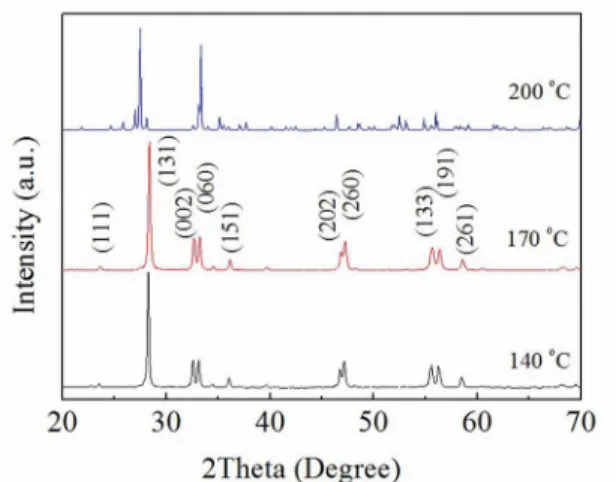
Figure 1 provides the representative XRD patterns of the Bi2MoO6 nanomaterials synthesized at the three reaction temperatures (140 oC, 170 oC, and 200 oC). As observed,
when the reaction temperatures are 140 oC and 170 oC, the
Bi2MoO6 nanomaterials show the difraction peaks at 2θ values 23.5o, 28.2o, 32.5o, 33.2o, 36.1o, 46.8o, 47.2o, 55.5o,
56.4o and 58.4o, which are assigned to (111), (131), (002),
(060), (151), (202), (260), (133), (191) and (262) planes of Bi2MoO6 (JCPDS No. 76-2388), suggesting pure Bi2MoO6 nanomaterials are obtained.23 The sharp and strong intensity
of XRD peaks at the two reaction temperatures suggest that the samples have better crystallinity. As reaction temperature is increased to 200 oC, many extra peaks arising from other
phases are detected, indicating impurity phase is introduced in the Bi2MoO6 nanomaterials. The morphologies of the
as-synthesized samples at diferent reaction temperatures
were investigated by SEM (Figure 2). As observed, when the reaction temperature is controlled at 140 oC, aggregated
and irregular nanosheets and nanoparticles are formed. Increasing the reaction temperature to 170 oC, the morphology
of the Bi2MoO6 nanomaterials tended to regular nanosheets. When the reaction temperature reaches 200 oC, the shape
of nanosheets grows more regular, and the sizes of these regular nanosheets are rough several hundreds nanometer.
( )
Sensitivity
R
R
1
g a=
where Ra and Rgare the electrical resistance of the sensor in air and in test gas, respectively.
Figure 1. XRD patterns of Bi2MoO6 samples.
Figure 3 displays N2 adsorption-desorption isotherms of the Bi2MoO6 samples synthesized at the three reaction temperatures (140 oC, 170 oC, and 200 oC). Obviously,
typical IV-type isothermal curves with a hysteresis loop are observed, which implies these materials have mesoporous
structure. As measured, the BET speciic surface areas of
the three Bi2MoO6 samples are found to be 16.99 m2·g-1,
10.43 m2·g-1, and 8.68 m2·g-1, respectively, which may result from their diferent microstructure synthesized at the three
The chemical composition of the Bi2MoO6 nanosheets was analyzed by XPS. The XPS survey spectrum in Figure 4a implies the presence of Bi, Mo and O. Figure 4b-d provide the high-resolution spectra of Bi4f, Mo3d and O1s. The two strong peaks at 159.26 and 164.58 eV belong to Bi4f7/2 and Bi4f5/2 peaks respectively, revealing the Bi3+ oxidation state.
The Mo3d5/2 and Mo3d3/2 peaks located at 232.48 eV and 235.62 eV imply the presence of the Mo6+ oxidation state.
The XPS spectra of O1s can be deconvoluted into three peaks at 529.75 eV, 530.87 eV, and 531.98 eV, corresponding
to the bond of Mo–O, Bi–O, and O–H on the Bi2MoO6
nanosheets.24, 25
3.2. Gas-sensing properties of Bi
2MoO
6nanomaterials
The operating temperature has a great inluence on the
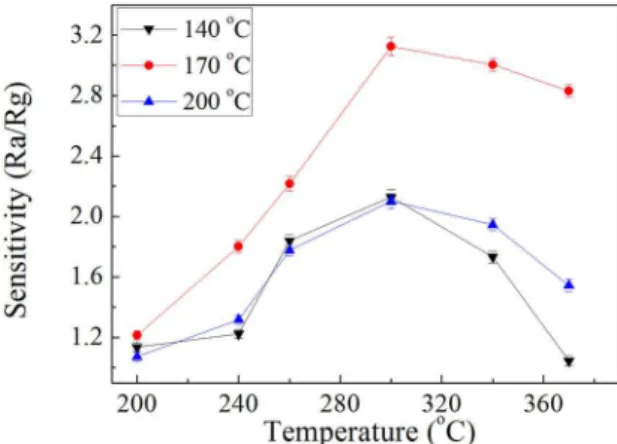
response of the Bi2MoO6 sensor towards nitrogen oxide (NO). Figure 5 presents the sensitivity of the Bi2MoO6 sensors obtained at 140 oC, 170 oC and 200 oC to 20 ppm nitrogen
oxide (NO) as a function of the operating temperature. As observed, the Bi2MoO6 sensor synthesized at the reaction temperature of 170 oC demonstrates high gas sensitivity, which
may be ascribed to its regular nonosheet-type structure and
high BET speciic surface area. The increase in the operating temperature signiicantly improves the sensitivity of the
Bi2MoO6 sensor, which reaches a maximum of 3.13 at 300
oC and then decreases. The phenomenon can be explained
by the kinetics and thermodynamics of gas adsorption and desorption on the surface of Bi2MoO6 nonosheets. When the operating temperature is lower than 300 oC, nitrogen oxide
Figure 2. SEM images of Bi2MoO6 synthesized at (a) 140 ºC, (b) 170 ºC, and (c) 200 ºC
Figure 3. Nitrogen adsorption-desorption isotherms of Bi2MoO6 synthesized at (a) 140 ºC, (b) 170 ºC, and (c) 200 ºC.
(NO) molecules cannot achieve enough thermal energy to react with adsorbed oxygen species (O2-, O-, O2-), resulting
in a low response. On the contrary, when the operating temperature increases beyond a threshold value, the adsorbed oxygen species (O2-, O-, O2-) may escape before reactions,
which leads to the decrease of the sensitivity towards nitrogen oxide (NO) as well.26
oxygen species (O2-, O-, O2-), which increases the electrical
resistance of the Bi2MoO6 sensor. When the Bi2MoO6 sensor is exposed to nitrogen oxide (NO), nitrogen oxide (NO) will react with oxygen species (O2-, O-, O2-) and release the
trapped electrons back to the conduction band, resulting in the decrease of the electrical resistance of the Bi2MoO6 sensor.28
In order to investigate the practicability of the Bi2MoO6 sensor for nitrogen oxide (NO) detection, the gas-sensing performances of the Bi2MoO6 sensor towards other interfering gases were also carried out under the same conditions. Figure 7 presents the nitrogen oxide (NO)-selective characteristics of the Bi2MoO6 sensor with respect to several typical interfering gases including CO, CO2, CH4, and NH3. The gas sensitivity of the Bi2MoO6 sensor to 100 ppm nitrogen
oxide (NO) is 3.94, which is signiicantly higher than all
the other gases. All those indicate that the Bi2MoO6 sensor processes excellent selectivity.
Figure 5. Sensitivity of the Bi2MoO6 sensor at diferent operating temperatures.
Figure 6 provides the relationship between the sensitivity of the Bi2MoO6 sensor and nitrogen oxide (NO) concentration (from 10 ppm to 50 ppm). It can be seen that with the increase of the nitrogen oxide (NO) concentration, the sensitivity of the Bi2MoO6 sensor also rapidly increases, and displays an almost linear relationship between them, implying the Bi2MoO6 sensor is more favorable for detecting low concentration of nitrogen oxide (NO) in real application.27
Figure 6. Sensitivity of the Bi2MoO6 sensor to diferent nitrogen oxide (NO) concentrations.
The response of the Bi2MoO6 sensor towards nitrogen oxide (NO) can be interpreted by the change in the electrical resistance of the Bi2MoO6 sensor, which is usually adopted as a response signal to detect the tested gas. In air, oxygen molecules adsorbed on the surface of the Bi2MoO6 sensor will capture electrons from the conduction band and form
Figure 7. Sensitivity of the Bi2MoO6 sensor to other interference gases.
4. Conclusions
We have fabricated the Bi2MoO6 nanosheets using a simple hydrothermal method. The XRD and SEM analysis revealed that pure and regular nanosheet-type Bi2MoO6 nanomaterials were obtained at the reaction temperature of 170 oC. The XPS wide scan spectra conirmed the presence of
Bi, Mo and O in Bi2MoO6 nanosheets. The sensitivity of the as-prepared Bi2MoO6 sensor towards 20 ppm nitrogen oxide (NO) increased with the increasing operating temperature and then reached a maximum at 300 oC. The Bi
2MoO6 sensor
showed almost linear relationships between the nitrogen oxide (NO) concentration and sensitivity of the Bi2MoO6 sensor. In the presence of other interference gases (including CO, CO2, CH4, and NH3), the Bi2MoO6 sensor still demonstrated excellent selectivity.
5. Acknowledgement
6. References
1. Fan F, Tang P, Wang Y, Feng Y, Chen A, Luo R, et al. Facile synthesis and gas sensing properties of tubular hierarchical ZnO self-assembled by porous nanosheets. Sensors and Actuators B: Chemical.2015;215:231-240.
2. Wetchakun K, Samerjai T, Tamaekong N, Liewhiran C, Siriwong C, Kruefu V, et al. Semiconducting metal oxides as sensors for
environmentally hazardous gases. Sensors and Actuators B: Chemical.2011;160(1):580-591.
3. Shi D, Wei L, Wang J, Zhao J, Chen C, Xu D, et al. Solid organic
acid tetraluorohydroquinone functionalized single-walled
carbon nanotube chemiresistive sensors for highly sensitive and selective formaldehyde detection. Sensors and Actuators B: Chemical. 2013;177:370-375.
4. Llobet E. Gas sensors using carbon nanomaterials: A review.
Sensors and Actuators B: Chemical. 2013;179:32-45.
5. Ramgir N, Datta N, Kaur M, Kailasaganapathi S, Debnath AK, Aswal DK, et al. Metal oxide nanowires for chemiresistive gas
sensors: Issues, challenges and prospects. Colloids and Surfaces A: Physicochemical and Engineering Aspects.2013;439:101-116.
6. Zhang P, Pan G, Zhang B, Zhen J, Sun Y. High sensitivity ethanol gas sensor based on Sn - doped ZnO under visible light irradiation at low temperature. Materials Research. 2014;17(4):817-822.
7. Song C, Sun M, Yin Y, Xiao J, Dong W, Li C, et al. Synthesis
of Star-Shaped Lead Sulide (PbS) Nanomaterials and theirs
Gas-Sensing Properties. Materials Research. 2016;19(6):1351-1355.
8. Corpuz RD, Albia JR. Electrophoretic fabrication of ZnO/ZnO-CuO composite for ammonia gas sensing. Materials Research. 2014;17(4):851-856.
9. Yeole B, Sen T, Hansora D, Mishra S. Polypyrrole/Metal Sulphide Hybrid Nanocomposites: Synthesis, Characterization and Room Temperature Gas Sensing Properties. Materials Research. 2016;19(5):999-1007.
10. Kolmakov A, Moskovits M. Chemical sensing and catalysis by
one-dimensional metal-oxide nanostructures. Annual Review of Materials Research. 2004;34:151-180.
11. Lou Z, Deng J, Wang L, Wang L, Zhang T. Curling-like Bi2WO6 microdiscs with lamellar structure for enhanced gas-sensing properties. Sensors and Actuators B: Chemical. 2013;182:217-222.
12. Li J, Liu X, Sun Z, Pan L. Mesoporous yolk-shell structure Bi2MoO6 microspheres with enhanced visible light photocatalytic activity. Ceramics International. 2015;41(7):8592-8598.
13. Zheng K, Zhou Y, Gu L, Mo X, Patzkeb GR, Chen G. Humidity
sensors based on Aurivillius type Bi2MO6 (M = W, Mo) oxide
ilms. Sensors and Actuators B: Chemical. 2010;148(1):240-246.
14. Martínez-de la Cruz A, Obregón Alfaro S, López Cuéllar E, Ortiz Méndez U. Photocatalytic properties of Bi2MoO6 nanoparticles prepared by an amorphous complex precursor. Catalysis Today. 2007;129(1-2):194-199.
15. Zhang M, Shao C, Zhang P, Su C, Zhang X, Liang P, et al. Bi2MoO6 microtubes: Controlled fabrication by using electrospun
polyacrylonitrile microibers as template and their enhanced
visible light photocatalytic activity. Journal of Hazardous Materials. 2012;225-226:155-163.
16. López Cuéllar E, Martínez-de la Cruz A, Lozano Rodríguez KH, Ortiz Méndez U. Preparation of γ-Bi2MoO6 thin ilms by thermal evaporation deposition and characterization for photocatalytic applications. Catalysis Today. 2011;166(1):140-145.
17. Chen W, Duan GR, Liu TY, Chen SM, Liu XH. Fabrication of Bi2MoO6 nanoplates hybridized with g-C3N4 nanosheets
as highly eicient visible light responsive heterojunction
photocatalysts for Rhodamine B degradation. Materials Science in Semiconductor Processing. 2015;35:45-54.
18. Wang X, Gu F, Li L, Fang G, Wang X. A facile
mixed-solvothermal route to γ-Bi2MoO6 nanolakes and their visible-light-responsive photocatalytic activity. Materials Research Bulletin. 2013;48(10):3761-3765.
19. Zhang T, Huang J, Zhou S, Ouyang H, Cao L, Li A. Microwave
hydrothermal synthesis and optical properties of lower-like
Bi2MoO6 crystallites. Ceramics International. 2013;39(7):7391-7394.
20. Yin W, Wang W, Sun S. Photocatalytic degradation of phenol over cage-like Bi2MoO6 hollow spheres under visible-light irradiation. Catalysis Communications. 2010;11(7):647-650.
21. Yan T, Sun M, Liu H, Wu T, Liu X, Yan Q, et al. Fabrication of hierarchical BiOI/Bi2MoO6 heterojunction for degradation of bisphenol A and dye under visible light irradiation. Journal of Alloys and Compounds. 2015;634:223-231.
22. Tan W, Yu Q, Ruan X, Huang X. Design of SnO2-based highly sensitive ethanol gas sensor based on quasi molecular-cluster imprinting mechanism. Sensors and Actuators B: Chemical. 2015; 212:47-54.
23. Li X, Fang S, Ge L, Han C, Qiu P, Liu W. Synthesis of
lower-like Ag/AgCl-Bi2MoO6 plasmonic photocatalysts with enhanced visible-light photocatalytic performance. Applied Catalysis B: Environmental. 2015;176-177:62-69.
24. Feng Y, Yan X, Liu C, Hong Y, Zhu L, Zhou M, et al. Hydrothermal synthesis of CdS/Bi2MoO6 heterojunction photocatalysts with excellent visible-light-driven photocatalytic performance.
Applied Surface Science. 2015;353:87-94.
25. Zhao J, Lu Q, Wei M, Wang C. Synthesis of one-dimensional
α-Fe2O3/Bi2MoO6 heterostructures by electrospinning process with enhanced photocatalytic activity. Journal of Alloys and Compounds. 2015;646:417-424.
26. Wu B, Lin Z, Sheng M, Hou S, Xu J. Visible-light activated ZnO/CdSe heterostructure-based gas sensors with low operating temperature. Applied Surface Science. 2016;360(Pt B):652-657.
27. Haija MA, Ayesh AI, Ahmed S, Katsiotis MS. Selective hydrogen
gas sensor using CuFe2O4 nanoparticle based thin ilm. Applied Surface Science. 2016;369:443-447.