LITERA
TURE
RE
VIE
W
Correspondence to: Lilian Ramiro Felicio – Avenida Paris, 34, – CEP: 21041-021 – Rio de Janeiro (RJ), Brasil – E-mail: [email protected]
Presentation: Oct. 2012 – Accepted for publication: Aug. 2013 – Financing source: none – Conflict of interests: nothing to declare – Approval at the Ethics Committee n. 032/11.
ABSTRACT | Dance involves integration between move-ment, postural balance and the multiple aspects involved with postural control. Information regarding the balance of ballet dancers is of great importance, as they are con-sidered models of great postural control. The aim was to review studies about static and dynamic postural balance of ballet dancers, characterizing visual dependency in the postural control of these athletes to maintain balance. A review of literature was performed on PubMed, SciELO, Lilacs, and Science Direct databases considering the pe-riod between 1997 and 2013, and using the descriptors balance, postural control, force plates ballet dancers, clas-sical ballet dancers and visual afferences. Eighteen articles were considered able to provide the quantitative and quali-tative data to assess the balance among those athletes, and were thus, selected. These papers were classified by Oxford level of evidence. The reviewed literature shows full consensus regarding the effect of removing visual infor-mation over postural stability according to the experience of subjects considered highly trained dancers. Studies comparing the balance of ballet dancers to other sporting techniques confirmed that they have a specific postural balance pattern. Nevertheless, in association with visual re-striction, ballet dancers show a greater center of pressure dislocation and instability compared to other sports, which suggests that they have higher visual dependence to maintain balance. Ballet dancers have better static balance compared to non-trained subjects and other types of athletes, but greater visual dependence to maintain balance.
Keywords | postural balance; dance; dance therapy.
Static and dynamic balance
in ballet dancers: a literature review
Equilíbrio estático e dinâmico em bailarinos: revisão da literatura
Equilibrio estático y dinámico en bailarines: revisión de la literatura
Michelle Silva da Silveira Costa1, Arthur de Sá Ferreira2, Lilian Ramiro Felicio2
Study conduced at the Postgraduate Program of Rehabilitation Sciences of Centro Universitário Augusto Motta (UNISUAM) – Rio de Janeiro (RJ), Brazil.
1Postgraduate Program of Rehabilitation Sciences of UNISUAM – Rio de Janeiro (RJ), Brazil.
RESUMO | A dança envolve integração de movimento, equilíbrio postural e aspectos relacionados ao controle postural. Informações sobre o equilíbrio em bailarinos são de grande importância, pois eles são considerados modelos de controle postural. O objetivo foi revisar estudos sobre equilíbrio postural estático e dinâmico em bailarinos, ca-racterizando o controle e a dependência visual desses atletas para a manutenção do equilíbrio. Para isso, foi rea-lizada uma revisão nas bases de dados PubMed, SciELO, Lilacs e Science Direct, considerando o período entre 1997 a 2013, utilizando os descritores equilíbrio, controle postural, plataforma de forças, ballet, bailarinos clássicos e aferência visual. Foram selecionados 18 artigos capazes de for-necer dados quantitativos para avaliação do equilíbrio nesses atletas classificados pelo nível de evidência científica Oxford. A literatura revisada mostra completa concor-dância quanto ao efeito da retirada da informação visual sobre a estabilidade postural de bailarinos considerados como executantes altamente treinados. Estudos mostrando a comparação do equilíbrio de bailarinos com outras téc-nicas desportivas confirmaram um padrão específico de equilíbrio nesses indivíduos. Entretanto, associando-se à restri-ção visual, bailarinos apresentaram maior deslocamento do centro de pressão comparado a outras modalidades desportivas, sugerindo maior dependência visual para a manutenção do equilíbrio. Bailarinos apresentam menor oscilação postural em relação a indivíduos não treinados e indivíduos treinados em outras práticas desportivas, com maior dependência visual para manutenção do equilíbrio.
INTRODUCTION
Ballet is a physical activity that requires musculoskeletal conditioning by the use of complex high impact mo-vements, with major joint amplitude, which works on the development of coordination, balance and laterality associated with eicient strength and lexibility in tech-nical execution1.
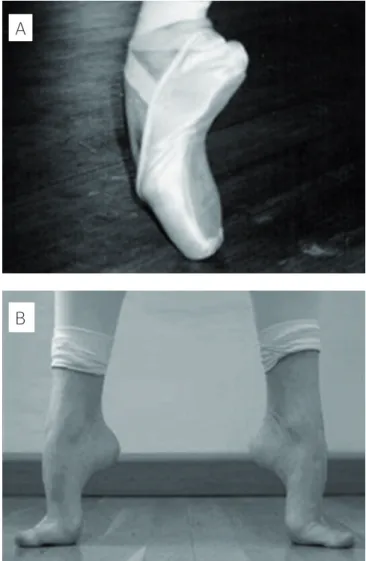
Postural control is important to understand the ca-pacity of the human being to perform their activities and maintain body balance, providing stability and orientation during motor tasks2. Such control de-pends on sensory information of the vestibular, visual and somatosensory systems, so that motor actions can be triggered based on experiences and skills3-5. One de-termining factor for balance control is the size of the support base, and the movements executed by the ballet dancer are usually performed on a small base, such as the en pointe balance6 (Figure 1A). his movement involves major weight discharge at the tip of the foot, besides being more unstable and depending on ligaments and muscles for stability and support6.
Balance training begins early for dancers, around the age of ive, and becomes more complex when they perform en pointe6, however, balance is rarely analyzed within the context of dance7. Training is conducted in the vertical position, with reduced support bases and the use of mirrors, and the direction of the eyes is important to keep control during spins, which implies visual de-pendency in order to maintain balance when compared to athletes of other sporting activities8.
Some studies used stabilometry to quantify the dislo-cation of the center of pressure (CoP) during orthostatic posture9, and they demonstrated that visual restriction
RESUMEN | La danza envuelve integración de movimiento, equilibrio postural y aspectos relacionados al control postu-ral. Informaciones sobre el equilibrio en bailarines son de gran importancia, pues ellos son considerados modelos de control postural. El objetivo fue revisar estudios sobre equilibrio postu-ral estático y dinámico en bailarines, caracterizando el control y la dependencia visual de esos atletas para la manutención del equilibrio. Para eso, fue realizada una revisión en las bases de datos PubMed, SciELO, Lilacs y Science Direct, considerando el período entre 1997 y 2013, utilizando los descriptores equilibrio, control postural, plataforma de fuerzas, ballet, bailarines clásicos y aferencia visual. Fueron seleccionados 18 artículos capaces de proveer datos cuantitativos para evaluación del equilibrio en esos atletas clasificados por el nivel de evidencia científica Oxford. La literatura revisada muestra completa concordancia en cuanto al
efecto de la retirada de la información visual sobre la estabilidad postural de bailarines considerados como ejecutantes altamente entrenados. Estudios mostrando la comparación del equilibrio de bailarines con otras técnicas deportivas confirmaron un estándar específico de equilibrio en esos individuos. Entre tanto, asociándose a la restricción visual, bailarines presenta-ron mayor desplazamiento del centro de presión comparado a otras modalidades deportivas, sugiriendo mayor depen-dencia visual para la manutención del equilibrio. Bailarines presentan menor oscilación postural en relación a individuos no entrenados e individuos entrenados en otras prácticas de-portivas, con mayor dependencia visual para manutención del equilibrio.
Descritores | equilibrio postural; danza; terapia por la danza.
Figure 1. (A) En pointe position. (B) En demi-point position.
A
B
aspect in stabilometric tests is the possibility to identify the visual dependency of the individual, characterized by higher values of these parameters when vision is restricted during a motor task, such as more oscillation speed and longer distance crossed by the CoP12.
he dynamic balance of ballet dancers was assessed by a few authors, and the execution of spins (pirouette) was considered as a complex task, involving a strategy of head movement, the “marking the head”, which disso-ciates the rotation of trunk and head — while the body spins, the eyes stare at an established point, and when the maximal cervical rotation is reached, the head performs a fast rotation towards the same direction of the move-ment, and then the eyes stare at the same point again; therefore, it is possible to observe the importance of vi-sual information for balance and quality of the motor performance during the spin, correlated to less postural oscillation8,13-17.
Considering that the analysis of static and dynamic balance of ballet dancers, in the main moves, is very important for their performance, besides collaborating with the elaboration of training and rehabilitation pro-grams for these athletes, the objective of this study was to review scientiic literature concerning balance in bal-let dancers, by observing if speciic training would lead to less postural oscillation and to more visual depen-dency in order to control balance.
METHODOLOGY
A literature review was performed with the following databases: Lilacs, Medline, PubMed, SciELO and Science Direct, with the descriptors: ballet dancers, postural control, balance, force platform, classic bal-let and visual aference, combined in groups of three. he pre-selection inclusion criteria of the articles were: date of publication (1997-2013), language (English or Portuguese) and the relation of title and abstract with the subject of interest (ballet and balance). he articles identiied in the pre-selection search were assessed according to the following inclusion criteria: (1) popu-lation (ballet dancers) and (2) intervention (assessment of static or dynamic balance).
Review was carried out in three stages. In the irst one, there was a general selection of publications on the subject, resulting in 57 studies. In the second stage, those which were duplicated and did not belong to the theme were ex-cluded — the 18 remaining articles were inex-cluded in
the review and grouped together according to the year of publication, being selected based on the abstract. In the third stage, these articles were classiied according to the recommendation criteria and evidence-based classi-ication from the Oxford Centre for Evidence-Based Medicine (OCEBM)18,19. Due to the low classiication of the selected articles, the level of classiication was not used as a selection criterion. he OCEBM levels con-sider the strength of evidence for therapeutic efect and damage, evidence of prevalence, accuracy of diagnostic tests, prognosis, therapeutic efects, rare damage, common damage, and are used as screening in review studies18.
RESULTS
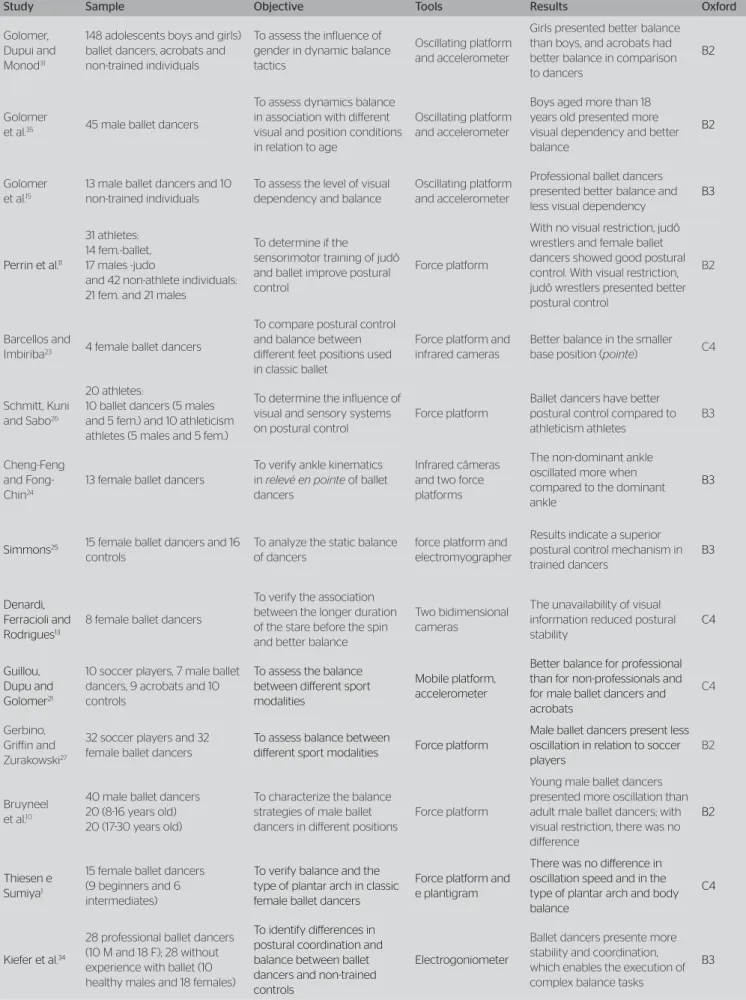
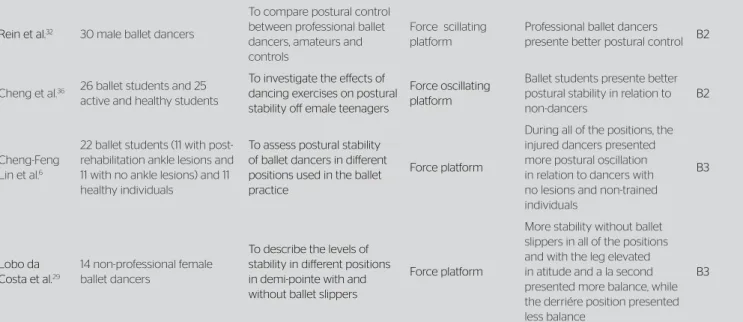
he 18 articles selected for this study are presented in Table 1, describing sample, objective, tools used to assess balance, synthesis of results and Oxford classiication18,19.
DISCUSSION
he studies included in this review mostly presented (83%) sample size between 8 and 45 dancers, and 11% of the articles ranged from 4 to 8 dancers. With that, it is possible to observe the diiculty to perform studies with larger samples, probably due to the level of experti-se and training of theexperti-se athletes. Becauexperti-se of the number of articles discussing speciic movements of professio-nal dancers, especially those related to dynamic balance, these articles were included in this review despite the low sample, level of evidence 3–4 and recommendation B (little satisfactory).
Stabilometry was the most used method to assess static balance (55.5%). However, a major variation was observed as to positions and time of permanence on the force platform for the static balance evaluation according to CoP variables and anterior-posterior and medial-lateral dislocation areas, thus characterizing the balance of dancers by means of these variables.
Table 1. Articles distributed considering sample size and characteristics, objective, used tools, results and Oxford classification17
Study Sample Objective Tools Results Oxford
Golomer, Dupui and Monod31
148 adolescents boys and girls) ballet dancers, acrobats and non-trained individuals
To assess the influence of gender in dynamic balance tactics
Oscillating platform and accelerometer
Girls presented better balance than boys, and acrobats had better balance in comparison to dancers
B2
Golomer
et al.35 45 male ballet dancers
To assess dynamics balance in association with diferent visual and position conditions in relation to age
Oscillating platform and accelerometer
Boys aged more than 18 years old presented more visual dependency and better balance
B2
Golomer et al.15
13 male ballet dancers and 10 non-trained individuals
To assess the level of visual dependency and balance
Oscillating platform and accelerometer
Professional ballet dancers presented better balance and less visual dependency
B3
Perrin et al.11
31 athletes: 14 fem.-ballet, 17 males -judo
and 42 non-athlete individuals: 21 fem. and 21 males
To determine if the
sensorimotor training of judô and ballet improve postural control
Force platform
With no visual restriction, judô wrestlers and female ballet dancers showed good postural control. With visual restriction, judô wrestlers presented better postural control
B2
Barcellos and
Imbiriba23 4 female ballet dancers
To compare postural control and balance between diferent feet positions used in classic ballet
Force platform and infrared cameras
Better balance in the smaller base position (pointe) C4
Schmitt, Kuni and Sabo26
20 athletes:
10 ballet dancers (5 males and 5 fem.) and 10 athleticism athletes (5 males and 5 fem.)
To determine the influence of visual and sensory systems on postural control
Force platform
Ballet dancers have better postural control compared to athleticism athletes
B3
Cheng-Feng and Fong-Chin24
13 female ballet dancers
To verify ankle kinematics in relevé en pointe of ballet dancers
Infrared câmeras and two force platforms
The non-dominant ankle oscillated more when compared to the dominant ankle
B3
Simmons25 15 female ballet dancers and 16
controls
To analyze the static balance of dancers
force platform and electromyographer
Results indicate a superior postural control mechanism in trained dancers
B3
Denardi, Ferracioli and Rodrigues13
8 female ballet dancers
To verify the association between the longer duration of the stare before the spin and better balance
Two bidimensional cameras
The unavailability of visual information reduced postural stability
C4
Guillou, Dupu and Golomer21
10 soccer players, 7 male ballet dancers, 9 acrobats and 10 controls
To assess the balance between diferent sport modalities
Mobile platform, accelerometer
Better balance for professional than for non-professionals and for male ballet dancers and acrobats
C4
Gerbino, Grifin and Zurakowski27
32 soccer players and 32 female ballet dancers
To assess balance between
diferent sport modalities Force platform
Male ballet dancers present less oscillation in relation to soccer players
B2
Bruyneel et al.10
40 male ballet dancers 20 (8-16 years old) 20 (17-30 years old)
To characterize the balance strategies of male ballet dancers in diferent positions
Force platform
Young male ballet dancers presented more oscillation than adult male ballet dancers; with visual restriction, there was no diference
B2
Thiesen e Sumiya1
15 female ballet dancers (9 beginners and 6 intermediates)
To verify balance and the type of plantar arch in classic female ballet dancers
Force platform and e plantigram
There was no diference in oscillation speed and in the type of plantar arch and body balance
C4
Kiefer et al.34
28 professional ballet dancers (10 M and 18 F); 28 without experience with ballet (10 healthy males and 18 females)
To identify diferences in postural coordination and balance between ballet dancers and non-trained controls
Electrogoniometer
Ballet dancers presente more stability and coordination, which enables the execution of complex balance tasks
B3
demi-point positions (Figure 1B), wearing ballet slippers and barefoot, being the use of ballet slippers the cause for more dislocations of the CoP in all of the positions. Bruyneel et al.10 also found a much smaller dislocation area in similar conditions when the free limb was tur-ned backwards (attitude derriére), in conditions with vision29,30. Barcellos and Imbiriba23 veriied, by means of kinetics, the angular variations of pelvis, hip, knee and ankle joints, and, together with the mean speed of CoP oscillation, they observed a smaller dislocation area in the en pointe position than in a position with total plantar support.
he oscillating platform and the accelerometer (33% of the articles) were used to compare dynamic balance in relation to diferent visual conditions and diferent positions, among individuals grouped as to age and sex8,15,17,21,31. It was observed that male professional dan-cers (>18 years old) with more practice time presented more visual dependency on a bipodal support over a mobile platform in comparison to younger male dancers (<18 years old)15, as well as women (>18 years old), because under the same conditions they presented smaller CoP area than the men31; according to the authors, the rela-tionship between balance and gender would be related to the diferent movements performed by the dancers during a technical execution, in which men perform rougher and more explosive movements, while women perform more contained and soft moves.
Besides, male ballet dancers seem to be more depen-dent on their vision than female dancers6,15,21,31,32, due
to diferences related to maturity and the development of the vestibular system, which takes place at the age of 9 and 10 years old among women, and 13 and 14 years old among men33.
Kiefer et al.34 also assessed female ballet dancers during a static task, with the objective of identifying diferences in postural coordination between professional dancers and controls, who were not trained during a dynamic visual follow-up task by means of a electro-goniometer, thus verifying the ankle and hip angular oscillations while the athlete searches for the target34. Since dancers are trained to look for reference points during gesture movements, they presented more control, as well as more stable hips and ankles when compared to controls34.
he balance of ballet dancers in comparison to athletes of other sporting activities, such as judo wres-tlers, runners, acrobats and soccer players, was discussed in 28% of the selected articles, and the dancers’ high balance pattern without visual restriction was consen-sual, probably related to the speciicity of the training for these athletes10,11,20,21,26,27,31. However, 61% of the articles did not control the position of the upper limbs of the athletes6,7,10,11,15,17,24,27,29,32,34; therefore, dancers could have taken the irst rank for the upper limb, thus impro-ving balance in the diferent assessed positions.
However, when assessing balance in association with visual restriction, ballet dancers presented a larger CoP dislocation in comparison to judo wrestlers, acrobats and non-athletes11,31, thus pointing out to the major
Rein et al.32 30 male ballet dancers
To compare postural control between professional ballet dancers, amateurs and controls
Force scillating platform
Professional ballet dancers presente better postural control B2
Cheng et al.36 26 ballet students and 25
active and healthy students
To investigate the efects of dancing exercises on postural stability of emale teenagers
Force oscillating platform
Ballet students presente better postural stability in relation to non-dancers
B2
Cheng-Feng Lin et al.6
22 ballet students (11 with post-rehabilitation ankle lesions and 11 with no ankle lesions) and 11 healthy individuals
To assess postural stability of ballet dancers in diferent positions used in the ballet practice
Force platform
During all of the positions, the injured dancers presented more postural oscillation in relation to dancers with no lesions and non-trained individuals
B3
Lobo da Costa et al.29
14 non-professional female ballet dancers
To describe the levels of stability in diferent positions in demi-pointe with and without ballet slippers
Force platform
More stability without ballet slippers in all of the positions and with the leg elevated in atitude and a la second presented more balance, while the derriére position presented less balance
B3
Oxford classification: Recommendation A – Consistent, controlled and homogeneous study ande; B – Controlled study with less quality; C – lower quality; poor reference pattern and D – Inconsistent or inconclusive. Level: 1 – Clinical, controlled and randomized studies; systematic homogeneous reviews; 2 – systematic review of cohort studies, cohort studies (including a randomized clinical trial with less quality); 3 – systematic review of case-control studies and case-control study; 4 – case report; and 5 – experts’ opinion, explicit critical evaluation and translational research17
visual dependency of ballet dancers to maintain balance. On the other hand, Schmitt, Kuni and Sabo 26 indicated that ballet dancers presented less postural oscillation in relation to athleticism. However, they assessed nonho-mogeneous groups as to age, time of profession, gender, gestural and analyzed position.
According to Kiefer et al.34, the diiculty to compare dancers with diferent groups of athletes is due to the fact that there are diversities not only concerning the dife-rent types of bodies, but also distinct training.
Despite the increased postural oscillation, other parameters should be taken into account to determine the eicacy of postural control, such as kinematics and kinetics. In relation to dynamic control, no studies com-paring the speciic activities of ballet with other sport modalities were found, nor those analyzing diferent types of dancers. Besides, assessing the visual depen-dency for balance during gestures of other modalities is important to understand the speciicity of training for balance.
According to the selected articles, it is possible to observe moderate or unsatisfactory level of recommen-dation, thus, studies using diferent control groups, which can monitor the positions of lower limbs, dif-ferent support bases and didif-ferent gestural movements, can contribute with the evaluation both of the static and dynamic balance of these athletes.
Based on the used articles, we understand that ballet provides better balance in relation to non-trained groups and in relation to other sport modalities, which leads to better body stability34, however, the visual dependency to maintain balance seems to be more present among dancers. Besides, it is possible to observe a relationship between sports training and postural oscillation, there-fore, inserting balance exercises in the training of ballet dancers without emphasizing visual ixation could in-crease the postural control of these athletes.
Data in this study point out the increased oscillations among ballet dancers with visual deprivation in relation to other populations of athletes. Given the importance of balance for the performance of movement in classic ballet, it is important to explore diferent situations in dancing gestures, exploring its speciicities. When postural control and balance is improved, producing more coor-dinated and coherent movement patterns, the probabilities of lesions could be reduced due to the presence of stra-tegies of preprogrammed movements.
So, in order to better understand balance, it is impor-tant to emphasize aspects of the ballet dancer’s gestures, and also work with a more homogeneous sample.
CONCLUSION
In literature, it was consensual that ballet dancers pre-sented better static balance in relation to non-trained individuals and athletes of diferent sport modalities, however, dancers presented more visual dependency in order to maintain static balance due to the speciicity of their training.
REFERENCES
1. Thiesen T, Sumiya A. Equilíbrio e arco plantar no balé clássico. Conscientiae Saúde. 2011;10(1):138-42.
2. Soares AV. A contribuição visual para o controle postural. Rev Neurocienc. 2010;18(3):370-79.
3. Carvalho RL, Almeida GL. Aspectos sensoriais e cognitivos do controle postural. Rev Neurocienc. 2009;17(2):156-60.
4. Mann L, Kleinpaul JF, Mota CB, Santos SG. Equilíbrio corporal e exercícios físicos: uma revisão sistemática. Motriz Rev Educ Fís. 2009;15(3):713-22.
5. Teixeira CS, Lemos LFC, Lopes LFD, Mota CB. A influência dos sistemas sensoriais na plataforma de força: estudo do equilíbrio corporal em idosas com e sem queixa de tontura. Rev CEFAC. 2010;12(6):1025-32.
6. Cheng-Feng L, I-Jung L, Jung-Hsien L, Hong-Wen W, Fong-Chin S. Comparison of Postural Stability Between Injured and Uninjured Ballet Dancers. Am J Sports Med. 2011;39:1324-31.
7. Picon AP, Lobo da Costa PH, Sousa F, Sacco ICN, Amadio AC. Biomecânica e Ballet Clássico: Uma avaliação de Grandezas dinâmicas do “sauté” em primeira posição e da posição “en pointe” em sapatilhas de ponta. Rev Paul Educ Fís. 2002;16(1):53-60.
8. Golomer E, Bouillette A, Mertz C, Keller J. Efects of mental imagery styles on shoulder and hip rotations during preparation of pirouettes. J Mot Behav. 2008;40:281-90.
9. Vieira TMM, Oliveira LF. Equilíbrio postural de atletas remadores. Rev Bras Med Esporte. 2006;12(3):135-38.
10. Bruyneel AV, Mesure S, Paré JC, Bertrand M. Organization of postural equilibrium in several planes in ballet dancers. Neurosci Lett. 2010;485(3):228-32.
11. Perrin P, Deviterne D, Hugel F, Perrot C. Judo, better than dance, develops sensorimotor adaptabilities involved in balance control. Gait Posture. 2002;15(2):187-94.
12. Raymakers JA, Samson MM, Verhaar HJJ. The assessment of body sway and the choice of the stability parameter(s). Gait Posture. 2005;21:48-58.
13. Denardi RA, Ferracioli MC, Rodrigues ST. Informação visual e controle postural durante a execução da pirouette no ballet. Rev Port Cien Desp. 2006;8(2):241-50.
14. Di Fabio RP, Emasithi A. Aging and the Mechanisms underly head and postural control during voluntary motion. Phys Ther. 1997;77(5):458-75.
15. Golomer E, Crémiex J, Dupui P, Isableu B, Ohlmann T. Visual contribution to self-induced body sway frequencies and visual perception of male professional dancers. Neurosci Lett. 1999;267(3):189- 92.
17. Golomer EME, Gravenhorst RM, Toussaint Y. Influence of vision and motor imagery styles on equilibrium control during whole-body
rotations. Somatosens Mot Res. 2009;26(4):105-10.
18. Phillips B, Ball C, Sackett DL, Badenoch D, Straus S, Haynes B, et al.
Oxford Centre for Evidence-based Medicine Levels Evidence. 2001. [cited 2012 Sep 12].. Available from: http://www.cebm.net/index. aspx?o=1025
19. Pereira AL, Bachion MM. Atualidades em revisão sistemática de
literatura, critérios de força e grau de recomendação de evidência. Rev Gaúcha Enferm. 2006;27(4):491-98.
20. Emery CA. Is there a clinical standing balance measurement appropriate for use in sports medicine? A review of the literature. J Sci Med Sport. 2003;6(4):492-504.
21. Guillou E, Dupu P, Golomer E. Dynamic balance sensory motor control and symmetrical or asymmetrical equilibrium training. Clin
Neurophysiol. 2007;118(2):317-24.
22. Bläsing B, Calvo-Merino B, Cross ES, Jola C, Honisch J, Stevens CJ.
Neurocognitive control in dance perception and performance. Acta
Psychol (Amst). 2012;139(2):300-8.
23. Barcellos C, Imbiriba LA. Alterações posturais e do equilíbrio corporal na primeira posição em ponta do ballet clássico. Rev Paul Educ Fís.
2002;16(1):43-52.
24. Cheng Feng L, Fong-Chin S. Ankle biomechanics of ballet dancers in relevé en pointé dance. Res Sports Med. 2005;13(1):23-35.
25. Simmons WR. Neuromuscular responses of trained ballet dancers to postural pertubations. Int J Neurosci. 2005;115(8):1193-203.
26. Schmitt H, Kuni B, Sabo D. Influence of Professional Dance Training on Peak Torque and Proprioception at the Ankle. Clin J Sport Med.
2005;15(5):331-9.
27. Gerbino PG, Grifin ED, Zurakowski D. Comparison of standing balance between female collegiate dancers and soccer players. Gait Posture. 2007;26(4):501-7.
28. Chockley C. Ground Reaction Force Comparison Between Jumps Landing on the Full Foot and Jumps Landing en Pointe in Ballet Dancers. J Dance Med Sci. 2008;12(1):5-8.
29. Lobo da Costa PH, Nora FGSA, Vieira MF, Bosch K, Rosenbaum D. Single leg balancing in ballet: Efects of shoe conditions and poses. Gait Posture. 2012;15 [Epub ahead of print].
30. Aberg AC, Thorstensson A, Tarassova O, Halvorsen K. Calculations of mechanisms for balance control during narrow and single-leg standing in fit olders adults: A Reliability study. Gait Posture. 2011;34(3):352-57.
31. Golomer E, Dupui P, Monod H. Sex-linked diferences in equilibrium reactions among adolescents performing complex sensorimotor tasks. J Physiol Paris. 1997;91(2):49-55.
32. Rein S, Fabian T, Zwipp H, Rammelt S, Weindel S.Postural control and functional ankle stability in professional and amateur dancers. Clin Neurophysiol. 2011;122(8):1602-10
33. Steindl R, Kunz K, Schrott-Fischer A, Scholtz AW. Efect of age and sex on maturation of sensory systems and balance control. Dev Med Child Neurol. 2006;48:477-82.
34. Kiefer AW, Riley MA, Shockley K, Sitton CA, Hewett TE, Cummins-Sebree S, et al. Multi-segmental postural coordination in professional ballet dancers. Gait Posture. 2011;34:76-80.
35. Golomer E, Philippe D, Sereni P, Monod H. The contribution of vision in dynamic spontaneous sways male classical dancers according to student or professional level. J.Physiol. 1999, 93:233-237.