ABSTRACT
BACKGROUND AND OBJECTIVES: Pain is frequent in
wards and impairs patients’ treatment and recovery, especially orthopedic patients. So, this study aimed at evaluating pre and postoperative analgesic adequacy in patients submitted to ortho-pedic surgeries, and at looking for possible variables predicting the analgesic adequacy of such patients in both moments.
METHODS: his is a quasi-experimental study with two groups, orthopedic pre and postoperative periods, carried out through structured interview, physical evaluation and medical record analysis, in the Surgical Clinic of the Teaching Hospital, School of Medicine, Itajuba/MG, developed with patients in the pre and postoperative periods of orthopedic surgery.
RESULTS: Participated in the study 31 patients, all of them with medical prescription of some analgesic drug, being weak opioids those most frequently prescribed in 84% of preoperative cases, increasing to 87% in the postoperative period; 39% had no preoperative pain, decreasing to 36% in the postoperative period. On the other hand, 39% of patients had moderate to severe pain in the preoperative period, increasing to 45% in the postoperative period, being that 74% had analgesic adequacy in the preoperative period, increasing to 81% in the postoperative period.
CONCLUSION: Most patients of this study had adequate anal-gesia in the pre and postoperative periods of orthopedic surgery. In our sample, selected variables have not adequately predicted analgesic adequacy in both moments of the orthopedic surgery.
Keywords: Analgesia, Orthopedics, Pain, Pain measurement.
Pre and postoperative analgesia for orthopedic surgeries*
Analgesia dos períodos pré e pós-operatório em cirurgias ortopédicas
Verônica Ferreira de Aguiar Kawai1, Paulo José Oliveira Cortez1, Vitor Engrácia Valenti2, Fernando Rocha Oliveira2, Luciano
Magalhães Vitorino3
*Received from Teaching Hospital of Itajubá, School of Medicine of Itajubá, Itajubá, MG, Brazil.
1. Faculdade de Medicina de Itajuba, Hospital Escola de Itajuba, Departamento de Residencia Multiproissional, Itajuba, MG, Brasil.
2. Universidade Estadual Paulista, Faculdade de Filosoia e Ciencias, Marilia, SP, Brasil. 3. Universidade Federal de Sao Paulo, Escola Paulista de Enfermagem, Sao Paulo, SP, Brasil. Submitted in December 14, 2014.
Accepted for publication in August 04, 2015. Conlict of interests: none – Sponsoring sources: none.
Correspondence to:
Verônica Ferreira de Aguiar Kawai Hospital Escola de Itajubá Rua Miguel Viana, n°420 37500-080 Itajubá, MG, Brasil. E-mail: [email protected]
© Sociedade Brasileira para o Estudo da Dor
RESUMO
JUSTIFICATIVA E OBJETIVOS: A dor é comum nas enfer-marias e diiculta o tratamento e a recuperação dos pacientes, principalmente ortopédicos. Assim, o objetivo deste estudo foi avaliar a adequação da analgesia em pacientes submetidos a ci-rurgias ortopédicas, no pré e pós-operatório, e veriicar possíveis variáveis preditoras da adequação analgésica desses pacientes nos dois momentos.
MÉTODOS: Trata-se de um estudo quase-experimental com dois grupos, pré e pós-operatório ortopédico, realizado através de entrevista estruturada, exame físico e análise de prontuário, na Clínica Cirúrgica do Hospital Escola da Faculdade de Medi-cina de Itajubá/MG, desenvolvido com pacientes no pré e pós--operatório de cirurgia ortopédica.
RESULTADOS: Foram avaliados 31 pacientes, todos tinham prescrição médica de algum fármaco analgésico, sendo o opio-ide fraco o mais prescrito em 84% dos casos no pré-operatório passando para 87% no pós-operatório; 39% não apresentavam dor no pré-operatório, diminuindo para 36% no pós-operatório. Por outro lado, 39% dos pacientes apresentaram dor moderada a intensa no pré-operatório, aumentando para 45% no período pós-operatório, 74% apresentaram adequação analgésica no pré--operatório, aumentando para 81% no pós-operatório.
CONCLUSÃO: A maiorparte dos pacientes desta pesquisa tinha adequação analgésica no pré e pós-operatório de cirurgia ortopé-dica. Na amostraestudada, as variáveis selecionadas não apresen-taram predição da adequação analgésica nos dois momentos da cirurgia ortopédica.
Descritores: Analgesia, Dor, Mensuração da dor, Ortopedia.
INTRODUCTION
Pain is defined by the International Association for the Stu-dy of Pain (IASP) as an unpleasant sensory and emotional experience associated to real or potential tissue injury or described in terms of such injury1, which may be acute or chronic, able to leave sequelae and even to be life threate-ning2. Calil & Pimenta3 have reported that after extensive literature review, it was found that pain in emergency situa-tions, such as trauma, is poorly investigated and inadequate-ly treated. In wards, orthopedists and nurses are daiinadequate-ly faced with this symptom in the pre and postoperative periods of orthopedic surgeries. In the postoperative period, orthope-dic patients have pain due to trauma-related tissue injury,
functional physical activity of the surgery4, lack of pain eva-luation and inadequate use of analgesics5,6. This pain makes difficult patients’ management and recovery, since there are significant vital signs changes7.
A systematic review of factors inluencing fast rehabilitation of patients submitted to total hip replacement has identiied that patients with postoperative pain had higher incidence of hospital readmission and presentation to urgency sectors8. Evaluating, controlling and relieving pain has its humanita-rian aspect and is also a vital part of trauma patients’ ma-nagement, because they contribute to the maintenance of physiological functions and accelerate the rehabilitation pro-cess3. Pain is a stressor agent for patients, however actions for its better evaluation and management are poorly studied3. It should be evaluated and managed by a multiprofessional team9. Orthopedists and nurses play important role when de-ciding about evaluation, administration of additional analge-sia and maintenance of pain6. When evaluating acute pain it is necessary to investigate location, intensity, onset, duration and periodicity of painful episodes, sensory quality, evolution pattern, worsening or improving factors and other associated symptoms3. Nurses, in their daily lives, evaluate and record patients’ pain, however, in spite of the availability of strate-gies, they often do not adjust analgesia, ignoring prescribed drugs in an “as necessary” basis10.
A study by Silva, Pimenta & Cruz10 has shown that ongoing education, both of the medical and the nursing team, had positive efect on pain evaluation and intensity recording, analgesic prescription and patients’ recovery in the postope-rative period. he visual analog scale (VAS) and verbal des-criptors have been used to plan pain control therapy and to check the adequacy of suggested schedules3,11. VAS is a one--dimension scale of public domain12, provides an estimate of patients’ pain, is easy to apply and has a score13. After sear-ch in Pubmed/Medline database, with Medical Subject He-adings (MESH) “analgesia, pain measurement, orthopedic pain”, and combination of Boolean operators “AND, OR and NOT”, 282 studies with human beings in the last 10 years were found. he same strategy was used for the Scienti-ic ElectronScienti-ic Library Online (Scielo) database, with Health Sciences Descriptors “analgesia, pain measurement, orthope-dics, pain” however no published study has returned.
As from such considerations, this study aimed at evaluating analgesic adequacy in patients submitted to orthopedic sur-geries in the pre and postoperative periods, and at observing potential predicting variables of analgesic adequacy for these patients in both moments.
METHODS
his was a prospective, quasi-experimental14,15, non rando-mized study with two groups, before and after orthopedic surgery, to collect information about patients’ management. Participants were admitted to the Surgical Clinic of the Tea-ching Hospital of Itajubá, MG (HE-FMIt). Daily visits were carried out looking for patients under surgical treatment of
fractures and who would meet inclusion criteria. Interviews and evaluations were carried out between January and August 2014. Tools were a structured questionnaire, physical evalu-ation and medical records analysis. Participated in the study 31 patients aged above 18 years, with Glasgow Coma Scale (GCS) score of 1516 and some type of bone fracture, being surgically treated by the orthopedic team.
Based on Calil & Pimenta study3, a questionnaire was deve-loped to characterize socio-demographic and clinical proile, in addition to describing pain intensity, use of analgesia and to evaluating the adequacy of analgesia for participants of the study. In the postoperative period, evaluation was carried out 24h after surgery and no longer than 48h later, because ac-cording to Landgraf et al.17, 24h after the procedure residual anesthesia efect has been already eliminated from the body. he following acute pain-related characteristics were evalua-ted: presence or absence of pain; location; intensity in VAS from 0 to 10, quality/type of pain; pain onset; pain dura-tion; worsening and improving factors3. Pharmacological in-terventions were investigated on patients’ medical records, as to schedule and administration. Analgesic prescriptions were classiied as: exclusively analgesics; exclusively non-steroid anti-inlammatory drugs (NSAIDs); weak opioids and strong opioids3. Pain Management Index (PMI) was used to evaluate analgesic adequacy3. PMI aims at analyzing analgesic potency according to patient’s referred pain intensity3. Analgesic po-tency (AP) was classiied as: 0 – no analgesic drug; 1 – NSAI-Ds; 2 – weak opioid (codeine, tramadol); 3 – strong opioid (morphine, meperidine)3.
Software BioEstat version 5.0 and Minitab 16 were used for data analysis and calculation of descriptive statistics with mean, standard deviation, absolute and relative frequencies. Anderson Darling test has shown that samples had no nor-mal distribution, so paired Student t test was used to compa-re pain management befocompa-re and after. Spearman corcompa-relation coeicient was also used with the classiication: 0.00 – 0.19 absent or very mild; 0.20 – 0.39 mild; 0.40 – 0.59 moderate; 0.60 – 0.79 severe; and 0.80 – 1.00 very severe18. Multivariate logistic regression was applied to identify possible predictors of pre and postoperative analgesia. Independent variables were age group, gender, education level, use of alcohol and illicit drugs, type of fracture, fracture segment, reason for the frac-ture, pain evaluation by physician, pain evaluation by nurse, use of analgesics and chronic disease. Outcome variable was analgesic adequacy in both periods. For all tests, p<0.05 was considered signiicant.
he study was approved by the Research Ethics Committee, School of Medicine of Itajubá (FMIt), via Plataforma Brasil
under opinion 496.465/2013.
RESULTS
In analyzing analgesic potency (Table 3), it was identified that all patients had medical prescription for some analgesic. NSAIDs, such as intravenous (IV) dipirone (500mg) every 6h or IV ketoprofen (100mg) every 12h were used in 16% of preoperative and just 3% of postoperative patients. Pres-cription of weak opioids in the pre and postoperative pe-riods has predominated (84 and 87%), such as IV tramadol (50mg) every 8h or 100mg every 12h. It was identified in this teaching hospital that no patient has received preope-rative prescription of strong opioids such as IV pethidine hydrochloride (50mg/mL) + metoclopramide (5mg/mL) + dipirone (500mg/mL) every 6h. Absence of pain was higher in the preoperative period as compared to the postoperative period, however analgesic adequacy was better in the posto-perative period.
here has been no statistically signiicant diference in pain management index in the pre and postoperative periods (p=0.207), as shown in table 4.
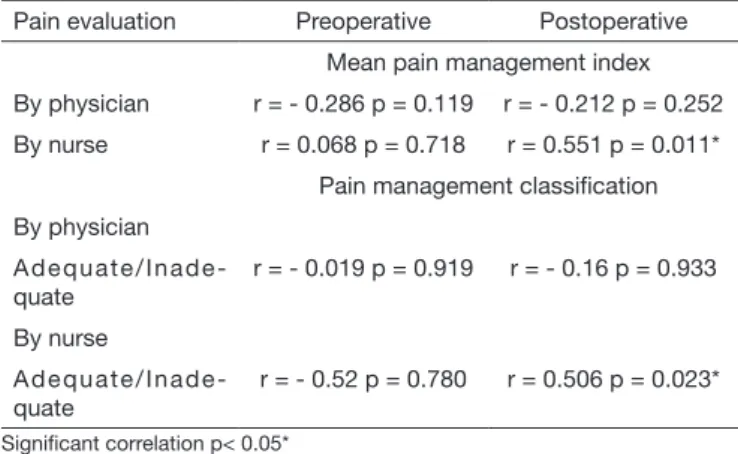
Spearman correlation (Table 5) has shown that pain manage-ment index and classiication of its managemanage-ment when carried
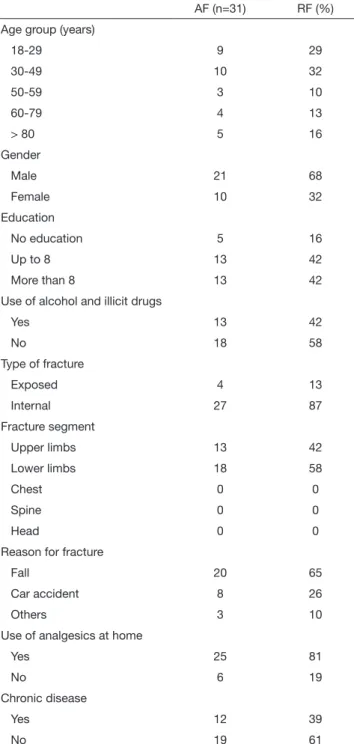
Table 1. Socio-demographic and clinic characterization of study par-ticipants
AF (n=31) RF (%)
Age group (years)
18-29 9 29
30-49 10 32
50-59 3 10
60-79 4 13
> 80 5 16
Gender
Male 21 68
Female 10 32
Education
No education 5 16
Up to 8 13 42
More than 8 13 42
Use of alcohol and illicit drugs
Yes 13 42
No 18 58
Type of fracture
Exposed 4 13
Internal 27 87
Fracture segment
Upper limbs 13 42
Lower limbs 18 58
Chest 0 0
Spine 0 0
Head 0 0
Reason for fracture
Fall 20 65
Car accident 8 26
Others 3 10
Use of analgesics at home
Yes 25 81
No 6 19
Chronic disease
Yes 12 39
No 19 61
AF = absolute frequency, RF = relative frequency.
had some level of education, 58% have reported not using alcohol or illicit drugs. With regard to type of fracture, 87% had internal fracture, lower limbs were the most frequently afected with 58% of fractures and fall was the reason for most fractures (65%).
Table 2 shows physicians and nurses who have evaluated pain in 52 and 29% of cases, respectively. Most patients (61%) reported not having chronic disease and 81% used some anal-gesic at home when feeling pain.
Table 2. Evaluation of study participants’ pain
Pain evaluation AF (n=31) RF (%)
By physician
Yes 16 52
No 15 48
By nurse
Yes 9 29
No 22 71
AF = absolute frequency, RF = relative frequency.
Table 3 shows pain management index evaluation for study participants.
Table 3. Pain management index evaluation
Preoperative Postoperative
AF (n=31)
RF (%)
AF (n=31)
RF (%)
Analgesic potency (AP)
No drug 0 0 0 0
Non-steroid anti-inlammatory 5 16 1 3
Weak opioid 26 84 27 87
Strong opioid 0 0 3 10
Pain intensity (PI)
No pain 12 39 11 36
Mild pain 7 22 6 19
Moderate pain 4 13 8 26
Severe pain 8 26 6 19
Pain management index (PMI=AP-PI)
Adequate 23 74 25 81
Inadequate 8 26 6 19
out by nurses had moderately signiicant correlation in the postoperative period.
Considering pain management as outcome variable in the multivariate logistic regression it was not possible to predict whether there is relationship between independent variables and pain management in the pre and postoperative periods of orthopedic surgeries (p=0.207).
DISCUSSION
he Committee of Sports Traumatology and the Brazilian Society of Orthopedics and Traumatology of São Paulo have carried out a study in 2010 which has shown that periopera-tive pain management is seen as the most adequate practice because it potentiates the analgesic efect and decreases com-plications19.
Our study has shown that all patients were under some anal-gesic in the pre and postoperative periods. his practice is diferent from the study by Oliveira et al.20 which reports that most postoperative patients had not received analgesics, even with pain complaint21. Analgesic prescription in both situa-tions is considered a positive factor, since it helps decreasing stress sufered by patients during admission, cooperates in de-creasing infection risk, costs and incidence of readmissions7,8, decreases morbidity-mortality, in addition to promoting early activities, such as physiotherapy and ambulation22.
Analgesic prescription was more common with weak opioids, with 84% in the preoperative and 87% in the postoperative periods. his category of analgesics occupies the second step of the World Health Organization (WHO) analgesic ladder23. hey are commonly used by orthopedists because they may or may not be associated to adjuvants21,23 to treat moderate pain, especially to control perioperative pain3.
Our study was carried out in a teaching hospital where me-dicine students and residents work every day, so it is valid to stress the importance of implementing ongoing education protocols and programs for pain management. his was well presented in a study by Moreira et al.24 which also shows lack of guidance with regard to the choice of adequate analgesic methods, deciding for the most popular prescription without taking into consideration whether this is the best indication for patients and may negatively inluence, delaying their reco-very and interfering with their quality of life.
In evaluating pain intensity before surgery, it is observed that 61% had some pain, and 64% had some pain after the pro-cedure. he high incidence of pain in patients admitted for orthopedic treatment has to be stressed19. his is due to dei-cits in evaluation and interventions on postoperative pain. In many situations, the unprepared professional underestimates patient’s complaint and real need. Barbosa et al.25 have car-ried out a study in a teaching hospital of the Triangulo Mi-neiro region and have identiied similar results, where 65.6% of patients in the immediate postoperative period had some pain complaint. In our study, most nurses and almost half of physicians have not evaluated patients’ pain, even with pain present in more than half of patients26.
It has been observed that 74% of orthopedic patients had ade-quate analgesia before surgery, going against the literature which shows analgesic inadequacy in the irst evaluation. his num-ber grows to 81% after procedure, in line with the study which shows better analgesic adequacy in the second evaluation3. Even with increased analgesic adequacy between pre and postoperative periods, this diference was not statistically signiicant.
We have identiied PMI limitation in the studied sample. Even with adequate analgesia in both evaluated periods, there has been high level of moderate and severe pain in the preoperative (39%) and postoperative (45%) periods of orthopedic surgeries. Most pre and postoperative patients received weak opioids (84 and 87%, respectively). Some studies mention the diiculty of or-thopedists to prescribe strong opioids such as morphine27. Our study has not identiied the use of preoperative strong opioids such as morphine and only 10% of patients had this opioid prescribed for the postoperative period. Morphine is the irst line opioid to treat moderate to severe pain and has advantages over other strong opioids28. Morphine in the irst 24 postoperative hours of orthopedic procedures was associa-ted to lower moderate to severe pain rates29. It is believed that high weak opioid prescription rates in both periods of this study may be associated to more complaints of moderate to severe pain among patients of this study.
Even with the low number of nurses (29%) who have evalua-ted pain and recorded it on patients’ medical records, Spear-man correlation has identiied that pain evaluation by nurses in the preoperative period has moderately and positively con-tributed for postoperative adequacy of analgesia. his inding was very important, because some studies show that postope-rative pain still continues to be a major clinical problem30,31. Nurses are the primary responsible for care, comfort promo-tion and pain relief in the postoperative period32,33.
Table 5. Spearman Correlation between pain management index scores
Pain evaluation Preoperative Postoperative
Mean pain management index
By physician r = - 0.286 p = 0.119 r = - 0.212 p = 0.252
By nurse r = 0.068 p = 0.718 r = 0.551 p = 0.011*
Pain management classiication
By physician
A d e q u a t e / I n a d e -quate
r = - 0.019 p = 0.919 r = - 0.16 p = 0.933
By nurse
A d e q u a t e / I n a d e -quate
r = - 0.52 p = 0.780 r = 0.506 p = 0.023*
Signiicant correlation p< 0.05*
Table 4. Pain management comparison in both periods
Pain management Preoperative Postoperative p<0.05
Mean 0.581 0.774 0.207ns
Standard deviation 1.311 1.117
Due to closer contact of nurses with patients, most physicians de-pend on nursing evaluations31. So, if nurses underestimate pain, it is possible that its management will be impaired32,33. Another important role of nurses in managing pain is analgesic administra-tion, especially in the medical prescription modality “if necessary”. In this modality, evaluation and drug administration require from nurses knowledge, professional responsibility and ethics32,34. In our study, it was not possible to identify predictors of anal-gesic adequacy in the pre and postoperative periods by means of selected socio-demographic and clinical variables. Ribeiro et al.35 have used the pain management index to evaluate 41 patients in the postoperative period of appendectomies. hey have not found signiicant association between clinical variables and anal-gesic adequacy. A study by Kamarul et al.36 has evaluated the use of analgesics to control pain of extremity and clavicle fractures in 42 adult patients to determine the association between the type of fracture (upper vs. lower limb) and pain management adequacy. Results have shown statistically signiicant association between age and pain intensity at arrival (p=0.0015).
his study was limited by sample size (31 individuals), by the analysis of just the analgesic class (not relating administration route and dose) and by selection of type of anesthesia, which su-ggests that future studies should include these suggestions. Stres-sing that pain is subjective, it is worth reminding that the use of validated scales and tools is necessary for accurate evaluations.
CONCLUSION
Results have shown that most patients had analgesic adequacy in the pre and postoperative periods of orthopedic surgeries. Ho-wever, many patients still had moderate to severe pain in both evaluated periods. With regard to selected variables, it was not possible to identify predictors of analgesic adequacy in both mo-ments of orthopedic surgeries.
REFERENCES
1. International Association for Study of Pain (IASP). Consensus development confe-rence statement: the integrated approach to the management of pain. J Accid Emerg Med. 1994;6(3):292-491.
2. Lima LR, Stival MM, Barbosa MA, Pereira LV. Controle da dor no pós-operatório de cirurgia cardíaca: uma breve revisão. Rev Eletr Enf. 2008;10(2):521-9.
3. Calil AM, Pimenta CA. [Pain intensity of pain and adequacy of analgesia]. Rev Lat Am Enfermagem. 2005;13(5):692-9. Portuguese.
4. Pasero C, McCafery M. Orthopaedic postoperative pain management. J Perianesth Nurs. 2007;22(3):160-73.
5. White PF, Kehlet H. Improving postoperative pain management: what are the unre-solved issues? Anesthesiology. 2010;112(1):220-5.
6. Roberts M, Brodribb W, Mitchell G. Reducing the pain: a systematic review of pos-tdischarge analgesia following elective orthopedic surgery. Pain Med. 2012;13(5):711-27.
7. Chester JG, Rudolph JL. Vital signs in older patients: age-related changes. J Am Med Dir Assoc. 2011;12(5):337-43.
8. Sharma V, Morgan PM, Cheng EY. Factors inluencing early rehabilitation after THA: a systematic review. Clin Orthop Relat Res. 2009;467(7):1400-11.
9. Han X, Gefen S, Browning M, Kenardy J, Gefen G. Outcome evaluation of a
mul-tidisciplinary pain management programme comparing group with individual change measures. Clin Psychologist. 2011;15(3):133-8.
10. Silva MA, Pimenta CA, Cruz Dde A. [Pain assessment and training: the impact on pain control after cardiac surgery]. Rev Esc Enferm USP. 2013;47(1):84-92. Portu-guese.
11. Freitas CC, Vieira PR, Torres GV, Pereira CR. Avaliação da dor com o uso das escalas unidimensionais. Rev Dor. 2009;10(1):56-62.
12. Burckhardt CS, Jones KD. Adult measures of pain: he McGill Pain Questionnaire (MPQ), Rheumatoid Arthritis Pain Scale (RAPS), Short- Form McGill Pain Questio-nnaire (SF-MPQ), Verbal Descriptive Scale (VDS), Visual Analog Scale (VAS), and West Haven-Yale Multidisciplinary Pain Inventory (WHYMPI). Arthritis Rheum. 2003;49:S96-104.
13. Hawker GA, Mian S, Kendzerska T, French M. Measures of adult pain: Visual Analog Scale for Pain (VAS Pain), Numeric Rating Scale for Pain (NRS Pain), McGill Pain Questionnaire (MPQ), Short‐Form Mcgill Pain Questionnaire (SF‐MPQ), Chronic Pain Grade Scale (CPGS), Short Form‐36 Bodily Pain Scale (SF‐36 BPS), and Mea-sure of Intermittent and Constant Osteoarthritis Pain (ICOAP). Arthritis Care Res. 2011;63(Suppl 11):S240-52.
14. Grimshaw J, Campbell M, Eccles M, Steen N. Experimental and quasi-experimental designs for evaluating guideline implementation strategies. Fam Pract. 2000;17(Suppl 1):S11-6.
15. Sousa VD, Driessnack M, Mendes IA. An overview of research designs relevant no nur-sing: Part 1: quantitative research designs. Rev Lat Am Enfermagem. 2007;15(3):502-7. 16. Jennett B. Development of Glasgow Coma and Outcome Scales. Nepal J Neurosc.
2005;1(2):24-8.
17. Landgraf CS, Marques RC, Pires OC, Constantino E, Leite VR, Posso MB, et al. Avaliação da analgesia pós-operatória em um hospital universitário. Rev Dor. 2010;11(4):319-22.
18. Swinscow TD. Statistics at Square: ONE. 9th ed. [Internet].London: BMJ; 1997 [acesso em 21 fev 2015]. Disponível em: http://www.bmj.com/about-bmj/resources--readers/publications/statistics-square-one.
19. Silva RT, Marchetto A, Pedrinelli A, Santili C, Laurino CF, Meirelles ES, et al. Con-senso brasileiro sobre dor perioperatória em ortopedia e traumatologia desportiva. Rev Bras Ortop. 2010;45(3):2-15.
20. Oliveira RM, Leitão IM, Silva LM, Almeida, PC, Oliveira SK, Pinheiro MB. Dor e anal-gesia pós-operatória: análise dos registros em prontuários Rev Dor. 2013;14(4):251-5. 21. Dadalt GT, Eizerik DP. Trauma físico: nível de dor relatado e analgésico prescrito. Rev
Bras Farm. 2013;94(2):89-93.
22. Bassanezi BS, Oliveira Filho AG. Analgesia pós-operatória. Rev Col Bras Cir. 2006;33(2):116-22.
23. Alivio del dolor en el cancer. Ginebr; OMS; 1987. 78p. pesquisa.bvsalud.org/portal/ resource/pt/rep-110876.
24. Moreira L, Truppel YM, Kozovitsvits FG, Santos VA, Atet V. Analgesia no pós-cirúr-gico: panorama do controle da dor. Rev Dor. 2013;14(2):106-10.
25. Barbosa MH, Araújo NF, Silva JA, Corrêa TB, Moreira TM, Andrade EV. Avaliação da intensidade da dor e analgesia em pacientes no período pós-operatório de cirurgias ortopédicas. Esc Anna Nery. 2014;18(1):143-7.
26. Nascimento LA, Kreling MC. Avaliação da dor como quinto sinal vital: opinião de proissionais de enfermagem. Acta Paul Enferm. 2011;24(1):50-4.
27. Webster BS, Verma SK, Gatchel RJ. Relationship between early opioid prescribing for acute occupational low back pain and disability duration, medical costs, subsequent surgery and late opioid use. Spine. 2007;32(19):2127-32.
28. Kraychete DC, Siqueira JT, Garcia JB e Grupo de Especialistas. Recommendations for the use of opioids in Brazil: Part II. Use in children and the elderly. Rev Dor. 2014;15(1):65-9. 29. Zaslansky R, Eisenberg E, Peskin B, Sprecher E, Reis DN, Zinman C, et al. Early
administration of oral morphine to orthopedic patients after surgery. J Opioid Manag. 2006;2(2):88-92.
30. Bennett P, St Marie B. he epidemiology of pain. Core Curriculum for Pain Manage-ment Nursing. Philadelphia: WB Saunders Co; 2002. 45-53p.
31. Mac Lellan K. Postoperative pain: strategy for improving patient experiences. J Adv Nurs. 2004;46(2):179-85.
32. Bell L, Dufy A. Pain assessment and management in surgical nursing: a literature review. Br J Nurs. 2009;18(3):153-6.
33. Sloman R, Rosen G, Rom M, Shir Y. Nurses’ assessment of pain in surgical patients. J Adv Nurs. 2005;52(2):125-32.
34. Duignan M, Dunn V. Congruence of pain assessment between nurses and emergency department patients: a replication. Int Emerg Nurs. 2008;16(1):23-8.
35. Ribeiro CO, Simone JC, Ramiro TH, Santos VS, Nunes MS, Alves JA. Dor em pa-cientes submetidos à apendicectomia. Rev Dor. 2014;15(3):198-201.