Prevalence of the use of light technologies by the nursing staff of a
state hospital
Prevalência da utilização de tecnologias leves pela equipe de enfermagem de um hospital
estadual
Pabliane Matias Lordelo Marinho1, Thialla Andrade Carvalho1, Maria Cláudia Tavares de Mattos1,Eliana Ofélia
Llapa-Rodríguez1, Maria Pontes de Aguiar Campos1
Objective: to describe the prevalence of the use of light technologies by the nursing team of a state hospital.
Methods: cross-sectional and observational study. The sample consisted of 19 Nurses and 67 Nursing Technicians. The data were collected through direct simple observation using a validated instrument. Chi-square was used to compare the use of light technologies between the nursing categories. Results: there was prevalence of nursing technicians, females, with no partner and with an employment relationship. In the “Bonding” dimension, the interventions presence and security enhancement prevailed for nursing technicians and nurses, respectively. In the “Welcoming” dimension, surveillance and security were the most used by both categories. Conclusion:
evaluation of the prevalence of light technologies showed that the dimensions “Welcoming” and “Bonding” were the most used by the nursing team and that nurses use them more often than the Nursing Technicians in the studied unit.
Descriptors: Biomedical Technology; Critical Care Nursing; Intensive Care Units.
Objetivo: descrever a prevalência da utilização de tecnologias leves pela equipe de Enfermagem de um hospital estadual. Métodos: estudo transversal e de natureza observacional. A amostra foi composta por 19 Enfermeiros e 67 Técnicos de Enfermagem. Os dados foram coletados por meio de observação simples direta, utilizando instrumento validado. Utilizou-se qui-quadrado para comparação do uso de tecnologias leves entre as categorias de enfermagem. Resultados: prevaleceu técnico de enfermagem, do sexo feminino, sem companheiro e com um vínculo empregatício. Na dimensão “Vínculo” prevaleceram as intervenções presença para os técnicos e aumento da segurança para enfermeiros. Na dimensão “Acolhimento”, supervisão e segurança foram as mais utilizadas pelas duas categorias. Conclusão: a avaliação da prevalência das tecnologias leves mostrou que as dimensões mais utilizadas pela equipe de enfermagem foram “Acolhimento” e “Vínculo” e que os enfermeiros utilizam-nas mais que os Técnicos de Enfermagem na unidade do estudo.
Descritores: Tecnologia em Saúde; Enfermagem de Cuidados Críticos; Unidade de Terapia Intensiva.
1Universidade Federal de Sergipe. Aracaju, SE, Brazil.
Corresponding author: Thialla Andrade Carvalho
Introduction
There are several technologies used for the de-velopment of work in health institutions. These can be
classified into: hard technologies, which includes te -chnological equipment such as machines, devices and organizational structures; light-hard technologies, which includes the knowledge that guide health work; and light technologies, which are relationships based on bonding, autonomy, welcoming and management of the work process(1-2).
Light technology can be understood as the cons-truction of an optimized relationship for the provision of health care, established between the professional and/or team and the patient. Thus, the formation of bond between the actors in the provision of health care is encouraged. Therefore, it broadens the recog-nition of individual and singular needs and, at the same time, promotes autonomy for decision making. In addition, it produces collective management spaces and active participation of all those involved in the care process - professional/health team, patient and managers(1-2).
The use of light technologies in a hospital envi-ronment is mentioned in the National Humanization Policy as essential for the recovery of universal access, equity and comprehensive care to the individual and to promote a humanized care. In this way, the
requa-lification of the relationships between professional
and/or health team and patients, based on values such as respect for singularities and defense of users’ rights, is extremely necessary and relevant(3).
Another parallel can be made with assump-tions of some nursing theorists who, although follo-wing distinct theoretical-philosophical references, are premised on the production of reciprocity and interaction and environmental relations, indispen-sable to an effective care, recovery of autonomy and citizenship(4-5).
There are few papers in the literature men-tioning or using relationship technologies or light technologies in nursing. This fact mat be due to the
difficulty of professionals in defining what these tech -nologies are and in recognizing them as technological resources. A study that evaluated the use of technolo-gies in nursing showed that only 9.0% of the articles addressed light technologies and 2.9% addressed li-ght and lili-ght-hard technologies(6).
Likewise, it was stated that the use of nursing technologies can have a 58.8% impact on the streng-thening and quality of patient care in nursing. There-fore, light technology, emanating from the relationship with the nursing team, is capable of providing plan-ning based on patients’ individualities and real
nee-ds. Thus, a singular, reflexive, effective and safe care is
generated(6).
Given the above and given the importance of this theme for the development of a quality nursing care, this study aims to describe the prevalence of the use of light technologies by the nursing team of a state hospital.
Methods
This is a cross-sectional and observational study. The research environment was the Intensive Care Unit of a large Health Care Institution of the State Health Network of Sergipe, Brazil.
The sample consisted of 86 workers (19 nurs-es and 67 nursing technicians/assistants), who cor-respond to 77.5% of the nursing staff professionals (111). The selection was made by non-probabilistic
sampling by quota, stratified by professional catego -ry and obtained assuming a 5.0% sample error and a
95.0% confidence interval. Inclusion criterion of this
research was developing care activity in the Intensive Care Unit. Exclusion criteria were professionals’ ab-sence due to vacations or leaves in the period of data collection.
the-oretical reference of light technologies of Mehry and Feuerweker and on the National Humanization Policy
of the Unified Health System.
Between December 2014 and January 2015, the instrument was validated by six judges, selected by criteria adapted from Fering, who analyzed six cri-teria: appearance, clarity/comprehension, content,
efficiency/consistency, objectivity and validity of the
proposed model.
The first part of the instrument is related to
the characterization of the sample in terms of bio-so-cio-demographic (age, sex, marital status, schooling) and professional aspects (position, length of time in the sector, weekly working hours, number of employ-ment relationships and satisfaction in working in the sector). The second part investigated the use of light technologies by the nursing team, based on four
di-mensions identified in the concept of light technology
of the selected theoretical framework.
In order to adapt the light technology to
nurs-ing practice, the Nursnurs-ing Interventions Classification
(NIC) was used. Thus, a search in NIC was conducted
and 19 nursing interventions with definitions and ac
-tivities that were more similar to the points identified
in the selected referential were selected. Then, these were grouped into the corresponding dimensions: Bonding, Autonomy, Welcoming and Management.
The guideline of the first dimension is the con -struction of bond between the person and the pro-fessional. This relationship requires an affective and moral connection and promotes learning about car-ing. Thus, the nursing interventions selected were: Active Listening (4920); Touch (5460); Complex Re-lationship Building (5000); Security Enhancement (5380); and Presence (5340).
In the second dimension, the guideline estab-lishes that the process of health production is complete when people become subjects capable of deciding about their care and, together with health profession-als, are able to build working rules for themselves and all. Self-Care Assistance (1800) was chosen; Asser-tiveness Training (4340); Emotional support (5270);
Self-awareness Enhancement (5390); and Values
Clarification (5480) were chosen in the NIC.
Welcoming the user, since his/her arrival, be-coming responsible for him/her and opening of spac-es for listening and speaking in care and assistance relationships are the guidelines of welcoming practic-es in servicpractic-es, which were applied to the third dimen-sion. For this study, the following nursing interven-tions were chosen: Surveillance: Safety (6654); Shift Report (8140); Case Management (7320); Admission Care (7310); Visitation Facilitation (7560).
In the last dimension, the way of managing work processes and the analysis of information and decision making is built by collective spaces, with in-volvement of all entities in the health producing units. Thus, the following interventions were selected: Crit-ical Path Development (7640); Decision-Making Sup-port (7560); Patient Rights Protection (7460); and Health Education Enhancement (5515).
Direct and simple observations were per-formed, in which professionals were analyzed during provision of care. Each pre-selected nursing interven-tion in which three activities were performed by the observed professional was equivalent to “yes”, being registered in the instrument. On average, three hours of observations were carried out from Monday to Fri-day during the three work shifts.
The variables selected for this study were: the dependent variable corresponding to the application of light technologies and the independent variables concerning the bio-socio-demographic and profes-sional attributes.
Data were tabulated in the Epi-info 7 program and analyzed using BioEstat software for Windows® version 5.3. In order to analyze the categorical vari-ables, a simple distribution frequency was used. The Kolmorogov-Smirnov test was performed to evaluate the normality distribution regarding the use of light technology and the Chi-square test (χ2) and/or
nursing interventions”, the central tendency measure - median - was used as the sample did not present a normal distribution.
The study complied with the formal require-ments contained in the national and international regulatory standards for research involving human beings.
Results
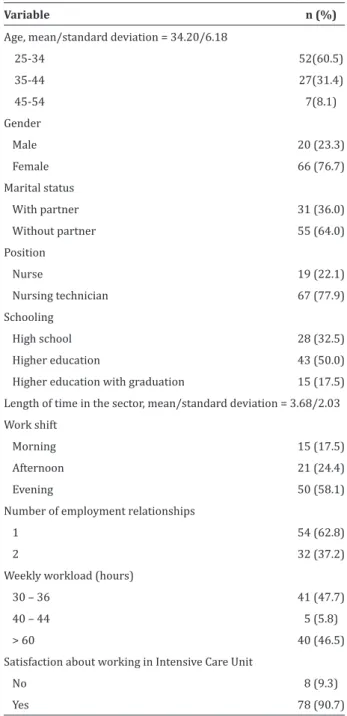
The results, shown in Table 1, evidenced pre-valence of females (76.7%). There was higher presen-ce of people without partner and nursing technicians with higher education.
The relationship between number of employ-ment relationships and workload showed that, al-though most professionals had only one employment relationship, the number of professionals with a we-ekly workload exceeding 60 hours per week was
sig-nificant (46.5%). Another highlight is the high percen -tage of positive answers (90.7%) about satisfaction in working in the Intensive Care Unit.
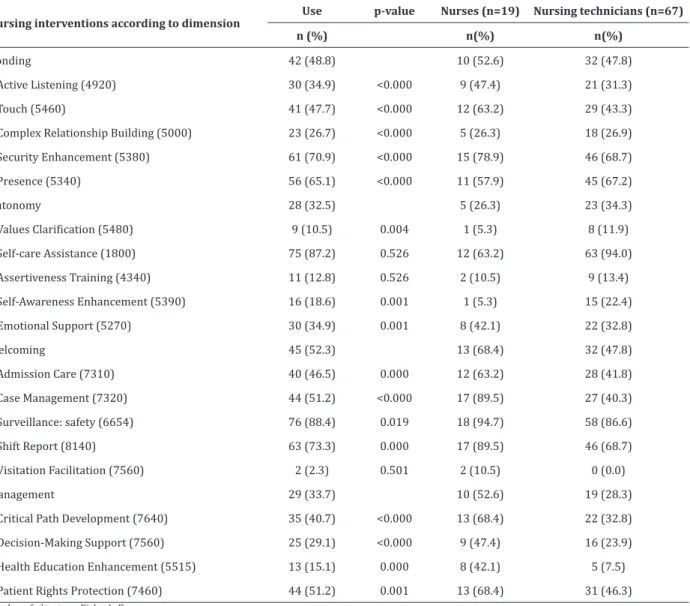
Regarding the light technologies (Table 2) used by the nursing team, the most prevalent dimensions were “Welcoming” (52.3%) and “Bonding” (48.8%). Regarding the professional category, the dimensions “Welcoming” (68.4%) and “Management” (52.6%) prevailed for nurses, while for nursing technicians, “Bonding” (47.8%) and “Welcoming” (47.8%) prevailed.
In the “Bonding” dimension, the most used nur-sing interventions were Security Enhancement (5380) for both categories, followed by Touch (5460) for nur-ses and Presence (5340) for nursing technicians.
The most prevalent nursing intervention in the “Autonomy” dimension was Self-Care Assistance (1800), occurring in the same way for both categories. It is observed that this intervention was the only one with prevalence in the nursing technician category. For the nursing team, the least prevalent was Values
Clarification (5480). It should be emphasized that this
was the least observed intervention in nursing care practice.
Table 1 - Distribution of the sample according to bio-socio-demographic and professional variables (n=86)
Variable n (%)
Age, mean/standard deviation = 34.20/6.18
25-34 52(60.5)
35-44 27(31.4)
45-54 7(8.1)
Gender
Male 20 (23.3)
Female 66 (76.7)
Marital status
With partner 31 (36.0)
Without partner 55 (64.0) Position
Nurse 19 (22.1)
Nursing technician 67 (77.9) Schooling
High school 28 (32.5)
Higher education 43 (50.0) Higher education with graduation 15 (17.5) Length of time in the sector, mean/standard deviation = 3.68/2.03 Work shift
Morning 15 (17.5)
Afternoon 21 (24.4)
Evening 50 (58.1)
Number of employment relationships
1 54 (62.8)
2 32 (37.2)
Weekly workload (hours)
30 – 36 41 (47.7)
40 – 44 5 (5.8)
> 60 40 (46.5)
Satisfaction about working in Intensive Care Unit
No 8 (9.3)
Yes 78 (90.7)
In the “Welcoming” dimension, the nursing in-tervention Surveillance: Safety (6654) was the most prevalent for nurses and nursing technicians, being used by 94.7% and 86.6% of these, respectively. It is
and the lamentable fact that this intervention is the second least practiced by nurses.
When the “Management” dimension was
eva-luated, there was a significantly higher percentage of
use among nurses (52.6%) when compared to nur-sing technicians (28.3%). Among the nurnur-sing inter-ventions of this dimension, Patient Rights Protection (7460) was the most prevalent for both nursing cate-gories, being more used by nurses.
Table 2 - Distribution of the prevalence of use of light technologies according to the dimensions Bonding, Au-tonomy, Welcoming and Management by professional category
Nursing interventions according to dimension
Use p-value Nurses (n=19) Nursing technicians (n=67)
n (%) n(%) n(%)
Bonding 42 (48.8) 10 (52.6) 32 (47.8)
Active Listening (4920) 30 (34.9) <0.000 9 (47.4) 21 (31.3)
Touch (5460) 41 (47.7) <0.000 12 (63.2) 29 (43.3)
Complex Relationship Building (5000) 23 (26.7) <0.000 5 (26.3) 18 (26.9)
Security Enhancement (5380) 61 (70.9) <0.000 15 (78.9) 46 (68.7)
Presence (5340) 56 (65.1) <0.000 11 (57.9) 45 (67.2)
Autonomy 28 (32.5) 5 (26.3) 23 (34.3)
Values Clarification (5480) 9 (10.5) 0.004 1 (5.3) 8 (11.9) Self-care Assistance (1800) 75 (87.2) 0.526 12 (63.2) 63 (94.0)
Assertiveness Training (4340) 11 (12.8) 0.526 2 (10.5) 9 (13.4)
Self-Awareness Enhancement (5390) 16 (18.6) 0.001 1 (5.3) 15 (22.4)
Emotional Support (5270) 30 (34.9) 0.001 8 (42.1) 22 (32.8)
Welcoming 45 (52.3) 13 (68.4) 32 (47.8)
Admission Care (7310) 40 (46.5) 0.000 12 (63.2) 28 (41.8)
Case Management (7320) 44 (51.2) <0.000 17 (89.5) 27 (40.3)
Surveillance: safety (6654) 76 (88.4) 0.019 18 (94.7) 58 (86.6)
Shift Report (8140) 63 (73.3) 0.000 17 (89.5) 46 (68.7)
Visitation Facilitation (7560) 2 (2.3) 0.501 2 (10.5) 0 (0.0)
Management 29 (33.7) 10 (52.6) 19 (28.3)
Critical Path Development (7640) 35 (40.7) <0.000 13 (68.4) 22 (32.8)
Decision-Making Support (7560) 25 (29.1) <0.000 9 (47.4) 16 (23.9)
Health Education Enhancement (5515) 13 (15.1) 0.000 8 (42.1) 5 (7.5)
Patient Rights Protection (7460) 44 (51.2) 0.001 13 (68.4) 31 (46.3)
*p-value of χ2 tests or Fisher’s Exac
Of the 19 nursing interventions applied by the team, only three did not present a statistically
signi-ficant difference between the professional categories:
Discussion
A limitation of this study was having conducted the research with professionals from a single health institution, thus portraying a local reality. The method used for data collection was also a limitation, as simple observation raises the subjective and partial interpre-tation of the studied phenomenon and the presence of the researcher can provoke alterations in the behavior of the observed participants.
Regarding the characterization of the sample, the prevalence of females corroborates a research of the Federal Nursing Council(7), which also had similar
result on the higher education of nursing technicians. This may be explained by the growing number of nur-sing colleges and by increased access to federal gover-nment grants through a student funding program(7-8).
This fact, however, did not approximate the results regarding the use of light technologies when the per-formance by category was evaluated.
Most of the professionals referred only to one employment relationship, but they had a long working day, associated with the fact that many of them worked extra hours in the same unit. This is a worrying result, since long journeys are pointed out in the literature as one of the main factors that trigger stress in the pro-fessional, thus compromising the quality of nursing care(9).
Almost all the participants of the study repor-ted satisfaction about working in the Intensive Care Unit under study. This is a positive result, since
satis-faction has influence in the care provided by the nur -sing team. This refers to a sum of internal and
exter-nal variables that influence motivation for developing
care activities and productivity, regardless of
techni-cal-scientific training, in addition to being intrinsically
linked to autonomy to perform labor activities and quality of life at work(4,10).
As for light technologies, the prevalence of the dimensions “Welcoming” and “Bonding” demonstrate
how much the nursing team is aware on the importance of the humanization process. This fact implies the involvement of health professionals and the use of relationships as technology, building a construction among the subjects and providing a foundation for the meeting of mutual needs(5-6). However, in view of the
obtained results, it is recommended the requalification
of the relations between professionals and patients with the re-evaluation in professional training(1,3,5).
Within these dimensions, the most used nur-sing interventions for both categories were those rela-ted to the control of risk factors for patient safety and
that confirm relevant aspects of care(4,5,11) adopted by
the nursing team working in this unit. The low percen-tage of use observed in the nursing intervention re-lated to the establishment of therapeutic relationship
can be justified by the profile of the patients hospita -lized in this unit, by the predominance of interaction with the hard technologies available and by the bio-medical model in the Intensive Care Unit, which hin-ders insight production(11).
Similarly, the same explanation is considered for the lower prevalence of the autonomy
interven-tion. However, a study confirms changes in the phy -siological responses when auditory and tactile stimuli are performed(12), a fact little observed in the
Inten-sive Care Unit. Therefore, it is paramount to expand nursing interventions regarding assertiveness, self--perception, emotional support and self-care for the recovery of equity and comprehensive care, which is a challenge of the National Humanization Policy(3).
The feasibility of access of relatives and compa-nions to the Intensive Care Unit is an action performed and guided by nurses; however, this was the least used nursing intervention by the studied team. This is an opposite result to that recommended by the National Humanization Policy guidelines(2), since the
Humanization in this unit is not an easy task, because it requires individual attitudes against an es-tablished biomedical model and a technological sys-tem, often not humanizing(6). Another complicating
factor is the existence of norms and routines, which are crucial to the organization, and which need to be manageable for the exercise of a humanized care to critical patients, and nurses have responsibility in this process(3,6,13). Visitation should provide effective
com-munication and a therapeutic relationship with the family, thus favoring the understanding of the whole and patient rehabilitation(3,14).
Management of care, with better results among
nurses, has confirmed the responsibility for the ma -nagement of the care provided by this category, in addition to complying with the Civil Code, Consumer Law, and the Professional Ethics Code with respect to the citizen’s rights(15-17). In critical units, in addition
to developing complex care activities, the nurse must manage care dynamically, leading the team to achieve the best results, client and family satisfaction, and to reduce adverse events related to care(4,10,17).
It should be emphasized that the unit under study carries out the Nursing Process, however, there is no emphasis on light technologies, being predomi-nant the biomedical model based on the resolution of biological problems. The light technologies are con-fused with the work process itself and nursing care. Therefore, it is emphasized, the need for reevaluation and the insertion of these technologies in the care process(3-4,11). Reformulations are necessary in order
to adopt light technologies in this Intensive Care Unit, in view of the positive impact on the care given to the critical patient(6,11,17).
It is highlighted, as contribution of this study,
the construction of scientific knowledge related to
the light technologies applied by the nursing team in intensive care unit. It also allows professionals and
managers of the studied institution to reflect on the
use of light technologies and to plan interventions to intensify the use thereof.
Conclusion
Evaluation of the prevalence of light techno-logies showed that the most used dimensions by the nursing team were “Welcoming” and “Bonding”. Con-sidering the professional category, the dimensions “Welcoming” and “Management” prevailed for nurses, while for nursing technicians, “Bonding” and “Welco-ming” prevailed. Nursing interventions, which mate-rialized the light technologies, were predominantly
significant.
Collaborations
Marinho PML contributed to project design, data collection, analysis and interpretation of data and article writing. CarvalhoTA contributed to the analysis and interpretation of data and article writing. MattosMCT andLlapa-Rodríguez EO performed criti-cal review of the intellectual content and approval of the version to be published. Campos MPA contributed to project design, analysis and interpretation of data and critical review of the intellectual content.
References
1. Merhy EE, Franco TB. Trabalho em saúde. In: Pereira IB, Lima JCF. Dicionário da educação
profissional em saúde. Rio de Janeiro: EPSJV;
2008.
2. Merhy EE. Saúde: a cartografia do trabalho vivo.
Saúde em Debate. São Paulo: Hucitec; 2002.
3. Ministério da Saúde (BR). Secretaria de Atenção à Saúde. Política Nacional de Humanização da Atenção e da Gestão do SUS [Internet]. 2006 [citado 2017 jan. 13]. Disponível em: http:// bvsms.saude.gov.br/bvs/publicacoes/humaniza_ sus_atencao_basica.pdf
5. Oliveira CN, Nunes EDCA. Caring for family mem-bers in the ICU: challenges faced by nurses in the interpersonal praxis of user embracement. Texto Contexto Enferm. 2014; 23(4):954-63. doi: http:// dx.doi.org/10.1590/0104-07072014003590013
6. Pereira CDFD, Pinto DPSR, Tourinho FSV, Santos VEP. Tecnologias em Enfermagem e o impacto na prática assistencial. Rev Bras Inov Tec Saúde [Internet]. 2012 [citado 2016 fev. 26]; 2(04):29-37. Disponível em: www.ufrn.emnuvens.com.br/ reb/article/view/333
7. Escola Nacional de Saúde Pública. Conselho
Federal de Enfermagem. Perfil da Enfermagem
[Internet]. 2012 [citado 2016 set. 18]. Disponível
em:
http://aenfermagem.com.br/materia/perfil-da-enfermagem.
8. Queiroz V. Fundo de Financiamento Estudan-til (FIES): uma nova versão do CREDUC. Uni-versidade Soc [Internet]. 2015 [citado 2017 fev. 08]; 24(55):44-57. Disponível em: http:// www.andes.org.br/imprensa/publicacoes/imp--pub-1227849465.pdf
9. Dalri RCMB, Silva LA, Mendes AMOC, Robazzi MLCC. Nurses’ workload and its relation with physiological stress reactions. Rev Latino-Am Enfermagem. 2014; 22(6):959-65. doi: http:// dx.doi.org/10.1590/0104-1169.3292.2503
10. Carvalho JF, Martins EPT, Lúcio L, Papandréa PJ. Qualidade de vida no trabalho e fatores motiva-cionais dos colaboradores nas organizações. Educ Foco. 2013; 7(9):21-31.
11. Terra TCC, Gomes SR. A humanização da assistên-cia em unidade de terapia intensiva para adultos. Reinpec. 2015; 1(1):233-44. doi: http://dx.doi. org/10.20951/2446-6778/v1n1a17
12. Puggina ACG, Silva M JP. Patients with disorders of consciousness: vital, facial and muscular responses to music or messages. Rev Bras Enferm. 2015; 68(1):102-10. doi: http://dx.doi. org/10.1590/0034-7167.2015680114p
13. Silva RS, Pereira Á, Mussi FC. Comfort for a good death: perspective nursing staff’s of intensive care. Esc Anna Nery. 2015; 19(1):40-6. doi: http:// dx.doi.org/10.5935/1414-8145.20150006
14. Barth AA, Weigel BD, Dummer CD, Machado KC, Tisott TM. Stressors in the relatives of patients admitted to an intensive care unit. Rev Bras Ter Intensiva. 2016; 28(3):323-9. doi: http://dx.doi. org/10.5935/0103-507X.20160055
15. Soares LG, Reis MR, Leticia Gramazio Soares.
Humanização na UTI: dificuldades encontradas
para sua implementação uma revisão integrativa. Rev Polidisciplinar Eletr Faculdade Guairacá [Internet]. 2014 [citado 2016 fev 21]; 6(1):70-86. Disponível em: http://www.revistavoos.com.br/ seer/index.php/voos/article/viewArticle/263
16. Conselho Federal de Enfermagem (BR). Resolução COFEN nº 311/2007 de 8 de fevereiro de 2007 (BR). Dispõe sobre: Aprova a reformulação do
Código de ética dos profissionais de enfermagem
[Internet], Rio de Janeiro (RJ). 2007 [citado 10 mar 2016]. Disponível em: http://se.corens. portalcofen.gov.br/codigo-de-etica-resolucao-cofen-3112007