1984-1462/© 2015 Sociedade de Pediatria de São Paulo. Published by Elsevier Editora Ltda. All rights reserved.
REVISTA PAULISTA
DE PEDIATRIA
www.rpped.com.brREVIEW ARTICLE
Food consumption and nutritional adequacy
in Brazilian children: a systematic review
Carolina Abreu de Carvalho, Poliana Cristina de Almeida Fonsêca, Silvia Eloiza Priore,
Sylvia do Carmo Castro Franceschini, Juliana Farias de Novaes*
Universidade Federal de Viçosa (UFV), Viçosa, MG, Brazil
Received 9 April 2014; accepted 18 July 2014
KEYWORDS Food consumption; Nutritional requirements; Infant nutrition; Child nutrition
Abstract
Objective: To perform a review of studies of food consumption and nutritional adaptation in Brazilian infants pointing the main indings and limitations of these studies.
Data source: The articles were selected from Literatura Latino-Americana e do Caribe
em Ciências da Saúde (Lilacs) (Latin-American and Caribbean Literature in Health Scien-ces), Scientiic Electronic Library Online (SciELO) and Science Direct in Portuguese and in English. The descriptors were: ‘‘food consumption’’, ‘‘nutritional requirements’’, ‘‘infant nutrition’’ and ‘‘child’’. The articles selected were read by two evaluators that decided upon their inclusion. The following were excluded: studies about children with patholo-gies; studies that approached only food practices or those adaptation of the food groups or the food offert; and studies that did not utilize the Dietary Reference Intakes (DRI).
Data synthesis: Were selected 16 studies published between 2003 and 2013. In the
eva-luation of the energy consumption, four studies presented energetic consumption above the individual necessities. The prevalence of micronutrients inadequacy ranged from 0.4% to 65% for iron, from 20% to 59.5% for vitamin A, from 20% to 99.4% for zinc, from 12.6% to 48.9% for calcium and from 9.6% 96.6% for vitamin C.
Conclusions: The food consumption of Brazilian infants is characterized by high
frequen-cies of inadequacy of micronutrients consumption, mainly iron, vitamin A and zinc. These inadequacies do not exist only as deiciencies, but also as excesses, as noted for energe -tic consumption.
© 2015 Sociedade de Pediatria de São Paulo. Published by Elsevier Editora Ltda. All rights reserved.
DOI of original article: http://dx.doi.org/10.1016/j.rpped.2015.03.002 *Corresponding author.
Consumo alimentar e adequação nutricional em crianças brasileiras: revisão sistemática
Resumo
Objetivo: Fazer uma revisão de estudos sobre o consumo alimentar e adequação
nutri-cional em crianças brasileiras e apontar os principais resultados e as principais limitações desses estudos.
Fontes de dados: Os artigos foram selecionados nas bases de dados da Literatura Lati
-no-Americana e do Caribe em Ciências da Saúde (Lilacs), Scientiic Electronic Library Online (SciELO) e Science Direct. Os descritores usados foram: ‘‘consumo alimentar’’ (food consumption), ‘‘necessidades nutricionais’’ (nutritional requirements), ‘‘nutrição do lactente’’ (infant nutrition) e ‘‘criança’’ (child). Os artigos selecionados nas bases
de dados foram lidos por dois avaliadores que decidiram sobre a inclusão. Excluíram-se estudos de crianças com patologias; que abordavam apenas práticas alimentares; que analisaram adequação somente de grupos alimentares ou da alimentação oferecida; e os que não usaram as Dietary Reference Intakes (DRI). Buscaram-se artigos em português ou
inglês e não se delimitou o período de busca.
Síntese dos dados: Selecionaram-se 16 estudos, publicados entre 2003 e 2013. Na
ava-liação do consumo de energia, quatro estudos mostraram consumo energético acima das necessidades individuais. A prevalência de inadequação de micronutrientes variou de 0,4% a 65% para o ferro, 20% a 59,5% para a vitamina A, 20% a 99,4% para o zinco, 12,6% a 48,9% para o cálcio e de 9,6% a 96,6% para a vitamina C.
Conclusões: O consumo alimentar de crianças brasileiras é marcado por frequências ele
-vadas de inadequação no consumo de micronutrientes, sobretudo ferro, vitamina A e zinco. Essas inadequações não se apresentam apenas sob o aspecto da deiciência, mas também por meio de excessos, como observado para o consumo energético.
© 2015 Sociedade de Pediatria de São Paulo. Publicado por Elsevier Editora Ltda. Todos os direitos reservados.
PALAVRAS-CHAVE Consumo alimentar; Necessidades nutricionais;
Nutrição do lactente; Nutrição da criança
Introduction
Children represent a group of highly vulnerable individuals, due to their rapid growth, physiological and immunological immaturity.1,2 Adequate nutrition in the early years of life is essential for healthy growth and development.3 Inadequate nutrient consumption can impair the nutritional status, leading to the development of nutritional deficien-cies or excesses.4
Deficiency diseases increase children’s susceptibility to diarrhea and infection and can compromise the maturation of the nervous, visual, mental and intellectual systems.5 In Brazil, iron and vitamin A deficiencies are the most often observed micronutrient deficiencies, representing a public health problem.6,7 Data from the National Demographic and Health Survey (PNDS), carried out in 2006, show a preva -lence of anemia of 20.9% and inadequate levels of vitamin A in 17.4% of children younger than five years.8
With the nutritional transition, obesity and overweight, which reflect excessive energy consumption and / or insuf -ficient energy expenditure, have shown a high prevalence in the Brazilian pediatric population. The Household Budget Survey (2008-2009) demonstrated the evolution of anthro-pometric indicators of Brazilian children aged five to nine years, showing an increase of overweight of 10.9% in 1974-1975 to 34.8% in 2008-2009 in boys and from 8.6% to 32% in girls, in the same period.9
Infant feeding practices should be able to provide enough food, with nutritional and sanitary quality, to meet the nutritional needs of children and ensure the development of their full potential.10 Proper nutrition in childhood con-tributes to the establishment of healthy eating habits, which will have an impact not only in the short term, but also in adulthood.3 Children with inadequate food intake since childhood tend to the early development of over-weight and obesity, as well as other associated chronic dis-eases.11 On the other hand, children submitted to optimal feeding practices reach their normal development and become healthier adults, with greater intellectual and pro-ductive capacity.12
Considering the importance of adequate dietary intake in childhood to reach the nutritional needs, this article aims to perform a systematic review of studies on food consumption and nutritional adequacy in Brazilian children, pointing out the main findings and limitations of these studies.
Method
on Health Sciences (LILACS), Scientific Electronic Library Online (SciELO) and Science Direct databases in December 2013. The descriptors used in the search for articles were chosen after consulting the “Descriptors in Health Sciences (DeCS)”. The following descriptors and their combinations in Portuguese and English were used: “Food Consumption” (“Consumo Alimentar”), “nutritional requirements”, (“Necessidades nutricionais”), “Infant nutrition” (“Nutrição do lactente”) and Child (Criança).
This review included articles published in Portuguese and English, carried out with Brazilian children aged 0 to 10 years that addressed the subject of food consumption in childhood and nutritional adequacy in quantitative terms. There was no limitation regarding the year of publication of the articles. Studies with children with any type of pathology; those that addressed inadequate feeding prac-tices without quantitatively expressing the inadequacies in nutrient intake; the ones that assessed the adequacy of food groups only, but not of nutrients; the ones that ana-lyzed the food offered to children without verifying con-sumption; and manuscripts that did not use the Dietary Reference Intakes (DRI) to verify nutritional adequacy were excluded.
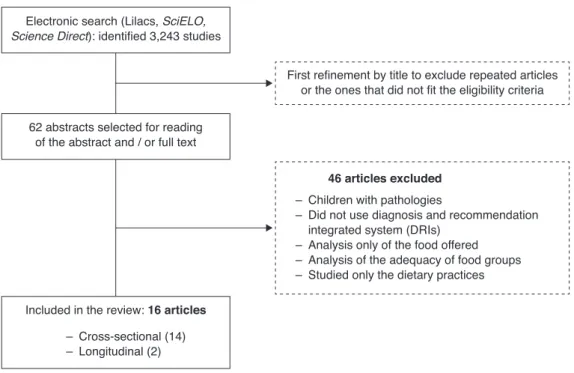
A total of 3,234 studies were identified in the database search. Subsequently, we performed an analysis by title to exclude repeated articles or articles that did not meet the predefined criteria, which resulted in 62 articles. After this phase, summaries or full texts were read in their entirety to verify the inclusion and exclusion criteria. The selected articles were read by two examiners who decided on their inclusion based on the eligibility criteria. Each examiner independently decided by “inclusion” or “exclusion” and discrepant results were reassessed by the examiners.
A total of 16 studies were selected for this review: 14 cross-sectional and two longitudinal studies, published between 2003 and 2013, which quantitatively evaluated dietary intake of Brazilian children (Fig. 1).
Results
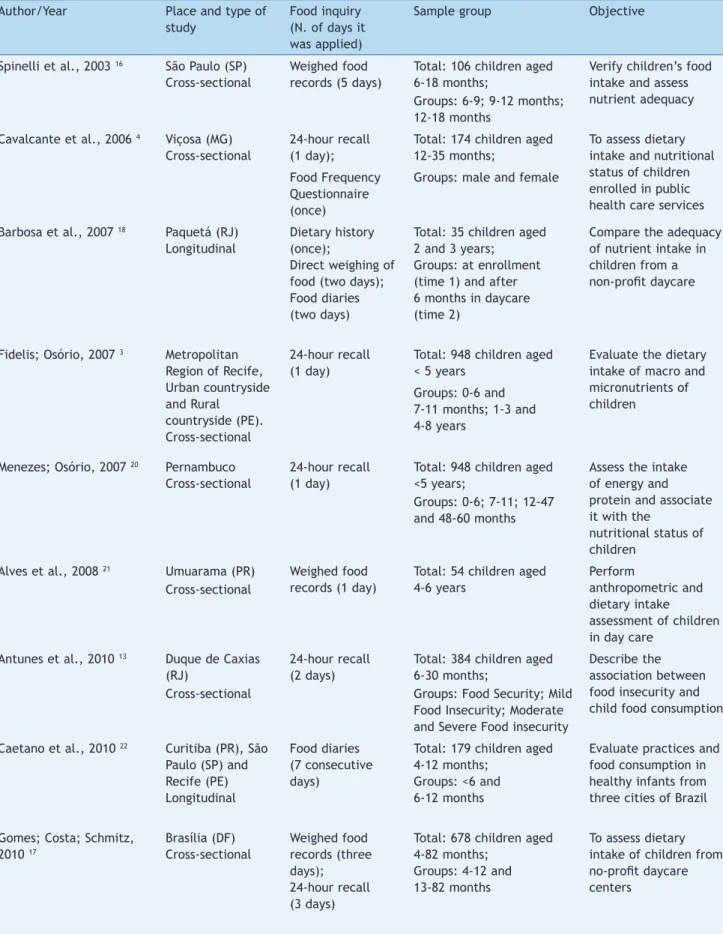
Table 1 shows the methodological aspects concerning the site and types of studies, the dietary survey used to assess dietary intake, sample group and objectives of the assessed studies.
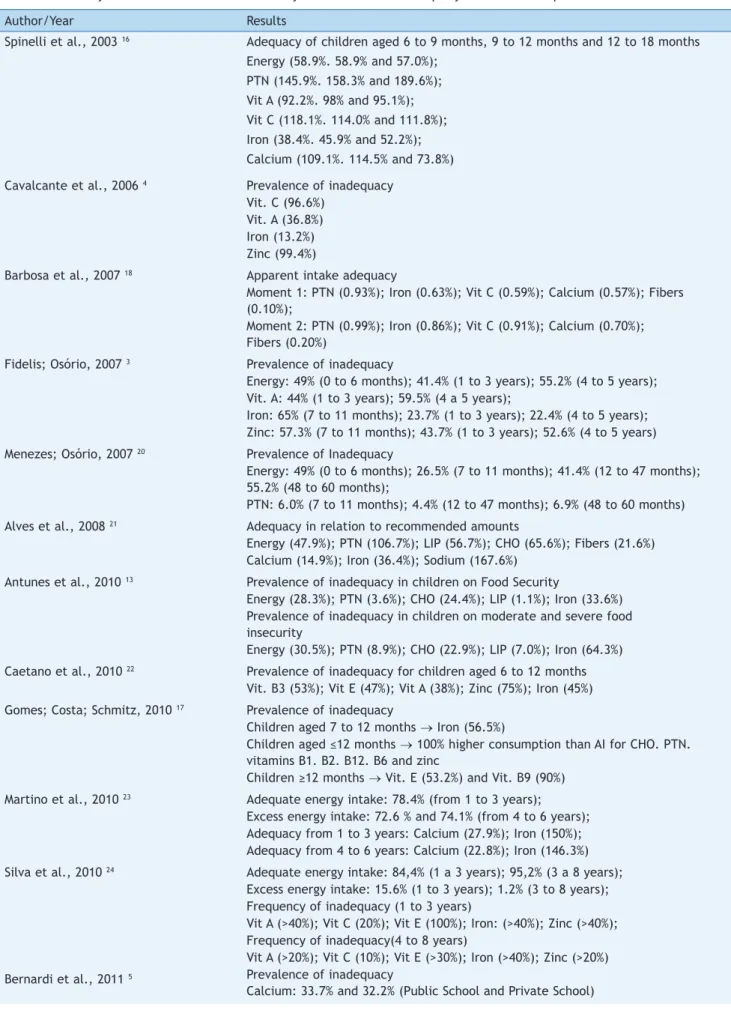
When assessing energy consumption in children, the studies by Cavalcante et al.,4 Antunes, Sichieri and Salles-Costa,13 Costa et al.14 and Tavares et al.15 were the ones that showed energy consumption above the individ-ual needs calculated by the Estimated Energy Requirements (EER). The studies by Spinelli et al.,16 Fidelis and Osório3 and Gomes et al.17 highlight the pro-tein intake above the recommended levels among the assessed children.
When assessing micronutrient intake, we observe that most studies demonstrate the inadequacy of iron, vitamin A and zinc levels. The prevalence of inadequacy ranged from 0.4% to 65% for iron, from 20.0% to 59.5% for vitamin A, from 20.0% to 99.4% for zinc, from 12.6% to 48.9% for calcium and from 9.6% to 96.6% for vitamin C. Table 2 shows the results of assessed studies.
In this article, eight studies assessed the dietary intake of institutionalized children, especially in public and pri-vate day care centers. Six publications used only one 24-hour recall record. Among the eight studies that applied weighed food records, five did so on a single day.
Electronic search (Lilacs, SciELO, Science Direct): identified 3,243 studies
62 abstracts selected for reading of the abstract and / or full text
Included in the review: 16 articles
– Cross-sectional (14) – Longitudinal (2)
First refinement by title to exclude repeated articles or the ones that did not fit the eligibility criteria
46 articles excluded
– Children with pathologies
– Did not use diagnosis and recommendation integrated system (DRIs)
– Analysis only of the food offered – Analysis of the adequacy of food groups – Studied only the dietary practices
Table 1 Methodological aspects and objective of the selected studies.
Author/Year Place and type of study
Food inquiry (N. of days it was applied)
Sample group Objective
Spinelli et al., 2003 16 São Paulo (SP)
Cross-sectional
Weighed food records (5 days)
Total: 106 children aged 6-18 months;
Verify children’s food intake and assess nutrient adequacy Groups: 6-9; 9-12 months;
12-18 months Cavalcante et al., 2006 4 Viçosa (MG)
Cross-sectional
24-hour recall (1 day);
Total: 174 children aged 12-35 months;
To assess dietary intake and nutritional status of children enrolled in public health care services Food Frequency
Questionnaire (once)
Groups: male and female
Barbosa et al., 2007 18 Paquetá (RJ)
Longitudinal
Dietary history (once);
Direct weighing of food (two days); Food diaries (two days)
Total: 35 children aged 2 and 3 years;
Groups: at enrollment (time 1) and after 6 months in daycare (time 2)
Compare the adequacy of nutrient intake in children from a non-proit daycare
Fidelis; Osório, 2007 3 Metropolitan
Region of Recife, Urban countryside and Rural countryside (PE). Cross-sectional 24-hour recall (1 day)
Total: 948 children aged < 5 years
Evaluate the dietary intake of macro and micronutrients of children
Groups: 0-6 and 7-11 months; 1-3 and 4-8 years
Menezes; Osório, 2007 20 Pernambuco
Cross-sectional
24-hour recall (1 day)
Total: 948 children aged <5 years;
Assess the intake of energy and protein and associate it with the
nutritional status of children
Groups: 0-6; 7-11; 12-47 and 48-60 months
Alves et al., 2008 21 Umuarama (PR) Weighed food
records (1 day)
Total: 54 children aged 4-6 years
Perform
anthropometric and dietary intake
assessment of children in day care
Cross-sectional
Antunes et al., 2010 13 Duque de Caxias
(RJ)
24-hour recall (2 days)
Total: 384 children aged 6-30 months;
Describe the association between food insecurity and child food consumption Cross-sectional Groups: Food Security; Mild
Food Insecurity; Moderate and Severe Food insecurity Caetano et al., 2010 22 Curitiba (PR), São
Paulo (SP) and Recife (PE) Longitudinal
Food diaries (7 consecutive days)
Total: 179 children aged 4-12 months;
Groups: <6 and 6-12 months
Evaluate practices and food consumption in healthy infants from three cities of Brazil
Gomes; Costa; Schmitz, 2010 17
Brasília (DF) Cross-sectional Weighed food records (three days); 24-hour recall (3 days)
Total: 678 children aged 4-82 months;
Groups: 4-12 and 13-82 months
Table 1 (Continued).
Author/Year Place and type of study
Food inquiry (N. of days it was applied)
Sample group Objective
Martino et al., 2010 23 Alfenas (MG) Weighed food
records (1 day);
Total: 186 children aged 12-72 months;
Assess socioeconomic, nutritional status and dietary intake of preschoolers attended by Municipal
Educational Centers (EMC)
Cross-sectional
Silva et al., 2010 24 Maceió (AL) 24-hour recall
(1 day)
Total: 272 children aged 1-8 years
To assess dietary intake of energy, macronutrients and micronutrients related to growth and development Cross-sectional
Bernardi et al., 2011 5 Caxias do Sul (RS) Individual
weighed food record (1 day); Food diary (1 day)
Total: 362 children aged 24-72 months
Assess the dietary intake of
micronutrients in preschool children at home and in public and private kindergartens Cross-sectional
Costa et al., 2011 14 Gameleira (PE)
and São João do Tigre (PB)
24-hour recall (1 day)
Total: 445 children aged 0-23 months: 238 in Gameleira and 207 in São João do Tigre
Evaluate the dietary intake of children
Cross-sectional Paiva-Bandeira et al.,
2011 25
João Pessoa (PB) Cross-sectional
Quantitative Food Frequency Questionnaire
Total: 183 children aged 2-10 years
Analyze the association between income and food Tavares et al., 2012 15 Manaus (AM)
Cross-sectional
Individual weighed food record (1 day);
Total: 308 children aged 24-72 months: 217 from public daycare and 91 from private daycare centers
Verify the nutritional status and dietary intake of children in day care centers Food diary
(1 day) Bueno et al., 2013 19 Brazil
Cross-sectional
Individual weighed food record (1 day);
Total: 3058 children aged 2-6 years in public and private schools
Estimate the nutritional risk of children
Food diary (1 day)
The study by Barbosa et al.18 performed the calculation of the apparent adequacy in the analysis of food intake in 35 children in Paqueta-RJ. Among the other assessed stud-ies, 15 used the Estimated Average Requirements (EAR) as the cutoff and only one used RDA (Recommended Dietary Allowance). Among the studies that estimated the preva-lence of inadequate nutrient consumption based on EAR, only five made the adjustment for intra-individual variabil -ity.5,14,15,17,19
Discussion
Among the studies that assessed children’s energy intake,3-5,14-24 four showed energy consumption above the individual requirements4,14,15,19 and three3,16,23 showed insuf-ficient energy intake among the assessed children.
Table 2 Summary of the main results of each study that assessed the adequacy of food consumption in children.
Author/Year Results
Spinelli et al., 2003 16 Adequacy of children aged 6 to 9 months, 9 to 12 months and 12 to 18 months
Energy (58.9%. 58.9% and 57.0%); PTN (145.9%. 158.3% and 189.6%); Vit A (92.2%. 98% and 95.1%); Vit C (118.1%. 114.0% and 111.8%); Iron (38.4%. 45.9% and 52.2%); Calcium (109.1%. 114.5% and 73.8%) Cavalcante et al., 2006 4 Prevalence of inadequacy
Vit. C (96.6%) Vit. A (36.8%) Iron (13.2%) Zinc (99.4%)
Barbosa et al., 2007 18 Apparent intake adequacy
Moment 1: PTN (0.93%); Iron (0.63%); Vit C (0.59%); Calcium (0.57%); Fibers (0.10%);
Moment 2: PTN (0.99%); Iron (0.86%); Vit C (0.91%); Calcium (0.70%); Fibers (0.20%)
Fidelis; Osório, 2007 3 Prevalence of inadequacy
Energy: 49% (0 to 6 months); 41.4% (1 to 3 years); 55.2% (4 to 5 years); Vit. A: 44% (1 to 3 years); 59.5% (4 a 5 years);
Iron: 65% (7 to 11 months); 23.7% (1 to 3 years); 22.4% (4 to 5 years); Zinc: 57.3% (7 to 11 months); 43.7% (1 to 3 years); 52.6% (4 to 5 years) Menezes; Osório, 2007 20 Prevalence of Inadequacy
Energy: 49% (0 to 6 months); 26.5% (7 to 11 months); 41.4% (12 to 47 months); 55.2% (48 to 60 months);
PTN: 6.0% (7 to 11 months); 4.4% (12 to 47 months); 6.9% (48 to 60 months) Alves et al., 2008 21 Adequacy in relation to recommended amounts
Energy (47.9%); PTN (106.7%); LIP (56.7%); CHO (65.6%); Fibers (21.6%) Calcium (14.9%); Iron (36.4%); Sodium (167.6%)
Antunes et al., 2010 13 Prevalence of inadequacy in children on Food Security
Energy (28.3%); PTN (3.6%); CHO (24.4%); LIP (1.1%); Iron (33.6%) Prevalence of inadequacy in children on moderate and severe food insecurity
Energy (30.5%); PTN (8.9%); CHO (22.9%); LIP (7.0%); Iron (64.3%) Caetano et al., 2010 22 Prevalence of inadequacy for children aged 6 to 12 months
Vit. B3 (53%); Vit E (47%); Vit A (38%); Zinc (75%); Iron (45%) Gomes; Costa; Schmitz, 2010 17 Prevalence of inadequacy
Children aged 7 to 12 months → Iron (56.5%)
Children aged ≤12 months → 100% higher consumption than AI for CHO. PTN. vitamins B1. B2. B12. B6 and zinc
Children ≥12 months → Vit. E (53.2%) and Vit. B9 (90%) Martino et al., 2010 23 Adequate energy intake: 78.4% (from 1 to 3 years);
Excess energy intake: 72.6 % and 74.1% (from 4 to 6 years); Adequacy from 1 to 3 years: Calcium (27.9%); Iron (150%); Adequacy from 4 to 6 years: Calcium (22.8%); Iron (146.3%) Silva et al., 2010 24 Adequate energy intake: 84,4% (1 a 3 years); 95,2% (3 a 8 years);
Excess energy intake: 15.6% (1 to 3 years); 1.2% (3 to 8 years); Frequency of inadequacy (1 to 3 years)
Vit A (>40%); Vit C (20%); Vit E (100%); Iron: (>40%); Zinc (>40%); Frequency of inadequacy(4 to 8 years)
Vit A (>20%); Vit C (10%); Vit E (>30%); Iron (>40%); Zinc (>20%) Bernardi et al., 2011 5 Prevalence of inadequacy
energy consumption. The diet of these children was charac-terized as dull, with high consumption of sugar and fat, and low in micronutrients. Tavares et al.15 emphasize that the high percentage of children with excess weight can be explained by the high energy intake observed in more than 40% of the children. As an effect of high energy consumption, there is a higher frequency of overweight and obesity, as well as micro-nutrient deficiencies due to poor diet quality.26 The high pro-tein intake observed in some studies is a marker of the diet quality of these children, as it may be a protective factor against protein-energy malnutrition.20 In situations of unbal-anced consumption of other macronutrients, protein can have its function diverted and used to supply energy.16
This review showed that micronutrient levels most often found to be inadequate in children were iron, vitamin A and zinc. Iron deficiency is associated with an increase in fre-quency and duration of infections, changes in growth and development, cognitive acquisition and intellectual perfor-mance impairment.27 Children are particularly at risk for this deficiency, mainly due to inadequate dietary habits during childhood. Some of the main ones are: delayed introduction of iron-rich foods (meats, for instance), wean-ing and early introduction of cow’s milk.28
The low prevalence of exclusive breastfeeding up to six months of age in Brazil has been documented in the litera-ture29,30 and represents an important risk factor for inade
-quate iron consumption. Breast milk is often replaced by cow’s milk, which has lower iron bioavailability, in addition to causing intestinal microbleeds.28 In Brazil, the prevalence of iron deficiency is high, especially in children aged 6-24 months due to the increased need for this micronutrient in this phase.6,31 In order to fight this deficiency, the Brazilian government has created the National Iron Supplementation Program, which proposes preventive supplementation of this nutrient for children aged 6 to 18 months in the entire coun-try. Although this supplementation has occurred since 2005, currently the prevalence of iron deficiency is still high.6,32 This demonstrates the complexity of the nutritional adequa-cy of this nutrient, which is not limited to supplementation, but requires a network of actions ranging from the increase in the population’s level of schooling to the promotion of exclusive breastfeeding until six months of age.33
Vitamin A deficiency is the leading cause of preventable blindness worldwide and even in milder cases, it can lead to a compromised immune system and increased childhood morbidity and mortality.7 The study by Caetano et al.22 demonstrated inadequate feeding practices, such as the short duration of exclusive breastfeeding, use of whole cow’s milk and the early introduction of processed foods rich in lipids, sugar and salt to children aged 4-12 months. As a consequence of this diet, we observed a high preva-lence of inadequacy for several micronutrients, including Table 2 (Continued).
Author/Year Results
Costa et al., 2011 14 Prevalence of inadequacy from 7 to 11 months (Gameleira and São João
do Tigre)
Energy: 23.9% and 30.5%; PTN: 9.8% and 13.5%; Iron: 45.6% and 61.0%; Zinc: 31.3% and 36.3%;
Prevalence of inadequacy from 12 to 23 months (Gameleira and São João do Tigre) Energy: 23.6% e 23.9%;
Vit. C: 23.9% e 28.1%; Iron: 25.1% e 15.4%; Zinc: 23.3% e 25.8 Paiva-Bandeira et al., 2011 25 Prevalence of inadequacy:
Vit C: 9.6% (4 to 8 years); 10% (9 to 10 years);
Vit E: 41.7% (2 to 3 years); 59.6%(4 to 8 years); 75% (9 to 10 years) Tavares et al., 2012 15 Prevalence of inadequacy
Energy: 40% > EER; Calcium: 27.6%; Vitamin D: 25.8%
Vitamins A and C, zinc and sodium exceeded more than 70% UL Bueno et al., 2013 19 Prevalence of inadequacy:
Public School: Iron (0.4%); Calcium (12.6%); Vit. D (93.6%) (2-3 years) Private School: Iron (<0.001%); Calcium (13.6%; Vit. D (92.3%) (2-3 years) Public School: Iron (<0.001%); Calcium (48.9%); Vit. D (90.9%) (4-6 years) Private School: Iron (<0.001%); Calcium (40.3%); Vit. D (94.1%) (4-6 years)
vitamin A. Similarly to the strategy adopted for iron, Brazil also created the Vitamin A Supplementation Program to fight deficiency of this vitamin. However, the prevalence of vitamin A deficiency remains high in Brazil, indicating the need for further actions that encourage greater consump-tion of this nutrient by Brazilian children.5
From the sixth month, approximately 70% of the infant’s iron and zinc requirements must be met through adequate complementary feeding.22 Imbalances in complementary feeding can cause damage to the adequacy of zinc in chil-dren. The study by Palmeira et al.2 observed a higher intake of dairy meals instead of other foods. This dietary practice may involve the lower consumption of meats and thus impair the consumption of zinc, as these are the main source of this nutrient in the child’s diet.34
Analysis of institutionalized children’s food intake was assessed in seven studies of this review. Martino et al.,23 when assessing children attending Municipal Educational Centers (EMC), found that the food consumption covered more than 70% of energy requirement and the distribution of macronutrients was adequate, although the intake of calcium and iron was inadequate. However, this study only evaluated the dietary intake of these children at the insti -tution and not at home, where the intake can be supple -mented and contribute to the achievement of these recom-mendations.35
Tavares et al.15 observed that food consumption did not differ between public and private day care centers. The authors of this study point out that the nutritional adequa-cy of children is more often related to the frequenadequa-cy of attendance at the daycare than to the type of day care (public or private). In the study by Bernardi et al.,5 although children attending private schools had better consumption than the ones in public schools, the latter showed no risk at the intake, as the recommendations were reached with the food received at home. Therefore, the analysis of total dietary intake of these children, considering the school and home, did not differ between the types of school.
The studies by Alves et al.21 and Gomes et al.17 demon-strated the need to adapt the diet consumed by children in the institutions. This indicates the need for greater caution regarding the proposed feeding recommendations at the institutional level. The National School Feeding Program (PNAE) is the oldest social program of the feder-al government and constitutes an important government strategy to ensure Food and Nutrition Security among the population.36 One aim of the program is to meet the nutri -tional needs of public school students during the period they are at school, in order to contribute to the adequate development and learning, as well as to improve school performance.37 In day care centers where children stay full-time, all the meals offered must provide at least 70% of the daily nutritional needs. It is supposed that the 30% complementation occurs at home, which can lead both to nutritional adequacy and excess, if there is no qualitative and quantitative balance.35
Children aged 7 months to 5 years that stay only part-time in the institution, must receive two meals that pro-vide 30% of the daily nutritional needs. For schoolchildren aged 6 to 10 years, who usually stay at school part-time, 20% of the nutritional needs must be provided. The reach
of these percentages in the meals offered in day-care cen-ters and schools is an important action to contribute to the nutritional adequacy of Brazilian children attending the public education network.37
Studies carried out in institutions show very different results of nutritional adequacy depending on the type of school, but they seem to indicate that children that receive their meals at school are more protected from inadequa-cies in their total consumption. And as observed in the study by Barbosa et al.,18 attending day care seems to improve the children’s dietary profile.
It is noteworthy that the different methods used to ana-lyze food intake in several studies is a factor that may con -tribute to result variability. The most often used tools were the 24-hour recall and weighed food record. It is essential to choose the most adequate method to assess dietary intake for increased estimate reliability. As no method of assessing dietary intake is free of errors, the choice of the dietary survey should take into account the aims of the study, age, gender and the agreement of the methods regarding their application and accuracy.38 In this review, six studies associated more than one type of food intake assessment method. A combination of methods is common-ly used in studies with children when they want to evaluate daily consumption in daycare and also at home.
The number of days of survey application is an import-ant aspect to consider, as by increasing the number of days one can minimize the effects of intra-individual vari-ability.39 In population studies, the application of 24-hour recalls for two nonconsecutive days seems to have similar results to applications for more days. To obtain the mean consumption by direct weighing, the application for 3 non-consecutive days is recommended.40 In this article, only two studies applied the 24-hour recalls for more than a day. It is noteworthy that the application of a single 24-hour recall or food record does not reflect the individ-ual’s usual intake and the use of repeated measures (repeating the survey with part of the sample) with cor-rection of intra-individual variability is necessary to pre-vent under or overestimation of the results. The study by Verly-Jr et al.41 investigated the accuracy of estimates of usual intake using different replication rates in different sample sizes. It was observed that it was necessary to repeat the measurement at least in 40% of the sample, as the accuracy of usual intake estimates decreased when low replication rates used were.
inter-personal variability and, therefore, American data are still used. It is worth mentioning that this type of analysis should only be used for the evaluation of individuals, being inadequate for population groups.
One study was found22 that used RDA values as a cutoff to calculate the prevalence of inadequate dietary intake. This is an inadequate method to evaluate the prevalence of inadequacies, as the RDA values refer to consumption goals and not need estimates. Therefore, it is possible that the results of this study overestimated the prevalence of inad-equacy.
EAR represents the value of a nutrient intake that meets the mean estimated needs according to the phase of life and gender.44,45 EAR, as a cutoff, is a simplified method of probabilistic approach, which allows the assessment of inadequate consumption of population groups.45 Among the studies that comprised this review, most used EAR as a cut-off to calculate the prevalence of micronutrient inadequa-cy. This is the correct approach for group analysis; however, it is necessary to perform control by intra-individual vari-ability to obtain a better estimate. To calculate the preva-lence of inadequate consumption, it is necessary to obtain the intrapersonal and interpersonal variances through the analysis of variance (ANOVA).38 For that purpose, we need at least two independent measurements of each individu-al’s diet, i.e., assessment of food consumption for at least two days. To remove the intra-individual variability, the methods most often used are those of the National Research Council / Institute of Medicine, Iowa State University, Iowa State University Foods, Best-Power and National Cancer Institute.46,47 After applying these methods, the adjusted distribution reflects only the interpersonal variability.42 Most studies3,4,13,16,18,20-25 did not perform the intra-individual variability control and, therefore, their results should be viewed with caution, as the prevalence of inadequacy may be overestimated. Statistical adjustments for food con -sumption analysis must be used to obtain more reliable results about the individuals’ usual consumption. Failure to use these techniques is an important limitation of some of the analyzed studies.
The results of the studies compiled in this review can be considered representative of Brazilian children, as they include several age ranges, socioeconomic strata, regions of the country and urban and rural areas. The PNDS, carried out with a representative sample of children younger than five years in the five Brazilian macroregions, in urban and rural areas, found a high prevalence of anemia and inade-quate levels of vitamin A, characterizing public health problems.8 The results of this study agree with those shown in the studies of this review; however, they did not cover all age ranges of childhood and evaluated only the micro-nutrients iron and vitamin A.
Conclusion
The dietary intake of Brazilian children shows high preva -lence of inadequate consumption of micronutrients, espe-cially iron, vitamin A and zinc. This inadequate consump-tion is not due only to deficiency, but also to excess, as observed for energy consumption in some studies of this
review. This profile discloses the children’s poor quality of the diet, which despite showing energy intake that is even higher than the recommended amounts, have significant nutritional deficiencies in terms of micronutrients.
The observed inadequacies are probably due to incor-rect dietary practices in infancy, mainly represented by the early cessation of breastfeeding, inadequate introduc-tion of complementary foods, excessive consumpintroduc-tion of industrialized products that are rich in sugars, fat and salt.
Institutionalization seems to have a protective effect on children regarding the best nutritional adequacy, as they complement the meals provided at home. However, analy-sis of the studies does not allow us to conclude whether the type of school or daycare influences the nutritional ade-quacy.
Finally, it is noteworthy the difficulties comparing the studies due to the methodological differences between them, both in relation to the methods used in assessing the diet, as well as the result analysis.
Funding
This study did not receive funding.
Conlicts of interest
The authors declare no conflicts of interest.
References
1. Lima DB, Fujimori E, Borges AL, Silva MM. Feeding in the two irst years of life. Rev Esc Enferm USP. 2011;45:1705-9. 2. Palmeira PA, Santos SM, Vianna RP. Feeding practice among
children under 24 mouths in the semiarid area of Paraíba, Brazil. Rev Nutr. 2011;24:553-63.
3. Fidelis CM, Osório MM. Dietary intake of macro and micronutrients by children under ive years of age in the State of Pernambuco, Brazil. Rev Bras Saude Mater Infant. 2007;7:63-74.
4. Cavalcante AA, Tinôco AL, Cotta RM, Ribeiro RC, Pereira CA, Franceschini SC. Food consumption and nutritional proile of children seen in public health services of Viçosa, Minas Gerais, Brazil. Rev Nutr. 2006;19:321-30.
5. Bernardi JR, Cezaro CD, Fisberg RM, Fisberg M, Rodrigues GP, Vitolo MR. Dietary micronutrient intake of preschool children at home and in kindergartens of the municipality of Caxias do Sul (RS), Brazil. Rev Nutr. 2011;24:253-61.
6. Brasil. Ministério da Saúde. Secretaria de Atenção à Saúde. Departamento de Atenção Básica. In: Programa Nacional de Suplementação de Ferro: manual de condutas gerais. Brasília: Ministério de Saúde; 2013.
7. Miglioli TC, Fonseca VM, Gomes Junior SC, Lira PI, Batista Filho M. Vitamin A deiciency in mothers and children in the state of Pernambuco. Cienc Saude Colet. 2013;18:1427-40.
8. Brasil. Ministério da Saúde. Centro Brasileiro de Análise e Planejamento. PNDS 2006: dimensões do processo reprodutivo e da saúde da criança [accessed 20 Mar 2014]. Available from: http://bvsms.saude.gov.br/bvs/publicacoes/pnds_crianca_ mulher.pdf
nutricional de crianças, adolescentes e adultos no Brasil [accessed 10 Mar 2014]. Available from: http://ibge.gov.br/ home/estatistica/populacao/condicaodevida/pof/2008_2009_ encaa/pof_20082009_encaa.pdf
10. Nejar FF, Segall-Corrêa AM, Rea MF, Vianna RP, Panigassi G. Breastfeeding patterns and ernergy adequacy. Cad Saude Publica. 2004;20:64-71.
11. Oliveira S, Filha E, Araújo JS, Barbosa JS, Gaujac DP, Santos CF, Silva DG. Consumption of food groups among children attending the public health system of Aracaju, Northeast Brazil, in Sergipe. Rev Paul Pediatr. 2012;30:529-36.
12. Penn H. Primeira infância: a visão do banco mundial. Cad Pesq. 2002;115:7-24.
13. Antunes MM, Sichieri R, Salles-Costa R. Food intake among children under three years of age in area with high food insecurity. Cad Saude Publica. 2010;26:1642-50.
14. Costa EC, Silva SP, Lucena JR, Batista Filho M, Lira PI, Ribeiro MA, et al. Food consumption of children from cities with a low human development index in the Brazilian Northeast. Rev Nutr. 2011;24:395-405.
15. Tavares BM, Veiga GV, Yuyama LK, Bueno MB, Fisberg RM, Fisberg M. Nutritional status and energy and nutrients intakes of children attending day-care centers in the city of Manaus, Amazonas, Brazil: are there differences between public and private day-care centers. Rev Paul Pediatr. 2012;30:42-50.
16. Spinelli MG, Goulart RM, Santos AL, Gumiero LD, Farhud CC, Freitas EB, et al. Consumo alimentar de crianças de 6 a 18 meses em creches. Rev Nutr. 2003;16:409-14.
17. Gomes RC, Costa TH, Schmitz BA. Dietary assessment of pre-school children from Federal District Brazil. ALAN. 2010;60:168-74.
18. Barbosa RM, Soares EA, Lanzillotti HS. Assessment of nutrients intake of children in a charity daycare center: application of dietary reference intake. Rev Bras Saude Mater Infant. 2007;7:159-66.
19. Bueno MB, Fisberg RM, Maximino P, Rodrigues GP, Fisberg M. Nutritional risk among Brazilian children 2 to 6 years old: a multicenter study. Nutrition. 2013;29:405-10.
20. Menezes RC, Osório MM. Energy and protein intake and nutritional status of children under ive years of age in Pernambuco state, Brazil. Rev Nutr. 2007;20:337-47.
21. Alves G, Colauto EV, Fernandes JK, Zabine L, Nienow RC. Anthropometric and food intake assessment of preschoolers in day-care centers in Umuarama, Paraná. Arq Cienc Saude Unipar. 2008;12:119-26.
22. Caetano MC, Ortiz TT, Silva SG, Souza FI, Sarni RO. Complementary feeding: inappropriate practices in infants. J Pediatr (Rio J). 2010;86:196-201.
23. Martino HS, Ferreira AC, Pereira CN, Silva RR. Anthropometric evaluation and food intake of preschool children at municipal educational centers, in South of Minas Gerais State, Brazil. Cienc Saude Colet. 2010;15:551-8.
24. Silva JV, Timóteo AK, Santos CD, Fontes G, Rocha EM. Food consumption of children and adolescents living in an area of invasion in Maceio, Alagoas, Brazil. Rev Bras Epidemiol. 2010;13:83-93.
25. Paiva-Bandeira GT, Rios-Asciutti LS, Riveira AA, Rodrigues-Gonçalves C, Pordeus-de-Lima RC, Marinho-Albuquerque T, et al. The relationship between income and children’s habitual consumption of b-carotene, vitamin C and vitamin E in food. Rev Salud Publica. 2011;13:386-97.
26. Leão AL, Santos LC. Micronutrient consumption and overweight: is there a relationship. Rev Bras Epidemiol. 2012;15:85-95. 27. Bortolini GA, Vitolo MR. The impact of systematic dietary
counseling during the irst year of life on prevalence rates of
anemia and iron deiciency at 12-16 months. J Pediatr (Rio J). 2012;88:33-9.
28. Braga JA, Vitalle MS. Iron deiciency in infants and children. Rev Bras Hematol Hemoter. 2010;32 Suppl 2:38-44.
29. Carrascoza KC, Possobon RF, Ambrosano GM, Costa Júnior AL, Moraes AB. Determinants of the exclusive breastfeeding abandonment in children assisted by interdisciplinary program on breast feeding promotion. Cien Saude Colet. 2011;16:4139-46. 30. Kaufmann CC, Albernaz EP, Silveira RB, Silva MB, Mascarenhas
ML. Feeding during the irst three months of life for infants of a cohort in Pelotas, Rio Grande do Sul, Brazil. Rev Paul Pediatr. 2012;30:157-65.
31. Brasil. Ministério da Saúde. Secretaria de Atenção à Saúde. Departamento de Atenção Básica. Carências de micronutrientes. Cadernos de Atenção Básica. 20. Brasília. Ministério da Saúde. 2007. Available from: http://189.28.128.100/nutricao/docs/ geral/abcad20.pdf
32. Castro TG, Silva-Nunes M, Conde WL, Muniz PT, Cardoso MA. Anemia and iron deiciency among schoolchildren in the Western Brazilian Amazon: prevalence and associated factors. Cad Saude Publica. 2011;27:131-42.
33. Bortolini GA, Vitolo MR. Low compliance with supplementary iron to infants attending public health services. Pediatria (São Paulo). 2007;29:176-82.
34. Cruz JB, Soares HF. Uma revisão sobre o zinco. Ensaios e C. 2011;15:207-22.
35. Longo-Silva G, Toloni MH, Goulart RM, Taddei JA. Evaluation of food consumption at public day care centers in São Paulo, Brazil. Rev Paul Pediatr. 2012;30:35-41.
36. Villar BS, Schwartzman F, Januario BL, Ramos JF. Situation of the municipalities of São Paulo state in relation to the purchase of products directly from family farms for the National School Feeding Program (PNAE). Rev Bras Epidemiol. 2013;16:223-6. 37. Brasil. Ministério da Educação. Fundação Nacional de
Desenvolvimento da Educação. Coordenação Geral do Programa Nacional de Alimentação Escolar. Manual de orientação para a alimentação escolar na educação infantil, ensino fundamental, ensino médio e na educação de jovens e adultos. 2ª ed. Brasília: Ministério da Saúde; 2012. Available from: http://www.fnde. gov.br/arquivos/category/110-alimentacao-e-nutricao? download=7669:manual-de-orientacao-sobre-alimentacao-escolar-nas-diferentes-etapas-de-ensino
38. Fisberg RM, Slater B, Marchioni DM, Martini LA. Inquéritos alimentares: métodos e bases cientíicos. São Paulo: Manole; 2005.
39. Verly Junior E, Cesar CL, Fisberg RM, Marchioni DM. Within-person variance of the energy and nutrient intake in adolescents: data adjustment in epidemiological studies. Rev Bras Epidemiol. 2013;16:170-7.
40. Falcão-Gomes RC, Coelho AA, Schmitz BA. Characterization of dietary intake assessment studies in pre-school children. Ver Nutr. 2006;19:713-27.
41. Verly-Jr E, Castro MA, Fisberg RM, Marchioni DM. Precision of usual food intake estimates according to the percentage of individuals with a second dietary measurement. J Acad Nutr Diet. 2012;112:1015-20.
42. Marchioni DM, Verly Junior E, Cesar CL, Fisberg RM. Assessment of nutrient intake adequacy in clinical practice. Rev Nutr. 2011;24:825-32.
43. Castro MA, Verly-Jr E, Fisberg M, Fisberg RM. Children’s nutrient intake variability is affected by age and body weight status according to results from a Brazilian multicenter study. Rev Nutr. 2014;34:74-84.
45. Slater B, Marchioni DL, Fisberg RM. Estimating prevalence of inadequate nutritent intake. Rev Saude Publica. 2004;38:599-605.
46. Dodd KW, Guenther PM, Freedman LS, Subar AF, Kipnis V, Midthune D, et al. Statistical methods for estimating usual intake of nutrients and foods: a review of the theory. J Am Diet Assoc. 2006;106:1640-50.