Arq Neuropsiquiatr 2005;63(2-B):380-382
Department of Psychiatry, University of São Paulo Medical School (FMUSP), São Paulo SP, Brazil Received 13 September 2004, received in final form 29 November 2004. Accepted 26 January 2005.
Dr. Homero Vallada - Instituto de Psiquiatria / FMUSP - 05403-010 São Paulo SP - Brasil. E-mail: [email protected]
LACK OF ASSOCIATION BETWEEN THE G681C
POLYMORPHISM IN THE 5-HT1D
β
AUTORECEPTOR
GENE AND SCHIZOPHRENIA
Quirino Cordeiro, Homero Vallada
ABSTRACT - A major role of the sero t o n e rgic system has been hypothesized in the pathogenesis of schizop-h renia, mostly based on tschizop-he evidence of action of atypical antipsycschizop-hotics. Disturbances of sero t o n e rgic patschizop-h- path-ways have been implicated in the etiology of schizophrenia. The aim of this study was to investigate the association between schizophrenia and the G861C polymorphism in the 5-HT1Dβa u t o receptor gene. There was conducted a case-control analysis in a sample of 196 schizophrenic patients and 143 gender, age and ethnic matched controls. No statistically diff e rences were found in allelic or genotypic distributions between cases and controls. Thus, the results do not support an association of the G861C polymorphism in the 5-H T 1 Dβ
autoreceptor gene with schizophrenia in the studied sample.
KEY WORDS: schizophrenia, 5-HT1Dβ, G861C polymorphism, genetic association
Ausência de associação entre o polimorfismo G861C do gene do auto-receptor 5-HT1Dβe
esqui-zofrenia
RESUMO - O sistema sero t o n é rgico tem sido implicado na fisiopatologia da esquizofrenia, principalmente por conta dos mecanismos de ação dos antipsicóticos atípicos. Alterações nas vias cerebrais sero t o n é rgicas têm sido relacionadas com a etiologia desse transtorno psiquiátrico. Assim, o objetivo do presente estudo foi investigar uma possível associação entre esquizofrenia e o polimorfismo G861C no gene do auto-receptor sero t o n é rg i-co 5-HT1Dβ. Para tanto, conduziu-se estudo do tipo caso-controle em amostra de 196 pacientes com esquizofre-nia e 143 indivíduos pareados para sexo, idade e etesquizofre-nia. Não se evidenciaram diferenças estatísticas nas dis-tribuições alélicas e genotípicas entre as populações de pacientes e controles. Desse modo, os resultados dessa investigação não correlacionaram o polimorfismo G861C no gene do auto-receptor sero t o n é rgico 5-HT1Dβ
como fator de susceptibilidade genética para o desenvolvimento de esquizofrenia na amostra estudada.
PALAVRAS-CHAVE: esquizofrenia, 5-HT1Dβ, polimorfismo G861C, associação genética.
S c h i z o p h renia (SCZ) is a psychiatric disorder t h a t a ffects some 1% of the general population, being associated with disturbances of thought, affect, sen-s o p e rception and behavior. Data from twin, adop-tion and family studies have demonstrated that ge-netics plays an important role in the etiology of t h i s disorder, and heritability as high as 80% has been re p o rt e d1. The most common mode of inheritance of SCZ involves multiple susceptibility loci2. Some evidences suggest that serotonergic dysfunctions may be related to the susceptibility for SCZ. The s e-rotonin hypothesis emerged following observ a-tions of psychotic features related to LSD, a sero-t o n e rgic drug. Lasero-ter, re p o rsero-ts showing sero-thasero-t sero sero-t o n-e rgic-dn-epln-eting drugs, such as rn-esn-erpinn-e could alln-e- alle-viate some symptoms of SCZ helped to build the theory that an increase in serotonin may be
relat-ed to the disord e r3. More evidences of the interest of serotonin in SCZ come from the finding of Joyce et al.4that this neurotransmitter uptake sites and receptors are altered in the limbic system of patients with the disord e r, and the observation that the new generation antipsychotics have potent serotonin-related activities5.
Arq Neuropsiquiatr 2005;63(2-B) 381
(a u t o receptors) in the brain6. Cloning studies found two 5-HT1D receptors subtypes, termed 5-HT1Dαa n d 5 - H T 1 Dβ7 - 9. The gene for 5-HT1D receptor has been localized to chromosome 6p13 and it is widely e x p ressed in the human brain1 0, with the highest le-vels of receptor expression observed in limbic re g i o n s and basal ganglia9. Considering the important ro l e of 5-HT1Dβ receptor in the control of sero t o n i n release and its location of pre f e rential expre s s i o n6, mutations occurring in this serotonin autore c e p t o r gene may contribute to the susceptibility for SCZ by c a u s i n g altered function of serotonergic neurons. Some studies have reported genetic linkage bet-ween SCZ and regions on chromosome 61 1 - 1 3. These linkage studies have been performed to localize major effect susceptibility genes for SCZ, although, since its genetic etiology may be multifactorial a n d polygenic, association study design is more appro-priated. Any single susceptibility gene contributes only a small fraction to the overall risk for SCZ and can be directly evaluated as susceptibility factors using candidate gene association studies14,15.
Serotonergic systems have been implicated in the pathophysiology of SCZ and the genetic associa-tion study is one of the most important appro a c h-es to detect genh-es for susceptibility to a complex d i s o rd e r, such as SCZ. Thus in the present study, the silent polymorphism G681C, which is located in t h e coding region of 5-HT1Dβa u t o receptor gene, will be investigated as a possible risk factor for SCZ.
METHOD
Sample – All controls and SCZ patients provided writ-ten informed consent. The ethical approval for the study was obtained from the Ethics Committee at the Hospital das Clínicas, University of São Paulo Medical School (CAPPesq).
A) Patients sample: 196 patients were re c ruited fro m inpatient and outpatient services at the Institute of Psy-c h i a t ry of the Hospital das ClíniPsy-cas, University of São Paulo Medical School and diagnosed according to DSM-IV1 6c r i-teria for SCZ.
B) Controls sample: 143 sex, age and ethnic matched healthy controls were re c ruited from the Blood Donation S e rvice at the Hospital das Clínicas, University of São Paulo Medical School.
Genotyping – We collected ten milli-liters of venous blood from each subject and genomic DNA was extract-ed using the phenol chloro f o rm method. The G861C ge-notypes (GG, GC, CC) were determined by the polyme-rase chain reaction method1 7. Determination of genoty-pes was performed by raters blind to the clinical status of the individuals.
Statistical analysis –For comparisons between cases and controls re g a rding frequencies of alleles and genoty-pes, we utilized the chsquare test. Hard y - We i n b e rg e q u i-librium was calculated using the STATA Program18.
RESULTS
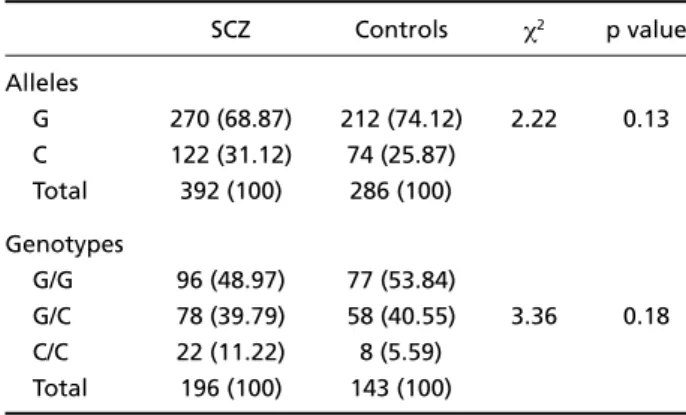
T h e re were no significant deviations from the H a rd y - We i n b e rg equilibrium in any of the samples for the polymorphism studied (SCZ: p=0.31; contro l s : p=0.49). Case-control analysis provided no diff e re n c e in allelic (p=0.13, χ2=2.22, OR=0.77 0.54<OR<1.10) and genotypic (p=0.18, χ2=3.36, 2d.f.) distributions between patients and controls samples (Ta b l e ) .
DISCUSSION
The results of the present study found no eviden-ce for an association between the polymorphism and SCZ. These findings are in agreement with a linkage study in a Canadian population1 9, a case-control asso-ciation study in a Portuguese population2 0, and a trio-based (father, mother and proband) study also in a P o rtuguese sample2 1. However, these results do not s u p p o rt some linkage studies that found evidence of linkage in regions of chromosome 6 and SCZ. Such phe-nomenon may reflect the possibility that there might be other mutations in this gene that play a role in SCZ, or that there are other genes related to the suscep-tibility for SCZ in chromosome 6.
A possible limitation of the present investigaton is related to the populatiinvestigaton stratificatiinvestigaton. Assoc i-ation studies using case-control approach can genrate false association because it is difficult to pre c i s e-ly match patients and controls for ethnicity because physical characteristics are not always related to ge-netic background, especially in Brazil where the po-pulation is so mixed2 2. So diff e rences in allele fre q u e n-cies between populations could generate false re s u l t s . Even trying to match the populations for ethnicity,
Table Distributions of the G861C alleles and genotypes fre q u e n -cies in SCZ patients and controls samples
SCZ Controls χ2 p value
Alleles
G 270 (68.87) 212 (74.12) 2.22 0.13 C 122 (31.12) 74 (25.87)
Total 392 (100) 286 (100)
Genotypes
G/G 96 (48.97) 77 (53.84)
G/C 78 (39.79) 58 (40.55) 3.36 0.18 C/C 22 (11.22) 8 (5.59)
382 Arq Neuropsiquiatr 2005;63(2-B)
as done in this work, this is an issue that has to be c o n s i d e red in case-control investigations.
In conclusion, the results of this work do not pro-vide epro-vidence of association between SCZ and alle-les and genotypes of the G861C polymorphism in the 5-HT1Dβ a u t o receptor gene with SCZ in the studied sample.
REFERENCES
1. M c G u ffin P, Owen MJ, O’Donovan MC, Thapar A, Gottesman I. Seminars in psychiatric genetics. London: Royal College of Psychiatrists, 1994. 2. Prasad S, Semwal P, Deshpande S, Bhatia T, Nimgaonkar VL, Telma BK.
Molecular genetics of schizophrenia: past, present and future. J Biosci 2002;27:35-52.
3. Stahl SM, Wets K. Neurochemistry and neuropharmacology of schizoph-renia. London: Elsevier, 1987.
4. Joyce JN, Shane A, Lexow N, Winokur A, Casanova MF, Kleinman JE. Serotonin uptake sites and serotonin receptors are altered in the lim-bic system of schizophenics. Neuropsychopharmacology 1993;8315-8336. 5. Kapur S, Remington G. Serotonidopamine interaction and its re l e v a
n-ce to schizophrenia. Am J Psychiatry 1996;153:466-476.
6. Barnes NM, Sharp T. A review of central 5-HT receptors and their func-tion. Neuropharmacology 1999;38:1083-1152.
7. Hamblin MW, Metcalf MA. Primary stru c t u re and functional characteri-zation of a human 5T1D-type serotonin receptor. Mol Pharmacol 1991; 40:143-148.
8. Demchyshyn L, Sunahara R, Miller K, et al. A human serotonin 1D re c e p-tor variant (5HT1Dβ) encoded by an intronless gene on chromosome 6. Proc Natl Acad Sci USA 1992;89:5522-5526.
9. Weinshank RL, Zgombick JM, Maccihi MJ, Branchek TA, Harting PR. Human serotonin 1D receptor is encoded by a subfamily of two dis-tinct genes: 5-HT1D alpha and 5-HT1D beta. Proc Natl Acad Sci USA 1992;89:3630-3634.
10. Jin H, Oksenberg D, Askhenazi A, et al. Characterization of human 5-hydroxytryptamine1B receptor. J Biol Chem 1992;267:5735-5738. 11 . Martinez M, Goldi L, Cao Q, et al Follow-up study on a susceptibility locus
for schizophrenia on chromosome 6q. Am J Med Genet 1999;83:337-343. 12. Hwu H-G, Lin M-W, Lee P-C, Lee F-C, Ou-Yang W-C, Liu C-M.
Evalua-tion of linkage of markers on chromosome 6p with schizophrenia in Taiwanese families. Am J Med Genet 2000;96:74-78.
13. B a ron M. Genetics of schizophrenia and the new millennium: pro g re s s and pitfalls. Am J Hum Genet 2001;68:299-312.
14. Lander ES. The new genomics: global views of biology. Science 1996; 274:1594-1595.
15. Collins FS, Guyer MS, Chakravarti A. Variations on the theme: catalo-ging human DNA sequence variation. Science 1997;278:1580-1581. 16. American Psychiatric Association. Diagnostic and statistical manual of
mental disorders, 4th ed. Washington, DC: American Psychiatric A s s o c i a-tion, 1994.
17. Lappalainen J, Dean M, Charbonneau L, Virkkunen M, Linnoila M, Goldman D. Mapping of the serotonin 5-HT1Dβautoreceptor gene on c h romosome 6 and direct analysis for sequence variants. Am J Med Genet 1995;60:157-161.
18. Shan P. Statistics in human genetics. New York: Arnold, 1998. 19. Sidenberg DG, Basset AS, Demchyshyn L, et al. New polymorphism
for human serotonin 1D receptor variant (5-HT1Dβ) not linked to schiz-ophrenia in five canadian pedigrees. Hum Hered 1993;43:315-318. 20. Coelho I, Macedo A, Valente J, et al. Association study of serotonin re c e
p-tors and schizophrenia in a portuguese population. Psiquiatria Clínica 1997;18:41-47.
21. Ambrósio AM, Kennedy JL, Macciardi F, et al. Lack of association or linkage disequilibrium between schizophrenia and polymorphisms in the 5-HT1DA and 5-HT1DB autoreceptor genes: family-based associ-ation study. Am J Med Genet 2004;128:1-5.