Mailing address: Maria das Graças Carvalho – Depto de Análises Clínicas e Toxicológicas – Faculdade de Farmácia da UFMG – Av. Olegário Maciel, 2360 30180-112 - Belo Horizonte, MG – E-mail: [email protected]
Objective - To investigate whether patients with heart valve prostheses and similar International Normalized Ratios (INR) have the same level of protection against thromboembolic events, that is, whether the anticoagula-tion intensity is related to the intensity of hypercoagulabi-lity supression.
Methods - INR and plasma levels of prothrombin frag-ment 1+2 (F1+2) were assessed in blood samples of 27 patients (7 with mechanical heart valves and 20 with bio-logical heart valves) and 27 blood samples from healthy donors that were not taking any medication.
Results - Increased levels of F1+2 were observed in blood samples of 5 patients with heart valve prostheses taking warfarin. These findings reinforce the idea that even though patients may have INRs, within the therapeu-tic spectrum, they are not free from new thromboembolic events.
Conclusion - Determination of the hypercoagulabili-ty marker F1+2 might result in greater efficacy and safehypercoagulabili-ty for the use of oral anticoagulants, resulting in improved quality of life for patients.
Key words: heart valve prostheses, warfarin, prothrom-bin fragment 1+2
Arq Bras Cardiol, volume 79 (nº 5), 505-9, 2002
Claudia Natália Ferreira, Lauro Mello Vieira, Luci Maria Sant'Ana Dusse, Carlos Faria Santos Amaral, William Antônio de Magalhães Esteves,
Lúcia Maria Amorim Fenelon, Maria das Graças Carvalho
Belo Horizonte, MG - Brazil
Evaluation of the Marker of Hypercoagulability Prothrombin
Fragment F 1+2 in Patients with Mechanical or
Biological Heart Valve Prostheses
Oral anticoagulants have been widely used to decrea-se the levels of vitamin K- dependent factors, that is II, VII, IX, and X, contributing to decreased thrombotic risk. Para-doxically, the use of anticoagulants reduces plasma levels of natural anticoagulants, C and S proteins, thus facilitating hypercoagulability. This fact raises concerns about the effects of oral anticoagulant use and its affects on hemosta-tic balance, protecting or not protecting the patient. Moni-toring of oral anticoagulant therapy through measuring prothrombin time (PT) has contributed to substantial advances, revealed by the expression of the results of this test in terms of the International Normalized Ratio (INR), which contributes to the reduction of differences between results, therefore, making them more reliable. However, the use of prothrombin time as the method of choice for monito-ring patients with heart valves who are taking oral anticoa-gulants is controversial. Are patients protected when the therapeutic range of IRN is similar to that expected? The number of patients with heart valve prostheses is signifi-cant, and they need anticoagulation medication for the rest of their lives, with constant monitoring. The main remai-ning problem is the thromboembolic potential of these valves 1. Although the use of INR represents an advance
However, no consistent information is available on the extension of hemostatic mechanism activation in patients with a history of systemic thromboembolism without a defi-nite defect in the coagulation system 3. Thus, the benefits of
the use of activation markers of coagulation, such as F1+2, have been emphasized for monitoring oral anticoagulant therapy 4, because reduction in plasma levels of F1+2 was
demonstrated in patients with oral anticoagulant treatment. Thus, some investigators have presumed that warfarin do-sage may be adjusted based on F1+2 concentrations 5.
Be-cause prothrombin plays a fundamental role in the result of procoagulant stimulation, the quantification of F1+2 levels is considered one of the most important markers of hyper-coagulability, reflecting the activation rate of prothrombin and, consequently, the levels of thrombin formed 6.
Eleva-tion in F1+2 levels was observed in familial prethrombotic conditions, such as in antithrombin AT-III and C and S protein deficiencies.
The main purpose of this study was to investigate whether patients with similar INRs have the same protection against thromboembolic events, that is, whether the intensity of anticoagulation is related to the level of hypercoagulability supression. This study may contribute to a better un-derstanding of the regulation of hemostatic mechanisms in therapy with oral anticoagulants and may also contribute to a better laboratory assessment of oral anticoagulant therapy in patients with heart valve prostheses, which would be clinically useful in the follow-up and prognosis of these patients.
Methods
We evaluated 54 patients: 27 patients were normal controls, 10 patients taking acetylsalicylic acid (Bio-AAS) had biological heart valve prostheses, 10 patients taking warfarin (Bio-War) had biological heart valve prostheses, and the remaining patients were taking warfarin (Mec-War) and had mechanical heart valve prostheses. Patients were consecutively enrolled at Hospitais das Clínicas, Vera Cruz, and Socor and were referred to the Laboratório de Hemato-logia Clínica da Faculdade de Farmácia da UFMG (Labora-tory of Clinical Hematology of the College of Pharmacy of the Federal University of Minas Gerais). All the patients re-ceived stable doses of warfarin (n=17) and acetylsalicylic a-cid (n=10), for at least 1 month. The present study was ap-proved by the Conselho Técnico Científico do Hospital das Clínicas da UFMG (Scientifical Technical Board of the Clini-cal Hospital of UFMG). Table I summarizes demographic characteristics and the number of patients from both study groups.
Venipunctures were performed in patients and in the control group after an 8-hour fast, and a 5-mL blood sample was drawn with vacuum tubes (Vacutainer system tube
-Becton-Dickinson) containing 3.8% sodium citrate (anti-coagulant: blood proportion 9:1), and processed as follows: blood samples were centrifuged at 2.500 rpm for 10 minutes to obtain plasma poor in platelets. After centrifugation, plas-ma samples were aliquoted for different purposes: one was
separated for analysis of prothrombin time and INR up to 3 hours after collection. The other was frozen at -20°C until the simultaneous testing of F1+2 from both patients and controls.
Prothrombin time and INR were determined with a coa-gulometer ST4–BIO (Diagnostica Stago, Asnieres-sur-Seine, France) that used rabbit brain thromboplastin ( Bio-lab Merieux, São Paulo, Brasil, ISI = 1.83). All plasma pools
were diluted with saline solution (0.85%) to determine the standard-curve. Plasma concentrations of F1+2 were deter-mined with the enzyme immunoassay Enzygnost F1+2 micro (Behring DiagnosticsGmbH, Marburg, Germany). This ELISA assay also uses microtitration plates, and rea-dings were conducted on Bio – Rad (model 550).
Results
The results are presented in table II as mean ± stan-dard deviation. Differences between the groups were tested with analysis of variance followed by Tukey’s test. A statis-tical significance level of 5% was adopted.
Regarding prothrombin time and INR, no significant difference was observed between the control group and the group of patients taking acetylsalicylic acid who had biolo-gical heart valves, whereas a significant statistical differen-ce was observed between the control group and the group
Table I - Characterization of the groups of individuals studied
Groups Control Bio-AAS Bio-War Mec-War Total
(n) (n) (n) (n) (n)
Patients 27 10 10 7 54
Male sex 15 5 2 5 27
Female sex 12 5 8 2 27
Age average 37 43 50 45
-(Age group) (17-64) (15-64) (23-72) (36-61)
Size of the sample (n), sex, age average, and age group of the groups studied: normal control, patients with biological heart valve prostheses taking in acetylsalicylic acid (Bio-AAS) or taking warfarin (Bio-War) and with mechanical heart valve prostheses also taking warfarin (Mec-War).
Table II - Results obtained in patients taking warfarin or acetyl-salicylic acid and normal controls, regarding the
parameters studied
Parameters Control Bio-AAS Bio-War Mec-War
AP (%) 84.2 83.0 48.9 38.6
(11.4) (10) (15.5) (8)
INR 1.15 1.19 2.33 2.83
(0.16) (0.13) (0.93) (1.1) F1+2 (µmol/L) 0.62 0.72 0.64 0.63 (0.22) (0.36) (0.41) (0.48)
of patients taking warfarin who had biological and mechani-cal heart valves (P<0.05).
Analysis of the results showed that the marker of pro-thrombin activation, fragment F1+2, was not significantly different between the groups studied, although great varia-tion inside the groups occurred. The highest F1+2 result was observed in a patient with mechanical heart valves ta-king 2 warfarin pills a day, which was the maximun anticoa-gulant dose used in this study. The results of F1+2 determi-nation in patients with heart valve prostheses in general are shown in table III. Of 27 patients with heart valves taking warfarin or acetylsalicylic acid, 5 had F1+2 levels above the reference range. No correlation between the results of F1+2 and INR were observed when all patients were compared as a whole. However, because the patients with mechanical heart valves constitute a group with greater thromboembo-lic risk and therefore, are mandatory users of oral anticoa-gulation, we also investigated the correlation between INR values and F1+2 for this group, aiming at determining whether the level of anticoagulation was related to supres-sion of the hypercoagulability state. No correlation was ob-served between INR values and F1+2, for the mechanical heart valve group, although this group used higher doses of oral anticoagulants and, thus, had mean INR values higher than those of the other groups. Results of individu-al vindividu-alues for INR and F1+2 in the mechanicindividu-al heart vindividu-alve prostheses group are presented in table IV.
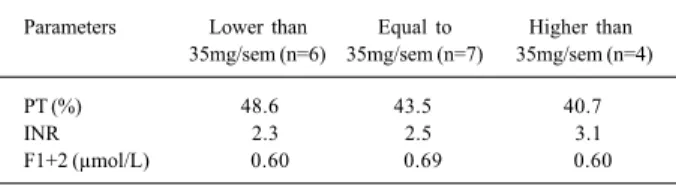
Regarding the dosage of warfarin used by patients, significant differences were not observed between levels of PT, INR, and F1+2 when dosages lower than, equal to, or greater than 35 mg/week were compared (tab. V).
The group of patients taking oral anticoagulants who had mechanical heart valves are divided into low-intensity warfarin (INR = 1.2–1.4); moderate-intensity warfarin (INR = 1.5-3.0), and high-intensity warfarin (INR > 3.0) groups and are presented in table VI. In the present study, of the 7 pa-tients with mechanical heart valves, 6 had INR values bet-ween 1.5 and 3.0.
Discussion
Through data analysis, we observed that acetylsali-cylic acid did not change the results of prothrombin time or INR in patients with biological heart valves.
Patients with biological heart valves generally expe-rience fewer thromboembolic events, compared with those with mechanical heart valves and, therefore, most of these patients use only acetylsalicylic acid. In the present study, we observed patients with plasma F1+2 levels above refe-rence levels (tab. III). However, it is possible that other fac-tors may be interacting in these patients, resulting in an ap-parent state of hypercoagulability suggested by the in-creased levels of F1+2.
Despite a suitable monitoring through prothrombin time, approximately 10 to 20% of the patients treated with warfarin developed thromboembolic or bleeding complications because of inadequate warfarin therapy. Although some of these complications may occur when prothrombin time is out of therapeutical range, about 50% of the complications occur when prothrombin time is within this range 7, strengthening the
idea that the introduction of a marker hypercoagulability,
Table III - Number of patients with heart valve prostheses with F1+2 results lower, within, or below reference values
(0.4 to 1.1 µmol/L)
F1+2 values Bio-AAS Bio-War Mec-War Total
Lower than 0.4 µmol/L 2 3 3 8
From 0.4 a 1.1 µmol/L 6 5 3 14
Above 1.1 µmol/L 2 2 1 5
Bio-AAS - patients taking acetylsalicylic acid with biological heart valve prostheses; Bio-War - patients with biological heart valve prostheses taking warfarin; Mec-War - patients with mechanical heart valve pros-theses taking warfarin.
Table V - Effects of warfarin dosage on the parameters studied
Parameters Lower than Equal to Higher than 35mg/sem (n=6) 35mg/sem (n=7) 35mg/sem (n=4)
PT (%) 48.6 43.5 40.7
INR 2.3 2.5 3.1
F1+2 (µmol/L) 0.600 0.690 0.603
Mean of studied parameters: PT- prothrombin time; INR- international nor-malized ratio; F1+2 - 1+2 prothrombin fragment in patients with mechanical or biological heart valve prostheses taking warfarin, at doses lower than, equal to, or higher than 35mg/week. No significant difference existed when the effect of different warfarin dosages was compared with to the parameters studied.
Table IV - Results of individual values for INR and F1+2 in the group of patients with mechanical heart valve prostheses
taking warfarin
Patients INR F1+2
1 2.46 0.64
2 2.53 0.30
3 2.07 1.06
4 5.30 1.50
5 2.60 0.48
6 2.50 0.24
7 2.83 0.20
INR- international normalized ratio; F1+2 - 1+2 prothrombin fragment.
Table VI - Number of patients with mechanical heart valve prostheses divided into: low- intensity warfarin, moderate-intensity warfarin,
and high-intensity warfarin 10
Level of anticoagulation Number of patients
Low intensity (INR = 1.2 – 1.4) 0 Moderate intensity (INR = 1.5 – 3.0) 6 High intensity (INR > 3.0) 1
together with INR, may be very useful for improving monitoring of patients receiving oral anticoagulants.
The benefits of determining markers of activated coa-gulation in monitoring oral anticoagulant therapy have been studied mainly by Conway et al. 8, the first to
demons-trate F1+2 supression in patients stabilized with an oral an-ticoagulant. Because of that, studies have been carried out to analyze the adjustment of warfarin dosage, using as a base F1+2 concentration 5. F1+2 concentration in patients
stabilized with oral anticoagulants was determined in the present study, and no correlation was observed between F1+2 concentration and the level of anticoagulation expres-sed as an INR. Despite the absence of a correlation between these 2 parameters, we cannot establish a parallel between the level of supression of hypercoagulability through the results of the marker of thrombin F1+2 generator, and the in-tensity of anticoagulation through INR values. Table II shows that no significant difference exists regarding F1+2 levels, between the groups using warfarin and the control groups. However, isolated cases with increased F1+2 levels were found in our study, which enabled us to make inferen-ces about the potential for the occurrence of a new throm-botic event.
Barcellona et al 9 and Tripodi et al 4 demonstrated that
F1+2 is a sensitive marker of anticoagulation, even when the intensity of treatment is very low. A statistically signifi-cant progressive decrease occurred in F1+2 levels with in-creasing anticoagulation up until an INR value of 3.0. The F1+2 decrease, however, was barely detectable at INR values > 3.0. The reason for this pattern is not clear.
Jafri et al 10 worked with 3 groups of patients with heart
failure, and the groups were treated with placebo, low-in-tensity warfarin (INR = 1.2 – 1.4), and moderate-inlow-in-tensity warfarin (INR = 1.5 – 3.0). They observed that the markers of hypercoagulability TAT (thrombin-anti-thrombin comple-xes), D-dimers, and F1+2 decreased with the increase in oral anticoagulant intensity. However, patients with increased F1+2 levels were observed in the groups treated with place-bo and in the groups treated with warfarin after 3 months of treatment.
The majority of patients had an adequate intensity of anticoagulation, as we can see in table VI. Table IV summa-rizes INR and F1+2 levels from patients with mechanical heart valves. Considering the results presented in these tables, it can be suggested that F1+2 determination is an im-portant tool in selecting patients at risk of developing thrombotic events, considering that the great majority of pa-tients seemed stably anticoagulated, considering INR values as parameters. Data analysis of each patient shows that activation of the coagulation mechanism may occur, which can be verified by increased F1+2 levels, is spite of adequate values for INR. This stresses the potentiality of the use of F1+2, an important marker of thrombin genera-tion, therefore, a marker of hypercoagulability, in such pa-tients, since they have greater thromboembolic risk for eventual coagulation hyperactivation.
In the present study, 5 patients had F1+2 values
abo-ve the reference range, while 14 patients were within this range and 8 patients were below it (tab. III). F1+2 increase observed in 5 patients may be explained because of hetero-genity in warfarin bioavailibility, prostheses characteristics, and because of concomitant diseases 11. However, the
rele-vance of F1+2 values observed in this study needs to be confirmed in a longer follow-up, seeking the establishment of the relationship between increased F1+2 levels and recur-rence of thromboembolic events.
We must consider that our patients were undergoing oral anticoagulation therapy throughout the period of the study, and they were at potential risk of hypercoagulability resulting mainly from mechanical heart valve prostheses or, to a lesser degree in, from biological heart valve prostheses. INR values of 2.0-3.0, corresponding to prothrombin levels of approximately 20-40% of the normal have been considered acceptable 12. However, the minimal level of each
Vitamin K-dependent protein required to protect the patient from thrombosis has still not been determined. Thus, F1+2 measurement may be useful as a tool in monitoring patients receiving oral anticoagulants.
Our data questions the protective effect of warfarin against thromboembolic events once F1+2 levels are incre-ased in some patients taking oral anticoagulants with heart valve prostheses. According to the literature, levels of hy-percoagulability markers are reduced in patients receiving oral anticoagulants 8,10. However, the use of these markers as
a tool to preview thromboembolic complications has still not been well analyzed in patients with heart valve prosthe-ses receiving oral anticoagulants or acetylsalicylic acid. Additionally, data in the literature suggest that the intensity of oral anticoagulants is associated with the level of hyper-coagulability supression. However, evidence exists of incre-ased fibrinolitic activity as well as platelet activation, and ab-normal endothelial function in patients with heart failure 12,13.
It is possible that the hypercoagulability state predisposes heart failure patients to intravascular thrombi and an in-crease in clinical events 10. The oral anticoagulant dosage
necessary to minimize this state of hypercoagulability varies from patient to patient. Thus, reduced dosages may be effi-cient for some patients, but other patients may need an in-creased dosage of oral anticoagulants or even the combina-tion of an oral anticoagulant and acetylsalicylic acid 14.
treatment of concomitant diseases. In the absence and/or impossibility of its diagnosis, the possibility of adding an antiagregating platelet agent to oral anticoagulant therapy must be considered. This procedure instead of increasing the need for oral anticoagulant dosing would possibly result in a reduction in the risk of thromboembolic complica-tions (which could be verified by a new assessment of F1+2 levels) and would not increase hemorrhagic risk. This mea-sure, probably, would result in greater efficacy and safety for the use of oral anticoagulants, providing a better quality of life for patients. However, further studies involving new experiments and others markers of coagulability in addition
to F1+2 are necessary, using a larger sample of patients with heart valve prostheses to confirm whether the reduction in thromboembolic events is related to lower events of F1+2 during concomitant use of oral anticoagulants and acetyl-salicylic acid.
Acknowledgments
To Fundação de Amparo à Pesquisa de Minas Gerais (FAPEMIG) (Foundation to Support Research), to CNPq, and Pró-Reitoria de Pesquisa (PRPq) of Universidade Fede-ral de Minas Gerais by the finantial support.
1. Cannegieter SC, Rosendaal FR, Briët E. Thromboembolic and bleeding compli-cations in patients with mechanical heart valve prostheses. Circulation 1994; 89: 635-41.
2. Saour JN, Sieck JO, Mamo LAR, Gallus AS. Trial of different intensities of anti-coagulation in patients with prosthetic heart valves. N Engl J Med 1990; 322: 428-32.
3. Kyrle PA, Eichinger S, Pabinger I, et al. Prothrombin fragment F1+2 is not predic-tive for recurrent venous thromboembolism. Thromb Haemost 1997; 77: 829-33. 4. Tripodi A, Cattaneo M, Molteni A, Cesana BM, Mannucci PM. Changes of pro-thrombin fragment 1+2 (F1+2) as a function of increasing intensity of oral anti-coagulation. Thromb Haemost 1998; 79: 571-3.
5. Tripodi A, Mannucci PM. Markers of activated coagulation and their usefulness in the clinical laboratory. Clin Chem 1996; 42: 664-9.
6. Rugman FP, Jenkins JA, Duguid JK, Maggs PB, Hay CRM. Prothrombin frag-ment F1+2: correlations with cardiovascular risk factors. Blood Coag Fibrinol 1994; 5: 335-40.
7. Furie B, Diuguid CF, Jacobs M, Diuguid DL, Furie BC. Randomized prospective trial comparing the native prothrombin antigen with the prothrombin time for mo-nitoring oral anticoagulant therapy. Blood 1990; 75: 344-9.
References
8. Conway EM, Bauer KA, Barzegar S, Rosenberg RD. Suppression of hemostatic system activation by oral anticoagulants in the blood of patients with thrombotic diatheses. J Clin Invest 1987; 80: 1535-44.
9. Barcellona D, Mameli G, Marongiu F. Inhibition of blood coagulation activation and oral anticoagulants in patients with mechanical heart valve prostheses. Thromb Res 1996; 81: 403-6.
10. Jafri SM, Mammen EF, Masura J, Goldstein S. Effects of warfarin on markers of hy-percoagulability in patients with heart failure. Am Heart J 1997; 134: 27-36. 11. Koefoed BG, Feddersen C, Gullov AL, Peterson P. Effect of fixed minidose
war-farin, conventional dose warfarin and aspirin on INR and prothrombin fragment 1+2 in patients with atrial fibrillation. Thromb Haemost 1997; 77: 845-8. 12. Jafri SM, Ozawa T, Mammen E, Levine TB, Johnson C, Goldstein S. Platelet
func-tion, thrombin and fibrinolytic activity in patients with heart failure. Eur Heart J 1993; 14: 205-12.
13. Sborouni E, Bradshaw H, Andreath F, Tuddenham E, Dakley CM, Cleland JGF. Re-lationship between hemostatic abnormalities and neuroendocrine activity in heart failure. Am Heart J 1994; 127: 607-12.