Cleaner production of soapstone in the Ouro Preto region of Brazil: a case study
M.L.M. Rodrigues, R.M.F. Lima
*Department of Mining Engineering, Federal University of Ouro Preto, Ouro Preto, MG, Brazil
a r t i c l e
i n f o
Article history: Received 1 October 2011 Received in revised form 23 March 2012 Accepted 25 March 2012 Available online 3 April 2012
Keywords: Soapstone residues Talc
Industrial mineral Residue characterisation Residue recovery Flotation
Magnetic separation Leaching process
a b s t r a c t
Soapstone is a metamorphic rock that is used for ornamental and construction purposes. Rock recovery during the exploitation process is low. Quarries in the state of Minas Gerais in Brazil sell small and low-quality blocks to artisans, who produce pans and souvenirs. This activity constitutes the main economic activity in several places within the Ouro Preto region, such as Santa Rita. Soapstone artisan workshops produce a large quantity of powder (approximately 10e15% rock recovery), which is discarded carelessly, often causing environmental problems. The objective of this study was to characterise and purify soapstone powder from the workshop of an artisan who works exclusively with rocks from Bandeiras-Santa Rita de Ouro Preto in order to identify potential applications for the residues and purified prod-ucts. First, the mineralogical composition was determined by X-ray diffractometry, the size distribution was determined by sieving and the chemical composition of the residue was determined by inductively coupled plasmaeoptical emission spectroscopy (ICP-OES). Next, purification tests were performed by magnetic separation for fraction sizes larger than 74mm. Fraction sizes smaller than 74mm were purified byflotation and leaching with hydrochloric acid. This research shows that it is possible to recover almost all residues of both small and large size distributions for use as insecticidefiller. In addition, it is possible to recover 100% and 96% of fraction sizes larger and smaller than 74mm, respectively, for use in the paper industry (wallpaper and packaging). For more valuable applications, it is necessary to leach the purified material fromflotation using hydrochloric acid. In addition to decreasing the environmental impact of soapstone powder discharge, it is possible for soapstone artisans to sell this powder for a profit, whether it is purified or not.
Ó2012 Elsevier Ltd. All rights reserved.
1. Introduction
Soapstone is a metamorphic rock that comes from primitive sedimentary limestone rocks or from basic/ultrabasic igneous rocks by hydrothermal and metasomatic alteration of magnesium sili-cate. The rock texture can be powder, massive or compact and lamellar (Lara Filho, 1997). To be classified as soapstone, the proportion of the mineral talc in the rock must be above 35%, and either the proportion of the minerals chlorite, quartz, calcite, dolomite, magnesite, tremolite, amphibole and hematite must be above 25% (Kuzvart, 1984; Pinheiro, 1973). Talc and soapstone are often used synonymously (Skinner et al., 1997).
Talc (Mg3(SiO4)10)(OH)2) is a magnesium silicate hydrate made up of 31.7% MgO, 63.5% SiO2and 4.8% H2O (Skinner et al., 1997). It is a filler-type industrial mineral that is used in many products, including paint, paper, ceramics, plastic, roofing products, rubber,
cosmetics, pharmaceutics, insecticide, explosives, soap, candles, textiles and cereal polishing (rice, corn and barley). For each application, the talc must have certain properties and characteris-tics in terms of size distribution, morphology, mineralogy, purity, and other factors (Roe, 1975; Pontes and Almeida, 2008; Pogrebenkove et al., 1997andNkoumbou et al., 2008). Soapstone rock is often used as building stone and dimension stone.Fig. 1 presents the main Brazilian deposits of talc, including soapstone, which occurs in the states of Minas Gerais (MG), Goiás (GO) and Bahia (BA).
In the Ouro Preto region of Brazil, located in Minas Gerais State, there are several soapstone quarries that exploit this rock as dimension stone. These places have rich deposits of talc that are extracted as by-products and sold to ceramic industries. The rough blocks are exported to European and North American countries, where they are cut into building stones. Currently, the annual production of soapstone in Bandeiras at Ouro Preto region is 4800 tons of soapstone and 2400 tons of talc.
During the exploitation of dimension stones, such as soapstone, only 30% of the rock is recovered. The remaining 70% is composed of small blocks that are used in artisan workshops, where pans and *Corresponding author. Departamento de Engenharia de Minas, Universidade
Federal de Ouro Preto, Campus Universitário, Morro do Cruzeiro, S/N, CEP: 35400-000, Ouro Preto, MG, Brasil. Tel.:þ55 31 3559 1590; fax:þ55 31 3559 1593.
E-mail address:[email protected](R.M.F. Lima).
Contents lists available atSciVerse ScienceDirect
Journal of Cleaner Production
j o u r n a l h o m e p a g e : w w w . e l s e v i e r . c o m / l o c a t e / j c l e p r o
souvenirs are produced. In the production of pans, for example, the recovery of rock is approximately 10 wt% (Santos, 2009), which means that the global recovery of soapstone exploited in quarries is only 40 wt%. Approximately 60 wt% of the rock is discharged as residue. Fig. 2 shows the main activities performed in a typical soapstone quarry in Santa Rita de Ouro Preto and the products that are sold to local artisans. Details of the production processes for souvenirs and pans are presented. A saw is applied to cut the rock and after a wood lathe is used to make and polish the produced objects. The large quantity of soapstone powder discharged from artisan workshops is also shown.
Lima et al. (2009)performed a technological characterisation of soapstone samples (Fig. 2(D)) used in artisan workshops fromfive different soapstone quarries in the Bandeiras region of Santa Ritae Ouro Preto. The minerals were identified using optical microscopy, X-ray diffraction and scanning Electron Microscopy with an Energy Dispersive System (SEM/EDS). The following minerals were found: silicates [talc (Mg3(Si4O10)(OH)2), chlinoclore ((Mg, Fe)(Si,Al)4O10(OH)8, phlogopite (KMg3(Si3Al)O10(F,OH)2), tremolite/ actinolite (Ca2Mg5(Si8O22)(OH)2/Ca2(Mg,Feþþ)5Si8O22(OH)2) and orthoclase (K(AlSi3O8)], carbonates [magnesite (MgCO3) and dolo-mite (CaMg(CO3)2)], sulphides [pyrite (FeS2), arsenopyrite (FeAsS) and pentlandite ((Fe,Ni)9S8)], oxides [magnetite(Fe3O4)/hematite (Fe2O3) and ilmenite (FeTiO3)]. The apparent porosities of the soapstone rock samples were between 0.3 and 0.4%, and the apparent water absorption was approximately 0.11%. The Rockwell hardness of the samples was of a high range (73e84). This variability was attributed to the mineralogical heterogeneity on the faces analysed. The uniaxial compressive strength of the rock samples was between 20 and 25 MPa, and rupture occurred on thefirst or second cycles of the thermal tests.
The density of soapstone powder collected from the artisan workshop in the Bandeiras region varied from 2.73 to 2.83 (Rodrigues, 2010). The value of oil absorption of the purified product was 28.5 (g/100 g). This value is within the specification for pigments and extenders (Rodrigues and Lima, 2011; Casanova et al.,
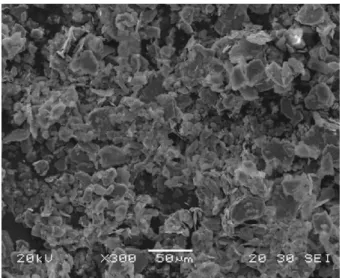
2007). The morphology of the particles of purified talc was lamellar, as shown inFig. 3.
This paper presents the characteristics and the main results of the purification tests carried out on the powder residues from an artisan workshop in Ouro Preto (Fig. 2(G)), the objective being to decrease the residues produced in this activity in order to find a classical application of this industrial mineral, as applications suggested byDriussi and Jansz (2006).
2. Materials and methods
Representative soapstone residues were collected in the work-shop of an artisan who works exclusively with rocks originating from the Bandeiras region in Santa Rita de Ouro Preto. First, the powder residue was homogenised and quartered to obtain subsamples to determine the size distribution of the particles, as well as to perform mineralogical and chemical characterisation. The size distribution of the material was determined by wet sieving, and the fraction size 74
m
m was determined by laser diffraction (Cilas 1064). Then, chemical analyses of size fractions greater and lower than 74m
m were carried out using an Inductively Coupled PlasmaeOptical Emission Spectrometer (Spectro model Ciros/CCD), except for SiO2content, which was determined by the difference between 100% and the sum of all chemical element/ compound contents plus the loss on ignition (LOI).The mineral composition of soapstone powder in both fraction size groups was performed using the X-ray diffraction (XRD) total powder method. The radiation used was Cu K
a
. The goniometer velocity was 1.2/min, the counting time was of 58 min and data were collected from 2to 70. A Rigaku model 3550 diffractometer was used. Mineral identification was performed using the pattern diffraction tool of the JADE 7.0 software package.The purification of soapstone powder was realised using magnetic separation (Carpco Inc. model WHIMS 3X4Leserial 210-97) and frothflotation (Cimaq cell). Leaching tests were performed with the concentrate of an optimisedflotation test using hydro-chloric acid (HCl).
In the magnetic concentration (fraction size above 74
m
m), the influence of the variable magneticfield intensity (3000; 4300 and 4900 G) on the mass recovery and whiteness of purified talc was studied. These experiments were replicated for each condition. The experimental procedure for the wet magnetic concentration tests consisted of the following steps. First, the magneticfield intensity wasfixed to the desired value. Then, with the water tap open (flow rate of 670 mL min 1), a 100 g sample of dry soapstone powder was fed into the equipment. When it was observed that no particles were dropping into the non-magnetic bucket product, a new bucket was substituted in. Then, the equipment was turned off and the magnetic product was collected in the new bucket. Finally, both the magnetic and non-magnetic products werefiltered, dried and weighed to calculate mass recovery. Finally, the products (magnetic and non-magnetic) were sampled to obtain subsamples for the determination of whiteness, CIE (L*a*b*) indices and chemical composition.Purification of the soapstone powder (fraction sizee74
m
m) was performed byflotation. Minitab 15 software was used to create and analyse the results of a fractional planning design (1/8) of eight factors (variables) on variable responses (mass recovery and whiteness). For each variable, two levels (minimum and maximum) were tested, as presented inTable 1. This analysis was performed on a total of 32flotation tests.The following experimental procedure was used for theflotation tests. A mass of soapstone powder ( 74
m
m) and the water quan-tities necessary to obtain the pulp density desired (10 or 20%) were put into a 2 L cell cube. The cell speed was then adjusted (800 or Fig. 1.Location of the talc deposits, including soapstone, in Brazil (CEeCeará; PIePiauí; BAeBahia; GOeGoiás; MGeMinas Gerais; SPeSão Paulo; PReParaná; RSe Rio Grande do Sul) (modified fromLara Filho, 1997).
1200 rpm). The airflow rates were 17.5 and 98 mL s 1for cell speeds of 800 and 1200 rpm, respectively. After 2 min, the depressant sodium silicate (500 or 1000 g/ton) was added and conditioned (5 or 10 min). During conditioning with the depres-sant, the pH of the pulp was adjusted (7 or 11). Next, kerosene (500 or 1000 g/ton) was added to the pulp and conditioned (5 or 10 min). The MIBC frother (75 or 150 g/ton) was then added to the pulp, and the pulp was conditioned (5 or 10 min). The air tap was opened, and the froth was collected for approximately 6 min. Both products
(float and sink) were filtered and weighed to calculate the mass recovery. Finally, the products were homogenised, sampled and powdered to determine the whiteness, CIE (L*a*b*) indices and chemical composition.
The leaching tests of the purified product, obtained using the optimisedflotation condition for the 74
m
m soapstone powder, were carried out using hydrochloric acid in the following condi-tions: HCl concentration (2 and 4 M), temperature (50C and 80C) and leaching time (30 and 60 min). Minitab 15 software was used to create and analyse the results of a planning factorial design with three factors (variables) on variable response whiteness. This analysis was performed on a total of 16 leaching tests.Desliming operation for soapstone powder (fraction size 74
m
m) was carried out with the objective of avoiding the heterocoagulation of ultrafine particles (<10m
m) of gangue minerals and talc, gangue ultrafine particles entraining in the concentrates and the slime coating of the gangue minerals by talc ultrafine particles and vice-versa (Sivamohan, 1990; Jameson et al.,Table 1
Variables and their respective levels tested in theflotation tests.
Factors (variables) Level
Minimum Maximum
Kerosene (g/ton) 500 1000
Sodium metasilicate (g/ton) 500 1000
Methyl isobutyl carbinoleMIBC (g/ton) 75 150
Pulp pH 7 11
Pulp density (%) 10 20
Cell speed (rpm) 800 1200
Kerosene conditioning time (min) 5 10
MIBC conditioning time (min) 5 10
Fig. 2.Typical operations in a soapstone quarry, the commercial products and the souvenir production process in artisan workshops in the Ouro Preto region: (A) Detail of the exploitation operation in a soapstone quarry of Santa Rita de Ouro Preto, (B) A rough block of soapstone, (C) Transport of the rough block to be exported, (D) Small pieces of soapstone to be used in artisan workshops, (E) Saw applied to cut the objects produced in artisan workshops, (F) An artisan performing his work and (G) Soapstone powder.
Fig. 3.Scanning electron microscope (SEM) image of purified talc from soapstone powder (Rodrigues and Lima, 2011).
2007). The desliming process consisted of the following steps. First, the soapstone powder was put into a 4 L cell cube. Then, a volume of water sufficient to obtain a pulp density of 15% was added, and theflotation cell (Cimaq) was turned on at an adjusted speed of 1200 rpm. After 3 min, theflotation cell was turned off, and after 10 min, the mud was removed. This operation was performed twice. Finally, the deslimed soapstone powder was dried at 105C. The leaching tests of purified soapstone byflotation consisted of the following steps. First, a pulp of 15% density was prepared with deionised water. Then, the speed of a constant temperature magnetic stirrer (BiomiXer, model 78HW-1) was adjusted to 640 rpm. The pulp was conditioned for 2 min at a temperature of 50C or 80C. After the pulp achieved the desired temperature (50C or 80C), hydrochloric acid was added (2 or 4 M), and the pulp was submitted to constant stirring for the specified time (30 or 60 min). The solids were then washed with deionised water, vacuum filtered with a Buchner funnel, dried at a temperature of 105C, weighed, homogenised, quartered and powdered to determine the whiteness, CIE indices (L*a*b*) and chemical composition.
The whiteness and CIE indices (L*a*b*) of the soapstone powder (þ74
m
m and 74m
m) and the purified talc were determined using a Technidyne Color Touch PC spectrometer. The samples were prepared for determination of the whiteness and CIE indices by powdering the sample in an orbital mill for 1 min. Next, the material was homogenised and quartered to obtain a mass subsample of 10 g that was placed on a watch glass to dry at a temperature of 105C. Then, a pellet of dried powder was made using a Powder Press Apparatus. To do this, the dried sample was transferred to a cylinder placed on a 200square glass compression plate; the plunger was then placed onto the powder, and the mount was put into a powder press at 80 psi. Finally, the pellet was transferred to the spectrometer, and the whiteness and CIE indices (L*a*b*) were determined.3. Results and discussion
3.1. Size distribution and mineralogy
Fig. 4presents the size distribution of the soapstone powder residue obtained using wet sieving. Approximately 50% of the particles are under 74
m
m, and approximately 27% of the particles are smaller than 37m
m. Thus, this material was classified in a74-m
m aperture sieve for the concentration tests performed by magnetic separation (fraction size over 74m
m) and frothflotation (fraction size under 74m
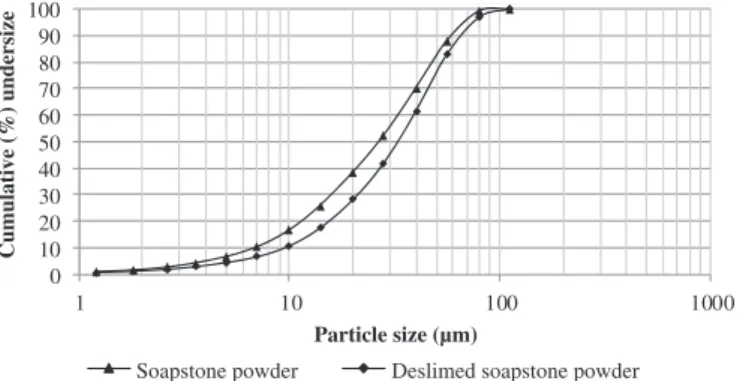
m).Fig. 5presents the size distribution of the soapstone powder residue ( 74
m
m), which was determined using laser diffraction (Cilas 1064). Thed10of soapstone powder without desliming was 7m
m and was 10m
m for deslimed soapstone.The minerals identified, with their respective dvalues (basal spacing), in the X-ray patterns of all size fractions of soapstone
powder analysed, are listed as follows: talc (9.205; 3.1021; 4.641; 2.4826; 1.5550; 1.3881 Å), kaolinite (7.062; 3.7221; 3.5540; 3.1021; 2.2261; 2.1874; 2.0035; 1.8067; 1.6702; 1.5550 Å), chloriteeserpentine (13.94; 7.062; 4.641; 3.554; 2.8453Å), nimite (13.94; 7.062; 4.7156; 3.5540; 2.8453 Å); magnesite (2.8453; 2.3294; 2.0829; 1.3881Å) and dolomite (2.8453; 2.1874; 2.0035 Å). The minerals, sulphides (pyrite, arsenopyrite, pentlandite) and oxides (magnetite/hematite) were identified in soapstone from the Bandeiras region (Lima et al., 2009) but were not detected in the X-ray patterns of the size fractions, probably due to the small proportion (less than 2%) of these minerals in the subsamples analysed and the presence of several minerals, which can make mineral identification in the X-ray patterns difficult. The identified kaolinite mineral may be a result of orthoclase alteration, as iden-tified byLima et al. (2009).
3.2. Purification tests in bench scale
3.2.1. Purification tests for theþ74
m
m sampleTable 2presents the mass recovery, whiteness and CIE indices of the feed and the purified products from the three magnetic sepa-ration tests performed using theþ74
m
m fraction size sample of soapstone powder in each test condition. Table 3 presents the average chemical composition and LOI of the feed and the purified products.As can be observed inTable 2, the mass recovery of the soap-stone residue varied from approximately 62e67%. Piga and
Maruzzo (1992)proposed a preconcentration step for an Italian talc ore containing chlorite, carbonates, magnetite and sulphides by low-intensity magnetic separation to remove the magnetite mineral before the flotation test, once the high intensity field conducted to very low recovery of talc.
The whiteness of the purified product in a 4900 Gfield (Table 2) increased by 6% compared with the feed whiteness (59.72%). This increase in whiteness is probably related to the removal of the iron oxides (magnetite, ilmenite and hematite) present in small proportions in this material. The CIE indices of the purified prod-ucts did not change significantly in comparison with the feed CIE
Table 2
Mass recovery, whiteness and CIE (L*a*b*) indices of purified (non-magnetic) product and feed (residues without ore dressing) for theþ74mm fraction size.
Purified product Mass recovery (%) Whiteness (ISO) CIE group L* a* b*
Feed 100.00 59.72 89.10 0.58 8.05
3000 G 62.53 64.75 88.67 0.68 7.86
4300 G 62.39 65.22 89.00 0.70 8.00
4900 G 67.42 65.44 89.05 0.68 7.88
10 20 30 40 50 60 70 80 90 100 0 0 0 0 1 0 0 0 1 0 0 1 0 1
Particle size ( µm)
Cumulative (%) undersize
Fig. 4.Particle size distribution of soapstone powder residue.
0 10 20 30 40 50 60 70 80 90 100
1 10 100 1000
Cumulative (%) undersize
Particle size (µm)
Soapstone powder Deslimed soapstone powder
Fig. 5.Particle size distribution of soapstone powder residue ( 74mm).
indices. In terms of whiteness, the feed and products purified by magnetic separation were within the specifications for paperfiller (wallpaper and packagingewhiteness ISO of 54e75%) (Pontes and
Almeida, 2008). The value of whiteness obtained and the chemical composition of the purified product (Table 3) are nearly within paint industry specifications (Pontes and Almeida, 2008). Based on these results, it is possible to recover 100% of theþ74
m
m residues for use asfiller in the paper industry, representing a total recovery of 70% of the exploited rock. For the paint industry, the recoveries of 62e67% observed in the non-magnetic product correspond to an 18e20% increase in the global recovery (40%) of exploited soapstone for dimension stone and artisan workshops.3.2.2. Purification tests for the 74
m
m sampleThe Pareto’s chart and surface plots of the studied effects on the mass recovery and whiteness of theflotation tests conducted with soapstone powder (fraction size 74
m
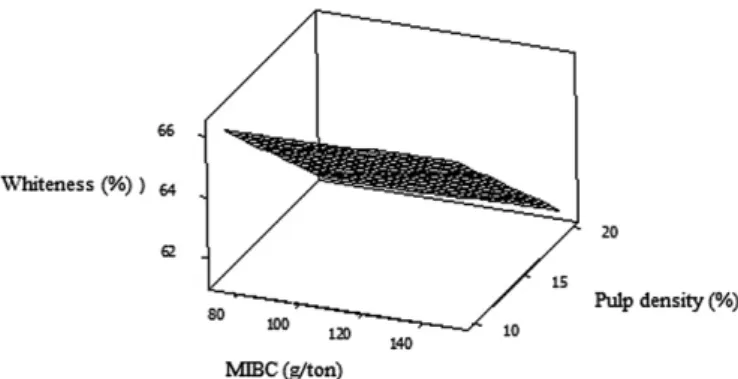
m) are presented in Figs. 6e9.As can be observed inFig. 6, among the studied effects, only the pulp density and the MIBC dosage were significant for mass recovery. In the case of whiteness, only the pulp density was significant (Fig. 7). The mass recoveries were higher when the pulp densities and MIBC dosages were higher (Fig. 8). The opposite occurred for whiteness (Fig. 9). After the optimisation of the factorial planning experimental design using Minitab 15 for a target of 80% mass recovery and 77% whiteness ISO, the optimised response was obtained using a pulp density of 14%, an MIBC dosage of 150 g/ton and a kerosene dosage of 500 g/ton. In this case, the predicted values of the mass recovery and whiteness were 80% and 64%, respectively. Thus, theflotation tests in the bench with soap-stone powder, without and with desliming, were conducted under the optimised conditions for the significant effects (pulp
density of 14% and MIBC dosage of 150 g/ton). All others effects werefixed at their minimum values (sodium metassilicate¼500 g/ ton, pH¼7, cell speed¼800 rpm, kerosene and MIBC conditioning time ¼5 min). For a mixing of four talc ores from the Eastern Desert of Egypt (Shalatin area) (tremoliteetalcechloriteeshist; antigoriteeserpentine; talceshist and talcechloriteeshist), the optimum conditions of theflotation tests were obtained at pH 11, a depressant dosage (sodium hexametaphosphate) of 1 kg/ton, a collector dosage (oleic acid in an equal mixture with kerosene) of 1.2 kg/ton and a pulp density of 200 g L 1(w18%) (Ahmed et al.,
2007). For a representative talc sample composed of magnesite (36.47%), talc (48.69%), serpentine (2.41%), dolomite (9.63%), and quartz (2.47%) from the Wadi El-Barramiya region in the Eastern Desert of Egypt, the optimum pH for natural talcfloatability was neutral (Yehia and Al-Wakell, 2000).
Afterwards, a leaching study of the purified talc from the opti-mised flotation test was conducted with HCl using a factorial planning design. The Pareto’s chart and surface plots of the studied effects (HCl dosage and leaching temperature) on whiteness, carried out with the purified rougherflotation product of soapstone powder (fraction size 74
m
m) without desliming, are presented in Figs. 10e12.As can be observed in the Pareto’s chart (Fig. 10), all of the studied effects were significant in the whiteness response variable. The surface plots (Figs. 11 and 12) show that the whiteness was higher (84%) for a dosage of 4 M of HCl, a temperature of 80C and a time of 60 min of leaching (Fig. 12), which was confirmed as the optimised condition for the levels of the studied variables, using the optimisation tool in Minitab 15 software. This result indicates a gain of 20.5% compared with the rougher purified flotation product (whiteness of 63.5%). An Argentine talc ore concentrate, with 10e20% carbonates (magnesite, dolomite and calcite) with an
Fig. 6.Pareto’s chart (alpha¼0.05) of standardised effects on the mass recovery of purified talc byflotation (rougher step) of soapstone powder ( 74mm) without
desliming.
Fig. 7.Pareto’s chart (alpha¼0.05) of standardised effects on the whiteness of purified talc byflotation (rougher step) of the soapstone powder ( 74mm) without desliming.
Table 3
Chemical composition and loss on ignition (LOI) of non-magnetic (purified) products and feed (fraction sizeþ74mm).
Purified product Content
ppm %
As Cu Ni Pb Zn Al2O3 CaO Fe2O3 MgO TiO2 SiO2 LOI
Feed 11.1 9.59 1941 <8.3 79.5 2.53 0.463 5.40 28.5 0.0642 57.5 6.01
3000 G <9.45 7.57 1944 <8.3 77 2.13 0.0554 3.78 30.4 0.0454 57.6 5.97
4300 G <9.45 8.56 1965 <8.3 68.6 2.12 0.049 3.86 29.8 0.0441 58.2 5.98
4900 G <9.45 7.35 1977 <8.3 67.7 2.14 0.0571 3.97 29.4 0.0426 58.5 5.9
GeGauss.
initial whiteness of 65.5%, exhibited an increase of 4e7% after leaching with hydrochloric acid (concentration of 25e100%) (Sarquis and Gonzalez, 1998). Table 4 presents the results of all purification tests of soapstone powder (fraction size 74
m
m) per-formed in the optimised conditions.As can be observed inTable 4, the mass recovery under the experimental optimised conditions was approximately 7% higher than the optimised value predicted using Minitab 15 (80%), and the whiteness (63.5%) was slightly lower than the optimised value (64.2%) predicted using Minitab 15. In this case, an increase of 12% was observed in the whiteness of the soapstone residue compared with the feed whiteness (51.34%). This result represents the possibility of obtaining an increase of approximately 25% of the global recovery of the exploited soapstone. After two cleaner flotation tests, a product with a whiteness of 68.7% was obtained, which represents an increase of 5% in whiteness compared with the experimental rougher test. However, the mass recovery decreased by approximately 23%. The increase of whiteness obtained with the two cleaning steps was not enough to justify these steps, once the whiteness obtained is just within the speci-fications forfiller paper as the rougher purified product, despite the whiteness gain.
After desliming the soapstone residue (fraction size 74
m
m), the whiteness of the product was 59% (Table 4), an increase of 8% compared with the feed whiteness (51.34%). The mass discharged in this case was only 6 wt%. With this value of whiteness, the fraction size 74m
m (51.34%) could be applied only in the insec-ticide filler. After desliming, 94 wt% of this material could be applied asfiller paper, which means approximately 30% and 28% global soapstone recovery for application in the insecticide andpaper industries, respectively. The mass recovery of the rougher purified product was 81% of the global residue ( 74
m
m), and the whiteness obtained was 67%, which is approximately 3.5% higher than that of the rougher purified product without desliming (Table 4); after two cleaning steps, it was approximately 71%. As in the previous case, a product with specifications within those for paperfiller and paint was obtained once the particles were lamellar and the oil absorption was 28.5 (g/100 g) (Rodrigues and Lima, 2011). Despite the whiteness gained in the cleaning steps, the cleaning steps are not justified because the mass recovery drops drastically and the whiteness of obtained product is not enough for more valuable use.As can be seen inTable 4, the values of lightness (L*) increase
and the values of redness (a*) and yellowness (b*) decrease from rougher concentrate to leached product. Thus, by observing the chemical compositions of all purified products (presented in Table 5), the contents of Fe2O3, Al2O3, TiO2, CaO, LOI, Cu and Zn in the rougher and cleanerflotation concentrate products decreased compared with the feed, which is consistent with the whiteness and lightness of these purified products. These decreases are probably related to the partial removal of the gangue minerals (sulphides, oxides, carbonates, chlinoclore, chloriteeserpentine and nimite), identified in this material byLima et al. (2009).
Higher whiteness (w84%) and a decrease in the indices a* (redness) and b* (yellowness) were observed in the leaching product compared to theflotation concentrates (Table 4). The SiO2 assay increased to 60.3% and the Fe2O3assay decreased to 3.42%. The final product, after leaching the flotation concentrate of Egyptian talc ore with diluted hydrochloric acid (10%), showed an Fig. 8.Mass recovery surface plot of purified talc byflotation (rougher step) of the
soapstone powder ( 74mm) as a function of the MIBC dosage and pulp density
without desliming.
Fig. 9.Whiteness surface plot of purified talc byflotation (rougher step) of the soapstone powder ( 74mm) as a function of MIBC dosage and pulp density without
desliming.
Fig. 10.Pareto’s chart (alpha¼0.05) of standardised effects on whiteness leaching of purified talc of rougherflotation without desliming (AeHCl dosage; Betemperature; Cetime).
Fig. 11.Whiteness surface plot of the purified talc as a function of the HCl dosage and leaching temperature for 30 min.
increase in the SiO2assay and a decrease in the Fe2O3assay (Ahmed et al., 2007).
In terms of the chemical composition of the leaching product presented inTable 5, it can be observed that all impurities, except the Cu grade, were smaller in the leaching product than in the purified rougherflotation product. The opposite was observed with MgO.
Castillo et al. (2011), using XRD and FTIR (Fourier Transform Infrared Spectroscopy), identified the following minerals in a talc sample: talc, chlorite, dolomite, calcite and magnesite. After leaching this sample with hydrochloric acid, they observed a decrease in the Fe2O3assay and loss on ignition assay, which was attributed to the removal of chlorite and carbonates from the sample, evidenced by the fact that the peaks assigned to these minerals in the X-ray pattern and the infrared spectrum dis-appeared. SiO2 and MgO are the main constituents of talc (Mg3(SiO4)10)(OH)2); thus, the increase in MgO content in the leached product is related to the increased proportion of talc and is mainly due to the removal of chlorite and carbonate by hydro-chloric acid. Therefore, based on the chemical composition, whiteness (83.99%) and CIE indices (L*¼94.62;a*¼ 0.11 and b*¼2.22) that were obtained for the leaching product, this purified product achieved the necessary specifications for use in the paint, paper (filler), insecticide, textile and plastic industries.
4. Conclusion
The studies conducted using soapstone powder from the Ban-deiras region of Santa Rita de Ouro Preto show that approximately 50% of the particles are smaller than 74
m
m and approximately 27% are smaller than 37m
m. The identified minerals, in all fraction sizes, were as follows: talc, kaolinite, chloriteeserpentine, magnesite, dolomite and nimite. Sulphides and oxides were not identified, probably due to their small proportion in the subsamples analysed and the presence of several minerals, which can make mineral identification in the X-ray patterns difficult. It is possible to recover 100% of the soapstone residue for use as insecticide filler. The fraction size above 74m
m can be used in the paper industry (wallpaper and packaging). The same application is possible for fraction sizes 74m
m after desliming (mass recovery of 94%). For the paint industry, it is necessary to purify the residues using magnetic separation (mass recovery of 67% for fraction size above 74m
m) and flotation (mass recovery above 80% for fraction size below 74m
m). For more valuable applications, such as usage in the plastic industry, the material must be leached by hydrochloric acid.Acknowledgements
Financial support from FAPEMIG and CNPq for scholarships for the authors is gratefully acknowledged. The authors are grateful to reviewers.
List of symbols
L* lightness
a* redness
b* yellowness
LOI loss on ignition MIBC metyl isobutyl carbinol
G Gauss
M molar
L liter
mL milliliter Fig. 12.Whiteness surface plot of the purified talc as a function of HCl dosage and
leaching temperature for 60 min. Table 5
Chemical compositions and LOI of feed and all optimised purified products (fraction size 74mm).
Product Content
(%) (ppm)
MgO SiO2 Al2O3 CaO Fe2O3 TiO2 LOI Ni Cu Pb Zn As
Feed ( 74mm) 27.7 59.2 2.27 0.0580 4.70 0.0513 5.98 1956 13.4 <8.30 85.8 11.1
Rougher concentrate 28.3 61.1 1.21 0.0260 4.00 0.0383 5.27 2096 3.45 <8.30 67.0 <9.45 Second cleaner concentrate 27.7 62.7 0.767 0.018 3.57 0.0304 5.20 2126 0.926 8.80 64.4 <9.45 Deslimed rougher concentrate 27.9 61.7 0.99 0.0247 4.03 0.0432 5.33 2089 1.80 <8.30 68.0 <9.45 Second deslimed cleaner concentrate 29.1 61.3 0.805 0.0157 3.57 0.0328 5.16 2097 2.09 10.20 62.4 <9.45 Leaching product 30.0 60.3 0.951 0.0207 3.42 0.0343 5.21 1916 6.60 <8.30 58.9 <9.45 Table 4
Mass recovery, whiteness and CIE indices of purified products under the optimised conditions (frothflotation and leaching with HCl) and feed (fraction size 74mm).
Product Mass recovery (%) Whiteness (ISO) CIE indices
L* a* b*
Rougher concentrate 86.65 63.45 88.82 1.27 9.30
Second cleaner concentrate 64.01 68.34 90.46 1.02 7.59
Deslimed rougher concentrate 81.00 67.21 89.85 0.75 7.71
Second deslimed cleaner concentrate 60.85 70.77 91.49 0.76 7.38
Leaching product e 83.99 94.62 0.11 2.22
Feed ( 74mm) 100.00 51.34 81.92 0.54 9.14
Deslimed feed ( 74mm) 94.00 59.03 87.14 1.54 10.55
ppm part per million g/ton gram per ton
MPa megaPascal
psi pound per square inch
Å angstrom (10 8m)
m
m micrometerC degree centigrade rpm rotations per minute
min minute
References
Ahmed, M.M., Ibrahim, G.A., Hassan, M.M.A., 2007. Improvement of Egyptian talc quality for industrial uses by flotation process and leaching. International Journal of Mineral Processing 83, 132e145.
Casanova, H., Orrego, J.A., Zapata, J., 2007. Oil absorption of talc minerals and dispersant demand of talc mineral non-aqueous dispersions as a function of talc content: a surface chemistry approach. Colloids and Surfaces A: Physicochem-ical and Engineering Aspects 299, 38e44.
Castillo, L.A., Barbosa, S.E., Maiza, P., Capiati, N.J., 2011. Surface modifications of talcs: effects of inorganic and organic acid treatments. Journal of Material Science 46, 2578e2586.
Driussi, C., Jansz, J., 2006. Technological options for waste minimization in mining industry. Journal of Cleaner Production 14, 682e688.
Jameson, G.J., Nguyen, A.V., Ata, S., 2007. Theflotation offine and coarse particles. In: Fuerstenau, M.C., Jameson, G., Yoon, R. (Eds.), Froth Flotation: A Century of Innovation, pp. 339e372.
Kuzvart, M., 1984. Industrial Minerals and Rocks. Elsevier, Amsterdam, pp. 252e262.
Lara Filho, J., 1997. Geologia do Talco e Pirofilita. In: DNPM/CPRM. Principais Depósitos Minerais do Brasil, vol. IV(part C), pp. 529e544.
Lima, R.M.F., Braga, D.M., Silva, F.B.R., 2009. Technological characterization of soapstone from Santa Rita de Ouro Preto/Brazil. In: Proceedings of Fifth Inter-national Materials Symposium. Recent Advances in Characterization Processing,
Design and Modelling of Structural and Functional Materials. Sociedade Por-tuguesa de Materiais, Lisbon, Portugal, p. 8.
Nkoumbou, C., Villiaras, F., Njopwouo, D., Ngoune, C.Y., Barres, O., Pelletier, M., Razafitianamaharavo, A., Yvon, J., 2008. Physicochemical properties of talc ore from three deposits on Lamal Pougue area (Yaoundle Pan-African Belt, Cameroon) in relation to industrial uses. Applied Clay Science 41, 113e132. Piga, L., Maruzzo, G., 1992. Preconcentration of an Italian talc by magnetic
separa-tion and attrisepara-tion. Internasepara-tional Journal of Mineral Processing 35, 291e297. Pinheiro, J.C.F., 1973. Perfil Analítico do Talco, Boletim No. 22. DNPM, p. 41. Pogrebenkove, V.M., Sedel’nikova, B.M., Vereshchagin, V.I., 1997. Talc-based ceramic
pigments. Glass and Ceramics 54 (11e12), 351e353.
Pontes, I.F., Almeida, S.L.M., 2008. Talco. In: Luz, A.B., Lins, F.F. (Eds.), Rochas e minerais industriais usos e especificações. CETEM/MCT, Rio de Janeiro, pp. 607e628.
Rodrigues, M.L.M., 2010. Caracterização tecnológica de resíduos de pedra-sabão de oficinas de artesanato em pedra-sabão da região de Ouro Preto. Ouro Preto: Programa de Pós-Graduação em Engenharia Mineral, Universidade Federal de Ouro Preto (Master dissertation). p. 120.
Rodrigues, M.L.M., Lima, R.M.F., 2011. Purificação de Resíduos de Oficina de Arte-sanato em Pedra-Sabão por Flotação e Alvejamento Químico. REM: Revista Escola de Minas, Ouro Preto 64 (3), 357e361.
Roe, L.A., 1975. Talc and pyrophyllite. In: Industrial Minerals and Rock. American Institute of Mining Metallurgical and Petroleum Engineers Inc., Baltimore, Maryland, pp. 1127e1147. Printed in United States of America by Port City Press. Santos, R.C.P., 2009. Análise dos entraves para a criação de um arranjo produtivo local (APL) de base mineral da pedra-sabão na região de Ouro Preto, Minas Gerais. Ouro Preto: Programa de Pós-Graduação em Engenharia Minerale Universidade Federal de Ouro Preto (Master dissertation). p. 92.
Sarquis, P.E., Gonzalez, M., 1998. Limits of the use of industrial talceThe carbonate effect. Minerals Engineering 11 (7), 657e660.
Sivamohan, R., 1990. The problem of recovering veryfine particles in mineral processing e A review. International Journal of Mineral Processing 28, 247e288.
Skinner, H.C.W., Foord, E.E., Mason, B., Rosenzweig, A., 1997. Pyrophylite talc group. In: Dana’s New Mineralogy. Jhon Wiley & Sons, Inc., England, pp. 1437e1444. Yehia, A., Al-Wakell, M.I., 2000. Talc separation from talc-carbonate ore to be
suitable for different industrial applications. Minerals Engineering 13 (1), 111e116.