Assessing the epidemiological data of
Staphylococcus aureus
food poisoning
occurred in the State of Rio Grande do Sul, Southern Brazil
Gustavo Costalunga Lima, Márcia Regina Loiko, Letícia Sopeña Casarin,
Eduardo Cesar Tondo
Instituto de Ciência e Tecnologia de Alimentos, Universidade Federal do Rio Grande do Sul, Porto Alegre, RS, Brasil.
Submitted: March 12, 2012; Approved: September 10, 2012.
Abstract
Staphylococcal food poisoning is one of the most frequent foodborne illnesses worldwide and it is caused by the ingestion of food contaminated with enterotoxins produced by some strains of Staphy-lococcus(S.)aureus.In the State of Rio Grande do Sul (RS), Southern Brazil,S. aureushas been identified as the second most frequent agent of foodborne illnesses in the last two decades. The aim of the present study was to assess and analyse the epidemiological data ofS. aureusfood poisoning oc-curred in the State of RS during the years of 2000 to 2002. The official records of epidemiological in-vestigations carried out by the Sanitary Surveillance Services of the State of RS were analysed. Among foodborne outbreaks for which aetiology was determined,S.aureus was identified as the re-sponsible agent of 57 foodborne outbreaks, being 42 (74%) confirmed by microbiological analyses and 15 (26%) confirmed by clinical symptoms and/or epidemiological data. Staphylococcal out-breaks were responsible for the exposition of 5,991 persons, of which 1,940 (32%) were interviewed by the Sanitary Surveillance officers. The most affected age group corresponded to people with 20 to 49 years old (48%), where men (48%) and women (52%) were affected similarly. The main involved food vehicles were meats servings (35%), followed by pastries (25%), cheese (23%), pasta (11%) and potato salad with homemade mayonnaise (11%). The majority of the outbreaks occurred inside private homes (33%) followed by commercial food establishments (28%). Inadequate control of tem-perature and failures in general hygiene practices were identified as the main factors responsible for the outbreaks. In conclusion,S. aureuswas an important food poisoning etiological agent in the State of RS during 2000 to 2002 and its prevention depends on control measures involving different parts of the food chain.
Key words:Staphylococcus aureus, food poisoning, RS State, Brazil.
Introduction
S. aureusis a leading cause of diverse infections in humans, including gastroenteritis. Staphylococcal food poisoning occurs due to the ingestion of enterotoxins pre-formed in food, and its symptoms include vomiting, diarrehea and cramps. This illness is one of the most preva-lent foodborne disease worldwide (Atanassovaet al., 2001; Cunha and Cunha; 2007; Pigott, 2008) and in Brazil S. aureuswas identified as the second most important food-borne pathogen during the period of 1999 to 2011 (Carmo
et al., 2008; Brasil, 2011). From 1987 to 1992, the official reports of the Secretary of Health of the State of RS identi-fiedS. aureusas the main etiological agent of foodborne ill-nesses in RS (CEVS, 2005; 2006). After this period up to the present,Salmonellaassumed the first place as the most important etiological agent for foodborne outbreaks in the State of RS followed byS. aureus. In the State of Paraná, other State of southern region of Brazil, during the period of 1978 to 2000,S. aureuswas responsible for 41% of the in-vestigated foodborne outbreaks, whileSalmonellaspp. was
Send correspondence to E.C. Tondo. Instituto de Ciência e Tecnologia de Alimentos, Universidade Federal do Rio Grande do Sul, Av. Bento Gonçalves 9500, Prédio 43212, 91501-970 Porto Alegre, RS, Brazil. E-mail: [email protected].
responsible for 34% of the reported outbreaks (Amsonet al., 2006).
TheS. aureusmultiplication and enterotoxin produc-tion occurs after the exposure of foods to temperatures above 10 °C (Korpysa et al., 2005; Cunhaet al., 2006). Currently, approximately 20 types of staphyloccocal ente-rotoxins are identified (Kishimotoet al., 2004; Huong et al., 2010), being enterotoxins A (SEA) and D (SED) those most involved with staphylococcal food poisoining. These enterotoxins are highly heat stable (D98.9°C= > 2 hours) and
also resistant to proteolytic enzymes (Forsythe, 2010). Even though several emergent food pathogens have been identified worldwide in the last years,S. aureusfood poisoning remains an expressive social problem, causing frequent outbreaks and financial losses. In the US during 1997, it was estimated that U$ 1, 5 billion were spent due to
S. aureusfood poisoning (CEVS, 2006). A few decades ago this agent was responsible for 25% of all foodborne out-breaks occurred in the US (Su and Wong, 1997).
According to Food and Drug Administration (FDA) (FDA, 2007), the main foods incriminated in staphylococ-cal food poisoning are meat and meat products, poultry and eggs, egg salads, tuna fish, chicken, cream pies, potatoes, pasta, sauces, cream-filled pastries, chocolate eclairs, sand-wiches fillings, milk and dairy products. Also according to the FDA,S. aureuscan be found in air, dust, sewage, water, milk, utensils used in food preparation, animals and hu-mans.
The investigation of foodborne illnesses is a very complex activitiy, which generally involves several steps. The most common steps are the following: 1) notification of the outbreaks, 2) inspection “in loco” of the involved food establishments, 3) localization and interview of the in-volved people, 4) sampling and analyses of the suspected foods and/or clinical samples, 5) analyses of the data col-lected, 6) elaboration and publication of final reports (Al-meidaet al., 2008). The coordination and execution of all those activities are not easily carried out, resulting in sub-notification of the foodborne outbreaks and lack of re-corded information about the outbreaks (Welker et al., 2010). In the State of RS the official epidemiological inves-tigations of foodborne diseases are carried out by the coor-dinated work of the Sector of Epidemiological Surveillance and the Division of Sanitary Surveillance, both sectors of the Centre of Surveillance of Health of the State of RS (CEVS/RS). The epidemiological investigation also counts with the collaboration of the sanitary officers from the 496 municipalities of the State of RS.
Epidemiological foodborne information has great value because it may be used to stablish regional or national control measures, define food safety priorities, set up food control strategies and also to conduct risk analysis studies. In order to make it feasible, such information must be ana-lysed and available to the regulation body officers,
scien-tific community, food industries, consumers and other stakeholders of the food chain.
Based on these facts, the present study aimed to as-sess and analyse the official records of foodborne illnesses caused byS. aureusin the State of RS, during the period of 2000 to 2002.
Materials and Methods
Data on foodborne illness outbreaks caused by S. aureuswere collected from the official worksheets contain-ing raw data of epidemiological investigation of foodborne outbreaks occurred in the State of RS during the period of 2000 to 2002.
These official data were stored with restricted access in the Center for Surveillance of Health of the State of RS (CEVS/RS), below the custody of the Sector of Epidemio-logical Surveillance. The records were compiled and ana-lysed by the Food Surveillance Service officers and by the personnel of the Laboratory of Microbiology and Food Control of the Universidade Federal do Rio Grande do Sul (ICTA/UFRGS).
The analysis of the records comprised the following aspects: 1) laboratory tests performed in suspect foods, 2) clinical and epidemiological investigation of the staphylo-coccal outbreaks, 3) characteristics of the affected popula-tion, 4) local of food preparation and consumppopula-tion, 5) storage conditions of the involved foods and 6) the season of the year in which the outbreaks occurred.
Results and Discussion
Considering the 57 staphylococcal food poinsoning outbreaks registered in the State of RS during the period analysed, 42 (74%) were confirmed by microbiological tests and 15 (26%) were confirmed by clinical symptoms of the victims an/or epidemiological investigations. Among the outbreaks confirmed by laboratorial analysis,S. aureus
was isolated in 93% of the suspected foods, in 10% of the stool samples and in 10% of the food handler hands. In some outbreaks,S. aureuswere found simultaneously in food and stool samples and/or hands, affecting the percent-ages showed above (sum of percentpercent-ages are bigger than 100%). In 15 other food poisoning outbreaks, theS. aureus
was not found in samples analysed in laboratories, but was confirmed as the etiological agent through the analysis of the symptoms observed - vomiting, nausea and abdominal cramping - and/or epidemiological information, for exem-ple, incubation time less than 6 hours.
parameters set up by the Brazilian microbiological stan-dards for foods (RDC12/2001- ANVISA) (Brasil, 2011).
The Staphylococcal outbreaks comprised 5,991 ex-posed persons and 1,940 (32%) of them were interviewed by Sanitary Surveillance officers. Among the people inter-viewed, 1,222 (63%) were confirmed as real patients and 333 (27%) (Figure 1) were hospitalized. No deaths were re-corded.
The affected age groups corresponded to the follow-ing intervals: 1 to 4 years old (5%), 5 to 9 years old (7%), 10 to 19 years old (20%), 20 to 49 years old (48%) and more than 50 years old (20%). Comparing the distribution of age groups of real patients involved in the outbreaks (Figure 2) with the demographic distribution of the population of the State of RS in 2002 (Figure 3) it was possible to observe that staphylococcal outbreaks did not affected a specific age group of RS population. The distribution between men and women affected in the outbreaks were 48% and 52%, respectively, and these numbers of men and women also coincides with the demographic distribution of general population of RS.
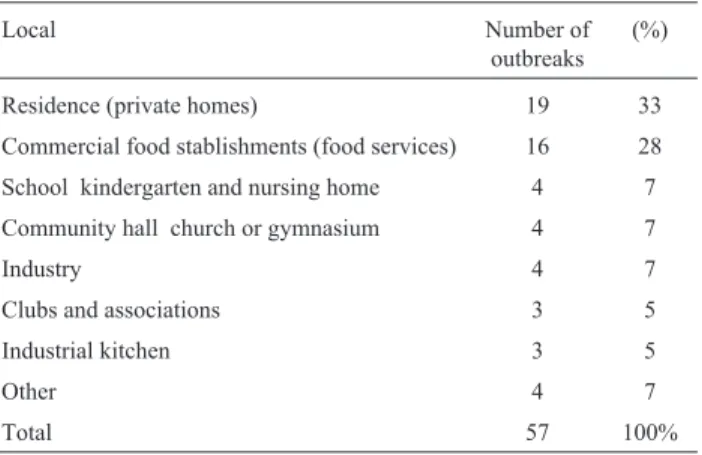
The private homes were the places of food prepara-tion mostly involved in the outbreaks (33%), followed by commercial food establishments (food services, 28%)
(Ta-ble 1). It is important to note that the same food may have been consumed in more than one place due to the distribu-tion of the involved food.
Similar results have been demonstrated in previous studies which identified the private homes and commercial food stablishments as the main sites involved in salmonellosis occurred in the State of RS (Costalunga and Tondo, 2002; Silveira and Tondo, 2006). For example, Costalunga and Tondo (2002) have reported that 43.7% of the salmonellosis of the State of RS occurred inside home and 25.21% in food services between 1997 and 1999. After that, during 2000 to 2001, the percentage of salmonellosis that occurred inside home increased to 61.5%, while those occurred in food services decreased to 13.7% (Silveira and Tondo, 2006). These data are in agreement with data con-cerning the whole Brazil between 2000 and 2011 (Brasil, 2011). Results show that the main place of food preparation involved in the total foodborne outbreaks were private homes (44.3%) followed by food services (23.6%) (Brasil, 2011).
The main causal factors responsible for S. aureus
food poisoning were the storage of food at room tempera-ture for more than 2 hours (27%), the usage of raw materi-als without inspection (26%) and the inadequate tempera-ture of food storage (8%).
Figure 1- Numbers of people involved in foodborne outbreaks caused by S. aureusoccurred in the State of Rio Grande do Sul, from 2000 to 2002.
Figure 2- Age groups (years) of victims of foodborne outbreaks caused byStaphylococcus aureusin the State of Rio Grande Sul, during 2000 and 2002.
Figure 3- Age groups of general population of the State of Rio Grande do Sul in 2002.
Table 1- Place of preparation of the foods involved in foodborne out-breaks caused byS. aureusoccurred in the State of Rio Grande do Sul from 2000 to 2002.
Local Number of
outbreaks (%)
Residence (private homes) 19 33
Commercial food stablishments (food services) 16 28
School kindergarten and nursing home 4 7
Community hall church or gymnasium 4 7
Industry 4 7
Clubs and associations 3 5
Industrial kitchen 3 5
Other 4 7
Considering the following causal factors together,i. e.the storage of food at room temperature for more than 2 hours, storage of food in inadequate cooling, storage of food in inadequate heat, improper cooking and inappropri-ate reheating of food, it is possible to observe that 41% of the staphylococcal outbreaks were caused by inadequate temperature control (Table 2). Results also demonstrated that 26% of the outbreaks occurred due to the use of raw materials without inspection, mainly meat and eggs, indi-cating that this kind of food should be considered important sources of microbiological hazards for the public health.
Other interesting result was that the sum of items re-lated to general hygiene,i. e.cross contamination, poor hy-giene of equipment and utensils; infected food handler and improper handling were responsible for 25% of the out-breaks. These causal factors are basic items of Good Manu-facturing Practices Programs (GMP) and the failures identified on that resulting in outbreaks were some of the reasons for the creation of a Brazilian GMP Regulation named RDC 216 in 2004 (Brasil, 2004) and a Regional GMP Regulation called Portaria 78 in 2009 in the State of RS (Secretaria da Saúde, 2009).
According to the reports analysed, diverse types of food preparation were consumed by the victims involved in the staphylococcal outbreaks. 71 food types were registered and their involvement confirmed by laboratory analyses. These foods were preliminarily classified into 7 groups,i. e.
1) pastries, 2) potato salad with homemade mayonnaise, 4) preparations containing cheese, 5) meat servings, 6) candy and 7) other kinds of prepared foods (ex. sand-wiches, pies, seafood). The higher incidence of food
in-volved in staphylococcal outbreaks was the following: 1) meat servings (35%), 2) candy (25%) and 3) preparations containing cheese (23%). Pireset al.(2012) have studied several outbreaks occurred in different countries and re-ported that dairy products were the most important source ofS. aureusillness (30.3%), followed by grains and beans (12.9%), meat (10.5%) and other sources (7.0%).
In Japan, the number of food poisoning cases due toS. aureusis trending lower because of factors such as provements in personal hygiene management and im-proved facilities and equipment. However, large-scale incidents of food poisoning arising from contaminated pro-cessed milk occurred during the year 2000, affecting 14,780 people (Anonymous, 2008).
December and January were the months of higher in-cidences of staphylococcal outbreaks, coinciding with the summer period in the State of RS. Also it was recorded a reasonable incidence of outbreaks in March, April and June, and these occurrances were attributed to traditional popular festivities, as Easter and São João festivities.
The results of this study showed thatS. aureuswas an important cause of foodborne outbreaks in RS State during the period from 2000 to 2002. The results also demon-strated that the most important control measures to prevent Staphylococcal foodborne illnesses were the control of temperature, general hygiene procedures and the use of in-spected raw materials. The implementation of these control measures depend on actions involving diverse parts of food chain, accordingly, being necessary the collaboration of the consumers, food producers, universities and Sanitary Sur-veillance services.
Acknowledgemets
The authors acknowledge the contribution of M.Sc. Josete Baialardi Silveira, Veterinary Denise Figueiredo and the Veterinary Suzana Costalunga Lima and all the profes-sionals of the Centro Estadual de Vigilncia em Saúde (CEVS/RS) and FEPPS/LACEN/RS for their continuous efforts to protect the public health of the State of RS and for the collaboration with this work.
References
Anonymous (2008) A massive outbreak of Staphylococcus aureus enterotoxin A associates with milk product. Food Sanit Res. 51:17-91.
Almeida CF, Araújo ES, Diniz RLC, Fook SML, Vieira KVM (2008) Perfil epidemiológico das intoxicações alimentares notificadas no Centro de Atendimento Toxicológico de Campina Grande, Paraíba. Rev Bras Epidemiol 11:139-46. Amson GV, Haracemiv SMC, Masson ML (2006) Levantamento
de dados epidemiológicos relativos à ocorrência/surtos de doenças transmitidas por alimentos (DTAs) no Estado do Paraná - Brasil, no período de 1978 a 2000. Ciência e Agrotecnologia 30:1139-1145.
atanassova V, Meindl A, Ring C (2001) Prevalence of Staphylo-coccus aureusand staphylococcal enterotoxins in raw pork
Table 2- Causal factors of foodborne outbreaks caused byS. aureus oc-curred in the State of Rio Grande do Sul from 2000 to 2002.
Causal factors Number of
outbreaks (%)
Storage in improper cooling 9 8
Inadequate storage in hot temperature 3 3
Improper cooking 2 2
Reheating inappropriate 1 1
Storage at room temperature for more than 2 h 32 27
Cross-contamination 11 9
Contamination with toxic chemicals 0 0
Use of toxic utensils 0 0
Ingestion of contaminated water 3 3
Infected food handlers 4 3
Poor hygiene of equipment and utensils 8 7
Improper handling 7 6
Use of raw material without sanitary inspection 30 26
Unknown 7 6
and uncooked smoked ham - A comparison of classical cul-turing detection and RFLP-PCR. International Journal of Food Microbiology 68:105-113.
BRASIL. Ministério da Saúde. Agência Nacional de Vigilncia Sanitária. Resolução - RDC nº 12, de 2 de janeiro de 2001.
Disponível em
http://www.anvisa.gov.br/legis/resol/12_01rdc.htm. Acesso em: 18 de dezembro de 2011.
BRASIL. Ministério da Saúde. Agência Nacional de Vigilncia Sanitária. Resolução - RDC n°216, de 15 de setembro de 2004a. Disponível em: http://www.anvisa.gov.br. Acesso em: 25 de julho de 2011.
BRASIL. Ministério da Saúde. Secretaria de Vigilncia Sanitária. (2011). Dados epidemiológicos - DTA período 2000 - 2011. Available in: http://portal.saude.gov.br/por-tal/arquivos/pdf/dados_epidemiologicos_dta_15911.pdf. Accessed in jun. 2010.
Carmo GMI, Oliveira AA, Dimech CP, Santos DA, Almeida MG, Berto LH, Alves RMS, Carmo EH (2005) Vigilncia Epide-miológica das doenças transmitidas por alimentos no Brasil, 1999-2004. Boletim Eletrônico Epidemiológico 6:1-7. Available in: http://portal.saude.gov.br/por-tal/arquivos/pdf/bol_epi_6_2005_corrigido.pdf. Accessed in jun. 2010.
Costalunga S, Tondo EC (2002) Salmonellosis in Rio Grande do Sul, Brazil, 1997 to 1999. Braz J Microbiol 4:342-346. Cunha M, Peresi E, Calsolari RAO, Araújo JPJ (2006) Detection
of enterotoxins genes in coagulase-negative staphylococci isolated from foods. Braz J Microbiol 1:70-74.
Cunha AS, Cunha MR (2007) Toxinfecção alimentar por Staphy-lococcus aureusatravés do leite e seus derivados, bem como o elevado potencial patogênico de resistência às drogas. Saúde & Ambiente em Revista 1:105-114.
Food and Drug Administration - FDA (2007). Foodborne Patho-genic Microorganisms and Natural Toxins Handbook - US FDA Bad Bug Book, 1992, 105-114.
Forsythe SJ (2010) The microbiology of safe food. 2 ed. Wiley-Blackwell. United Kingdom 182-184.
Huong BTT, Mahmud ZH, Neogi SB, Kassu A, Nhien NV, Mohammad A, Yamato M, Ota F, Lam NT, Dao HTA, Khan NC (2010) Toxigenicity and genetic diversity of
Staphylo-coccus aureus isolated from Vietnamese ready-to-eat foods. Food Control 2:166-171.
Kishimoto M, Hioki Y, Okano T, Konuma H, Takamizawa K, Kashio H, Kasuga F (2004) Ribotyping and a study of trans-mission ofStaphylococcus aureuscollected from food prep-aration facilities. J Food Protec 6:1116-1122.
Korpysa W, Rola JG, Osek J (2005) Staphylococcal enterotoxins and their detection in milk and milk products. Medycyna Weterynaryjna 6:633-636.
Pigott DC (2008) Foodborne Illness Emergency Medicine Clinics of North America 2:475-497.
Pires SM, Vieira AR, Perez E, Wong DLF, Hald T (2012) Attrib-uting human foodborne illness to food sources and water in Latin America and the Caribbean using data from outbreak investigations. International Journal of Food Microbiology 152:129-138.
Rio Grande do Sul. Secretaria Estadual da Saúde (2006) Divisão de Vigilncia Sanitária. Relatórios Anuais de Doenças Trans-mitidas por Alimentos. Porto Alegre, p. 21.
Rio Grande do Sul. Secretaria Estadual da Saúde (2005) Centro Estadual de Vigilncia em Saúde. Rede de Análises e Divulgação de Indicadores para a Saúde, 2006.A saúde da população do Estado do Rio Grande do Sul, 2005. Porto Alegre, CEVS, p.183.
Rio Grande do Sul. Secretaria da Saúde (2009) Portaria 78 de 30 de janeiro de 2009. Estabelece procedimentos de boas prá-ticas para serviços de alimentação, a fim de garantir as condições higiênico-sanitárias do alimento preparado. Silveira JB, Tondo EC (2006) Salmonellosis outbreaks occurred
in Rio Grande do Sul, Southern Brazil, during 2000 to 2001. In:International Symposium Salmonella and Salmonelosis. Epidemiology and Public Health. Saint Malo, France. Pierre Colin e Geneviève Clément 521-522.
Su YC, Wong ACL (1997) Current perspectives on detection of Staphylococcal Enterotoxins. J Food Prot 60:195-202. Welker CAD, Both JMC, Longaray SM, Haas S, Soeiro MLT,
Ramos RC (2010) Análise microbiológica dos alimentos envolvidos em surtos de doenças transmitidas por alimentos (DTA) ocorridos no Estado do Rio Grande do Sul, Brasil. Rev Bras de Biociências 1:44-48.