Expe rim e ntal anxie ty and the
re info rcing e ffe cts o f e thano l in rats
Departamento de Farmacologia, Centro de Ciências Biológicas, Universidade Federal de Santa Catarina, Florianópolis, SC, Brasil S.L. Blatt and
R.N. Takahashi
Abstract
In order to examine the relationship between anxiety and reinforcing effects of alcohol, drug-naive male Wistar rats weighing 250-300 g were classified as anxious and non-anxious in the elevated plus-maze test. A conditioned place preference test was then used to investigate the reinforcing effects of ethanol (EtOH) on these animals. On 2 alternate days, groups of anxious, non-anxious and nor-mal rats received intraperitoneal (ip) injections of EtOH (0.5, 1.0 or 1.5 g/kg) immediately before a 15-min confinement to the white compartment. On the 2 intervening days the same rats received ip injections of saline before confinement to the opposite compartment. On day 5, a 15-min free-choice test was carried out with no injections. Rats classified as anxious showed a significant, though not dose-dependent preference for all doses of ethanol compared to saline-treated animals. These data demonstrate that rats regarded as anx-ious are more sensitive to the reinforcing effects of EtOH than non-anxious and normal Wistar rats and emphasize the relevance of the basal levels of anxiety of rats when trying to detect the reinforcing effects of EtOH.
Co rre spo nde nce R.N. Takahashi Rua Ferreira Lima, 82
88015-420 Florianópolis, SC Brasil
Fax: + 55-48-222-4164
Presented at the 6th World Congress of Biological Psychiatry, Nice, France, June 22-27, 1997.
Research supported in part by CNPq. S.L. Blatt was the recipient of a fellowship from CNPq.
Received July 30, 1998 Accepted January 11, 1999
Ke y wo rds
·Anxiety ·Plus-maze ·Place preference ·Ethanol ·Wistar rats
Intro ductio n
The reinforcing properties of drugs of abuse are seen as the major factor leading to drug-seeking behavior and to a subsequent addictive state. However, probably due to a more complex pharmacodynamic action of ethanol (EtOH) than of other addictive drugs, the demonstration of reinforcing effects of EtOH in animal models has been difficult to achieve (1,2). Thus, in the conditioned place preference (CPP) paradigm, which has been used widely to study the rewarding effects of various drugs of abuse (3-5), studies with ethanol have generated conflicting results (1,2,6). In this context, it is important to
labora-tory animals attempting to validate the ten-sion-reduction hypothesis have produced conflicting results. For example, in hetero-geneous populations of Wistar rats, high baseline levels of experimental anxiety have been reported to predict high voluntary EtOH self-administration (14), whereas more contradictory results have been reported with rat lines bred for EtOH preference (15,16). Since little is known about the pos-sible interaction between experimental anxi-ety and the effects of alcohol, in the present study we investigated the relationship be-tween different levels of anxiety and the reinforcing effects of EtOH in rats. For this purpose, drug-naive Wistar rats were tested in the elevated plus-maze for their initial level of anxiety. Rats were then classified as anxious and non-anxious and subsequently tested in a conditioned place preference para-digm.
Mate rial and Me tho ds
Anim als
Male Wistar rats weighing 250-300 g from our colony were used. The animals were housed in groups of 6 in plastic cages and maintained in a room with controlled temperature (23 ± 1oC) and a 12-h light cycle
(lights on 7:00 h) with food and tap water available ad libitum.
D rugs
Ethanol (Merck) was diluted in NaCl to 10.0% (w/v) concentration. The control so-lution consisted of an equivalent volume of saline. All drugs were administered intraper-itoneally.
Apparatus
Elevated plus-maze test. The wooden plus-maze consisted of two opposite 50-cm long x 10-cm wide open arms and two 50 x
10 x 40 cm (length, width and height) en-closed arms. The arms extended from a cen-tral 10 x 10-cm platform. The maze was elevated to a height of 50 cm above the floor. The enclosed arms were painted black. To determine the exploratory activity of rats, white tapes (about 2 mm wide) were used to divide the floor of each open arm into three equal sectors.
The procedure of the test was as de-scribed previoulsy (13). Briefly, each rat was placed in the center of the maze and time spent in the open and closed arms was re-corded over a 5-min test period by an ob-server sitting at a distance of approximately 1 m from the apparatus. In addition, the following parameters were recorded: the la-tency period to the first entry into one of the open arms of the maze and the number of sectors crossed in the open arms. To con-sider an animal as anxious, the two param-eters measured had to correlate. Thus, rats that crossed fewer sectors than 10 and spent a total time in open arms of less than 60 s were considered to be anxious. The non-anxious group consisted of rats that crossed more than 20 sectors and spent more than 120 s in the open arms. The cut-off times applied were established using the mean value of time spent in the open arms ± 3 SEM. One week after selection, anxious, non-anxious and normal rats received control solution or EtOH (0.5, 1.0 or 1.5 g/kg) 15 min prior to testing in the conditioned place preference test. A total of 263 rats were used in the plus-maze test for the selection procedure which provided 65 anxious, 68 non-anxious and 130 normal rats.
Co nditio ne d place pre fe re nce
A biased place-conditioning procedure was used. The conditioning period of this experiment lasted 4 consecutive days. On days 1 and 3, animals received control solu-tion, were immediately placed in the black end chamber and confined there for 15 min. On days 2 and 4, rats were injected with EtOH (0.5, 1.0 or 1.5 g/kg) and immediately confined to the white chamber for the same 15-min period. The apparatus was cleaned after each conditioning session with a cloth dampened with 10% ethanol.
During the next day (the fifth day) unin-jected rats were given free access to the two sections of the apparatus and the number of seconds each subject spent in each chamber was recorded for 15 min. The location of the animal was defined by the position of the four paws in the compartment.
For this procedure, three main groups of rats were formed and divided into 4 experi-mental groups, each consisting of at least 10 rats.
Me asure me nt o f blo o d e thano l
A separate group of rats submitted to the same injection schedule as in the CPP test was used to determine blood EtOH concen-tration. Fifteen minutes after the last ip injec-tion of EtOH (0.5, 1.0 or 1.5 g/kg) or saline, animals were anesthetized with ether and blood was collected by cardiac puncture. Plasma aliquots were stored at 2-4oC for
later determination of EtOH levels. The de-termination of alcohol in the blood was based on the titration reaction technique of Nicloux (17).
Statistical analysis
The data are reported as means ± SEM and were analyzed statistically by analysis of variance (ANOVA) followed by the Newman-Keuls post hoc test. Differences were considered to be significant when P£0.05.
Re sults
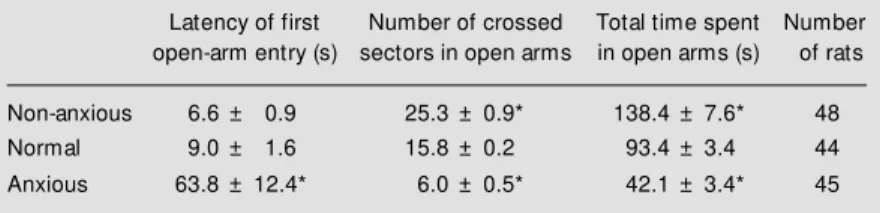
Table 1 summarizes the results of the selection procedure of drug-naive rats in the plus-maze test for their basal level of anxi-ety. The subsequent division into anxious, non-anxious and normal rats resulted in sta-tistically well-differentiated groups [F2,89 =
31.069, P<0.0001]. Thus, rats classified as non-anxious exhibited shorter latencies to entry into the open arms, crossed more sec-tors, and spent more time in the open arms of the maze compared to normal rats. All of these measurements suggest reduced aver-siveness in the non-anxious subgroup. The opposite was true for rats assigned to the anxious subgroup.
Figure 1 shows the results of place pref-erence conditioning for anxious, non-anx-ious and normal rats in the elevated plus-maze. As can be seen, a significant prefer-ence for the treatment-paired compartment was observed in anxious rats injected with EtOH (0.5, 1.0 or 1.5 g/kg, ip) [F6,64 = 3.52,
P<0.045]. In non-anxious rats, EtOH, 0.5 g/ kg, caused an increase of time spent on the drug-paired side; however, this response did not reach statistical significance (Figure 1). These results indicate the reinforcing prop-erties of EtOH only in anxious rats as meas-ured in the place preference paradigm.
Since no variations were detected in blood EtOH levels among the different groups of rats, the data were pooled for each dose. Blood EtOH concentrations measured in
Table 1 - Selection experiment according to the exploratory activity of naive undrugged Wistar rats in an elevated plus-maze.
Data are reported as the mean ± SEM . * P£0.05 compared to the normal group
(one-w ay ANOVA and Ne(one-w man-Keuls test).
Latency of first Number of crossed Total time spent Number
open-arm entry (s) sectors in open arms in open arms (s) of rats
Non-anxious 6.6 ± 0.9 25.3 ± 0.9* 138.4 ± 7.6* 48
Normal 9.0 ± 1.6 15.8 ± 0.2 93.4 ± 3.4 44
animals 15 min after ip injection of EtOH (0.5, 1.0 and 1.5 g/kg) yielded the following means: 7.9, 15.9 and 19.4 mg/dl, respec-tively.
D iscussio n
The wide variation in anxiety levels ob-served in the plus-maze in an outbred Wistar rat population is consistent with the results of our earlier study (13) and suggest a ge-netic heterogeneity for the anxiety response. The most important finding of the pres-ent study is that EtOH induces reinforcing effects as measured in the conditioned place preference paradigm only in rats classified as anxious. These results confirm the notion that EtOH may possess weak reinforcing properties in normal rats. For example, most place-conditioning studies show no effects of low EtOH doses and conditioned place aversions at higher doses (18,19). A few studies have shown EtOH-induced CPP in rats with a history of pre-exposure to EtOH (6,20,21) or when the drug is combined with food (22,23) or morphine (20,24). Bozarth (1) reported place-preference without any EtOH pre-exposure after 15 drug-compart-ment pairings, suggesting that a longer con-ditioning period might be necessary to
asso-ciate weak positive reinforcing properties of EtOH with a distinct compartment.
As mentioned previously, the relation-ship between anxiety and EtOH has been a matter of considerable controversy. The pres-ent data showing that anxious rats developed place preference after a short period of con-ditioning, 4 days, favor the hypothesis that the anxiety state may contribute to the vul-nerability to EtOH intake. Thus, in a recent study Spanagel et al. (14) showed a signifi-cantly higher intake and preference for EtOH in rats selected as anxious in the plus-maze test, which led them to suggest that the de-gree of anxiety may underlie, at last in part, the initial motivation to drink alcohol. These results agree with the study of Stewart et al. (16) which indicated a higher degree of anxi-ety in EtOH-preferring than non-preferring rats.
In addition, blood EtOH levels measured within the time range of 15 min for the behavioral test were dose-dependent and seemed to be sufficient to influence the place preference conditioning.
Although not tested in the present inves-tigation, it is important to emphasize that studies in this laboratory using EtOH in a quite similar dosage range (0.8-1.2 g/kg, ip) did not find differences in anxiety measure-ments recorded in the plus-maze test (25). Therefore, it is likely that the results of place preference conditioning were not confounded by the potential anxiolytic effect of EtOH. Also, the locomotor activity of these animals was measured and dissociated from a seda-tive action of EtOH at the doses used here in our study (data not shown).
In conclusion, the present data demon-strate a significant place preference for the EtOH-paired compartment by rats previously selected to be anxious. In addition, these results emphasize the relevance of basal level of anxiety of rats in terms of sensitivity to the reinforcing effects of EtOH and may contri-bute to the understanding of alcohol depend-ence.
Figure 1 - M ean time (s) spent on the test day in the previously drug-paired compartment of the place pref erence apparat us. Place condit ioning sessions w ere held for 4 days for anx-ious, non-anxious and normal
rats injected ip w ith saline or
ethanol (EtOH) (0.5, 1.0 or 1.5 g/ kg). Data are reported as the mean ± SEM . Numbers in pa-rentheses indicate the size of
the groups. * P£0.05 compared
to the control group (New man-Keuls test).
T
im
e
(
s
)
700
600
500
400
300
200
100
0
Saline EtOH 0.5 g/kg EtOH 1.0 g/kg EtOH 1.5 g/kg
*
(10) (10)
(10)
Anxious Normal Non-anxious
*
*
(15)
(12)(12)
(10) (10)
(15) (13) (10)
Re fe re nce s
1. Bozarth M A (1990). Evidence for rew ard-ing effects of ethanol usard-ing the
condi-tioned place preference method.
Pharma-cology, Biochemistry and Behavior, 35: 485-487.
2. Stew art RB, M urphy JM , M cBride WJ, Lumeng L & Li TK (1996). Place condition-ing w ith alcohol in alcohol-preferrcondition-ing and
non-preferring rats. Pharmacology,
Bio-chemistry and Behavior, 53: 487-491. 3. Barr GA, Paredes W & Bridger WA (1985).
Place conditioning w ith morphine and phencyclidine; dose dependent effects.
Life Sciences, 36: 363-368.
4. Shippenberg TS & Heidbreder CH (1995). Sensitization to the conditioned rew ard-ing effects of cocaine: pharmacological
and temporal characteristics. Journal of
Pharmacology and Experimental Thera-peutics, 273: 808-815.
5. Shoaib M , Stolerman IP & Kumar R (1994). Nicotine-induced place preferences
fol-low ing prior nicotine exposure in rats.
Psy-chopharmacology, 113: 445-452. 6. Reid LD, Hunter GA, Beam an CM &
Hubbell CL (1985). Tow ard understanding ethanol’s capacity to be reinforcing: a con-ditioned place preference follow ing
injec-tions of ethanol. Pharmacology,
Biochem-istry and Behavior, 22: 483-487. 7. George DT, Nutt DJ, Dw yer BA & Linnoila
M (1990). Alcoholism and panic disorder: Is the com orbidity m ore than
coinci-dence? Acta Psychiatrica Scandinavica,
81: 97-107.
8. Kushner M G, Sher KJ & Beitmen BD (1990). The relation betw een alcohol
prob-lems and anxiety disorders. American
Journal of Psychiatry, 147: 685-695. 9. Schuckit M A & Hesselbrock V (1994).
Al-cohol dependence and anxiety disorders:
w hat is the relationship? American
Jour-nal of Psychiatry, 151: 1723-1734. 10. Pellow S, Chopin P, File SE & Briley M
(1985). Validation of open:closed arm en-tries in an elevated plus-maze as a
meas-ure of anxiety in the rat. Journal of
Neuro-science M ethods, 14: 149-167. 11. Rodgers TJ, Cao B-J, Dalvi A & Holmes A
(1997). Animal models of anxiety: an
etho-logical perspective. Brazilian Journal of
M edical and Biological Research, 30: 289-304.
12. Ram os A, Bert on O, M orm ede P & Chaouloff F (1997). A multiple-test study of anxiety-related behaviours in sex
in-bred rat strains. Behavioural Brain
Re-search, 85: 57-69.
13. Rogério R & Takahashi RN (1992). Anxio-genic properties of cocaine in the rat evaluated w ith the elevated plus-maze.
Pharmacology, Biochemistry and
Behav-ior, 43: 631-633.
14. Spanagel R, M ontkow ski A, Allingham K, Stöhr T, Shoaib M , Holsboer F & Landgraf R (1995). Anxiety: a potential predictor of vulnerability to the initiation of ethanol
self-administration in rats.
Psychopharma-cology, 122: 369-373.
15. M oller C, Wiklund L, Thorsell A, Hytia P & Heilig M (1997). Decreased measures of experimental anxiety in rats bred for high
alcohol preference. Alcoholism: Clinical
and Experimental Research, 21: 656-660. 16. Stew art RB, Gatto GJ, Lumeng L, Li T-K & M urphy JM (1993). Comparison of alco-hol preferring (P) and non-preferring (NP) rats on tests of anxiety and for the
anxio-lytic effects of ethanol. Alcohol, 10: 1-10.
17. Sica P (1983). Alcoolismo e Portaria do
Contran: Uma Resolução Importante. O Laudo, Porto Alegre, 49-55.
18. Asin KE, Wirtshafter D & Tabakoff B (1985). Failure to establish a conditioned place preference w ith ethanol in rats.
Pharmacology, Biochemistry and
Behav-ior, 22: 169-173.
19. Cunningham CL (1979). Flavor and
loca-tion aversion produced by ethanol.
Be-havioral and Neural Biology, 27: 362-367. 20. Bienkow ski P, Kuca P, Piasecki J & Kostow ski W (1996). Low dose of ethanol induced conditioned place preference in rats after repeated exposures to ethanol
or saline injections. Alcohol and
Alcohol-ism, 31: 547-553.
21. Gauvin DV, Briscoe RJ, Baird TJ, Vallet M & Hollow ay FA (1997). The paradoxal hedonic valence of acute ethanol w ithdraw -al (hangover) states in rats: place and taste
conditioning. Alcohol, 14: 261-268.
22. Stew art RB & Grupp LA (1985). Some determinants of the motivational proper-ties of ethanol in the rat: Concurrent
ad-ministration of food or social stimuli.
Psy-chopharmacology, 87: 43-50.
23. Stew art RB & Grupp LA (1981). An inves-tigation of the interaction betw een the reinforced properties of food and ethanol using the place preference paradigm.
Progress in Neuropsychopharmacology, 5: 609-613.
24. M arglin SH, M ackechine DK, M attie M E, Hui Y & Reid LD (1988). Ethanol w ith small doses of morphine establishes a
conditioned place preference. Alcohol, 5:
309-313.
25. Ferreira VM M & M orato GS (1996). Influ-ence of age and pre-treatment w ith D-cycloserine on the behavior of ethanol-treated rats tested in the elevated
plus-maze apparatus. Addiction Biology, 1: