Diego de Lucena Camarão
Diffusive properties of soft condensed matter systems under
external confinement
Diffuse eigenschappen van zachte gecondenseerde materie
systemen met uitwendige opsluiting
Diego de Lucena Camarão
Diffusive properties of soft condensed matter systems under
external confinement
Doctoral thesis presented to the Department of Physics of Federal University of Ceará as part of the prerequisites to obtain the title of Doctor of Science (D.Sc.)
Federal University of Ceará
Department of Physics
Graduation Program in Physics
Supervisor: Prof. Dr. Wandemberg Paiva Ferreira
Co-supervisor: Prof. Dr. François M. Peeters
Diego de Lucena Camarão. – Fortaleza / CE / Brazil,
2014-141p. : il. (color.) ; 30 cm.
Supervisor: Prof. Dr. Wandemberg Paiva Ferreira Doctoral Thesis – Federal University of Ceará Department of Physics
Graduation Program in Physics, 2014.
1. Soft condensed matter. 2. Colloids. 3. Computer simulation. I. Prof. Dr. Wandemberg Paiva Ferreira. II. Federal University of Ceará. III. Department of Physics. IV. Title
Diego de Lucena Camarão
Diffusive properties of soft condensed matter systems under
external confinement
Doctoral thesis presented to the Department of Physics of Federal University of Ceará as part of the prerequisites to obtain the title of Doctor of Science (D.Sc.)
Approved doctoral thesis. Fortaleza / CE / Brazil, 27/08/2014:
Prof. Dr. Wandemberg Paiva Ferreira
Supervisor (UFC, Brazil)
Prof. Dr. François M. Peeters
Co-supervisor (UAntwerpen, Belgium)
Prof. Dr. Ramón Castañeda-Priego
University of Guanajuato, Mexico
Prof. Dr. Fabrício Q. Potiguar
UFPA, Brazil
Prof. Dr. Gil de Aquino Farias
UFC, Brazil
Prof. Dr. Raimundo N. da Costa Filho
UFC, Brazil
Acknowledgements
I would like to kindly express my full gratitude to my supervisor Prof. Wandemberg Paiva
Fer-reira, for all the support during the development of this thesis. Not less important is my gratitude
towards my co-supervisor Prof. François Peeters for all his insightful comments to improve this
thesis, and specially his endless patience. I would also like to thank Prof. Felipe Munarin, Dr.
Kwinten Nelissen and Dr. Vyacheslav Misko for all the support during the preparation of some
of the works presented in this thesis.
Scientific developments are certainly not a result of individual achievement, therefore
I would like to thank all people involved in my life during all these (almost) four years of my
PhD studies, specially my family and my friends. It would be unfair if I forgot any names, so
I’ll just keep it simple and plain: Thank you very much for all the support throughout these
years.
I would also like to thank all the employees from the Department of Physics of Federal
University of Ceará (UFC) and from the Department of Physics of University of Antwerp (UA).
Last but not least, I would like to thank the Brazilian agencies CAPES and CNPq, and the
Flemish agency FWO, for financial support.
Diego
“The first principle is that you must not fool yourself.
And you are the easiest person to fool.”
Abstract
In this thesis we study the influence of external confinement potentials on the dynamical
prop-erties of soft condensed matter systems. We analyze the diffusive propprop-erties of two specific
systems by means of Langevin and Brownian Dynamics simulations. In Chapter 1, we
intro-duce the subject of soft condensed matter. We show several theoretical and experimental aspects
of these type of systems. We make a brief introduction to the topic of diffusion (Sec.1.5), where
we discuss main aspects of Brownian motion. We introduce the single-file diffusion (SFD)
prob-lem (Sec.1.5.3) and discuss it in the context of soft condensed matter systems, both theoretically
and experimentally. In Chapter 2, we introduce the computational method used in this thesis.
We discuss Molecular Dynamics (MD) and its variants, Langevin and Brownian Dynamics
sim-ulations. We also introduce numerical algorithms used in the following chapters. In Chapters
3, 4and5, we analyze two different systems, namely (i) a system of interacting Yukawa
parti-cles confined in a parabolic quasi-one-dimensional (q1D) channel and (ii) a system of magnetic
colloidal particles under the influence of both a parabolic confinement potential and a periodic
external modulation along the unconfined direction. In the former, we study the transition from
the single-file diffusion (SFD) regime to the two-dimensional (2D) diffusion regime. In the
lat-ter, we study the influence of several parameters that characterizes the system, e.g., the strength
of an external magnetic field and the periodic modulation along the unconfined direction, on its
dynamical properties. Finally, we present the summary of the main findings reported in this
the-sis and we show some open questions as perspectives for future research in the field of diffusion
in soft condensed matter systems.
Resumo
Nesta tese estudamos a influência de potenciais de confinamento externos nas propriedades
dinâmicas de sistemas de matéria condensada mole. Analisamos as propriedades difusivas
de dois sistemas específicos utilizando simulações computacionais (Dinâmica Molecular de
Langevin e Dinâmica Browniana). No Capítulo1, introduzimos o tópico sobre matéria
conden-sada mole. Mostramos vários aspectos teóricos e experimentais neste tipo de sistema. Fazemos
uma breve introdução ao tópico de difusão (Sec.1.5), onde discutimos os principais aspectos do
movimento Browniano. Introduzimos o problema de difusão em linha (SFD, do inglês
single-file diffusion) (Sec.1.5.3) e o discutimos, teorica e experimentalmente, no contexto de sistemas de matéria condensada mole. No Capítulo2, introduzimos os métodos computacionais
utiliza-dos nesta tese. Discutimos os métoutiliza-dos de Dinâmica Molecular e suas variantes, o método de
Dinâmica de Langevin e Dinâmica Browniana. Também introduzimos algoritmos de integração
utilizados nos capítulos posteriores. Nos Caps. 3,4e5, analisamos dois sistemas distintos, (i)
um sistema de partículas de Yukawa confinadas em um canal parabólico quasi-unidimensional
(q1D) e (ii) um sistema de colóides magnéticos sob a influência de um potencial parabólico
e uma modulação periódica externa ao longo da direção não confinada. No primeiro sistema,
estudamos a transição do regime de difusão em linha (SFD) para o regime de difusão normal
(2D). No segundo sistema, estudamos os efeitos de vários parâmetros que caracterizam o
sis-tema (e.g., a magnitude do campo magnético externo e a presença da modulação periódica
externa) em suas propriedades dinâmicas. Finalmente, apresentamos um sumário dos
princi-pais resultados obtidos nesta tese e mostramos algumas questões em aberto como perspectivas
para pesquisas futuras na área de difusão em sistemas de matéria condensada mole.
Samenvatting
In deze thesis werd de invloed van uitwendig aangelegde inperkingspotentialen onderzocht op
de dynamische eigenschappen van zacht gecondenseerde materie systemen. De diffusie
ei-genschappen van twee specifieke systemen werden onderzocht doormiddel van Langevin en
Brownse dynamische simulaties. In Hfst. 1 wordt het onderwerp van zacht gecondenseerde
materie geintroduceerd. Verschillende theoretische en experimentele aspecten van dit type van
systemen worden vermeld. Ook wordt er een korte inleiding gegeven van het onderwerp
diffu-sie (Sec. 1.5), waar de verschillende hoofd aspecten van Brownse beweging worden vermeld.
Het probleem van ‘single file’ diffusie (SFD) (Sec.1.5.3) wordt geintroduceerd en besproken in
de context van zacht gecondenseerde materie systemen, zowel theoretisch als experimenteel. In
Hfst. 2, wordt de computationele methode besproken die in deze thesis werd aangewend. We
bespreken de Moleculaire Dynamica (DM) simulatie methode en de varianten zoals Langevin
and Brownse dynamische simulaties. De numerieke algoritmen die in de volgende hoofstukken
worden aangewend worden geintroduceerd. In de Hfst. 3, 4en5analyzeren we twee
verschil-lende systemen, namelijk: (i) een systeem van interagerende Yukawa deeltjes die opgesloten
zijn in een parabolische kwasi-één-dimensionaal (q1D) kanaal, en (ii) een systeem van
mag-netisch colloidale deeltjes onder de invloed van een parabolische inperkingspotentiaal en een
periodisch externe modulatie langs de vrije richting. In het eerste systeem bestuderen we de
overgang van het ‘single-file’ diffusie regime naar het twee-dimensionaal diffusie regime. We
bestuderen de invloed van de verschillende parameters die het systeem karakteriseren, bijv. de
sterkte van het uitwendig magneetveld en de aanwezigheid van een periodische modulatie langs
de vrije richting op de dynamische eigenschappen. Eindelijk, presenteren we de overzicht van
de thesis en we vermelden een aantal open vragen die interessant zijn voor toekomst onderzoek
in het gebied van diffusie van zacht gecondenseerde materie systemen.
List of Figures
Figure 1 – Examples of soft condensed matter systems. Top panel: (left) Paints, and
(right) powder soap. Bottom panel: (left) A colloidal gel dispersion, and
(right) glue. . . 30
Figure 2 – Schematic representation of polystyrene colloidal particles of radius R=1.4
µm dispersed in heavy water (D2O) and confined by external laser beams.
Taken from Ref. (10). . . 31
Figure 3 – (a) Schematic representation of a Penning trap, where charged particles are
confined by using electric and magnetic fields. (b) Sketch of the experiment
used to confine the particles and (c) image of the actual device used in the
experiments of Ref. (16). . . 32
Figure 4 – (a) Schematic representation of the electric double layer, which consists of
the positively charged cloud of counter ions around the colloidal particle
and the negatively charged surface (total charge Z) of the colloidal particle.
(b) Two colloidal particles interact with each other through a repulsive
inter-particle interaction potential which is screened by the cloud of counter ions.
Taken from Ref. (20). . . 33
Figure 5 – A 2D system of N=230 electrons confined by a parabolic trap and
interact-ing through a repulsive potential tend to form a Wigner crystal in the
cen-ter. However, some defects can appear due to the competition between the
confinement potential (trap) and the repulsion between the particles. Also,
particles in the borders tend to be accommodated in a distorted triangular
lattice. Taken from Ref. (26). . . 35
Figure 6 – A series of Wigner crystal structures showing the arrangement of electrons
in a circular island from an occupation number of N =3 to N=100. The
electrons form ring structures as more electrons are added. For large N,
a triangular Wigner lattice forms in the center, while the outer electrons
remain in rings. Taken from Ref. (29), illustration by Alan Stonebraker.. . . 36
Figure 7 – Representation of a dusty plasma. The free positive ions in the plasma
ad-here to the surface of the dust particles creating a strong electrostatic
repul-sive interaction between these particles. Taken and adapted from Ref. (30). . 37
Figure 8 – Trajectory of a particle executing a Brownian movement. Note that the
movement is very irregular and experiments by Robert Brown showed that
the movement is most active in less viscous liquids and less active for lower
channels with the particles (black dots) inside. Taken from Ref. (41). . . 41
Figure 10 – Pictorial representation of periodic boundary conditions (PBC) for a 2D
sys-tem. In the center, there is the main computational unit cell, and the identical
copies around it. From Ref. (71) . . . 50
Figure 11 – (a) In the center there is the reference particle (dark circle). The circles
around it represents other particles in the system. A centered ring is drawn
as reference and it has radius r and width dr. (b) As an example, we show
the typical radial distribution function for a Lennard–Jones system in the
liquid phase. Taken from Ref. (74). . . 53
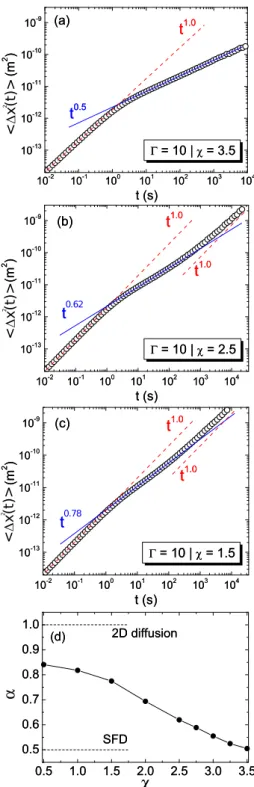
Figure 12 – (a)-(c) Log-log plot of the mean square displacement (MSD)h∆x2(t)ias a function of time for different values of χ. Different diffusion regimes can
be distinguished: normal diffusion regime (α =1.0) and intermediate
sub-diffusive regime (ITR,α <1.0). Note that for the case ofχ = 1.5, there is a
normal diffusion regime (i.e. α =1.0) after the ITR. The dashed and solid
lines in (a)-(c) are a guide to the eye. Panel (d) shows the dependence of
the slope (α) of the MSD curves (in the ITR, characterized by an apparent
power-law;h∆x2(t)i∝tα) on the confinement strengthχ. . . 67 Figure 13 – (a)-(c) Log-log plot of the mean square displacement (MSD)h∆x2(t)ias a
function of time for different values of Rw. Different diffusion regimes can
be distinguished: normal diffusion regime (α =1.0) and intermediate
sub-diffusive regime (ITR,α<1.0). Note that for the case of Rw= 0.60, there is
a normal diffusion regime (i.e. α =1.0) after the ITR. The dashed and solid
lines in (a)-(c) are a guide to the eye. Panel (d) shows the dependence of
the slope (α) of the MSD curves (in the ITR, characterized by an apparent
power-law;h∆x2(t)i∝tα) on the confinement parameter Rw. . . 68
Figure 14 – (a)-(b) Exponent α as a function of time, calculated from Eq. (3.15) for
different values of the confinement parametersχ and Rw, respectively. . . . 69
Figure 15 – (a) Number of crossing events C(t)as a function of time for N =400
par-ticles, for χ=1.5 (black open circles) andχ=3.5 (green open diamonds).
The solid red line is a linear fit to C(t). Panels (b) and (c) show the rate
of the crossing eventsωc as a function of the confinement potential
param-eters (χ and Rw). The insets in the panels (b) and (c) show the derivatives,
dωc(χ)/dχ and dωc(Rw)/dRw, correspondingly.. . . 72
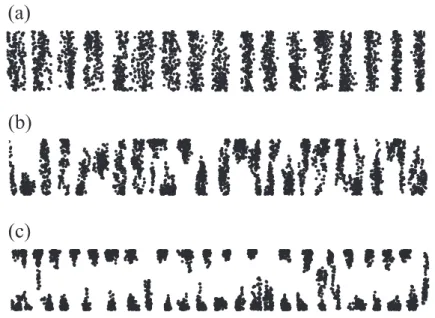
Figure 16 – For the hard-wall confinement case, we show typical trajectories of particles
(i.e. 106 MD simulation steps) confined by the channel of width (a) Rw=
Figure 17 – Probability distribution of the particle density P(y)along the y-direction are
shown for (a) different values ofχ (parabolic 1D confinement) and (b) four
different values of the width Rwof the channel (hard-wall confinement). . . 74
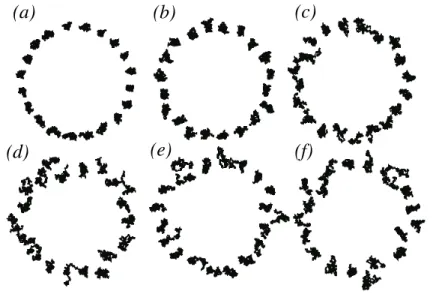
Figure 18 – Trajectories of N=20 particles diffusing in a ring of radius rch=9 mm for
106consequent time steps for different values of γ. γ=1 (a), 2 (b), 3 (c), 5
(d), 7 (e), 9 (f). . . 76
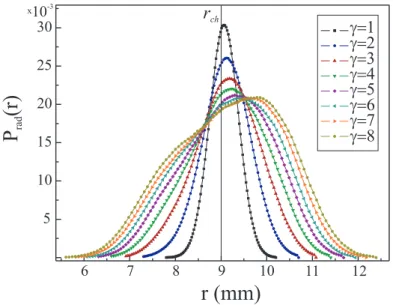
Figure 19 – The distribution of the probability density of particles Prad(r)in a circular
channel of radius rch =9 mm along the radial direction r. The different
curves correspond to various γ. Increasingγ the width of the distribution
Prad(r)increases due to a weakening of the confinement. . . 77
Figure 20 – Spatial distribution of the potential Vint(r,φ)created by a particle (red (grey)
circle) and the qualitative distribution of the probability density of particles
in circular channel Prad(r)(green (light grey) line) along the radial direction
r. The function∆r determines an approximate radial distance between parti-cles when the potential barrier Ubar becomes “permeable” for given
temper-ature T . The function∆rsw characterizes a width of the distribution Prad(r)
at this temperature T . . . . 77
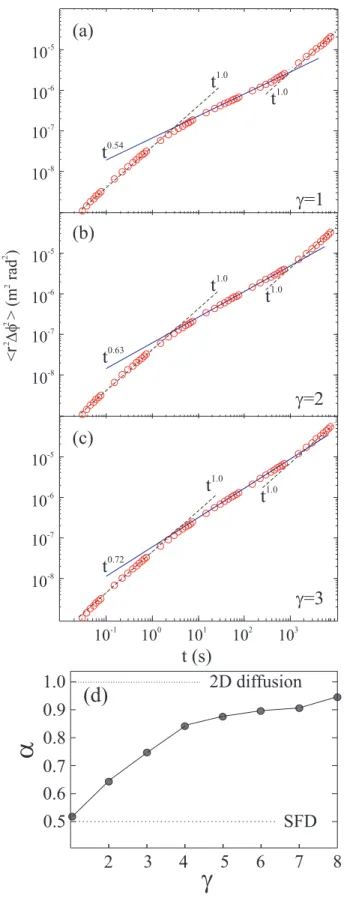
Figure 21 – (a)–(c): Log-log plot of the mean square displacement (MSD) h∆φ2i as a function of time for different values of the “effective” temperature γ = (a)
1, (b) 2, and (c) 3. Here (Nens=100,Npar =20). (d) The diffusion
expo-nent α as a function of γ. Increase of the “effective” temperature γ leads
to the gradual transformation of the single-file regime of diffusion into the
diffusion regime of free particles. . . 80
Figure 22 – Log-log plot of the MSD h∆x2(t)i(a) and corrected MSD h∆x2(t)icorr (b)
as a function of time for different values of the probability P of bypassing.
Averaging was done over Nsim=1000 ensembles. . . 82
Figure 23 – Schematic representation of the system. The particles have diameterσ and
dipole moment µµµi, which forms an angle θi with respect to the x-axis. An
in-plane external magnetic field B is applied with magnitude B andφ is the
angle between B and the x-axis. . . . 87
Figure 24 – Potential energy, as defined by Eqs. (4.4)-(4.5), per particle as a function of
time t for B=100, µ =2.0. In the inset we show the same, but for B=2.
In both cases, the number of particles in the computational unit cell was
N=300 and all the other parameters are given in Sec. 4.2.2. . . 89
Figure 25 – Dipole-dipole interaction potential Vdip(r) [Eq. (4.9)] as a function of the
function of the time t for B=100 and (a)φ =90 , (b)φ =70 , (c)φ =50
and (d) φ =0o. The dashed orange lines are a guide to the eye and the crossover time tcfor each case is indicated by the vertical arrow. . . 93
Figure 27 – (a) Mobility Fb in region (II) as a function of φ and (b) crossover time tc
between the STND regime and the sub-diffusive regime as a function of
φ. The solid lines are a guide to the eye. The dashed vertical line in (b) divides regions with (II) and without (I) an attractive part in the inter-particle
interaction potential. . . 94
Figure 28 – (a) Minimum inter-particle distance d between neighboring particles for
B=100 and T =1.0 as a function of the orientationφ of the external field.
(b) Exponent of diffusion (α) as a function of the orientation φ of the
ex-ternal magnetic field. Note that d decreases with decreasingφ in the region
0o<φ .55o, which is the same region where we found the increase of the diffusion mechanism [cf. panel (b)]. The solid lines are a guide to the eye. . 95
Figure 29 – Typical snapshots of the system after 106 simulation time steps for (a)φ =
90oand (b)φ =30o. Other parameters are B=100 and T =1.0. . . 96 Figure 30 – Mean-square displacement of the system [open black circles, W(t)] and
mean square displacement of individual particles [gray triangles, Wj(t)] as a
function of the time t for two different values ofφ =(a) 90oand (b) 0o. The dashed orange lines are a guide to the eye. Other parameters are B=100
and T =1.0. . . 97
Figure 31 – Log-log plot of the mean square displacement (solid black curves) W(t)as a
function of the time t for B=0.1 and (a)φ =90o, (b)φ =70o, (c)φ =50o and (d) φ =0o. The dashed orange lines are a guide to the eye and the crossover time tcfor each case is indicated by the vertical arrow. . . 98
Figure 32 – Typical snapshots of the system after 106 simulation time steps for (a)φ =
90oand (b)φ =30o. Other parameters are B=0.1 and T =1.0. . . 98 Figure 33 – Log-log plot of the mean square displacement (solid black curves) W(t)as
a function of the time t forφ =90oand (a) B=10, (b) B=2, (c) B=1 and (d) B=0.1. The dashed orange lines are a guide to the eye. . . 99
Figure 34 – Exponent of diffusionα (in the ITR regime) as a function of the strength B
of the external magnetic field forφ =90o. The solid line is a guide to the eye. 99 Figure 35 – Log-log plot of the mean square angular displacement Wrot(t)as a function
of the time t forφ =90oand B=10, B=2, B=1 and B=0.1. The dotted orange horizontal lines correpond to the saturation values of Wrot(t). . . 100
Figure 36 – Effective self-diffusion coefficient Deff/D0 of a single-particle in one
di-mension in the presence of a thermal bath and a periodic potential V(x′) =
Figure 37 – Snapshot of the configuration of the system for V0/kBT =2.0. The particles
are represented by yellow circles where the black arrows indicate the
direc-tion of the dipoles. The contour plot of the potential Vmod(x) +Vconf(y) is
also shown. The linear density isρ =0.5σ−1 and the transversal
confine-ment strength isω =1.0p2kBT/mσ2. . . 108
Figure 38 – Log-log plot of the mean square displacement in the x direction Wx(t) as
a function of time t for different values of the ratio V0/kBT . The yellow
dotted line is a guide to the eye. The open diamonds indicate approximately
the time scale (tN) where the normal diffusive regime, i.e. Wx(t) ∝t, is
recovered. The transversal confinement strength is ω = 1.0p2kBT/mσ2
and the linear density isρ=0.5σ−1. . . 109
Figure 39 – Long-time self-diffusion coefficient Ds/D0as a function of the ratio V0/kBT ,
for different linear densitiesρ. The effective self-diffusion coefficient Deff/D0
[Eq. (5.2)] as a function of V0/kBT for a single particle is also shown (solid
red curve) for comparison. The inset shows the ratio R=Ds/Deffas a
func-tion of V0/kBT for the caseρ =0.5σ−1. . . 110
Figure 40 – (a) Log-log plot of the mean square displacement in the x direction, Wx(t),
as a function of time t for different values of the ratio V0/kBT . The yellow
dotted line is a guide to the eye. The transversal confinement strength is
ω =10.0p2kBT/mσ2and the linear density isρ =0.5σ−1. Vertical black
arrows indicate the relaxation time tc. Inset: Single-file diffusion mobility F,
obtained from the relation (5.16), as a function of V0/kBT . (b) Snapshot of
the configuration of particles (black dots) for V0/kBT=1.0. The modulation
Vmod(x)is plotted as the solid red curve. . . 111
Figure 41 – The same as Fig. 37 but now for V0/kBT =4.0. Linear density is (a) ρ =
0.25σ−1, and (b)ρ=0.75σ−1. For both cases, the transversal confinement
strength isω =1.0p2kBT/mσ2and the commensurability factor is p=1. . 112
Figure 42 – The same as Fig. 38 but now for density (a) ρ =0.25σ−1, and (b) ρ =
0.75σ−1. The transversal confinement strength isω=1.0p2kBT/mσ2and
the commensurability factor is p=1. . . 113
Figure 43 – (a)-(c) Log-log plot of the mean square displacement in the x direction Wx(t),
as a function of time t for different values of the ratio V0/kBT . The yellow
dotted line has a slope of 1 and is a guide to the eye. The transversal
confine-ment strength isω =1.0p2kBT/mσ2and the linear density isρ=0.5σ−1.
Color code is the same as in Fig. 42. (d) Long-time self-diffusion coefficient,
Ds, as a function of V0/kBT for different values of the commensurability
mensurability factor p=(a) 1/2, (b) 1 and (c) 3/2. For all cases, the strenght
of the x direction modulation is V0/kBT =2.0. Note that L changes
accord-ing to the value of p. . . . 115
Figure 45 – (a) Snapshot of the configuration of particles (black dots) for V0/kBT =3.0.
The modulation Vmod(x) is plotted as the solid red curve. (b), (c) Log-log
plot of the MSD as a function of time t in the parallel and transversal
di-rection, respectively, for different values of V0/kBT . The dotted yellow line
has a slope of 1, the magenta dotted-dashed line has a slope of 0.35 and
both are guide to the eye. The open diamonds in (b) [(c)] indicate
approxi-mately the time scale (tN) where the normal diffusive regime [sub-diffusive
regime] appears. (d) Parallel self-diffusion coefficient D||and (e) anomalous
transversal diffusion coefficient Ktrans, both as a function of V0/kBT .
Param-eters of the simulation are p=2,ρ=1.0σ−1andω =1.0p2kBT/mσ2. . . 118
Figure 46 – Log-log plot of the transversal MSD Wy(t) as a function of time t, for
dif-ferent values of V0/kBT . The magenta dotted-dashed line has a slope of 0.5
and is a guide to the eye. Inset: snapshot of the configuration of particles
(black dots) for V0/kBT =4.0. The modulation Vmod(x) is plotted as the
solid red curve. Parameters of the simulation are p=4, ρ =2.0σ−1 and
Contents
I Literature review
27
1 Soft condensed matter . . . . 29
1.1 General considerations . . . 29
1.2 Colloidal dispersions . . . 30
1.3 Pair interaction between colloidal particles . . . 32
1.3.1 van der Waals forces . . . 32
1.3.2 Debye-Hückel inter-particle interaction potential . . . 33
1.4 Structural and dynamical properties of colloidal dispersions . . . 34
1.4.1 Wigner crystals . . . 34
1.5 Diffusion and Brownian motion. . . 35
1.5.1 Diffusion equation . . . 35
1.5.2 Brownian motion . . . 38
1.5.3 Single-file diffusion (SFD) . . . 40
II Methods
43
2 Computer simulation . . . . 45
2.1 Introduction . . . 45
2.2 Molecular Dynamics (MD) . . . 46
2.2.1 Description of the MD method . . . 47
2.2.2 Numerical integration algorithms . . . 48
2.2.2.1 The Verlet algorithm . . . 48
2.2.2.2 The leapfrog algorithm . . . 49
2.2.3 Periodic boundary conditions (PBC) . . . 50
2.2.4 Calculation of physical properties . . . 51
2.2.4.1 Radial distribution function (RDF) . . . 52
2.2.5 Relation between MD and statistical mechanics . . . 54
2.3 Langevin Dynamics (LD) . . . 54
2.3.1 Brownian Dynamics (BD) . . . 55
2.3.2 Numerical integration of stochastic differential equations . . . 56
IIIResults
59
3 Single-file to two-dimensional diffusion . . . . 61
3.1 Introduction . . . 61
3.2 Model system and numerical approach . . . 63
3.3.2 “Long-time” behavior of the MSD curves and crossing events C(t) . . . 70
3.3.3 Distribution of particles along the y-direction . . . 71
3.4 Diffusion in a circular channel . . . 73
3.4.1 Breakdown of SFD . . . 76
3.4.2 Diffusion regimes . . . 78
3.5 Discrete site model: The long-time limit . . . 79
3.6 Concluding remarks . . . 83
4 Tunable diffusion of magnetic particles . . . . 85
4.1 Introduction . . . 85
4.2 Model and Numerical Methods . . . 87
4.2.1 Model System . . . 87
4.2.2 Numerical Methods . . . 88
4.3 Interaction potential between two dipoles . . . 90
4.4 Influence of a strong external magnetic field on diffusion . . . 91
4.4.1 Region (I): 55o.φ ≤90o . . . 92 4.4.2 Region (II): 0o≤φ .55o. . . 92 4.5 Exponent of diffusion (α) in the intermediate (ITR) sub-diffusive regime . . . . 93
4.6 Weak magnetic fields . . . 96
4.7 Influence of the strength of the magnetic field . . . 97
4.8 Concluding remarks . . . 100
5 Single-file and normal diffusion of magnetic colloids . . . 103
5.1 Introduction . . . 103
5.2 Single-particle in an external periodic potential . . . 104
5.3 Interacting magnetic dipoles . . . 105
5.4 Normal and single-file diffusion for fixed linear density . . . 107
5.4.1 Caseω =1.0p2kBT/mσ2 . . . 107
5.4.2 Caseω =10.0p2kBT/mσ2 . . . 108
5.5 Effect of linear density on diffusion. . . 110
5.6 Effect of commensurability factor . . . 111
5.7 Anisotropic diffusion and transversal sub-diffusion . . . 114
5.7.1 Two particles per potential well. . . 114
5.7.2 Four particles per potential well . . . 116
5.8 Concluding remarks . . . 117
Summary . . . 121
Appendix
135
APPENDIX A Appendix . . . 137A.1 Interaction torque and external magnetic field torque . . . 137
Annex
139
ANNEX A Annex . . . 141
A.1 List of publications related with this thesis . . . 141
Part I
29
1 Soft condensed matter
In this chapter we introduce the topic of Soft Condensed Matter. We define colloidal
disper-sions and we give motivation for using these particles as model systems for testing theoretical
predictions of statistical physics. Many of the ideas presented here can be found in the
follow-ing much more specialized textbooks: “Soft condensed matter” by R. A. L. Jones and “Soft
matter physics” by Masao Doi.
1.1
General considerations
Condensed matter physics is a discipline in the field of Physical Sciences which studies the
physical properties of condensed phases of matter (1). It is mainly concerned in addressing
problems related to liquid and solid systems, but it also deals with different condensed phases
as, for instance, the Bose-Einstein condensate (BEC) in cold atomic systems (2) and the
super-conducting phase (3) found in low temperature materials.
However, there is a variety of materials found in nature which do not fall into the
cat-egory of either simple liquids or crystalline solids. For instance, glues, paints, soaps, and
col-loidal gels (Fig.1) are examples of these type of materials. They are usually referred to as soft
condensed matter systems (4) or soft matter, for short. These systems are formed of colloidal particles (solute) which are dispersed in another liquid (solvent). For example, fat and proteins
in milk are types of colloidal dispersions (∼0.1µm of diameter) embedded in water.
All of these soft matter systems share some common characteristics. For example, the
characteristic length scale of colloidal dispersions is in an intermediate regime between the
atomic scale and the macroscopic scale. It is therefore usual to refer to colloidal dispersions
as a class of mesoscopic systems. The diameter of the colloidal particles ranges between 10
nm and 10µm. Another feature is that the common physical properties of these materials (e.g.,
self-assembly and non-linear response to external perturbations) are related to the fact that the
energy scales involved are of the order of the thermal energy, kBT . This means that quantum effects do not play an important role in the properties of soft matter systems, which make them
strong candidates for testing theoretical models in statistical physics using relatively simple
Figure 1 – Examples of soft condensed matter systems. Top panel: (left) Paints, and (right) powder soap. Bottom panel: (left) A colloidal gel dispersion, and (right) glue.
1.2
Colloidal dispersions
A colloidal particle of diameter∼1µm at room temperature T =300 K in water has a
charac-teristic relaxation time1τs∼1 s. Therefore, the dynamics of this particle can be time resolved
using an experimental technique called video microscopy, which consists in recording the
parti-cle’s trajectory to extract useful information not only about the dynamics of the particle itself,
but also about the fluid properties in which it is embedded in.
On the other hand, in atomic systems, where particles have a diameter of a few angstroms,
the characteristic relaxation time is of the order ofτs ∼10−9 s, which is too short for
time-resolved experiments with atomic resolution. In principle it is also possible to study atomic
systems by means of atomic force microscopy (AFM), but colloidal dispersions are usually
more simple and flexible. The main experimental tools to study the static and dynamical
proper-ties of colloidal suspensions are static and dynamic light scattering (SLS and DLS, respectively)
(5,6).
Furthermore, mesoscopic systems can be much more easily tuned in experiments. The
interaction of colloids with external fields and the inter-particle interaction potential between
1.2. Colloidal dispersions 31
pairs of colloids are customizable in order to allow the study of different basic physical problems
in statistical physics. For instance, colloidal crystals show similar diffraction patterns (7) as
X-ray diffraction in atomic systems. One could also, for example, use colloidal crystals as model
systems to study kinetics of crystallization (8, 9), a much more difficult task to achieve using
atomic systems.
Figure 2 – Schematic representation of polystyrene colloidal particles of radius R= 1.4 µm dispersed in heavy water (D2O) and confined by external laser beams. Taken from Ref. (10).
As stated above, one major advantage of using colloidal particles as model systems
to study theoretical predictions of statistical physics is the possibility to tune inter-particle
in-teraction potentials. For instance, colloids can interact through a screened Coulomb potential
(commonly known as the Yukawa potential) or through a dipole-dipole potential, just to cite a
few. In the first case, the strength of interaction between colloids can be tuned by changing the
salt concentration of the solution in which the particles are moving in. In the second case, the
magnetic interaction (dipole-dipole) can be adjusted by introducing an external magnetic field
which induces a magnetic dipole moment inside the colloidal particles. The strength of this
interaction is then proportional to the magnitude of the external magnetic field. The Yukawa
po-tential has an exponential decay form, V(r)∝exp(−r/λD)/r and the dipole-dipole interaction
has a 1/r3dependence, where r is the center-to-center distance between a pair of colloids and λDis the so-called Debye screening length (11).
Besides the tuning of the inter-particle interaction potential by adjusting external
param-eters, it is also possible to experimentally control the interaction of colloidal particles with
exter-nal fields (cf. Fig.2). For instance, colloidal dispersions can be placed on the top of modulated
(either periodic or random) substrates which are created by using, e.g., light fields (10,12,13).
Furthermore, several types of external potential shapes can be also realized experimentally by
using topographic patterns (14,15).
One of the devices used to experimentally trap colloidal charged particles is called a
Penning trap, where both an electric and a magnetic field are used to confined the particles.
This device usually has a cylindrical symmetry (Fig.3) and batteries are placed on the tips of
temperature of the system to very low values, where liquid and crystal phases are found.
Figure 3 – (a) Schematic representation of a Penning trap, where charged particles are confined by using electric and magnetic fields. (b) Sketch of the experiment used to confine the particles and (c) image of the actual device used in the experiments of Ref. (16).
1.3
Pair interaction between colloidal particles
1.3.1
van der Waals forces
In general, colloidal particles interact with each other through van der Waals forces. In the
case of the spherical particles, the van der Waals potential is given by the analytical expression
(17,18)
V(ri j) =−C
" 2R2
r2i j−4R2+ 2R2
r2i j +ln 1+
4R2
r2i j
!#
, (1.1)
where ri j is the center-to-center distance between a pair of particles i and j, R=σ/2 is the
radius of each particle, and C is a constant that depends on the type of colloidal particle and
the medium where it is embedded2. Note that the negative sign in Eq. (1.1) indicates that this
interaction is strongly attractive and therefore colloidal particles tend to stick together, which
is known as the coagulation effect. In order to study different kind of effects other than the
coagulation, it is of course desirable to have stabilized colloidal suspensions. This is mainly
achieved by introducing repulsive interaction between the particles, which can be done, e.g., by
electrostatic stabilization techniques (19).
1.3. Pair interaction between colloidal particles 33
1.3.2
Debye-Hückel inter-particle interaction potential
The surface of a colloidal particle is covered by molecules which are electrically neutral.
How-ever, when a colloidal particle is dispersed in water (for instance) the positive charged counter
ions of the molecules are dissolved due to water molecule polarization (20). Therefore, the
surface of the particle is negatively charged and the entropy tends to spread the ions over the
whole volume. When equilibrium is reached, the balance between energy and entropy creates
an electric double layer (21). This layer consists of the positively charged cloud of counter
ions around the colloidal particle and the negatively charged surface of the colloidal particle
itself. Therefore, the cloud of counter ions around the particle is responsible for screening the
interaction between colloidal particles.
Figure 4 – (a) Schematic representation of the electric double layer, which consists of the posi-tively charged cloud of counter ions around the colloidal particle and the negaposi-tively charged surface (total charge Z) of the colloidal particle. (b) Two colloidal particles interact with each other through a repulsive inter-particle interaction potential which is screened by the cloud of counter ions. Taken from Ref. (20).
In order to calculate the inter-particle interaction potential for this case, the
Poisson-Boltzmann (PB) equation
ε0εW∇2φ(r)∝exp
−ziekφ(r)
BT
, (1.2)
can be solved analytically (11) in the first-order approximation case (i.e., by linearization of the
PB equation). By doing so, one gets the potentialφ(r)created by a colloidal particle at a point
r in space as
φ(r) = Ze 4πε0εW
exp(σ/2λD) (1+σ/2λD)
exp(−r/λD)
r , (1.3)
where Z is the total charge (in units of the elementary charge e) on the surface of the colloidal
particle,ε0andεW are the permittivity of vacuum and water, respectively. The Debye screening
length is given by λD−1=pε0εWkBT/s with s=∑i(ez2i)ci (zi and ci are the valence and the bulk concentration of the counter ions of type i, respectively). Linear superposition of Eq. (1.3)
leads to the well-known Debye-Hückel (22) inter-particle interaction potential
V(ri j) =
(Ze)2 4πε0εW
exp(σ/2λD) (1+σ/2λD)
2
exp(−ri j/λD)
ri j
for a pair of colloidal particles i and j separated by a distance ri j. Note that the screening effect
is directly related to the concentration of ions present in the sample, i.e.,λD−1∝1/√s. Therefore,
it is possible to experimentally tune the inter-particle interaction potential by adjusting the salt
(ions) concentration of the sample, as previously stated.
Note that, as opposed to the potential of Eq. (1.1), the Debye-Hückel potential is
pos-itive, which means the interaction between particles is repulsive. Consequently, experimental
techniques such as the electrostatic stabilization are mainly based on the adjustment of the salt
concentration of the samples. These adjustments prevent particles agglomeration and allows the
creation of well-defined 2D and 3D lattices of colloidal suspensions, e.g., nanocrystals (23,24).
1.4
Structural and dynamical properties of colloidal dispersions
1.4.1
Wigner crystals
In 1934, physicist Eugene Wigner predicted that a gas of electrons could present a phase
transi-tion from a liquid phase to a solid (crystalline) structure (25). This solid phase is now usually
called a Wigner crystal. The main physical mechanism behind this effect is that for a certain
value below a critical density (n<nc), the potential energy of the electrons dominates over the kinetic energy. Therefore, the spatial arrangement of the electrons becomes very important. In
3D, the electrons form a body-centered cubic (bcc) structure. In 2D, they form a triangular
lattice (Fig.5) and in 1D, the electrons become evenly spaced.
The first experimental observation of the Wigner crystallization of electrons was
re-ported by Grimes and Adams (27) in 1979. They found that, under certain circumstances,
electrons deposited on a 2D substrate of liquid helium would arrange themselves in a triangular
lattice, just like predicted by Wigner.
More recently, in 2009, an experimental and numerical study (28) also reported the
formation of Wigner crystal structures using trapped electrons on the surface of liquid helium.
Even more, by experimentally manipulating electrons one by one, the authors were able to
calculate the energy spectrum to add (or to extract) one electron from the trap with occupation
number N. Depending on N, the system of electrons would arrange itself into ring structures.
Previously, in 1994, Bedanov and Peeters (26) showed a theoretical prediction of the formation
of these ring structures (Fig.6) by means of numerical and analytical calculations.
Nowadays, Wigner crystals are also referred to as crystal phases found in non-electronic
systems (e.g., soft condensed matter systems) at low density regimes. For instance, these phases
have been observed experimentally in dusty plasmas (31). In this experiment, dust particles
dispersed in a weakly ionized argon plasma acquire a negative charge (due to the ions present
1.5. Diffusion and Brownian motion 35
Figure 5 – A 2D system of N =230 electrons confined by a parabolic trap and interacting through a repulsive potential tend to form a Wigner crystal in the center. However, some defects can appear due to the competition between the confinement potential (trap) and the repulsion between the particles. Also, particles in the borders tend to be accommodated in a distorted triangular lattice. Taken from Ref. (26).
particles in water (Sec.1.3.2), the interaction between dust particles is also screened by a double
electric layer. Since the inter-particle interaction potential between these particles is similar to
the one presented in Eq. (1.4), there has been a large number of theoretical and experimental
investigations about the Wigner crystallization phenomenon using soft condensed matter as
model systems.
1.5
Diffusion and Brownian motion
1.5.1
Diffusion equation
Diffusive processes occur frequently in nature and they are directly related to the transport of
any given physical quantity in space and time. For instance, the transport of molecules in a fluid
(molecular diffusion), the heat conduction in a metal bar (heat diffusion) and the movement of a
suspended particle in a viscous fluid (Brownian motion) are a few examples of known diffusive
processes.
One of the first mathematical description of a diffusion phenomenon was due to the
French mathematician Joseph Fourier, in his Théorie analytique de la chaleur (The Analytic
Theory of Heat) published in 1822. He studied the heat conduction through a metal bar and
Figure 6 – A series of Wigner crystal structures showing the arrangement of electrons in a cir-cular island from an occupation number of N =3 to N =100. The electrons form ring structures as more electrons are added. For large N, a triangular Wigner lattice forms in the center, while the outer electrons remain in rings. Taken from Ref. (29), illustration by Alan Stonebraker.
equation of the form
∂
∂tu(x,t) =DT
∂2
∂x2u(x,t), (1.5)
where DT is known is as the thermal diffusion coefficient and it is a material-specific quantity.
In 1855, German physician Adolf Fick published his work on particle diffusion and
established what is known today as the Fick’s laws of diffusion. The first Fick’s law states that
the flux of molecules always goes from regions in space of high concentration of particles to
regions of lower concentration, across a gradient of concentration. In mathematical terms, this
law is written as
jjj=−D(c)∇∇∇c(rrr,t), (1.6)
where jjj is flux (amount of matter per unit area per unit time), D(c)is the diffusion coefficient which may depend on the concentration profile c(rrr,t). Note that the negative sign in Eq. (1.6) comes from the postulate that the flux of molecules goes from the regions of higher to lower
1.5. Diffusion and Brownian motion 37 ûckel ûckel elétrons elétrons+ -+ + + + + + + - -+
-Plasma
+ -+ + + + + + + - -+ -electrons ions adsorption particlesdustyFigure 7 – Representation of a dusty plasma. The free positive ions in the plasma adhere to the surface of the dust particles creating a strong electrostatic repulsive interaction between these particles. Taken and adapted from Ref. (30).
∂
∂tc(rrr,t) +∇∇∇· jjj=0, (1.7)
is valid (there are no sinks or sources, i.e., there is no effective creation or destruction of matter),
the combination of Eqs. (1.6) and (1.7) leads to a similar diffusion equation as obtained by
Fourier
∂
∂tc(rrr,t) =∇∇∇·(D(c)∇∇∇c(rrr,t)). (1.8)
Note that if the diffusion constant is independent of the concentration profile c(rrr,t), Eq. (1.8) reduces to
∂
∂tc(rrr,t) =D∇
2
c(rrr,t), (1.9)
which is similar to the heat diffusion equation and also usually called the second Fick’s law.
A solution to Eq. (1.9), considering an initial condition c(rrr,0) =δ(rrr−rrr0) (where rrr0 is the initial position of the concentration of particles) and assuming isotropy of space, is given by a
Gaussian propagator (33)
c(rrr,t) = 1
h(t)exp
−|rrr−rrr0|
2
m(t)
, (1.10)
where3 h(t)∝√t and m(t)∝t.
From the distribution c(rrr,t) it is possible to calculate its moments. The first two mo-ments are the commonly studied ones, i.e., the average displacement
hri=
Z ∞
−∞r c(rrr,t)dV, (1.11)
and the mean square displacement (MSD)
hr2i=
Z ∞
−∞r
2
c(rrr,t)dV. (1.12)
These quantities are important because they can be obtained through experiments. Furthermore,
they are directly related to macroscopic quantities, such as temperature and viscosity, as we will
show in the following.
1.5.2
Brownian motion
The random movement of suspended particles on a fluid was first observed by Scottish botanist
Robert Brown in his work A Brief Account of Microscopical Observations (34) published in
1828, where he reported the irregular motion of pollen grains in water. Brown was intrigued by
the phenomenon but could not explain it in terms of any previously known theory at the time.
Much longer after Brown’s reports, in 1888, the French physicist Louis-Georges Gouy
made some important remarks about these random movements. Among these remarks, we cite a
few: (i) The motion is extremely irregular (Fig.8), the trajectory seems to be not differentiable,
and the motion never ceases; (ii) the motion is most active4 in less viscous liquids; (iii) the
motion is most active at higher temperatures.
Figure 8 – Trajectory of a particle executing a Brownian movement. Note that the movement is very irregular and experiments by Robert Brown showed that the movement is most active in less viscous liquids and less active for lower temperatures.
These observations were important for the later development of a Brownian motion
theory by Albert Einstein (35) published in 1905 and subsequent independent works by Paul
Langevin (36) in 1908, Marian Smoluchowski (37) in 1915, and others.
1.5. Diffusion and Brownian motion 39
The Einstein theory of Brownian motion is based on the arguments presented now.
Con-sider a set of N independent (non-interacting) particles performing successive random
displace-ments. In the time interval τ, the coordinates of each particle are changed by ∆x= ε. The fraction of particles which changes their positions between x and x+εin the time intervalτcan
be expressed by
dN
N =p(ε)dε, (1.13)
where p(ε)is a distribution of displacements. It is evident that this distribution must obey the
normalization condition Z
∞
−∞p(ε)dε =1. (1.14)
The concentration of particles (number of particles per unit length) is c(x,t). Let us now calculate the distribution of particles at a time t+τ from their previous distribution at instant t.
By the definition of p(ε), the number of particles in the interval x and x+ε at the instant t+τ
is
c(x,t+τ)dx=dx
Z ∞
−∞c(x+ε,t)p(ε)dε. (1.15)
If we consider that the time interval τ is sufficiently small and that the displacementε is also
small, we can expand c(x,t)in powers ofτ andεup to second order. By doing so and replacing the results into Eq. (1.15), we get
c(x,t) +∂c(x,t) ∂t τ+
∂2c(x,t) ∂t2
τ2
2 =c(x,t)
Z ∞
−∞
p(ε)dε+
+∂c(x,t) ∂x
Z ∞
−∞εp(ε)dε+
∂2c(x,t) ∂x2
Z ∞
−∞
ε2
2 p(ε)dε.
(1.16)
From the normalization condition [Eq. (1.14)] and from the fact that the second term on
the r.h.s. of Eq. (1.16) vanishes5, we obtain the following differential equation for the
concen-tration c(x,t)
τ 2
∂2c(x,t) ∂t2 +
∂c(x,t) ∂t =D
∂2c(x,t)
∂x2 , (1.17)
where D is defined by the expression
D≡ 1
τ
Z ∞
−∞
ε2
2 p(ε)dε. (1.18)
In the limit where the concentration of particles varies very slowly in time (∂∂tc(x,t)≫τ∂∂t22c(x,t)), we can drop the first term on the l.h.s. of Eq. (1.17) and find
∂
∂tc(x,t) =D
∂2
∂x2c(x,t), (1.19)
5 From the construction of the function p(ε), it is clear that it must be an even function (otherwise the nor-malization condition would not be satisfied), i.e., p(ε) =p(−ε). Therefore, sinceεp(ε)is an odd function,
R∞
which is the same as the second Fick’s law [Eq. (1.9)]. Therefore, by this analysis, Einstein
showed that the movement of the now called Brownian particles in a viscous fluid is governed
by a diffusion equation. The solution of this equation is given by Eq. (1.10) and in a 1D system
of non-interacting particles, the propagator c(x,t)has the exact form (33)
c(x,t) = √ 1
4πDtexp
−|x−x0|
2
4Dt
, (1.20)
which is a Gaussian around x0and has a width proportional to the diffusion coefficient D.
Plug-ging Eq. (1.20) into Eq. (1.12) one obtains the well-known result (38)
hx2(t)i ≡W(t) =2Dt, (1.21)
which shows that the mean square displacement of a Brownian particle in a fluid grows linearly
in time6. This is usually called the normal diffusion regime sometimes also known as Einstein
(or Fickian) diffusion.
1.5.3
Single-file diffusion (SFD)
In 1955, physiologists Hodgkin and Keynes (39) were studying the passage (dynamics) of
molecules through narrow pores. These channels were so narrow that molecules could only
enter one by one, and therefore they would conserve the original sequence of molecules in a file.
This 1D process is now referred to as the single-file diffusion (SFD) problem.
As opposed to 2D and 3D diffusion, where normal diffusion (Einstein or Fickian
dif-fusion) is expected, i.e., the mean square displacement of a tagged particle in the long-time
limit grows linearly in time (W(t)∝t), the dynamics of a tagged particle in a file of interacting
particles exhibits anomalous diffusion, i.e.,
W(t) =2F√t, (1.22)
where F is the so-called single file diffusion mobility.
The first mathematical description of the SFD problem was introduced in the seminal
paper of Harris (40), in 1965, where he obtained the result of Eq. (1.22). The model of Harris
consisted in the following. Consider N point-like particles diffusing in a 1D infinite straight line
with the fixed condition x1(t)<x2(t)< ... <xN−1(t)<xN(t)for all times t≥0. This condition implies that the particles are not allowed to pass each other7. Harris showed that the probability
distribution of a tagged particle is given by a Gaussian propagator, similar to the one described
in Eq. (1.20) but where the width of the distribution is proportional to the square root of time,
6 This result holds at long-times, i.e., t→∞.
1.5. Diffusion and Brownian motion 41
i.e.,
PT(xT,t)∼
1 q
2πhx2T(t)i exp
− x
2 T 2hx2T(t)i
, (1.23)
with
hx2T(t)i= (2/ρ)pDt/π as t →∞, (1.24)
whereρis the average density of particles (in an uniform system, 1/ρis the average distance
be-tween neighboring particles) and D is the diffusion coefficient. Note that comparing Eqs. (1.22)
and (1.24), one arrives at
F = 1 ρ
r
D
π, (1.25)
which relates the single-file diffusion mobility with the diffusion coefficient.
Figure 9 – (a) Circular narrow channels created by photolithography. (b) Image of the channels with the particles (black dots) inside. Taken from Ref. (41).
Eq. (1.24) is the main result of the theory of SFD and it has been obtained analytically
(42, 43, 44, 45, 46, 47, 48, 49, 50) by several different approaches. Furthermore, it has also
been observed experimentally in different contexts, including in soft matter systems (colloidal
dispersions) (41, 51, 52) and in NMR (nuclear magnetic resonance) studies of diffusion in
zeolites (53,54). The heuristic argument to justify the anomalous diffusive behavior reported
by Harris is that the dynamics of a tagged particle in a file are correlated with its neighboring
particles due to the special geometric constraint (i.e., the single-file condition). This means that
for a given particle to diffuse a certain distance its neighbors also needed to have diffused the
same amount.
For instance, one of the first experimental evidences of the anomalous diffusion behavior
[Eq. (1.22)] was reported by Wei et al. (41) in 2000. In this experiment, the authors constructed
1D circular narrow channels by a photolithography process (Fig.9) where super-paramagnetic
colloidal particles where dispersed to diffuse. The 3.6µm diameter particles were subjected to
condition was fulfilled, i.e., particles could not pass each other. Besides, the interaction between
particles was controlled by an external magnetic field, which induced a magnetic moment to
each particle. By following the trajectories of the particles over long periods of time with a
video microscopy technique, the authors showed that the mean square displacement of a tagged
particle followed Eq. (1.22) and its probability distribution was given by Eq. (1.23).
The single-file diffusion mobility factor, F, has also been extensively investigated, both
theoretically and experimentally. In the seminal work of Kollmann (46), the author showed
analytically that, regardless of the inter-particle interaction potential, the SFD law is always
obtained. Kollmann imposed some restrictions in his model: the inter-particle potential has to
be of finite range and the system must be homogeneous and in the liquid state. Another result
of Kollman’s work was relation between F and the structure factor S(q), given by
F= 1 ρ
r
DS(q)|q→0
π , (1.26)
where S(0) =S(q)|q→0is the structure factor calculated in the limit of long wavelengths (q→0). The transition from a liquid to a solid-like state in a 1D colloidal system has been recently
analyzed by Herrera-Velarde et al. (55). For finite-size particles (with diameterσ) interacting
through a hard-core potential, Lizana and Ambjörnsson showed (56) that F = 1−ρρσpD/π, which reduces to the point-like particle (σ =0) case [Eq. (1.25)]. Last but not least, Leibovich
Part II
45
2 Computer simulation
In this chapter we will discuss briefly some aspects about computer simulation. We will present
methods commonly used in simulations, for instance, the Molecular Dynamics (MD) method,
as well as variations of this method, specifically Langevin Dynamics (LD) and Brownian
Dy-namics (BD). Although we try to cover a fair amount of information on the subject, the reader
is referred to much more specialized and complete texts, e.g., “Molecular Dynamics
Simula-tions”, by J. M. Haile, “The Art of Molecular Simulations” by D. C. Rapaport, and “Computer
Simulation of Liquids” by M. P. Allen.
2.1
Introduction
Computer simulation techniques were initially developed during the World War II, mainly
through the Manhattan Project1 in order to model nuclear detonation processes. However, due
to the fast development of the electronic industry and the facilitation of access to personal
computers (PCs), computer simulations started to be used in several other areas of scientific
research, specially in the mathematical modeling of physical, chemical and biological systems,
market analysis in economic sciences, social sciences (vote models, disease spreading, etc), and
engineering processes of new technologies.
Computational physics, a discipline which uses numerical algorithms to simulate
phys-ical systems, is considered an intermediate field between theoretphys-ical and experimental physics.
Nowadays, the majority areas of Physical Sciences (e.g. astrophysics, statistical physics, fluid
dynamics, and solid state physics) uses numerical techniques for the solution and analysis of
problems which can not be directly solved by analytical methods. The role of computers in
scientific research has been very relevant both in the theoretical and in the experimental realms.
From a theoretical point of view, computers allowed a new paradigm for scientists:
in-stead of using some analytical approximations to a specific physical problem, it is now possible
to use a computer experiment (computer simulation) to go beyond that approximation and to
examine directly the original system. It is clear, however, that computer simulations also use a
model system which includes certain approximations. Nevertheless, it is still a very powerful
tool to analyze complicated systems, e.g., many-body problems.
From an experimental point of view, computers have become a virtual laboratory, where
numerical experiments are carried out. The results from a computer simulation can be
com-pletely unexpected, i.e., they were not comcom-pletely evident from the mathematical formulation
of the model used to describe the real physical system. A wide variety of computational
model-ing techniques have been developed over the years.
2.2
Molecular Dynamics (MD)
Molecular Dynamics (MD) simulations refers to a computational set of methods (numerical
algorithms) widely used in scientific research, e.g., Physical Sciences, Chemistry, Biophysics,
and many others. This method allows one to calculate a set of macroscopic properties of a
given physical system (e.g., temperature, pressure, kinetic energy, etc). Furthermore, it allows
the calculation of both static and dynamical properties. The starting point of the method is
based on a well-defined microscopic description of the physical system under consideration
(58). This description can be made through the Hamiltonian or the Lagrangian formalisms, or
even directly by using Newton’s equations of motion.
In its most simple form, the MD method consists of choosing a set of initial conditions
(position and velocity of each particle), an inter-particle interaction potential, an appropriate
statistical ensemble, a numerical technique in order to integrate the equations of motion and
the implementation of the periodic boundary conditions. The objective of the MD method is
then to calculate the trajectories, in phase space, of a collection of particles which individually
obey classical coupled equations of motion (58). Therefore, it is necessary to solve numerically
(using appropriate algorithms2) these coupled equations of motion.
The first MD simulations described in the literature (59,60,61) are:
• Simulation of a system of hard spheres, by Alder and Wainwright (1957);
• Simulation of radiation damage events in a model of crystalline cooper, by Vineyard (1960);
• First simulation of a liquid system (liquid Argon), using a Lennard-Jones inter-particle interaction potential, by Rahman (1964).
An important observation should be made: the MD method can be applied, in
princi-ple, for both equilibrium systems (where there is conservation of total energy and number of
particles, for instance) and for systems out of equilibrium. The reader is refereed to the
fol-lowing literature (62, 63,64, 65) for a deep reading regarding MD methods for systems out of
equilibrium. In this thesis, however, we shall restrict ourselves to equilibrium systems.
2.2. Molecular Dynamics (MD) 47
2.2.1
Description of the MD method
The starting point of the MD method is to define a set of initial positions and velocities to all
the particles in the system. The most common used geometries in 3D are FCC (face-centered
cubic) and cubic. In 2D, the preferred initial geometry are square or triangular (hexagonal)
lattices. It is also possible to distribute the particles in the simulation box assigning random
initial coordinates. However, care should be taken in order to avoid particle overlap3. The
crystalline arrangements (e.g. square or triangular lattices) are most used, in general, due to its
simplicity.
In general, the initial velocities for the particles are drawn from either an uniform
dis-tribution or a Maxwell–Boltzmann (66) distribution. For instance, if one desires to simulate a
system on the micro-canonical ensemble NVE (where the total energy E of the system, the total
number of particles N, and the volume V of the simulation box are conserved), the distribution
of velocities can be drawn following the equipartition theorem4:
K=1 2
N
∑
i=1
miv2i = 3
2NkBT, (2.1)
where K is the total kinetic energy, N is the total number of particles in the system, kB is the
Boltzmann constant, T is the absolute temperature of the system, and mi and vi are the mass
and velocity of the ith particle, respectively. The total linear momentum of the system should
be zero, i.e., there should not be external forces acting on the center of mass of the system.
Therefore, the initial velocities should be re-scaled in order for the center of mass of the system
to remain at rest (67).
Given that all the particles’ positions and velocities are known, the following step in the
MD method is to obtain the subsequent positions and velocities of all particles. This is done by
integrating the coupled equations of motion for each particle, under conditions established by
the inter-particle interaction potential defined in the model system.
The choice of the inter-particle interaction potential between particles is a very
impor-tant step in order to correctly describe the physical system under consideration. In general, an
effective pairwise potential5is chosen, which considers only interactions between pairs of
par-ticles i and j separated by a distance ri j =|ri−rj|, at each simulation step. Some very known inter-particle interaction potential are, for instance, the hard-sphere potential, the soft Lennard–
Jones potential and others much more complex potentials, e.g., the ones used to model
interac-tions between ions and molecules (longitudinal and angular bending, and torsion potentials).
3 If two particles overlap and the distance between them is very small compared to the length scale of the problem, this could generate an infinite force between a pair of particles, leading to numerical instabilities in the integration algorithm.
4 See, for instance, F. Bloch, “Fundamentals of Statistical Mechanics” ICP (1989).
5 The term effective means that this potential incorporates, on average, the interaction of all other particles of the system. Generally speaking, the total potential energy of a set of N particles is of the form U(r) =
∑N