Carotenoid Compounds in Grapes and Their Relationship to
Plant Water Status
C. O
LIVEIRA,
†A. C. S
ILVAF
ERREIRA,
†M. M
ENDESP
INTO,
†T. H
OGG,
†F. A
LVES,
‡ANDP. G
UEDES DEP
INHO*
,†Escola Superior de Biotecnologia, Universidade Cato´lica Portuguesa, R. Dr. Anto´nio Bernardino de Almeida, 4200-072 Porto, Portugal, and ADVID, Associac¸a˜o para o Desenvolvimento da Viticultura
Duriense, R. Jose´ Vasques Oso´rio 62, 5aApt 137, 5050-280 Peso da Re´gua, Portugal
The aim of this work was to study the relationship between carotenoid contents in grapevine berries and plant water status. For this purpose, a black grapevine variety,Vitis vinifera L. cv. Touriga Nacional, was studied. The experiments were carried out in the same Douro vineyards, with plants of the same age, in two different water retention soils. A higher water retention capacity soil, soil A, and a lower water retention capacity soil, soil B, were both in a 1.2 m deep silt-loam schist-derived soil. The training system was the double cordon trained and spur pruned. A first range was nonirrigated (NI) and a second one was irrigated (I), 60% of evapotranspiration (ET0). For soil B, a 30% of ET0treatment was also applied. The plant water status was estimated by predawn leaf water potential. The effects of plant water status on berry growth were studied by measurement of the berry weight and total soluble solids (°Brix). The carotenoid profile was quantitatively determined by high-performance liquid chromatography/diode array. Carotenoids determined wereβ-carotene, lutein, neoxanthin, violaxanthin, and luteoxanthin. The comparison between irrigated and nonirrigated grapes was followed from 2 weeks before veraison until the ripe stage. Results showed that at harvest time, berries exposed to the NI had a lower weight than those exposed to the irrigated treatment (60% of ET0), 0.89 vs 1.36 g/berry and 0.94 vs 1.34 g/berry, for soils A and B, respectively. The irrigated treatment contributed to a higher sugar concentration in both soils. However, depending on the soil water retention capacity, the carotenoid contents were different in soils A and B. For soil A, the total carotenoid content was similar for both NI and I treatments. However, with regard to soil B, in irrigated treatment, levels of carotenoids were approximately 60% lower than those found for the NI. It seems to be possible to produce higher weight berries (with higher sugar levels) with similar carotenoid contents. On the other hand, soil characteristics had a larger influence than irrigation on the concentration of carotenoids in grapes, resulting in an important viticultural parameter to take into account in aroma precursor formation.
KEYWORDS: Vitis vinifera; carotenoids; plant water status; irrigation; berry growth INTRODUCTION
The presence of carotenoids in grapes is well-documented, having been demonstrated that β-carotene and some xantho-phylls (neoxanthin, flavoxanthin, and lutein) are abundant before veraison, and subsequently decreasing dramatically (1-3). Three other xanthophylls, namely, violaxanthin, luteoxanthin, and 5,6-epoxylutein, appear after veraison, when the sugar concentration reaches approximately 160 g/L (3). Cultivar, viticultural region, exposure to sunlight, and ripening stage all affect carotenoid concentrations in grapes (4-7). Carotenoids are known as precursors of C13-norisoprenoid compounds (8, 9), which have
been identified in grapes and wines and are known to be responsible for the typical aroma of some varieties.
The effect of irrigation on berry composition (°Brix, glucose, fructose, pH, organic acids, mineral elements, and phenolic content), color, and weight (g/berry) has been reported by many authors (10-15). It is reported that sugar content increases when irrigation is applied during the ripening stage, while irrigation during the early stages of berry development brings about an increase in grape yield together with a decrease in sugar concentration (10). Recent studies have indicated that weight (g/berry), °Brix, and glucose and fructose concentrations are significantly higher in Is than NIs (11, 12). This fact could be related to a higher vegetative growth (I) resulting in higher pruning weights and a higher leaf area index, where irrigated vines are not exposed to heat stress as compared to nonirrigated * To whom correspondence should be addressed. Tel: +351225580095.
Fax: +351225580088. E-mail: [email protected]. †Universidade Cato´lica Portuguesa.
‡ADVID.
10.1021/jf034275k CCC: $25.00 © 2003 American Chemical Society Published on Web 08/30/2003
vines that suffer high temperatures (12). The organic acids (tartaric acid, malic acid, and citric acid) are present in high concentrations in green grapes and begin to decrease at veraison (12). The rate of decrease is greater for malic acid than for tartaric acid, and this difference is greatest in NIs (12). Medium or severe water deficits, occurring in the early stages of growth, have significant effects on cell size but not on cell division (13), while water deficit levels occurring during the period from veraison to maturity stimulate phenolic biosynthesis (13-15). The aroma potential during ripening, caused by moderate irrigation, showed higher values for Is (16). The relationship between carotenoid contents in grapevine berries and plant water status has not yet been established. The aim of this present study was to examine the relationship between carotenoid content in grapevine berries and plant water status. For this purpose a black grapevine variety, Vitis Vinifera L. cv. Touriga Nacional, was studied during the 2 weeks before veraison until full ripeness. The effects of plant water status on berry growth were studied by measuring the berry weight and°Brix, and the carotenoid profile was quantitatively determined by high-performance liquid chromatography (HPLC)/diode array.
MATERIALS AND METHODS
Plant Material. This experiment was conducted during 1 year (2002) with the variety Vitis Vinifera L. cv. Touriga Nacional. Vines were 6 years old and were planted with 196-17 rootstock in the same vineyard plot in the Douro Superior subregion of northern Portugal.
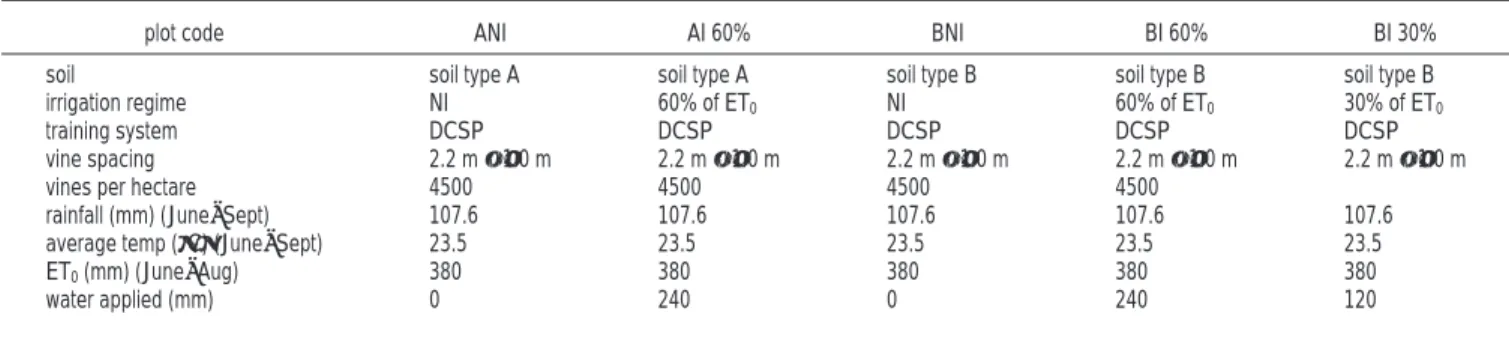
Soils Types, Irrigation, and Sampling. Samples were taken from vines segregated into elemental plots (45 vines each) defined in terms of soil type and irrigation regime. The sampling period was from 2 weeks prior to veraison until full ripeness (19/07, 22/08, 4/09, and 19/ 09). All plots can be considered equal in terms of vine training system, plant density, and climatic conditions (Table 1). The ET0was estimated by the Penman-Monteith method as described by Allen et al. (17). The irrigation period was from 14/06 till 19/09.°Brix was measured using a refractometer LEICA-model 7530.
Extraction and Determination of Carotenoids. Grape Material. Approximately 50 g of fresh berries, of seeds, were homogenized using a Turrax homogenizer at 9500 rpm for 15 min. This procedure provided 40 g of sample that was spiked with 200µL of internal standard and 170 mg/L ofβ-apo-8′-carotenal (Fluka, Portugal) (10810) and was diluted with 40 mL of water (18.3 MΩ/cm). Extraction was carried out with 40 mL of ether/hexane (1:1, v/v), HPLC grade (MERCK, Portugal), and agitated for 30 min. The extraction was repeated two more times with 20 mL of ether/hexane (30 min each). The final combined extract was concentrated to dryness (rotavapor) and resus-pended in 1 mL of acetone/hexane (1:1, v/v) for HPLC determination. Light exposure was minimized during sample preparations in order to avoid photoisomerization.
HPLC. A Beckman model 126 quaternary solvent system, equipped with a System 32 Karat software and a 168 rapid-scanning, UV-visible photodiode array detector, was used. The absorption spectra were recorded between 270 and 550 nm.
Stationary Phase. Nova-Pack C18 60 Å 4µm particles (3.9× 300 mm), Waters.
Mobile Phase. Solvent A, ethyl acetate (Merck pure grade); solvent
B, acetonitrile/water (9:1 v/v) (Merck pure grade and pure water); flow rate ) 1 mL/min. The following gradient was employed, 0-31 min (0-60% A); 31-46 min (60% A); 46-51 min (60-100% A); 51-55 min (100% A); 55-60 min (100-0% A); 60-65 min (0% A). Rt values: neoxanthin (5.5 min), violaxanthin (6.0 min), luteoxanthin (6.2 min), lutein (13.6 min), unknown (27.5 min), chlorophyll (30.2 min), andβ-carotene (32.4 min) (18).
Identification. Carotenoids were identified by comparison with commercially available standards,β-carotene (Sigma 95%, synthetic) (C-9750), lutein (Sigma 70%, from alfalfa) (X-6250), neoxanthin (0234.1) and violaxanthin (0259) from (CaroteNature GmbH from Switzerland), and chlorophyll a (Aldrich, from spinach) (25 825-3). Luteoxanthin was identified by comparison of retention time and UV-visible photodiode array spectra (Table 2 and Figure 1).
Statistical Analysis. Principal component analysis (PCA) and cluster analysis (dendogram) were carried out using a XLSTAT-Pro version 6.1.8. The PCA method shows similarities between samples projected on a plane and makes it possible to determine which variables determine Table 1. Definition of Soil Type, Irrigation Regime, and Climatic Conditions for Elemental Plotsa
plot code ANI AI 60% BNI BI 60% BI 30%
soil soil type A soil type A soil type B soil type B soil type B
irrigation regime NI 60% of ET0 NI 60% of ET0 30% of ET0
training system DCSP DCSP DCSP DCSP DCSP
vine spacing 2.2 m×1.0 m 2.2 m×1.0 m 2.2 m×1.0 m 2.2 m×1.0 m 2.2 m×1.0 m
vines per hectare 4500 4500 4500 4500
rainfall (mm) (June−Sept) 107.6 107.6 107.6 107.6 107.6
average temp (°C) (June−Sept) 23.5 23.5 23.5 23.5 23.5
ET0(mm) (June−Aug) 380 380 380 380 380
water applied (mm) 0 240 0 240 120
aSoil type A, high water retention capacity soil: initially escavated to 1.2 m depth with the base rock (schist) at approximately 0.8 m deep. The stoniness of this soil is approximately 40%. Soil type B, low water retention capacity soil: initially excavated to 1.2 m depth with the base rock (schist) at approximately 0.4 m deep. The stoniness of this soil is approximately 80%. DCSP, double cordon and spur pruned.
Table 2. Data Used for Carotenoid Identification in Grape Berries
spectral data, λmax(nm)
pigment identified tr (HPLC) HPLC solvent ethanol source of pigment
neoxanthin 5.5 415 438 466 415 438 467 CaroteNature
violaxanthin 6.0 418 441 471 420 441 471 CaroteNature
luteoxanthin 6.2 400 422 448
lutein 13.6 (422) 447 476 (421) 446 475 Sigma (alfalfa)
IS (β-apo-8′-carotenal) 18.8 460 464 Fluka
chlorophyll a 30.2 410 Aldrich (spinach)
these similarities and in what way. The dendogram method shows correlations by clusters diagrams.
RESULTS AND DISCUSSION
The effect of irrigation on changes in carotenoid contents for soil A and soil B is shown in Table 3. The comparison was
made from 2 weeks before veraison, during ripening, and at harvest time (19/07, 22/08, 4/09, and 19/09). Carotenoids analyzed wereβ-carotene, lutein, neoxanthin, violaxanthin, and luteoxanthin. Chlorophyll a was also considered due to its major impact during grape ripening, as an indicator of maturation. Results showed that from all plots and experimentation, caro-tenoid content decreased during ripening with a concomitant
Figure 1. HPLC chromatogram of carotenoids of Touriga Nacional from BNI grapes at harvest time (19/09). DO ) 447 nm. (1) Neoxanthin, (2) violaxanthin, (3) luteoxanthin, (4) lutein, (5) internal standard, (6) unknown, (7) chlorophyll a, and (8) β-carotene.
Table 3. Changes in Carotenoid Contents of the Grape Berries Harvested from Different Soils with and without Irrigation during Ripeninga
plot code neoxanthin violaxanthin luteoxanthin lutein chlorophyll a carotene weight/berry °Brix
ANI•I 66 0 0 1183 327 1981 0.48 6 ANI•II 92 22 2 929 163 1363 0.88 15 ANI•III 70 23 1 571 90 918 0.90 17 ANI•IV 85 12 0 624 93 1046 0.89 17 AI 60%•I 115 0 0 1499 334 2153 0.56 5 AI 60%•II 71 16 2 548 94 764 1.56 18 AI 60%•III 65 23 2 519 80 746 1.52 22 AI 60%•IV 164 27 4 874 121 1204 1.36 25 BNI•I 65 0 0 1563 360 2018 0.50 6 BNI•II 49 6 1 514 89 739 0.94 16 BNI•III 63 7 2 452 67 677 0.95 19 BNI•IV 98 26 17 728 116 1102 0.94 19 BI 30%•I 33 0 0 881 198 1198 0.57 6 BI 30%•II 39 1 1 340 55 448 1.39 21 BI 30%•III 41 10 4 260 38 369 1.26 23 BI 30%•IV 32 6 1 152 21 238 1.02 24 BI 60%•I 44 0 0 855 194 999 0.54 5 BI 60%•II 94 4 1 615 110 721 1.42 19 BI 60%•III 84 17 0 629 93 762 1.20 23 BI 60%•IV 57 9 0 282 40 356 1.34 26
aI, sample data for 19/07; II, sample data for 22/08; III, sample data for 04/09; IV, sample data for 19/09. Carotenoid concentration is expressed in µg/kg of berry.
increase of °Brix. The largest percentage decreases were observed for chlorophyll a, lutein, and β-carotene of 64-89, 42-83, and 44-80%, respectively. Violaxanthin and luteo-xanthin appeared only from 22/08 and seem to have slightly increased during this period (Table 3). These results are in agreement with previous work where the presence of carotenoids in grape berries demonstrated that β-carotene and several xanthophylls are abundant before veraison, with decreasing levels during ripening. These decreases were less prominent during the maturation (3).
Berry growth was studied by measurement of the berry weight and°Brix (Table 3). Is contributed to an increase of berry size and to higher sugar concentrations in both soils (A and B). The higher sugar accumulation noted in irrigated vines may be related to their higher photosynthetic activity as compared to water-stressed vines, prolonging the period of photosynthetic activity by slowing leaf senescence. This effect can contribute to a lower rate of sugar transport to the berries in nonirrigated vines (11). Furthermore, higher vegetative growth (I) results in higher pruning weights and higher leaf area index where irrigated vines are not exposed to heat stress as compared to nonirrigated vines, which suffer high temperatures (12).
Figure 2 shows the degree of correlation of carotenoid
contents with different regimes of irrigation in the two different soils, while Figure 3 gives the factors scores (factor score plot 1-2 accounts for 83% of total variance) from the principal components study carried out with data from Table 3. From a detailed study of these figures, it can be concluded that (i) for the first stage of maturation (I•19/07) two different groups can be seen, a first group (ANI, AI 60%, and BNI) and a second group (BI 30% and BI 60%), that follow different patterns of variation. Carotenoids found in nonirrigated and irrigated grapes in the higher water retention capacity soil (ANI and AI 60%) were similar. Because carotenoids are in much higher levels in skins than pulp (17), this nonvariation could be explained by the fact of observed increases in pulp-skin ratios with Is. Carotenoids found in the nonirrigated grapes in the lower water
retention capacity soil (BNI) are close to those found in the higher water retention capacity soil (soil A). However, irrigation, in the lower water retention capacity soil (soil B), leads to a lower carotenoid concentration in the grapes. Nevertheless, different levels of irrigation, 30% and 60% of ET0, had similar values of carotenoids for BI 30% and BI 60%, respectively. Carotenoid contents in irrigated grapes in the lower water retention soil (BI 60%) were approximately 61 and 68% lower for lutein andβ-carotene, respectively, than that of the nonir-rigated grapes (BNI).
(ii) For the last stage of maturation (IV•19/09), AI 60% and BNI are well-grouped, indicating that carotenoid levels were similar for a nonirrigated lower water retention capacity soil (BNI) and an irrigated higher water retention capacity soil (AI 60%).
(iii) The other plots, which all exhibit different behaviors, are different from the others. For (II•22/08 and III•4/09) stages, Is, in soil B, are well-grouped, with the exception of the 60% of ET0treatment. One these dates carotenoid decreas-ing, during ripeness, slowly down for this treatment. For soil A, the NI and I follows an identical variation in these stages of ripeness.
°Brix and berry weight are well-correlated. The correlation coefficient at the level of significance R ) 0.050 (two-tailed test) is 0.853. All carotenoids analyzed are well-correlated with °Brix (correlation values higher than -0.6 reach -0.868 for
Figure 2. Dendogram of the carotenoid contents with different regimes of irrigation in the two analyzed soils.
Figure 3. Principal components diagram of the carotenoid contents with different regimes of irrigation in the two analyzed soils. Factor score plot 1-2. Components 1 and 2 account for 83% of the total variance.
chlorophyll a) with the exception of neoxanthin, violaxanthin, and luteoxanthin, which have different behaviors. Although °Brix and berry weight increases were concomitant with I, no direct effect could be established between these parameters and carotenoid contents in grapes. Soil characteristics and water retention capacity affect canopy density and consequently bunch exposure to sunlight. Light has probably the largest effect on carotenoids content.
CONCLUSION
Soil and water retention capacity affect carotenoid contents in grapes. I seems to contribute to lower carotenoid levels in grapes, when vines are planted in a lower water retention capacity soil. This decrease was similar for both 30 and 60% of ET0. However, in a higher water retention capacity soil, I seems to have no effect in carotenoid contents when compared with NI.
It seems possible to produce grapes with higher weight and higher sugar levels together with similar carotenoid contents in an irrigated higher water retention capacity soil. It is reasonable to establish the possibility of improving wine production together with the eventual presence of substances with high aroma impact, knowing that carotenoids are precursors of several of these aroma compounds. On the other hand, soil characteristics had a larger influence than irrigation on the concentration of carotenoids in grapes, resulting in an important viticultural parameter to take into account in aroma precursor formation. To gather more information concerning other viticultural parameters that might help to better understand the results of the present work, ongoing research is under development. ABBREVIATIONS USED
NI, nonirrigated treatment; I, irrigated treatment; ET0, po-tential evapotranspiration; 30% of ET0, 30% of evapotranspira-tion; 60% of ET0, 60% of evapotranspiration;°Brix, total soluble solids; ANI, nonirrigated treatment in soil A; AI 60%, irrigated treatment at 60% of evapotranspiration in soil A; BNI, non-irrigated treatment in soil B; BI 60%, non-irrigated treatment at 60% of evapotranspiration in soil B; BI 30%, irrigated treatment at 30% of evapotranspiration in soil B.
LITERATURE CITED
(1) Razungles, A.; Bayonove, C.; Cordonnier, R.; Baumes, R. Etude des carote´noides du raisin a` maturite´. Vitis 1987, 26, 183-191. (2) Razungles, A.; Bayonove, C.; Cordonnier, R.; Sapis, J. Grape carotenoids: Changes during the maturation period and localiza-tion in mature berries. Am. J. Enol. Vitic. 1988, 39 (No. 1), 44-48.
(3) Razungles, A.; Babic, I.; Sapis, J.; Bayonove, C. Particular behavior of epoxy xanthophylls during veraison and maturation of grape. J. Agric. Food Chem. 1996, 44, 3821-3825. (4) Marais, J.; van Wyk, C.; Rapp, A. Carotenoid levels in maturing
grapes as affected by climatic regions, sunlight and shade. S.
Afr. J. Enol. Vitic. 1991, 12 (No. 2), 64-69.
(5) Bureau, S.; Razungles A.; Baumes, R.; Bayonove, C. Effect of vine or bunch shading on the carotenoid composition in Vitis
Vinifera L. berries. I. Syrah grapes. Vitic. Enol. Sci. 1998, 53
(No. 2), 64-71.
(6) Razungles, A.; Bureau, S.; Bayonove, C.; Baumes, R. Effect de l’ensoleillement sur les teneurs en precurseurs d’aromes des baies de Syrah. OIV 1999, II, 382-388.
(7) Bureau, S.; Baumes, R.; Razungles, A. Effects of vine bunch shading on the glycosylated flavor precursors in grapes of Vitis
Vinifera L. Cv. Syrah. J. Agric. Food Chem. 2000, 48,
1290-1297.
(8) Marais, J.; van Wyk, C.; Rapp, A. Carotenoids in grapes. FlaVors
and Off-FlaVors; Proceedings of the 6th International Flavor
Conference, Rethymnon, Crete, Greece, 5-7 July 1989. (9) Kotseridis, Y.; Baumes, R.; Skouroumounis, G. K. Synthesis of
labeledβ-damascenone, 2-methoxy-3-isobutylpyrazine, R-ionone andβ-ionone for quantification in grapes, juices and wines. J.
Chromatogr. A 1998, 824, 71-78.
(10) Ruhl, E. H.; Alleweldt, G. Investigations into influence of time of irrigation on yield and quality of grapevines. Acta Hortic. 1985, 171, 457-462.
(11) Bartolome´, C. Respuestas de la vida (V. Vinifera L.) a condiciones de estres hı´drico: efectos sobre las relaciones agua-planta, el crescimiento, la produccio´n y la calidad (cv. Tempranillo). Tesis, Universidad Polite´cnica de Madrid, 1993.
(12) Esteban, M. A.; Villanueva, M. J.; Lissarrague, J. R. Effect of irrigation on changes in berry composition of Tempranillo during maturation. Sugars, organic acids and mineral elements. Am. J.
Enol. Vitic. 1999, 50 (No. 4), 418-434.
(13) Ojeda, H.; Deloire, A.; Carbonneau, A. Influence of water deficits on grape berry growth Vitis 2001, 40 (3), 141-145.
(14) Deloire, A.; Carbonneu, A.; Federspilel, B.; Ojeda, H.; Wang, Z.; Costanza, P. La vigne et le´au. Prog. Agric. Vitic. 2003, 120 (No. 4), 79-90.
(15) Lopes, C.; Vicente-Paulo, J.; Santos. T.; Rodrigues, M. L.; Barroso, J.; Chaves, M. M. An Attempt to Quantify GrapeVine
Water Stress in a Mediterranean EnVironment; 11th Meeting
GESCO, University Degli Studi di Palermo, Palermo, Italy, 1999; pp 211-217.
(16) Escalona, J. M.; Flexas, J.; Schultz, H. R.; Medrano, H. Effect of moderate irrigation on aroma potential and other markers of grape quality. Acta Hortic. 1999, 493, 261-268.
(17) Allen, R.; et al. Crop eVapotranspiration-Guidelines for
com-puting crop water requirements; FAO Irrigation and Drainage
Paper 56; FAO: Rome, 1998.
(18) Guedes de Pinho, P.; Ferreira, A. C.; Mendes Pinto, M.; Gomez Benitez, J.; Hogg, T. Determination of carotenoid profiles in grapes, musts and fortified wines from Douro varieties of Vitis Vinifera. J. Agric. Food Chem. 2001, 49 (11), 5484-5488. Received for review March 20, 2003. Revised manuscript received July 25, 2003. Accepted August 3, 2003. This work was supported by the Portuguese Ministry of Agriculture through the AGRO program (Project 313).