Chemical Industry & Chemical Engineering Quarterly www.ache.org.rs/CICEQ
Chem. Ind. Chem. Eng. Q. 21 (2) 295−303 (2015) CI&CEQ
AMAL JUMA HABISH1 SLAVICA LAZAREVIĆ1
IVONA JANKOVIĆ-ČASTVAN1 BRANISLAV POTKONJAK2
ĐORĐE JANAĆKOVIĆ1 RADA PETROVIĆ1 1
Faculty of Technology and Metallurgy, University of Belgrade, Belgrade, Serbia 2
Institute of Chemistry, Technology and Metallurgy, University of Belgrade, Belgrade, Serbia SCIENTIFIC PAPER
UDC 66.081:546.48-128:628:544 DOI 10.2298/CICEQ140130028H
THE EFFECT OF SALINITY ON THE
SORPTION OF CADMIUM IONS FROM
AQUEOUS MEDIUM ON Fe(III)-SEPIOLITE
Article Highlights
• Cadmium ions sorption from saline waters onto Fe(III)-sepiolite was studied
• Sorption capacities in saline waters were lower than in distilled water
• The bonds sorbate-sorbent were stronger in distilled water than in saline waters
• Sorption was well described by Sips isotherm and pseudo-second order kinetic models
• Desorption studies indicated strong sorbate-sorbent bonds, i.e., chemisorption
Abstract
In this study, the sorption of cadmium ions onto sepiolite modified with hyd-rated iron(III) oxide, Fe(III)-sepiolite, has been investigated in natural seawater, artificial seawater, aqueous solution of NaCl of the same ionic strength as the seawater and distilled water. The sorption experiments were performed as a function of the initial solution pH value, initial metal concentration, and equi-libration time, using the batch method. The equilibrium sorption data were analyzed by the Langmuir, Freundlich and Sips isotherm models and the kinetics of sorption was analyzed using the first-order and the pseudo-second-order kinetic models. The maximum sorption capacity and the strength of the sorbate-sorbent bonds at initial pH 7 were found to decrease in the following order: distilled water > NaCl solution > artificial seawater > natural
seawater. The values of parameter nS in the Sips model, which fitted the
equi-librium sorption results best, showed that heterogeneity of the sorbent surface was the highest in distilled water and the lowest in natural seawater. The sorption kinetic data fitted well with the pseudo-second-order kinetic model,
which suggests that the rate-limiting step in Cd2+ sorption onto Fe(III)-sepiolite
could be chemisorption. The low desorption percentage in both distilled water
and 0.001 M HNO3 indicated that sorption occurred mainly by chemisorption
mechanisms.
Keywords: chemisorption, Cd2+, modified sepiolite, seawater, modeling,
desorption.
The contamination of natural waters by toxic heavy metals through the discharge of industry is a significant environmental problem. In particular, cad-mium is a highly toxic element at relatively low dos-ages and causes serious health problems to human, animals and aquatic life [1,2]. Cadmium is released into natural waters mainly through a number of
Correspondence: R. Petrović, Faculty of Technology and Metallurgy, University of Belgrade, Karnegijeva 4, 11000 Bel-grade, Serbia.
E-mail: [email protected] Paper received: 30 January, 2014 Paper revised: 9 July, 2014 Paper accepted: 29 July, 2014
ustries such as smelting, metal plating and mining, nickel-cadmium battery manufacturing, phosphate fertilizers, pigments, stabilizer and alloys production [1,3]. To avoid significant toxic effects on aquatic
eco-systems, a cost-effective method to remove Cd2+ from
natural waters is needed. The sorption is an appro-priate technology for cadmium removal from natural water systems, especially using low-cost sorbents such as zeolite [4], bentonite [5,6] and sepiolite [7,8].
Sepiolite is fibrous hydrated magnesium silicate
clay with a unit cell formula Mg8Si12O30(OH)4
(OH2)4⋅8H2O. In some aspects, sepiolite is similar to
A.J. HABISH et al.: THE EFFECT OF SALINITY ON THE SORPTION OF Cd2+… Chem. Ind. Chem. Eng. Q. 21 (2) 295
−303 (2015)
magnesium layer), but it has discontinuities and inversion in silica sheets, which give rise to structural channels filled with water molecules and running along the c-axis of fibrous particles. Due to its unique structure with micro channels and high surface area, sepiolite has received considerable attention as a sor-bent for organic and inorganic compounds from water, as well as a support for catalysts [9-14].
Recently, research interest has increased in term of use of iron oxides for modification of clay minerals to improve their sorption capacity [10-13]. These systems, which are characterized by the pre-sence of additional active sites, were applied as effective sorbents for metal ions removal from aque-ous solutions.
A number of sorbents have shown high
capa-cities for the removal of Cd2+ from aqueous solutions.
However, these sorption capacities have been deter-mined in deionized water, a simple matrix that fails to account for the effects of metal ion speciation, com-plexation, competing ions, and fouling of the sorbent materials by organic molecules often present in real waters [15]. In this study, the cadmium sorption on sepiolite modified with hydrated iron(III) oxide was investigated by using saline waters as an aquatic matrix. The cadmium sorption from different types of saline waters (natural seawater, artificial seawater and aqueous solution of NaCl of the same ionic strength as seawater) was compared with the sorp-tion from distilled water. The influence of the initial
solution pH value, initial Cd2+ concentration and the
equilibration time on the amount of Cd2+ sorbed on
the modified sepiolite and the capability of the Lang-muir, Freundlich and Sips isotherm models to fit the experimental sorption data, were investigated.
EXPERIMENTAL PROCEDURE
Materials
Sorbent
The natural sepiolite used for the modification with hydrated iron(III) oxide was sampled from Andrici (Serbia). The chemical composition, specific surface area, pore size, X-ray diffraction and FTIR analyses of the sepiolite were reported previously [14]. The Fe(III)-sepiolite was prepared by mixing 20.0 g of
sepiolite, 200 cm3 of freshly prepared 0.5 mol/dm3
FeCl3 aqueous solution, and 360 cm3 of 1 mol/dm3
NaOH aqueous solution [11]. The addition of NaOH solution was rapid and with stirring. The suspension
was diluted to 1 dm3 by distilled water and was kept in
closed polyethylene flask at 70 °C for 48 h. Then, the
precipitate was centrifuged and washed by distilled
water until it was Cl¯-free. The Fe(III)-sepiolite powder
had a dark red color, and its elemental analysis rev-ealed that the content of iron reached 22.2 wt.% [11]. The characterization of the modified sepiolite showed that Fe(III)-sepiolite maintained the basic structure of the natural sepiolite, which contained pure sepiolite, without impurities [11]. The presence of new crystal-line Fe phases was not observed by X-ray diffraction analysis, indicating that an amorphous Fe compound
was formed. The pHpzc of Fe(III)-sepiolite (8.5±0.1)
was higher than the pHpzc of the natural sepiolite
(7.4±0.1), which means that the basicity of the sepio-lite surface was increased [11]. In addition, it was showed that modification of the sepiolite with hyd-rated iron(III) oxide caused negligible change of the
specific surface area (from 280.0 to 285.6 m2/g) and
small decrease of the pore volume (from 0.311 to
0.227 cm3/g) [12,13].
Types of water
The four types of aquatic systems were used for
Cd2+ solutions preparation:
1. Natural seawater (NSW) obtained from Greece,
which contained Cl¯ (564.13 mmol/dm3), Na+ (488.9
mmol/dm3), K+ (8.74 mmol/dm3), Mg2+ (45.22 mmol/
/dm3), Ca2+ (8.56 mmol/dm3), SO42- (27.91 mmol/dm3)
and Br- (0.62 mmol/dm3); the concentration of the
major cations and anions in NSW was determined on a Metrohm ion chromatography instrument, 861 Adv-anced Compact IC MSM II.
2. Artificial seawater (ASW), prepared according to analysis of the seawater; the quantities of salts used for the artificial seawater preparation were:
488.9 mmol/dm3 NaCl, 8.74 mmol/dm3 KCl, 25.88
mmol/dm3 MgCl2, 19.34 mmol/dm3 MgSO4, 8.56
mmol/dm3 CaSO
4 and 0.62 mmol/dm3 NaBr.
3. Distilled water (DW);
4. Aqueous solution of NaCl (NCS) of the same ionic strength as the seawater, prepared by
dissol-ution of 40.2 g NaCl(s) in 1 dm3 of distilled water;
ionic strength of NSW, I, was calculated according to
the equation:
=1
2 i i
I c z (1)
where: ci is the concentration of the ion and zi is the
charge of the ion.
Sorbate
The Cd2+ solutions were prepared by using
cad-mium nitrate (Cd(NO3)2·4H2O) produced by Zorka,
Šabac (Serbia).
Sorption experiments
The batch equilibration method was used to
Fe(III)-sepiolite at 25±1 °C. The equilibrations of
samples with 0.04 g Fe(III)-sepiolite and 20 cm3 of the
solution were performed in a thermostated water bath with shaking. The sorption experiments were per-formed as a function of the initial metal concentration, the initial solution pH and the equilibration time. The
initial Cd2+ concentrations as well as the
concentra-tion of Cd2+ after the sorption were determined using
atomic absorption spectroscopy (AAS, Perkin-Elmer
730; detection limit for Cd2+ was 0.3 mg/dm3). All the
sorption studies were repeated twice; the reported values are the average of two measurements.
Influence of the initial solution pH
The influence of the initial solution pH value
(pHi) on the sorption capacity was investigated using
Cd2+ solution of 50 mg/dm3 concentration. The
start-ing pH value was adjusted by HNO3 or KOH at 4, 5, 6,
7 and 8. The suspensions were equilibrated for 24 h and then filtrated through a filter paper (retention of
particles larger than 11 μm). The final solution pH
(pHf) was measured using a pH meter InoLab WTW
series pH 720.
The amount of cadmium sorbed per unit mass of
Fe(III)-sepiolite at equilibrium, qe (mg/g), was
calcul-ated using the equation:
−
= e
e o
c c
q V
m (2)
where co and ce are the initial and the equilibrium
concentrations (mg/dm3), m is the mass of the
sor-bent (g), and V is the volume of the solution (dm3).
Sorption isotherms
Sorption isotherms were determined using Cd2+
solutions of different concentration (5, 10, 20, 30, 45,
75, 100 and 150 mg/dm3) at pH
i 7.0±0.1. The samples
were equilibrated for 24 h. The amount of Cd2+ sorbed
per unit mass of Fe(III)-sepiolite at equilibrium, qe
(mg/g), was calculated using Eq. (2).
Sorption kinetics
The kinetic experiments were performed at the
Cd2+ initial concentration of 50 mg/dm3 (
co), at the
ini-tial pH 7.0±0.1, for the contact time of ½, 1, 2, 4, 8, 16
and 24 h.
The quantity of Cd2+ ions sorbed per unit mass
of Fe(III)-sepiolite after the period of time t (qt) was
calculated according to the equation:
qt= o− t
c c V
m (3)
where ct is the concentration of Cd2+ after the period
of time t.
Desorption studies
Desorption studies were performed with the sor-bent samples obtained by the sorption from the sol-utions in DW, NCL, ASW and NSW at the initial
con-centration of 150 mg/dm3. The loaded sorbent samples
were dried at 100 °C for 24 h and used in batch
desorption experiments. Test flasks were filled with
20 cm3 of desorbing solution (distilled water or 0.001
M HNO3), and 0.04 g of the loaded sorbent sample
was added. After an equilibration for 24 h in a thermo-stated water bath with shaking at a temperature of 25
°C, the dispersions were filtered and the filtrates were
analyzed to check the desorbed Cd2+, using AAS. The
desorption efficiency was defined as the ratio between
the amount of Cd2+ desorbed and the amount of Cd2+
sorbed on the sorbent. In addition, concentration of
Fe3+ in the filtrates after desorption, as well as in
sol-ution after the sorption at the initial concentration of
150 mg/dm3, was determined in order to check
sta-bility of hydrated iron(III) oxide on the sepiolite sur-face.
RESULTS AND DISCUSSION
Influence of initial solution pH on the sorption capacity
Metal sorption from aqueous solutions can be greatly affected by the solution pH that influences not
only the binding sites (e.g., degree of protonation or
deprotonation of functional groups at the sorbent sur-face), but also the metal chemistry (e.g. speciation
and precipitation). At pH below 8, Cd2+ is a dominant
and soluble form, while precipitate is formed at higher pH values [16]. In general, the precipitate formation
depends on the Cd2+ concentration, other present
cat-ions concentration, types and concentratcat-ions of anions, temperature, and presence of solids.
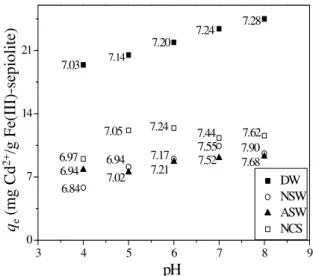
The influences of the initial solution pH value on the sorption capacity of Fe(III)-sepiolite in distilled water, seawater, artificial seawater and NaCl solution
are presented in Figure 1. The effect of pHi was
studied in the pH range from 4 to 8 in order to avoid the occurrence of the precipitation of cadmium hyd-roxide at higher pH values. According to the value of
the solubility product constant of Cd(OH)2 and Cd2+
initial concentration, Cd(OH)2 precipitation starts at
pH > 8.5. The final pH values, pHf, for each sample
are also given in Figure 1.
According to Figure 1, the sorption capacity gen-erally increased with the initial pH increase for all types of water systems that can be explained by
decrease in number of H+ that compete with Cd2+ for
the sorption sites. The values of pHf show that H+ ions
associated with the surface functional groups of
Fe(III)-sepiolite at pHi ≤ 7 (pHf > pHi), while at pH 8
disso-A.J. HABISH et al.: THE EFFECT OF SALINITY ON THE SORPTION OF Cd2+… Chem. Ind. Chem. Eng. Q. 21 (2) 295
−303 (2015)
ciation of the functional groups (pHf < pHi). Thus, the
pH value at which the surface charge changed from positive to negative and vice versa is between pH 7 and pH 8 for all types of water, which is lower than the
pHpzc of Fe(III)-sepiolite (8.5±0.1). This indicates the
specific sorption of Cd2+, i.e., formation of inner-sphere
complexes with the surface functional groups. Such bonds are stronger than electrostatic interactions between charged surface and oppositely charged ions
(outer-sphere complexes). As pHi decreased from 7 to
4, more H+ were bonded to the surface functional
groups, leaving a smaller number of groups for Cd2+
binding, so the sorption capacity decreased with the
pHi decrease. In addition, as pHi was lower, the
negative charge of the surface became lower and the positive charge higher, which also decreased the sorption of positively charged cadmium ions by elec-trostatic interactions.
3 4 5 6 7 8 9
0 7 14 21
7.68 7.90 7.62
7.52 7.55 7.44
7.21 7.17 7.24
6.94 7.02 7.05
6.84 6.94 6.97
7.28 7.24
DW NSW ASW NCS
q
e(mg C
d
2+
/g Fe(I
II)-sepiolite)
pH
7.03 7.147.20
Figure 1. The effect of the initial pH on Cd2+ sorption by
Fe(III)-sepiolite from DW, NCS, ASW and NSW for the initial Cd2+ concentration of 50 mg/dm3 (the numbers in the figure
indicate the final pH values).
The sorption capacity of Fe(III)-sepiolite is sig-nificantly higher in the case of sorption from distilled water than from the saline waters, which can be explained by competitive effect of ions from saline waters for active sites at the surface of the sorbent.
NSW and ASW contain higher-valence ions (Ca2+ and
Mg2+), which have more competitive effect than
monovalence ions, so sorption capacity was lower in NSW and ASW than in NaCl solution. Moreover, high concentration of ions in water, like in all types of saline waters, caused decreasing of surface charge of the sorbent [17] and consequently, sorption capacity decreasing. Comparison of the sorption capacity of Fe(III)-sepiolite in different types of water was done
fur-ther by sorption isofur-therm determination at pHi 7.0±0.1.
Sorption isotherms studies and modeling
The experimental sorption isotherms as the
dependence of mass of Cd2+ sorbed per unit mass of
Fe(III)-sepiolite at equilibrium on the Cd2+ equilibrium
concentration, for distilled water, natural seawater,
artificial seawater and NaCl solution at pHi 7.0±0.1
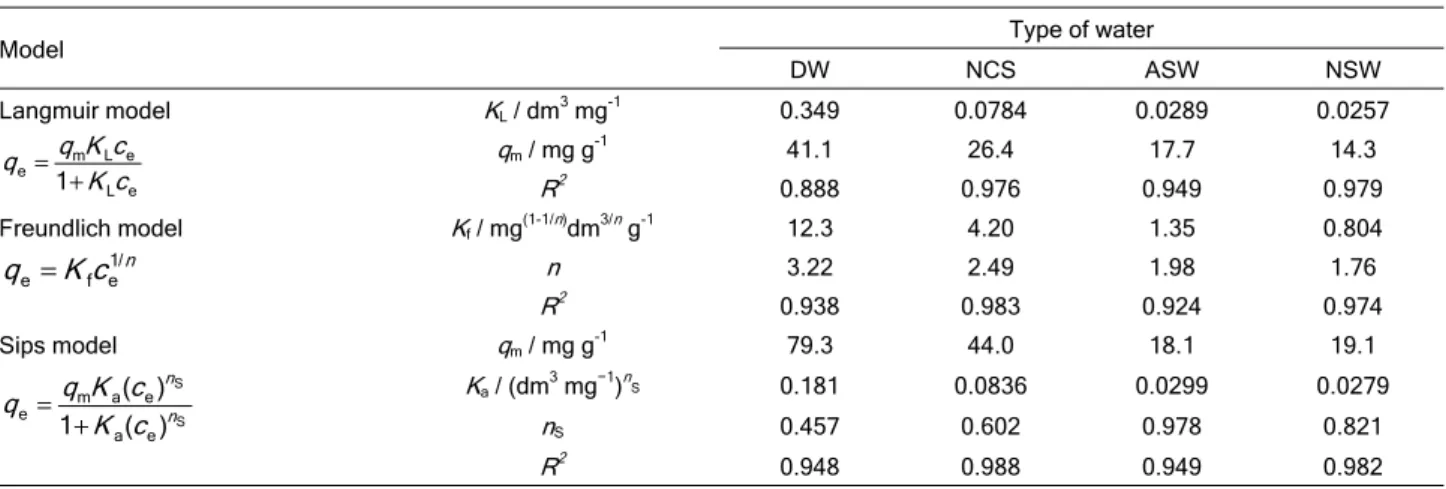
are presented in Figure 2. The equilibrium sorption data were fitted to the Langmuir, Freundlich and Sips isotherms, and the model fits are presented with the experimental data in Figure 2. The sorption isotherms constants, determined by non-linear regression anal-ysis using the Easy Plot, are summarized in Table 1,
where: qm is the maximum adsorption capacity, KL is
the Langmuir constant related to the energy of
ads-orption, Kf is the Freundlich constant related to the
adsorption capacity, n is the dimensionless sorption
intensity parameter, Ka is the Sips equilibrium
cons-tant and nS is the index of heterogeneity.
According to Figure 2, the Fe(III)-sepiolite
showed the highest sorption capacity for Cd2+ in
dis-tilled water, then in NaCl solution, followed by sorp-tion capacity in artificial seawater and the lowest in natural seawater. Such order of sorption capacity, which is the same as in the investigation of the effect
of pHi on Cd2+ sorption, confirmed strong influence of
salinity on the sorption properties of Fe(III)-sepiolite. Salinity was also observed to limit performance of dif-ferent organic and inorganic chemisorbents for the collection of a diverse range of fission and activation product elements of the nuclear fuel cycle including Co, Zr, Nb, Ru, Ag, Te, Sb, Ba and Cs [18]. Salinity dependence was most significant for hard cations,
i.e., Cs+ and Ba2+. Likewise, sorption capacities of
three nanoporous sorbents containing chelating
diamine functionalities [15] for Cu2+ were lower in
sal-ine water than in river water.
The saline waters used in this research had the same ionic strength, but Fe(III)-sepiolite had lower sorption capacity in NSW and ASW than in NaCl
sol-ution because Ca2+ and Mg2+ from seawaters
com-pete with Cd2+ more effectively than Na+. The similar
results were observed for the sorption of Cd2+ onto
amorphous hydrous manganese dioxide [19], where sorption has been studied in 0.5 M NaCl solution and major ion seawater: sorption capacity was lower in seawater than in 0.5 M NaCl solution. Lower sorption capacity of Fe(III)-sepiolite in the NSW than in ASW may result from the presence of natural organic mat-ter (NOM) and other ions that are not present in ASW. NOM might have occupied some binding sites of
Fe(III)-sepiolite, which led to the reduction of Cd2+
0 20 40 60 80 0
10 20 30 40 50
qe
(mg Cd
2+ /g Fe(III
)-sep
iolite)
DW Langmuir Freundlich Sips
ce (mg Cd2+/dm3)
0 20 40 60 80
0 10 20 30
ce (mg Cd2+/dm3) qe
(mg Cd
2+
/g Fe(III)-sep
io
lite)
NCS Langmuir Freundlich Sips
(a) (b)
0 20 40 60 80 100 120
0 5 10 15 20
ASW Langmuir Freundlich Sips
ce (mg Cd2+/dm3) qe
(m
g Cd
2+
/g
Fe
(I
II
)-sep
io
lite)
0 20 40 60 80 100
0 2 4 6 8 10 12
qe
(mg Cd
2+
/g Fe(III)-sepiolite)
NSW Langmuir Freundlich Sips
ce (mg Cd2+/dm3)
(c) (d)
Figure 2. The sorption isotherms for Cd2+ onto Fe(III)-sepiolite in DW (a), NCS (b), ASW (c) and NSW (d) at pH i 7.
Table 1. Langmuir, Freundlich and Sips isotherms constants for the sorption of Cd2+ onto Fe(III)-sepiolite at pH i 7
Model Type of water
DW NCS ASW NSW Langmuir model
= +
m L e e
L e
1
q K c q
K c
KL / dm3 mg-1 0.349 0.0784 0.0289 0.0257
qm / mg g-1 41.1 26.4 17.7 14.3
R2
0.888 0.976 0.949 0.979 Freundlich model
= 1/
e f e
n
q K c
Kf / mg(1-1/n)dm3/n g-1 12.3 4.20 1.35 0.804
n 3.22 2.49 1.98 1.76
R2 0.938 0.983 0.924 0.974
Sips model
= +
S S
m a e e
a e ( )
1 ( )
n
n q K c q
K c
qm / mg g-1 79.3 44.0 18.1 19.1
Ka / (dm3 mg−1)n
S 0.181 0.0836 0.0299 0.0279
nS 0.457 0.602 0.978 0.821
R2
0.948 0.988 0.949 0.982
The study of equilibrium sorption isotherms provides important data for understanding the mech-anism of the sorption. The different sorption isotherms are characterized by their constants, the values of
sor-A.J. HABISH et al.: THE EFFECT OF SALINITY ON THE SORPTION OF Cd2+… Chem. Ind. Chem. Eng. Q. 21 (2) 295
−303 (2015)
bed species. The Freundlich equation [21,22] des-cribes sorption (possibly multilayer in nature) on a heterogeneous surface consisting of non-identical and energetically non-uniform sites. A combined form of Langmuir and Freundlich expressions, the Sips model [21,23], deduced for predicting the heterogen-eous sorption systems and circumventing the limit-ation of the rising sorbate concentrlimit-ation associated with the Freundlich isotherm model. At low sorbate concentrations (when the sorbate content is much lower than the sorbent capacity), the model reduces to Freundlich isotherm, while at high concentrations (when the sorbate content is higher than the sorbent capacity), it predicts a monolayer sorption capacity, characteristic of the Langmuir isotherm.
The results presented in Table 1 show that the Sips model is the best model to explain the sorption
behavior of Cd2+ onto Fe(III)-sepiolite, but also both
Langmuir and Freundlich fit the results well.
The maximum sorption capacity obtained by
Langmuir equation, qm, and the affinity parameter, KL,
were found to decrease in the following order: DW >
> NCS > ASW > NSW. The higher values of KL imply
stronger sorbate-sorbent interactions, so the strong-est bonds were formed in distilled water and the weakest in natural seawater [21]. The Freundlich
con-stant Kf, which is an approximate indicator of
adsorp-tion capacity, and intensity parameter n, which is an
indicator of the strength of sorption [21], decrease in
the same order as qm and KL.
The values of the maximal sorption capacity obtained by the Sips model were higher than those obtained by the Langmuir model. The Sips constant
Ka, similarly to the Langmuir constant KL, could be
regarded as representative of the strength of sorption:
higher value of Ka implies stronger bonds between
sorbate species and sorbent active sites [21,23].
According to the values of Ka in Table 1, the strength
of sorbate-sorbent bonds decreases in the order: DW >
> NCS > ASW > NSW. The parameter nS in Sips
model is the heterogeneity factor, which shows the
deviation from the Langmuir model. The value of nS
for a homogeneous material is 1, and it is less than one for heterogeneous materials [24,25]. According to
the values of nS for Cd2+ sorption onto Fe(III)-sepiolite
(Table 1), the heterogeneity of the sorbent is the high-est in distilled water, lower in NaCl solution and the lowest in seawaters. Heterogeneity of a sorbent sur-face is a result of existence of different active sites for sorption. In the case of sorption from NaCl solution, it
can be supposed that Na+ and Cl- blocked some
active sites for Cd2+ sorption at the surface of Fe(III)-
-sepiolite and thus the surface had less different act-ive sites than in the case of the sorption from distilled
water, meaning lower heterogeneity of the surface. Having in mind that sorbate-sorbent bonds were stronger in distilled water than in NaCl solution, it can
be supposed that Na+ and Cl– blocked active sites of
higher energy, leaving active sites of lower energy for
Cd2+ sorption. In seawaters, where there were Ca2+
and Mg2+, the heterogeneity was even lower and
sor-bate-sorbent bonds were weaker than in NaCl sol-ution.
The results of the isotherm modeling showed
that Cd2+ sorbed onto heterogeneous surface of Fe(III)-
-sepiolite until the monolayer is formed, but sorption capacity and surface heterogeneity were highly inf-luenced by the presence of ions in saline waters.
Sorption kinetics and modeling
The influence of the contact time t on the
amount of Cd2+ sorbed onto Fe(III)-sepiolite, q
t, is
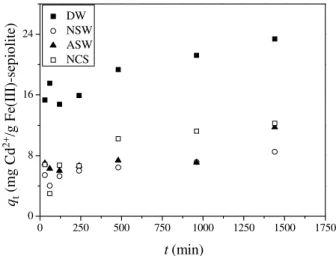
shown in Figure 3. It can be seen that the removal of
Cd2+ from different water systems by sorption onto
Fe(III)-sepiolite is comprised of three steps: the rapid sorption in the first 0.5 h, then slightly decreased sorption, followed by its slow increase after 2 h, until the equilibrium was reached. The high number of active sites available at the beginning of the sorption
may explain the fast initial Cd2+ uptake at the Fe(III)-
-sepiolite surface. However, some rapidly sorbed ions were desorbed in the next step. After that, a slow
increase of the amount of sorbed Cd2+ can be
obs-erved, since the most sorption sites were occupied
and Cd2+ concentration in the solutions decreased;
thus, the sorption became less efficient.
0 250 500 750 1000 1250 1500 1750 0
8 16 24
DW NSW ASW NCS
qt
(
mg Cd
2+
/g Fe(I
II
)-sepio
lite)
t (min)
Figure 3. The effect of contact time on Cd2+ sorption onto
Fe(III)-sepiolite in DW, NCS, ASW and NSW at pHi 7, for initial
Cd2+ concentration of 50 mg/dm3.
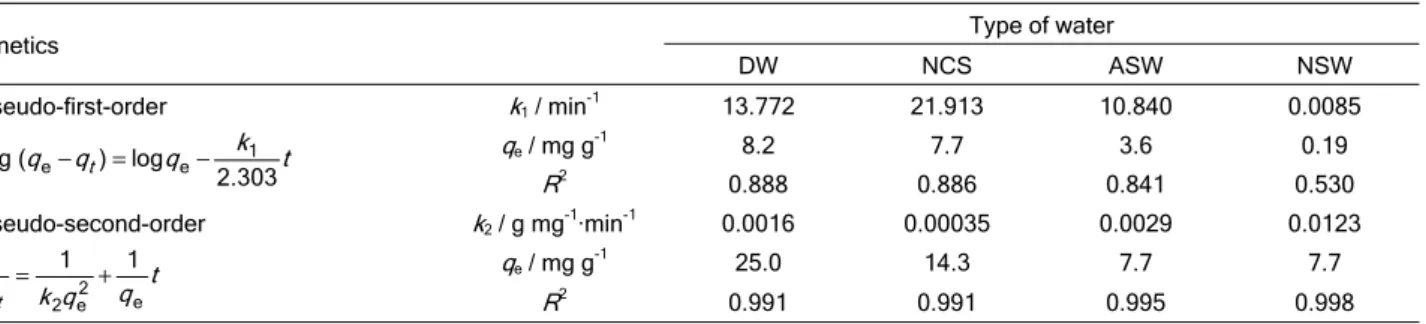
The kinetics of Cd2+ sorption onto
pseudo-second-order kinetic model proposed by Ho and McKay [27], and the results are presented in Table 2. Accordingly, the pseudo-second-order equation is the model that best describes the experimental data,
since the qe values estimated by this model are in
good agreement with the experimental results and the values of the correlation coefficients are close to 1. The fact that the pseudo-second-order model gave better agreement with the experimental data than the pseudo-first-order model is not surprising, since this seems to be a generally prevalent observation in heavy metal sorption studies [27,28]. Further, this trend suggests that the rate-limiting step in heavy metal sorption is chemisorption, which involves val-ence forces through sharing or exchange of electrons between sorbent and sorbate, complexation, coordi-nation and/or chelation, rather than physisorption [28]. As the correlation coefficients for the pseudo-second-order model are high (Table 2), it may be assumed
that the sorption of Cd2+ onto Fe(III)-sepiolite occurs
mainly through chemisorption mechanisms, e.g.,
spe-cific sorption, as it was shown during investigation of
pHi influence on the sorption capacity, and ion
exchange of Mg2+ from the sepiolite structure by Cd2+
from the solutions [14]. Similarly, sorption of Ni2+ [11]
and Co2+ [12] from solution in distilled water onto
Fe(III)-sepiolite was mainly governed by chemisorp-tion and was best described by the pseudo-second-order model.
Kinetic analysis confirmed that sorption capacity of Fe(III)-sepiolite is the highest in distilled water, and that capacity in saline waters (natural and artificial) with higher valence ions present, is lower than in NaCl solution. Salinity influenced not just sorption capacity, but also rate of the sorption: according to the values of the kinetic constant, the rate of sorption was the highest in natural seawater, lower in artificial and distilled water and the lowest in NaCl solution.
Desorption studies
Desorption studies were conducted to better
understand the mechanism of Cd2+ sorption, i.e., to
investigate the strength of sorbate-sorbent bonds. The results of desorption studies are given in Table 3.
Table 3. Percentage desorption of Cd2+ from Fe(III)-sepiolite
loaded in different types of water
Fe(III)-sepiolite loaded in:
Percentage desorption in: Distilled water 0.001 M HNO3
DW 0.36 2.54
NCL 0.40 2.80
ASW 2.24 3.61
NSW 3.30 4.67
Very low desorption percentage in both
desorb-ing media suggests that the sorption of Cd2+ onto
Fe(III)-sepiolite occurred significantly via chemisorp-tion mechanisms, as it was found according to
dependences pHf-pHi and kinetics modeling.
Desorp-tion was slightly more intense in 0.001 M HNO3 than
in distilled water, as it was expected, because the acid solution is a stronger desorbing agent than water
due to higher concentration of H+. In both desorbing
media, percentage desorption was the lowest for the sorbent loaded in DW and the highest for the sorbent loaded in NSW (Table 3). These results indicate that the strongest sorbate-sorbent bonds were formed in
DW, than in NCL, followed by ASW and the weakest in NSW, as it was found according to isotherm mod-eling.
The concentration of Fe3+ in solution after
sorp-tion, as well as after desorption in both distilled water
and 0.001 M HNO3, was below detection limit of the
AAS (≤ 0.3 mg/dm3), which indicate high stability of
hydrated iron(III) oxide on the sepiolite surface, i.e.
low Fe3+ releasing from Fe(III)-sepiolite, even in acid
solution.
Table 2. Kinetic parameters for Cd2+ sorption onto Fe(III)-sepiolite at pH
i 7, for the initial Cd2+ concentration of 50 mg/dm3 (k1 is the rate
constant of pseudo-first-order model; and k2 is the rate constant of the pseudo-second-order model)
Kinetics Type of water
DW NCS ASW NSW Pseudo-first-order
− = − 1
e e
log ( ) log
2.303
t
k
q q q t
k1 / min-1 13.772 21.913 10.840 0.0085
qe / mg g-1 8.2 7.7 3.6 0.19
R2 0.888 0.886 0.841 0.530
Pseudo-second-order
= 2+
e 2 e
1 1
t
t
t q k q q
k2 / g mg-1·min-1 0.0016 0.00035 0.0029 0.0123
qe / mg g-1 25.0 14.3 7.7 7.7
A.J. HABISH et al.: THE EFFECT OF SALINITY ON THE SORPTION OF Cd2+… Chem. Ind. Chem. Eng. Q. 21 (2) 295
−303 (2015)
CONCLUSIONS
In this study, sepiolite modified with hydrated iron(III) oxide, Fe(III)-sepiolite, was used as a sorbent
for Cd2+ from different types of water and aqueous
solutions. It was shown that the sorption capacity was highly influenced by the ions presented in aqueous media: the highest capacity was in distilled water,
where there were no other ions except Cd2+, than in
NaCl solution, followed by artificial seawater and the lowest capacity was in natural seawater. The equ-ilibrium sorption data modeling with the Langmuir, Freundlich and Sips models showed that the Sips model was the best to explain the sorption behavior of
Cd2+ onto Fe(III)-sepiolite at initial pH 7, which
indi-cates the sorption onto heterogeneous surface until the monolayer is formed. According to the values of Sips parameters, it was concluded that the strength of sorbate-sorbent bonds and heterogeneity of the sorb-ent surface decreased in the following order: distilled water > NaCl solution > artificial seawater > natural seawater. The sorption kinetic data fitted well with the pseudo-second-order kinetic model, which suggested
that the rate-limiting step in Cd2+ sorption onto Fe(III)-
-sepiolite could be chemisorption. The desorption
studies in distilled water and 0.001 M HNO3, as well
as dependence of final pH on initial pH, suggested
that the sorption of Cd2+ onto Fe(III)-sepiolite occurred
significantly via chemisorption mechanisms.
Acknowledgements
The authors wish to acknowledge the financial support for this research from the Ministry of Edu-cation, Science and Technological Development of the Republic of Serbia through the project III 45019.
REFERENCES
[1] E. Gutierrez-Segura, M. Solache-Rios, A. Colin-Cruz, C. Fall, J. Environ. Manage. 97 (2012) 6-13
[2] A. Maleki, A.H. Mahvi, M.A. Zazouli, H. Izanloo, A.H. Barati, Asian J. Chem. 3 (2011) 1373-1376
[3] H.K. Boparai, M. Joseph, D.M. O'Carroll, J. Hazard. Mater. 186 (2011) 458-465
[4] S. Wang, Y. Peng, Chem. Eng. J. 156 (2010) 11-24 [5] D. Zhao. S. Chen, S. Yang, X. Yang, S. Yang, Chem.
Eng. J. 166 (2011) 1010-1016
[6] E. Alvares-Ayuso, A. Garcia-Sanchez, Clays Clay Miner. 51 (2003) 475-480
[7] S. Kocaoba, Desalination 244 (2009) 24-30
[8] M.F. Brigatti, C. Lugli, L. Poppi, Appl. Clay Sci. 16 (2000) 45-57
[9] I. Kuncek, S. Sener, Ultrason. Sonochem. 17 (2010) 250-257
[10] E. Eren, H. Gumus, Desalination 273 (2011) 276-284 [11] S. Lazarevic, I. Jankovic-Castvan, V. Djokic, Z.
Radova-novic, Dj. Janackovic, R. Petrovic, J. Chem. Eng. Data 55 (2010) 5681-5689
[12] S. Lazarevic, I. Jankovic-Castvan, B. Potkonjak, Dj. Janackovic, R. Petrovic, Chem. Eng. Process. 55 (2012) 40-47
[13] S. Lazarevic, I. Jankovic-Castvan, A. Onjia, J. Krstic, D. Janackovic, R. Petrovic, Ind. Eng. Chem. Res. 50 (2011) 11467-11475
[14] S. Lazarevic, I. Jankovic-Castvan, D. Jovanovic, S. Milo-njic, D. Janackovic, R. Petrovic, Appl. Clay Sci. 37 (2007) 47-57
[15] W. Chouyyok, Y. Shin, J. Davidson, W.D. Samuels, N.H. Lafemina, R.D. Rutledge, G.E. Fryxell, Environ. Sci. Technol. 44 (2010) 6390-6395
[16] V.A. Nazarenko, V.P. Antonovich, E.E. Neveskaya, Hyd-rolysis of metal ions in diluted solutions, Atomizdat, Moscow, 1979
[17] J.C. Crittenden, R.R. Trussell, D.W. Hand, K.J. Howe, G. Tchobanoglous, Water Treatment: Principles and Design, John Wiley & Sons. Inc., Hoboken, NJ, 2005
[18] B.E. Johnson, P.H. Santschi, R.S. Addleman, M. Douglas, J.D. Davidson, G.E. Fryxell, J.M. Schwantes, Appl. Radiat. Isotopes 69 (2011) 205–216
[19] S.S. Tripathy, J.-L. Bersillon, K. Gopal, Desalination 194 (2006) 11–21
[20] I. Langmuir, J Am. Chem. Soc. 40 (1918) 1361-1403 [21] K.Y. Foo, B.H. Hameed, Chem. Eng. J. 156 (2010) 2-10 [22] H. Freundlic, Z. Phys. Chem. 57 (1906) 385-470 [23] V. Hernández-Montoya, M.A. Pérez-Cruz, D.I.
Mendoza-Castillo, M.R. Moreno-Virgen, A. Bonilla-Petriciolet, J. Environ. Manage. 116 (2013) 213-221
[24] E. Turiel, C. Perez-Conde, A. Martin-Esteban, Analyst 128 (2003)137-141
[25] R.J. Umpleby, S.C. Baxter, Y. Chen, R.N. Shah, K.D. Shimizu, Anal. Chem. 73 (2001) 4584-4591
[26] S. Lagergren, K. Sven, Vetenskapsakad. Handl. 24 (1898) 1-39
[27] Y.S. Ho, G. Mckay, Process Biochem. 34 (1999) 451-465 [28] S.O. Lesmana, N. Febriana, F.E. Soetaredjo, J. Sunarso,
AMAL JUMA HABISH1 SLAVICA LAZAREVIĆ1 IVONA JANKOVIĆ-ČASTVAN1
BRANISLAV POTKONJAK2
ĐORĐE JANAĆKOVIĆ1 RADA PETROVIĆ1 1Tehnološko-metalurški fakultet,
Univerzitet u Beogradu, Beograd, Srbija
2Institut za hemiju, tehnologiju i
metalurgiju, Univerzitet u Beogradu, Beograd, Srbija
NAUČNI RAD
UTICAJ SALINITETA VODE NA SORPCIJU JONA
KADMIJUMA NA Fe(III)-SEPIOLITU
U ovom radu je proučavana sorpcija jona kadmijuma iz prirodne morske vode, labo-ratorijski pripremljene morske vode, vodenog rastvora NaCl iste jonske jačine kao morska voda i destilovane vode, na sepiolitu modifikovanom hidratisanim gvožđe(III)-oksidom. Eksperimenti su izvedeni u šaržnim uslovima, pri različitim početnim pH vrednostima, početnim koncentracijama jona kadmijuma i vremenima uravnotežavanja. Rezultati sorp-cije u ravnotežnim uslovima su analizirani primenom modela Langmira, Frojndliha i Sipsa, a kinetika sorpcije je analizirana kinetičkim modelima pseudo-prvog i pseudo-drugog reda. Utvrđeno je da maksimalni adsorpcioni kapacitet i jačina veza sorbat-sorbent pri početnoj pH 7 opadaju u nizu: destilovana voda > NaCl rastvor > laboratorijski pripremljena morska voda > prirodna morska voda. Vrednosti parametra ns u modelu Sipsa, koji najbolje opisuje
eksperimentalne rezultate, pokazuju da je heterogenost površine sorbenta najveća u destilovanoj vodi i najmanja u prirodnoj morskoj vodi. Rezultati ispitivanja kinetike sorpcije se bolje fituju modelom pseudo-drugog reda, što sugeriše da stupanj koji određuje brzinu sorpcije može biti hemisorpcija. Mali stepen desorpcije i u destilovanoj vodi i u 0.001 M HNO3 je potvrdio da se joni kadmijuma vezuju za modifikovani sepiolit uglavnom
hemi-sorpcijom.
Ključne reči: hemisorpcija, Cd2+, modifikovani sepiolit, morska voda,