adfa, p. 1, 2011.
© Springer-Verlag Berlin Heidelberg 2011
Active Ageing – enhancing digital literacies in elderly
citizens
Ana Loureiro1,*, Maria Barbas1
1Instituto Politécnico de Santarém & CIDTFF/Universidade de Aveiro, Portugal
{accloureiro, mariapbarbas}@gmail.com
Abstract. Being digital and information literate is crucial in nowadays society, although not every citizen has the necessary means and resources to achieve these skills, especially the elderly ones. Therefore it is necessary to develop ways to help them to develop and enhance their digital and information competences. In this paper we will present an ongoing project that was designed and implemented with the goal to provide elderly citizens with the necessary skills of a networked society, contributing for an active ageing. The methods used were based on a set of hands on workshops delivered by a team of voluntary students and teacher, with the help of collaborators from a nursing home. The workshops were devel-oped accordingly with the detected needs of a group of elderly citizens, based on the answers of an implemented questionnaire.
Keywords: active ageing, digital literacy, elderly citizens, ICT, inclusion
1
Introduction
We live in a network society, in an era of sharing and collaboration, brought by the exponential growth of the Internet - in particular the Web 2.0 and Social Web services – and the faster development of the Information and Communication Technologies (ICT). Citizens all over the world are more dependent of ICT, “becoming increasingly
central to many people’s lives, making it possible to be connected in any place at any time” [1] They are no longer mere passive receivers of information and knowledge,
instead they are active and .reactive - searching, creating, sharing and commenting on content of multiple contexts, contributing to the collective intelligence. Collective in-telligence is seen as “a form of universally distributed inin-telligence, constantly
en-hanced, coordinated in real time, and resulting in the effective mobilization of skills”
[2]. We can only have this diversity if we have the collaboration and cooperation of all citizens of our society. But mastering the technologies doesn’t seem to be accessible to everyone. Digital literacy and information literacy are now key concepts of this net-worked society; therefore, every citizen should hold competences on this matter. Every day new and different gadgets, applications, widgets arise expecting “us to know or be
able to guess, what, where and when to connect, click, double-click, tap, flick, scroll”
easy, especially for those with some sort of technological disadvantage – being the el-derly one of the most affected groups in society.
The European Union’s population structure is changing and becoming progressively older – at the beginning of 2010, there were 87 million people aged 65 and over in the EU, more than 17 % of the total population. In response to demographic challenges being faced within Europe, the European Union designated 2012 as the European Year for Active Ageing and Solidarity between Generations [3]. The general goal was to facilitate the creation of an active ageing culture in Europe based on a society for all ages. As Europeans live longer and healthier lives, governments are looking for ways to involve elderly citizens more in society and to keep them active.
Active ageing means growing old in good health and as a full member of society, feel-ing more fulfilled in our jobs, more independent in our daily lives and more involved as citizens. No matter how old we are, we can still play our part in society and enjoy a better quality of life. The challenge is to make the most of the enormous potential that we harbor even at a more advanced age [4]. Active ageing can give senior citizens the opportunity to continue to work and share their experiences, to continue to play an ac-tive role in society and to live their lives as healthy, independent, and fulfilled as pos-sible. The European Year for Active Ageing and Solidarity between Generations, ap-pealed precisely on taking actions in very different areas: employment, social protec-tion, education and training, health and social services, housing and public infrastruc-ture. Given the fact that we are living in the society of knowledge and information or networked society it is also imperative to provide all citizens with skills in digital and information literacy.
Digital literacy refers “to the awarenesses, skills, understandings, and reflective
ap-proaches necessary for an individual to operate comfortably in information-rich and IT-enabled environments” [5]. It is thus the ability a person has to perform, effectively,
tasks in digital environments - including the ability to read and interpret media to re-produce data and images through digital manipulation, and evaluate and apply new knowledge in digital environments [6]. On the other hand information literacy “is the
adoption of appropriate information behaviour to identify, through whatever channel or medium, information well fitted to information needs, leading to wise and ethical use of information in society” [7].
Despite the fact that being digital and information literate is crucial in nowadays soci-ety, and as already mentioned, not every citizen has the necessary means and resources to achieve these skills, especially the elderly ones. Therefore it is necessary to develop ways to help them to develop and enhance their digital and information competences. In this paper we will present an ongoing project that was designed and implemented with the goal to provide elderly citizens with the necessary skills of a networked soci-ety, contributing for an active ageing. The methods used were based on a set of hands on workshops delivered by a team of voluntary students and teacher, with the help of collaborators from a nursing home. The workshops were developed accordingly with the detected needs of a group of elderly citizens, based on the answers of an imple-mented questionnaire.
2
Theoretical Framework
On nowadays society, “jobs and their skills requirements are constantly evolving.
Con-cepts such as critical thinking, multi-tasking, collaboration and team work are increas-ingly strategically relevant. E-skills can provide the opportunities to meet these fast-changing requirements of the knowledge-based society and achieve a better position to overpass global competitive challenges” [8]. This calls for citizens with digital and
in-formation literacy competences that provide certain digital infrastructures and also cit-izens with digital skills to use them. Therefore, a digitally literate society is a precursor to a knowledge-based society, requiring specific skills from their citizens, including from elderly citizens to facilitate an active ageing. Those specific skills are character-ized by:
transdisciplinarity; social intelligence;
adaptive and computational thinking; literacy in social media;
virtual collaboration;
and cross-cultural skills, among others. Thus, to be digitally literate involves:
know how to access information and know how to collect it from virtual and digital environments;
manage and organize information to be able to use it in the future;
evaluate, integrate, interpret and compare information from multiple sources; create and generate knowledge by adapting, applying and recreating new
infor-mation;
communicate and relay information to different and varied audiences through appro-priate means.
Access to information is a way to access knowledge. Parallel to digital literacy it is crucial to develop competences on information literacy. A citizen, to be information literate, “must be able to recognize when information is needed and have the ability to
locate, evaluate and use effectively the needed information”, available all over the
In-ternet [9].
Despite these facts, in Portugal, accordingly with the latest data from 2013, 64 % of the Portuguese population use the computer and the Internet; those, only 20, 2 % of elderly citizens (between the ages of 65 and 74) use the computer and merely 18, 6% use the Internet [10]. Plus the range of elderly citizens in the Portuguese society is growing, accordingly with the 2011 census 19, 15% of the population is over 65 years old [11]. The necessary transition to an economy and society based on knowledge leads us to think, work and meet in a network. In this context is required to promote the appropri-ation of digital literacies throughout the Portuguese society, namely the elderly citizens. To achieve this goal it’s necessary to propose and implement innovative initiatives for digital inclusion and increasing digital literacy and skills. The ability to develop those
skills is intrinsically related with the concept of lifelong learning, which is the pursuit of knowledge permanent and continuous, performed on a voluntary basis and self-mo-tivated, for reasons both personal and professional, improving social inclusion, active citizenship and personal development as well as the competitiveness and employability [12].
3
Active Citizenship | Grandparents 2.0
As mentioned before, active ageing means taking more and no less out of life as you age, both at work and at home or in the community, affecting each person individually, but also society as a whole. Thus, given this context, we intend to build this project, fostering intergenerational dialogue between students and seniors. Moreover, 2013 was the European Year of Citizens, focusing on the rights that all people automatically enjoy throughout the European Union because they are European citizens. Every day, 500 million Europeans enjoy these rights, which also benefits the European economy. So, if Europeans are better informed and know better utilize their rights as individuals may benefit more, which will also bring benefits for the EU economy and society. Moreover, with the project Cidadania Activa | Avós 2.0 (Active Citizenship | Grandparents 2.0) is intended to meet the Digital Agenda for Europe 2020 strategies, which reports that over “50% of Europeans use the internet daily – but 30% have never used it at all! Moreover,
disabled persons face particular difficulties in benefiting fully from new electronic con-tent and services. As ever more daily tasks are carried out online, everyone needs en-hanced digital skills to participate fully in society. The Digital Agenda tackles the dig-ital divide” [13]. Therefore, the project aims to contribute to the "Pillar VI: Enhancing digital literacy, skills and inclusion" and especially the actions:
Action 57: Prioritize digital literacy and competences for the European Social Fund Action 59: Prioritize digital literacy and skills in the 'New skills for jobs' flagship Action 60: Increase participation of women in the ICT workforce
Action 61: Educate consumers on the new media Action 62: EU-wide indicators of digital competences Action 64: Ensure the accessibility of public sector websites Action 65: Helping disabled people to access content Action 126: Grand Coalition for Digital Jobs and Skills
Within the Agenda Portugal Digital [14], we hope to contribute to the objective for the promotion and use of online public services, to be used by 50% of the population by 2016, namely the measure aiming to improve literacy, skills and digital inclusion, in particular:
Develop skills for the Digital Economy;
One way to promote active ageing and develop their skills in digital literacy, under-goes provide senior forms of access to information and other ways of communicating, including Web, while still allowing the bridging of insulation that often found.
Active Citizenship | Grandparents 2.0 thus intends to provide Portuguese senior cit-izens with skills in digital literacy, particularly regarding the use of social networking and online communication tools, contributing to the increase of competences in the use of the services available on the Internet.
The project has its roots in a wider national Portuguese programme from FCT (foun-dation for science and technology) which intends to develop the ICT skills of people with disadvantaged backgrounds and to improve their inclusion in society – Rede TIC
& Sociedade (ICT & Society Network) [15]. To develop this wider project a network
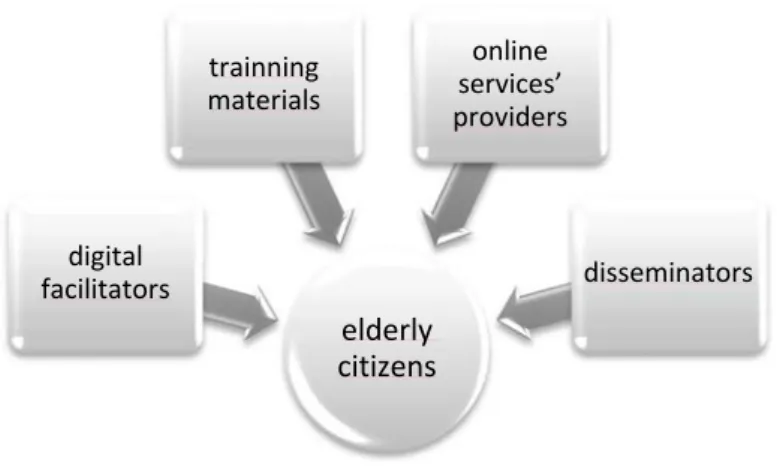
of stakeholders was required (cf. Fig. 1.), which aims to mobilize a number of contact points that increase the synergies for the appropriation of digital literacies throughout the elderly citizens, contributing for their active ageing and taking them into the web 2.0 era. The stakeholders involved were working in a voluntary basis. This network will contribute to the:
reduction in the percentage of non-Internet users among elderly citizens;
mobilization of an operational infrastructure that aims to include: space, equipment and trainers;
development of training material for digital literacies enhancement; improvement of the levels of perceived trust (safety and usefulness).
Fig. 1. Project’s Stakeholders
Focused on a strategy for digital inclusion and the development of digital and infor-mation literacy, will cover a range of activities, such as:
Propose and implement innovative initiatives and promoting the inclusion and in-creasing digital literacy;
elderly citizens digital facilitators trainning materials online services’ providers disseminators
Promote the acquisition of ICT skills through the development of digital content available for free;
Promote guidelines for the effective and efficient use of infrastructure, equipment and resources available to the network;
Support the sharing among the collaborators of the Network.
With the Active Citizenship | Grandparents 2.0 we will focus on the development of digital literacies among elderly citizens, fostering them into a networked society.
We felt the need to develop such a project because it was detected the feeling of social isolation and loneliness among elderly citizens once that many of them are away from their families and friends.
3.1 Social isolation and loneliness in elderly
The feeling of loneliness appears associated with a reduced social network, being asso-ciated with social isolation, which triggers some disturbances in self-esteem and quality of life for the elderly. Social loneliness occurs when a person feels a lack of belonging to the community or to establish social ties, leaving a mixture of feelings of rejection, anger and non-acceptance. Emotional loneliness happens when one feels the lack of personal and intimate relationships. You cannot mitigate the loneliness replacing it with another form of relationship, being emotional loneliness the most painful form of iso-lation that a person can suffer [16]. In fact, loneliness is a subjective feeling, associated with the quality of social interaction and not with the quantity of social contact, and may be due to the emotional pain of losing someone very special, a sense of exclusion or marginalization of social ties [17].
Some causes related to the inherent feeling of loneliness are mainly due to population isolation. Elderly living in rural areas are more prone to loneliness than elderly living in urban centers. The weak physical state, widowhood, low yields, diseases and lack of friends are agents that also contribute to the loneliness. On the other hand, contact with other individuals can contribute to the adoption of healthy habits as well as contribute to increased personal control, helping to psychological well-being of the elderly [18]. There are several strategies that help the elderly to combat loneliness: meet new people and mingle with them, participating in voluntary social activities at the local level, in-tegrating into acquaintanceship groups, seek to recognize their rights and duties as a citizen, take care of mental and physical health, understand the natural changes associ-ated with aging, and find or retrieve new channels of communication between individ-uals from the same generation [19]. Healthy aging is closely related to the promotion of independence and the prevention of loneliness and social isolation [20]. Sociability in the elderly is crucial for the prevention several problems, contributing to their health, quality of life and well-being.
3.2 ICT as a way to fight social isolation and loneliness
ICT has been an asset to the dissemination of information and knowledge through var-ious digital tools, ensuring forms of socialization that will benefit elderly on the fight
of the loneliness and social isolation. On the other hand, virtual tours of museums, li-braries and shopping centers are also one of the most sought after activities [21], plus the elderly in addition to sending e-mail, still seek to gather information about hobbies, news, health information and updates on the weather [22].
The access of elderly to the social networks and other ways of online contact, such as email, chat rooms, newsgroups, hangouts and videoconference, will ensure contact with friends and family and can be fostered through training sessions. Digital inclusion means apprehending the discourse of technology, not only in the perspective of imple-mentation and qualification, but also from the perspective of the subjects were able to influence the importance and purposes of their own digital technology. It is intended that the elderly can obtain greater autonomy, knowledge, social participation, personal development and skills that will foster relationships with others. Contact with technol-ogies allows the elderly to redefine its insertion in the nuclear family and in society, promoting intergenerational relationships. The use of computers and tablets and the access to the internet allows others ways of communication and interaction, providing also ways to solve a problem situation, such as access to various services of daily-life - home banking, post office, health center, finance.
3.3 The pilot study
Previously to a wider action a pilot study was implemented in order to understand the viability of the project. In order to understand the needs of the elderly citizens concern-ing the digital literacies a questionnaire was applied. The target were elderly citizens from a nursing home, in a total of 14 answers – chosen due to their proximity and fa-cility to reach out. The detected needs in terms of ICT skills were varied (cf Fig. 2.) – the need to learn how to use a search engine and how to edit content in a word document are among the most requested ones.
Fig. 2. Detected training needs among elderly citizens
0 1 2 3 4 5 6
use a search engine use an excel sheet use tools to edit content in word use the internet for phone calls use a chat room modify security & privacy settings in browser send emails with attached files create presentations
Also the ability to send emails with attached files, use a chat room or make a phone call through the internet were mentioned by the elderly citizens. This necessity arises from the need to have a closer and more often contact with their family and friends, helping to reduce the sense of isolation.
Bearing in mind these needs a set of hand on workshops, covering those topics, were designed to be delivered to the elderly citizens in the selected nursing home.
The nutshell team (cf. Fig. 3.) for this project was constituted by students from a social service course, the ICT teacher, the course coordinator, the nursing home director and their employees and the elderly citizens – all done in a voluntary basis.
Fig. 3. Nutshell team
The training sessions were made in the nursing home facilities with the resource of personal computers and tablets.
Although the study is ongoing, the following results are expected: Reduce digital exclusion among the elderly citizens;
Development, dissemination and maintenance of a set of basic, useful and functional digital resources aimed at helping citizens in the development of digital and infor-mational literacies;
Mobilization of a set of physical, functional and useful features, addressed to the inclusion;
Promote the importance of improvement of digital and information literacy as an emerging need for elderly citizens;
Develop a sense of belonging to a community that can stay on time, which can strengthen, allowing further collaboration.
By the end of the project we expect to contribute to a more active, healthier and happier ageing among elderly citizens.
digital & information literate elderly social work students & coordinator ICT teacher nursing home collaborators
4
Final Considerations
Despite our health declines as we grow old, a lot can be done to cope with this decline. And quite small changes in our environment can make a big difference to people suf-fering from various health impairments and disabilities. Active ageing also means em-powering us as we age so that we can remain in charge of our own lives as long as possible. Provide citizens with competences on digital and information literacy is a way to contribute for an ageing with quality and independence, giving the opportunity to the elderly to feel as part of the modern and networked society. Initiatives like the one we presented here not only contribute for an active ageing but also to the strengthening solidarity between generations and for the lifelong learning. Information and digital literates holds a “set of skills needed to find, retrieve, analyze, and use information (…)
Ultimately, information literate people are those who have learned how to learn. They know how to learn because they know how knowledge is organized, how to find infor-mation, and how to use information in such a way that others can learn from them. They are people prepared for lifelong learning, because they can always find the infor-mation needed for any task or decision at hand” [9]. A better informed citizen, elderly
or not, is a more successful citizen and will have ways to bridge the gap between their past and present lives – being provided with tools that allow them to fully integrate the nowadays networked society. Plus the “greater the number of collective intellects with
which an individual is involved, the more opportunities he has to diversify his knowledge and desire” [2], and by giving the possibility of elderly citizens to share
their experiences online the better the society will be. Acknowledgements
The research was co-funded by FEDER (Programa Operacional Fatores de Competiti-vidade – COMPETE) and FCT (Fundação para a Ciência e a Tecnologia – Project PEst-C/CED/UI0194/2011. Research Center “Didática e Tecnologia na Formação de Forma-dores” – CIDTFF, Departamento de Educação, Universidade de Aveiro, Portugal).
5
References
1. Mieczakowski, A. & Clarkson, J. (2012). Ageing, Adaption and Accessibility: Time for the Inclusive Revolution! Engineering Design Centre, University of Cambridge.
2. Lévy, P. (1997). Collective intelligence. Mankind's emerging world in cyberspace. Massa-chusetts: Perseus Books.
3. Eurostat European Commission (2012). Active ageing and solidarity between generations. A statistical portrait of the European Union 2012. Retrieved from: http://epp.eurostat.ec.eu-ropa.eu/cache/ITY_OFFPUB/KS-EP-11-001/EN/KS-EP-11-001-EN.PDF
4. European Union (2012). European Year for Active Ageing and Solidarity between Genera-tions. Retrieved from: http://europa.eu/ey2012/ey2012main.jsp?catId=971
5. Martin, A. & Ashworth, S. (2004) Welcome to the Journal of eLiteracy! JeLit 1(1). 6. Jones-Kavalier, B. & Flannigan, S. (2006). Connecting the Digital Dots: Literacy of the 21st
Century. Retrieved from: http://connect.educause.edu/Li-brary/EDUCAUSE+Quarterly/ConnectingtheDigitalDotsL/39969
7. Webber, S. & Johnston, B. (2003). Information literacy in the United Kingdom: a critical review. In: Basili, C. (Ed) Information Literacy in Europe. Rome: Italian National Research Council. 258-283. Retrieved from: http://dis.shef.ac.uk/sheila/webber-johnston-uk.pdf 8. McCormack, A. (2010). The e-Skills Manifesto. Belgium: European Schoolnet. ISBN:
9789490477301.
9. International Federation Library Association (2012). About the Information Literacy Sec-tion. Retrieved from: http://www.ifla.org/en/about-information-literacy
10. Pordata (2013). Indivíduos que utilizam computador e Internet em % do total de indivíduos: por grupo etário – Portugal. Retrieved from: http://www.pordata.pt/Portugal/Indi- viduos+que+utilizam+computador+e+Internet+em+percentagem+do+total+de+indi-viduos+por+grupo+etario-1139
11. Governo de Portugal. (2012). Ano Europeu do Envelhecimento Ativo e da Solidariedade entre Gerações. Programa de Ação. Retrieved from: http://www.igfse.pt/up-load/docs/2012/Programa%20A%C3%A7aoAnoEuropeu2012.pdf.
12. Loureiro, A. & Bettencourt, T. (2013 – to be published). The use of virtual environments as an extended classroom – a case study with adult learners in tertiary education. Procedia Technology. Elsevier. ISSN: 2212-0173. DOI: 10.1016/j.protcy.2014.02.013
13. European Commission (2012). Digital Agenda for Europe. Retrieved from: http://ec.eu- ropa.eu/digital-agenda/en/our-goals/pillar-vi-enhancing-digital-literacy-skills-and-inclu-sion
14. Governo de Portugal (2012). Agenda Portugal Digital. Retrieved from: http://www.portu-galdigital.pt/
15. FCT (2014). Rede TIC & Sociedade. Unpublished document. [http://www.ticsociedade.pt/] 16. Weiss, R. (1973). Loneliness: The experience of emotional and social isolation. Cambridge,
MA, US: The MIT Press
17. Freitas, P. (2011). A Solidão nos Idosos. Percepção em Função da Rede Social. Tese de mestrado Inédita em Gerontologia Social Aplicada. Universidade Católica Portuguesa, Cen-tro Regional de Braga, Faculdade de Ciências Sociais. Retrieved from: http://reposito-rio.ucp.pt/bitstream/10400.14/8364/1/SOLID%C3%83O%20EM%20IDOSOS.pdf 18. Ramos, M. (2002). Apoio Social e Saúde entre idosos. Sociologias, 7.
19. Neril, A. & Freire, S. (2000). E por falar em boa velhice. Campinas: Papirus.
20. Chau, F., Soares, C., Fialho, J. & Sacadura, M. (2012), O Envelhecimento da População: Dependência, Ativação e Qualidade. Relatório de projeto financiado inédito, Centro de Es-tudos dos Povos e Culturas de Expressão Portuguesa, Faculdade de Ciências Humanas,
Uni-versidade Católica Portuguesa. Retrieved from: http://www.qren.pt/np4/np4/?newsId=1334&fileName=envelhecimento_populacao.pdf.
21. Pasqualotti, A.; Barone, D. & Doll, J. (2007). As tecnologias de informação e comunicação na vida de idosos com sintomas de depressão: significado, experiências e relacionamentos. Renote v. 5, n. 2 (2007). ISSN 1679-1916. Retrieved from: http://seer.ufrgs.br/index.php/re-note/article/view/14381/8277
22. Jantsch, A.; Machado, L.; Behar, P. & Lima, J. (2012). As Redes Sociais e a Qualidade de Vida: os Idosos na Era Digital. IEEE-RITA. 4. 173-179. Retrieved from: http://rita.det.uvigo.es/201211/uploads/IEEE-RITA.2012.V7.N4.A2.pdf.