INSTITUTO DE INVESTIGAÇÃO E FORMAÇÃO AVANÇADA
ÉVORA, JANEIRO 2017 ORIENTADORES:Professora Doutora Esmeralda de Jesus Ratinho Lopes Arranhado Ramalho
Professor Doutor Carlos Manuel Rodrigues Vieira Tese apresentada à Universidade de Évora para obtenção do Grau de Doutor em Economia
Vânia Gomes de Carvalho Gramaça da Silva
ESSAYS ON THE USE OF
PAYMENT INSTRUMENTS
i
Essays on the use of payment instruments
Vânia Gomes de Carvalho Gramaça da Silva
Orientadores:
Professora Doutora Esmeralda de Jesus Ratinho Lopes Arranhado Ramalho
Professor Doutor Carlos Manuel Rodrigues Vieira
ii
iii
Acknowledgments
Reaching this point in my studies would not have been possible without the support of many people. First, I want to express my sincere gratitude to my supervisors, Professors Esmeralda Ramalho and Carlos Vieira, for their constant availability, careful readings, invaluable suggestions and motivation during all the process.
I also want to thank Banco de Portugal for the possibility to conduct my research on the payments area. I am very grateful to the Heads of the Payment Systems Department for their support and to my colleagues and friends with whom I exchanged ideas and questions. The assistance of Rui Pimentel and José Rodrigues in collecting specific information is gratefully acknowledged.
A word of recognition goes also to the various members of CEFAGE and Universidade de Évora that either directly, namely at the Doctoral Consortium, or indirectly contributed to the development of this thesis. I owe as well special thanks to Professor Joaquim Ramalho for the packages developed for fractional regression models. I am also grateful for the suggestion provided by Professor Ermelinda Lopes.
Financial support from Fundação para a Ciência e a Tecnologia and
FEDER/COMPETE (grants PTDC/EGEECO/119148/2010 and
UID/ECO/04007/2013) that allowed the presentation of the first essay on the 9th Annual Meeting of the Portuguese Economic Journal, which took place at the University of Azores, on July 3 to 5 of 2015, is also gratefully acknowledged.
Lastly, I want to thank my family for their unconditional love, encouragement and support, as well as their patience and constant faith in me.
iv
Essays on the use of payment instruments
Abstract
The use of non-cash payment instruments in European Union (EU) countries changed quite noticeably in the past years. Electronic payment instruments usage grew, while paper-based payments declined. The objective of this thesis, comprised by three essays, is to provide empirical evidence of the impact on the use of cheques, bank cards, and credit transfers of a selected set of specific measures. As cheques are still a relevant question of concern for some countries due to their considerable social costs and risks, the first essay analyses the determinants of cheque usage in the EU, with data for the period 2000-2012. The study focuses on the effects of the application of fees in a framework where unfunded cheques are considered as an autonomous type of crime in some countries. The second essay examines the impact on cards usage of the adoption of the EMV (Europay, MasterCard and Visa) standard in the EU between 2006 and 2011. This technology protects information more effectively than magnetic stripes and aims to reduce fraud at the point-of-sale. Finally, the third essay investigates the effect of the implementation process of the Single Euro Payments Area (SEPA) – a project that intends to increase integration in retail payments – on credit transfers usage in euro area countries from 2008 to 2013. The results obtained suggest that: (i) the existence of fees influences negatively cheque usage, even when there are legal elements that increase security; (ii) the progress in the adoption of EMV technology had a positive effect in the use of cards; and (iii) the evolution in the migration to SEPA formats had a positive impact on the share of credit transfer payments.
v
Ensaios sobre a utilização de instrumentos de
pagamento
Resumo
A utilização de instrumentos de pagamento que não o numerário na União Europeia (UE) registou significativas alterações nos últimos anos. O uso de instrumentos eletrónicos aumentou e os pagamentos assentes em papel reduziram-se. O objetivo desta tese, composta por três ensaios, é fornecer evidência empírica do impacto de um conjunto de medidas na utilização de cheques, cartões bancários e transferências a crédito. Dado que os cheques são ainda uma preocupação em alguns países atendendo aos custos sociais e riscos associados, o primeiro ensaio analisa os determinantes da utilização de cheques na UE, com dados para o período 2000-2012. O estudo centra-se nos efeitos da imposição de encargos num contexto em que a emissão de cheques sem provisão é considerada crime em alguns países. O segundo ensaio examina o impacto na utilização de cartões da adoção, entre 2006 e 2011, do padrão EMV (Europay, MasterCard e Visa) na UE. Esta tecnologia protege a informação de forma mais eficaz que as bandas magnéticas e visa reduzir a fraude nos pontos de venda físicos. Finalmente, o terceiro ensaio investiga o efeito da implementação da Área Única de Pagamentos em Euros (SEPA) – um projeto que visa impulsionar a integração nos pagamentos de retalho – na utilização de transferências a crédito nos países da área do euro entre 2008 e 2013. Os resultados obtidos sugerem que: (i) a existência de encargos influencia negativamente a utilização de cheques, mesmo quando existem fatores legais que aumentam a segurança; (ii) o progresso na adoção da tecnologia EMV teve um efeito positivo na utilização de cartões; e (iii) a evolução na migração para os formatos SEPA gerou um impacto positivo na proporção de pagamentos com transferências a crédito.
Palavras-chave: Cartão bancário, Cheque, Dados de painel, EMV, Pagamentos de retalho, SEPA
vi
Contents
Acknowledgments ... iii Abstract ... iv Resumo ... v List of tables ... ix List of figures ... x Chapter 1: Introduction ... 11. The role of payment instruments in modern economies ... 1
2. Brief review of the literature on the use of payment instruments ... 4
3. Research objectives and main contributions ... 6
References ... 9
Chapter 2: The use of cheques in the European Union: A cross-country analysis ... 12
1. Introduction ... 13
2. Framework ... 15
2.1. Brief overview of cheques as a payment instrument ... 15
2.2. Outline of some of the measures adopted to reduce the use of cheques .... 18
2.3. Literature review ... 18
3. Data and methodology ... 21
3.1. Data and descriptive statistics ... 21
3.2. Model specification and methodology... 24
3.2.1. Models for the number of per capita payments with cheques ... 25
3.2.2. Models for the share of payments with cheques ... 27
4. Empirical results ... 27
4.1. Model selection ... 27
4.2. The effect of legal variables ... 28
4.3. The effect of socio-demographic, economic, technological and institutional factors ... 29
vii
5. Concluding remarks ... 34
References ... 37
Appendix ... 40
Chapter 3: Is EMV adoption changing card payments? Evidence from the European Union ... 41
1. Introduction ... 42
2. Framework ... 44
2.1. Card payments and the EMV migration process in the EU ... 44
2.2. Literature review ... 49
3. Data and methodology ... 52
3.1. Data and descriptive statistics ... 52
3.2. Model specification and methodology... 56
3.2.1. Models for the number of per capita payments with cards ... 56
3.2.2. Models for the share of payments with cards... 57
4. Empirical results ... 58
4.1. Model selection ... 58
4.2. The effect of EMV migration ... 58
4.3. The effect of socio-demographic, economic, technological and institutional factors ... 59
5. Concluding remarks ... 64
References ... 66
Appendix ... 70
Chapter 4: The impact of SEPA in credit transfer payments: Evidence from the euro area ... 71
1. Introduction ... 72
2. Framework ... 74
2.1. Credit transfer payments in the euro area ... 74
2.2. Brief overview of the SEPA project ... 76
viii
3. Data and methodology ... 81
3.1. Data and descriptive statistics ... 81
3.2. Model specification and methodology... 84
3.2.1. Univariate analysis ... 85
3.2.2. Multivariate analysis ... 85
4. Empirical results ... 87
4.1. Model selection ... 87
4.2. The effect of SEPA adoption process ... 87
4.3. The effect of socio-demographic, economic, technological and institutional factors ... 88 5. Concluding remarks ... 91 References ... 93 Appendix ... 96 Chapter 5: Conclusion ... 98 References ... 103
ix
List of tables
Table 2.1: Evolution of cheques usage between 2000 and 2012 ... 16 Table 2.2: Descriptive statistics of the dependent and independent variables for EU countries (2000-2012) ... 24 Table 2.3: Estimation results of the impact of legal factors in EU countries (2000-2012) 32 Table 2.4: APE of selected models ... 34 Table A2.1: Description of the dependent and independent variables used in the empirical analysis ... 40 Table 3.1: Evolution of cards usage between 2006 and 2011 ... 45 Table 3.2: Evolution of card payments and the share of EMV adoption in cards, ATM and POS terminals in EU countries (2006-2011) ... 53 Table 3.3: Descriptive statistics of the dependent and independent variables for EU countries (2006-2011) ... 55 Table 3.4: Estimation results of the relevance of EMV adoption in EU countries (2006-2011) ... 62 Table 3.5: APE of selected models ... 64 Table A3.1: Description of the dependent and independent variables used in the empirical analysis ... 70 Table 4.1: Evolution of the share of payments made through credit transfers between 2008 and 2013 (in volume) ... 75 Table 4.2: Descriptive statistics of the dependent and independent variables for euro area countries (2008-2013) ... 83 Table 4.3: Estimation results of the impact of SEPA in euro area countries (2008-2013) 90 Table 4.4: APE of selected models ... 91 Table A4.1: Description of the dependent and independent variables used in the empirical analysis ... 96 Table A4.2: APE of other payment instruments shares used in the multivariate analysis for the period 2008-2013 in euro area countries ... 97
x
List of figures
Figure 1.1: Evolution of the number of transactions per payment instrument in the EU (between 2010 and 2014) ... 4 Figure 1.2: Evolution of the number of transactions per payment instrument in the euro area (between 2010 and 2014) ... 4 Figure 2.1: Evolution of the per capita number of payments made with cheques between 2000 and 2012 ... 17 Figure 2.2: Evolution of the share of payments made with cheques between 2000 and 2012 (in volume) ... 17 Figure 3.1: Evolution of the per capita number of payments made with cards between 2006 and 2011 ... 45 Figure 3.2: Evolution of the share of payments made with cards between 2006 and 2011 (in volume) ... 46 Figure 3.3: Distribution of the value of card fraud by transaction channel from an issuing perspective in 2011 ... 47 Figure 4.1: Evolution of the share of credit transfer payments (in volume) between 2008 and 2013 in euro area countries ... 75 Figure 4.2: Evolution of the share of SCT and SDD transactions in the euro area between 2008 and 2013 ... 78 Figure 4.3: Evolution of the SEPA adoption process in euro area countries between 2008 and 2013 ... 78
1
Chapter 1
Introduction
Payment instruments play a crucial role to the smooth functioning of modern economies, as they are employed on a daily basis to transfer funds among various economic agents, such as consumers, merchants and public authorities. The choice between the various payment instruments available is not innocuous, since the costs to society differ according to the instrument and the potential benefits for the economy can also be diverse. In this context, it is essential to understand how certain factors influence non-cash payment instruments usage. In general, the original contribution of this thesis consists of providing new empirical evidence on the impact of specific measures adopted in EU countries on payments made with cheques, bank cards and credit transfers. The results obtained in this investigation can support policy orientations that promote a more efficient payments landscape and encourage a deeper reflexion on these topics.
This chapter provides an overview of the importance of payment instruments, as well as a concise review of the key literature on this topic. The research objectives and contribution of this thesis are also presented.
1. The role of payment instruments in modern
economies
Money is ever-present in our daily lives and plays a relevant role in societies. From an economists’ point of view, money is usually considered in its functional definition as being
2
a unit of account, medium of exchange and store of value – a definition that derives from the one proposed for the first time by Jevons (1876). However, money can be analysed from various, sometimes contradictory, perspectives (Persson, 2016). Scholars from areas that range from economics to sociology, philosophy and anthropology paid particular attention to the impact of money in social relations. Karl Marx, a philosopher, economist and sociologist of the nineteen century defended that money plays a central role in the relations between the owners of the means of production and the workers (Hart and Ortiz, 2014). For George Simmel, a sociologist and philosopher of the beginning of the twentieth century, money is a social institution that can impact social and moral relations among individuals. He argues that money acts as tool of valuation and comparison among things, generating a detachment from them. As a result, it reduces social relations to quantitative ones (Dodd, 2014), causing individualization and disorder on social relations (Coeckelbergh, 2015) because it makes individuals indifferent towards objects and people. Max Weber, a sociologist, philosopher and economist, underlines that money is a mean of exchange as long as people believe that it will be accepted. By using money that provides a specific value to objects, enhanced rationality is introduced into economic life (Carruthers and Ariovich, 2010; Reijers, 2014). Geoffrey Ingham, a sociologist born in 1942, reinforced the social nature of money by arguing that money is basically constituted by the social relations between creditors and debtors (Carruthers and Ariovich, 2010). Moreover, for the anthropologist born in 1943 Keith Hart, money is an instrument of collective memory, intensely connected with the cultural conditions of its production and use (Dodd, 2014).
Due to technological developments, the way money is used to make payments has seen significant changes. Nowadays economic agents process a large amount of transactions in order to purchase goods or pay for services. The associated payments are usually made with cash or through the transfer of funds in banking accounts. In the latter option, the transmission of money is typically ensured by payment systems. According to Kokkola (2010), payment systems comprise the instruments, procedures and systems which enable the exchange of funds in the economy. Taking into consideration their key importance to an efficient economy, payment systems are usually referred to as the plumbing or
3
circulatory system (Kahn and Roberds, 2009). Generally it is only when something goes wrong that end-users notice with greater awareness the payment process.
The relevance of payment systems has been growing steadily. Between 2010 and 2014, the total number of payment and terminal transactions made by non-monetary financial institutions1 in the EU augmented from around 86 641 million to 103 160 million,
reflecting an increase from 173 to about 202 payments per capita. In the euro area, the total number of transactions rose from 60 219 million to 68 073 million and the per capita number of payments expanded from around 183 to 202 during the same period. The total value of payment and terminal transactions in 2014 was around 1813% of the EU Gross Domestic Product (GDP).2
Payment instruments are probably the most visible part of the payment systems to the general public. A payment instrument is a tool or a set of procedures that allow the transfer of funds between economic agents (Kokkola, 2010). In the EU, the most usual non-cash payment instruments comprise cheques, cards, credit transfers and direct debits. A cheque is a written order from one party (the drawer) to another (the drawee, frequently a credit institution) requiring the drawee to pay a particular amount to the drawer or to a third party named by the drawer. A bank card is a device that can be used to withdraw money from Automated Teller Machines (ATM) or make payments at the point-of-sale/remotely (for example, through the internet). Credit transfers allow the payer to instruct the institution where it holds his account to transfer funds to a beneficiary. Finally, direct debits are based on the authorisation of the debiting of the payers bank account, being initiated by the payee.
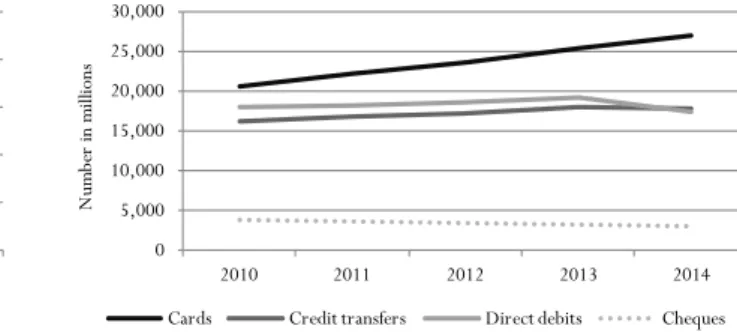
The use of the different non-cash payment instruments has undergone some changes in the past years. In the period 2010-2014 electronic payment instruments usage grew in general, while cheque payments decreased in the EU and euro area countries (Figures 1.1 and 1.2). In both cases, cards have been gaining ground and are nowadays the most relevant non-cash payment instrument (in volume).
1 Includes credit transfers, direct debits, card payments with cards issued by resident payment service providers (except cards with an e-money function only), e-money payment transactions, cheques and other payment services. 2 Information available at the European Central Bank Statistical Data Warehouse.
4
Figure 1.1: Evolution of the number of transactions per payment instrument in the
EU (between 2010 and 2014)
Figure 1.2: Evolution of the number of transactions per payment instrument in the
euro area (between 2010 and 2014)
Source: European Central Bank Statistical Data Warehouse.
Taking into account the relevance of efficient payment instruments, not only for the adequate functioning of the economy but also for preserving confidence in the currency, this thesis focuses on this specific component of payments systems.
2. Brief review of the literature on the use of payment
instruments
Research on the Economics field regarding non-cash payment instruments usage has grown considerably in the past years3. Early theoretical studies were mainly focused on
understanding the demand for cash (Baumol, 1952, Tobin, 1956 and Whitesell, 1989). More recent theoretical investigation is generally centred on the areas of pricing, competition, interchange fees, surcharging and two-sided markets (Bolt and Chakravorti, 2008, Bolt and Chakravorti, 2010 and Humphrey, 2010). In fact, as the Bank of International Settlements and the World Bank highlight in a recent consultative report on payment aspects of financial inclusion (BIS, 2015), retail payment markets are characterised by economies of scale (i.e., a decrease in average costs per unit with an increase in the output level), economies of scope (i.e., cost rewards resulting from the provision of different services or products) and network externalities (i.e., an increase in the value of a payment system with an higher number of users). Even so, the mainstream
3 Note that our focus is on non-cash payment instruments and, for that reason, information on the existing research on the evolution of the use of cash is not included in our analysis.
0 10,000 20,000 30,000 40,000 50,000 2010 2011 2012 2013 2014 N um be r in m ill io ns
Cards Credit transfers Direct debits Cheques
0 5,000 10,000 15,000 20,000 25,000 30,000 2010 2011 2012 2013 2014 N um be r in m ill io ns
5
research on the non-cash payment instruments field is of empirical nature. This type of literature can be divided into two main areas: the analysis of consumers’ use of payment instruments at national level and the examination of the use of payment instruments across countries.
The empirical studies on payment behaviour use data collected through surveys and/or payment diaries to households or provided, for example, by grocery stores. They are mostly focused on the impact of socio-demographic aspects (such as age, education and income), consumers’ perceptions of payment attributes and characteristics of the transactions. Boeschoten (1998), Mantel (2001), Stavins (2001), Klee (2006) and Borzekowski and Kiser (2008) are examples of authors that found evidence of the effect of consumers’ age, income and education on the use of payment instruments with data collected through surveys. Schuh and Stavins (2010) and Schuh and Stavins (2013) underlined the importance of consumers’ perceptions of payment attributes (e.g., cost, speed, security, control, convenience and ease). Hayashi and Klee (2003) highlighted that payment choices are also related with consumers’ propensity to adopt new technologies (for example, computers and cellular phones). Klee (2008) and Bounie and François (2009) emphasized the relevance of transactions characteristics, such as the physical attributes of the point-of-sale and the value of the transaction.
The literature focused on the pattern of use of payment instruments at cross-country level is sparse. The seminal paper by Humphrey et al. (1996), uses data from fourteen countries for the period between 1987 and 1993 to estimate a model of payment instrument demand. Guariglia and Loke (2004) extended this analysis using payment transactions data from fifteen countries for the period 1990-1998. Deungoue (2008) and Martikainen et al. (2015) analysed the convergence of payments in European countries during the periods 1990-2002 and 1995-2001, respectively. Pietrowiak (2014), Goczek and Witkowski (2015) and Dagdemir and Sauer (2015) also explored different sets of panel data but are mainly focused on card payments. Our investigation follows this last strand of literature, but targets the examination of the impact of specific measures on the use of payment instruments. Therefore, this thesis contributes to the literature in this field
6
by providing empirical evidence of the effect of a selected set of elements on the use of three payment instruments.
3. Research objectives and main contributions
In this thesis we examine the evolution in the use of certain non-cash payment instruments in the EU and in the euro area. The sample was selected taking into consideration its relevance as an example at a global level and bearing also in mind the data availability. The main research questions are: “How have legal factors affected the use of cheques; fraud-fighting measures influenced cards usage; and the implementation process of Single Euro Payments Area (SEPA) changed the use of credit transfers?” From the empirical evidence obtained, several policy orientations can be derived in order to assist policymakers in their catalyst role.
The use of payment instruments, an intrinsic part of contemporary economies (Kokkola, 2010), has evolved significantly over the past years, as the technology for making electronic payments have become increasingly available for everyday use. According to the ECB Statistical Data Warehouse, the relative importance of cheques in the EU countries (as a percentage of the total number of transactions) declined from around 11.4% in 2004 to about 3.5% in 2014, while the relative importance of card payments (except with an e-money function only) rose from 32.3% to around 46% in the same period. Understanding these changes and the role played by specific measures adopted in this field is of particular relevance.
On the one hand, research has shown that the cost to society connected with retail payments can be substantial. Using a sample of thirteen EU countries, Schmiedel et al. (2012) concluded that, on average, the costs supported by banks and infrastructures as well as retailers amounted to 0.96% of GDP. On average, debit cards revealed the lower unit social costs. Conversely, cheques had the highest unit social costs of non-cash payment instruments. On the other hand, encouraging efficiency in retail payments can promote economic growth and social welfare. Hasan et al. (2013) found evidence that the adoption of more efficient payment instruments can contribute to the positive evolution of
7
consumption, trade and the economy. This impact is particularly relevant for card and credit transfer payments.
Although the existing literature provides insights on some of the factors that might help explain the use of the various payment instruments, the conclusions are mainly based on data from specific countries and do not cover factors that became relevant in the recent past. Contrary to the previous studies, our goal is not to compare the effect of general determinants on different payment instruments, but rather to investigate the effect of selected measures on given payment instruments. Bearing this in mind, and taking also into consideration that the data available on these measures is limited (different information is available in terms of sets of countries and time span for the three topics), in order to take advantage of all the existing information our analysis was split into separate examinations of three payments instruments: cheques, bank cards and credit transfers. Our study also incorporates some potential socio-demographic factors identified by the research based on survey data. Due to the small sample size, parsimonious model specifications had to be defined.
This thesis is composed of three interconnected essays that have the common objective of investigating the use of payment instruments. The first essay examines how legal factors connected with the application of fees and the establishment of an autonomous type of crime for unfunded cheques contributed to the evolution of cheque payments in EU countries between 2000 and 2012. The second essay investigates in which way the migration process to EMV – a technology developed by Europay, MasterCard and Visa that protects information more effectively than magnetic stripes – has impacted card payments in the EU in the period 2006-2011. In the two essays the analysis is performed considering both the traditional dependent variable of the per capita number of payment transactions, and the share of the number of payments. As far as we know, this last measure of payment instruments usage was rarely exploited in the existing literature, despite its several potential advantages, such as considering only effective users of payment instruments and minimising the effects of variations in consumption. Moreover, we applied various estimation techniques for panel data ranging from traditional linear-based fixed effects and random effects estimators, to estimators based on Poisson and fractional
8
regression models (FRM). To the best of our knowledge, the last models – that present the advantage of taking into consideration the fractional nature of the dependent variables in analysis – were not considered in the studies of this field. Nevertheless, one key methodological difference between these two essays is the inclusion, in the first one, of time-invariant variables, which required special attention on the estimation techniques applied, namely by using the Hausman-Taylor estimator.
The third essay focuses on the effect of the implementation process of the SEPA project on the share of credit transfer payments in euro area countries during the period from 2008 to 2013. In this situation the analysis of the number of per capita payments was not adequate according to the specification tests performed (we believe that this results from the small dimension of the sample available), so we focused only on the share of payments. The econometric examination was performed using univariate FRM, as well as FRM that allow for the presence of neglected heterogeneity and multivariate FRM that describe simultaneously the share of interest and other shares of non-cash payments instruments, controlling for potential substitution effects between them. The results provide for the first time evidence on the impact of this project on credit transfer payments.
The three essays are presented using a similar structure to the ones of the papers submitted for consideration for publication in international journals of CEFAGE-UE Journal Ranking and in CEFAGE-UE Working Papers. Since the three essays were prepared to be read autonomously, there is an unavoidable recurrence of concepts, given that they cover a common topic and are all based on the empirical analysis of panel data.
The remainder of this thesis is organised as follows. In the next three chapters we present the essays. Each one of these chapters is organised according to the following structure: abstract, introduction, framework, data and methodology, results and concluding remarks. The last chapter provides the general conclusions obtained with the investigation, the key limitations of the research and potential topics for future analyses.
9
References
Baumol, W. (1952), “The transactions demand for cash: An inventory theoretic approach”, The Quarterly Journal of Economics, Vol. LXVI No. 4, pp. 545–556.
BIS. (2015), Consultative report: Payment aspects of financial inclusion.
Boeschoten, W. (1998), “Cash management, payment patterns and the demand for money”, De Economist, Vol. 146 No. 1, pp. 117–142.
Bolt, W. and Chakravorti, S. (2008), Economics of payment cards: A status report, Federal Reserve Bank of Chicago Economic Perspectives 4Q/2008.
Bolt, W. and Chakravorti, S. (2010), Digitization of retail payments, DNB Working Paper No. 270/2010.
Borzekowski, R. and Kiser, E.K. (2008), “The choice at the checkout: Quantifying demand across payment instruments”, International Journal of Industrial Organization, Vol. 26, pp. 889–902.
Bounie, D. and François, A. (2009), Cash, Check or Bank Card? The Effects of Transaction
Characteristics on the Use of Payment Instruments.
Carruthers, B.G. and Ariovich, L. (2010), Money and Credit: A Sociological Approach, Polity Press.
Coeckelbergh, M. (2015), Money machines: electronic financial technologies, distancing, and
responsibility in global finance, Ashgate Publishing Limited, Surrey.
Dagdemir, C. and Sauer, J. (2015), The Use of Card Payment Instruments: a panel data
approach, Jönköping University.
Deungoue, S. (2008), “Will we pay in the same way?”, The European Journal of Finance, Vol. 14 No. 1, pp. 49–67.
Dodd, N. (2014), The Social Life of Money, Princeton University Press, Woodstock.
Goczek, Ł. and Witkowski, B. (2015), Determinants of non-cash payments, Nrodowy Bank Polski Working Paper No. 196, Warsaw.
Guariglia, A. and Loke, Y.J. (2004), “What determines the value and volume of noncash transactions? Evidence from a panel of European and North American countries”, Applied
Economics, Vol. 36, pp. 291–303.
Hart, K. and Ortiz, H. (2014), “The Anthropology of Money and Finance: Between Ethnography and World History”, Annual Review of Anthropology, Vol. 43 No. 1, pp. 465– 482.
Hasan, I., Renzis, T. De and Schmiedel, H. (2013), Retail payments and the real economy, European Central Bank Working Paper No. 1572/2013.
10
Hayashi, F. and Klee, E. (2003), “Technology Adoption and Consumer Payments: Evidence from Survey Data”, Review of Network Economics, Vol. 2 No. 2, pp. 175–190. Humphrey, D.B. (2010), “Retail payments: New contributions, empirical results, and unanswered questions”, Journal of Banking & Finance, Vol. 34, pp. 1729–1737.
Humphrey, D.B., Pulley, L.B. and Vesala, J.M. (1996), “Cash, Paper, and Electronic Payments: A Cross-Country Analysis”, Journal of Money Credit and Banking, Vol. 28 No. 4, pp. 914–939.
Jevons, W.S. (1876), Money and the Mechanism of Exchange, New York: D. Appleton and Co.
Kahn, C.M. and Roberds, W. (2009), “Why pay? An introduction to payments economics”, Journal of Financial Intermediation, Vol. 18, pp. 1–23.
Klee, E. (2006), Families’ use of payment instruments during a decade of change in the U.S.
payment system, Federal Reserve Board, Finance and Economics Discussion Paper Series,
Washington.
Klee, E. (2008), “How people pay: Evidence from grocery store data”, Journal of Monetary
Economics, Vol. 55, pp. 526–541.
Kokkola, T. (Ed.). (2010), The payment system, European Central Bank, Frankfurt am Main.
Mantel, B. (2001), Why do consumers pay bills electronically? An empirical analysis, Federal Reserve Bank of Chicago Economic Perspectives.
Martikainen, E., Schmiedel, H. and Takalo, T. (2015), “Convergence of European retail payments”, Journal of Banking & Finance, Vol. 50, pp. 81–91.
Persson, M.E. (2016), “The social life of money”, Accounting History Review, Vol. 26 No. 1, pp. 45–49.
Pietrowiak, A. (2014), European Payment Instruments: Institutional Determinants of an Efficient
POS Payment Mix, HHL Leipzig Graduate School of Management.
Reijers, W. (2014), Critique of Digital Money, University of Twente.
Schmiedel, H., Kostova, G. and Ruttenberg, W. (2012), The social and private costs of retail
payment instruments: A European perspective, European Central Bank Occasional Paper No.
137/2012, Frankfurt am Main.
Schuh, S. and Stavins, J. (2010), “Why are (some) consumers (finally) writing fewer checks? The role of payment characteristics”, Journal of Banking & Finance, Vol. 34, pp. 1745–1758.
Schuh, S. and Stavins, J. (2013), “How Consumers Pay: Adoption and Use of Payments”,
11
Stavins, J. (2001), “Effect of Consumer Characteristics on the Use of Payment Instruments”, New England Economic Review, No. 3, pp. 19–31.
Tobin, J. (1956), “The interest-elasticity of transactions demand for cash”, The Review of
Economics and Statistics, Vol. 38 No. 3, pp. 241–247.
Whitesell, W. (1989), “The demand for currency versus debitable accounts: note”, Journal
12
Chapter 2
The use of cheques in the European Union:
A cross-country analysis
1Abstract
Some European Union (EU) countries have implemented policies to discourage the use of cheques due to its considerable social costs and risks. This article provides a cross-country analysis for the period 2000-2012 of the determinants of cheque usage. Special attention is given to the effects of the application of fees in a framework where unfunded cheques are considered as an autonomous type of crime in some EU countries. Our results suggest that the existence of fees influences negatively cheque usage, even when there are legal elements that increase its security.
JEL Classification: E41, E42, C25, F36, G21
Keywords: Cheques, European Union, Panel Data, Retail Payments
13
1. Introduction
Payment habits in EU countries have been changing quite noticeably in past years. Payments with cheques, in particular, have decreased, while the relevance of electronic payment instruments (such as cards, credit transfers and direct debits) has increased. Between 2000 and 2012 the annual per capita number of payments made with cheques in the EU reduced from around 24 to about 9. This corresponded to a reduction in the share2
of cheque payments from 18% to 5% during that period. Despite the declining tendency in cheques usage, in a number of EU countries their use is still quite substantial. For example, in 2012 more than 15 cheques per capita were used in France, Cyprus, Malta and Ireland3. Considering this and bearing also in mind that making payments with
cheques involves considerable social costs and risks, some countries in their analysis regarding the possible evolution of retail payments might intend to reduce their use and promote the adoption of electronic payment instruments. In fact, Schmiedel et al. (2012) obtained evidence in a sample of EU countries that the average unit social cost of cheques is €3.55, which compares with €0.99 for cards. In addition, Kokkola (2010) refers that, among other risks, it is important to take into consideration the potential issues connected with the drawer’s creditworthiness. As a result, in Malta an educational campaign to promote the use of cards and electronic payments was developed in 2012 and in Ireland rules to abolish the use of cheques by Government Departments, Local Authorities and State Agencies were established in 2014.
In order to define policies that effectively support a decline in the use of cheques, it is important to identify which are the determinants of cheques usage. The existing literature shed light on some of the elements that might influence the use of this payment instrument. On the one hand, a strand of empirical literature based on the analysis of individual survey data collected at the national level (Boeschoten, 1998, Stavins, 2001, Klee, 2006, Borzekowski and Kiser, 2008, and Koulayev et al., 2012) highlights the relevance of socio-demographic determinants in cheques usage. On the other hand,
2 The share was computed considering the relative importance of the number of payments with cheques on the total number of payments made with cheques, credit transfers, direct debits and cards.
3 According to the Bank for International Settlements, in 2014, the relative importance of cheques (in volume) was 37.5% in the United States of America, and 13.1% in France.
14
cross-country studies on retail payments, such as Humphrey et al. (1996) and Guariglia and Loke (2004), conclude that the economic environment and technological developments play a relevant role in shaping payment habits. Our article follows this last line of research, but also incorporates some potential socio-demographic determinants identified by the former strand of literature, as well as factors that reflect the existence of differences in the cost and security structure of cheque payments in the various countries.
Specifically, we propose the empirical examination of the impact on cheque payments of the existence of a fee associated with the use of cheques and the fact that unfunded cheques are considered as an autonomous crime (hereinafter referred to as legal variables), while controlling the effect of socio-demographic, economic, technological and institutional factors. We employ country level data from the European Central Bank Statistical Data Warehouse for the period between 2000 and 2012, as well as information on legal variables collected specifically for this research.
Cheque usage is analysed not only in terms of the traditional dependent variable of the per capita number of payment transactions, but also in terms of the share of the number of payments made with cheques, a measure of cheque usage that, as far as we known, was not considered before. In fact, while the former variable is obtained using the total population and this implies including persons that do not use any payment instruments (e.g., children) as well as persons that might not use all payment instruments (i.e., unbanked population), in our view the share or proportion of payments made with cheques (in volume), as an indicator of relative importance, eases cross-country comparisons of the intensity of cheques usage. This latter dependent variable has also the potential advantage of minimising the effects of variations in consumption (for example, due to situations of financial crisis, since it might affect in a similar way the use of other payment instruments).
The analysis of the two measures of cheque usage employs various estimation techniques: traditional linear-based fixed effects, random effects and Hausman-Taylor estimators, as well as estimators based on Poisson and fractional regression models (FRM). The latter present the advantage of taking into consideration the nature of the dependent variables in analysis. In particular, the Poisson estimator incorporates the fact that the
15
number of per capita payments made with cheques is a count variable and the fractional regression estimator accommodates the bounded nature on the interval (0,1) of the share of payments made with cheques.
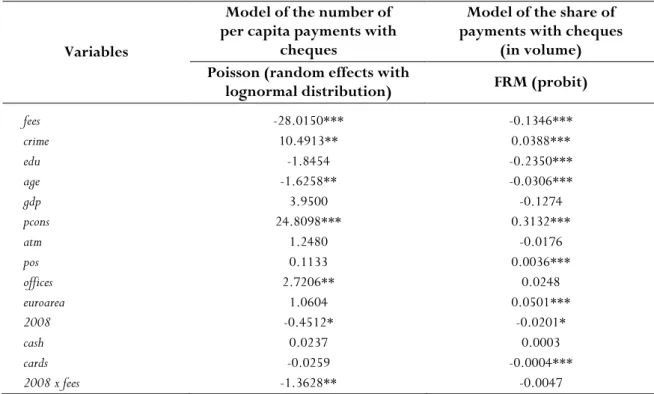
We estimate a negative average partial effect of the existence of fees in the number of per capita and the share of payments made with cheques of around 28 and 0.13, respectively, and a positive effect related with the fact that unfunded cheques are considered as an autonomous crime of 10 and 0.04, respectively. The magnitude of these results is quite relevant because the mean of the number of per capita number and share of payments made with cheques in our sample is 8 and 0.08.
The remainder of this essay is organized as follows. Section 2 defines the background and provides a summary of related literature. Section 3 describes the data used in the study and the methodology. Section 4 reports the empirical results. Finally, Section 5 draws the conclusions and provides policy orientations.
2. Framework
This section presents an outline of the use of cheques as a payment instrument in EU countries and highlights a number of measures already adopted to reduce payments with cheques. A summary of related literature is also provided.
2.1. Brief overview of cheques as a payment instrument
According to Kokkola (2010), a payment instrument is a tool or a set of procedures that allow the transfer of funds. Non-cash payment instruments, in particular, include those instruments that are not banknotes and coins. The most usual non-cash payment instruments in EU countries comprise cheques, payment cards, credit transfers and direct debits.4
Cheques are one of the oldest non-cash payment instruments. Their use in Europe began around the year 1400, and even though fraud situations occurred quite frequently,
16
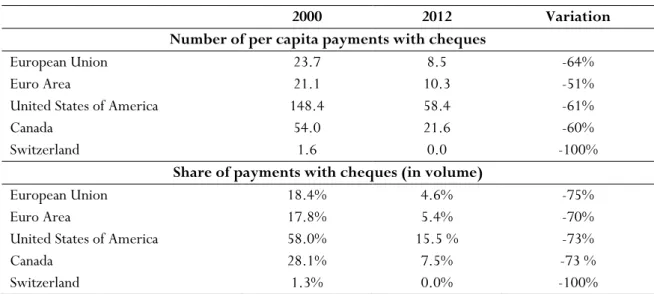
cheques were considered as a convenient mean of making payments (Quinn and Roberds, 2008). The past years have seen remarkable changes in payment habits. Between 2000 and 2012 the annual number of per capita payments with cheques in the EU decreased 64%, from around 24 to about 9 payments per capita (Table 2.1). The decreasing tendency in the use of cheques is also noticeable in the United States of America and in Canada, although in these countries the per capita number of payments made with cheques remained higher.
Table 2.1: Evolution of cheques usage between 2000 and 2012
2000 2012 Variation
Number of per capita payments with cheques
European Union 23.7 8.5 -64%
Euro Area 21.1 10.3 -51%
United States of America 148.4 58.4 -61%
Canada 54.0 21.6 -60%
Switzerland 1.6 0.0 -100%
Share of payments with cheques (in volume)
European Union 18.4% 4.6% -75%
Euro Area 17.8% 5.4% -70%
United States of America 58.0% 15.5 % -73%
Canada 28.1% 7.5% -73 %
Switzerland 1.3% 0.0% -100%
Source: European Central Bank Statistical Data Warehouse for data on European Union and Euro Area and Bank for International Settlements for data on the United States of America, Canada and Switzerland.
Focusing on the evolution of the per capita number of payments with cheques in the EU countries between 2000 and 2012, we conclude that the decreasing trend in the use of cheques is visible in all countries. Nonetheless, a noticeable heterogeneity still remains in the use of cheques. From the analysis of Figure 2.1 we observe that, in 2012, more than 8 cheque payments per capita were made, on average, in France, Cyprus, Malta, Ireland, the United Kingdom and Portugal. The highest usage occurred in France, with around 43 cheque payments per capita in 2012. A clearer picture can be obtained if we add to the previous analysis information regarding the percentage share of payments made with cheques.
17
Figure 2.1: Evolution of the per capita number of payments made with cheques between 2000 and 2012
Source: European Central Bank Statistical Data Warehouse.
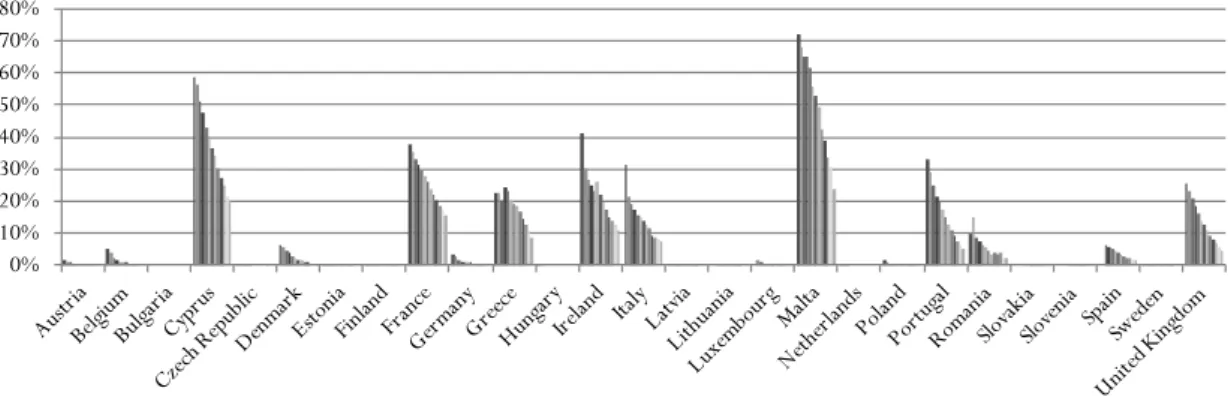
In the EU, the proportion of payments made with cheques (computed considering the relative importance of the total number of payments with cheques on the total number of payments made with cheques, credit transfers, direct debits and cards) has decreased from 18.4% to 4.6% between 2000 and 2012 (Table 2.1). Regarding the relative importance of cheques in all the EU countries in 2012, we observe that in Malta, Cyprus, France and Ireland, the share of payments with cheques remained above 10% (Figure 2.2).
Figure 2.2: Evolution of the share of payments made with cheques between 2000 and 2012 (in volume)
Source: European Central Bank Statistical Data Warehouse. 0 10 20 30 40 50 60 70 80 N um be r i n un its 2000 2001 2002 2003 2004 2005 2006 2007 2008 2009 2010 2011 2012 0% 10% 20% 30% 40% 50% 60% 70% 80% 2000 2001 2002 2003 2004 2005 2006 2007 2008 2009 2010 2011 2012
18
2.2. Outline of some of the measures adopted to reduce the
use of cheques
In order to diminish the use of cheques, different approaches have been followed by various authorities, such as Central Banks. At a cross-border level, in 2002, the guaranty of €200 provided with the Eurocheque5 was removed. In addition, the European
Commission decided to keep cheques outside the scope of community legislation as it considered that, since cheques are not as efficiently processed as other payment instruments, their use in a cross-border context should be avoided.
In 2001, Slovenia abolished the guidance of realisation of cheques (i.e., cheques can only be realised if there are funds on the account) and between 2001 and 2012 the number of per capita payments with cheques reduced around 98%. In Malta, the Bankers Association, in collaboration with the Central Bank and the Association of Credit Management, implemented a campaign in 2012 to encourage the use of cards and online payments. In Ireland, cheques are no longer used by Government Departments, Local Authorities and State Agencies since the 19th of September 2014. In the United Kingdom,
after an unsuccessful attempt to close the cheque clearing, it was decided, in 2011, to look for ways to improve the process. Other countries managed to reduce the use of cheques with the imposition of a fee on its use and increasing the marketing on other payment instruments provided free of charge, as occurred in Sweden, or through a raise in the processing charges and a reduction in the supply of free cheques, as happened in the Netherlands (APCA, 2011).
2.3. Literature review
The decreasing trend in the use of cheques has been reported and analysed in a number of investigations. The vast majority of the studies in this field have generally focused on the analysis of consumers’ use of payment instruments at national level, using data either collected through surveys and/or payment diaries to households or provided, for example, by grocery stores. Although this literature is mainly focused on the increasing
19
use of electronic payment instruments, some studies still explore the use of cheques, but address mainly the impact of socio-demographic aspects, consumers’ perceptions of payment attributes, characteristics of the transactions and financial incentives.
Boeschoten (1998), Stavins (2001), Klee (2006), Borzekowski and Kiser (2008) and Koulayev et al. (2012) are among the many authors that reported the effect of consumers’ age, income and education in the use of payment instruments using data collected through surveys. More recent studies, for example of Koulayev et al. (2012), found evidence of a positive impact of age and a negative effect of income and education in the adoption and use of cheques. Schuh and Stavins (2010) and Schuh and Stavins (2013) complemented those analyses by incorporating in the explanatory factors consumers’ perceptions of payment attributes (e.g., cost, speed, security, control, convenience and ease). Schuh and Stavins (2010) concluded that the use of cheques was negatively influenced by the perception of the cost and the inconvenience of cheques in comparison with alternative payment instruments. Schuh and Stavins (2013) also observed that consumers perceived cheques as being slow in terms of processing and less secure when compared with other payment instruments. The effect of transactions’ characteristics in the choice of payment instruments was reported by Hayashi and Klee (2003), who found evidence of a negative impact of cashier absence and availability of self-service on consumers’ probability of using cheques. Using data on payments made at grocery stores, Klee (2008) observed that the likelihood of using cheques reduced on Sundays and with smaller payments.
Humphrey et al. (2001) and Bolt et al. (2008) are among the small number of authors who were able to include information of the price of payment instruments in the analysis at country level (regarding Norway and the Netherlands). The authors concluded that the pricing of cheques could be an effective instrument in promoting the use of electronic payment instruments. Even though these studies provided empirical evidence of some of the reasons that explain the evolution in consumers’ use of cheques, in particular in the United States of America (US), they have not presented detailed cross-country analyses. In fact, only few researchers studied the differences in the use of payment instruments between countries. Humphrey et al. (1996), although more focused on the shift to electronic payments, identified some of the factors that could explain the use of cheques.
20
The authors used data on the number of transactions per person for the period between 1987 and 1993 from fourteen countries to estimate a model of payment instrument demand with Ordinary Least Squares (OLS). They found evidence of a negative impact of Point-of-Sale (POS) terminals availability and a statistically significant substitution effect with other payment instruments. While not providing empirical evidence, the authors emphasized that the differences in the use of payments instruments (including cheques) across countries exist due to historical reasons. Indeed, theoretical studies stressed that, although cheques originate from the eastern Mediterranean, their use has been traditionally higher in the US than in Europe (in line with the data provided on Table 2.1) due to the reduced concentration in the banking sector (Humphrey, 2010) as well as owing to a nineteenth century banking legislation that discouraged the use of other payment instruments in the US (Quinn and Roberds, 2008).
Guariglia and Loke (2004) extended Humphrey et al. (1996) analysis by estimating static equations using the within estimator and dynamic equations using the difference Generalized Method of Moments (GMM) and considering data on the per capita volume and value of payment transactions from fifteen countries for the period between 1990 and 1998. The authors obtained empirical evidence of a substitution effect between cards and cheques in the volume and value of transactions with cheques. Deungoue (2008) and Martikainen et al. (2015), while focusing their analysis on the convergence of payment behaviour in European countries (for the periods from 1990 to 2002 and 1995 to 2001, respectively), put forward some possible reasons for the differences in payments with cheques. In both cases, the results suggested that payments with cheques were not converging in the EU. Deungoue (2008) argued that this could be due to card competition and to the existence of different rules in the various EU countries (although this was not empirically tested).
The abovementioned studies shed light on some of the factors that explain the use of cheques. Nonetheless, legal factors associated with this payment instrument were not considered by those authors. As a result, the questions “what is the effect in the use of cheques in EU countries of the application of fees and the establishment of an autonomous type of crime for unfunded cheques, as well as what policy orientations can be derived
21
from the empirical evidence?” remain to be answered. Therefore, we intend to contribute to the existing literature through the investigation, at the EU level, of the impact of the abovementioned legal factors, taking also into consideration the effect of socio-demographic, economic, technological and institutional factors, both in terms of the per capita number and share of payments made with cheques. As the use of cheques involves considerable social costs for EU countries that still rely on this payment instrument (see Schmiedel et al. (2012)), the proposed analysis is of particular relevance to policymakers, such as Central Banks, as it can unveil elements that could be taken into consideration when defining policies that intend to discourage cheques usage.
3. Data and methodology
In this section we present a brief description of both the analysed variables and the methodology adopted in the econometric approach.
3.1. Data and descriptive statistics
The analysis was performed using data from the European Central Bank Statistical Data Warehouse regarding the per capita number and share of payments made with cheques in the EU countries. The data comprises all payment transactions initiated with cheques. According to the methodological notes of this database, it is considered as a cheque any written order from one party (the drawer) to another (the drawee, which is usually a credit institution) requiring the drawee to pay a specified amount to the drawer or to a third party named by the drawer. Cheques are only counted on the payee’s side when submitted for cheque clearing.
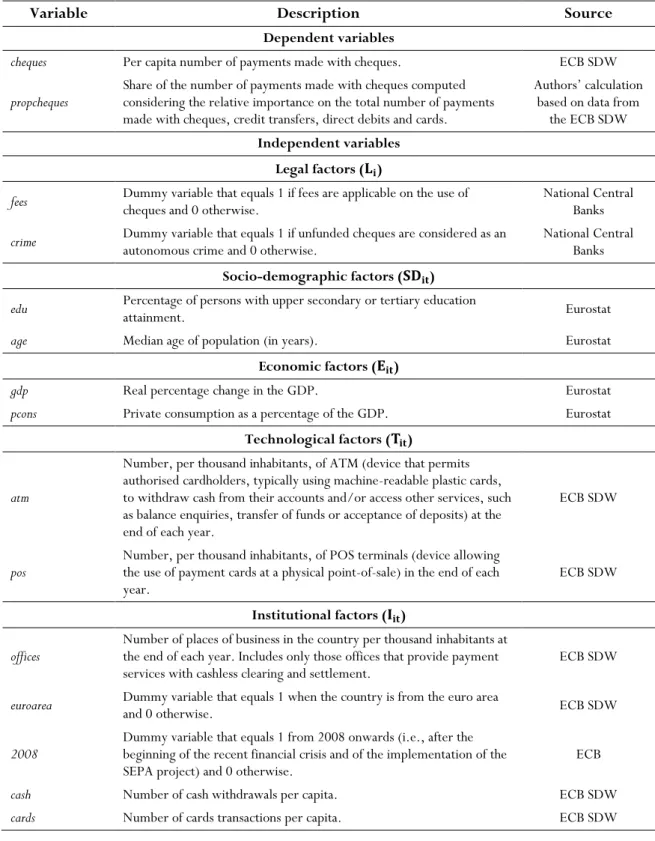
In terms of explanatory variables, and considering that this study intends to offer an examination of the impact in the use of cheques of legal factors not considered in the existing literature, two legal variables were included in the analysis: (i) the application of fees; and (ii) the establishment of an autonomous type of crime for unfunded cheques. In order to collect information on the existence of fees associated with the use of cheques we
22
consulted the EU National Central Banks6 and included in the model a time-invariant
dummy variable (fees).7 In addition, to verify if legal rules can impact the use of cheques,
we also confirmed with National Central Banks if writing unfunded cheques was considered as an autonomous crime and included another time-invariant dummy variable (crime).
The choice of payment instruments can also be related with its users’ characteristics. In general terms, cheques can be used by consumers and businesses (including from the public sector). In our model, we tried to capture the relevance of consumers’ characteristics through socio-demographic factors typically only included in the analysis of survey data (e.g., in Boeschoten (1998), Stavins (2001) and Klee (2006)). In fact, investigations based on national payments data found that the education level of consumers has a negative impact in the use of cheques, while age might have a positive effect. Hence, in order to capture the effect of those characteristics at an aggregate level we included: (i) the share of population with upper secondary or tertiary education attainment (edu); and (ii) the median age of the population (age). We also attempted to reflect the business environment using two economic variables: the percentage change in the real Gross Domestic Product (gdp) and the private consumption as a percentage of GDP (pcons).
On the other hand, technological and institutional factors, usually incorporated in the existing literature on the analysis of cross-country differences in payment habits (e.g., in Humphrey et al. (1996) and Guariglia and Loke (2004)), were also included. We added as technological factors the number of Automated Teller Machines or ATM (atm) and POS terminals (pos) per thousand inhabitants. In fact, ATM facilitate cash withdraws and can also promote the use of cards for certain transactions. POS terminals, on the other hand, support payments with cards. These factors might assist the substitution of cheques at the point-of-sale. In addition, we also included institutional country characteristics: two
6 In some cases we obtained the information on the website of the Central Banks and/or of commercial banks. In the collection of the information we requested data for the period under analysis. Since not all time information was provided by Central Banks, we considered it as time-invariant in the model.
7 One of the elements that might affect the use of payment instruments is price. However, at cross-country level there is no information available on this factor. Humphrey et al. (1996) computed a proxy for the price of payment instruments used on their analysis that consisted on the amount of fees, but concluded that the influence was very modest. Our variable differs from the proxy proposed by Humphrey et al. (1996) since it captures the impact of the existence of fees, not the effect of their amount.
23
dummy variables that reflect the fact that countries belong (or not) to the euro area (euroarea) and the impacts of the beginning of the recent financial crisis and of the SEPA project8, in particular, the launch of the SEPA credit transfers scheme (2008). We also
incorporated a variable denoting the number of offices or places of business that provide payment services (i.e., that execute payment transactions on behalf of a natural or legal person) per thousand inhabitants (offices), as they can facilitate the handling of cheques by consumers and businesses. In order to account for possible substitutability effects, we included the number of per capita payments with cards (cards) and the number of cash withdrawals (cash) as a simple proxy for cash usage. Credit transfers and direct debits are generally used for payments of a different nature (e.g., rents) and, therefore, were not considered as direct substitutes of cheques at the point-of-sale. An interaction term between the variables 2008 and fees was also included in order to identify if the impact of the establishment of fees changed after the beginning of the recent financial crisis and of the SEPA project. Detailed information on the variables used in the empirical analysis can be found in Table A2.1 of the Appendix.
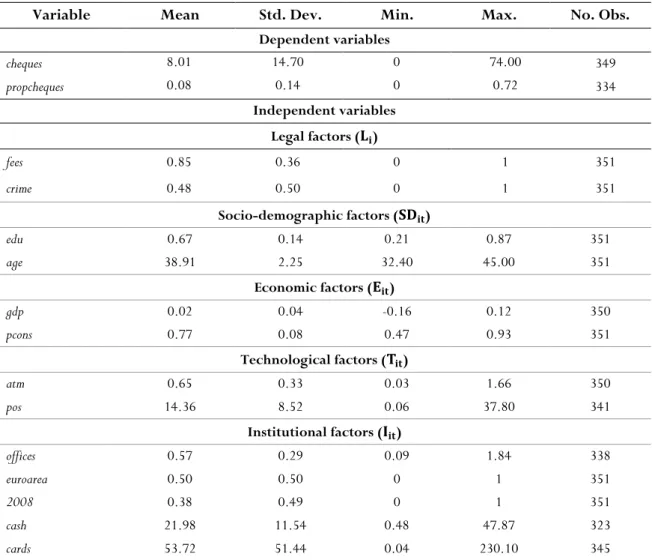
Table 2.2 presents the descriptive statistics for the dependent and independent variables used in the model. The mean number of per capita payments made with cheques between 2000 and 2012 was 8, while the mean share of cheque payments (in volume) was 0.08 or 8%. The variation between the minimums and maximums was quite substantial in both variables. In around 85% of the sample there are fees associated with the use of cheques, while unfunded cheques are only considered as an autonomous crime in around 48% of the sample. In what concerns to socio-demographic factors, we observe considerable differences in the education level between countries, while age characteristics are more similar. The economic and institutional factors reveal a diversity of situations, as we would expect.
8 The Single Euro Payments Area (SEPA) is a project that aims to harmonise retail payments in euro by enabling individuals, firms and public administrations to make and receive cashless payments throughout the Member States of the EU and Iceland, Liechtenstein, Monaco, Norway, Switzerland and San Marino using just one bank account located in any of these countries and a single set of payment instruments (credit transfers, direct debits and cards). For more information see, for example, Virtanen (2014).
24
Table 2.2: Descriptive statistics of the dependent and independent variables for EU countries (2000-2012)
Variable Mean Std. Dev. Min. Max. No. Obs.
Dependent variables cheques 8.01 14.70 0 74.00 349 propcheques 0.08 0.14 0 0.72 334 Independent variables Legal factors ( ) fees 0.85 0.36 0 1 351 crime 0.48 0.50 0 1 351 Socio-demographic factors ( ) edu 0.67 0.14 0.21 0.87 351 age 38.91 2.25 32.40 45.00 351 Economic factors ( ) gdp 0.02 0.04 -0.16 0.12 350 pcons 0.77 0.08 0.47 0.93 351 Technological factors ( ) atm 0.65 0.33 0.03 1.66 350 pos 14.36 8.52 0.06 37.80 341 Institutional factors ( ) offices 0.57 0.29 0.09 1.84 338 euroarea 0.50 0.50 0 1 351 2008 0.38 0.49 0 1 351 cash 21.98 11.54 0.48 47.87 323 cards 53.72 51.44 0.04 230.10 345
The table reports the descriptive statistics of the dependent and independent variables in the period between 2000 and 2012 for the 27 EU countries. “Std. Dev.” stands for standard deviation, “Min.” for the smallest value of the observations, “Max.” for the highest value of the observations and “No. Obs.” for the number of observations.
3.2. Model specification and methodology
The empirical analysis of the effect on cheques usage of: (i) legal factors connected with the existence of a fee and the fact that unfunded cheques are considered as an autonomous type of crime in certain countries; and (ii) socio-demographic, economic, technological and institutional factors, was made by estimating a static model with the following functional form:
25
where is either the number of per capita payments made with cheques or the share of
payments made with cheques (in volume), with representing each country and t (t denoting the time period; refers to two time-invariant dummies of legal factors (i.e., fees and crime); regards to socio-demographic factors (i.e., edu and
age); denotes economic factors (i.e., gdp and pcons); regards to technological factors
(i.e., atm and pos); refers to institutional determinants (i.e., offices, euroarea, 2008, cash
and cards); is an interaction term, , being the
country-specific effects and the idiosyncratic error term. Finally, , j = 1,… 6, are
vectors of parameters associated to each type of explanatory variables. Whenever is a nonlinear function, average partial effects (APE) are computed in order to measure the effect of unitary changes in these explanatory variables on the response variable.
The next subsections detail the econometric approach to model the two measures of cheque usage in analysis. The number of per capita payments with cheques, widely analysed by the literature, is modelled with linear models for panel data and a new approach based on count data regressions. Then, the share of payments made with cheques is described by FRM.
3.2.1. Models for the number of per capita payments with cheques
In order to choose the most appropriate estimator for the examination of the effect of selected factors on the number of per capita payments made with cheques, we began by considering standard linear models, where model (1) is simply the linear index. In particular, we considered the fixed effects (or within) estimator and the random effects estimator (Wooldridge, 2002). In the former, the fixed effects are eliminated by mean-differencing and, therefore, it is possible to obtain consistent estimates even with endogenous regressors, as long as the independent variables are only correlated with the time-invariant component of the error (i.e., ). However, because in the framework of this estimator it is not possible to estimate the coefficients of time-invariant variables such as those referring to the legal factors, our interest is focused on the random-effects estimator. This estimator allows the estimation of coefficients of time-invariant variables,
26
but assumes that individual unobserved effects are random and not correlated with the explanatory variables.
A robust Hausman (1978) test was performed to validate the random effects estimator. As usual, under the null hypothesis the individual effects are random. In addition, a RESET test was applied to the random effects model to confirm the adequacy of the specification. To examine the robustness of the results we also validated the possibility that some of the explanatory variables (i.e., the technological variables atm and
pos, as well as the institutional variables cash and cards) were correlated with the
individual-level random effects, by using an alternative estimator based on instrumental variables proposed by Hausman and Taylor (1981) that includes elements from the fixed and random effects models. In this estimator, the time-variant variables are used not only to estimate their own coefficients but also as instruments in order to estimate the coefficients of time-invariant variables9. To assess overidentifying restrictions in the
model, we performed the Sargan-Hansen test (Cameron and Trivedi, 2009). The null hypothesis of this test postulates that the instruments used in the model are valid.
Although linear models have been widely applied on the previous literature, they can have some shortcomings when using the type of data under investigation. In fact, the number of per capita payments made with cheques is a count variable with nonnegative integer values. According to Wooldridge (2002), linear models might not be the best solution, since they can generate negative predicted values. Therefore, a Poisson regression estimated by quasi-maximum likelihood (QML) was also tested10. In this
framework, in (1), Three alternatives were considered: a fixed effects Poisson model, a random effects Poisson model where the random effects follow a gamma distribution, and a random effects Poisson model where the random effects follow a lognormal distribution. To validate the adequacy of the random effects models, RESET tests were performed. Finally, the linear random effects estimators were compared with
9 In our analysis we considered that the variables atm, pos, cash and cards as endogenous. All these time-variant variables exhibited sufficient within-panel variation to serve as their own instruments.
10 Note that, according to Gourieroux et al. (1984), the Poisson estimator with robust standard errors is consistent, even under misspecification of the Poisson distribution, as long as the mean is correctly specified.