RESUMO.- [Ausência de enterococos resistentes à vanco-micina na microbiota intestinal de primatas não-humanos.] Os reservatórios animais de Enterococos Resistentes à Van-comicina (VRE) têm um importante papel na epidemiologia
Absence of intestinal colonization by
vancomycin-resistant enterococci in nonhuman primates
1Diego Batista Xavier2,Adriana Helena Rosa2, Hilana dos Santos Sena2, Danillo Simonini Teixeira3, Carlos Tomaz3 and Ricardo Titze-de-Almeida2*
ABSTRACT.- Xavier D.B.,Rosa A.H., Sena H.S., Teixeira D.S., Tomaz C. & Titze-de-Almeida R. 2010. Absence of intestinal colonization by vancomycin-resistant enterococci in nonhuman primates. Pesquisa Veterinária Brasileira 30(6):491-496. Microbiologia Molecular e Biotecnologia, Faculdade de Agronomia e Medicina Veterinária, Universidade de Brasília, Cx. Postal 04508, Brasília, DF 70910-900, Brazil. E-mail: [email protected]
The animal reservoirs of vancomycin-resistant enterococci (VRE) have important role in the epidemiology of the bacteria and resistant genes. The present work searched fecal samples taken off nonhuman primates for the presence of VRE. Resistance profiles, virulence traits, and genetic variability among enterococci isolates were also analyzed. The samples included Capuchin monkeys (Cebus apella, n=28) and Common marmoset (Callithrix penicillata, n=37) housed in the Primate Center of the University of Brasília, Brazil. Most individuals were captive monkeys from the Central-West and South-East regions of Brazil (n=48). We collected rectal swabs and carried out selective isolation followed by multiplex Polymerase Chain Reaction (PCR) to identify species and resistance genes. No vanA or vanB-containing enterococci were found. The carriage rates ranged from 1.5% for the VanC-type E. casseliflavus and E. gallinarum
until 12.3% (n=8) for Enterococcus faecalis. All E. faecalis isolates showed susceptibility to vancomycin, teicoplanin, ampicillin, gentamicin, and streptomycin. The virulence genes ace
and esp were prevalent (100.0%, 87.5%). Multilocus variable number of tandem repeats (MLVA) revealed diversity in the number of repeats among E. faecalis isolates and targets, which was higher for espC, efa5, and efa6. We identified six different MLVA genotypes that were divergent from those described in human beings. Also, they were clustered into two genogroups that showed host-specificity for the species Cebus apella or Callithrix penicillata. In conclusion, no vanA- or vanB-containing enterococci were found colonizing those primate individuals. This finding suggested that the primate individuals investigated in our study are not directly involved in the epidemiological chain of high-level vancomycin-resistant genes vanA or vanB in Brazil. Our study also showed that E. faecalis isolated from nonhuman primates carry virulence traits and have ability to spread their lineages among different individuals.
INDEX TERMS: Enterococcus, vancomycin-resistance, MLVA, monkey.
1 Received on May 20, 2009.
Accepted for publication on April 27, 2010.
2 Laboratório de Microbiologia Molecular e Biotecnologia, Faculdade
de Agronomia e Medicina Veterinária, Universidade de Brasília (UnB), Cx Postal 04508, Brasília, DF 70910-900, Brazil. *Corresponding author: [email protected]
3Centro de Primatologia e Laboratório de Neurociências e
Compor-tamento, UnB, Brasília, DF.
identi-ficar espécies e genes de resistência. Não foram isolados enterococos contendo os genes vanA ou vanB. A porcenta-gem de enterococos variou de 1,5% para E. casseliflavus e E. gallinarum VanC até 12,3% (n=8) para Enterococcus faecalis. A totalidade dos isolados da espécie E. faecalis demonstrou sensibilidade aos antimicrobianos vancomicina, teicoplanina, ampicilina, gentamicina e estreptomicina. Os genes de viru-lência ace e esp foram prevalentes (100%, 87.5%). A análise em multilocus de repetições em tandem de número variável (MLVA) revelou diversidade no número de repetições entre os isolados de E. faecalis, que foi mais alta para espC, efa5 e
efa6. Foram identificados seis diferentes genotipos de MVLA, divergindo daqueles já descritos em humanos. Os genotipos foram ainda agrupados em dois genogrupos, demonstrando especificidade de hospedeiro para as espécies Cebus apella
ou Callithrix penicillata. Concluindo, não foram isoladas linha-gens de enterococos contendo os genes vanA ou vanB coloni-zando as espécies de primatas analisadas. O presente estudo demonstrou que os isolados de E. faecalis obtidos de primatas não-humanos apresentam determinantes de virulência e pos-suem a habilidade de disseminar linhagens entre diferentes indivíduos.
TERMOS DE INDEXAÇÃO: Enterococcus, resistência à van-comicina, MLVA, macacos.
INTRODUCTION
Two decades after the first isolation reports, the epidemiology of vancomycin-resistant enterococci (VRE) remains not fully understood (Uttley et al. 1988, Cetinkaya et al. 2000, Nordmann et al. 2007). The bacteria colonize pets and food production animals and have shown remarkable ability to spread hospital-adapted lineages (Aarestrup et al. 2002, Klare et al. 2003, Willems et al. 2005, Rice 2006).
Most epidemiological studies in animals were focused on the food production chain and found relationships between the use of growth promoters and the rate of resistance development (Bager et al. 1997, Aarestrup et al. 2001). These studies also identified virulence genes in E. faecalis strains isolated from food (Franz et al. 2003, Moreno et al. 2006). However, resistance and virulence traits in enterococci isolated from wild animals were seldom reported (Livermore et al. 2001, Butaye et al. 2002, Poeta et al. 2005). This study was aimed to examine whether VRE colonize individuals from the species Cebus apella and
Callithrix penicillata housed in a Primate Center from Brazil. We also analyzed genes for virulence and resistance, as well as the genetic variability among Enterococcus faecalis isolates.
MATERIALS AND METHODS
Individuals. We examined 65 fecal samples from Capuchin monkeys (Cebus apella, n=28) and Common marmoset (Callithrix pennicilata, n=37) housed in the Primate Center of the University of Brasília (CPUnB), Brazil, during July and August 2006. The samples included animals breed at the CPUnB (n=17) and captive monkeys from the Central-West and South-West Regions of Brazil (n=48) (Table 1). The animals were feed daily with tropical fruits (banana, orange, pineapple, mango, and others), vegetables (potato, carrot, tomato, pumpkin,
cucumber, cabbage, cauliflower, spring greens, and others), and commercial cat food. Twice a week they received insect larva as a protein source. Water was provided ad libitum. We administrated twice a year either Ivermectin or a combination of Pyrantel, Oxantel and Praziquantel as antiparasitics for the species C. apella and C. pennicillata, respectively. Individuals eligible for this study received no antibiotic treatment within 12 months prior the sampling procedure.
Specimen collection, isolation of enterococci and species identification. The rectal swabs (n=65) were inoculated in the selective media BBL Enterococcosel broth (Becton Dickinson and Co., Sparks, MD) supplemented with vancomycin 8μg/mL. After 24-48h of incubation at 35°C, the positive samples were seeded onto sheep blood agar plates. The colonies showing typical morphology and positive phenotypic testing for
Enterococci were submitted to multiplex PCR as described earlier (Titze-de-Almeida et al. 2004a; Table 2). This PCR identifies the species E. faecalis, E. faecium, E. gallinarum
(vanC1), E. casseliflavus (vanC2/3) and, in addition, the resistance genes vanA and vanB (Xavier et al. 2006). Virulence genes detection and multilocus variable number of tandem repeat analysis - MLVA. We used a previously described MLVA scheme to analyze genetic polymorphisms in seven different repeat regions (Titze-de-Almeida et al. 2004b). The method was also used to type the isolates and to identify the virulence genes ace and esp that code for microbial surface proteins with function of cellular adhesins. To obtain the DNA, the strains were cultured at 37°C in brain heart infusion broth; 1.0 mL of this media was then centrifuged at 13.000 G for 3 min. The pellets were diluted in 100μL of sterile milli-Q water, boiled for 10 min., and centrifuged at 13.000 G for 3 min. To prepare the PCR mixture, we added 5μL of this supernatant, 25pmol of the previously described primers aceB, espC, espA, efa2, efa3, efa5
and efa6 (Titze-de-Almeida et al. 2004b; Table 2), 10 mM Tris-HCl (pH 8.3), 50mM KCl, 1.5mM MgCl2, 0.25 mM of each deoxynucleotide triphospate (dATP, dCTP, dGTP, dTTP), and 1.2U of Taq DNA polymerase. We used the following PCR program: initial preheating step at 94° for 2 min; initial denaturation step at 94°C for 4min; 35 cycles of amplification (denaturation 94°C for 1 min., annealing at 55°C for 1min, extension at 72°C for 2min); and a final extension at 72°C for 5min. The PCR products were electrophoresed through a 1% agarose gel stained with ethidium bromide for 1 hour at 60V. The gel was photographed under UV light.
Antimicrobial susceptibility testing. The disk diffusion susceptibility testing was used to determine antimicrobial resistance to vancomycin, teicoplanin, and ampicillin, according to the NCCLS guidelines (NCCLS, 2002). High-level resistance to gentamicin and streptomycin (Oxoid, Basingstoke, UK) was also tested.
RESULTS
Sixty-five rectal samples from Capuchin monkeys and Common marmoset from the Primate Center of the University of Brasília were examined for the presence of VRE. No vanA- or vanB -containing enterococci were found in this study. The most prevalent species was Enterococcus faecalis (n=8, 12.3%), followed by E. gallinarum (n=1, 1.5%, vanC1), and E. casseliflavus (n=1, 1.5%,
vanC2/3).
and targets, which varied from one repeat in espA until nine in
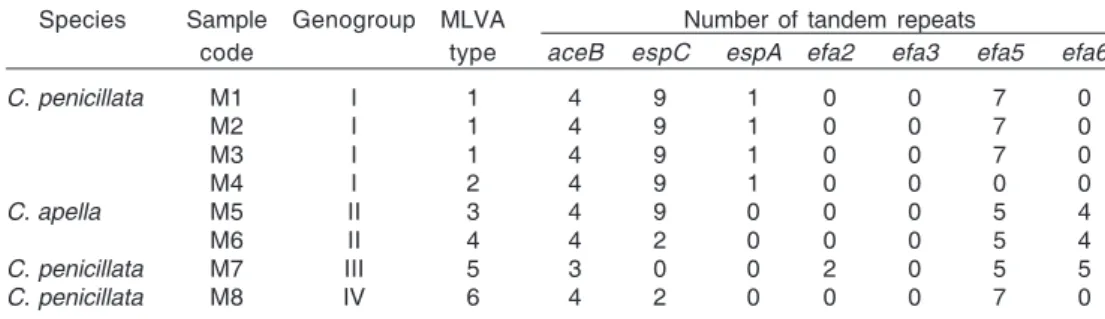
espC (Table 4). Except for aceB, all loci showed any negative repeat results. The variability in the number of repeats was higher for espC, efa5, and efa6, in comparison with aceB, espA and efa2. Six different MLVA genotypes were found and they were clustered in four genogroups of isolates sharing 6-7 identical number of repeats (Table 3). Two of them composed major genogroups of isolates. The genogroup I comprised enterococci with MLVA types 1 and 2, all of them isolated from C. penicillata individuals. Within this genogroup, three isolates showed identical number of repeats for all the seven alleles tested (M1- M3); the remaining one (M4) differed only in efa5 target. MLVA types 3 and 4 were clustered in
the genogroup II. This genogroup contained two isolates from the species C. apella that differed only in espC repeats.
Genes coding for the virulence traits aceB and espC were identified in E. faecalis isolates, as part of the MLVA method. All isolates harboured aceB and seven of the eight isolates carried espC.
The disk diffusion testing showed antimicrobial susceptibility to vancomycin, teicoplanin, ampicillin, gentamicin, and streptomycin.
DISCUSSION
The present study examined rectal samples from the nonhuman primates Cebus apella and Callithrix penicillata for the
presen-Table 2. Oligonucleotide primers and target genes for PCR reaction
Amplified gene Sequence (5’- 3’)a Repeat / Reference
Ampliconsize (bp)
aceB F: AAAATGTGGAAATGCCAACAGAAGAAAGTC 141b Nallapareddy et al., 2000
R: ATTTAATTTTTGAATTGGTTCACTAAGCAG
esp2/5 F: CAGATGGATCATCTGATGAAGT 252b Shankar et al., 1999
R: GTAACGTTACTGTTACATCTGC
esp46/47 F: TTACCAAGATGGTTCTGTAGGCAC 246b Shankar et al., 1999
R: CCAAGTATACTTAGCATCTTTTGG
efa2 F: TTCGCTGGTTCTTCAGG 393b Titze-de Almeida et al. 2004b
R: CGTTGAGGCAGTAGATATTTTAAC
efa3 F: TGTCACGCCATCTAAATTG 282b Titze-de Almeida et al. 2004b
R: CACCAGTGGGGTATGTATTAG
efa5 F: TTGTTTCGTACCAGTTTGATC 213b Titze-de Almeida et al. 2004b
R: GTTAAATGGCAGCTCGC
efa6 F: AGTACCAAGGACCGTGC 270b Titze-de Almeida et al. 2004b
R: ATTTAGATGCTCGTTTTGTAGG
vanA F: GGGAAAACGACAATTGC 732c Dutka-Malen et al. 1995
R: GTACAATGCGGCCGTTA
vanB F: ACCTACCCTGTCTTTGTGAA 300c Zanella et al. 2003
R: AATGTCTGCTGGAACGATA
vanC-1 F: GGTATCAAGGAAACCTC 822c Dutka-Malen et al. 1995
R: CTTCCGCCATCATAGCT
vanC-2, vanC-3 F: CTCCTACGATTCTCTTG 439c Dutka-Malen et al. 1995
R: CGAGCAAGACCTTTAAG
ddlE. faecalis F: ATCAAGTACAGTTAGTCT 941c Dutka-Malen et al. 1995
R: ACGATTCAAAGCTAACTG
ddlE. faecium F: TAGAGACATTGAATATGCC 550c Dutka-Malen et al. 1995 M
R: TCGAATGTGCTACAATC
aF, sense primer; R, antisense primer.
b Size of each repeat amplified through the MLVA typing method.
c Size of the amplified sequence used for enterococci speciation and vancomycin resistance detection.
Table 1. Individuals distribution according to the species and geographic origin
Specie Origin Year
1997 1998 1999 2000 2001 2002 2003 2004 2005 2006 Total
Callithrix penicillata CPUnBa - 1 0 2 1 2f 4 - 4 2 16
Captive (CW)b - - 3e 1 4 1 - 1 5 1 16
Captive (SE)c - 3d - - - - - - 2 - 5
Cebus paella CPUnBa - - - - - - - - 1 - 1
Captive – (CW)b 8 2 2 - 6g 5 - - 2 2 27
Total 8 6 5 3 11 8 4 1 14 5 65
a Individuals breed at the Primate Center of the University of Brasília (CPUnB), according to the date of birth. b Captive monkeys from the Central-West Brazilian Region, according to the year they were brought to CPUnB. c Captive monkeys from the South-East Brazilian Region, according to the year they were brought to CPUnB. d Samples from which the isolates M1 and M8 were obtained.
e Samples from which the isolates M2, M4, and M7 were obtained. f Samples from which the isolate M3 was obtained.
ce of VRE. Antimicrobial resistance, genetic polymorphism, and presence of virulence genes were also evaluated.
Enterococcal species prevalence varied greatly according to the host species studied. Poeta et al. (2005) examined faecal samples (n=77) from various wild animals including birds of prey, owls, foxes, wild rabbits, European genets, forest wildcats, salamanders, storks, magpies, deer, vipers, otters, wolves, mouflon, badgers, partridge, hedgehog, pigeon, ferret, quails and wild boar. In that study, Enterococcus faecalis (52.1%) was the most prevalent species, followed by E. faecium (32.1%), E. hirae
(10%), E. casseliflavus (2.8%), and E. gallinarum (1.4%). In contrast, the prevalence of E. faecalis was relatively low (1.5%) in Sus scrofa wild boars, in which E. faecium (50%) and E. hirae
(40.3%) were prevalent (Poeta et al. 2007).
The method used for enterococci isolation may also affects the species prevalence results. In a previous study using selective media with vancomycin, E. gallinarum
(VanC1, 13.0%) and E. casseliflavus (VanC2/3, 5.5%) were the most prevalent species isolated from poultry raised on nonintensive production farms in Brazil (Xavier et al. 2006). The Van-C enterococci were also prevalent in samples from wild animals (deer, duck, goose, llama, and squirrel) from USA in a surveillance study using selective media for VRE (Rice et al. 2003). Despite using the selective isolation in our study, the prevalence rate for E. faecalis (12.3%) was higher than those observed for E. gallinarum and E. casseliflavus (1.5% each one).
VRE have been identified from food production animals and pets (Aarestrup et al. 2002) but few studies reported their isolation from wild animals. Mallon et al. (2002) isolated lineages of E. faecium with vanA genotype from woodmice (Apodemus sylvaticus, n=6, 4.6%) and badgers (Meles meles, n=2, 1.2%) in the northwest England. However, the bacteria were absent in
the bank voles (Clethrionomys glareolus) that live in the same region. High-level vancomycin resistant enterococci were also absent from 77 wild animal samples (mammals, birds, and other) from Portugal natural parks (Poeta et al. 2005). Rice et al. (2003) also failed to find VRE in a surveillance study on 14 different species of domestic and wild animals, including cow, deer, duck, goat, horse, llama, pig, rabbit, sheep, squirrel, dog, turkey, and goose. In a previous study, we also found absence of VRE in cloacal samples from poultry raised on nonintensive production farms in Brazil (Xavier et al. 2006). In the present study, no vanA- or vanB-containing enterococci were found in Capuchin monkeys and Common marmoset housed in the Primate Center of the University of Brasília, Brazil.
Few surveillance studies in wild animals have tested antimicrobial resistance to the clinically important antibiotics teicoplanin, ampicillin, gentamicin, and streptomycin. A previous study that analyzed 140 enterococci isolated from wild animals in Portugal revealed susceptibility to teicoplanin and ampicillin; resistance to gentamicin and, streptomycin occurred in only two isolates from an owl (Poeta et al. 2005). Low resistance rates to kanamycin, streptomycin, and ampicillin (9.0%, 6.7%, 3.7%), and susceptibility to gentamycin was found in samples from Sus scrofa
(Poeta et al. 2007). In our study, E. faecalis strains isolated from the nonhuman primates Cebus apella and Callithrix penicillata were all susceptible to teicoplanin, ampicillin, gentamicin, and streptomycin. The low prevalence of antimicrobial resistance in enterococci isolated from wild animal species contrasts with those data concerned to food animals. This fact corroborates the selective pressure theory, in which the volume of antibiotic use would affect the rate of resistance development (Aarestrup et al. 2001).
In our study, we also examined whether enterococci colonizing wild monkeys carry the virulence genes ace (adhesin of collagen from E. faecalis) and esp (enterococcal surface
Table 4. Diversity in multilocus variable number of tandem repeat analysis allele scores as determined by the number of repeats in given loci
Gene Number of tandem repeats (frequence in alleles)
0 1 2 3 4 5 7 9
aceB 1(12.5 ) 7( 87.5)
espC 1(12.5 ) 2(25.0) 5(62.5%)
espA 4(50.0) 4(50.0)
efa2 7( 87.5) 1(12.5 ) efa3 8(100.0)
efa5 1(12.5) 3(37.5) 4(50.0)
efa6 5(62.5%) 2(25.0) 1(12.5 )
Table 3. Multilocus variable number of tandem repeat analysis polymorphism among the Enterococcus faecalis strains isolated from Callithrix penicillata and Cebus apella
Species Sample Genogroup MLVA Number of tandem repeats
code type aceB espC espA efa2 efa3 efa5 efa6
C. penicillata M1 I 1 4 9 1 0 0 7 0
M2 I 1 4 9 1 0 0 7 0
M3 I 1 4 9 1 0 0 7 0
M4 I 2 4 9 1 0 0 0 0
C. apella M5 II 3 4 9 0 0 0 5 4
M6 II 4 4 2 0 0 0 5 4
C. penicillata M7 III 5 3 0 0 2 0 5 5
protein) (Shankar et al. 1999, Nallapareddy et al. 2000, Mundy et al. 2000). Both factors are involved in microbial adhesion to host tissue; Ace binds extracellular matrix proteins and Esp is involved in microbial infection and biofilm formation, which exact role remains controversial (Shankar et al. 1999, Nallapareddy et al. 2000, Willems & Bonten 2007). In a previous study from a broad range of wild animals, the prevalence of ace and esp was relatively low (9.6%, 4.1%) compared to values found in our study (100% and 87%, respectively). The prevalence of esp found in our study was also higher than those observed in E. faecalis isolates recovered from human (44-46%) and food (33%) samples (Eaton & Gasson 2001, Titze-de-Almeida et al. 2004b).
The MLVA revealed different levels of genetic variability among the loci studied, which was previously described in medical isolates (Titze-de-Almeida et al. 2004b). espC, efa5, and efa6 showed three different alleles, contrasting with aceB,
espA,and efa2 that presented only two different alleles (Table 4). The six MLVA types found in nonhuman primates (Table 3) differed from those previously described in human beings (Titze-de-Almeida et al. 2004b). These genotypes were classified in major clusters named genogroups I (n=4) and II (n=2) and others composed by single isolates, genogroups III and IV. This clustering characteristic was also observed in previous work from human beings, where isolates formed major genogroups (MLVA types 9 and 37; n=13 and n=14, respectively) and minor genogroups composed by unique isolates, MLVA types 1, 2, 4-8 (Titze-de-Almeida et al. 2004b). The enterococci have shown a remarkable ability to spread epidemic clones throughout the word, as observed for the hospital-adapted E. faecium clonal complex-17 (Titze-de-Almeida et al. 2004a, Willems et al. 2005, Titze-de-(Titze-de-Almeida et al. 2006, Willems & Bonten 2007). In our study, the genetically related isolates M1-M4 from the genogroup I have colonized monkeys originated from geographically distant regions which includes the South-east (M1), Central-West (M2, M4), and CPUnB (M3) (Table 1 and 3). We should remark that these primates live in distinct cages in CPUnB. However, the cage structure allowed physical contact between neighbors. In addition, the animals were treated by the same technicians, which could contribute for the lineages spreading. Indeed, host-specificity recently described in enterococci suggests the microbial lineages evolved in parallel with the host evolution (Willems et al. 2000). In our study, we also found host-specificity among nonhuman primate enterococci isolates; the MLVA genogroups I and II shared no isolates from different primate species.
In conclusion, we found absence of VRE colonizing individuals from the species C. apella and C. penicillata housed in CPUnB.
E. faecalis isolated from these primates showed host-specificity, ability to harbour virulence genes, and the spreading behavior already reported in other animal species.
REFERENCES
Aarestrup F.M., Seyfarth A.M., Emborg H.D., Pedersen K., Hendriksen R.S. & Bager F. 2001. Effect of abolishment of the use of antimicrobial agents for growth promotion on occurrence of antimicrobial resistance
in fecal enterococci from food animals in Denmark. Antimicrob. Agents Chemother. 45:2054-2059.
Aarestrup F.M., Butaye P. & Wolgang W. 2002. Nonhuman Reservoirs of Enterococci, p.55-99. In: Gilmore M.S. (Ed.), The Enterococci: Patho-genesis, molecular biology, and antibiotic resistance. ASM Press, Washington, DC.
Bager F., Madsen M., Christensen J. & Aarestrup F.M. 1997. Avoparcin used as a growth promoter is associated with the occurrence of vancomycin-resistant Enterococcus faecium on Danish poultry and pig farms. Prev. Vet. Med. 31:95-112.
Butaye P., Baele M., Devriese L.A. & Haesebrouck F. 2002. Comparison of susceptibility to antimicrobials of the enterococcal species isolated from pigeons (Columba livia). Microb. Drug Resist. 8:215-218. Cetinkaya Y., Falk P. & Mayhall C.G. 2000. Vancomycin-resistant
Ente-rococci. Clin. Microbiol. Rev. 13:686-707.
Dutka-Malen S., Evers S. & Courvalin P. 1995. Detection of glycopeptide resistance genotypes and identification to the species level of clinically relevant Enterococci by PCR. J. Clin. Microbiol. 33:24-27.
Eaton T.J. & Gasson M.J. 2001. Molecular screening of Enterococcus virulence determinants and potential for genetic exchange between food and medical isolates. Appl. Environ. Microbiol. 67:1628-1635. Franz C.M., Stiles M.E., Schleifer K.H. & Holzapfel W.H. 2003.
Entero-cocci in foods: A conundrum for food safety. Int. J. Food Microbiol. 88:105-122
Klare I., Konstabel C., Badstübner D., Werner G. & Witte W. 2003. Occurrence and spread of antibiotic resistances in Enterococcus faecium. Int. J. Food Microbiol. 88:269-290.
Livermore D.M., Warner M., Hall L.M.C., Enne V.I., Projan S.J., Dunman P.M., Wooster S.L. & Harrison G. 2001. Antibiotic resistance in bac-teria from magpies (Pica pica) and rabbits (Oryctolagus cuniculus) from west Wales. Environ. Microbiol. 3:658-661.
Mallon D.J.P., Corkill J.E., Hazel S.M., Wilson J.S., French N.P, Bennett M. & Hart C.A. 2002. Excretion of vancomycin-resistant enterococci by wild mammals. Emerg. Infect. Dis. 8:636-638.
Moreno M.R.F., Sarantinopoulos P., Tsakalidou E. & De-Vuyst L. 2006. The role and application of enterococci in food and health. Int. J. Food Microbiol. 106:1-24.
Mundy L.M., Sahm D.F. & Gilmore M. 2000. Relationships between enterococcal virulence and antimicrobial resistance. Clin. Microb. Rev. 13:513-522.
Nallapareddy S.R., Singh K.V., Duh R., Weinstock G.M. & Murray B.E. 2000. Diversity of ace, a gene encoding a microbial surface component recognizing adhesive matrix molecules, from different strains of Ente-rococcus faecalis and evidence for production of Ace during human infections. Infect. Immun. 68:5210-5217.
NCCLS. National Committee for Clinical Laboratory Standards (NCCLS). 2002. Performance Standards for Antimicrobial Suscep-tibility Testing. Twelfth Informational Supplement, M100-S12, 22:1. National Committee for Clinical Laboratory Standards, Villanova, PA (January).
Nordmann P., Naas T., Fortineau N. & Poirel L. 2007. Superbugs in the coming new decade; multidrug resistance and prospects for treatment of Sta-phylococcus aureus, Enterococcus spp. and Pseudomonas aeruginosa in 2010. Curr. Opinion Microbiol. 10:436-440
Poeta P., Costa D., Sáez Y., Klibi N., Ruiz-Larrea F., Rodrigues J. & Torres C. 2005. Characterization of antibiotic resistance genes and virulence factors in faecal enterococci of wild animals in Portugal. J. Vet. Med. B. 52:396-402.
Rice L.B. 2006. Antimicrobial resistance in gram-positive bacteria. Am. J. Infect. Control 34:S11-S19.
Shankar V., Baghdayan A.S., Huycke M.M., Lindahl G. & Gilmore M.S. 1999. Infection-derived Enterococcus faecalis strains are enriched in esp, a gene encoding a novel surface protein. Infect. Immun. 67:193-200.
Titze-de-Almeida R., Rollo-Filho M., Nogueira C.A., Rodrigues I.P., Eudes-Filho J., Nascimento R.S., Ferreira II R.F., Moraes L.M., Boelens H., Van Belkum A. & Felipe M.S.S. 2004a. Molecular epi-demiology and antimicrobial susceptibility of Enterococci recover-ed from Brazilian intensive care units. Braz. J. Infect. Dis. 8:197-205.
Titze-de-Almeida R., Willems R.J.L., Top J., Rodrigues I.P., Fonseca II R.F., Boelens H., Brandileone M.C., Zanella R.C., Felipe M.S.S. & Van Belkum A. 2004b. Multilocus variable number of tandem repeats polymorphism among Brazilian Enterococcus faecalis strains. J. Clin. Microbiol. 42:4879-4881.
Titze-de-Almeida R., Van Belkum A., Felipe M.S.S., Zanella R.C., Top J. & Willems R.J.L. 2006. Multilocus sequence typing of hospital associated Enterococcus faecium from Brazil reveals their unique evolutionary history. Microb. Drug Res. 12:121-125.
Uttley A.H.C., Collins C.H., Naidoo J. & George R.C. 1988. Vancomycin-resistant Enterococci. Lancet 1:57-58.
Willems R.J., Top J., van Den Braak N., van Belkum A., Endtz H., Mevius D., Stobberingh E., Van Den Bogaard A. & Embden J.D. 2000. Host specificity of vancomycin-resistant Enterococcus faecium. J. Infect. Dis. 182:816-823.
Willems R.J., Top J., van Santen M., Robinson D.A., Coque T.M., Ba-quero F., Grundmann H. & Bonten M.J. 2005. Global spread of vancomycin-resistant Enterococcus faecium from distinct nosocomial genetic complex. Emerg. Infect. Dis. 11:821-828.
Willems R.J.L. & Bonten M.J. 2007. Glycopeptide-resistant Entero-cocci: deciphering virulence, resistance and epidemicity. Curr. Opin. Infect. Dis. 20:384-390.
Xavier D.B., Bernal F.E.M. & Titze-de-Almeida R. 2006. Absence of VanA-and VanB-Containing Enterococci in Poultry Raised on Nonintensive Production Farms in Brazil. Appl. Environ. Microbiol. 72:3072-3073. Zanella R.C., Brandileone M.C., Bokermann S., Almeida S.C., Valdetaro