(Annals of the Brazilian Academy of Sciences) ISSN 0001-3765
www.scielo.br/aabc
Molluscicidal activity of 2-hydroxy-[1,4]naphthoquinone and derivatives
CELSO A. CAMARA1, TANIA M.S. SILVA2, THIAGO G. DA-SILVA2, RODRIGO M. MARTINS2, TICIANO P. BARBOSA2, ANGELO C. PINTO3 and MARIA D. VARGAS4
1Departamento de Química, Universidade Federal Rural de Pernambuco, Rua Dom Manoel de Medeiros s/n,
Campus Dois Irmãos, 52171-030 Recife, PE, Brasil
2Laboratório de Tecnologia Farmacêutica, LTF-UFPB, Campus I, Cidade Universitária,
Caixa Postal 5009, 58051-970 João Pessoa, PB, Brasil
3Departamento de Química Orgânica, Instituto de Química-CT, Bloco A, Universidade Federal do Rio de Janeiro,
Cidade Universitária, 21941-590, Rio de Janeiro, RJ, Brasil
4Instituto de Química, Universidade Federal Fluminense, Outeiro de São João Batista,
Campus do Valonguinho, Centro, 24020-150, Niterói, RJ, Brasil
Manuscript received on October 10, 2007; accepted for publication on January 21, 2008; contributed byANGELOC. PINTO*ANDMARIAD. VARGAS*
ABSTRACT
The toxic profile of lawsone (2-hydroxy-[1,4]naphthoquinone) and a series of [1,4]naphthoquinone derivatives was evaluated against the brine shrimpArtemia salina and against the molluskBiomphalaria glabrata, the main transmitting vector of schistosomiasis in Brazil. Of the seventeen compounds tested nine fell below the threshold of 100µg/mL set for potential molluscicidal activity by the World Health Organization. As a general rule derivatives with non-polar substituents presented the highest molluscicidal activities. These substances showed significant toxicity in A. salinalethality bioassay.
Key words: Biomphalaria glabrata, Artemia salina, toxicity, quinones, schistosomiasis, molluscicidal activity, lawsone, 1,4-naphthoquinone.
INTRODUCTION
Among human parasitic diseases, schistosomiasis (also called bilharziasis) remains one of the most prevalent parasitic infections, with significant economic and pub-lic health consequences (Chitsulo et al. 2000). Mor-tality due to schistosomiasis was estimated at 11,000 deaths per year (WHO 2005). The aquatic gastropod mollusk Biomphalaria glabrata(Perrett and Whitfield 1996, Verjovski-Almeida and DeMarco 2004) is the main intermediate host of schistosomiasis in South America. Infection usually occurs by contact with wa-ter containing infected snails. Permanent solutions to this problem include restriction of human contact with polluted water and prevention of further contamination
*Member Academia Brasileira de Ciências Correspondence to: Maria D. Vargas E-mail: [email protected]
of the environment (Chitsulo et al. 2000). The use of molluscicides as a prophylactic treatment involves break-ing the life cycle ofSchistosoma mansoni(the etiologi-cal agent of schistosomiasis) through the destruction of its intermediate host, the snailB. glabrata(Perrett and Whitfield 1996, Bezerra et al. 2002). This constitutes the weakest link in the transmission cycle and is the log-ical point of attack to control the disease. The search for molluscicides is of great interest for potential focal con-trol of parasitary diseases, especially schistosomiasis, in endemic countries (Pointier and Giboda 1999, Capron 1998). New, safe, and effective molluscicides are ur-gently needed, but in order to be useful the products must be stable, inexpensive and easy to apply, and must show high selective toxicity to the target pest (Singh et al. 1996).
either natural (Silva et al. 2007a, b, 2006, 2005a) or synthetic (Silva et al. 2005b, Barbosa et al. 2005, Vas-concellos et al. 2006) we have recently described some effective molluscicide compounds prepared from natural 2-hydroxy-[3-methyl-(2-buten)]-1,4-naphthoquinone
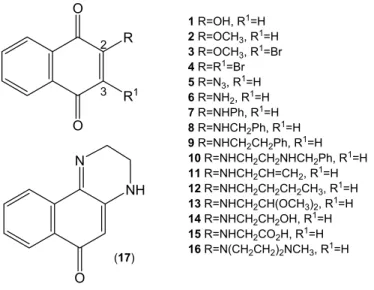
(lapachol). Studies on the amine and aza-antraquinones derivatives of lapachol and nor-lapachol (2-hydroxy-[3-methyl-(2-propen)]-1,4-naphthoquinone) showed that in general the compounds containing the most polar groups bonded to the nitrogen generally exhibited the lowest molluscicidal activities and that the lapachol derivatives were slightly more active than the nor-lapachol ones (Silva et al. 2005b, Barbosa et al. 2005). In order to find out whether a side chain on position 3 of the amino-naphthoquinone is necessary for activity, we have eval-uated, and describe herein, both molluscicidal activity and brine shrimp toxicity of readily available 2-amino-derivatives of lawsone 1
(2-hydroxy-1,4-naphthoqui-none) (Fieser and Martin 1955), whose structures are shown in Figure 1.
EXPERIMENTAL
SYNTHESIS OF THECOMPOUNDS
Seventeen derivatives of [1,4]naphthoquinone were pre-pared by know methods and their structures were con-firmed by infrared spectroscopy, NMR, and mass spec-trometry. Some of the title compounds are analogues of 2-amino-derivatives of lapachol and nor-lapachol re-ported elsewhere (Silva et al. 2005, Barbosa et al. 2005). All the nitrogen compounds were readily obtained by nucleophilic displacement of the methoxyl group of 2-methoxy-1,4-naphthoquinone2(Fieser and Martin
1955) with the appropriate amines. Except for com-pound13, all compounds were described previously in
the literature: 2-bromo-3-methoxy-1,4-naphthoquinone
3 (Fieser and Brown 1949),
2,3-dibromo-1,4-naphtho-quinone4(Kohn and Schwarz 1926),
2-azido-1,4-naph-thoquinone5(Molina et al. 1995), 2-nitrogen derivatives 6-16(Aristoff and Johnson 1992, Bowman et al. 1969,
Couladouros et al. 1997, Fieser et al. 1948, Johnson et al. 1997) and cyclic derivative17(Kallmayer and
Sey-fang 1980). All compounds were purified by chromato-graphic techniques, especially flash chromatography, using silica-gel-60 (230-400 Mesh, Fluka), and fully characterized by analytical and spectroscopic methods.
Melting points were obtained from an electrically heated metal block apparatus (Quimis) and compared with the literature data. FTIR spectra were obtained in a Bomen-Michelson spectrophotometer using KBr film, NMR spectra, in a Varian-Mercury 200 MHz for 1H and
50.3 MHz for 13C, with CDCl
3 or DMSO-d6 as
sol-vents, and HR mass spectra, on a VG Autospec spec-trometer (electron-impact at 70 eV).
MOLLUSCICIDALASSAYS
The bioassays were carried out as described previously (Silva et al. 2005b, 2007a, b) by dissolving the sam-ple first in dimethyl sulfoxide (DMSO) and then adding dechlorinated water, to give a solution 0.1% in DMSO. Ten adult snails (9-16 mm in diameter) were placed in a beaker, containing 250 mL of the molluscicide sus-pension at four appropriate concentrations (1000, 100, 10 and 1µg/mL). Each test concentration was set in
duplicate. Snails were exposed to the potential mollus-cicide for 24 h, at room temperature, and were kept un-der normal diurnal lighting. After 24 h, the suspension was decanted; the snails were washed with water and offered lettuce leaves as food. The tested snails were then left in water for another 24 h, and at the end of this period were examined to assess mortality. Snails were considered dead if they either remained motionless or did not respond to the presence of food, or if the shell looked discolored. In order to verify the snails’ suscep-tibility, two control sets were used: one with cupric car-bonate at 50 ppm and the other containing 0.1% DMSO dechlorinated water. The concentrations that kill 90% (LC90), 50% (LC50) and 10% (LC10) of the exposed
snails (that would have survived in the negative-control cultures) was estimated by probit analysis, using the Ori-gin 6.0 software package (Microcal Software, Northamp-ton, MA). In this study,B. glabratasnails were grown in
the laboratory (Laboratório de Tecnologia Farmacêutica, UFPB) from stock which originated from Universidade Federal de Pernambuco (Professor F.F. Amancio, CCB-UFPE). They were not infected by trematodes and were grown in transparent containers with appropriate sources of food, light and temperature.
TOXICITYAGAINSTArtemia salina
O
O R
R1
2
3
N
O
NH
(17)
1 R=OH, R1=H
2 R=OCH3, R1=H
3 R=OCH3, R1=Br
4 R=R1=Br
5 R=N3, R1=H
6 R=NH2, R1=H
7 R=NHPh, R1=H
8 R=NHCH2Ph, R1=H
9 R=NHCH2CH2Ph, R1=H
10 R=NHCH2CH2NHCH2Ph, R1=H
11 R=NHCH2CH=CH2, R1=H
12 R=NHCH2CH2CH2CH3, R1=H
13 R=NHCH2CH(OCH3)2, R1=H
14 R=NHCH2CH2OH, R1=H
15 R=NHCH2CO2H, R1=H
16 R=N(CH2CH2)2NCH3, R1=H
Fig. 1 – Structures of lawsone1and derivatives2-17.
The growth medium was prepared with sea water of in a small tank divided into two compartments. The shrimp eggs were added to the covered compartment. A lamp was placed above the open side of the tank to attract hatched shrimps through perforations in the par-tition wall. After 48 h the shrimps are mature as nau-plii and ready for the assay. Test compounds were dis-solved in three drops of Cremophor, 2 mL of DMSO
and sea water to complete 5 mL of total volume. Appro-priate volumes were then added to tubes with 5 mL of sea water containing 10 nauplii to afford the five de-sired concentrations, in quadruplicate for each concen-tration. The control samples containing Cremophor
and DMSO, under the same conditions, do not cause sig-nificant brine shrimp mortality. After 24 h incubation un-der light, the number of dead and survivor brine shrimps in each tube was counted. The LC50values were
calcu-lated by graphics from drug concentrationvs. lethality percentage using a Probit scale adjust. Data analysis was performed with Origin 6.0 software.
RESULTS AND DISCUSSION
All compounds, except for the glycine derivative 15,
showed toxicity in the brine shrimp lethality bioassay, with toxicities ranging from LC50 =3.1 (4) to LC50 =
163.5µg/mL (12), as summarized in Table I.
Substitu-tion at posiSubstitu-tions 2 and 3 of the naphthoquinone nucleus resulted in a series of compounds with increased
toxic-ity compared with lawsone1. For example, substitution
of the hydroxyl group in1 (LC50 = 97.3 µg/mL) for
a methoxyl group in2 (LC50 = 14.6µg/mL) led to a
remarkable six fold enhancement of the toxicity. Intro-duction of a bromine atom at position 3 in compound
3(LC50 = 10.2µg/mL) and of two bromine atoms in
compound4(LC50 =3.1µg/mL) resulted, respectively,
in ten and thirty fold toxicity enhancement compared to compound1. The presence of an azido group in 5
(LC50 = 26.1µg/mL) in place of the hydroxyl group
in1 also resulted in toxicity enhancement. Although
the amino group in compound6(LC50 =14.4 µg/mL
showed similar profile to the methoxyl group of2,
fur-ther substitution at the nitrogen atom led to an overall loss of activity, the toxicity in the 2-aminonaphthoquinone series ranging from LC50 = 10.1 µg/mL (amine 7)
to LC50 = 163.5µg/mL (compound12). This series
also includes a non-toxic derivative 15 with a glycine
moiety. Decrease in polarity of the group attached to the nitrogen atom did not show any clear correlation with toxicity (e.g. compounds10and9presented
simi-lar activity profiles), and neither did the introduction of oxygen functionalities attached to the 2-amino groups [e.g. compounds13(LC50 =21.7µg/mL),2(LC50 =
14.6µg/mL) and6(LC50 =14.4µg/mL)].
As shown in Table I of the seventeen compounds tested nine fell below the threshold of 100 µg/mL set
TABLE I
Molluscicidal activity (µg/mL) of lawsone and derivatives onB. glabrata
and toxicity againstArtemia salina.
B. glabrata A. salina
LC10(µg/mL) LC50(µg/mL) LC90(µg/mL) LC50(µg/mL)
1 14.4 28.3 41.9 97.3
2 3.3 10.2 17.0 14.6
3 0.1 2.1 4.2 10.2
4 4.9 16.7 28.4 3.1
5 1.7 7.4 13.1 26.1
6 9.8 20.0 29.9 14.4
7 – – Inactivea 10.1
8 3.5 23.8 44.1 83.1
9 – – Inactivea 61.9
10 35.8 64.3 92.7 69.2
11 15.0 32.9 50.8 27.2
12 – – Inactivea 163.5
13 – – Inactivea 21.7
14 – – Inactivea 89.3
15 – – Inactivea Non toxicb
16 – – Inactivea 10.1
17 – – Inactivea 61.8
aInactivity corresponds to a value of LC
90>100µg/mL.bNon toxicity corresponds
to a value of LC50>1000µg/mL.
Organization (WHO 1965). The results of the assays of compounds1-17indicated that the
dibromonaphtho-quinone 3 (LC50 = 2.1 µg/mL), which contains two
non-polar groups, is the most active of the series, fol-lowed by the azido derivative5(LC50 = 7.4 µg/mL).
These two compounds also figure as the most toxic in the brine shrimp assay for overall toxicity profile. As a general rule, derivatives with non-polar substituents (e.g., 1-6in Table I) present the highest molluscicidal activities.
The presence of a glycine moiety results in inactive com-pounds, as found previously for analogous derivatives of lapachol (Silva et al. 2005b) and nor-lapachol (Barbosa et al. 2005). The appended moieties of derivatives13and 14led to inactivity in the present study and in the
nor-lapachol series (Barbosa et al. 2005). In the nor-lapachol series, however, the corresponding compounds exhibit median to low activities (LC50=54.9 and 72.6µg/mL,
respectively) (Silva et al. 2005b).
In general, the amine derivatives of lapachol and
nor-lapachol showed higher moslluscicidal activity than those of lawsone1 (Silva et al. 2005b, Barbosa et al.
2005), probably for being less polar than 1, as a
sult of the presence of a lipophilic side chain; this re-sult is in agreement with the general trend discussed above. Furthermore, the desired lowest toxicity in the brine shrimp assay/highest molluscicidal activity, al-though not verified for the most active compounds (3
and5), was achieved in the nor-lapachol series (Barbosa
et al. 2005) which suggests that the side chain is an im-portant tool in tuning this selectivity.
Thus although several compounds containing polar substituents exhibited high toxicity in the brine shrimp assay, as a general rule these compounds did not show molluscicidal activity (e.g., compounds13and16).
The bioactivity of lawsone1 and derivatives2-17
with our previous findings with a similar series of 2-amino-naphthoquinones synthesized from lapachol and nor-lapachol.
ACKNOWLEDGMENTS
This work was supported by grants from Conselho Nacional de Desenvolvimento Científico e Tecnológico (CNPq), Coordenação de Aperfeiçoamento de Pessoal de Nível Superior (CAPES), Fundação Carlos Chagas Filho de Amparo à Pesquisa do Estado do Rio de Janeiro (FAPERJ), Programa de Apoio a Núcleos de Excelên-cia (PRONEX-CNPq), Instituto do Milênio do Semi-Árido (IMSEAR-CNPq), Rede Nordestina de Biotec-nologia (RENORBIO) and Programa Institucional de Bolsas de Iniciação Científica (PIBIC-UFPb).
RESUMO
A toxicidade da lausona (2-hidroxi-1,4)-naftoquinona e de di-versos derivados foi avaliada frente àArtemia salinae ao mo-luscoBiomphalaria glabrata, o principal vetor de transmissão da esquistossomose no Brasil. Entre os dezessete compostos testados, nove apresentaram um perfil de toxicidade menor que 100µg/mL, sendo potenciais agentes moluscicidas de acordo com as designações da Organização Mundial da Saúde. No presente estudo, os compostos contendo substituintes apolares exibiram as maiores atividades. Estes compostos também se mostraram significantemente tóxicos frente àA. salina.
Palavras-chave: Biomphalaria glabrata, Artemia salina, toxicidade, quinonas, esquistossomose, atividade moluscicida, lausona, 1,4-naftoquinona.
REFERENCES
ARISTOFFPAANDJOHNSONPD. 1992. Synthesis of CBI-PDE-I-dimer, the benzannelated analog of CC-1065. J Org Chem 57: 6234–6239.
BARBOSA TP, CAMARA CA, SILVA TMS, MARTINS RM, PINTOACANDVARGASMD. 2005. New 1,2,3,4-tetrahydro-1-aza-anthraquinones and 2-aminoalkyl com-pounds from nor-lapachol with molluscicidal activity. Bioorg Med Chem 13: 6464–6469.
BEZERRAJCB, SILVAIA, FERREIRAHD, FERRIPHAND SANTOSSC. 2002. Molluscicidal activity against Biom-phalaria glabrataof Brazilian Cerrado medicinal plants. Fitoterapia 73: 428–430.
BOWMAN DF, MIDDLETONBS ANDINGOLD KU. 1969. The oxidation of amines with peroxy radicals. N-phenyl-2-naphthylamine. J Org Chem 34: 3456–3461.
CAPRONA. 1998. Schistosomiasis: Forty years’ war on the worm. Parasitol Today 14: 379–384.
CHITSULOL, ENGELSD, MONTRESORAANDSAVIOLIL. 2000. The global status of schistosomiasis and its control. Acta Tropica 77: 41–51.
COULADOUROSEA, PLYTAZF, HAROUTOUNIANSAAND PAPAGEORGIOUVP. 1997. Efficient synthesis of amino-naphthoquinones and azidobenzohydroquinones: Mecha-nistic considerations of the reaction of hydrazoic acid with quinones. An overview. J Org Chem 62: 06–10. FIESER LFANDBROWNRH. 1949. Synthesis of
naphtho-quinones for studies of the inhibition of enzyme systems. J Am Chem Soc 71: 3609–3614.
FIESERLF ANDMARTINEL. 1955. 2-Hydroxy-1,4-naph-thoquinone. Org Synth Coll 3: 465–468.
FIESER LF ET AL. 1948. Naphthoquinone antimalarials. X. Miscellaneous compounds with oxygen, halogen, or nitrogen in the side chain. J Am Chem Soc 70: 3206– 3211.
JOHNSON MG, KIYOKAWA H, TANI S, KOYAMA J, MORRIS-NATSCHKE SL, MAUGER A, BOWERS-DAI -NESMM, LANGE BCAND LEEK. 1997. Antitumor agents. CLXVII. Synthesis and structure-activity correla-tions of the cytotoxic anthraquinone 1,4-bis-(2,3-epoxy-propylamino)-9,10-anthracenedione, and of related com-pounds. Bioorg Med Chem 5: 1469–1479.
KALLMAYERHJANDSEYFANGKH. 1980. Quinone amine reactions. 4. 2,3,4-trihydrobenzo[f]quinoxalin-6-ones. Arch Pharmazie 313: 603–611.
KOHNMANDSCHWARZL. 1926. Bromophenols. XVII. Brominated α-naphthoquinones. Monatsh Chem 46: 347–353.
MOLINA P, PASTOR A, VILAPLANA MJ AND FOCES -FOCESC. 1995. Vinyliminophosphorane-mediated pre-paration of 2-arylquinoline and 4-aryl-1-azaanthraquinone derivatives – X-Ray crystal-structure of 1,2-dihydro-3H-indazolo[2,3-a]quinolin-4-one. Tetrahedron 51: 1265– 1276.
PERRETTSANDWHITFIELDPJ. 1996. Currently available molluscicides. Parasitol Today 12: 156–159.
SILVATMS, BATISTAMM, CAMARACAANDAGRAMF. 2005a. Molluscicidal activity of some BrazilianSolanum spp. (Solanaceae) againstBiomphalaria glabrata. Ann Trop Med Parasitol 99: 419–425.
SILVA TMS, CAMARA CA, BARBOSATP, SOARES AZ, CUNHA LC, PINTO AC AND VARGAS MD. 2005b. Molluscicidal activity of synthetic lapachol amino and hydrogenated derivatives. Bioorg Med Chem 13: 193– 196.
SILVA TMS, CAMARACA, AGRAMF, CARVALHOMG, FRANAMT, BRANDOLINISVPB, PASCHOALLSAND BRAZ-FILHOR. 2006. Molluscicidal activity ofSolanum species of the Northeast of Brazil onBiomphalaria gla-brata. Fitoterapia 77: 449–452.
SILVA TMS,DASILVATG, MARTINS RM, MAIA GLA, CABRAL AGS, CAMARACA, AGRA MF AND BAR -BOSA-FILHOJM. 2007a. Molluscicidal activities of six species of Bignoniaceae from north-eastern Brazil, as measured against Biomphalaria glabrata under labora-tory conditions. Ann Trop Med Parasitol 101: 359–365. SILVATMS, NASCIMENTORJB, BATISTAMM, AGRAMF,
BARBOSA-FILHOJMANDCAMARACA. 2007b. Brine shrimp bioassay of some species ofSolanumfrom North-eastern Brazil. Rev Bras Farmacogn 17: 35–38.
SINGHOK, MISRATMANDAGRAWALRA. 1996. Mollus-cicides of plant origin. Biol Agric Hort 13: 205–252. VASCONCELLOS MLAA, SILVA TMS, CAMARA CA,
MARTINS RM, LACERDAKM, LOPES HM, PEREIRA VL,DESOUZAROMA ANDCRESPOLT. 2006. Baylis-Hillman adducts with molluscicidal activity against Biom-phalaria glabrata. Pest Manag Sci 62: 288–292. VERJOVSKI-ALMEIDASANDDEMARCOR. 2004. Genoma
contra a Esquistossomose. Scient Am Brasil 28: 54–61. WHO – WORLDHEALTHORGANIZATION. 1965.
Mollus-cicide screening and evaluation. Bull WHO 33: 567–581. Available at:
<http://whqlibdoc.who.int/bulletin/1965/Vol33/ Vol33-No4/bulletin_1965_33(4)_memoranda.pdf> (accessed 8th January 2008).
WHO – WORLDHEALTHORGANIZATION. 2005. Schisto-somiasis: Western Pacific, Available at: