Carlos Jorge de Sousa Gonçalves
Mestre em Engenharia InformáticaParallel and Distributed Statistical-based
Extraction of Relevant Multiwords from Large
Corpora
Dissertação para obtenção do Grau de Doutor em
Informática
Orientador: José Alberto Cardoso e Cunha, Professor Catedrático (Aposentado), Faculdade de Ciências e Tecnologia da Universidade Nova de Lisboa
Co-orientador: Joaquim Francisco Ferreira da Silva, Professor Auxiliar,
Faculdade de Ciências e Tecnologia da Universidade Nova de Lisboa
Júri
Presidente: José A. Legatheaux Martins, Prof. Catedrático, FCT/Univ. Nova de Lisboa Arguentes: Salvador P. de Abreu, Prof. Catedrático, Univ. de Évora
Pedro M. Pinto Ribeiro, Prof. Auxiliar, Fac. de Ciências da Univ. do Porto Vogais: José A. Cardoso e Cunha, Prof. Catedrático, FCT/Univ. Nova de Lisboa
Parallel and Distributed Statistical-based Extraction of Relevant Multiwords from LargeCorpora
Copyright © Carlos Jorge de Sousa Gonçalves, Faculdade de Ciências e Tecnologia, Uni-versidade NOVA de Lisboa.
A Faculdade de Ciências e Tecnologia e a Universidade NOVA de Lisboa têm o direito, perpétuo e sem limites geográficos, de arquivar e publicar esta dissertação através de exemplares impressos reproduzidos em papel ou de forma digital, ou por qualquer outro meio conhecido ou que venha a ser inventado, e de a divulgar através de repositórios científicos e de admitir a sua cópia e distribuição com objetivos educacionais ou de inves-tigação, não comerciais, desde que seja dado crédito ao autor e editor.
Este documento foi gerado utilizando o processador (pdf)LATEX, com base no template “novathesis” [1] desenvolvido no Dep. Informática da FCT-NOVA [2].
Ac k n o w l e d g e m e n t s
Ao terminar este projeto de doutoramento encerro um importante marco no meu percurso de vida, onde só a força de vontade e perseverança tornaram possível trilhar este árduo caminho repleto de constantes desafios pautados por avanços e recuos, deceções e vitórias. Embora se trate de um caminho por vezes longo e solitário, felizmente o meu não foi percorrido na solidão. Tive o privilégio de contar com o apoio de uma rede de pessoas e instituições a quem quero expressar os meus mais sinceros agradecimentos.
Em primeiro lugar quero agradecer ao meu orientador e co-orientador, os Professores José Cardoso e Cunha e Joaquim Ferreira da Silva, não só pelo sentido de rigor científico e exigência desafiadora; mas sobretudo pelo apoio, constante disponibilidade na troca de ideias e discussão de alternativas e estratégias a seguir.
Aos membros da Comissão de Acompanhamento da Tese, os Professores Omer Rana, Gaël Dias, Vítor Rocio e Vítor Duarte, o meu agradecimento pelos importantes contributos no âmbito da realização das provas intermédias de avaliação deste trabalho.
No plano institucional, quero agradecer os apoios disponibilizados pela Faculdade de Ciências e Tecnologia da Universidade Nova de Lisboa (FCT/UNL), pelo Instituto Politécnico de Lisboa (IPL) e pelo Instituto Superior de Engenharia de Lisboa (ISEL). No-meadamente, o apoio logístico e financeiro prestado pelo Departamento de Informática da FCT/UNL e pelo centro de investigação NOVALINCS que possibilitou a minha partici-pação e consequente divulgação do presente trabalho, em vários painéis de conferências de âmbito nacional e internacional, assim como, a comparticipação dos custos decorrentes do trabalho de investigação e experimentação prática, nas pessoas do Presidente do De-partamento de Informática, Professor Luís Caires; do coordenador do programa doutoral de informática, Professor Nuno Correia e aos membros do secretariado do Departamento de Informática: Anabela Duarte, Sandra Rainha, Susana Pereira e Joana Dâmaso.
rimentação prática realizada em ambientes decloudpúblicas com custos de
operacionali-dade associados, não posso deixar de agradecer à LunaCloud as condições facilitadoras de acesso, fundamentais para a conclusão deste estudo.
Um agradecimento a todos os amigos, por serem tão bons ouvintes, e aos colegas de trabalho, em especial, ao Luís Assunção, que mais do que um companheiro de viagem, foi acima de tudo um grande amigo. Obrigada Luís, não só pelas contribuições, mas sobretudo, pelas palavras de encorajamento nos momentos mais difíceis.
O meu agradecimento sentido a todos os familiares que me ajudaram e contribuíram positivamente para este trabalho. Nomeadamente, aos meus sogros, Delfina e Fausto e aos meus pais Elisabete e José, por todo o apoio e incentivo que me deram ao longo deste percurso.
And, when you want something, all the universe conspires in helping you to achieve it
A b s t r a c t
The amount of information available through the Internet has been showing a significant growth in the last decade. The information can result from various sources such as scientific experiments resulting from particle acceleration, recording the flight data of a commercial aircraft, or sets of documents from a given domain such as medical articles, news headlines from a newspaper, or social networks contents.
Due to the volume of data that must be analyzed, it is necessary to endow the search engines with new tools that allow the user to obtain the desired information in a timely and accurate manner. One approach is the annotation of documents with their relevant expressions. The extraction of relevant expressions from natural language text documents can be accomplished by the use of semantic, syntactic, or statistical techniques. Although the latter tend to be not so accurate, they have the advantage of being independent of the language. This investigation was performed in the context of LocalMaxs, which is a statistical method, thus language-independent, capable of extracting relevant expressions from natural languagecorpora.
However, due to the large volume of data involved, the sequential implementations of the above techniques have severe limitations both in terms of execution time and memory space. In this thesis we propose a distributed architecture and strategies for parallel implementations of statistical-based extraction of relevant expressions from largecorpora.
A methodology was developed for modeling and evaluating those strategies based on empirical and theoretical approaches to estimate the statistical distribution ofn-grams in
natural languagecorpora. These approaches were applied to guide the design and
evalu-ation of the behavior of LocalMaxs parallel and distributed implementevalu-ations on cluster and cloud computing platforms. The implementation alternatives were compared regar-ding their precision and recall, and their performance metrics, namely, execution time, parallel speedup and sizeup. The performance results indicate almost linear speedup and sizeup for the range of largecorporasizes.
R e s u m o
A quantidade de informação existente na Internet tem vindo a crescer a um ritmo signi-ficativo na última década. A informação pode ter origem em diversas fontes tais como experiências científicas que efetuam aceleração de partículas, o registo de dados do voo de um avião comercial ou o conjunto de documentos de um dado domínio tais como artigos médicos, notícias de um jornal ou conteúdos de redes sociais.
Tendo em conta o volume de dados a analisar, é necessário dotar os motores de busca de novas ferramentas que permitam ao utilizador comum obter a informação desejada em tempo útil. Uma abordagem possível é a anotação dos documentos com as suas expres-sões relevantes. A extração de expresexpres-sões relevantes de documentos de texto de língua natural pode ser efetuada com recurso a técnicas semânticas, análise sintática ou técnicas estatísticas. Apesar de as últimas não serem tão precisas, têm a vantagem de serem inde-pendentes da língua. O trabalho desenvolvido nesta tese é baseado no método LocalMaxs que, por ser estatístico, pode ser utilizado para extrair expressões relevantes de textos de língua natural sem necessitar de conhecimento prévio da língua utilizada.
No entanto, devido ao grande volume dos dados envolvidos, as implementações se-quenciais das técnicas acima referidas têm geralmente fortes limitações em termos de tempo de execução e espaço de memória. Nesta tese propõe-se uma arquitetura distri-buída e estratégias de implementação paralela de métodos estatísticos de extração de expressões relevantes paracorporade grande tamanho.
Foi desenvolvida uma metodologia, baseada em abordagens empírica e teórica, para estimar a distribuição estatística dosn-grams emcorpusde língua natural. As abordagens
foram utilizadas na conceção e avaliação das implementações paralelas e distribuídas do método LocalMaxs em ambientes de computação emclusterecloud. As implementações
foram comparadas face à sua precisão, cobertura, tempo de execução e capacidade de expansão da escala para lidar comcorporade grande tamanho. Os resultados indicam um comportamento quase linear quanto à aceleração de desempenho e à capacidade de lidar com a escala, para a gama decorporade grande tamanho.
C o n t e n t s
List of Figures xxi
List of Tables xxvii
Listings xxxi
Glossary xxxiii
Acronyms xxxv
I Introduction and Background 1
1 Introduction 3
1.1 Objectives . . . 3
1.2 Contributions and Main Results . . . 6
1.3 Methodology . . . 7
1.4 Publications . . . 8
1.5 Document Organization . . . 9
2 Background 11 2.1 Extraction inCorpusMining . . . 12
2.1.1 Extraction of Relevant Expressions . . . 12
2.1.2 n-gram Based Data Extraction . . . 14
2.1.2.1 n-gram Models and Data Structures . . . 14
2.1.2.2 The LocalMaxs Method . . . 15
2.2 Use of Parallel and Distributed Computing . . . 16
2.2.1 Parallelism . . . 16
2.2.2 Data Organization and Distribution . . . 17
2.2.3 Parallel Performance Metrics . . . 19
2.2.3.1 Absolute Performance Metrics . . . 20
2.2.3.2 Relative Performance Metrics . . . 20
II n-gram Statistical Distribution 23
3 Modeling and Analysis of Statistical Distribution ofn-grams in Natural
Lan-guagecorpora 25
3.1 Concepts . . . 25
3.2 A Theoretical Model to Estimate the Number of Distinctn-grams . . . 27
3.2.1 Background . . . 28
3.2.2 The Number of Distinctn-grams inCorpora . . . 29
3.2.2.1 The Zipfian Models . . . 29
3.2.2.2 Estimating the Number of Distinct Single Words inCorpora 29 3.2.2.3 Estimating the Number of Distinct Multiwords inCorpora 32 3.2.2.4 An Efficient Implementation . . . 33
3.2.3 Instantiation of the Model Parameters:α,β,|ν|andp1 . . . 35
3.2.4 Validation of Model . . . 37
3.2.5 Applying the Model to LargeCorpusSizes . . . 39
3.2.6 Summary. . . 41
3.3 Analysis of Distinctn-grams and their Frequencies of Occurrences in the Corpus. . . 41
3.3.1 Percentages of Distinctn-grams . . . 41
3.3.2 Average Repetition ofn-grams incorporaup to Infinity . . . 43
3.4 A Theoretical Model to Estimate the Number of n-grams with a Given Frequency . . . 43
3.4.1 Background . . . 44
3.4.2 The Number ofn-grams with the Same Frequency in aCorpus . . 44
3.4.3 Validation of the Model. . . 45
3.5 Analysis of the Singletons in theCorpus . . . 47
3.6 Analysis of the Nonsingletons in theCorpus . . . 48
3.7 Fixed Frequency Accumulation Set — FAset . . . 51
3.7.1 Concept . . . 51
3.7.2 Definition . . . 51
3.8 Chapter Summary . . . 52
III Parallel and Distributedn-gram Extraction 55 4 A Distributed Architecture forn-gram Extraction 57 4.1 Rationale of a Distributed Architecture forn-gram Extraction . . . 57
4.1.1 Multiphasen-gram Statistical-based Extraction . . . 58
4.1.2 Distributedn-gram Table Storage . . . 59
4.1.3 A Three-layered Architecture . . . 59
4.1.3.1 Algorithm Layer . . . 60
CO N T E N T S
4.1.3.3 Runtime Environment and Infrastructure . . . 62
4.2 Description of the Distributed Architecture forn-gram Extraction . . . . 63
4.3 Implementing the Logical Architecture on top of Runtime Environments 66 4.3.1 Characterization of the Target Runtime Environments . . . 67
4.3.2 Development and Support Tools . . . 67
4.4 Chapter Summary . . . 75
5 A Global Method for Statistical Extraction based on LocalMaxs 77 5.1 Rationale of the Global Method . . . 77
5.2 Logical Workflow . . . 79
5.3 Implementation of the Global Method . . . 80
5.3.1 Implementing Phase One . . . 80
5.3.2 Implementing Phase Two . . . 81
5.3.3 Implementing Phase Three. . . 82
5.4 Work Partitioning and Data Partitioning . . . 82
5.4.1 Work Partitioning . . . 83
5.4.2 Hash-basedn-gram Table Partitioning . . . 84
5.4.3 Influence of the Distribution of the Distinctn-gram Tables upon Phase Two . . . 87
5.5 Time Complexity of the Global Method. . . 92
5.5.1 Basic Concepts. . . 92
5.5.1.1 The Computation Time . . . 93
5.5.1.2 The Input and Output Times . . . 93
5.5.1.3 The Communication Time. . . 94
5.5.1.4 Efficiency and Granularity . . . 96
5.5.2 Time Complexity of Phase One . . . 98
5.5.2.1 Execution Model for Phase One. . . 98
5.5.2.2 Granularity Analysis for Phase One . . . 101
5.5.3 Time Complexity of Phase Two . . . 107
5.5.3.1 Execution Model for Phase Two. . . 107
5.5.3.2 Granularity Analysis for Phase Two . . . 110
5.5.4 Time Complexity of Phase Three . . . 113
5.5.4.1 Execution Model for Phase Three. . . 113
5.5.4.2 Granularity Analysis for Phase Three . . . 115
5.5.4.3 Use of Cache on Phase Three . . . 116
5.5.5 Experimental Measurement of thetn−gramandtopTimes . . . 117
5.5.5.1 Measuringtn−gram . . . 117
5.5.5.2 Measuring the Basic Operation Time in Phase Two (tgn) . 121 5.5.5.3 Revisiting Phase Two Granularity with a Real Time Ratio 126 5.5.6 Discussion of the Time Complexity of the Global Method . . . 128
IVn-gram Cache Models 131
6 Ann-gram On-demand Fetch Dynamic Cache System for LocalMaxs 133
6.1 Generic Structure of then-gram Cache System . . . 133
6.1.1 Model — Finitevs.Infinite Capacity . . . 134
6.1.2 Management — Dynamic, Static, and Static plus Dynamic. . . 135
6.2 Dynamic Cache System . . . 137
6.3 n-gram Cache Evaluation with Cold-start . . . 139
6.3.1 The Single Machine Case . . . 139
6.3.2 The Multiple Machines Case . . . 142
6.4 n-gram Cache Evaluation with Warm-up . . . 145
6.4.1 Cache Warm-up Efficiency . . . 147
6.4.2 Overall Estimation of Cache Benefits for a Single Machine. . . 151
6.4.3 Overall Estimation of Cache Benefits for Multiple Machines. . . . 155
6.5 Experimental Results in Real Execution Environments . . . 160
6.5.1 n-gram Cache System Experimental Evaluation . . . 161
6.5.1.1 Real Execution Results . . . 161
6.5.1.2 Isolated glueg2 . . . 162
6.5.1.3 Isolated glueg3 . . . 163
6.5.1.4 Combined glueg23 . . . 164
6.5.1.5 Isolated glueg4 . . . 165
6.5.1.6 Combined glueg234 . . . 167
6.5.1.7 Impact of then-gram Cache in Phase Two Execution Time 172 6.5.2 Phase Two Relative Speedup and Relative Sizeup Evaluation . . . 174
6.6 Chapter Summary . . . 178
7 Static Cache Prefetching in LocalMaxs Based on Fixed Frequency Accumula-tion Sets 181 7.1 Static Cache Prefetching . . . 182
7.1.1 Definitions . . . 182
7.1.2 Analysis of the Global Hit Ratio (hRO) . . . 184
7.1.2.1 n-gram Coverages . . . 185
7.1.2.2 Influence of the Individual Hit Ratios (hRO Ci) UponhRO . 186 7.1.2.3 Influence of theCorpusSize uponhRO . . . 188
7.1.3 FAset for LocalMaxs . . . 188
7.1.3.1 FAset Definitions . . . 188
7.1.3.2 An Example . . . 190
7.1.4 Algorithm for Searching the Minimal Cost FAset . . . 191
7.1.4.1 FAset Sizes as a Function of thehROCi for the Isolated Glues 192 7.1.4.2 Minimal Cost FAset Algorithm . . . 194
CO N T E N T S
7.1.4.4 Influence ofn-grams Frequency Distribution in the FAset 202
7.1.4.5 Excluding the Singletonn-grams from the FAset . . . 206
7.1.5 Multiple Machines Case — Evolution of FAsetversusK . . . 211
7.2 Static plus Dynamic Cache . . . 214
7.2.1 Definitions . . . 215
7.2.2 Single Machine Case . . . 217
7.2.3 Multiple Machines Case . . . 220
7.2.3.1 Execution Environment and Experimental Scenarios . . 221
7.2.3.2 Analysis of the Individual Miss Ratios for Isolated Glues 222 7.2.3.3 Analysis of the Individual Miss Ratios for Combined Glues 224 7.2.3.4 Analysis of the Per Machine Global Miss Ratio . . . 228
7.3 Real Execution Times . . . 231
7.3.1 FAsets Building and Prefetching Times. . . 231
7.3.2 Execution Times of Phase Two with a Static plus Dynamic Cache . 235 7.4 Chapter Summary . . . 237
8 Filteringn-gram Singletons in LocalMaxs Using Bloom Filters 239 8.1 Filtering Singletons Using Bloom Filters . . . 239
8.1.1 Introduction to Bloom Filters . . . 240
8.1.2 Implementing Bloom Filters for LocalMaxs Global Method . . . . 241
8.2 Extending then-gram Dynamic Cache with Bloom Filters . . . 243
8.2.1 Metrics Used . . . 243
8.2.1.1 Impact of Filtering Singletons upon the Cache Size, Miss Ratio, Granularity and Efficiency . . . 244
8.2.2 Evolution of Singletons and Nonsingletons . . . 246
8.2.3 Single Machine Case . . . 251
8.2.3.1 Cache Size . . . 251
8.2.3.2 Miss Ratio and Miss Penalty. . . 253
8.2.3.3 Granularity and Efficiency . . . 257
8.2.4 Multiple Machines Case . . . 259
8.2.4.1 Execution Environment . . . 259
8.2.4.2 Cache Size . . . 260
8.2.4.3 Miss Ratio . . . 262
8.2.4.4 Execution Time . . . 264
8.3 Extending the Static plus Dynamic Cache with Bloom Filters . . . 266
8.4 Chapter Summary . . . 268
9.1.1 Analysis of the Memory Space . . . 271
9.1.1.1 Analytical Modeling of the Memory Space . . . 272
9.1.1.2 Experimental Evaluation of the Memory Space . . . 277
9.1.2 Comparison of the Cache Approaches . . . 283
9.1.3 Overall Evaluation of the Performance of the Global Method . . . 286
9.1.3.1 Global Method Performance Prediction Over the Entire CorpusRange . . . 286
9.1.3.2 Analysis of the Experimental Results forCorpusup to 1 Gw292 9.2 Local Method . . . 300
9.2.1 Rationale of the Local Method . . . 300
9.2.2 Implementation of the Local Method . . . 301
9.2.3 Time Complexity of the Local Method Parallel Implementation. . 302
9.2.4 Analysis of the Memory Space . . . 306
9.2.5 Precision and Recall . . . 306
9.3 Comparison of the Global and Local Methods . . . 307
9.3.1 Precision and Recall . . . 308
9.3.2 Memory Space . . . 308
9.3.3 Estimated Performance . . . 309
9.4 Chapter Summary . . . 310
10 Conclusions and Future Work 311 10.1 Overview of the Contributions . . . 311
10.2 Future Work . . . 313
Bibliography 315
A Controller Configuration File 329
B Tools Configuration File 333
L i s t o f F i g u r e s
1.1 Methodology followed . . . 8
1.2 Document organization . . . 10
2.1 Areas in the research context . . . 11
3.1 Dimensions of then-grams statistical properties of the natural languagecorpora 26 3.2 Probabilities of the ranks from 1 up to 1×10⁷rank for unigrams . . . 32
3.3 Number of distinctn-grams for English — model estimationvs.observed . . 38
3.4 Number of distinctn-grams for French — model estimationvs.observed . . 39
3.5 Number of distinctn-grams estimated by the modelvs. corpusfor English . . 40
3.6 Number of distinctn-gramsvs. corpusby model estimation for French . . . . 41
3.7 Ratio|Di|/|C|vs. corpussize . . . 42
3.8 Average repetition factorRi vs. corpussize up to theplateauregions . . . 43
3.9 Number of singletonsvs. corpussize. . . 47
3.10 Number of singletons, nonsingletons and distinctn-gramsvs. corpussize . . 49
3.11 Number of nonsingletons for alln-gramsvs. corpussize . . . 50
3.12 Total number of distinct, singletons and nonsingletonsn-gramsvs. corpussize 50 3.13 Ratio of nonsingletons over distinctn-gramsvs. corpussize . . . 50
3.14 Distribution of unigram ranks . . . 52
4.1 A layered architecture forn-gram extraction . . . 60
4.2 Logical workflow to express dependencies among extraction operations . . . 61
4.3 Logical architecture mapped to logical cluster . . . 62
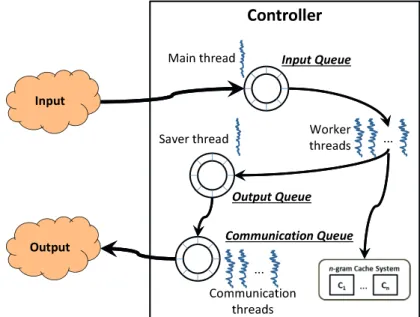
4.4 Controller internal organization . . . 65
4.5 Logical to physical mappings . . . 66
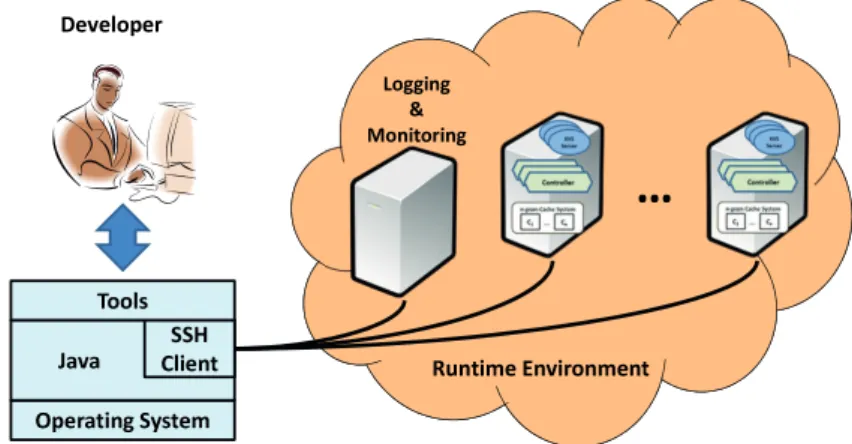
4.6 Developer interacting with the distributed architecture . . . 67
4.7 Development functionalities and architecture layers . . . 68
4.8 Tools launcher for “Workflow Generation” . . . 68
4.9 LocalMaxs settings . . . 69
4.10 Workflow generation . . . 70
4.11 Tools launcher for “Machine Images” . . . 71
4.12 Management of server instances and images using Lunacloud . . . 71
4.14 File copy . . . 72
4.15 Execution of remote commands . . . 73
4.16 Workflow management . . . 73
5.1 Global method tasks and structure . . . 78
5.2 Global method logical workflow forre2···5 . . . 79
5.3 An alternative workflow decomposition for the Global method . . . 80
5.4 Work table and data partitioning within the architecture. . . 83
5.5 Distribution ofn-grams with different hash methods for acorpusof 466 Mw 87 5.6 Subn-grams needed for glue calculation . . . 88 5.7 Distinct subunigrams per machine for acorpusof 466 Mw . . . 89 5.8 Average numbers of subn-grams inDnper machine for acorpussize of 1 Mw 90
5.9 Percentage of distinct subunigrams inD2per machine for differentcorpussizes 91
5.10 Percentage of distinct subbigrams inD3per machine for differentcorpussizes 91
5.11 Percentage of distinct subtrigrams inD4per machine for differentcorpussizes 91
5.12 Messages exchanged between controllers and KVS servers . . . 94
5.13 Phase one multithreaded operations sequence . . . 100
5.14 Phase one problem size and total number of distinctn-gramsvs. corpussize . 102 5.15 Granularity for phase one when using partial local aggregation . . . 105
5.16 Granularity increment for phase one when using partial local aggregation . . 106
5.17 Phase two multithreaded operations sequence . . . 109
5.18 Phase two problem size and total number ofn-gram referencesvs. corpussize 111 5.19 Granularity and efficiency for phase two for a single machine case . . . 112 5.20 Glues needed for relevance evaluation . . . 114
5.21 Phase three multithreaded operations sequence . . . 115
5.22 Phase three problem size and total number ofn-gram referencesvs. corpussize 116
5.23 Time for fetchingn-grams from KVS serversvs.buffer size. . . 119 5.24 Average time for fetchingn-grams and fitting curve. . . 120 5.25 Obtainedtgntimes for gluesg2,g3andg4 . . . 122
5.26 Average obtainedtgn times for gluesg2,g3andg4 . . . 123
5.27 Calculatedtgn for glueg234vs. corpussize. . . 123
5.28 Calculatedtgn forg234whenplateauxare reached . . . 124
5.29 Range of obtainedtgn times for gluesg2up tog7 . . . 125
5.30 Obtainedtgnforg234 vs. corpussize in different execution environments . . . 125
5.31 Obtainedtgnfor different combined glue calculationsvs. corpussize . . . 126
5.32 Granularityvs.buffer size for different miss ratio values . . . 127 5.33 Efficiencyvs.buffer size for different miss ratio values . . . 127
6.1 n-gram cache system . . . 134
6.2 Diagram of a single dynamic cache system . . . 137
L i s t o f F i g u r e s
6.4 Cold miss penalties and global cold miss ratio whenK= 1 forg234 . . . 141
6.5 Cold miss penalties and global cold miss ratio whenK= 1 forg2···6 . . . 141
6.6 Single machine global cold miss penalty and miss ratiovs.combined glue . . 142
6.7 Distinct unigrams and cold miss ratio for cacheC1per machine. . . 143
6.8 Per machine cold miss penalty and global cold miss ratiovs.K . . . 144 6.9 Per machine global cold miss penalty and miss ratiovs.combined glue. . . . 145 6.10 Calculate all glue combined . . . 145
6.11 C1warming-up efficiency by glueg2when calculating glueg3 . . . 147
6.12 Global warm-up efficiency of the cache system for acorpusof 466 Mw . . . . 149 6.13 Warm miss ratio over cold miss ratio of the cache system for acorpusof 466 Mw 150 6.14 Warm miss penalty and global warm miss ratio whenK= 1 forg234 . . . 153
6.15 Single machine global miss penalty and miss ratio — warm and cold . . . 153
6.16 Single machine global warm miss penaltyvs.combined glue . . . 154
6.17 Single machine global warm miss ratiovs.combined glue . . . 155
6.18 Per machine warm miss penalty and global warm miss ratiovs.K . . . 159 6.19 Per machine global miss penalty and miss ratio — warm and cold . . . 159
6.20 Per machine global warm miss penalty and miss ratiovs.combined glue . . . 159 6.21 Cache misses for isolated glueg2 . . . 162
6.22 Cache misses for isolated glueg3 . . . 163
6.23 Cache misses for isolated glueg4 . . . 166
6.24 Per machine global miss ratiovs.K . . . 170 6.25 Per machine miss ratiosvs.number of machines for glueg234 . . . 170
6.26 Per machine miss penalties for glueg234 . . . 171
6.27 Per machine global miss ratio and penaltyvs.combined glues . . . 171
6.28 Average distribution of the per-phase execution times . . . 173
6.29 Phase two execution time reductionvs.total execution time reduction . . . . 174 6.30 Phase two execution time . . . 175
6.31 Phase two relative speedup . . . 176
6.32 Phase two relative efficiency . . . 177 6.33 Phase two relative sizeup . . . 177
6.34 Phase two per machine execution time . . . 178
7.1 Diagram of a single static cache system . . . 182
7.2 Diagram of a static cache system for glueg234 . . . 183
7.3 Individualn-gram coveragesvs. corpussizes . . . 185 7.4 Static global hit ratio for theplateaux . . . 187 7.5 Global hit ratiovs. corpussize . . . 188 7.6 Unigrams FAset for English . . . 192
7.7 Bigrams FAset for English . . . 192
7.8 Trigrams FAset for English . . . 193
7.10 FAset efficiencies for a fixedcorpusof 259 Mw . . . 194 7.11 Bucket stacks for combined glueg234 . . . 195
7.12 FAset algorithm — Evolution of the global hit ratio . . . 199
7.13 FAset algorithm — Ordered list of selected buckets . . . 199
7.14 FAset algorithm — Global sizeFAvs.hROfor acorpusof 466 Mw . . . 201
7.15 FAset algorithm — SizesFA1,FA2andFA3vs.hROfor acorpusof 466 Mw . 201
7.16 FAset algorithm — Ratio|FA|/hROvs.hRO for acorpusof 466 Mw . . . 202
7.17 FAset unigram histograms for acorpusof 466 Mw andhROC
1= 80%. . . 204 7.18 FAset bigram histograms for acorpusof 466 Mw andhROC
2 = 60% . . . 205 7.19 FAset trigram histograms for acorpusof 466 Mw andhROC3= 30% . . . 205 7.20 CacheC1hit ratios for nonsingletons FAset . . . 208
7.21 Global hit ratio for nonsingletons FAset for combined gluesg234 andg2···6 . . 211
7.22 Per machine FAset for unigramsvs.K . . . 212 7.23 Per machine FAset for bigramsvs.K . . . 212 7.24 Per machine FAset for trigramsvs.K . . . 213
7.25 Per machine average static cache misses for acorpusof 64 Mwvs.K . . . 214
7.26 Diagram of a composite static plus dynamic cache system . . . 215
7.27 Diagram of a static plus dynamic cache system for glueg234 . . . 216
7.28 FAset cardinalities and dynamic cache sizes for gluesg2,g3,g4,g234 . . . 218
7.29 Global miss ratio for acorpusof 466 Mw —hROC3 = 30%. . . 219
7.30 Global miss ratio for acorpusof 466 Mw —hROC3= 60%. . . 219
7.31 Global miss ratio for acorpusof 466 Mw —hRO
C3= 90%. . . 220
7.32 Numbers of misses and individual miss ratios forC1,C2andC3vs.K . . . . 223
7.33 Contribution of each individual cache to the global miss ratio . . . 229
7.34 Per machine global miss ratio for glueg234for differentcorpus vs.K . . . 230
7.35 Loading FAset in overlap with the glue calculation . . . 231
7.36 Per machine individual FAset building times for acorpusof 511 Mw . . . 233 7.37 Per machine FAset average building and loading time . . . 234
7.38 Phase two average execution time . . . 236
7.39 Phase two relative speedup . . . 237
8.1 Example of a Bloom filter trained with animal names . . . 241
8.2 Training Bloom filter and checkingn-gram membership . . . 241 8.3 Actions executed to fetch the subn-gram data during glue calculation . . . . 242 8.4 Distinct, singletons, nonsingletons andSFvs. corpussize for unigrams . . . . 246
8.5 Distinct, singletons, nonsingletons andSFvs. corpussize for bigrams . . . . 247
8.6 Distinct, singletons, nonsingletons andSFvs. corpussize for trigrams . . . . 247
L i s t o f F i g u r e s
8.11 Subn-gram singletons evolution. . . 251
8.12 Number of cache entriesvs. corpussize for glueg234 . . . 252
8.13 Number of cache entriesvs. corpussize for glueg2···6 . . . 252
8.14 Nonsingleton ratio for cache sizes for combined gluesg234andg2···6 . . . 253
8.15 Global miss ratiovs. corpussize with Bloom filters . . . 255 8.16 Global and individual miss ratiosvs. corpussize . . . 256 8.17 Granularity and efficiencyvs. corpussize . . . 258 8.18 Sizes of cacheC1up toC5vs.gluesg2tog2···6for acorpusof 64 Mw. . . 260
8.19 Nonsingleton filter ratio for the cache system for acorpusof 64 Mwvs.glues 262 8.20 Per machine individual cache miss ratiosvs.glues for acorpusof 64 Mw . . . 263 8.21 Per machine global miss ratio for acorpusof 64 Mw and glueg234. . . 264
8.22 Phase two execution time for acorpusof 64 Mw and glueg2···6 . . . 265
8.23 Detailed execution time using Bloom filters for acorpusof 64 Mw and glueg2···6 265
8.24 Diagram of a static plus dynamic plus Bloom filter cache system . . . 266
8.25 Global miss ratio reduction by filtering the singletonn-grams . . . 267
9.1 Controllern-gram aggregation tables . . . 273 9.2 Average pern-gram byte costvs. corpussize . . . 275 9.3 Memory usage evolution forre2···6 . . . 280
9.4 Memory usage reduction due to Bloom filter forre2···6 . . . 281
9.5 Average total heap memory per machine . . . 282
9.6 Cache configurations comparison . . . 283
9.7 Global method efficiency . . . 288 9.8 Problem size ratios of the three phases of the LocalMaxs Global method . . . 289
9.9 Phase one execution time over phase two execution time . . . 290
9.10 Detail of phase one execution timevs.phase two execution time . . . 290 9.11 Speedup of the Global method forre2···5vs.K . . . 291
9.12 Global method total execution time forre23in environments A and B . . . . 296
9.13 Global method relative speedup forre23in environments A and B . . . 296
9.14 Detail of Global method relative speedup forre23in environment A . . . 297
9.15 Detail of Global method relative speedup forre23in environment B . . . 298
9.16 Global method relative efficiency forre23in environments A and B . . . 299 9.17 Global method relative sizeup forre23in environments A and B . . . 299
9.18 Three-phase per machine execution time — Environment B . . . 300
9.19 Local method logical workflow . . . 301
9.20 Local method granularity and efficiency forre23. . . 303 9.21 Local method granularity and efficiency forre2···5 . . . 303 9.22 Speedup of the Local method forre2···5 . . . 305
9.23 Local method metrics obtained by union of partition results . . . 307
9.24 Dimensions involved . . . 308
L i s t o f Ta b l e s
2.1 Subn-grams for“European Court of Human Rights” . . . 15
3.1 Corporassets used . . . 27 3.2 Number of distinctn-gramsvs. corpussize for the English language . . . 35 3.3 Number of distinctn-gramsvs. corpussize for the French language . . . 36 3.4 Bestα,β,|ν|andp1for the Englishcorpora . . . 36
3.5 Bestα,β,|ν|andp1for the Frenchcorpora . . . 37
3.6 Relative errors of the estimated number for English. . . 37
3.7 Relative errors of the estimated number for French . . . 37
3.8 Plateauvalues for distinct Englishn-grams and correspondingcorpussizes . 40
3.9 Plateauvalues for distinct Frenchn-grams and correspondingcorpussizes . . 41
3.10 Ratio|Di|/|C|vs. corpussize for the English language . . . 42
3.11 Relative errors of the estimated numbers with the same frequency for English 46
3.12 Relative errors of the estimated numbers with the same frequency for French 46
5.1 Distribution of unigrams across four KVS servers . . . 85
5.2 Distribution of bigrams across four KVS servers . . . 85
5.3 Distribution of trigrams across four KVS servers . . . 85
5.4 Distribution of tetragrams across four KVS servers . . . 85
5.5 Subn-grams and corresponding KVS server identifier using hash methodh1 86
5.6 Subn-grams and corresponding KVS server identifier using hash methodh3 86
5.7 Phase one problem size and total number of distinctn-grams . . . 102 5.8 Granularity for phase one when using partial local aggregation . . . 105
5.9 Granularity increment for phase one when using partial aggregation . . . 107
5.10 Glue references . . . 108
5.11 Phase two problem size and total number of subn-gram references. . . 111
5.12 Phase three problem size and total number ofn-gram references . . . 116
5.13 Polynomials factors fortf etchfitting curves . . . 120
5.14 Number of distinctn-grams for thecorporaused in the determination oftgn . 122
5.15 Values oftgn for different execution environments. . . 124
5.16 Influence of the miss ratio on the granularity and efficiency . . . 126
6.2 Individual cache cold miss ratios for each isolated glue calculation (K= 1) . 139 6.3 Global miss ratiosColdStart/N oCachewhenK=1 . . . 151 6.4 Global miss ratiosW armStart/ColdStartwhenK = 1 . . . 152 6.5 Comparison ofN o−cache/Cold−start/W arm−startcaches for a 466 Mwcorpus 156 6.6 Memory configurations used per machine . . . 160
6.7 Miss ratio forg2 . . . 162
6.8 Per machine miss ratios forg3 . . . 164
6.9 Per machine miss ratios forg23 . . . 165
6.10 Per machine global miss ratio forg23 . . . 165
6.11 Per machine miss ratios forg4 . . . 167
6.12 Per machine miss ratios forg234 . . . 168
6.13 Per machine global miss ratio forg234 . . . 169
6.14 Measured phase two total execution times and time ratio . . . 172
6.15 Phase two warm miss ratiovs.K for a fixedcorpussize of 466 Mw andg234 . 173
6.16 Execution time in environment B in minutes . . . 175
7.1 Distinctn-grams and coverages for differentcorpus . . . 186 7.2 Hypothetical table of distinct unigrams for an hypotheticalcorpus . . . 191 7.3 Hypothetical table of distinct bigrams for an hypotheticalcorpus . . . 191
7.4 Algorithm results for acorpusof 466 Mw and glueg234 . . . 200
7.5 Number of distinctn-grams for thecorporaanalyzed . . . 221
7.6 Per machine FAset sizesvs.K for acorpusof 64 Mw . . . 224 7.7 Number of hit and miss percentages for isolated glues and acorpusof 511 Mw 225 7.8 Number of hit and miss percentages for combined glue and acorpusof 511 Mw 228 7.9 Per machine global miss ratio for glueg234for differentcorpus vs.K . . . 230
7.10 Per machine FAset average building time . . . 233
7.11 Per machine average time of phase two . . . 235
7.12 Per machine average execution time for phase two . . . 236
8.1 Distinct, singletons, nonsingletons andSFvs. corpussize for unigrams . . . . 246 8.2 Distinct, singletons, nonsingletons andSFvs. corpussize for bigrams . . . . 247 8.3 Distinct, singletons, nonsingletons andSFvs. corpussize for trigrams . . . . 248 8.4 Distinct, singletons, nonsingletons andSFvs. corpussize for tetragrams . . . 248
8.5 Distinct, singletons, nonsingletons andSFvs. corpussize for pentagrams . . 249
8.6 Distinct, singletons, nonsingletons andSFvs. corpussize for hexagrams . . . 250 8.7 Global miss ratiovs. corpussize with Bloom filters . . . 255 8.8 Individual cache warm miss ratiovs. corpussize without Bloom filters . . . . 256 8.9 Individual cache warm miss ratiovs. corpussize with Bloom filters . . . 257 8.10 Per machine distinct, singletons, nonsingletons andSF observed . . . 260
8.11 Per machine average of observed individual cache sizes . . . 260
L i s t o f T a b l e s
8.13 Per machine obtained global miss ratios for combined glues . . . 263
9.1 Size in bytes of the primitive types in Java . . . 274
9.2 n-grams sizes for the different phases and server tables . . . 274 9.3 Average pern-gram byte costvs. corpussize . . . 275
9.4 Memory space estimatesvs. corpussize . . . 277 9.5 Average total heap memory per machine . . . 282
9.6 Cache alternatives — Miss ratio and size . . . 285
9.7 Cache alternatives — Examples . . . 285
9.8 Efficiency and speedup of the Global method forre2···5 . . . 292 9.9 Memory configurations used per machine in environment B . . . 294
9.10 Global method execution time in environment A forre23. . . 294
9.11 Global method execution time in environment B forre23 . . . 295
9.12 Local method granularity and efficiency forre23andre2···5 . . . 304 9.13 Efficiency and speedup of the Local method forre2···5 . . . 305
C.1 Per machine FAset sizesvs.K for acorpusof 128 Mw . . . 339
C.2 Per machine FAset sizesvs.K for acorpusof 256 Mw . . . 339 C.3 Per machine FAset sizesvs.K for acorpusof 511 Mw . . . 339 C.4 Number of hit and miss percentages for isolated glues,corpusof 64 Mw (K=3) 340 C.5 Number of hit and miss percentages for isolated glues,corpusof 64 Mw (K=6) 340 C.6 Number of hit and miss percentages for isolated glues,corpusof 64 Mw (K=9) 341 C.7 Number of hit and miss percentages for isolated glues,corpusof 64 Mw (K=12) 341
C.8 Number of hit and miss percentages for isolated glues,corpusof 64 Mw (K=18) 342 C.9 Number of hit and miss percentages for isolated glues,corpusof 128 Mw (K=6) 342 C.10 Number of hit and miss percentages for isolated glues,corpusof 128 Mw (K=9) 343
C.11 Number of hit and miss percentages for isolated glues,corpusof 128 Mw (K=12)343 C.12 Number of hit and miss percentages for isolated glues,corpusof 128 Mw (K=18)344 C.13 Number of hit and miss percentages for isolated glues,corpusof 256 Mw (K=12)344
L i s t i n g s
8.1 Pseudo code to fetch subn-grams . . . 242
A.1 Structure of ParLocalMaxs configuration file . . . 329
G l o s s a r y
C Corpus.
Ci Individual cache forn-grams of sizei.
DAll(1···n)inLocalPartition Set of distinctn-grams from sizes 1 up tonin a local partition. DAll(1...n)inC Set of distinctn-grams from sizes 1 tonin thecorpus.
Di Set of distinctn-grams of sizei.
DiinDn Set of distinctn-grams of sizeiin tableDn.
Diinallgluegn Ref Set of distinct n-grams of size i within the input reference stream
allgluegnRef.
E0 Absolute efficiency relative to an ideal sequential machine. EK1→K2 Relative efficiency when going fromK1toK2machines.
G Granularity ratio of the computation time over the total overheads time.
K Number of machines.
N SAll(1...n)inC Set of nonsingletonn-grams from sizes 1 tonin thecorpus. N Si Set of nonsingletonn-grams of sizei.
Nn Problem size.
Ri Average repetition factor ofn-grams of sizei.
SAll(1...n)inC Set of singletonn-grams from sizes 1 tonin thecorpus. Si Set of singletonn-grams of sizei.
SetAlli Set of all occurrences ofn-grams of sizei.
Sp0 Absolute speedup relative to an ideal sequential machine. SpK1→K2 Relative speedup when going fromK1toK2machines.
Tcomm Time for intermediate communications during the execution of the
Lo-calMaxs method.
Tcomp Computation time of the LocalMaxs functions with no overheads. allΩiRef Set of remote references for applying the LocalMaxs relevance criterion
ton-grams of sizei.
allgluegnRef Set of remote references needed for glue calculationgn.
gi Glue calculation function (also used to denote the set of glue values of
gn1...n2 Glue calculation function (also used to denote the set of glue values for then-grams of sizen1up to and includingn2).
hRO Hit ratio of static cache.
hRO+RW Hit ratio of a composite static plus dynamic cache. hRW Hit ratio of a dynamic cache.
mr Miss ratio of the cache. mrCold Cold-start miss ratio. mrRO Miss ratio of a static cache.
mrRO+RW Miss ratio of a composite static plus dynamic cache. mrRW Miss ratio of a dynamic cache.
mrW arm Warm-start miss ratio.
re2···n Relevance evaluation function (also used to denote the set of relevant
expressions of bigrams up ton-grams of sizen).
tn−gram Average time for sending or fetching ann-gram to/from the KVS
ser-vers.
Ac r o n y m s
Amazon S3 Amazon Simple Storage Service. Amazon AWS Amazon Web Services.
API Application Program Interface.
AWARD Autonomic Workflow Activities Reconfigurable and Dynamic.
BATON BAlanced Tree Overlay Network.
CAN Content Addressable Network.
CN Computing Node.
CPU Central Processing Unit.
DASS Data Access Storage Service.
DBMS Database Management System.
DHT Distributed Hash Table.
Ew Exaword (1018).
FAset Fixed Frequency Accumulation Set.
Gn−gram Gigan-gram (109).
GB Gigabyte (109).
Gw Gigaword (109).
HDFS Hadoop Distributed File System.
HTML HyperText Markup Language.
IBS Input Buffer Size.
JVM Java Virtual Machine.
KVS Key-Value Store.
MPI Message Passing Interface.
Mw Megaword (106).
NFS Network File System.
OpenMP Open Multi-Processing.
P2P Peer-to-peer.
PB Petabyte (1015).
Pw Petaword (1015).
RMI Remote Method Invocation.
SCP Secure Copy Program.
SSH Secure Shell.
Tn−gram Teran-gram (1012).
TB Terabyte (1012).
AC R O N Y M S
Tw Teraword (1012).
vCPU virtual CPU.
VM Virtual Machine.
P
a
r
t
C
h
a
p
t
e
r
1
I n t r o d u c t i o n
The building of scalable solutions for enabling data-intensive applications, as found in science and engineering or in business data analytics, for example in Web applications and social networking sites, requires capabilities to provide relevant information to users and applications. Due to such huge amount of generated infor-mation, there is a need for methods, algorithms and tools that enable an automatic identification and extraction of relevant expressions from documents, so that their analysis and processing are made feasible.
1.1 Objectives
Importance of Extraction Methods. Document descriptors can be built automatically from their most relevantn-grams, contributing to guide a more focused search. In the context of this work ann-gram is a sequence ofn consecutive words, wheren is then -gram size. An expression or term is ann-gram with a defined morphological class. As
the number of Internet users and applications grows, the volume of generated and stored data is increasing very rapidly. Due to such huge amount of generated information, there is a need for methods, algorithms and tools that enable an automatic identification and extraction of relevant expressions from documents, so that their analysis and processing are made feasible. This is only possible by relying on parallel and distributed computing, with access to large numbers of processors and massive storage capabilities.
The automatic extraction of relevant expressions from raw text is an area of great inte-rest. Relevant expressions can be extracted by different approaches: symbolic/linguistic,
Challenges Regarding the Extraction of Relevant Expressions. The extraction of rele-vant expressions involves several challenges and difficulties encompassing, on one hand,
general issues concerning the extraction approaches and their practical validation. For example, how to deal with the complexity of interpreting and detecting the significant terms or expressions (based on syntactic, semantic, statistical or hybrid methods); how to meet the increasing need of dealing with a diversity of different languages, and
con-ciliating this with favoring neutral approaches as happens with statistical-based ones, but also enabling specific domain and semantic interpretations; and how to integrate automatic extraction and user interaction tools to validate the obtained results. On the other hand, in the last decade, due to the rapid growth of Internet information systems and applications, there have been increasing concerns with large-scale data extraction issues, and the need to deal with the diversity of Internet access media and the growing amount of generated information, for example in Web and social networking applications. Those concerns led to an increased interest in the investigation of solutions to address the large scale of generated information and its dynamics, the need of filtering the raw information using knowledge based on the application domain and the user profiling in order to extract relevant information, and devising efficient solutions to process such
large scale of information in acceptable time and memory space.
Problem Description. In this dissertation we propose solutions to the extraction of relevant expressions, up to hexagrams, from largecorpora, using parallelism to reduce the execution time and distribution to handle large data sets. The investigation is cente-red on the LocalMaxs method but can also be applied to other extraction methods and applications based on n-gram models. The proposed solutions (to the extraction of re-levant expressions) must accomplish an adequate trade-offbetween execution time and
solutions quality, defined in terms of the precision and recall metrics, and computing resources/cost.
LocalMaxs [SL99;Sil+99] is a statistical method, thus language-independent, capable of extracting relevant expressions of a given size from a givencorpus, based on a cohesion
(also named “glue” in this document) metric and a relevance criterion. It relies on an exhaustive approach based on counting all occurrences of then-grams in acorpus. In the context of this work we use the expressions “number of occurrences of ann-gram in the
corpus” or “frequency of ann-gram in thecorpus” as equivalent. The typical precision
and recall achieved by this method are around 75 % [SL99] when consideringn-grams
up to hexagrams, but to achieve these values it requires a documentcorpusof at least 1
Megaword (106) (Mw)as reported in [SL99]. However, its sequential implementations pose limitations in terms of execution time and memory consumption, being unable to process largecorpora, typically beyond a few hundred million words [SL99].
Considered Approaches. We assume that thecorporabeing analyzed are located in an
1 . 1 . O B J E C T I V E S
the entire extraction process. Issues concerning geographical data distribution as well as dynamic and continuous data generation in data streaming systems, although important, are left out of the scope of this dissertation.
We developed an approach to support extraction methods, which are based on a first phase collectingn-gramcorpus statistics, followed by other phases to execute different
methods for calculating the relevance ofn-grams by applying specific filtering criteria. An
entire application can process a given inputcorpusas a single shot batch job, or any of its individual phases can be executed on its own. For example, after the first phase, multiple independent analyses can be performed based on the n-gram statistics describing the corpuscharacteristics.
The functionality to support the sequencing and execution of the application phases and the storage of the intermediate n-gram data is provided by a generic distributed
architecture forn-gram based extraction. It relies on a collection of distributed machines that supports the parallelization of the extraction functions and the distribution of then
-gram data. This architecture was instantiated to support the execution of the LocalMaxs functions with their associatedn-gram data structures.
Issues regarding the memory space efficiency of then-gram data representation raise
an important concern that can influence the overall performance of an algorithm imple-mentation. This has been intensively studied in related works as mentioned in chapter2, but it was left out of the scope of this dissertation, because our main goal was to study the influence of alternative parallel and distributed processing approaches to implement relevantn-gram extraction based on LocalMaxs.
When considering each specific computing infrastructure there is a limit to the num-ber of available machines and to the maximum per machine available memory. This poses a constraint upon the maximum size of thecorporaand the maximumn-gram size
that can be processed by the proposed architecture, so that the total memory required by each phase of the algorithm may fit into the total aggregated memory of the collection of available machines. If a more efficientn-gram representation is used instead, the above
size constraint will occur at slightly highercorpussizes than with the currently developed
implementation, but eventually it will also occur beyond a certaincorpusscale.
However, from the conducted experimentation for the range of analyzedcorpora, the
above memory/machine constraint did not preclude the demonstration of the usefulness of the proposed approaches as far as parallelism and distribution are concerned. Furt-hermore, per machine local memory optimizations can be applied orthogonally to the proposed parallel and distributed architecture.
to the LocalMaxs definition, and also allows a data-parallel approach but has a reduced communication volume (compared to the Global method) that improves its performance and scalability.
The two methods are evaluated regarding a trade-offbetween the solutions quality
(precision and recall) compared to the LocalMaxs definition and the system performance (execution time, memory space, parallel efficiency, scale), in a broad spectrum ofcorpus
sizes andn-gram sizes.
1.2 Contributions and Main Results
The main contributions of this thesis are discussed in detail in chapters3to9. They are briefly identified in the following:
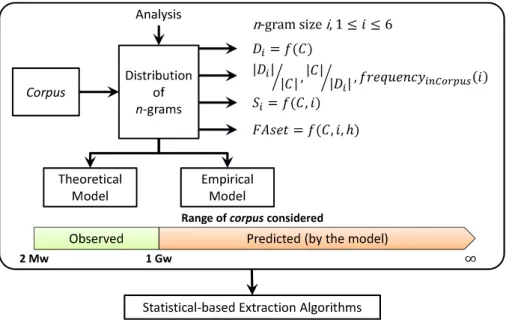
Statisticaln-gram Distribution in Natural Languagecorpora. We conducted an ana-lysis of the statistical distribution of n-grams in natural language corporaand applied
it to understand the behavior of the alternative parallel LocalMaxs implementations, in-cluding the design and analysis of ann-gram cache. Three dimensions were considered: i) An empirical analysisof then-grams distribution, from unigrams to hexagrams, in
corporaup to 1 Gigaword (109) (Gw), that was used as input to an analytical model of
the behavior of the parallel LocalMaxs implementations; ii)A theoretical modelfor ef-ficiently estimating the number of distinct unigrams, bigrams, ..., hexagrams, for any
corpussize, based on Zipf-Mandelbrot Law and Poisson distribution. It was used to
esti-mate the asymptotic behavior of the parallel LocalMaxs implementations for very large
corporawhen the numbers of distinctn-grams tend to constantplateauxas thecorpussize
increases beyond well-identified thresholds; iii)The concept ofFixed Frequency Accu-mulation Set (FAset), to model the cumulative sum of frequencies of a set of distinct
n-grams that represents a percentage of the totaln-gram occurrences in acorpus. This
is useful to determine the minimaln-gram subset necessary to ensure a desired corpus
coverage, identifying the culpritn-grams which should be kept in ann-gram cache, and also guiding possible cache prefetching and replacement strategies;
A Distributed Architecture forn-gram Extraction Applications with Multiple Phases. This distributed architecture is capable of executing extraction algorithms based on statis-ticaln-gram models on cluster- or cloud-based infrastructures. It is based on a distributed
collection of virtual machines: i) Each machine contains one or multiplecontroller pro-cesses to execute the algorithm functions, and one or multiple servers to contain tables withn-gram information; ii) The servers collectively implement adistributed in-memory key-value storesupporting the intermediaten-gram data shared between multiple
appli-cation phases; iii) Each machine contains ann-gram cache system, exploiting the locality and the statistical knowledge on then-gram references to reduce the volume of remote
1 . 3 . M E T H O D O LO G Y
execution of extraction applications with multiple phases and the mapping of the appli-cation components into the virtual machines supported by the underlying computing infrastructures.
Parallel and Distributed LocalMaxs Implementations. Two main approaches were considered. One is based on a global method (denoted as Global method) which ensures the same precision and recall as the LocalMaxs method definition. Its implementation, based on the above distributed architecture, exhibits almost linear relative speedup and sizeup, when executed in a public cloud environment with up to 54 virtual machines, for the extraction of relevant bigrams and trigrams from Englishcorporaup to 1Gw. A
theoretical analysis of the Global method behavior predicts that the above performance metrics exhibit the same linear evolution even beyondcorpussizes of 1Gw.
The other approach is based on a local method (denoted as Local method) whose precision and recall tend to be lower than LocalMaxs, but they tend to increase with
thecorpuspartitions size. Its performance (execution time and scalability) and solutions
quality (precision and recall) are evaluated and compared to the Global method, for the consideredcorpusranges up to 1Gwand also estimated for largercorpussizes.
Study of the n-gram Cache Behavior. To reduce the remote data communication, a noveln-gram cache system, composed of a set of individual caches for differentn-gram
sizes, was designed and implemented. Then-gram cache system can be configured as an on-demand dynamic cache with a cooperative-based warm-up strategy leading to reduce the miss ratio and miss time penalty; or it can also be configured as a static prefetching cache based on theFAsetconcept, leading to further reductions in the miss ratio. Both cache configurations can be complemented with an integrated Bloom filter to select the singletonn-grams existing in thecorpus.
A cache analytical model was proposed to estimate the performance of the Global method, considering cache cold-start and cache warm-up scenarios, for the glue calcu-lation ofn-gram expressions, based on thecorpusempirical data. The model estimates
agree with the real execution results. The model was also used to predict the n-gram cache behavior for the very largecorporaasymptoticplateaux. The implementation can
be configured to support a finite or infiniten-gram cache, depending on each algorithm
memory requirements for eachcorpus size and according to the available memory per machine.
1.3 Methodology
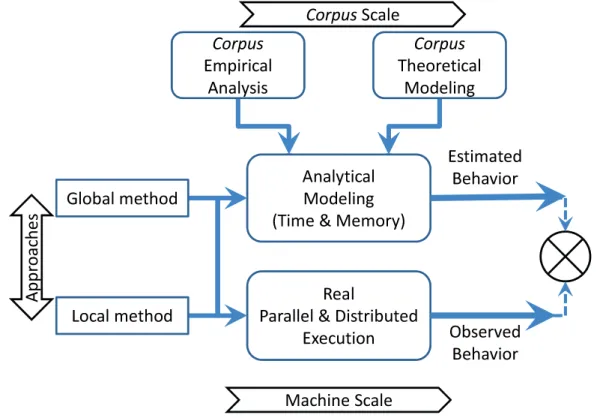
Figure1.1illustrates the main dimensions of the methodology that guided this work. The results of the analysis of the statistical distribution ofn-grams in natural lan-guage corporawere provided as input to an analytical performance model to estimate
!
"
"
#
$
%
&
'
(
)*+,-.
)*+,-.
/
0
1
)*+,-.!
Figure 1.1: Methodology followed.
corpussize, then-gramsize, and the number of machines. This analysis was based on the
empirical data for thecorporasizes up to 1Gw, and was based on the theoretical model to identify the asymptotic behavior of then-gramdistribution for very largecorpora. The
analytical performance model estimates were then compared to the real execution results, obtained from a parallel and distributed implementation of each approach.
1.4 Publications
The following publications resulted from the work done in the context of this dissertation.
1. J. F. Silva, C. Gonçalves, and J. C. Cunha,“A Theoretical Model for n-gram
Distribu-tion in Big Data Corpora”. In 2016 IEEE International Conference on Big Data (IEEE
Big Data 2016), December 2016, pp. 134—141. doi:10.1109/BigData.2016.7840598
2. C. Gonçalves, J. F. Silva and J. C. Cunha,“An n-gram Cache for Large-scale Parallel
Extraction of Multiword Relevant Expressions with LocalMaxs”. In 12thIEEE
Interna-tional Conference on eScience (eScience 2016), October 2016, pp. 120—129. doi: 10.1109/eScience.2016.7870892
3. C. Gonçalves, J. F. Silva and J. C. Cunha, “A Parallel Algorithm for Statistical
Multiword Term Extraction from Very Large Corpora”. In 17th IEEE International
1 . 5 . D O C U M E N T O R GA N I Z AT I O N
4. C. Gonçalves, L. Assunção, and J. C. Cunha. “Flexible MapReduce Workflows for
Cloud Data Analytics”. In International Journal of Grid and High-Performance
Com-puting (IJGHPC), Special Issue on Cloud ComCom-puting - Algorithmic, Experimental, Prototyping and Implementation, vol. 5, no. 4, pp. 48—64, October-December 2013. ISSN 1938-0259. doi: 10.4018/IJGHPC
5. C. Gonçalves, L. Assunção, and J. C. Cunha. “Data Analytics in the Cloud with
Flexible MapReduce Workflows”. In 4th IEEE International Conference on Cloud
Computing Technology and Science (CloudCom 2012), pages 427—434. IEEE Com-puter Society, December 2012. doi:10.1109/CloudCom.2012.6427527
6. L. Assunção, C. Gonçalves, and J. C. Cunha. “Autonomic Workflow Activities: The
AWARD Framework”. In International Journal of Adaptive, Resilient and Autonomic
Systems (IJARAS), vol. 5, no. 2, pp. 57—82, April-June 2014. ISSN 1947-9220. doi: 10.4018/IJARAS
7. L. Assunção, C. Gonçalves, and J. C. Cunha.“Autonomic Activities in the Execution
of Scientific Workflows: Evaluation of the AWARD Framework”. In 9th International
Conference on Autonomic Trusted Computing (ATC 2012), pages 423 –430. IEEE Computer Society, September 2012. doi: 10.1109/UIC-ATC.2012.14
8. L. Assunção, C. Gonçalves, and J. C. Cunha.“On the Difficulties of Using Workflow
Tools to Express Parallelism and Distribution - A Case Study in Geological Sciences”
(GPC 2009), pages 104—110. In International Workshop on Workflow Management of the International Conference on Grid and Pervasive Computing, IEEE Computer Society, 2009. doi: 10.1109/GPC.2009.30
1.5 Document Organization
Figure1.2shows the organization of this document in 5 parts. PartI,Introduction and Background, is composed of this chapter and chapter 2 that briefly surveys the back-ground and related work. PartII,n-gram Statistical Distribution, is composed of chap-ter3, where we analyze the statistical distribution ofn-grams in natural languagecorpora.
PartIII,Parallel and Distributedn-gram Extraction, is divided in two chapters: 4and
5describing a distributed architecture forn-gram extraction and the implementation of the LocalMaxs Global method. PartIV,n-gram Cache Models, is presented in chapters
6to8, namely: chapter6describes a dynamicn-gram cache system; chapter7presents
ann-gram cache system composed of a static cache followed by a dynamic one; chapter8
describes the influence of filtering the singletonn-grams out of the cache system
used in the developed architecture; andC, containing complementary data for the static plus dynamic cache system.
[.pdf 3 – Modeling and Analysis of Statistical Distribution of n-grams in Natural Language corpora
II –n-gram Statistical Distribution
4 – Distributed Architecture for n-gram Extraction
5 – A Global Method for Statistical Extraction based on LocalMaxs III – Parallel and Distributed n-gram Extraction
10 – Conclusions and Future Work V – Global Evaluation
1 – Introduction 2 – Background
I – Introduction and Background
6 – An n-gram On-demand Fetch Dynamic Cache System for LocalMaxs IV –n-gram Cache Models
7 – Static Cache Prefetching in LocalMaxs based on Fixed Frequency Accumulation Sets
8 – Filtering n-gram Singletons in LocalMaxs Using Bloom filters
9 – Evaluation of the Parallel and Distributed LocalMaxs Implementations
C
h
a
p
t
e
r
2
Ba c k g r o u n d
This chapter discusses background and related work in the context of this thesis.
The main goal of this thesis was to developparallel and distributedsolutions in order to improve the execution performance of computational methods for statistical-based extraction of relevant expressionsinnatural languagecorpora. The focus of this work lies on the intersection of the areas represented in Figure2.1.
The extraction of relevant expression in natural languagecorporais related to the data
mining area in the sense that it involves the process of finding meaningful patterns in data and present those patterns to the end users. Because of the complexity of those
Text Mining
Natural Language Processing
Relevant Expressions Extraction
Parallel and Distributed Processing
problems it is common that data mining uses methods and tools from different domains
such as computer science, statistics and mathematics (section2.1).
Furthermore, due to the large amount of data typically involved in the actual Internet information systems and applications related to the field commonly referred to as Big Data, one of the important issues to be addressed is the capability to analyze large scale data in a timely manner, requiring the usage of extensive computing resources made available through parallel and distributed infrastructures (section2.2).
The thesis encompasses the development of parallel implementations of the statistical-based extraction method LocalMaxs in distributed cluster and cloud computing infra-structures, and the study of their execution performance behavior concerning the parallel speedup and scale.
2.1 Extraction in
Corpus
Mining
In this section a succinct discussion of the approaches for extraction of relevant expression in natural languagecorporais first presented (section2.1.1) including the description of
ann-gram based statistical extraction method, LocalMaxs (section2.1.2).
2.1.1 Extraction of Relevant Expressions
Terminology mining, term extraction, term recognition, glossary extraction or relevant expression extraction are terms denoting a subtask of information extraction. The goal of extractors is to automatically identify relevant expressions from a givencorpus.
One of the difficulties of extracting relevant expressions using statistical approaches
is the quantity of data that must be processed to obtain good precision and recall, i.e., correctly identify ann-gramas a valid relevant expression (for good precision), and extract
the greatest possible amount of existing relevant expression (for good recall). Precision, also called positive predictive value, can be defined as:
precison=number of Relevant Expressions correctly identified by the Algorithm
number of Relevant Expressions identified by the Algorithm (2.1)
and recall, also known as sensitivity, can be defined as:
recal=number of Relevant Expressions correctly identified by the Algorithm
number of Relevant Expressions in the corpus (2.2)