Pedro Manuel Saraiva Cardoso
Licenciado em Engenharia do Ambiente
Wastewater Treatment and Energy
Valorisation in Small Wastewater Treatment
Plants
Dissertação para obtenção do Grau de Mestre em
Bioenergia
Orientador: José Filipe Santos Oliveira, Professor Catedrático,
Faculdade de Ciências e Tecnologia, Universidade Nova de
Lisboa.
Co-orientador: João Fernando Pereira Gomes, Professor
Coordenador, Instituto Superior de Engenharia de Lisboa.
Júri:
Presidente: Prof. Doutora Benilde Simões Mendes Arguente(s): Prof. Doutor Santino Eugénio Di Berardino
Vogal(ais): Prof. Doutor Nuno Lapa
Wastewater Treatment and Energy Valorisation in Small Wastewater Treatment Plants
Direitos de Autor © Pedro Manuel Saraiva Cardoso Faculdade de Ciências e Tecnologia
Universidade Nova de Lisboa
Acknowledgements:
I want to express my sincere gratitude to Professor Santos Oliveira and Professor João Gomes for all motivation, technical support and references, during all my academic and professional development.
I want to show also my appreciation for all persons that I contacted and worked during the presented work, namely to Ing. Ana Alegria and Ing. Mónica Morais from SMAS de Sintra, Dr. Susana Perez and Dr. Mikel Belsue from INASMET, Ing. Norberto Duarte, Ing. Rui Braz, Ing. Catarina Gonçalves and Ing. Dinis Rodrigues from ISQ.
Abstract:
This dissertation aims to find ways to improve environmental and energy performances of three small wastewater treatment plants (WWTP). These WWTP, placed in Sintra municipality, were case studies for the identification of corrective measures and solutions in order to improve their environmental and energy performance. The settings of these three WWTP was obtained by an audit exercise, performed under a specific methodology for small WWTP. After this assessment were proposed corrections and solutions for all identified improvement opportunities.
Were also discussed solutions for the treatment of sewage sludge, due to the actual problems resulted by its disposal and to take advantage of its energy valorisation potential. Was presented as case study, a sludge thermal treatment and its energy valorisation by gasification. This specific case study was occurred in a pilot gasification reactor in San Sebastian, Spain.
Another theme discussed on this dissertation was the possibility to provide energy autonomy for small and isolated WWTP using renewable energies, in this specific case, wind energy. Was studied the wind availability and pattern, for the region of Magoito, where Magoito WWTP is placed. This study was supported by Wasp software, analysis of meteorological databases for the region and by the collection of data provided by an on-site a meteorological station, placed on Magoito WWTP.
The state of the art on wastewater treatment technologies and sludge treatment and valorisation, for small WWTP, was also compiled, as well as an overview of the main Portuguese and European legislation and European policies on this subject.
Resumo:
Esta dissertação pretende de encontrar possibilidades de melhoria de desempenho ambiental e energético de três Estações de Tratamento de Águas Residuais (ETAR). Estas ETAR situam-se no Município de Sintra, e serviram de caso de estudo para a identificação de medidas corretivas e soluções que melhorassem o seu desempenho ambiental e energético.
As condições de funcionamento destas ETAR foram obtidas através de exercícios de auditoria cuja metodologia foi desenvolvida para se adaptassem corretamente á realidade das pequenas ETAR. Em consequência destas auditorias foram propostas medidas corretivas e soluções para todas as oportunidades de melhoria identificadas.
Também foram discutidas soluções para o tratamento das Lamas de ETAR, devido aos atuais problemas relacionados com o seu encaminhamento para destino final e para explorar o seu potencial de valorização energética. Foi apresentado como caso de estudo o tratamento térmico destas lamas e a sua valorização energética, por via da gasificação. Este caso de estudo específico ocorreu num gasificador piloto, em San Sebastian, Espanha.
Outro tema abordado nesta dissertação foi a possibilidade de tornar autónomas, do ponto de vista energético, pequenas ETAR que se encontrem isoladas ou em localizações remotas, utilizando energias renováveis e neste caso especifico energia eólica. Foram estudados a disponibilidade e o padrão dos ventos dos ventos, na região do Magoito, onde se situa a ETAR do Magoito. Este estudo foi obtido com recurso ao programa Wasp, análise de dados meteorológicos disponíveis para a região em estudo e através da compilação de dados provenientes de uma estação metrológica, colocada na ETAR do Magoito, para esse efeito.
Também foi compilado o estado da arte nas tecnologias de tratamento de água e lamas para pequenas ETAR, bem como um apanhado da principal legislação Portuguesa e Europeia e políticas europeias, para este setor.
Table of Contents:
1. Legislation overview ... 1
1.1.
European legislation on wastewater ... 1
1.2.
European legislation on sewage sludge ... 2
1.2.1.
Sewage sludge Directive ... 2
1.2.2.
Legislation compliance ... 3
1.3.
Portuguese legislation on wastewater ... 5
1.4.
Portuguese legislation on sludge ... 9
1.5.
Municipal wastewater drainage
–
SMAS de Sintra regulations ... 10
2. Portuguese chronological water policies ... 13
2.1.
Evolution of the strategy and planning in the water sector ... 13
2.2.
Recent statistic data ... 15
2.3.
Overview of wastewater treatment in Portugal ... 15
2.4.
Sludge production in Portugal ... 17
3. Best available WWT technology for small populations (up to 5.000 population equivalents) ... 19
3.1.
Traditional intensive techniques ... 19
3.1.1.
Biological filters ... 19
3.1.2.
Rotating Biological Contactors (Bio-Disks) ... 19
3.1.3.
Activated Sludge
–
Extended Aeration ... 19
3.2.
Extensive Techniques: ... 20
3.2.1.
Fixed Film Cultures on Small Media ... 20
3.2.2.
Infiltration-Percolation through Sand ... 20
3.2.3.
Vertical Flow Reed Bed Filters ... 20
3.2.4.
Horizontal Flow Reed Bed Filters ... 21
3.2.5.
Suspended Growth Cultures ... 21
3.2.6.
Natural Lagoons (Stabilization Ponds) ... 21
3.2.7.
Macrophytes Lagoons ... 21
3.2.8.
Aerated Lagoons ... 21
4. Case Study of SMAS de Sintra WWTP ... 23
4.1.
Magoito WWTP ... 23
4.1.1.
Pre-treatment ... 26
4.1.2.
Primary Treatment ... 27
4.1.3.
Secondary Treatment ... 27
4.1.5.
Sludge treatment ... 30
4.1.6.
Equipment ... 31
4.1.7.
Sensors and alarms ... 32
4.1.8.
Plant Efficiency and optimisation potential ... 32
4.1.9.
Recommendations... 33
4.2.
Almoçageme WWTP ... 34
4.2.1.
Pre-treatment ... 37
4.2.2.
Primary Treatment ... 37
4.2.3.
Secondary Treatment ... 38
4.2.4.
Sludge treatment ... 39
4.2.5.
Equipment ... 40
4.2.6.
Sensors and alarms ... 41
4.2.7.
Plant efficiency and optimisation potential ... 41
4.2.8.
Recommendations... 41
4.3.
Vila Verde WWTP ... 42
4.3.1.
Pre-treatment ... 45
4.3.2.
Primary treatment ... 45
4.3.3.
Secondary treatment ... 46
4.3.4.
Sludge treatment ... 47
4.3.5.
Equipment ... 47
4.3.6.
Sensors and alarms ... 48
4.3.7.
Plant Efficiency and optimisation potential: ... 48
4.3.8.
Recommendations... 48
5. Thermal treatment of wastewater sludge and its applications ... 51
5.1.
Sewage sludge treatment process ... 51
5.1.1.
Introduction ... 51
5.1.2.
Drying process ... 52
5.1.3.
Incineration ... 52
5.1.4.
Gasification ... 53
5.1.5.
Composting... 53
5.1.6.
WWTP Sludge characteristics ... 53
5.2.
WWTP sludge in Portugal ... 54
5.2.1.
Sludge production ... 54
5.2.2.
Final sludge destination ... 57
5.3.
Analysis of Sintra WWTP sewage sludge: ... 62
5.4.1.
Technologies ... 65
5.4.2.
Thermal drying and gasification process ... 65
5.4.3.
Combustible Gas Use ... 65
5.4.4.
Case study ... 66
5.4.5.
Results ... 67
5.4.6.
Conclusions about gasification ... 72
5.4.7.
Comparative analysis ... 72
6. Wind Energy Availability at Magoito WWTP Site and Nearby Area ... 75
6.1.
Characterisation of Magoito WWTP Anemometric Station: ... 75
6.2.
Characterization of the reference anemometric station ... 78
6.3.
Results ... 80
6.4.
Conclusion of the wind potential study ... 82
7. Global conclusion and further investigation opportunities ... 83
List of Figures:
Figure 2.1 Map from 1941 with geographic information of water supply services. (Source: INAG) ... 13
Figure 2.2 Chronological evolution of the attendance levels in Portugal of wastewater drainage and treatment. (Source: INSAAR) ... 15
Figure 2.3 A) Attendance index of Portuguese wastewater drainage service; B) Attendance index of Portuguese wastewater treatment service. (Source: INSAAR) ... 16
Figure 2.4 View of Magoito Beach and Ribeira da Mata water line. ... 23
Figure 2.5 Magoito WWTP treatment scheme. ... 24
Figure 2.6 A) Affluent entry; B) Parshall channel... 27
Figure 2.7 A) Pre-treatment screen (manual and mechanical); B) Pre-treatment grit remover. ... 27
Figure 2.8 Aeration tank and secondary decanter. ... 28
Figure 2.9 Aeration tank turbine. ... 28
Figure 2.10 Surface spray system. ... 28
Figure 2.11 Rotary drum screen. ... 29
Figure 2.12 U.V. unit. ... 29
Figure 2.13 Tertiary treatment electric board ... 29
Figure 2.14 Final effluent with sodium hypochlorite injection ... 30
Figure 2.15 Sludge Drying Beds ... 30
Figure 2.16 – A) Filter bags; B) Mobile strip filter ... 30
Figure 2.17 Sludge for agriculture use ... 31
Figure 2.18 Almoçageme WWTP treatment scheme ... 34
Figure 2.19 Two types of screens ... 37
Figure 2.20 Primary sedimentation tanks ... 38
Figure 2.21 Bio-disks ... 38
Figure 2.22 Secondary decanter ... 39
Figure 2.23 A) Filter bags; B) Drying beds ... 39
Figure 2.24 Anaerobic digester ... 39
Figure 2.25 Vila Verde WWTP treatment scheme ... 43
Figure 2.26 Pre-treatment ... 45
Figure 2.27 Vila Verde WWTP Imhoff tank ... 45
Figure 2.28 Vila Verde WWTP bio-disks ... 46
Figure 2.29 Vila Verde WWTP secondary decanter ... 46
Figure 2.30 Vila Verde WWTP drying beds ... 47
Figure 5.1 Portuguese Sludge (dry material) production, in 1994, 1999 and 2006. ... 55
Figure 5.2 Estimative of sludge production, in plurimunicipal system of Portugal at 2006 ... 56
Figure 5.3 Sludge final destination ... 57
Figure 5.4 Principal processes of WWTP sludge treatment ... 59
Figure 5.5 Principal processes of WWTP sludge treatment (cont.) ... 59
Figure 5.6 Functional scheme of Parada WWTP ... 60
Figure 5.8 Portugal soil map ... 61
Figure 5.9 Gasification scheme ... 65
Figure 5.10 Thermal drying treatment. ... 66
Figure 5.11 Inasmet Gasification system. ... 67
Figure 6.1 Satellite view of Magoito WWTP where the anemometric station is located (source: Google Earth) ... 75
Figure 6.2 Map with the zone in study for the wind energy potential ... 76
Figure 6.3 Wind rose of the Magoito WWTP anemometric station... 77
Figure 6.4 Wind speed data of Magoito WWTP anemometric station: histogram of wind class ... 77
Figure 6.5 Wind speed data of Magoito WWTP anemometric station: Weibull distribution. ... 78
Figure 6.6 Wind rose of the reference anemometric station. ... 79
Figure 6.7 Wind speed data of the reference anemometric station: histogram of wind class ... 79
Figure 6.8 Wind speed data of the reference anemometric station: Weibull distribution ... 80
List of Tables:
Table 1.1 European legislation on wastewater ... 2
Table 1.2 Portuguese legislation on wastewater policy ... 6
Table 1.3 Maximum recommended values (MRV) and emission limit values (ELV) established by SMAS de Sintra Industrial Wastewater Discharge Regulation. ... 11
Table 4.1 Maximum recommended values (MRV) and emission limit values (ELV) established by SMAS de Sintra Industrial Wastewater Discharge Regulation. ... 23
Table 4.2 Characteristics of Magoito WWTP ... 24
Table 4.3 Magoito WWTP operational data (2004) ... 25
Table 4.4 Treatment units of Magoito WWTP ... 25
Table 4.5 Affluent quality from January to December 2004 ... 26
Table 4.6 Effluent quality from January to December 2004 ... 26
Table 4.7 Sludge quality ... 31
Table 4.8 Instrument list ... 31
Table 4.9 Equipment list ... 32
Table 4.10 Characteristics of Almoçageme WWTP ... 34
Table 4.11 Technology installed in Almoçageme WWTP ... 34
Table 4.12 Almoçageme WWTP operational data (2004) ... 35
Table 4.13 Affluent quality from January to December 2004 ... 35
Table 4.14 Affluent quality from January to December 2004 ... 36
Table 4.15 ELV specified in Almoçageme WWTP discharge licence ... 37
Table 4.16 Sludge quality ... 39
Table 4.17 Instruments list ... 40
Table 4.18 Equipment list ... 40
Table 4.19 Sludge treatment equipment ... 40
Table 4.20 Characteristics of Vila Verde WWTP ... 42
Table 4.21 Technology installed in Vila Verde WWTP ... 43
Table 4.22 Vila Verde WWTP operacional data (2004) ... 43
Table 4.23 Affluent quality from January to December 2004 ... 44
Table 4.24 Effluent quality from January to December 2004 ... 44
Table 4.25 ELV specified in Vila Verde WWTP discharge licence ... 45
Table 4.26 Sludge quality (2004) ... 47
Table 4.27 Equipment ... 48
Table 5.1 Estimative for the sludge production during the years of 1994, 1999 and 2006 (dry matter) ... 56
Table 5.2 Estimate for quantity and total volume of sludge, in the year 2006, in Portugal ... 57
Table 5.3 Limit values for heavy metals in the soil (mg/(kg of dry matter)) ... 62
Table 5.4 Limit values for heavy metals in the sludge for agriculture use (mg/kg (dry matter)) ... 62
Table 5.5 Limit values for annual quantities of heavy metals that may be introduced in agriculture soils based on an average of 10 years (Kg/ha/year) ... 62
Table 5.6 Heavy Metals concentration values of Magoito WWTP ... 63
Table 5.7 Heavy Metals concentration values of Vila Verde WWTP ... 63
Table 5.8 Heavy Metals concentration values of Almoçageme WWTP ... 63
Table 5.10 Sewage sludge characterisation ... 67
Table 5.11 Sewage sludge (1) gasification ... 68
Table 5.12 Ashes characterisation (1) ... 69
Table 5.13 Gases composition (1) ... 69
Table 5.14 Sewage sludge (2) gasification ... 69
Table 5.15 Ashes characterisation (2) ... 70
Table 5.16 Gases composition (2) ... 70
Table 5.17 Sewage sludge (3) gasification ... 71
Table 5.18 Ashes characterisation (3) ... 71
List of Abbreviations:
DGSB - General Directorate of Sanitary Services; DRA - Regional Environment Directorates;
DSS - Health Services Directorate; ELV - Emission Limit Values;
GEPAT - Territory Administration Bureau;
INSAAR - Portuguese inventory on water supply services and wastewater drainage and treatment services;
ISBN - National Sanitary Inventory; MRV - Maximum Recommended Values; p.e. – Population Equivalents;
PDR - Regional Development Plan PDR - The Regional Development Plan;
PEAASAR - Strategic Plan for Water Supply and Wastewater Drainage; RBCs - Rotating Biological Contactors;
1. Legislation overview
1.1. European legislation on wastewater
According to the European environmental policy, the concept of sustainable development implies the necessity to use water rationally and to control urban and domestic wastewater discharges, recurring to the best available techniques and energy saving processes, whenever possible.
Council Directive 2000/60/EC of October 23rd 2000, known as Water Framework Directive (WFD), is the
main instrument of the EU Water Policy. It is an ambitious and innovative approach to the management of water resources. It established a coordinated management system among Member States, allowing the improvement of EU water resources, thus promoting water sustainability, ecosystem protection, and safeguard of future European water uses.
The WFD extends the ambit of water protection to all types of water and defines clear objectives to be achieved until 2015. The main targets are the following:
To expand the scope of water protection to all kinds of water, surface water and groundwater;
To achieve a good ecological status for all waters, by setting pollutants limit values, through an ecologic management approach of the different water uses;
To manage water, based on river basins;
To set a combined approach of emission limit values and water quality standards;
To set the adequate prices for water;
To achieve an extended citizen involvement;
To streamline the water legislation.
Wastewaters must be treated appropriately before its discharge, in order to contribute to the high standard ecological status of the European waters. European regulations, concerning wastewater treatment and its disposal, are supported primarily by the Council Directive 91/271/EEC of 21st of May.
The ambit of this Directive is extended to the collection, treatment and discharge of urban wastewaters and the treatment and discharge of wastewaters, from several industrial sectors. This Directive established the following requirements related to collecting systems design, minimum levels of wastewater treatment and the quality of final effluents:
Deadlines for providing all agglomerations of population with collecting systems for urban wastewaters: 31st of December 2000 for a population equivalent (p.e.) of more than 15.000; 31st
of December 2005 for a p.e. of between 2000 and 15.000 and 31st of December 1998 for p.e.
of more than 10.000 (discharging into sensitive areas);
Requirements for design, construction and maintenance of collecting systems;
Deadlines to apply at least secondary treatment to wastewaters entering collecting systems: 31st of December 2000 for discharges from agglomerations of more than 15.000 p.e; 31st of
December 2005 for discharges from agglomerations of between 10.000 and 15.000 p.e.; 31st of
December 2005 for discharges to fresh-waters and estuaries from agglomerations of between 2000 and 10.000 p.e. Wastewaters discharged in sensitive areas must had a more stringent treatment by 31st of December 1998 at the latest (for agglomerations of more than 10.000 p.e.);
Requirements for urban WWTP affluent quality;
Criteria for the identification of sensitive areas and its periodical revision.
Paired with the WFD, which defines strategies against water pollution (article 16th), the European
Parliament and the Council adopted the Decision 2455/2001/EC of 20th of November, which defines the
list of priority substances including those identified as hazardous, selected by its significant risk to the aquatic environment. A first list of 33 priority substances or groups of substances has been selected on the basis of the COMMPS (combined monitoring-based and modeling-based priority setting) scheme, developed by the Commission.
Table 1.1 European legislation on wastewater
Legal Document Scope
Decision 2455/2001/EC of the European Parliament and of the Council of 20th of November
Establishes the list of priority substances in the field of water policy and amending Directive 2000/60/EC.
Commission Directive 98/15/EC of
27th February Amends Council Directive 91/271/EEC with respect to certain requirements established in Annex I thereof.
Council Directive 91/676/EEC of 12th
of December Protection of waters against pollution caused by nitrates from agricultural sources. Council Directive 91/156/EEC of 18th
of March Amends Directive 75/442/EEC on waste. Adapted by Decision 96/350/EC. Council Directive 91/271/EEC of 21st
of May Urban wastewater treatment
Council Directive 90/415/EEC of 27th
of July
Amends Annex II to Directive 86/280/EEC on limit values and quality objectives for discharges of certain dangerous substances included in list I of the Annex to Directive 76/464/EEC.
Council Directive 88/347/EEC of 16th
of June
Amends Annex II to Directive 86/280/EEC on limit values and quality objectives for discharges of certain dangerous substances included in List I of the Annex to Directive 76/464/EEC.
Council Directive 86/280/EEC of 12th
of June
Defines limit values and quality objectives for discharges of certain dangerous substances included in List I of the Annex to Directive 76/464/EEC.
Council Directive 86/278/EEC of 12th
of June Protection of the environment, and in particular of the soil, when sewage sludge is used in agriculture. Council Directive 84/491/EEC of 9th of
October Defines limit values and quality objectives for discharges of hexachlorocyclohexane (HCH). Council Directive 83/513/EEC of 26th
of September Defines limit values and quality objectives for cadmium discharges. Council Directive 82/176/EEC of 22nd
of March Defines limit values and quality objectives for mercury discharges by the chloralkali electrolysis industry.
1.2. European legislation on sewage sludge
After the implementation of the Urban Wastewater Treatment Directive (UWWTD) (91/271/EEC), the major part of the population, in EU 25 countries, will be served by wastewater drainage and wastewater treatment plants by the year 2008. This will result on circa 10,7 million tons (dry weight) of sewage sludge every year.
The directive 86/278/EEC regarding the use of sewage sludge in Agriculture requires certain quality standard to be fulfilled before its use. This Directive aims to avoid the accumulation of toxic substances, especially heavy metals, which might reach excessive levels in the soil after intensive applications of sludge.
Sea dumping is also not permitted, and landfilling is expected to be regulated with the new Landfill Directive which will make mandatory the removal of the organic load of the waste stream. Although the final disposition of sewage sludge remains therefore an unsolved problem, both because the amount sewage sludge generated will be increased and due to the quality standards for its agriculture use which limits the quantities of usable sewage sludge for agricultural means.
1.2.1. Sewage sludge Directive
The sewage sludge Directive 86/278/EEC aims to promote the use of sewage sludge in agriculture and to regulate its use in order to prevent harmful effects on soil, vegetation, animals and man. Following this purpose, it is not allowed to use untreated sewage sludge on agricultural land unless it fulfils the requirements to be injected or spread in the soil.
must not be applied in agro-food soils which grows fruits and vegetables, or must be applied ten months before the harvest of these crops. Grazing animals must also not have access to grassland or forage land before three weeks after the application of the treated sludge.
The Directive also requires that treated sludge should meet the nutrients necessities of the soil, in which it will be applied, in order to guarantee the quality of soils and surface and ground waters.
Therefore, the application of sludge is prohibited for the following uses:
On grassland or forage crops if the grassland is to be grazed or the forage crops to be harvested before a certain period has elapsed (this period, fixed by the Member States, may not be less than three weeks);
Soil in which fruit and vegetable crops are growing, with the exception of fruit trees;
Soil for the cultivation of fruit and vegetable crops which are normally in direct contact with the soil and normally eaten raw, for a period of ten months preceding the harvest of the crops and during the harvest itself.
The Directive also specifies rules for the sampling and analysis of sludge and soils. It sets out requirements for collection and archive of detailed records of the quantities of sludge produced, the quantities used in agriculture, the composition and properties of the sludge, the type of treatment and the sites where the sludge is used. And it limits the quantities of heavy metals in sewage sludge for agricultural use and in sludge-treated soils.
The main applications of the treated sewage sludge, allowed for agricultural use are the following:
Sewage sludge application in agriculture is only one source for organic contamination of soils, water or plants. Consequently, environmentally decisions need to be based on an integrative evaluation of contaminant sources and transfer pathways.
There is general agreement that the recycling of nutrients by means of sludge application in agriculture must not lead to adverse effects on the quality of products nor on the environment and hence contamination of the sludge has to be prevented.
Among fertilizers sewage sludge is generally the product carrying the highest load of organic contaminants.
The monthly variations in toxic organic content can be substantial for most of the parameters analyzed, and the variation within each waste water treatment plant can be greater than the variation between different plants.
Persistent compounds such as PCBs, PCDD/Fs and PAHs are generally not transferred from soil to crops, meat and milk although the possible evaporation of PCBs and foliar uptake needs more attention. Little is known about the uptake of phthalates and nonylphenol which are present in relatively high levels in sludge.
To prevent elevated levels in digested sewage sludge, organic substances must be aerobically and anaerobically degradable.
The application of sewage sludge to farmland must be only for fertilization purpose. The need for fertilization will decide the amount applied. With exception for soils with deficit in phosphorous or where sludge is used on tillage land. The maximum application rate is 1 t/a dm of sludge.
1.2.2. Legislation compliance
Sewage sludge has different physical-chemical and bacteriological characteristics, resulting from the different origins, with different water characteristics and the chosen treatment techniques.
The Directive that regulates the production of sludge, which results from the EU demands in terms of urban effluents is the Community Directive 91/271/CEE (21st of May), transposed to the National
Legislation through the law decree 152/97 (19th of June). This decree establishes the requirements
above mentioned Directive prohibits the sludge deposition in superficial waters since December 31st of
1998.
The sludge which results from the treatment in the liquid stage, presents a very low concentration of solids, which makes it difficult to transport and handle. Another problem related to the management of this product lies in the risk of its degradation. Thus, in order to reduce the occupied volume and to avoid the release of unpleasant odours (resulting from organic matter decomposition) this product is subjected to treatment or stabilisation. There are several processes for treating the sludge, integrating physical stages, chemical and/or biological, which creates a great variety of sludge characteristics, depending on the treatment adopted. At the present time there still is inexistent a legislation that clearly specifies the requirements for the sludge treatments. Nevertheless, a second draft version of the Directive for
biological treatment of “bio residues” is already known, and establishes the criteria for treatment to apply
to the organic waste, which includes the WWTP sludge.
The sludge management includes not only the treatment, but also the option for final destination, since the availability of deposit sites is decreasing. These final destination options should be technically viable and cost-effective. Although there are a great variety of techniques for final sludge deposition, and the majority fit into one of the three main categories: application to the soil, deposition into landfills and thermal technologies. These techniques are, as expected, the ones who draw the most complete legislative frame.
If the agricultural valorisation can be considered as an adequate final destination, then the sludge is subjected to what lies in the Directive 86/278/CEE (12th of June), which was transposed into the national
legislation through the decree 446/91 (22nd of November). This decree concerns the protection of the
soils which are subjected to the use of sludge coming from water and sludge waters. The law decree 176/96 (2nd series) and 177/96 (2nd series), issued in October 3rd, establish the maximum concentration
in heavy metals present in the sludge and in the soils where the sludge will be applied, and the rules relative to the sludge and soil analyses.
In terms of the near future, a new Community Directive is being prepared (the draft version is already known – ENV. E. 3/LM, April 27, 2000). This document establishes that the sludge should be applied to the soils whenever benefits can be taken from this action, in terms of the cultures growing, or as a conditioner for the soil. If the application conditions and established value-limits are confirmed in the future, the agricultural valorisation will become a less used solution, since the sludge can hardly comply with the established parameters.
In conditions where the sludge cannot be applied to the soil, due to environmental, geographical or political constraints, they are included in another category of residue which regulates the handling principles for these materials.
The guidelines for waste management are established in the Directive 91/156/CEE (15th of June), which
was adopted by the decision n 96/350/CE. In Portugal, these Directives were transposed through the law decree 239//97 (9th of September), while the requirements for storage, treatment, valorisation and
elimination of waste are established by the law decree 961/98 (10th of November). As for the
transportation in the National territory, the norms are defined in the decree 335/97, dated May 16th.
Due to the specificity of its characteristics, the sludge is considered to be dangerous waste. As such, they are subject to legislation that regulates this type of residues, namely the Directive 91/689/CE, changed by the Directive 94/31/CE.
The incineration is one of the possible processes to adopt for waste elimination. In result of the environmental risks that are involved, in terms of air emissions, the subject was regulated through EU norms, such as the Directive 89/369/CEE (8th of June) and 89/429/CEE (21st of June) concerning,
respectively, the prevention and reduction of air pollution coming from the new urban waste incineration facilities. The transposition of the Directive 89/369/CEE to the National law was made through the law decree 352/90 (9th of November), and regulated through the law decree 286/93 (12th of March), recently
The incineration processes for dangerous and non-dangerous waste are regulated, respectively, by the Directives 94/67/CE (16th of December) and 2000/76/CE (4th of December), and have as their major objectives the prevention and reduction of the negative effects of these activities for the environment.
Later on, the Directive 2000/767/CE revokes the former Directives 89/369/CEE and 89/429/CEE, in order to promote the adoption of more restrictive measures. This Directive also establishes that there should be a common Directive to regulate both incineration and co-incineration of dangerous and non-dangerous wastes, with a structure similar to the Directive 94/67/CEE.
1.3. Portuguese legislation on wastewater
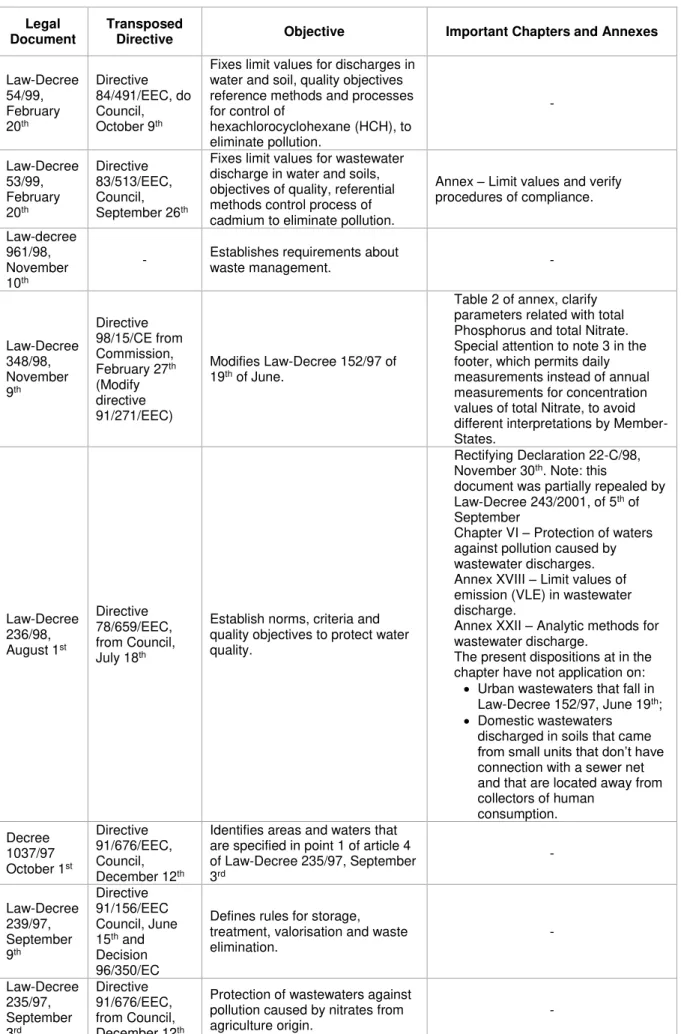
Over the last decade, Portuguese legislation concerning water policy has been growing considerably mainly due to the necessity to transpose European Legislation, but also due to the necessity to fulfil the objectives and achieve the targets defined by national strategies and policies aiming the sustainable development of urban water services. The most important Portuguese laws are briefly described in Erro! A origem da referência não foi encontrada..
Council Directive 91/271/EEC of 21st of May, concerning urban wastewater treatment, was transposed
to the Portuguese Law. Were transposed the parts related to the conception of drainage and treatment systems (law Decree 23/95 of 23rd of August) and industrial and urban wastewaters discharge licenses
regime (Law Decrees 45/94, 46/94 and 47/94, of 22nd of February). The transposition was completed
with the publication of Law Decree 152/97 of 19th of June, which establishes rules for the discharge of
urban wastewaters in aquatic media.
Law-decree 152/97 defines several requirements for treated urban wastewater discharges, taking into consideration the dimension of population agglomerations and the classification of the receptor media (sensitive or less sensitive areas). The sludge resulting from wastewater treatment, according to this diploma, should be reused whenever possible. Its discharge to surface waters is strictly forbidden and its elimination should be performed under authorization from competent authorities. The main requirements established by this diploma are related with:
The construction, conception and maintenance of wastewater collecting systems;
The quality of WWTP effluents discharged in aquatic media (maximum concentration levels, minimum percentage reduction, selection of discharge points);
The quality of WWTP effluents discharged in sensitive areas with risk of eutrophication;
Pre-treatment (when necessary) of industrial effluents prior to their discharge in collecting systems;
Sample collection, control reference methods and evaluation of results;
The deadlines for the implementation of collecting systems and secondary treatment in WWTP (depending on the population size).
The deadlines for the implementation of collecting systems and secondary treatment in WWTP, according to the dimension of the population served, are the same of those defined by Council Directive 91/271/EEC of 21st of May, and described before in this document (see European Legislation).
In the second Commission report on the Implementation of Council Directive 91/271/EEC of 21st of May,
dated 31st of December 1998, the Commission believes that all Portuguese agglomerations of more
than 15.000 p.e. should have at least secondary treatment on 31st of December 2000, including those
which discharge into the less sensitive areas identified by the Portuguese authorities.
In October 1999, the Portuguese authorities sent to the Commission a list of 27 agglomerations of more than 10.000 p.e. situated in the catchments areas of the sensitive areas identified by Portugal. On 31st
December 1998, only five of these 27 agglomerations were in conformity with the provisions of the Directive. The Portuguese authorities proposed then to achieve compliance for the other agglomerations in 2003 at the latest.
Commission. Portugal is facing an ongoing infringement procedure related with prior regulations or specific authorisations for industrial discharges.
Table 1.2 Portuguese legislation on wastewater policy
Legal Document
Transposed
Directive Objective Important Chapters and Annexes
Law-Decree. 149/2004, June 22nd
Directive 91/271/EEC, of the Council, May 21st
Related with wastewater treatment, lists and identifies sensitive and less sensitive areas.
Annex I (Identification list):
Sensitive Areas
Less Sensitive Areas
Decree 91/2000, February 19th
- Approves action programs to avoid and eliminate pollution from multiple sources of chloroform.
Annex I – Action program for chloroform waste management in medical units.
Annex II – Action program for chloroform waste management in periodical analyses. Decree 39/2000, January 28th -
Approves the action program to avoid and eliminate pollution from multiple sources of
hexachlorobutadiene.
Annex I nr. 4 e) Program applied until 31st of December 2001 but submitted
to posterior updates, considering the technical progress in this domain. Law-Decree
506/99 November 20th
-
Fixes quality objectives for certain dangerous products included in annex XIX (list II) of Law-Decree 236/98 - Law Decree 431/99, October 22nd Directive 82/176/EEC from Council, March 22nd
Fixes limit values for normative fixation of discharge in water and soil, quality objectives, referential methods and control process in industrial plants, when electrolyses of alkaline chlorates occurs by cathode cells of mercury, to eliminate pollution caused by these substances
Annex I – Limit values for conformities verification, quality objectives and referential methods
Annex II – Procedures to control quality objectives
Repeal Decree 1033/93, 15th of
October
Decree 429/99, July
15th -
Fixes limit values for wastewater discharge in water and soil by industrial establishments, that produced:
Sodium carbonate, by “Solvay” process with ammonium, acrylic fibers, aniline, phosphate dicalcic, solid aluminium sulphate, ammonium by partial oxidation, urea, ammonium fertilizers, composts fertilizers.
Annexes (I-IX):
Norms of water discharged by different productions.
Law-Decree 68/99, March 11th
Directive 91/676/EEC, Council, December 12th
Modifies Law-Decree 235/97 (Water pollution by agriculture nitrates) articles 4, 5 e 7.
Law-Decree 56/99, February 26th Directive 86/280/EEC Council, of 12 June and Directive 88/347/CE, Council June 16th
Fixes limit values for discharge in water and soil, quality objectives for dangerous substances, reference methods and control for wastewater discharges.
Annex II:
Specific dispositions related to carbon tetrachloride
Specific dispositions related to DDT
Specific dispositions related to pentachlorophenol (PCP)
Specific dispositions related to: Aldrin, Dieldrin, Endrin, Isodrin.
Specific dispositions related to hexachlorobenzene (HCB)
Specific dispositions related to hexachlorubutadiene (HCBD)
Legal Document
Transposed
Directive Objective Important Chapters and Annexes
Law-Decree 54/99, February 20th Directive 84/491/EEC, do Council, October 9th
Fixes limit values for discharges in water and soil, quality objectives reference methods and processes for control of
hexachlorocyclohexane (HCH), to eliminate pollution. - Law-Decree 53/99, February 20th Directive 83/513/EEC, Council, September 26th
Fixes limit values for wastewater discharge in water and soils, objectives of quality, referential methods control process of cadmium to eliminate pollution.
Annex – Limit values and verify procedures of compliance.
Law-decree 961/98, November 10th
- Establishes requirements about waste management. -
Law-Decree 348/98, November 9th Directive 98/15/CE from Commission, February 27th
(Modify directive 91/271/EEC)
Modifies Law-Decree 152/97 of 19th of June.
Table 2 of annex, clarify parameters related with total Phosphorus and total Nitrate. Special attention to note 3 in the footer, which permits daily measurements instead of annual measurements for concentration values of total Nitrate, to avoid different interpretations by Member-States.
Law-Decree 236/98, August 1st
Directive 78/659/EEC, from Council, July 18th
Establish norms, criteria and quality objectives to protect water quality.
Rectifying Declaration 22-C/98, November 30th. Note: this
document was partially repealed by Law-Decree 243/2001, of 5th of
September
Chapter VI – Protection of waters against pollution caused by wastewater discharges. Annex XVIII – Limit values of emission (VLE) in wastewater discharge.
Annex XXII – Analytic methods for wastewater discharge.
The present dispositions at in the chapter have not application on:
Urban wastewaters that fall in Law-Decree 152/97, June 19th;
Domestic wastewaters discharged in soils that came from small units that don’t have connection with a sewer net and that are located away from collectors of human
consumption. Decree
1037/97 October 1st
Directive 91/676/EEC, Council, December 12th
Identifies areas and waters that are specified in point 1 of article 4 of Law-Decree 235/97, September 3rd - Law-Decree 239/97, September 9th Directive 91/156/EEC Council, June 15th and
Decision 96/350/EC
Defines rules for storage, treatment, valorisation and waste
elimination. -
Law-Decree 235/97, September 3rd Directive 91/676/EEC, from Council, December 12th
Protection of wastewaters against pollution caused by nitrates from
Legal Document
Transposed
Directive Objective Important Chapters and Annexes
Decree 423/97,
June 25th -
Establishes norms of wastewater
discharge from textile sector. Annex: Discharge procedures.
Law-Decree 152/97, June 19th
Directive 91/271/EEC, Council, May 21st
Drainage, treatment and discharge of urban wastewaters.
Modifies Law-Decrees 348/98, November 9th and 149/2004, July
22nd.
Annex I (Requirements for urban wastewater treatment):
Drainage system;
Urban wastewater discharge in receptor waters (Table 1, Table 2);
Industrial wastewaters;
Referential methods for evaluation and control of results (Table 3); Annex II (Identification criteria of sensitive areas)
Modified by:
Law-Decree 348/98 – Table 2 Requirements for discharges of urban wastewaters in sensitive areas or waters with eutrophication risk.
Law-Decree 149/2004 – Annex I List of identification of sensitive areas – superficial waters, estuaries and lagoons.
Decree 176/96 (2nd
series), 3rd
October
-
Establishes the maximum concentration level of heavy metals on WWTP sludge (to be used in agriculture) and soils, for receiving that sludge.
-
Decree 177/96 (2nd
series), 3rd
October
- Defines procedures for WWTP sludge analysis (to be used in
agriculture). -
Decree 1147/94, December 26th
-
Defines criteria for discharge, storage, deposition or injection in soil of industrial wastewaters with titanium dioxide.
Annex III:
Discharge procedures for seawater (estuaries, costs, profound waters). Annex IV:
Discharges procedures for superficial waters.
Annex V:
Storage procedures for soil deposition.
Decree 895/94, October 3rd
Directive 90/415/EEC, Council
Establishes quality objectives and emission limit values for the discharge of certain dangerous substances in waters and soils.
Annex I:
Discharge limit values:
1,2-dichloroetan
Trichloroethylene
Perchloroethylene
Trichlorobenzene Annex II:
Objectives of quality for reception points.
Law-Decree 207/94,
August 8th -
To assure the good management of public systems of water distribution and drainage of wastewaters. - Law-Decree 46/94, February 22nd Directive 91/271/CE, Council, May 21st
Establishes the regime for the use of public water domain, under
jurisdiction of the Water Institute. Section III – Wastewater rejection. Decree
Legal Document
Transposed
Directive Objective Important Chapters and Annexes
October
15th Council, March 19th industrial activities which deals with more than 100kg/year of
asbestos.
Nr 5 – Accidental discharges prevention. Decree 1030/93, October 14th -
Establishes procedures for wastewater discharges from industrial units of surface treatments.
Nr 4 - Accidental discharges prevention;
Procedures for discharge of wastewater from industrial surface treatment facilities.
Decree 512/92,
June 22nd -
Establishes procedures for wastewater discharges from leather sector.
Nr 3 - Discharges procedures; Procedures for wastewater discharges from leather sector.
Decree 505/92, de
June 19th -
Establishes norms for wastewater discharges from cellulose sector.
Nr 3 Discharges norms; Table
Procedures for discharge of wastewaters of cellulose sector. Law-Decree 446/91, November 22nd Directive 86/278/EEC Council June 12th
Protection of the environment, in particular the soil, when sewage
sludge is used in agriculture. -
Decree 810/90, September 10th
- Establishes procedures for wastewater discharges from piggeries.
Nr 3 Discharge procedures; Table
Discharge procedures for wastewaters from piggeries.
Decree 809/90, September 10th
- Establishes procedures for wastewater discharges from slaughterhouses.
Nr 3 Discharges procedures; Table I
Procedures for wastewater discharges from slaughterhouses.
Table II
Procedures for wastewater discharges from meat sector.
At 5th of June 2005, the Portuguese Council of Ministers approved a Law Proposal for the transposition into internal Law of the Water Framework Directive (WFD) - Council Directive 2000/60/EC of 23rd of October 2000.
The new Portuguese Water Framework Law has been recently approved in the Portuguese Parliament and it was promulgated and published. This new Law include two Decrees, one related with the rules for hydrological resources protection and another related with its property. The Council of Ministers also approved:
Law Decree complementing the transposition of WFD;
Law Proposal establishing the property of hydrological resources;
Law Decree establishing the economic and financial regime of the hydrological resources;
Resolution approving the National Program for Rational Consumption of Water.
1.4. Portuguese legislation on sludge
As result of the wastewater treatment processes, two products are obtained, a liquid effluent, with a reduced concentration of pollutants, which turns its deposition in the environment an acceptable issue; and a semi-solid product, the sludge, which has a higher concentration of pollutants, in comparison with the wastewater before its treatment. The wastewater treatment process is a transfer of pollution from a liquid stage into a solid stage, which occupies a lower volume and consequently has a higher concentration of pollutant substances. It is important to note that, although the sludge results from a concentration of wastewater compounds, it could also contain other products which results from a chemical conditioning and stabilisation processes.
of the production of sludge, and a consequent rise of costs related with the sludge management, concerning its treatment, transportation and final destination.
The treatment of sludge is a complex process, and is more difficult in areas with a higher population density, such as the coastal region between Setúbal and Viana do Castelo and Algarve coast. The difficulty results from the conjunction of three major factors: the dimension of the population served, the high quality level of wastewater treatment in the coastal areas and the lack of available areas for the sludge final deposition.
According to the RDP 2000-2006, it is foreseen that the service will grow, covering 96% of the population in water supply and 90% in drainage and wastewater treatment. Additionally, the compliance with the Community Directive 91/271/CEE, of 21st of May, and subsequently transposed into the National
Legislation through the law decree 152/97 of 19th of June, implies that wastewater from locations with
more than 2000 people must be subjected, at least, to secondary treatment, depending on its discharge location. This will result in a significant increase of the sludge production, in a short period of time, and consequently will cause a rise on the costs associated with its treatment and disposal. One of the problems caused by the compliance with the objectives established by the Strategic Plan for Water Supply and Wastewater Treatment is the inefficient management plans for the sludge resulting from the treatment processes.
1.5. Municipal wastewater drainage – SMAS de Sintra regulations
Many Municipalities in Portugal have implemented municipal regulations for the discharge of wastewater into their collectors. Were defined maximum levels for pollutants and published several norms regarding the protection of the collecting systems, in order to assure the safeguard of infrastructures, the effective treatment in WWTP and the good quality of the final effluent, according to the national legislation.
Municipal regulations also define responsibilities for the installation and maintenance of collectors, inspection, audit activities, prevention of fresh water contamination, forbidden dumping, tariffs and other activities.
SMAS de Sintra, as the water management entity, are responsible for the conception, construction and exploitation of the public wastewater drainage systems of Sintra municipality. SMAS de Sintra is responsible for the operation and management of 11 small WWTP, most of them located in coastal areas.
The Municipal Wastewater Discharge Regulation established by SMAS Sintra (SMAS MWDR), was prepared in compliance with the disposed on Law-Decree 207/94 of 6th of August 1994 and with the
Regulation Decree 23/95 of 23rd of August. It is valid since 1997, after being subjected to public
discussion and approved in Municipal Assembly with the main specifications described below:
SMAS de Sintra is responsible for the management of the public drainage system and responsible for its connection with the buildings. The maintenance and repair of these infrastructures is also the responsibility of SMAS (except when damages are caused by third parties);
All drainage projects must be performed in accordance with a project of civil engineering, previously approved by SMAS de Sintra;
The consumer or end-user is responsible for the conservation and repair of building’s drainage systems;
SMAS de Sintra may proceed to inspection activities during and after de construction of building’s drainage systems;
All building’s drainage systems will be connected to a public collector after its compliance with all requirements established by SMAS MWDR;
SMAS MWDR also establishes norms to prevent the contamination of fresh water by wastewater;
It lists the materials and substances whose discharge into public collectors is strictly forbidden, such as:
• laboratory effluents;
• hospital effluents;
• sand;
• ashes;
• effluents with temperatures above 30ºC;
• wastewater sludge from septic tanks;
• oils and greases;
• food wastes;
• industrial effluents (containing dangerous substances to human life and for the environment).
SMAS MWDR defines some norms related with the communication between SMAS de Sintra
and the system end-users, such as the responsibilities when damage in buildings occurs due to inappropriate occurrences in the drainage system;
SMAS de Sintra may demand the installation of water/wastewater flow counters;
In order to support the costs associated with the construction and maintenance of collectors and WWTP, SMAS de Sintra may charge connection, conservation and treatment tariffs to end-users;
SMAS de Sintra also has another regulation, the Industrial Wastewater Discharge Regulation (IWDR), with the objective to ensure that industrial wastewater will not affect negatively WWTP staff health, the durability and hydraulic conditions of flow ducts, interceptors and emissaries, the WWTP exploitation conditions, the quality of effluents, the ecology conditions of the environment and the final destiny of the produced sludge, according to the actual legislation.
The IWDR defines:
the industrial wastewaters characteristics for its discharge into municipal drainage systems (in terms of forbidden substances, forbidden effluents and emission limit values);
a contingency plan after accidental discharges;
procedures for emission acceptance;
procedures for monitoring and control (inspection activities, self-control, etc.);
sample collection procedures, in-situ measurement procedures and analytical methodologies;
a formula for tariff calculation.
All industrial wastewaters entering municipal drainage systems must comply with the maximum recommended values (MRV) and emission limit values (ELV) established by SMAS de Sintra IWDR. These values are presented below in 1.3Table 1.3.
Table 1.3 Maximum recommended values (MRV) and emission limit values (ELV) established by SMAS de Sintra Industrial Wastewater Discharge Regulation.
Parameter Units MRV ELV Parameter Units MRV ELV
pH Scale
Sörensen - 5,5 9,5 – Amoniacal Nitrogen mg/L NH4 - 60
Temperature ºC - 30 Total nitrogen mg/L N - 90
BOD (20ºC) mg/L O2 300 800 Nitrates mg/L NO3 - 80
COD mg/L O2 600 1.200 nitrites mg/L NO2 - 10
TSS mg/L 300 1.000 Total phosphorous mg/L P - 20
Conductivity (20ºC)
µS/cm - 3000 Sulphates mg/L SO4 - 2.000
Total chlorides mg/L - 500 Sulphites mg/L SO3 - 2,0 Total available
residual chlorine
mg/L - 1,0 sulphides mg/L S - 1,0
Total aluminium mg/L - 10 Aldehydes mg/L - 1,0
Total arsenic mg/L 0 1,0 Chlorophorm mg/L - 1,0
Total boron mg/L - 4,0 Detergents mg/L 2,0 15
Total cadmium mg/L - 0,2 Phenols mg/L
C6H5OH
0,0 0,5
Total lead mg/L - 1,0 Hexachlorobenzene (HCB) mg/L - 1,5
Parameter Units MRV ELV Parameter Units MRV ELV
Total copper mg/L - 1,0 Hexachlorociclohexane (HCH)
mg/L - 2,0
Chromium VI mg/L - 0,1 Total hydrocarbons mg/L 0 15
Total chromium mg/L - 2,0 Oils and greases (soluble in ether)
mg/L 50 100
Total tin mg/L - 2,0 Pentachlorophenol mg/L - 1,0
Total iron mg/L - 20 Carbon tetrachloride mg/L - 1,5
Total manganese mg/L - 2,0 Aldrin, Dieldrin, Endrin, Isodrin
µg/L - 2,0
Total mercury mg/L - 0,05 Pesticides µg/L 0 3,0
Total nickel mg/L - 2,0 DDT µg/L - 2,0
Total silver mg/L - 1,5 1,2 – Dichloroethane (DCE)
mg/L - 0,2
Total selenium mg/L - 0,5 Trichloroethane (TRI) mg/L - 0,2
Total vanadium mg/L - 10 Perchloroethilene (PER) mg/L - 0,2
Total zinc mg/L - 5,0 Trichlorobenzene (TCB) mg/L - 0,1 Total heavy
metals
2. Portuguese chronological water policies
2.1. Evolution of the strategy and planning in the water sector
The earliest activity related with the compilation of information about demography, water distribution, sanitary systems and municipal activity remounts to 1934. At this time, the biggest concern was to compile an inventory which integrates economic data, namely data related with water tariffs.
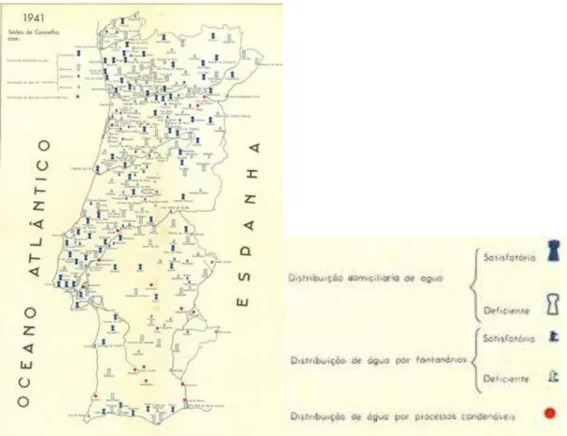
The Portuguese water supply cartography remounts to 1941. As observed in Figure 2.1, was collected information regarding water distribution services and its geographic distribution as well as the location of public fountains. It was noted also concerns about the identification of areas where the water
distribution was made by “incorrect processes”.
Figure 2.1 Map from 1941 with geographic information of water supply services. (Source: INAG)
In 1972, the Health Services Directorate (DSS) performed a survey of the state of the art of the water supply services, sewage systems and urban wastes collection. In 1976 another survey was made by the General Directorate of Sanitary Services (DGSB) on the demography of the system, attendance levels, consumptions, and on the economic and financial status of the water municipal services. In 1987 a new inventory was made by Territory Administration Bureau (GEPAT).
The first national sanitary inventory (ISBN) was promoted in 1990, with the participation of the Regional Environment Directorates (DRA), aiming the characterization of the Portuguese sanitation services status. Also in 1990, the first alphanumerical database of water services indicatorswas accomplished, as well as the collection of its geographical information.
The second national sanitary inventory was completed in 1994 and updated in 1997 by the Water National Institute and DRA. This inventory was only edited in digital version. The geographic information obtained resulted in a 1/25.000 scale map.
There was a significant increase on the number of population served by water supply services (90% by the year 2000) as well as a significant improvement of the service quality. The same evolution happened with wastewater drainage and treatment services, reaching, by the year 2000 the attendance levels of 75% and 55%, for wastewater drainage and treatment, respectively. The installed capacity for wastewater treatment was 70% and the main reason for the lower attendance level (55%) was due to the inexistence connections between the municipal wastewater drainage systems and the existing WWTP.
The Law-Decree 95/94 of 22nd of February 1994 was published in order to regulate the planning process
of the hydrological resources. This diploma allowed the elaboration and approval of 15 basin plans and a national water plan. For this purpose, the Portuguese Continental territory was divided into 15 regions, according with the main hydrographic basins and its adjacent coastal regions.
In 2000, all Hydrographic Basin Plans were concluded. They defined the regional strategies for an adequate valorisation, protection and management of waters, for each hydrographic basin or for the aggregation of smaller basins, according to the ministerial dispatch of 98/12/31 and according to the Law Decree 45/94 of 22nd of February 1994. The Hydrographic Basin Plans have been updated until
1998 and a has a database with information on the water supply systems and wastewater collection and treatment systems, as well as the same information georeferenciated on maps.
The National Water Plan, elaborated in the sequence of the Basin Plans and approved by Law Decree 112/2002 of 17th of April, defines the national strategies for the integrated management of the
Portuguese waters, supported by the results of the surveys on the current water situation which promoted the definition of objectives and targets. The Regional Water Plans of Azores and Madeira were approved, respectively in 2003 and 2004.
The National Water Plan and the Hydrographic Basin Plans were important documents for the improvement of the hydrological management in the beginning of the XXI century. They were the main planning documents, for the restructuring the management of the hydrological and, were fundamental factor, for the achievement of effective and coherent hydrological policies.
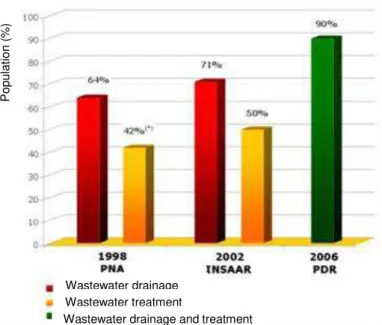
The objectives defined by the most recent Regional Development Plan (PDR 2000-2006) aim the consolidation of the targets defined by the previous PDR (1994-1999), by the improvement on the attendance levels of fresh water supply and wastewater drainage and treatment, achieving respectively, 95% and 90%.
In order to assure the fulfilment of these objectives, the Ministry of Environment and Territory promoted the realization of a Strategic Plan for Water Supply and Wastewater Drainage (PEAASAR) for the period of 2000-2006. The main actions of this plan are the following:
Growth of existing water supply systems and wastewater drainage and treatment systems, with the construction of new infrastructures;
Rehabilitation of WWTP;
Reduction of water losses and renewal of the distribution ducts and collectors;
Promotion of integrated solutions;
Reuse of treated effluents;
Promotion of rational water use;
Promotion of specialized technical training;
Promotion of the quality of water sources and of urban water services. In order to successfully achieve the objectives of PEEASAR was also necessary to:
Establish fair tariffs for the consumers;
Promote corporative solutions for systems management.
2.2. Recent statistic data
INSAAR is the most recent project developed for the collection and storage of geographical and alphanumerical data regarding the urban water cycle. This data is available and updated online, with the objective of serving the general public, with clear and accessible information. INSAAR is a national project which the first results are from 2002 and is prepared for future updates and iterations. Its technical scope is centred in water supply systems, as well as wastewater drainage and treatment systems.
According to INSAAR (2002), 71% of the Portuguese population had access to public wastewater collection systems, while only 50% had access to both collection and treatment services.
INSAAR identified 1.312 WWTP, with different levels of water treatment: pre-treatment (3), primary (47), secondary (747) and tertiary (58). For the remaining 457 WWTP it was not possible to identify the type of treatment, due to insufficient data.
Like any other industrial facility in Portugal, every WWTP must be licenced to develop their activity. From the 1.312 WWTP listed, only 205 had a valid licence, 120 did not had any licence and for the rest 987 it was not possible to confirm this information.
Regarding the system management entities, INSAAR identified 599 entities dedicated to the management of water supply services and wastewater drainage and treatment services. These 599 entities could be divided in 221 (37%) entities which exclusively deliver water to consumers, 30 (5%) were exclusively dedicated to wastewater collection and treatment and 292 (49%) were dedicated both to water supply and wastewater drainage and treatment.
2.3. Overview of wastewater treatment in Portugal
According to the last Portuguese inventory on water supply services and wastewater drainage and treatment services (INSAAR), published in 2002, 71% of the Portuguese population had access to public wastewater collection systems, while only 50% had access to both collection and treatment services.
The Figure 2.2 presents the evolution of public wastewater services, since 1998.
Figure 2.2 Chronological evolution of the attendance levels in Portugal of wastewater drainage and treatment. (Source: INSAAR)
Pop
ula
tio
n
(%
)
Wastewater drainage Wastewater treatment
Portugal had 6.912.376 inhabitants served by public services of wastewater drainage and 2.813.493 inhabitants which did not had access to this service. The annual volume of drained wastewater was 325hm3; with a capitation of 129l/inhabitant per day.
The number of the population served by wastewater treatment services was 4.834.219 inhabitants, nearly 50% of the Portuguese population. There were 2.078.157 (21,4%) inhabitants served by public services of drainage, without treatment, and 2.813.475 (28,9%) inhabitants were not served by any wastewater services.
Figure 2.3 shows the wastewater drainage and treatment attendance indexes in Portuguese municipalities.
Figure 2.3 A) Attendance index of Portuguese wastewater drainage service; B) Attendance index of Portuguese wastewater treatment service. (Source: INSAAR)
INSAAR identified in the Portuguese wastewater drainage and treatment public systems the flowing
equipment’s:
4.644 emissaries;
625 pumping stations;
4.881 sewage systems (collectors);
9 tanks;
3.077 septic tanks;
1.312 WWTP;
4.544 discharge points:
o water lines (2.600);
o lakes (4);
o soil (902);
o artificial masses of water (12);
o transition waters (16);
Attendance level (%)
Wastewater Drainage Attendance level (%) Wastewater Treatment
o bays (53);
o coast wasters (22);
o unavailable data (935).
Preliminary treatment attended 25.000 inhabitants (0.3%), primary treatment attended 1.865.542 inhabitants (19%), secondary treatment attended 1.757.414 inhabitants (18%) and tertiary attended 1.476.916 inhabitants (15%).
From the 205 licenced WWTP, 1 had pre-treatment, 4 had primary treatment, 147 had secondary treatment and 31 had tertiary treatment. For the remaining 22 it was not possible to obtain any information.
2.4. Sludge production in Portugal
From the 1.312 identified WWTP, only 195 (15%) had available data on their sludge production. The annual sludge production in from all these 195 WWTP was 299.117 tons.