Inês Miguel Troles Duarte do Carmo
Mestrado Integrado em Engenharia Química e Bioquímica
Food waste valorization through the
production of polyhydroxyalkanoates by
mixed microbial cultures
Dissertação para obtenção do Grau de Mestre em
Engenharia Química e Bioquímica
Orientador: Professora Doutora Maria Ascensão C. F. Miranda Reis
Co-orientador: Doutora Catarina S. S. Oliveira
Doutora Anouk F. Duque
Inês Miguel Troles Duarte do Carmo
Mestrado Integrado em Engenharia Química e Bioquímica
Food waste valorization through the
production of polyhydroxyalkanoates by
mixed microbial cultures
Dissertação para obtenção do Grau de Mestre em
Engenharia Química e Bioquímica
Orientador: Professora Doutora Maria Ascensão C. F. Miranda Reis
Co-orientador: Doutora Catarina S. S. Oliveira
Doutora Anouk F. Duque
“I do not know what I may appear to the world; but to myself I seem to have been only like a boy
ACKNOWLEDGMENTS
É com orgulho que dou por terminada mais uma etapa da minha vida académica. Contudo, não posso deixar de agradecer a todos aqueles quem me incentivaram e cooperaram para a sua realização. A todos vós os meus sinceros agradecimentos.
Agradeço à Professora Dr.ª Maria Ascensão Reis pela oportunidade de integrar o seu grupo de investigação, BIOENG, bem como todo o apoio e dedicação durante este percurso.
Gostaria igualmente de agradecer à Dr.ª Catarina Oliveira e à Dr.ª Anouk Duque pelos conhecimentos científicos transmitidos e ideias concedidas, pela ajuda e apoio em todas as fases deste trabalho.
Agradeço aos Engenheiros Alexandra Silva, Ricardo Santos e Mário Teixeira, pelo companheirismo, carinho e amizade que me deram ao longo de todo este percurso, pela prontidão em me ajudar sempre que precisava. O meu sincero Obrigada.
Ao meu namorado, amigo e colega Tiago Ceia, que ao longo deste período esteve sempre a meu lado. Sempre com o seu apoio nos momentos menos bons, felicitando-me pelas novas conquistas e até mesmo dando raspanetes quando necessários. OBRIGADA por tudo!
Resumo
Os Polihidroxialcanoatos (PHAs) são poliésteres constituídos por ácidos hidroxilos gordos, cuja acumulação se dá no interior das culturas microbianas e são utilizados como fonte de carbono/energia.
Os PHAs são uma promissora alternativa aos plásticos convencionais uma vez que, são polímeros de origem biológica, biodegradáveis e dispõem de uma elevada gama de propriedades termoplásticas.
Actualmente a sua produção industrial incide essencialmente na utilização de culturas microbianas puras. Contudo, apesar da elevada eficiência de produção em PHAs, a utilização de culturas puras apresenta elevados custos associados à esterilização de todo o processo, bem como a utilização de matériasprimas quimicamente definidas contendo ácido orgânicos (AOs) como fonte de carbono.
As culturas microbianas mistas (CMMs) surgem por isso como alternativa á utilização de subprodutos industriais como matérias-primas na produção destes polímeros, porém a maioria destes resíduos é produzida sazonalmente. Assim, é necessário estudar o comportamento das culturas mistas quando sujeitas a diferentes substratos. O principal objectivo deste trabalho foi então compreender em que medida o processo de produção de PHAs, através de culturas microbianas mistas, é afectado por uma mudança de substratos, nomeadamente soro de leite (SL) e melaço de cana-de-açúcar (MCA), simulando a disponibilidade sazonal das matérias-primas. Contudo, a utilização de resíduos industriais por CMM requer a conversão do seu principal constituinte, os açúcares, em AOs, que é conseguida através da sua fermentação anaeróbia.
O processo de produção de PHA por culturas microbianas mistas realizado neste trabalho compreende as seguintes etapas: (1) fermentação anaeróbica realizada num bioreactor membranar (AnMBR) dos substratos (SL e MCA) em ácidos orgânicos; (2) selecção de culturas microbianas ricas em organismos acumuladores de PHAs nos substratos fermentados produzidos na primeira etapa e quando impostas condições de fome/fartura (F/F) ao reactor; e (3) a produção de biopolímero pelas culturas seleccionadas e as matérias-primas fermentadas produzidas nas etapas anteriores.
Numa primeira fase deste trabalho estudou-se o efeito das diferentes matérias-primas (SL e MCA) na fermentação acidogénica (etapa 1). Assim, o AnMBR foi operado com SL até estado estacionário. Posteriormente procedeu-se sua à substituição por MCA, tendo sido observado um período adaptação de 10 a 15 dias, por parte da cultura anaeróbia à nova matéria-prima. Contudo, quando este último foi novamente substituído por SL, a cultura respondeu rapidamente a esta mudança, sendo que apenas foram necessários, aproximadamente, 7 dias para a sua adaptação.
IV
nomeadamente do MCA, resultou num perfil de ácidos orgânicos consideravelmente diferente (%g-COD HAA/g-(%g-COD S): 24% acetato, 38% propionato, 19% butirato, e 19% valerato.
Numa segunda fase deste trabalho, diferentes substratos fermentados foram utilizados na selecção de microorganismos acumuladores de PHAs, sob condições de fome/fartura num SBR (etapa 2). Inicialmente o SBR foi então alimentado com uma solução sintética de AOs; e seguidamente por MCA fermentado (fMCA) e SL fermentado (fSL) conforme foram produzidos no AnMBR. Após terem sido atingidos os estados estacionários com os diferentes substratos, realizaram-se ensaios de acumulação de polímero com as culturas mistas seleccionadas e as respectivas matérias-primas (etapa 3). Rendimentos em polímero de 0.74, 0.49, e 0.73 C-mol PHA/ C-mol AOs e conteúdos celulares em polímero de 60%, 56% e 65 % g PHA/g VSS foram obtidos nos ensaios de acumulação com as culturas alimentadas com a solução sintética de AOs, o fMCA e o fSL, respectivamente. No que diz respeito á composição do polímero produzido constatou-se que a mesma está directamente relacionada com o perfil de ácidos orgânicos dos substratos fermentados.
Embora estudo do efeito da modificação sazonal de substratos, no processo de produção de PHAs por CMM, ainda se encontre numa fase embrionária, este trabalho demostrou que é possível a selecção de culturas acumuladoras de PHAs capazes de adaptar o seu metabolismo a diferentes substratos. Consequentemente, inúmeras matérias-primas poderão ser utilizadas como fonte de carbono, bem como a melhorar estratégias tendo em vista à optimização das etapas fermentação acidogénica, selecção de culturas e produção de polímero.
Abstract
Polyhydroxyalkanoates (PHAs) are polyesters of hydroxyl fatty acids, which are accumulated in microbial cells as carbon/energy reserves.
PHAs are bio-based and biodegradable and display a wide range of thermoplastic properties, being a promising alternative to conventional plastics.
Presently, industrial PHA production was primarily based on pure microbial cultures. Although this process has high PHA production efficiency, it presents high costs associated with the use of chemically-defined feedstocks, and to the need for sterility.
An attractive feature of mixed microbial cultures (MMCs) PHAs production is the ability to use waste/surplus feedstocks. Many industrial wastes are seasonally produced making it necessary find the best method of utilization of this feedstock on PHA production process. Two different approaches might be taken account: (1) stock of industrial wastes during their production for their use throughout the year. However, the high fermentability of these agro-industrial wastes makes them susceptible to degradation during storage period; (2) the use of different feedstocks over the year according its availability. It is thus important to study MMC’s response to different feedstocks. The aim of this work is study how MMC PHA production process is affected by a feedstock shift, using cheese whey (CW) and sugar cane molasses (SCM) as model feedstocks. The use of waste based feedstock by MMCs requires a previous conversion of sugars to organic acids (OAs), which is achieved through anaerobic fermentation.
In this study, a three-stage MMC PHA process was used, comprising: (1) anaerobic fermentation of surplus feedstocks to produce OAs in a membrane bioreactor (AnMBR); (2) PHA accumulating culture selection in a sequencing batch reactor (SBR) under feast and famine conditions using fermented feedstocks; and (3) PHA production using the selected cultures and the OAs produced in the earlier stages.
Initially the effect of both feedstocks (CW and, SCM) in the acidogenic fermentation (stage 1) was assessed. Firstly, the AnMBR was operated under steady state with CW. When the feedstock was changed to SCM an adaption period of about 10 to 15 days was observed. When SCM was replaced by CW a faster adaptation response, approximately 7 days, was observed.
The AnMBR reached similar OAs profiles in both phases when CW was fed (% g-COD HAA/g-COD OAs): 65% acetate, 10% propionate, 22% butyrate, 2% valerate, and 1% lactate. These results
demonstrate that the system’s performance is reproducible. On the other hand, the anaerobic
fermentation of a different feedstock, SCM, resulted in a different OAs profile (%g-COD HAA/g-COD OAs): 24% acetate, 38% propionate, 19% butyrate, and 19% valerate.
VI
solution, fSCM, and fCW. Storage yields of 0.74, 0.49, and 0.73 C-mol PHA/ C-mol OAs were obtained with synthetic OAs solution, fermented molasses, and fermented CW, respectively. The culture reached a maximum PHA content of 60%, 56% and 65%, when feedstock fed were synthetic OAs solution, fSCM and fCW, respectively. A direct relation between the used feedstock and the polymers composition was observed, which was related with the different OAs profile.
Even though, the shift of complex feedstock in three-stage MMC PHA process is still at a very early stage of development, this work illustrates the advantage of favoring the selection of cultures with the capacity to adapt its metabolism to different feedstocks. This will offer the possibility of using numerous substrates and improving strategies to optimize acidogenic fermentation, culture selection and polymer production.
Abbreviations
%PHA max – Maximum PHA content, in; ADF – Aerobic Dynamic Feeding;
AnMBR – Anaerobic Membrane bioreactor; C/N – Carbon to nitrogen ratio, in C-mol/N-mol;
C/N/P – Carbon to nitrogen to phosphorus ratio, in C-mol/N-mol/P-mol; CSTR – Continuous stirred tank reactor;
CW – Cheese whey;
%DA – Degree of acidification, %(g-COD OAs/g-COD S); F/F – Feast to Famine ratio, in h/h;
fCW – Fermented cheese whey;
fSCM – Fermented sugar cane molasses; HA – Hydroxyl acid;
HAc – Acetic acid; HB – Hydroxybutyrate; HBut – Butyric acid; HHx – Hydroxyhexanoate; HLac – Lactic acid;
HPLC- High Performance Liquid Chromatography; HProp – Propionic acid;
HRT – Hydraulic retention time, in days; HV – Hydroxyvalerate;
HVal – Valeric acid;
mcl-PHA- Medium chain length polyhydroxyalkanoates; MMC- Mixed microbial cultures ;
OAs – Organic acids;
OLR – Organic loading rate, in C-mmol/L.d or g-CO g-COD/L.d; PE – Polyethylene;
PHA – Polyhydroxyalkanoates;
qOAs – Organic acids production rate, in g-COD OAs/gVSS h; -qOAs – Organic acids uptake rate, in C-mol OAs/C-mol X h; qPHA – PHA production rate, in C-mol OAs/C-mol X h; -qS – Substrate uptake rate, in g-COD S/gVSS h;
rOAs – Organic acids volumetric productivity, in g-COD OAs/L d; SBR – Sequencing Batch Reactor;
VIII
TNb – Total nitrogen;
TOAs – Total organic acids, in g-COD OAs/L or C-mmol/L; VFA – Volatile fatty acids, in C-mmol VFA/L;
VSS – Volatile suspended solids, in gVSS/L; X – Active biomass;
YOAs– Organic acids yield, in g-COD OAS/ g-COD S;
List of Contents
ACKNOWLEDGMENTS ... I Resumo ... III Abstract ... V Abbreviations ... VII
Chapter I – Introduction ... 1
1.1. Polyhydroxyalkanoates: a family of bioplastics for the future. ... 1
1.1.1. Polyhydroxyalkanoates: Chemical Structure, Properties and Applications. ... 1
1.2. Current mixed microbial culture PHA synthesis ... 4
1.2.1. Feast and famine (FF) or Aerobic dynamic feeding (ADF): PHA enrichment strategy ... 5
1.2.2. Three-step process for PHA production by mixed microbial cultures from waste streams 5
Acidogenic Fermentation... 6
ccumulatin Culture Selection... 7
Factors that affect mixed microbial culture selection under FF conditions ...7
1.3. Substrate selection: a critical factor of polyhydroxyalkanoates production ... 10
o Sugar Molasses ... 11
o Cheese Whey ... 12
Chapter II – Thesis Motivation and Outline ... 13
2.1. Thesis Motivation ... 13
2.2. Dissertation Objectives ... 15
2.3. Thesis Outline ... 17
Chapter III – Acidogenic fermentation of cheese whey and sugar cane molasses: feedstock shift impact on organic acids production ... 19
3.1. Introduction ... 19
3.2. Materials and Methods ... 20
3.2.1. Feed preparation ... 20
3.2.2. Acidogenic fermentation reactor set up and operation ... 20
3.2.3. Analytical Procedures ... 21
3.2.4. Calculations ... 22
3.3. Results and Discussion ... 25
3.3.1. Anaerobic fermentation response to a waste/surplus based feedstock shift ... 25
3.4. Conclusion ... 30
Chapter IV − Feedstock shift impact on PHA-accumulating culture selection and PHA production .. 31
4.1. Introduction ... 31
4.2. Materials and Methods ... 32
4.2.1. Feed preparation ... 32
X
4.2.4. PHA Accumulation: batch assays ... 34
4.2.5. Analytical procedures ... 34
4.3.6. Calculation of kinetic and stoichiometric parameters ... 35
4.3. Results and Discussion ... 37
4.3.1. Effect of substrate shifts on the SBR’s performance ... 37
4.3.2. Effect of feedstock shift on PHA accumulation. ... 42
4.3.3. Effect of OAs concentration profiles in polymer profile and PHA production yield ... 47
4.4. Conclusions ... 48
Chapter V
–
General conclusions and future perspectives ... 49
Figure Index
Table Index
Table 1.1 - Physical-chemical and mechanical properties of polyhydroxyalkanotes (PHAs) polymers
(Adapted from (Khanna S. and Srivastava A. K., (2005); Liu X. et al., (2009)). ... 3
Table 1.2 – Substrate cost (Volova T. G., (2004)). ... 11
Table 3.1 – Effect of feedstock shift on the MBR performance in steady state. ... 27
Table 3.2 – MBR operating conditions and general performance in the steady state (StSt). ... 28
Table 4.1 – Operating conditions and feed composition for culture selection reactor under feast and famine conditions. ... 34
Table 4.2 – Average OAs feedstocks profiles and substrate uptake rates on the performance of PHA-accumulating culture selection SBR subjected to an FF conditions. ... 39
Table 4.3 - Average performance of PHA-accumulating culture selection SBR subjected to a ADF conditions and a feedstock shift with a synthetic OAs solution (OAs Syn), fermented molasses (fSCM), and fermented CW (fCW). ... 41
Chapter I
–
Introduction
In the past few years, it has become increasingly clear a dependency of the world from crude oil and its byproducts. The necessity to find a balance between Nature and Man has intensified the search for new renewable resources, as alternative to fossil fuels and, therefore, attain a sustainable industry, environmental efficient and green chemistry (Akaraonye et al., 2010).
Plastics are one of the largest sectors of application for crude oil, with over 200 million tons of plastic consumed per year and a growth of 5% per annum (EPA, 2000). However, in the eminence
of “depletion” of crude oil as well as the constant fluctuation of its prices, it becomes necessary to
find new alternatives (Albuquerque, 2009; Reis et al., 2011). Furthermore, synthetic-plastics are recalcitrant to biological degradation, which causes the accumulation of millions of tons of wastes every year in landfills and marine environments. In fact, only 20% of the synthetic-plastics are recycled or incinerated (Albuquerque, 2009).
Bioplastics appear as a possible response to the problematic of harmful effects of the plastics which are petroleum derivatives, since they can be biodegradable, biobased or both. Therefore, it may be possible to reduce greenhouse emissions and the use of nonrenewable resources (Salehizadeh H. and Van Loosdrecht M.C.M., 2003; Reis et al., 2011).
1.1. Polyhydroxyalkanoates: a family of bioplastics for the future.
Polyhydroxyalkanoates (PHAs) are one of the most well-known groups of biodegradable plastics. They are completely bio-based, as they can be produced from renewable carbon sources. Moreover, their thermoplastic and elastomeric properties are similar to those of conventional plastics such as polyethylene and polypropylene, with the advantage of being both biodegradable and biocompatible (Salehizadeh and Van Loosdrecht, 2003; Albuquerque et al., 2010)
PHAs are polyesters of hydroxyl fatty acids accumulated into microbial cells, in amorphous state, as granules, and are used as carbon/energy reserves (Salehizadeh and Van Loosdrecht, 2003; Johnson, 2010; Reis et al., 2011)
1.1.1. Polyhydroxyalkanoates: Chemical Structure, Properties and
Applications.
Chemical Structure
2
Hydroxyalkanoic acids monomers are the mainly constituent of PHAs, and can be classified into two groups depending on the length of the carbon chains: short chain length (SCL) PHAs, which consist of 3 to 5 carbon monomers (C3-C5); and medium chain length (MCL) that have 6 to 14 carbon monomers (C6-C14) (Khanna and Srivastava, 2005; Platt, 2006; Albuquerque, 2009; Liu et al., 2009; Akaraonye et al., 2010). Each type of PHA generally consists of 100-30000 monomers and the polymer molar mass ranges from 1x10⁴ to 3x10⁶ Da (Sudesh, 2000; Albuquerque, 2009).
Poly(3hydroxybutyrate), P(3HB), was the first PHA to be identified on Bacillus megaterium
by Lemoigne M., (1926) and is the most common type of PHA produced by various microorganisms in nature. Wallen and Rohwedder, (1974) also discovered different repeating units of HAs, such as hydroxyvalerate (HV) and, Hydroxyhexanoate (HHx). Subsequently more than 150 different types of HA monomers have been recognized, being synthesized by over 300 bacterial (Sudesh et al., 2000; Albuquerque, 2009).Depending on the kind of monomers present in their structure PHAs can be: homopolymers, containing one type of a repeating units or heteropolymers (copolymers), which have more than one type of HA (Sharma et al., 2011).
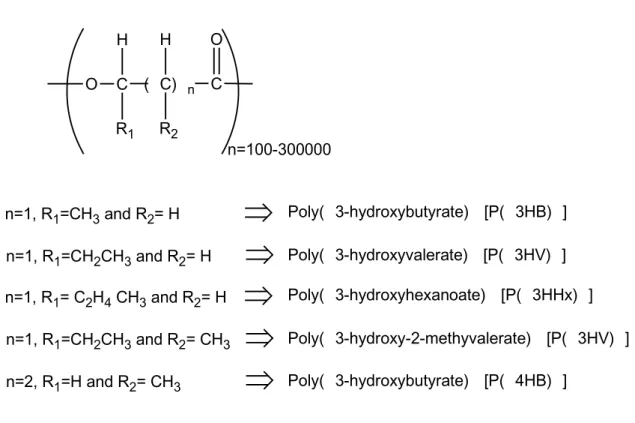
In Figure 1.1 the general chemical structure of PHA monomers is represented, with n indicating the number of carbons in the linear polyester structure and R1 and R2 the variable
hydrocarbon side chains.
Figure 1.1 - General chemical structure of PHA monomers that constitutes polymer macromolecules (Adapted fromAlbuquerque, (2009)).
Properties
C
C
( C)
nO
O
n=100-3000000
H
R
1H
R
2n=1, R
1=CH
3and R
2= H
n=1, R
1=CH
2CH
3and R
2= H
Poly( 3-hydroxybutyrate) [P( 3HB) ]
Poly( 3-hydroxyvalerate) [P( 3HV) ]
n=1, R
1= C
2H
4CH
3and R
2= H
n=1, R
1=CH
2CH
3and R
2= CH
3Poly( 3-hydroxyhexanoate) [P( 3HHx) ]
Poly( 3-hydroxy-2-methyvalerate) [P( 3HV) ]
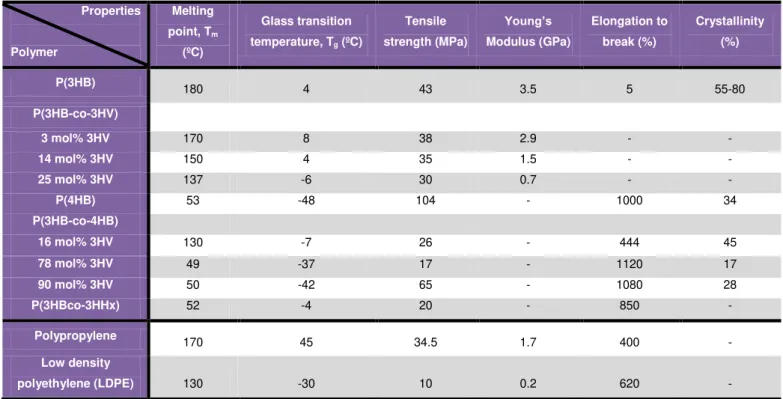
The properties of PHAs can differ depending on the composition of the monomer units in the polymer backbone. P(3HB) is a typically thermoplastic polymer with a melting point (Tm) of 180 ºC, a
glass transition temperature (Tg) of 4 ºC. It is highly crystalline (55-80%), brittle and stiff, limiting it to
some applications (Volova, 2004; Albuquerque, 2009; Reis et al., 2011; Sharma et al., 2011). The incorporation of other HA units on the P(3HB) structure, such as 3-hydroxyvaletare (3HV), to form a PHA copolymer can improve its physical properties. These polymers exhibit lower crystallinity, and lower melting and glass temperature transitions, enabling their thermal processing without a thermal degradation at lower temperatures and reducing molecular weights losses. Furthermore, the presence of HV monomers also makes the polymer tougher, which means it is more resistant to
impact stren th, and decreases the Youn ’s modulus, i.e. the flexibility increases (Khanna and
Srivastava, 2005; Reis et al., 2011). Introduction of HA monomers, other than 3HV, on the P(3HB) structure also originates copolymers with different mechanical properties, as shown in Table 1.1.
Table 1.1 - Physical-chemical and mechanical properties of polyhydroxyalkanotes (PHAs) polymers (Adapted from (Khanna S. and Srivastava A. K., 2005; Liu X. et al.,
2009).
Properties
Polymer
Melting point, Tm
(ºC)
Glass transition temperature, Tg (ºC)
Tensile strength (MPa) Young’s Modulus (GPa) Elongation to break (%) Crystallinity (%)
P(3HB) 180 4 43 3.5 5 55-80
P(3HB-co-3HV)
3 mol% 3HV 170 8 38 2.9 - -
14 mol% 3HV 150 4 35 1.5 - -
25 mol% 3HV 137 -6 30 0.7 - -
P(4HB) 53 -48 104 - 1000 34
P(3HB-co-4HB)
16 mol% 3HV 130 -7 26 - 444 45
78 mol% 3HV 49 -37 17 - 1120 17
90 mol% 3HV 50 -42 65 - 1080 28
P(3HBco-3HHx) 52 -4 20 - 850 -
Polypropylene 170 45 34.5 1.7 400 -
Low density
4
PHAs have a wide range of applications owing to their features, which enable their use in several sectors of industry. They can be used as cover paper or cardboard to make water-resistant surfaces, being better than aluminium which is utilized nowadays and is non-biodegradable (Philip et al., 2007).
In medicine biodegradable polymers are playing an important role. PHAs are frequently applied in tissue engineering, such as bone plates, osteosynthetic material and surgical sutures. They are also useful in the slow release of drugs and hormones (Philip et al., 2007).
One of the major contributions of PHAs to the medical field has been in the cardiovascular area. Tepha Inc., a USA company, has specialized in manufacturing pericardial patches, artery augments, cardiological stents, vascular grafts sutures, dressings, etc, (Williams and Martin , 2002).
In the agricultural sector, PHAs have been used as mulch films (Hocking P. J. and Marchessault et al., 1994). Recently, Procter & Gamble has been producing NodaxTM which is a copolymer containing mainly 3HB and small quantities of MCL monomers. This product can be used as a coating for urea fertilizers, which are used in rice fields, or for herbicides and insecticides (Philip et al., 2007).
1.2. Current mixed microbial culture PHA synthesis
Industrial PHA production is nowadays based on pure microbial cultures in their wild form or genetically modified strains. They may accumulate PHA up to 90% of the cell dry weight, but the high costs of substrate and sterilization have an economically negative impact on PHA production by pure cultures (Dias et al., 2006; Serafim et al., 2008; Jiang Y., 2011).
In recent years, attempting to reduce PHA production costs, low value substrates as waste feedstock, and microbial mixed cultures (MMC) have been investigated (Dias et al., 2006; Serafim et al., 2008).
1.2.1. Feast and famine (FF) or Aerobic dynamic feeding (ADF): PHA
enrichment strategy
The dominant PHA enrichment strategy for mixed culture is the fully aerobic feast and famine cycle (Figure 1.2), using a sequencing batch reactor (SBR). This process, involves a simultaneous growth and biopolymer storage when external carbon source is available (feast period). Hereupon, PHA accumulated in this phase can be used as carbon/energy reserve when an absence of substrate is verified. Therefore only the microorganisms that accumulated polymer in the feast phase can be survived to the starvation period (Johnson, 2010; Jiang, 2011). At the end of each feast-famine cycle, excess of biomass produced is withdrawal, favoring selective pressure of the PHA-accumulating organisms.
It is important to understand that the storage capacity appears when excess carbon source is available and growth limiting conditions are, simultaneously, imposed to the aerobic bacteria culture (Salehizadeh and Van Loosdrecht, 2003; Reis et al., 2011).
Figure 1.2 – Typical SBR cycle of an aerobic PHA storing culture. (Adapted from Albuquerque, (2009))
1.2.2. Three-step process for PHA production by mixed microbial
cultures from waste streams
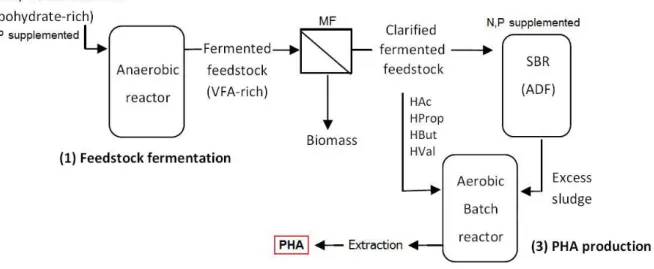
PHA production by MMC from complex feedstocks, such as surplus from different agro-industrial sectors, is based on a three-step process, comprising: (1) acidogenic fermentation of carbohydrate-rich feedstocks to organic acids (OAs); (2) PHA storing culture selection and biomass
OAs PHA %O2
µ
FEAST FAMINE FAMINE
Time OAs,
PHA, µ
6
the first stage; and (3) PHA production with the selected culture and the organic acids produced in the previously stages. The physical separation of the culture enrichment and PHA production stages allows the optimization of the process, since different optimal conditions were shown to be required in each step (Johnson, 2010). PHA produced in the accumulation step is then extracted and purified (Albuquerque, 2009).
Figure 1.3 presents a scheme of the three-step process for PHA production by mixed microbial.
Figure 1.3 – Three-step process for PHA production by mixed microbial cultures from waste streams (adapted from Albuquerque, (2009)).
Acidogenic Fermentation
Carbohydrates are the main constituents of waste feedstocks used in the three-step PHA production process by MMC. However, they cannot be directly process in PHAs. In fact, PHA-accumulating organisms do not store sugars as polymer but rather as glycogen (Carta et al., 2001). Therefore, a previous anaerobic phase is necessary to convert sugars into OAs, the precursors of polyhydroxyalkanoates. (Figure 1.3 - stage 1), (Bengtsson et al., 2008; Albuquerque, 2009).
organic acids profiles can be attained and, consequently, the composition of PHA produced in later stages (Albuquerque, 2009).
ccumulating Culture election
The second stage of the three-step process for PHA production by MMCs is the culture enrichment on PHA-accumulating organisms using alternating presence and absence of the carbon source, feast/famine (F/F) periods, respectively, as selective pressure (Johnson, 2010; Jiang, 2011). Indeed, the effectiveness of this stage is determinant for the development of stable and highly adapted mixed culture to F/F regime, with a high PHA storage capacity. Therefore, the first aim of this stage is to sustain a high selective pressure for favoring a PHA-storing culture and avoiding non-storing organisms, which have a negative impact not only in PHA productivity, but also on the downstream processing, increasing polymer extraction costs (Albuquerque, 2009; Reis et al., 2011).
A second goal of the selection stage is to produce the enriched culture for the following PHA accumulation stage. Therefore, higher biomass volumetric productivities are desirable. Despite PHA production by MMCs have been increasing in terms of specific storage rates, PHA contents and storage yields, the volumetric productivities attained by MMCs still fall short when compared to those obtained with pure cultures. Indeed, the use of feast and famine conditions to carry out culture
selection limits the culture’s primary metabolism (cell rowth). Therefore, lower cell densities and
volumetric productivities are observed in PHA production stage (Reis et al., 2011).
The most common reactor type used for biomass enrichment step is the SBR, which is ideal to achieve the feast-famine conditions regime in a continuous mode (Johnson, 2010). Each SBR cycle consists, usually, of four discrete periods: (1) fill, in which reactor is filled up with fresh medium; (2) aerobiosis, when feast and famine regime occurs; (3) settling phase, when the reactor is not aerated, nor stirred; and (4) exhausted supernatant withdrawal (Johnson, 2010; Reis et al., 2010). The common values of operating parameters used for PHA-accumulating enrichment culture in MMC processes are: 1 - 20 days of sludge retention time (SRT), 1.8 - 31.25 g/L.d of organic loading rate (OLR), 0.18 - 2.7 g/L of substrate concentration, 10 - 140 C-mol/N-mol C/N ratio, pH between 7 and 9, and 2 to 12 h of SBR cycle (Albuquerque, 2009).
Factors that affect mixed microbial culture selection under FF
conditions
8
The amount of substrate supplied, and consequently the OLR, is a critical factor to the effectiveness of PHA-accumulating culture selection. Indeed, in order to select microbial cultures with high storage capacity, the SBR has to be operated at higher OLR. However, if OLR is too high, the F/F ratio is diminished, which suggests the needed of an optimal OLR to be found (Vilano et al., 2010). Albuquerque, et al. (2007) studied the effect of OLR on a SBR operated without pH control, 12h cycle, SRT of 10 day, 25ºC, 1.4 and 2.5 N-mmol/L, and two OLR of 120 and 60 C-mmol/L.d. The authors demonstrated that PHA storage capacity was lost at higher OLR for similar cycle length and nutrient conditions resulting in inhibition by high substrate concentration (Serafim, et al. 2008; Albuquerque, 2009).
F/F ratio is directly related with the changes on OLR and influent substrate concentration. If the OLR or substrate concentrations are low (lower F/F ratios) the fast PHA-storing microorganism will be enough to quickly remove substrates and store it as PHA, and a feast/famine regime will be established. Consequently, these microorganisms will be better fit to survive the starvation phase (famine). On the other hand, if OLR or substrate concentrations are too high, resulting in high F/F ratios, PHA-storing microorganisms will not be able to quickly remove all available substrate (PHA saturation) allowing non-storing microorganisms to grow unconstrained during the feast periods. In this manner, the competition among these organisms will be based on culture growth, and not on the PHA storage capacity. Thus, the selective pressure favouring storing microorganisms will be partially lost (Dionisi, et al. 2006; Alkaya and Demirer, 2010; Albuquerque, et al. 2011; Reis, et al. 2011; Arroja, 2012) studied the effect of OLR (in the range of 8.5-31.25 g-COD/L.d, and F/F ratios range 0.10-1.15 h/h, respectively) on the performance of SBR culture selection, using a mixture of acetic, lactic, and propionic acids. The authors showed a growth response at higher OLR and, consequently, F/F ratios higher than 0.9 h/h. On the other hand, at lower OLR values (F/F ratios up to 0.26 h/h) a storage response was observed. Albuquerque, et al. (2011) studied the effect of influent substrate concentration (30 to 60 C-mmol VFA/L) on the selection PHA-storing culture, using fermented sugar cane molasses. A similar trend was showed and the predominant storage response was observed at lower influent substrate concentration (1.6 g-COD/L), which resulted in a low F/F ratio, 0.21 h/h.
The effective growth rate of a culture is given by the reciprocal of the SRT (Reis et al. 2011). Thus, a lower SRT can be representative of a higher growth rate, which means that a higher fraction of the substrate is being used for growth, instead of storage polymer. Beun J. et al., (2002) confirmed this assumption, and observed that, for SRTs lower than 2 days, a polymer storage yield and productivity decreased sharply with the decreasing SRT. On the other hand, a SRT higher than 2 days and for specific acetate uptake rates over 0.3 C-mol/C-molX.h, the PHA yield from acetate under excess nutrients was constant (reviewed by Albuquerque, 2009)
will have two major competitive advantages: the faster rate of substrate uptake during feast enables them to rapidly deplete the limited available carbon substrate, while the presence of nutrients throughout the full cycle offers the possibility of growth at an almost constant rate (using the intracellular polymer) (Johnson, 2010; Reis et al., 2011).Consequently, volumetric productivity will increase with decreasing C/N ratio (Reis et al., 2011).
The majority of studies performed with MMC under feast and famine conditions have demonstrated an increase of pH during feast phase, as result of organic acids uptake, until a stabilized value (Albuquerque, 2009). Villano et al., (2010) investigated the effect of pH, over the 7.5 to 9.5 range on PHA production by mixed cultures enriched in a SBR using a mixture of acetate and propionate as substrates. Higher polymer production rates and yields were shown when the pH was controlled at 7.5, and those parameters have decreased as pH increased to 9.5. Chua et al., (2003) also studied the effect of pH on culture selection, using acetate as carbon source. It was observed that cultures acclimatized under pH 7 and 8 conditions in SBRs exhibited similar PHA storage capability. However, in PHA production assays, pH value influenced significantly the PHA accumulation behavior of the culture. The authors have shown that when pH of batch experiments was controlled at 6 or 7, a very low PHA production was observed. On the other hand, the production of PHA was stimulated when pH was kept at 8 or 9.
PHA-accumulation stage
The PHA accumulation step is strongly dependent of good optimization of the previous PHA-accumulating selection stage since it is in this step that the performance of the stable enriched PHA-accumulating organisms will be evaluated. This stage is carried out in a fed-batch mode under external or internal limiting conditions, such as lack of nutrients or lower RNA enzyme levels, respectively. In this manner, if at the same time, an excess carbon source is available, maximization of PHA storage can be achieved (Albuquerque, 2009).
Attempting to improve the performance of the selected PHA storage culture and adjust the polymer composition to final application, lead several authors to study different strategies to maximize PHA production and its stability as polymer (Dionisi et al., 2005; Beccari et al., 2009; Bengtsson et al., 2010; Johnson K., 2010; Albuquerque et al., 2011).
Albuquerque et al., (2011) studied the effect of substrate composition and, feeding regime (continuous or pulses) on a PHA production stage, using sugar cane molasses as feedstock. The authors have shown that if a continuous feeding strategy was used in PHA production rather than a pulse feeding mode, higher substrate uptake rates and polymer storage yields were observed, mainly due to the constant residual substrate concentration in the reactor when a continuous feeding regime was applied. Moreover, the use of continuous feeding regime increased the percentage of HV monomer in the final polymer composition. Therefore, a variety of polymer structures were synthetized, which subsequently resulted in different polymer properties for different applications.
10
authors have shown that maximum productivities in PHA production stage were obtained at the same pH used for enrichment PHA accumulation culture selection stage or, at a slightly higher value (pH 7.5 and 8.5). Thus, it was demonstrated that each culture performs optimally close to its respective optimum pH value (Reis et al., 2011).
The PHA accumulation stage finishes with the polymer recovery. Several methods for PHAs extraction have been studied. The most common is the extraction of PHAs with organic solvents, such as chloroform, dichloroethane, propylene carbonate and methylene chloride. However, the large amount of solvent required and the toxic nature of the chemical compounds used in the extraction makes this method economically and ecologically unattractive (Albuquerque, 2009; Reis, et al. 2011).
1.3. Substrate selection: a critical factor of polyhydroxyalkanoates
production
PHAs can be applied in several industrial sectors, namely, medicine, agriculture, pharmacology, food industry and engineering. However, the substrate selection is a critical factor for its production since the quantity to use, the type of substrate, the quality of the same and the cost, changes for each application. Furthermore, feedstocks constitute the major cost in PHA production and influence the bacterial performance and the final product. Thus, a good approach in the selection of the substrate must consider all these factors (Volova, 2004; Chee, et al. 2010b).
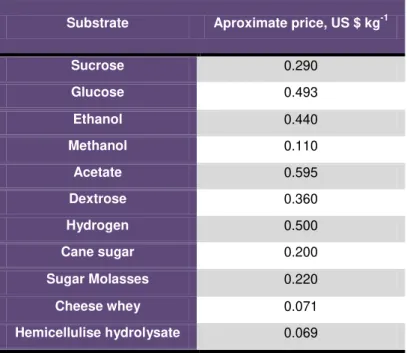
Microorganisms are capable of producing PHA from various carbon sources such as complex waste effluents of various industries (cheese way, molasses, etc.) as well as simple compounds like alcohols, carbohydrates, acids, sugars and carbon dioxide. In this manner, the amount of industrial wastes that are discharged every year in landfills and marine environments can be utilized as carbon source, which contribute not only for a reduction of substrates costs and, consequently, the cost of PHA, but also for lowering the costs of waste disposal (Volova, 2004; Chee et al., 2010b).
Table 1.2 – Substrate cost (Volova T. G., (2004)).
Substrate Aproximate price, US $ kg-1
Sucrose 0.290
Glucose 0.493
Ethanol 0.440
Methanol 0.110
Acetate 0.595
Dextrose 0.360
Hydrogen 0.500
Cane sugar 0.200
Sugar Molasses 0.220
Cheese whey 0.071
Hemicellulise hydrolysate 0.069
PHA production from waste streams is confronted with other problems, i.e., the availability of
the feedstock during an entire production year. In fact, some waste streams are seasonal. In this manner, for the planning and design of the PHA production facilities it is crucial to consider the seasonal availability of the waste-based feedstocks.
o
Sugar Molasses
Sugar molasses is a liquid residue resultant of the condensation of sugar cane or sugar beets until crystal precipitate. The high sugar content, 48 to 50 %, is result of the presence of glucose, sucrose and fructose. Also water and polysaccharides (dextrin, pentosans, polyuronic acids) are constituents of sugar molasses, ranging between 17 to 25%, and 2 to 5%, respectively (Arroja L., (2012)).
About 145 million sugar tons are produced worldwide each year. In 2004, the global sugar production generated about 39 million tons of sugar cane molasses and 12 million tons of beet
molasses, which generates environmental residues
12
o
Cheese Whey
Cheese whey is a major by-product of cheese-manufacturing or casein from bovine milk. It represents 80 to 90% of the total volume of milk transformed and retains 55% of milk nutrients. Lactose (4.5 – 5 (%w/w)), lipids (0.4 – 0.5 (%w/w)) soluble proteins (0.6 – 0.8 (%w/w)) and mineral salts (8 – 10 (%w/w)) are the main constituents of cheese whey. However, only lactose, lipids and soluble proteins are fermentable (Siso, 1986; Farinha, 2009). In 2000, in the European Union 6.385.000 tons of cheese were produced, resulting in 40.5 million tons of whey. Despite 67% of this whey is used for the production of animal feed, the remaining 33%, which represent 13.5 million tons of whey, constitute a serious disposal problem for the dairy industries (Koller, 2008; Farinha, 2009).
Chapter II
–
Thesis Motivation and Outline
2.1. Thesis Motivation
Plastics are one of the main sectors of application for crude oil. They have become an important commodity of quotidian life and in almost all industries. However, these petroleum based-products are the most contributors to the millions of tons of wastes accumulated every year in the environment. Bioplastics, such as PHAs, offer the best possible response to the problematic of conventional plastics harmful effects.
In the last decade, alternative pure cultures PHAs production processes, aiming to substantially decrease their cost, have been developed. Such alternative processes include the use MMCs which do not required sterile conditions.
One big advantage of MMC PHA production processes is that cultures can use a range of low cost complex feedstocks, such as agricultural and industrial residues or by products, namely starch, tapioca hydrolysate, cheese whey, sugar cane molasses, malt, and soy (Dias et al., 2006). Furthermore, from their acidogenic fermentation can result different OAs profiles. Consequently, a variety of polymer compositions can be achieved and their utilization in different applications sectors will be possible. However, many of these industrial wastes are seasonally produced creating serious difficulties concerning to the sustainability of production of this polymer. In fact, the quality and the polymer composition cannot be guarantee under these conditions. It is thus important to study MMC’s response to different feedstocks accordin its availability durin the year.
2.2. Dissertation Objectives
In the last few years, more cost-effective mixed microbial PHA production processes have been studied by several authors. Nevertheless the considerable effort and knowledge gathered on PHA storage by mixed cultures, a question remain without an answer, namely if the MMC will be capable to adapt its metabolism to a feedstock shift.
By mimicking a seasonally feedstock modification the major goals of this thesis were:
(1) to study the individual effects on each of the three-stage processes. For that purpose, two waste-based feedstocks, cheese whey and sugar cane molasses, were used as model feedstocks with different composition.
(2) to understand how a feedstock shift affects agro-industrial waste acidogenic fermentation. Cheese whey and sugar cane molasses were used as model feedstock on OAs production.
(3) To assess the effect of clarified fermented substrates (fCW and fSCM), produced in acidogenic fermentation, or a synthetic OAs solution shift on PHA-accumulating culture selection reactor performance;
2.3. Thesis Outline
This thesis is composed of four chapters, including an overview of the state of the art on PHA production (Chapter I) and the motivation and outline of the work developed (Chapter II). The following chapters include the description of the work developed in order to accomplish the objectives of this thesis (Chapter III and IV).
The state of the art (Chapter I) starts by mirroring the dependency of the world on petroleumbased byproducts, their environmental impact, and the importance of bioplastics development as a possible solution. It then focuses particularly on PHAs, describing their mechanical, physical and thermal properties, as well as their application sectors. In the second section, the current biotechnology industrial approach to PHA production by MMC, and an overview of PHA production mechanisms by open culture systems, enriched in PHA-accumulating organisms solely by operational conditions imposed on the reactor are described. Finally, in the third section the importance of using low cost carbon sources is described.
Chapter III presents the impact of a feedstock shift, using cheese whey and sugar cane molasses, on anaerobic fermentation, the first step of the 3-stage MMC PHA production process.
Chapter III
–
Acidogenic fermentation of cheese whey and sugar
cane molasses: feedstock shift impact on organic acids production
3.1. Introduction
Several industrial wastes (e.g., effluent paper mill, cheese whey, sugar cane molasses, etc.)
represent a significant loss of resources and a serious pollution problem (Saddoud et al., 2007). However, due to their high organic content, numerous microbial species, through their fermentative metabolic processes (hydrolysis, acidification, acetogenesis and methanogenesis) and under anaerobic conditions, can convert them into organic acids (OAs) (propionic, butyric, acetic, valeric and lactic acid) and other fermented products such as alcohols, carbon dioxide, and methane (Saddoud et al., 2007; Bengtsson et al., 2008). This process commonly designated as anaerobic digestion, consists: primarily in the conversion of carbohydrates to organic acids by acidogens; further OAs are converted by acetogens to acetate and H2/CO2; finally methanogens convert acetate
and H2/CO2 into methane (Saddoud et al., 2007; Bengtsson et al., 2008; Yu et al., 2008). In
anaerobic digestion, acid forming and the methane forming organisms differ widely in terms of physiology, nutritional needs, growth kinetic, and sensitivity to environmental conditions (Chen et al., 2008; Arroja et al., 2012). Therefore, in order to maintain an anaerobic sludge with a high metabolic activity to favor either OAs or biogas production, it is necessary to apply favorable environmental conditions. Among these factors are temperature, pH, the absence of toxic materials, hydraulic retention time (HRT), availability of nutrients and substrate type (Fang and Yu, 2001; Rajagopal and Béline, 2011). Fang H. and Yu H., (2001) have investigated the individual effects of pH and temperature on the acidification of a wastewater containing lactose as sole carbon source. It was concluded an optimum acidification of lactose at pH 5.5 and 55 ºC, which could indicate inhibition of methanogenic fermentation. In fact, methanogenisis requires a pH near the neutral value (6.5 < pH < 7.5), therefore a decrease in pH might lead to a reduction of the methane production rate and further accumulation of acids (Fang and Yu, 2001). Bengtsson et al., (2008) have studied the influence of HRT in acidogenic fermentation performance of whey and paper mill effluents. The authors have shown that the produced volatile fatty acids (VFA) composition profile was strongly affected with the increasing of HRT above 10h, since butyrate production decreased and propionate production increased. Rajagopal R. and Béline F., (2011) have developed a biochemical test to characterize the hydrolytic potential of various organic wastes (secondary sludge, pre-treated sludge, pig and cattle slurries). It was observed that the performance of hydrolysis and acidification steps is considerable dependent of the nature of substrate. Secondary sludge was the substrate which produced higher amount of OAs.
20
to PHA final cost. Low value feedstocks utilization (wastes and agro-industrial effluents) effectively reduces the negative economic impact on PHA production. However, some waste streams are seasonally available which is crucial to consider on organic acids production.
The aim of this work was to study how OAs production process was affected by feedstocks shift, mimicking a seasonal availability of substrates. Two agro-industrial waste/surplus feedstocks, cheese whey and sugar cane molasses, were used as feedstock.
3.2. Materials and Methods
3.2.1. Feed preparation
In this study, sugar cane molasses (SCM) and cheese whey powder (CW) were used as substrate for organic acids (OAs) production. These wastes/surplus based feedstocks were obtained from Refinaria de Açúcares Reunida (RAR, Porto), and from Lactogal (Porto), respectively.
SCM has a very high sugar content, 54 % (w/w M), consisting mainly of sucrose (62%) and fructose (38%) (Albuquerque et al., 2007). On the other hand, cheese whey powder is composed by 78 % (w/w CW) of lactose, 13.62 % (w/w CW) of protein and 1.21 % (w/w CW) of lipids (source: Lactogal).
Both carbon substrates were diluted with tap water in order to obtain a final sugar concentration of ca. 15 g/L, and were kept at 4 ºC in a continuously stirred vessel. The SCM medium was supplemented with a micronutrients solution which is necessary for biomass growth. Therefore, NH4Cl (0.10 g/L), and KH2PO4 (0.08 g/L) were supplied as source of ammonia and phosphate,
respectively. Due to their high protein content, CW was not supplemented with nutrients.
3.2.2. Acidogenic fermentation reactor set up and operation
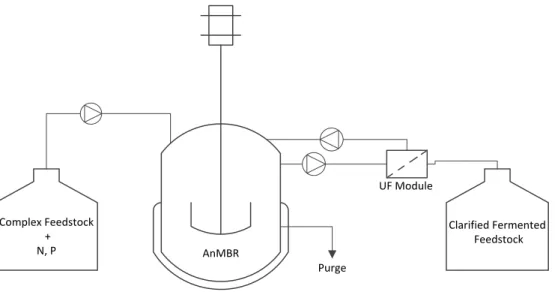
Acidogenic fermentation was performed in a laboratory scale anaerobic membrane bioreactor (AnMBR) (Figure 3.1) which consisted on a reactor with a working volume of 1250 ml coupled to an ultrafiltration hollow fiber membrane module (5 x 10⁵ MW cut-off). Stirring was kept on 200 rpm being performed with magnetic stirrers and feeding with a peristaltic pump. CW and SCM feed solutions flow rates were adjusted to keep the reactor HRT at 1 day and an OLR of 15 g Sug/L.d.
culture selection SBR (stage 2) or in PHA batch accumulation assays (stage 3). Sampling was taken daily from the reactor, in order to monitor sugars, organic acids (and other possible fermentation products), proteins, ammonia, phosphate, and biomass from volatile suspended solids (VSS). In the latter it was considered that all VSS were biomass and the volatile compounds contributor was despicable.
AnMBR Complex Feedstock
+ N, P
Clarified Fermented Feedstock UF Module
Purge
Figure 3.1- Acidogenic Fermentation set up.
3.2.3. Analytical Procedures
Ammonium concentration was measured in filtered samples (0.45 µm) with IDS3000 DIONEX ion chromatograph, equipped with a conductivity detector and a CSRS 300 (4 mm) DIONEX self-regenerating suppressor, and a IonPac CS16 column and a IonPac CG16 pre column (column temperature 30 ºC, methanesulfonic acid 48 mM eluent, flow rate 1 mL/min). A calibration curve was obtained with NH4Cl standards (0.6-6 Nmmol/L).
Biomass concentration was measured as volatile suspended solids (VSS) concentration according to Standard Methods (APHA 1995).
22
Protein content was determined spectrophotometrically at 750 nm as described by Lowry H. et al., (1951). Bovine serum albumin was used as calibration standard (20-200 mg/l).
Chemical oxygen demand (COD) and total nitrogen (TNb) were analyzed using cuvette test
kits (Hach-Lange, Germany).
Total sugars were determined by two different spectrophotometric methods due to the different characteristic of feedstock, namely, the color. In SCM were used the method as described Morris, (1948) with modifications by Koehler, (1952), Bailey, (1958) and Gaudy, (1962). Sucrose standards (0-100 mg/l) were used to determine total sugars. Absorbance was measured at 625 nm. On the other hand, sugars in CW feed were determined as described Dubois M. et a., (1956), using D-Lactose monohydrated as calibration standard (0-200 mg/L), instead of D-glucose monohydrated. Absorbance was measured at 490 nm.
Phosphate was analyzed by segmented flow analysis as described by (Carvalho et al., 2007).
3.2.4. Calculations
The degree of acidification (DA in %(g-COD OAs/g-COD S)) was calculated by the total organic acids (TOAs) produced divided by the waste surplus feedstock influent soluble COD (SCOD).
[1]
The OAs yield (YOAs in g-COD OAs/g-COD S) was calculated as amount of the OAs
produced divided by the amount of substrate consumed.
[2]
The specific substrate uptake rate (-qS in g-COD S/gVSS h) and OAs production rate (qOAs in
g-COD OAs/gVSS h) were determined by applying individual mass balances to the reactor:
[3]
[4]
Organic acids volumetric productivity (, in g-COD OAs/L.d) was calculated by the total OAs produced multiple by dilution rate.
∑
[5]The quantity of protein (Prot) removed for culture growth (in %(g/g)) was calculated by dividing the variation of protein inlet (TProIN) and protein outlet of the reactor (TProR) by the total
protein inlet:
[6]
Total protein removal (in %(g/g)) was calculated by dividing the variation of protein inlet (TProIN) and the protein in the permeate (TProP) by the total protein inlet:
[7]
Organic acids profile (in %(g-COD HA/g-COD OAs)) was obtained by fraction of each hydroxyl acid produced in relation to total OAs concentration (TOAs):
[8]
3.3. Results and Discussion
Initially, the anaerobic MBR was operated under steady state with CW (StSt1). Subsequently, the feedstock was changed to sugar molasses, and the anaerobic culture adaptation was assessed until steady state was reached (StSt2). Finally, molasses was replaced by CW, and physiological adaptation of anaerobic culture was again evaluated until stability (StSt3). In this manner, the performance of anaerobic mixed culture to a substrate shift was monitored over the time in terms of OAs production rate, cell growth, sugars uptake rate, and organic acids profile.
3.3.1. Anaerobic fermentation response to a waste/surplus based
feedstock shift
Figure 3.2 shows the organic acids production performance for the different feedstock periods. It was observed that, when CW was replaced by sugar cane molasses there was an adaptation period of about 10 to 15 days until the system reached steady state. This behavior is quite notorious between 17 and 30 days when total organic acids produced range from 8.99 to 14.53 g-COD OAs/l, respectively. In the steady state a total OAs produced of 14.8 g-COD OAs/l was obtained. On the other hand when molasses was replaced by CW, a faster adaptation response was observed. Seven days were necessary for steady state to be reached (between days 91 and 98). TOAs of 9.1 g-COD OAs/l was produced which was similar to the first period of CW (StSt1), 8.5 g-COD OAs/l. This response can be explained by the fact that AnMBR was initially operated with CW, which may have caused a selective pressure favoring organisms that convert the main carbohydrate (lactose) into OAs. Arroja et al., (2012) have studied acidogenic valorisation of high strength wastes products, such as molasses, and cheese whey, in anaerobic moving bed biofilm reactors. The effect of inoculums type was studied, i.e., distinct anaerobic biomass was used, namely, acidogenic sludge
26
(A)
(B)
(C)
Figure 3.2 – Organic acids concentration profile during the AnMBR operation, (A) Acetic acid (HAc), and Butiric acid (HBut); (B) Valeric acid (HVal), and Propionic acid
(HProp); (C) Lactic acid (HLac), and Total organic acids (TOAs).
In both periods of acidogenic fermentation of CW (StSt1 and 3) outliers of Lactic acid were observed (Figure 3.2 (C)). These peaks were resulted of system disturbances which can be explained by electrical outages, temperature (T) and pH upsets. In fact, whenever culture was perturbed in terms of T or pH, it produces during a shorter period of time lactate. Therefore, these results were not considered on parameters calculations.
Even though the anaerobic culture showed the need of a period of acclimatization, when subjected to a feedstock shift, the capacity to adapt its metabolism to this modification was clear.
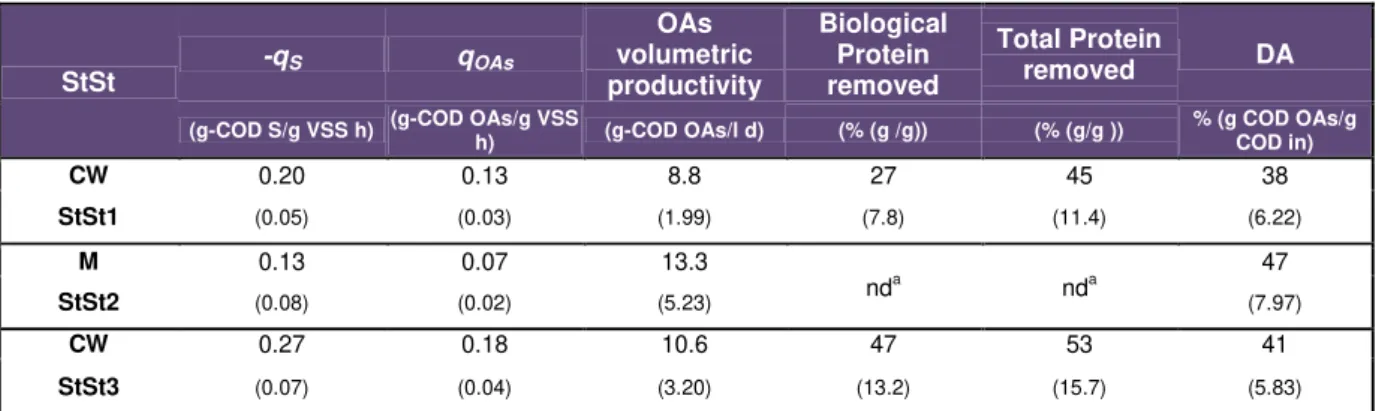
Average substrate uptake (-qS) and organic acids production (qOAs) rates did not vary
significantly with the feedstock shift (Table 3.1). Nevertheless, when CW replaced SCM (StSt3) slightly higher specific rates were observed compared to the first period of CW feeding (StSt1);
CW SCM CW
CW SCM CW
substrate uptake rate and organic acids production rate increased from 0.20 to 0.27 g-COD S/g VSS.h and from 0.13 to 0.18 g-COD OAs/g VSS.h, respectively. These specific substrate conversion rates are consistent to that reported by Bengtsson et al., (2008), 0.31 g-COD S/g VSS.h, in the acidogenic fermentation of whey at pH 6.0 and a HRT of 50 hours (2.1 days). However, these rates are lower than the maximum value reported by Kissalita et al., (1989) and Yu and Pinder, (1993) for acidification of lactose, 1.5 and 3.0 g-COD/g VSS.h, respectively.
In terms of organic acids conversion yields (YOAs) the AnMBR reached 0.52 to 0.59 g-COD
OAs/g-COD S for the acidogenesis of CW, and 0.69 g-COD OAs/g-COD S (or 0.58 C-mmol OAs/C-mmol S) for anaerobic digestion of CW and SCM (Table 3.2). The increase on OAs yield from anaerobic digestion of molasses compared with fermentation of CW can be explained by the differences between substrates composition. In fact, wastes from food industry are rich in organic matter and ideal for acidogenic fermentation. However, the anaerobic fermentation of these substrates may be hindered by the presence of various inhibitors such as proteins, mineral salts (Na, K, Mg, C, and Al), etc (Chen, 2008). The obtained sugars conversion yield of acidogenic fermentation of sugar cane molasses is similar to which has been reported by Albuquerque et al., (2007). The authors have developed a three-stage process to produce PHAs from sugar cane molasses. In this process the effect of pH on molasses acidogenic fermentation step operated in a CSTR at different pH values (7, 6, and 5) and a HRT of 10 hours were studied. Organic acids conversion yields of 0.63 – 0.75 C-mol VFA/C-mol S were observed. Bengtsson S. et al., (2008) have reported organic acids conversion yields of 0.74 - 0.87 g-COD OAs/g-COD S as result of acidogenic fermentation of CW (without protein and mainly composed by lactose (86%)). These results are considerably higher compared to which was obtained in this work, mostly due to differences of cheese whey.
.
Table 3.1 – Effect of feedstock shift on the MBR performance in steady state.
StSt -qS qOAs
OAs volumetric productivity Biological Protein removed Total Protein
removed DA
(g-COD S/g VSS h) (g-COD OAs/g VSS
h) (g-COD OAs/l d) (% (g /g)) (% (g/g ))
% (g COD OAs/g COD in)
CW 0.20 0.13 8.8 27 45 38
StSt1 (0.05) (0.03) (1.99) (7.8) (11.4) (6.22)
M 0.13 0.07 13.3
nda nda 47
StSt2 (0.08) (0.02) (5.23) (7.97)
CW 0.27 0.18 10.6 47 53 41
StSt3 (0.07) (0.04) (3.20) (13.2) (15.7) (5.83)
Standard deviation);a
nd: not detected
28
to 13.3 g-COD OAs/l d, respectively. These results were mainly due to the increase on propionic acid concentration (from 1.2 to 4.6 g COD/l). Acetate (HAc) was the main concentrated organic acid obtained from CW acidogenesis, making up 65 % to 69 % of the TOAs produced, StSt3 and StSt1, respectively. In fact, in the both periods of acidogenic fermentation of CW similar organic acids profiles were obtained which demonstrate that the system performance is reproducible. When molasses was fed to the AnMBR, a great change on the organic acids profile was observed. Propionate (HProp) was predominant, constituting 38% of the TOAs concentration. Further, butyrate (HBut) increased from 0.16 to 0.19 g-COD HA/g-COD OAs, while valerate (HVal) from 0.04 to 0.19 g-COD HA/g-COD OAs. The differences observed were most likely due to the different composition in organic matter of both feedstocks. The high fermentablility observed for molasses was expected since the organic fraction is dominated by sugars (fructose and sucrose) (Albuquerque, 2009).
Table 3.2 – MBR operating conditions and general performance in the steady state (StSt).
StSt VSS ORL HRT SRT YOAs
Total Organic acids concentration profiles
OAs HAc HProp HBut HVal HLac
(g/l) (g-COD/l h) (d) (d) (g-COD OAs/ g-COD S) (g-COD/l) (g-COD HA/g-COD OAs)
CW 3.6 16.42 1.0 2.7 0.52 8.5 0.69 0.11 0.16 0.04
nda
StSt1 (0.50) (2.70) (0.10) (0.6) (0.05) (1.20) (0.07) (0.09) (0.10) (0.05)
M 6.5 16.66 1.0 3.3 0.69 14.8 0.24 0.38 0.19 0.19
nda
StSt2 (1.80) (4.96) (0.10) (1.6) (0.14) (3.50) (0.03) (0.07) (0.05) (0.05)
CW 2.6 15.20 0.9 2.7 0.59 9.1 0.65 0.10 0.22 0.02 0.01
StSt3 (0.80) (1.64) (0.10) (0.9) (0.15) (2.00) (0.09) (0.06) (0.10) (0.01) (0.01) *values in the brackets are standard deviation; and: not detected
One of the most important parameters of acidogenic fermentation, which is acidification degree (DA), compares the proportions of substrates converted into OAs (Arroja et al., 2012) This parameter was calculated for each period of substrate fermentation in order to express the acidification efficiency of the anaerobic cell culture when subjected to a feedstock shift (Table 3.1). Acidification degrees of both substrates did not vary significantly and values between 38 and 47 % g-COD OAs/g-g-COD S were observed. These results are consistent with those obtained by Arroja et al., (2012) for acidogenic fermentation of high strengh waste products including CW and molasses (DA between 30 and 65% g-COD OAs/g-COD sug).
Figure 3.3 presents the AnMBR volatile suspended solids variation during the feedstock shifts. An increase on biomass concentration was observed between day 18th and 45th when
shownt) of protein was consumed. Therefore, the anaerobic mixed culture might be nitrogen deficient which limits the culture’s rowth (Albuquerque, 2009; Reis et al., 2011; Rajeshwari, 2000).
Figure 3.3 – Effect of feedstock shift on volatile suspended solids during the MBR operation.
Anaerobic fermentation appears to be suitable for valorization of wastewater streams of agro-industry as substrates for production of polyhydroxyalkanoates. Monomer composition of PHAs from a known OAs profile concentration can be anticipated (Dias et al., 2006; Bengtsson et al., 2008; Serafim et al., 2008; Arroja et al., 2012; Albuquerque, 2009). In this manner, considering propionate and valerate are the organic acids precursors of the HV monomer, it is expected that the PHA produced from the fermented molasses obtained have a high percentage of this monomer in its composition. Similarly, acetate and butyrate (HB precursors) were the main organic acids produced of CW fermentation. Thus, it is expected HB as principal constituent of the PHA produced from clarified fermented CW.
30
3.4. Conclusion
The effect of feedstock shifts in the acidogenic fermentation performance of an anaerobic mixed microbial culture was investigated. Two different agro-industrial waste/surplus feedstocks, cheese whey, and sugar cane molasses, were used in organic acids production.
The main conclusion observed in this study was the capacity of anaerobic mixed cultures to adapt their metabolism to a waste/surplus based feedstock shift. However the need for biomass acclimatization to each substrate was demonstrated.
CW and sugar cane molasses were simultaneously converted to organic acids in acidogenic fermentation reactor with considerable acidification degrees (38-47%).
In terms of TOAs concentration and volumetric productivities, an increase of both parameters was observed when SCM replaced CW.
The composition of fermented feedstocks, regarding organic acids, was significantly affected by the substrate shifts. For whey, the main fermentation products were acetate and butyrate. On the other hand, when molasses was fed, a drastic modification in organic acids composition was observed. Propionate was the main concentrate organic acid (0.35 C-mol HA/C-mol OAs) followed by acetate and butyrate (0.20-0.25 C-mol HA/C-mol OAs).