Conflict Against a Central Authority:
from Mechanisms to Complex Behaviour
A Thesis presented in partial fulfillment of the Requirements
for the Degree of Doctor of Philosophy in
Complexity Sciences
By
Carlos Miguel Reis Silva de Oliveira e Lemos
Thesis advisor: Professor Rui Jorge Lopes
Thesis co-advisor: Professor Helder Manuel Ferreira Coelho
Conflict Against a Central Authority:
from Mechanisms to Complex Behaviour
Carlos Miguel Reis Silva de Oliveira e Lemos
Jury Members:
Doctor Ernesto Jorge F. Costa, Full Professor, University of Coimbra, Portugal Doctor Helder Manuel F. Coelho, Full Professor, University of Lisbon, Portugal Doctor Francisco C. Santos, Associate Professor, University of Lisbon, Portugal
Doctor Lu´ıs Antunes, Assistant Professor, University of Lisbon, Portugal Doctor Rui J. Lopes, Assistant Professor, Instituto Universit´ario de Lisboa, Portugal
Doctor Pedro Magalh˜aes, Researcher, University of Lisbon, Portugal
President of the Jury:
Doctor Jorge Lou¸c˜a, Assistant Professor, Instituto Universit´ario de Lisboa, Portugal
In this work, an Agent-Based model of large scale conflict against a central authority was developed. The model proposed herein is an extension of Epstein’s Agent-Based model of civil violence, in which new mechanisms such as deprivation-dependent hardship, generalised vanishing of the risk perception (‘massive fear loss’) below a critical ratio between deterrence and ‘group support’, legitimacy feedback, network influences and ‘mass enthusiasm’ (contagion) were implemented. The model was explored a set of computer experiments and the results compared with statistical analyses of events in the “Arab Spring”.
The main contributions of the present work for understanding how mechanisms of large scale conflict lead to complex behaviour were (i ) a quantitative description of the impact of the “Arab Spring” in several countries focused on complexity issues such as peaceful vs violent, spontaneous vs organized, and patterns of size, duration and recurrence of conflict events; (ii ) the explanation of the relationship between the estimated arrest probability and the size of rebellion peaks in Epstein’s model; (iii ) a new form of the estimated arrest probability with a mechanism of ‘massive fear loss’; (iv ) the derivation of a relationship between the legitimacy and action threshold for complex solutions to occur with both low and high values of the legitimacy; (v ) a simple representation of political vs economic deprivation with a parameter which controls the ‘sensitivity’ to value; (vi ) the effect of legitimacy feedback; and (vii ) the effect of network influences on the stability of the solutions.
Keywords: Social Conflict, Complexity, Mechanisms, Agent-Based Model, Social Simulation, “Arab Spring”
Neste trabalho, ´e apresentado um modelo baseado em agentes para o estudo do conflito massivo contra uma autoridade central. O modelo proposto ´e uma extens˜ao do modelo baseado em agentes para o estudo da violˆencia civil devido a Epstein, incluindo os mecanismos de rela¸c˜ao entre a priva¸c˜ao relativa e ‘prova¸c˜ao’ (hardship), o desaparecimento generalizado da percep¸c˜ao de risco abaixo de uma rela¸c˜ao cr´ıtica entre a capacidade de dissuas˜ao e o ‘apoio colectivo’, a retroalimenta¸c˜ao da legitimi-dade em fun¸c˜ao da contesta¸c˜ao, as influˆencias associadas as redes, e o mecanismo do ‘entusiasmo colectivo’ (cont´agio). O modelo foi explorado atrav´es de um conjunto de experiˆencias de simula¸c˜ao, e os resultados comparados com uma an´alise estat´ıstica de eventos ocorridos durante a “Primavera ´Arabe”.
Os principais contributos do presente trabalho foram (i ) a descri¸c˜ao quantitativa do impacto da “Primavera ´Arabe” em diversos pa´ıses, focada em aspectos de complex-idade; (ii ) a explica¸c˜ao da rela¸c˜ao entre a fun¸c˜ao de estimativa de probabilidade de pris˜ao e a magnitude dos picos de revolta social; (iii ) uma nova forma para a fun¸c˜ao de estimativa de probabilidade de pris˜ao, como mecanismo de ‘perda generalizada do medo’; (iv ) a dedu¸c˜ao de uma rela¸c˜ao entre a legitimidade e o limiar de ac¸c˜ao para a ocorrˆencia de solu¸c˜oes com comportamento complexo, tanto para valores elevados como baixos da legitimidade; (v ) uma representa¸c˜ao simples da priva¸c˜ao pol´ıtica e da priva¸c˜ao econ´omica, com um parˆametro regulador da ‘sensibilidade’ ao valor; (vi ) a introdu¸c˜ao do mecanismo de retroalimenta¸c˜ao da legitimidade; e (vii ) o efeito das influˆencias devidas a redes na estabilidade das solu¸c˜oes.
Palavras-chave: Conflito Social, Complexidade, Mecanismos, Modelo Baseado
I wish first of all to express my gratitude to my advisers, Professors Rui Jorge Lopes and Helder Coelho, for their continuous advice and encouragement, as well as for their personal support in some difficult moments during the long process of preparing this thesis.
This work would hardly have been completed without the financial support of the Portuguese Joint Command and Staff College (PJCSC). Thanks are due to Lieutenant-General Xavier Matias of the Portuguese Army, who as Director of the PJCSC always showed the highest consideration and enthusiasm towards my work and gave high priority to funding my participation in several conferences to present papers. Support by the BioISI - Instituto de Biossistemas e Ciˆencias Integrativas, which provided the installations, working conditions and appropriate environment for productive work, is also gratefully acknowledged.
Thanks are due to Professor Bruce Gilley of the Portland State University, for sharing his data on legitimacy and presenting valuable explanations and suggestions for modelling legitimacy feedback in the model developed in this work.
Finally, I thank my wife S˜ao and my daughters Mariana and Marta for their continuous love, support, trust and enthusiasm, without which this work would have never been completed. They were, are and will always be my strongest source of energy and inspiration.
Abstract iii
Resumo iv
List of Tables ix
List of Figures xii
List of Symbols and Abbreviations xx
1 Introduction 1
1.1 Motivation . . . 4
1.2 Purpose and Scope . . . 5
1.3 Objectives and Research Questions . . . 6
1.4 Methodology of Development . . . 7
1.5 Structure of the Work . . . 8
2 Theoretical Foundations 13 2.1 Social Conflict and Violence . . . 14
2.1.1 Social Conflict Theories . . . 14
2.1.2 Violence . . . 17
2.2 Ted Gurr’s Frustration-Aggression Theory on the Psychological Fac-tors of Civil Violence . . . 21
2.3 Gene Sharp’s Theory of Non-violent Action . . . 24
2.4 Social Context. Macro-Scale Variables and Indicators . . . 26
2.5 Indices of Economic Deprivation . . . 29
2.6 Legitimacy . . . 31
2.7 Concluding Remarks . . . 34
3.1 Agent Definitions, Architectures and Rule-Based Models of Binary
Decision . . . 38
3.1.1 Reactive Agents and Agents with Internal State . . . 39
3.1.2 Rule-Based Models of Binary Decision . . . 40
3.1.3 Framework for Presentation and Discussion of ABM . . . 41
3.2 Epstein’s ABM of Civil Violence . . . 41
3.3 Discussion of Epstein’s ABM . . . 45
3.3.1 Scope . . . 45
3.3.2 Measures of Size, Duration, and Interval (Waiting Time) of Outbursts . . . 46
3.3.3 Input Parameters, Scales and Mechanisms . . . 47
3.4 Abstract ABM Based on Epstein’s Model . . . 50
3.4.1 The EMAS Civil Violence Model of Goh and Collaborators . . 50
3.4.2 An ABM of Worker Protest by Kim and Hanneman . . . 50
3.4.3 A Study of Urban Crime by Fonoberova and Collaborators . . 51
3.4.4 Extensions of Epstein’s Model I by Lemos, Lopes and Coelho . 52 3.4.5 The ABM of Violent Political Revolutions by Alessandro Moro 56 3.5 Concluding Remarks . . . 58
4 Analysis of Conflict Datasets & Indicators 61 4.1 Analysis of the SCAD database for the African “Arab Spring” Countries 62 4.1.1 A Note on Geographic Information, Accuracy of the Informa-tion, and Exceptional Events . . . 64
4.1.2 Question 1: How important were demonstrations and riots, in terms of number of events and mobilization (estimated number of participants)? . . . 65
4.1.3 Question 2: Which were the most significant issues (grievance factors) that triggered conflict events? . . . 68
4.1.4 Question 3: Which were the issues, organization and escalation in large demonstrations and riots? . . . 68
4.1.5 Question 4: What were the patterns of recurrence, duration and size of demonstrations and riots? . . . 74
4.2 Analysis of the FSI Indicators for the African “Arab Spring” Countries 84 4.3 Analysis of the Freedom in the World Indicator for the African “Arab Spring” Countries . . . 92
4.4 Analysis of the “All the Ginis” Dataset for the African “Arab Spring” Countries . . . 94
5 Agent-Based Model of Social Conflict 99
5.1 Abstract ABM of Civil Violence. Summary Description . . . 101
5.1.1 Synopsis . . . 101
5.1.2 Model Entities . . . 101
5.1.3 Process Overview and Scheduling . . . 104
5.1.4 Submodels . . . 105
5.1.5 Model Output. R Scripts for Pre- and Post-Processing . . . . 106
5.2 Model Explorations and Computer Experiments . . . 108
5.2.1 Analysis of the Decision Rule in Epstein’s ABM . . . 108
5.2.2 Risk Perception and the Estimated Arrest Probability . . . 119
5.2.3 The Influence of the Jail Term . . . 126
5.2.4 Variable Deterrence in a Scenario of Low Legitimacy . . . 130
5.2.5 Dependence of Hardship on Relative Deprivation . . . 133
5.2.6 Legitimacy Feedback . . . 137
5.2.7 Network Influences . . . 146
6 Conclusions 155 6.1 Synopsis . . . 155
6.2 Contributions to the State-of-the-Art . . . 159
7 Future Work 167 7.1 Improvements of Model Exploration . . . 167
7.2 Improvements of Model Capabilities . . . 169
Bibliography 173 Appendices 183 A ABM of Civil Violence. ODD Description 185 A.1 Purpose . . . 185
A.2 Entities, State variables and Scales . . . 185
A.3 Process Overview and Scheduling . . . 189
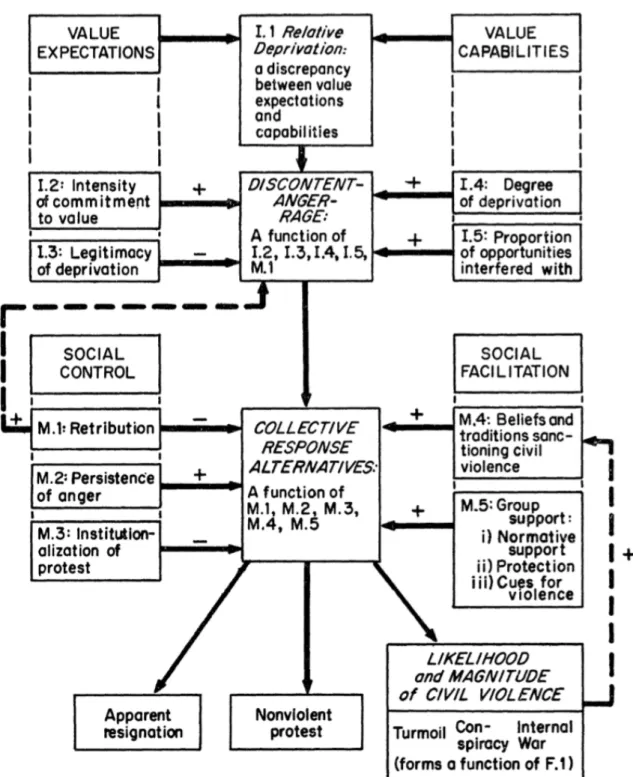
2.1 Ted Gurr’s propositions on the influence of psychological factors in the likelihood and magnitude of civil violence. (Source: Ted Gurr, [49]) 22 2.2 Representative datasets of potential conflict indicators (indices of
political, economic and social factors) and information on conflict events. (Source: author) . . . 27 2.3 Social, Economic, and Political & Military sub-indicators of the FSI.
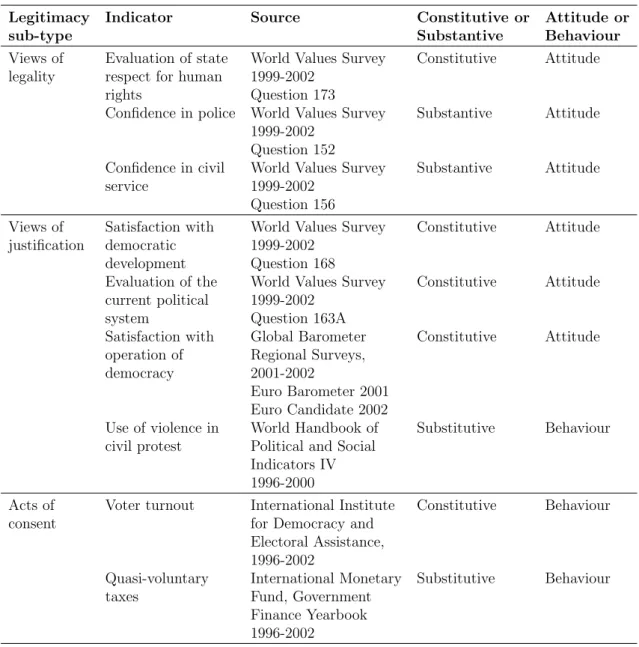
(Source: The Fragile States Index (FSI) [38]) . . . 28 2.4 Legitimacy indicators related to legality, justification and consent.
(Source: Gilley [44]). . . 33 2.5 Qualitative descriptors for the “State Legitimacy” indicator of the FSI.
(Source: CAST Conflict Assessment Framework Manual [38], page 11.) 34 3.1 Threshold rules used in ABM of complex systems. (Source: author) . 40 3.2 Framework for the review and discussion of existing ABM of social
conflict and civil violence. (Source: author) . . . 42 3.3 Global model parameters in Epstein’s ABM and their values/ranges
taken from Appendix A to Epstein et al. [33]. (Source: Epstein et al. [33]) . . . 42 3.4 Agent attributes in Epstein’s ABM and their values/ranges taken from
Appendix A to Epstein et al. [33]. (Source: Epstein et al. [33]) . . . . 43 4.1 Summary of the information items (fields) in the SCAD database.
(Source: Salehyan and Hendrix [97]) . . . 63 4.2 R functions coded by the author for exploration of the SCAD database.
(Source: author) . . . 64
4.3 Number of very large and huge demonstrations and riots for
African“Arab Spring” countries, before and after December 15th, 2010. (Source: author, based on [97]) . . . 71
4.4 Summary of the information on the aggregated Gini index (field Giniall in [13]) for the African “Arab Spring” countries. (Source: Milanovic [13]) . . . 95 5.1 Simplified ODD description of the ABM of civil violence. (Source:
author) . . . 102 5.2 R functions for post-processing of model output files. (Source: author)106 5.3 Reference values for the analysis of cascades in Epstein’s ABM. (Source:
Epstein et al. [33]) . . . 110 5.4 Summary of statistics of waiting time between successive
demonstra-tions in African “Arab Spring” countries, and rebellion bursts in simulations of the Jmax variation experiment. (Source: author, based
on model simulations and [97]) . . . 132 5.5 Values of the input parameters and number of ‘citizen’ and ‘cop’
agents for the experiments with low legitimacy and variable deterrence capability, for the cases of ‘small society’ and ‘large society’. (Source: author) . . . 133 5.6 Values of the input parameters and number of ‘citizen’ and ‘cop’
agents for the RD experiment, for the cases of ‘small society’ and ‘large society’. (Source: author) . . . 136 5.7 Input parameters for the simulations with RD and legitimacy
feed-back, with homogeneous and heterogeneous legitimacy perception and different time averaging intervals L-memory. (Source: author) . . . 150 5.8 Peak size (% of the population) and waiting time for bursts of social
unrest (in time steps) with grievance expressed as a function of RD, for homogeneous and heterogeneous legitimacy perception and different time averaging windows (in time steps), in the ‘small society’ case. (Source: author) . . . 151 5.9 Peak size (% of the population) and waiting time for bursts of social
unrest (in time steps) with grievance expressed as a function of RD, for homogeneous and heterogeneous legitimacy perception and different time averaging windows (in time steps), in the ‘large society’ case. (Source: author) . . . 151 5.10 Input parameters for the simulations with the ‘group’ and ‘infl’
net-works. (Source: author) . . . 152 A.1 Attributes of ‘citizen’ agents. (Source: author) . . . 187
A.2 Agents’ sensing: information space, type of influence, related state variables and percept (information used for decision/action). (Source: author) . . . 192 A.3 Interactions between agents and related mechanisms. (Source: author) 193 A.4 Description of the input parameters for the ABM of large scale conflict
1.1 Classification of social conflict manifestations based on their intensity (level of violence), showing the disciplines in which they are stud-ied. Transitions between different manifestations are represented by rounded rectangles. (Source: author) . . . 2 1.2 Evolution of social conflict viewed as complex and path-dependent
process with micro-macro and feedback links. (Source: author) . . . . 3 1.3 Schematic representation of the relationships between the steps of
methodology of development. The steps within rectangles correspond to SOA review and those within rounded rectangles to contributions of the present work. (Source: author) . . . 9 2.1 Patterns of RD: decremental (left), aspirational (middle) and
progres-sive (right). (Source: author, adapted from Gurr [50]) . . . 16 2.2 Social conflict cycle, derived from Rummel’s conceptual approach [86].
(Source: author) . . . 17 2.3 Social conflict vs violence manifestations. (Source: author) . . . 18 2.4 Social conflict vs violence perspectives. (Source: author) . . . 20 2.5 Variables determining the likelihood and magnitude of civil violence.
(Source: Ted Gurr [49], page 252) . . . 23 2.6 Lorenz curve for representing inequality of income. (Source: author) . 30 3.1 Agent architectures for a reactive agent (a) and for an agent with
internal state (b). In these figures, P is the agent’s percept. (Source: author, adapted from Wooldridge [108]) . . . 39 3.2 Contexts and input parameters in Epstein’s ABM of civil violence.
The dashed lines represent the boundary wrapping of the 2D torus model space. (Source: author) . . . 47
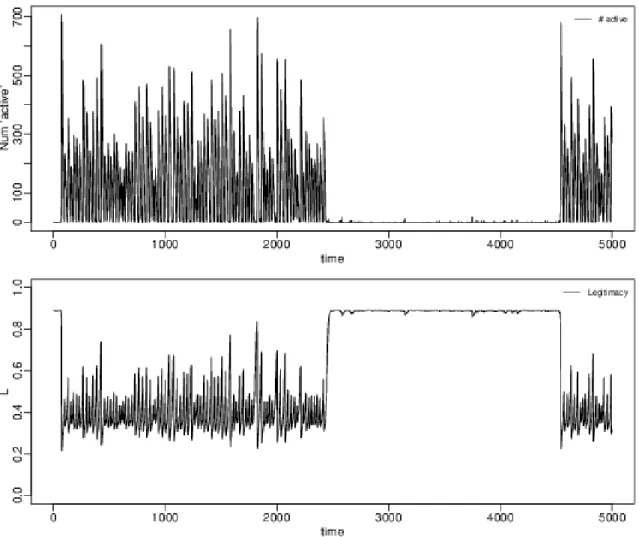
3.3 Time history of the number of ‘active’ citizens (for a population of 1120 ‘citizens’) and legitimacy for a simulation of the R21G case reported in [64], showing long alternating periods of calm and unrest. (Source: Lemos et al. [64]) . . . 53 4.1 Type of social conflict events against central governments in African
countries (Algeria, Egypt, Libya, Mauritania, Morocco, Sudan and Tunisia) in the SCAD database, before and after the beginning of the “Arab Spring”: % of events of each type (a) and event type by estimated number of participants (b). (Source: author, based on [97]) 66 4.2 Issues in conflict events against central governments in African “Arab
Spring” countries (Algeria, Egypt, Libya, Mauritania, Morocco, Sudan and Tunisia) - event type (a) and estimated number of participants (b). (Source: author, based on [97]) . . . 69 4.3 Issues in very large and huge demonstrations in African “Arab Spring”
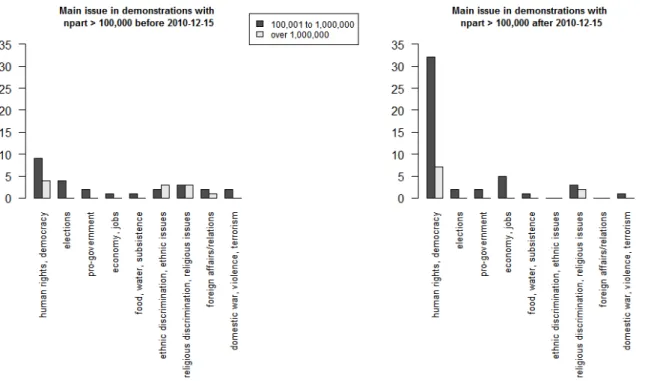
countries, before and after the beginning of the AS. (Source: author, based on [97]) . . . 70 4.4 Organized vs spontaneous demonstrations (a) and riots (b), before
and after the beginning of the AS. (Source: author, based on [97]) . . 72 4.5 Escalation in very large and huge demonstrations in African “Arab
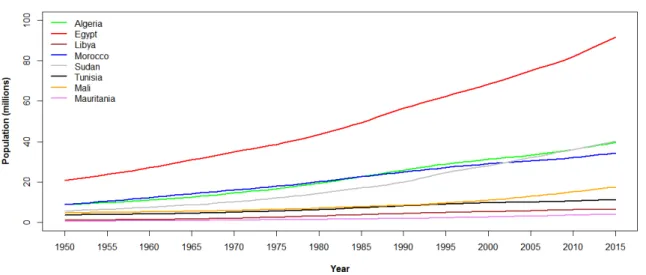
Spring” countries, before and after the beginning of the AS. (Source: author, based on [97]) . . . 74 4.6 Demographic evolution of African “Arab Spring” countries, from 1950
to 2015. (Source: author, based on [102]) . . . 75 4.7 Distribution of estimated number of participants in demonstrations
(a) and riots (b) in African “Arab Spring” countries (Algeria, Egypt, Libya, Mauritania, Morocco, Sudan and Tunisia). (Source: author, based on [97]) . . . 76 4.8 Box-and-whisker diagrams for the distribution of duration of
demon-strations with more than 1,000 (a) and riots with more than 1,000 participants (b) in African “Arab Spring” countries (Algeria, Egypt, Libya, Mauritania, Morocco, Sudan and Tunisia). (Source: author, based on [97]) . . . 77 4.9 Box-and-whisker diagrams for the distribution of time interval between
demonstrations with more than 1,000 (a) and riots with more than 100 participants (b) in African “Arab Spring” countries (Algeria, Egypt, Libya, Mauritania, Morocco, Sudan and Tunisia). (Source: author, based on [97]) . . . 78
4.10 Proportions of time with calm and activity in demonstrations (a) and riots (b) with more than 1,000 estimated participants for African AS countries, before and after the beginning of the AS.(Source: author, based on [97]) . . . 79 4.11 Time history of the range of estimated % of the population
participat-ing in demonstrations with more than 1,000 estimated participants, for Algeria (a) and Egypt (b). Events with more than 1,000,000 estimated participants are represented by dashed red lines with indefinite upper limit. All other events are represented by blue error bars. (Source: author, based on [97] and [102]) . . . 82 4.12 Time history of the range of estimated % of the population
participat-ing in demonstrations with more than 1,000 estimated participants, for Morocco (a) and Tunisia (b). Events with more than 1,000,000 estimated participants are represented by dashed red lines with indefi-nite upper limit. All other events are represented by blue error bars. (Source: author, based on [97] and [102]) . . . 83 4.13 Scaled FSI “Legitimacy of the State” scores for “Arab Spring”
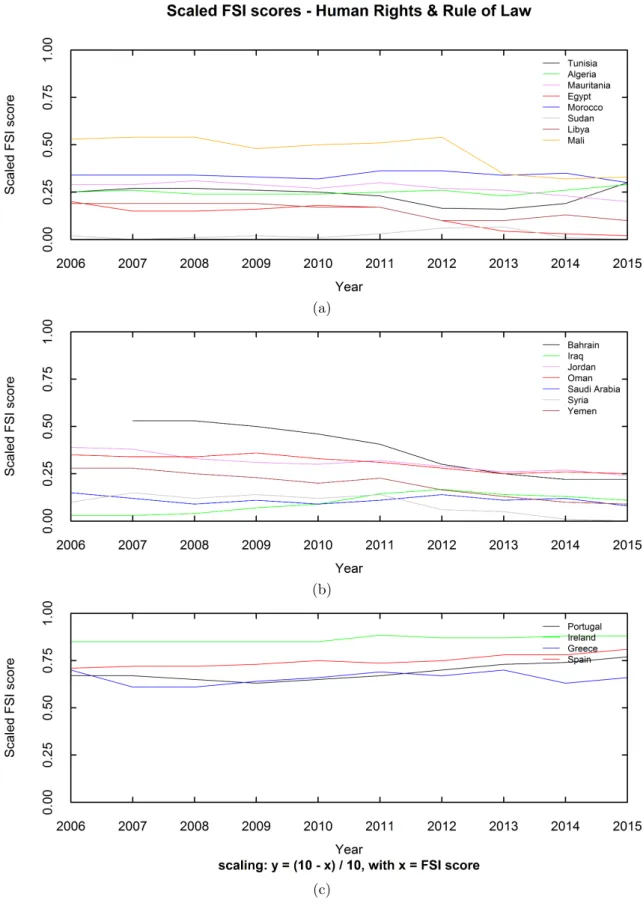
coun-tries in Africa (a) and Middle-East (b), and councoun-tries affected by the European Sovereign Debt Crisis (c). (Source: author, based on [96]) . 85 4.14 Scaled FSI “Human Rights and Rule of Law” scores for “Arab Spring”
countries in Africa (a) and Middle-East (b), and countries affected by the European Sovereign Debt Crisis (c). (Source: author, based on [96]) 88 4.15 Scaled FSI “Uneven Economic Development” scores for “Arab Spring”
countries in Africa (a) and Middle-East (b), and countries affected by the European Sovereign Debt Crisis (c). (Source: author, based on [96]) 89 4.16 Scaled FSI “Poverty and Economic Decline” scores for “Arab Spring”
countries in Africa (a) and Middle-East (b), and countries affected by the European Sovereign Debt Crisis (c). (Source: author, based on [96]) 90 4.17 Scaled FSI “Group Grievance” scores for “Arab Spring” countries in
Africa (a) and Middle-East (b), and countries affected by the European Sovereign Debt Crisis (c). (Source: author, based on [96]) . . . 91 4.18 “Freedom in the World” scores for “Arab Spring” countries in Africa (a)
and Middle-East (b) and countries affected by the European Sovereign Debt Crisis (c). (Source: author, based on [37]) . . . 93
4.19 “All the Ginis” scores of the Gini index for “Arab Spring” countries in Africa. The generally assumed bounds for “small” and “large” inequality (30% and 60%, respectively) are represented by horizontal dashed lines. (Source: author, based on [13]) . . . 95 5.1 Illustration of the “fear threshold lowering” mechanism for switching
between ‘quiet’ and ‘active’ states in Epstein’s ABM, for H and G uniformly distributed in the [0, 1] interval ([33, 31]). A ‘citizen’ agent remains ‘quiet’ if the inhibiting term N + T exceeds the drive to rebel G (left). If N + T drops below G due to collective behaviour the ‘citizen’ turns ‘active’ (right). In this figure, N = R · Pa. (Source:
Lemos et al. [62]) . . . 109 5.2 Variation of Pa as a function of (C/A)v for three values of the arrest
constant k, for equations (3.5) (left) and (3.6) (right). (Source: author)110 5.3 Probability density functions uX(x, L, ρ) for L = 0.82 and estimated
arrest probability functions given by equations (3.5) (left) and (3.6) (right), with G(L) ∼ U (0, 1 − L) and N (ρ) ∼ U (0, Pa(ρ)). (Source:
author) . . . 111 5.4 Proportion of ‘active’ citizens as a function of ρ for L = 0.82 and
two values of the threshold (T = 0.05 and T = 0.1), with G(L) ∼ U (0, 1 − L) and N (ρ) ∼ U (0, Pa(ρ)). (Source: author) . . . 112
5.5 Graphical representations of C/A(L, T, ρ) vs ρ for L = 0.82 and T = 0.025, 0.05, 0.075, and 0.1, and estimated arrest probability functions given by equations (3.5) (left) and (3.6) (right), with G(L) ∼ U (0, 1 − L) and N (ρ) ∼ U (0, Pa(ρ)). (Source: author) . . . 113
5.6 Simulated histogram of G − N (top) and time variation of the pro-portion of ‘active’ citizens (bottom), for estimated arrest probability given by equations (3.5) (left) and (3.6) (right). (Source: Lemos et al. [62]) . . . 114 5.7 Probability density functions uX(x, L, ρ) given by equations (5.8) (left)
and (5.9) (right), for L = 0.82 . (Source: author) . . . 115 5.8 Proportion of ‘active’ citizens as a function of ρ for L = 0.82
and two values of the threshold (T = 0.05 and T = 0.1), with gG∼ N ((1 − L)/2, (1 − L)/ √ 12) and nN ∼ N (Pa(ρ)/2, Pa(ρ)/ √ 12). (Source: author) . . . 116 5.9 Graphical representations of C/A(L, T, ρ) vs ρ for L = 0.82 and T =
0.025, 0.05, 0.075, and 0.1, with uX(x, L, ρ) given by equations (5.8)
5.10 Forms of Pa in the ABM of urban crime of Fonoberova et al. [35].
(Source: author, based on [35]) . . . 119 5.11 ρc variation experiment. Percentage of time with calm and
rebel-lion (left) and statistics of rebelrebel-lion burst duration (right) for the ρc
variation experiment. (Source: author) . . . 120 5.12 Statistics of rebellion peak size (% ‘active’ citizen agents) and interval
(waiting time between peaks, in time steps) as a function of ρc. (Source:
author) . . . 122 5.13 Simulated time series of the proportion of ‘active’ citizens for the first
two thousand cycles, for ρc= 0.0, 0.55, 0.95 and 2.05. (Source: author)123
5.14 Simulated time series of the proportion of ‘active’ citizens for the first two thousand cycles, for ρc= 0.0, 0.25, 0.50 and 1.0. (Source: author) 124
5.15 Box plot summary representation of the distributions of rebellion peak size (% of ‘active’ citizens) for ρc= 0, 0.25, 0.5 and 1. (Source: author)125
5.16 Box plot summary representation of the distributions of rebellion burst duration (in time steps) for ρc= 0, 0.25, 0.5 and 1. (Source: author) 125
5.17 Box plot summary representation of the distributions of interval (wait-ing time, in time steps) between successive bursts for ρc= 0, 0.25, 0.5
and 1. (Source: author) . . . 126 5.18 Jmax variation experiment, for the case ρc= 0.5. Percentage of time
with calm and rebellion (left) and statistics of rebellion burst duration (right). (Source: author) . . . 127 5.19 Jmax variation experiment, for the case ρc= 0.5. Statistics of rebellion
peak size (% ‘active’ citizen agents) and interval (waiting time between peaks, in time steps). (Source: author) . . . 128 5.20 Box plot summary representation of the distributions of the interval
(waiting time, in time steps) between successive bursts for four cases of the Jmax variation experiments, with ρc= 0.5. (Source: author) . . 129
5.21 Simulated time series of the proportion of ‘active’ citizens for the first five thousand cycles, for Jmax = 10, 20, 40 and 60, and ρc= 0.5.
(Source: author) . . . 130 5.22 Simulated time series of the proportion of ‘active’ citizens for the first
five thousand cycles, for Jmax = 40 and ρc= 0.25. (Source: author) . 131
5.23 % of time with rebellion for the low legitimacy and variable deterrence capability experiment, for the ‘small society’ (a) and ‘large society’ (b) cases. (Source: author) . . . 134
5.24 Minimum, median and maximum peak size (% of the population) of rebellion bursts for the low legitimacy and variable deterrence experiment, for the ‘small society’ (a) and ‘large society’ (b) cases. (Source: author) . . . 135 5.25 % of time with rebellion for the RD experiment, for the ‘small society’
(a) and ‘large society’ (b) cases. (Source: author) . . . 137 5.26 Minimum, median and maximum peak size (% of the population) of
rebellion bursts for the RD experiment, for the ‘small society’ (a) and ‘large society’ (b) cases. (Source: author) . . . 138 5.27 Event duration (in time steps) for the RD experiment, for the ‘small
society’ (a) and ‘large society’ (b) cases. (Source: author) . . . 139 5.28 Trajectories in the phase space of % of ‘active’, % of ‘jailed’ and
median of deprivation, for six selected runs of the RD experiment for the ‘small society’ case. (Source: author) . . . 140 5.29 Trajectories in the phase space of % of ‘active’, % of ‘jailed’ and
median of deprivation, for six selected runs of the RD experiment for the ‘large society’ case. (Source: author) . . . 141 5.30 % of time with rebellion for the RD with legitimacy feedback
experi-ment, for the ‘small society’ (a) and ‘large society’ (b) cases. (Source: author) . . . 142 5.31 Minimum, median and maximum peak size (% of the population) of
rebellion bursts for the RD with legitimacy feedback experiment, for the ‘small society’ (a) and ‘large society’ (b) cases. (Source: author) . 143 5.32 Time history of the first two thousand cycles of the median of
legiti-macy (over all agents and L-memory = 5 time steps) for the simulations of the ‘large society’ case with initial-cop-density = 4%, for the two values γ = 0.10 and γ = 0.15. (Source: author) . . . 144 5.33 Time history of the first two thousand cycles of the medians of
ex-pectation and deprivation (over all ‘citizens’) for the simulations of the ‘large society’ case with initial-cop-density = 4%, for the two values γ = 0.10 and γ = 0.15. (Source: author) . . . 144 5.34 Plot of the median of legitimacy vs median of deprivation (both
over all ‘citizens’) for the simulations of the ‘large society’ case with initial-cop-density = 4%, for the two values γ = 0.10 and γ = 0.15. (Source: author) . . . 145
5.35 Trajectories in the phase space of % of ‘active’, % of ‘jailed’ and median of deprivation, for six selected runs of the RD with legitimacy feedback experiment for the ‘small society’ case. (Source: author) . . 146 5.36 Trajectories in the phase space of % of ‘active’, % of ‘jailed’ and
median of deprivation, for six selected runs of the RD with legitimacy feedback experiment for the ‘large society’ case. (Source: author) . . 147 5.37 Trajectories in the phase space of median of deprivation, % of
‘ac-tive’, and median of legitimacy, for six selected runs of the RD with legitimacy feedback experiment for the ‘small society’ case. (Source: author) . . . 148 5.38 Trajectories in the phase space of median of deprivation, % of
‘ac-tive’, and median of legitimacy, for six selected runs of the RD with legitimacy feedback experiment for the ‘large society’ case. (Source: author) . . . 149 5.39 % of time with rebellion for the ‘group’ (a) and ‘infl’ (b) simulations
of the network influence effects experiment. (Source: author) . . . 153 5.40 Minimum, median and maximum peak size (% of the population) of
rebellion bursts for the ‘group’ (a) and ‘infl’ (b) simulations of the network influence effects experiment. (Source: author) . . . 153 5.41 Minimum, median and maximum event duration (in time steps) of
rebellion bursts for the ‘group’ (a) and ‘infl’ (b) simulations of the network influence effects experiment. (Source: author) . . . 154 A.1 Class diagram for the entities in the NetLogo implementation of the
Abbreviations
α Shape parameter in the Pareto distribution
αi Learning constant for the i -th agent in Rescorla-Wagner conditioning model
(salience of conditioned stimulus)
βi Learning constant for the i -th agent in Rescorla-Wagner conditioning model
(salience of unconditioned stimulus)
δ Exponent in generalized Rescorla-Wagner conditioning model
AGi The set of ‘active’ citizens in the group network, in the ith ‘citizen’ in the
ABM of social conflict
AIN F Li The set of ‘active’ citizens in the infl network, in the ith ‘citizen’ in the
ABM of social conflict
N (µ, σ2) Normal distribution with mean value µ and variance σ2
U (a, b) Continuous uniform distribution with support [a, b]
A Generic agent
M ‘Mass enthusiasm’ term in the action rule for a ‘citizen’ agent in the ABM of social conflict
P Agent’s percept
R Set of possible finite runs
S Sum of social influences in the action rule for a ‘citizen’ agent in the ABM of social conflict
ρ C/A, the ratio between the number of ‘cops’ and the number of ‘active’ citizens in the ABM of social conflict
ρc Critical ‘cop’-to-‘active’ ratio below which risk perception vanishes; a
param-eter in the proposed form of the estimated arrest probability function (Pa)
which models the mechanism of ‘massive fear loss’ in a population
ρf Fixed point value of the ‘cop’-to-‘active’ ratio in the analytical model described
in§ 5.2.1 ρv = (Cv/Av)
var(X) Variance of random variable X
A(t) Total number of ‘active’ citizens at time step t
Av Number of ‘active’ citizens within a citizen’s vision radius in the ABM of
social conflict
Ac Set of actions available to an agent A
C Number of ‘cops’ in the analytical model described in § 5.2.1
Cv Number of ‘cops’ within a citizen’s vision radius in the ABM of social conflict
E Set of possible environment states
G Grievance
gG Probability density function of G
H Hardship
I Agent’s internal state
J Jail term for a citizen in the ABM of social conflict J (t) Total number of ‘jailed’ citizens at time step t Jmax Maximum jail term in the ABM of social conflict
k Arrest constant in the expression of the estimated arrest probability function (Pa)
L Legitimacy
L0 Initial legitimacy in the social conflict model with endogenous legitimacy
feedback; also the value of the government-legitimacy input parameter Lcons “Acts of consent” (component of legitimacy)
Ljust “Views of justification” (component of legitimacy)
Lleg “Views of legality” (component of legitimacy)
Lp Citizens’ perceived legitimacy (in the case of endogenous legitimacy feedback)
N Net risk, = R · Pa
nactive Total number of ‘citizens’ in the ‘active’ state, in the ABM of Social conflict
Ncitizen Total number of citizens in the social conflict model
njailed Total number of ‘citizens’ in the ‘jailed’ state, in the ABM of Social conflict
NM J C Maximum jail capacity
nN Probability density function of N
nquiet Total number of ‘citizens’ in the ‘quiet’ state, in the ABM of Social conflict
P Deliberative component of disposition, in Epstein’s Agent Zero framework
R Risk aversion
S Social component of disposition, in Epstein’s Agent Zero framework T Threshold in threshold rules of binary decision
Ti Threshold for agent Ai
UX Probability distribution of X
uX Probability density function of X
V Affective component of disposition, in Epstein’s Agent Zero framework v Citizens’ vision radius in the ABM of social conflict
v0 Cops’ vision radius in the ABM of social conflict
X = G − N
xm Scale parameter in Pareto distribution
γ Parameter in the proposed form of RD in the ABM of social conflict which
expresses sensitivity to value (to differentiate political from economic RD) Av Set of ‘active’ citizens within an agent’s vision radius in the ABM of social
conflict
Pa Estimated arrest probability
ABM Agent-Based model(s)
AS “Arab Spring”
CAST Conflict Assessment System Tool
FFP The Fund For Peace
FSI Fragile States Index (indicator published by The Fund For Peace) FWI Freedom in the World Indicator
ICT Information and Communication Technologies
ODD “Overview, Design Concepts and Details” protocol for describing ABM
RD Relative deprivation
SCAD Social Conflict Analysis Database
SN Social networks
SOA State-of-the-art
UN United Nations
Introduction
Social conflict and violence are two fundamental characteristics of human societies [86, 1]. Both are deeply rooted on biology and evolution, and depend on culture and situational factors [67]. As such, they are extremely heterogeneous and varied in terms of type, motif, scale, intensity and evolution pattern. They are distinct and related – not all forms of social conflict are violent and not all violence results from social conflict.
Understanding how the social context leads to latent social conflict, and how this can evolve to large protests, civil violence or unanticipated revolution, is a topic of central importance in history, political science, sociology, social psychology, and also in military and security studies. Rulers and governments fear the “power of the crowds” [12]. History provides striking examples of large street protests sparking revolutions and overthrowing regimes, as in the French Revolution in 1789, the October Revolution in Russia in 1917 and the Iran Revolution of 1979 [57]. Widespread access to Social Networks (SN) and Information and Communication Technologies (ICT) changed the dynamics of social conflict processes in dramatic ways, as they allow organizations or groups of activists to summon, coordinate and show protest events or violence to a worldwide audience in almost real time [85, 34, 18]. The protesters’ motifs may range from challenging the authorities on specific issues (e.g. the 2013 protests in Turkey against the transformation of the Gezi Park and the 2014 protests in Brazil against the FIFA World Cup), general aspects of governance (e.g. anti-austerity protests in several European countries following the European Sovereign Debt Crisis, whose roots can be traced to 2007 [19]), or regime change, as in the “Arab Spring” (AS) uprising that began in December 2010 or the Hong-Kong protests of 2014.
Figure 1.1: Classification of social conflict manifestations based on their intensity (level of violence), showing the disciplines in which they are studied. Transitions between different manifestations are represented by rounded rectangles. (Source: author)
Social conflict encompasses an extremely wide spectrum of processes and phenom-ena and is a multidisciplinary topic [2]. It can be latent or manifest, and manifest conflict can be non-violent (e.g. peaceful demonstrations, strikes, public petitions) or violent (demonstrations with violent confrontation, riots and civil violence). There is no single criterion for classifying social conflict processes and phenomena. Figure 1.1 shows a simplified classification of some typical manifestations of social conflict, using the intensity of violence as a criterion and showing the scientific disciplines in which they are studied. In this figure, conflict manifestations were divided into three broad categories: (i ) peaceful manifestations, (ii ) low-intensity violence (non-armed conflict) and (iii ) high-intensity violence (armed conflict).1 This division is consistent
with general definitions of ‘violence’ [109], ‘civil violence’ [49] and ‘armed conflict’ [101]. There is also the possibility of escalation, represented by coloured rounded-corner rectangles in figure 1.1. Predicting the time evolution of social conflict and whether or not violence and escalation will occur, and if possible controlling these processes, is a problem of great practical importance in security studies and political science. However, these processes are very complex and path-dependent on social
1‘Armed conflict’ is defined as “a contested incompatibility that concerns government and/or territory where the use of armed force between two parties, of which at least one is the government of a state, results in at least 25 battle-related deaths.” in page 1 of the UCDP/PRIO Armed Conflict Dataset Codebook [101]. Specific forms of armed conflict are thoroughly studied in the realm of Military Sciences. Modern definitions of ‘insurgence’ and ‘war’ can be found in military doctrine publications, such as the AAP6 – NATO GLOSSARY OF TERMS AND DEFINITIONS [77].
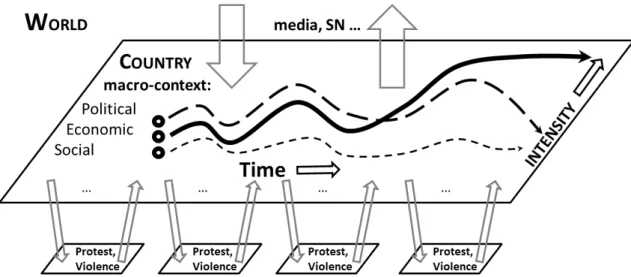
Figure 1.2: Evolution of social conflict viewed as complex and path-dependent process with micro-macro and feedback links. (Source: author)
factors, particular settings, types of interactions and scales (of time, space, and size or proportion of individuals involved). Such processes may be stable or unstable, as sketched in figure 1.2. Unstable processes may be gradual (build-up of tension or violent confrontations) and lead to sudden changes (e.g. revolution or outbreak of armed conflict) [57, 58].
Figure 1.2 shows a simplified model of the evolution of large scale social conflict and civil violence in which the details of events in the lower layer are described in a very crude way.
Real conflict processes are strongly dependent on the dynamics of particular events, such as motif, mobilization (organized or spontaneous), crowd size, emotional intensity, place, occurrence of violent confrontation, and police action. One critical aspect is the formal or informal media coverage of specific events, and whether or not the transmitted contents increase the population’s grievance towards the government. Describing the dynamics of these events (e.g. street protests) and their intensity (likelihood and magnitude of violent confrontation) requires a much more complicated modelling of the physical and social environments and individual entities (actors) than the framework shown in figure 1.2.
The development of computers and software tools added simulation to the tra-ditional methods of scientific research – observation, laboratory experimentation, mathematical deduction and empirical inference. Simulation has the advantages of providing a deep level of insight and understanding, and allows the consideration of many different scenarios which would be impossible to test in reality. Social
simulation using Agent-Based models (ABM) has been successfully introduced to study many social phenomena such as segregation [90, 91], the formation of culture [5], opinion dynamics [110], or rumour spreading [42]. Several ABM were proposed to study conflict phenomena such as civil or ethnic violence [33, 31], urban crime [35], worker protest [56], riots [25], insurgence [28] and land combat [53], and also for modelling crowd dynamics with different degrees of sophistication. ABM are suitable for studying the dynamic of protests, escalation and civil violence, because these are large-scale, weakly organized peaceful or low-violence conflict manifestations, whereas armed conflict requires a high degree of leadership and organization [49]. Thus, the problem of modelling the dynamics of protests and violence is one of complexity and Agent-Based modelling is a promising approach for providing insight and understanding of their underlying mechanisms.2
In this work, an ABM for studying large scale conflict against a central authority was developed and explored in a set of computer experiments. The model proposed herein is an extension of Epstein’s ABM of civil violence, in which new mechanisms such as deprivation-dependent hardship, vanishing of the risk perception (‘massive fear loss’) below a critical ratio between deterrence and ‘group support’, legitimacy feedback (drop of the central authority’s legitimacy due to uprisings), network influences and ‘mass enthusiasm’ (contagion) were implemented.
1.1
Motivation
The motivation for studying the dynamics of protests and civil violence in terms of mechanisms using ABM is due to the following aspects:
– Protests, violence and other manifestations of social conflict in many countries became part of our daily experience. The AS was a startling example of a series of unanticipated very large scale uprisings that started in December 2010 and ravaged several Arab countries, with profound consequences. During the course of this work, anti-government protests against austerity measures due to the European Sovereign Debt Crisis were frequent in Portugal and other European countries;
– There is a need for improving our understanding on how social context factors lead to large scale protests and civil violence, and how these in turn affect the
2Although in the modern conceptions insurgence and war are also studied using methods from complexity sciences [53], in this work we will only consider protests and civil violence, as defined in §1.2 and §2.1.2, respectively.
social context factors (figure 1.2);
– Simulation using ABM and the methods of complex systems studies provides insight and explanatory power not attainable using the theories and methods of other disciplines (e.g. sociology and social psychology).
1.2
Purpose and Scope
The purpose of the present work is to study the mechanisms by which social context factors lead to large scale protests and civil violence and these in turn affect the social context, using ABM with the maximum simplicity possible, i.e. with a small number of agent types and parameters, and simple rules and submodels. More specifically, the focus will be on how the complex patterns of size, duration and recurrence of bursts of social unrest in large scale conflict processes (like the AS) can be explained in terms of underlying mechanisms and modelled via ABM.
The scope of the present work is framed by the peaceful and low intensity conflict phenomena shown in figure 1.1, which involve a significant proportion of a population, and for which self-organization is important. To make this scope more precise, it is convenient to introduce the following general definitions:
Definition 1. Social conflict – Confrontation or dynamic balance of social powers, which can be latent or manifest, direct or indirect, coercive or non-coercive. (Source: author, based on Coser [20], Rummel [86] and Allan [1])
Definition 2. Demonstration – Distinct, continuous, and largely peaceful action directed toward members of a distinct “other” group or government authorities. (Source: Salehyan and Hendrix [88])
Definition 3. Riot – Distinct, continuous and violent action directed toward mem-bers of a distinct “other” group or government authorities. The participants intend to cause physical injury and/or property damage. (Source: Salehyan and Hendrix [88])
Definition 4. Mechanism – An intelligible description and general explanation of the relationships between causes and effects in a system, in terms of the system’s entities and their activities. (Source: author, adapted from Machamer et al. [68])3
3Machamer et al. [68] define “mechanisms” as follows: “Mechanisms are entities and activities organized such that they are productive of regular changes from start or set-up to finish or terminal conditions.” and add “Descriptions of mechanisms show how the termination conditions are produced by the set-up conditions and intermediate changes. Activities are the producers of change.
In this work we are only interested in politically motivated large scale conflict against a government or authority. Other important forms of violence such as ethnic clashes, hooliganism, or riots mobilized by groups via Facebook, will not be treated. These forms of collective violence will be mentioned only in those aspects that are relevant for the present work.
Likewise, the study and modelling of revolution will not be explicitly considered. Although revolution is an extremely important topic in the study of large scale conflict (e.g. [57, 58, 69, 74]), the present work will be centred on the stability, instability and complexity of the patterns of confrontation of a grieved population demanding change from a government, and not on the process of overthrowing governments.
1.3
Objectives and Research Questions
The specific objectives of the present work are:
– Discuss Epstein’s classic ABM of civil violence [33, 31], which includes two types of agents ‘citizens’ and ‘cops’ (which represent the population and law-enforcing capability of the central authority, respectively), each with two action rules. ‘Citizen’ agents decide between being ‘quiet’ or ‘active’ (rebellious), and ‘cops’ arrest ‘active’ citizens;
– Extend this model to include the mechanisms of deprivation-dependent hard-ship, ‘massive fear loss’, endogenous legitimacy feedback, network influences, and ‘mass enthusiasm’;
– Develop the extended ABM by combining four viewpoints: (i ) theories of social conflict, to identify the key concepts and variables for model specification (scope, entities and interactions); (ii ) analysis of datasets of social indicators and conflict events; (iii ) consideration of the role and meaning of each input parameter and agent attribute; (iv ) analysis of the mechanisms described by the theories and represented in the ABM;
– Investigate and discuss how social context factors and different mechanisms influence the nature of the solutions (equilibrium, intermittent peaks of unrest, alternating periods of calm and turmoil or permanent rebellion) and the distributions of size, duration and interval between successive rebellion bursts, Entities are the things that engage in activities.”
by means of simulation. In other words, investigate how mechanisms and combinations of input parameters and distributions of the agents’ attributes generate complex time-dependent solutions;
– Validate the model using existing datasets of political, social and economic indicators, and non-armed conflict events.
The main research questions considered in this work are the following:
1. Which mechanisms and social context variables are the most relevant to describe the potential for social conflict and the likelihood and magnitude of large scale protest (peaceful or violent)?
2. How can the important mechanisms identified in theories be modelled by extending existing ABM of large scale social conflict (i.e. Epstein’s model)? 3. Which combinations of input parameters, distributions of agents’ attributes,
and functional forms of the agents’ action rules lead to complex solutions (i.e. with intermittent peaks of rebellion, complicated trajectories in a suitable phase space, tipping points and changes of qualitative behaviour, etc.), and how can the complexity of the solutions be associated with mechanisms?
1.4
Methodology of Development
The methodology of development used in this work consisted of the following steps:
1. Survey of conflict theories, to identify the main mechanisms and the most relevant variables that must be considered in ABM of large scale conflict against a central authority;
2. Survey of datasets of international indicators and conflict events, which can be used for model parametrization and validation, respectively;
3. Discussion of Epstein’s classical ABM and its extensions proposed by other authors, to characterize their explanatory power and limitations;
4. Analysis of conflict events and international indicators for eight African coun-tries affected by the AS – Algeria, Egypt, Libya, Mali, Mauritania, Morocco, Sudan and Tunisia – to:
of complexity issues (e.g. spontaneous vs organized events, escalation, etc.) in this recent and important conflict process;
– Derive statistical descriptions of the patterns of size, duration and recur-rence of conflict events;
– Obtain plausible estimates for important social context variables for those countries, such as legitimacy and the Gini index of inequality.
5. Extension of existing ABM based on Epstein’s model to include new mecha-nisms;
6. Exploration of the extended ABM via a set of computer experiments, illustrative of its explanatory power.
The first three items above were done in the state-of-the-art (SOA) revision presented in chapters 2 and 3. The last three contain most of the innovations and contributions of the present work, and are presented in chapters 4 and 5. Figure 1.3 shows a representation of the relationships between the development steps. Each box (rectangle or rounded rectangle) corresponds to a different chapter, as described in the next section.
1.5
Structure of the Work
The remainder of the present work is structured in six chapters, as described be-low.
Chapter 2 contains a review of the theories and concepts relative to social conflict against a central authority, as well as a reference to the datasets of social indicators an conflict events that can be used for ABM parametrization and validation. The most salient aspects of this review are the analyses of Ted Gurr’s frustration-aggression theory on the psychological factors of civil violence [49] (which clearly identifies the mechanisms and key variables that determine the likelihood and intensity of social unrest), Gene Sharp’s theory on non-violent action [92] (which is important for the analysis and discussion of the AS in chapter 4) and the importance of legitimacy [43, 44]. This chapter also contains a brief survey of the datasets of international indicators and information on conflict events which provide elements of observation on patterns of conflict events and plausible values for social context variables.
Chapter 3 contains a review of the existing ABM for simulation of large scale social conflict. Consistent with the framework in figure 1.2, the review is restricted
Figure 1.3: Schematic representation of the relationships between the steps of methodology of development. The steps within rectangles correspond to SOA review and those within rounded rectangles to contributions of the present work. (Source: author)
to ABM of ‘abstract’ type [41]. Epstein’s landmark model of civil violence (Model I, [33, 31]) is described and discussed at length. In this model, the time evolution of conflict events is described using just two agent types (‘citizens’ and ‘cops’), simple rules (all agents have random movement; ‘citizens’ make a binary decision ‘rebel’/‘not rebel’, and ‘cops’ arrest rebellious citizens) and interactions (modelled as a variable risk perception for ‘citizens’). Other ABM inspired in Epstein’s ABM are also analysed. The limitations of existing models are discussed in terms of the mechanisms and key variables described by the theories.
Chapter 4 describes an analysis of conflict events and international indicators for eight African countries affected by the AS (Algeria,Egypt, Libya, Mali, Mauritania, Morocco, Sudan and Tunisia) based on the Social Conflict Analysis Database (SCAD) [97], the Fragile States Index (FSI) [96] indicators by the Fund For Peace, the Freedom in the World Indicator (FWI) by Freedom House [37], and the “All the Ginis” database of welfare inequality [13]. The results of this analysis provided justification for the
theoretical framework in figure 1.1, as well as statistical descriptions of the duration, recurrence and size (in terms of the estimated % of the population) of conflict events, for comparison with ABM simulations. The analysis of the international indicators (FSI, FWI, “All the Ginis”) led to representative values for social context variables, like legitimacy or the Gini index, for the African AS countries. The results of this chapter were used for the discussion of the simulation results presented in chapter 5.
Chapter 5 contains the description of the proposed ‘abstract’ ABM for simula-tion of large scale conflict against a central authority, followed by a set of model explorations. These latter started with an analytical study of the ‘citizens’ decision rule in Epstein’s ABM to show why some forms of the estimated arrest probability function lead to solutions with large rebellion peaks whereas others do not, followed by a set of simulation experiments to show how the various input parameter and newly introduced mechanisms lead to plausible results (by comparison with those obtained in chapter 4) and influence the solutions’ behaviour (permanent unrest, complex solutions with intermittent peaks of rebellion, or permanent calm).
Chapter 6 describes the innovations and the contributions of the present work to the SOA on ABM simulation of large scale conflict processes.
In terms of methodology of development, the main contributions of the present work were (i ) the combination of theory, analysis of mechanisms, data from real processes, and ABM, in a coherent and integrated way, and (ii ) the use of datasets of indicators and information on conflict events to guide both model development and exploration.
Another contribution was the analysis of the indicators of social and political context and of the SCAD database of conflict events for the eight African AS countries, which provided a quantitative description of the type, issue, estimated number of participants, spontaneous vs organized conflict events and escalation, as well as statistical distributions of size, duration and waiting time between successive events, for the case of demonstrations and riots. The analysis of the international indicators (FSI, FWI, “All the Ginis”) led to representative values for social context variables, like legitimacy or the Gini index, for the African AS countries.
The innovations introduced in the proposed ABM were (i ) the introduction of two subtypes of ‘citizen’ agents, called ‘normal’ and ‘activist’; (ii ) an improved form of the estimated arrest probability function; (iii ) a simplified model to set the hardship as a function of relative deprivation, with a power law for describing the ‘commitment
to value’ (or difference between types of deprivation); (iv ) network influence effects due to two different networks (‘group’ and ‘influentials’); (v ) legitimacy feedback with variable ‘memory effect’; and (vi ) ‘mass enthusiasm’ (or dispositional contagion by ‘active’ citizens). The design concept for implementing these extensions was the generalization of the ‘citizens’ action rule to include social influences and ‘mass enthusiasm’, via the mechanism of ‘dispositional contagion’ proposed in [32]. The submodels for relative deprivation and legitimacy feedback were inspired in [49] and [44], respectively.
The most salient contributions for the understanding of the relationship between mechanisms and complexity in the ABM of social conflict were:
– The proposal of a form of the estimated arrest probability with a parameter for representing the effect of a mechanism of ‘massive fear loss’ (or vanishing of the risk perception for the whole population);
– The derivation of a ‘rule of the thumb’ condition between the legitimacy, estimated arrest probability and population threshold, for the solutions to have intermittent peaks of rebellion with both low and high values of the legitimacy; – The identification of tipping points associated with the ‘massive fear loss’ and
‘sensitivity to deprivation’ parameters;
– The identification of the appearance of trajectories with complicated shapes in the appropriate phase spaces associated with the mechanisms of deprivation-dependent hardship and legitimacy feedback, once the level of deprivation surpasses a certain threshold;
– The destabilizing effects of legitimacy feedback and network influences. Chapter 6 contains a more complete listing of the specific contributions relative to the general research questions enunciated in§1.3. Finally, chapter 7 contains a reference to possible future developments, which include improvements in model exploration and capabilities, as well as extension to ethnic and religious conflict.
Theoretical Foundations
In this chapter a review of the SOA on theories of large scale social conflict against a central authority will be presented, followed by a discussion on published international indicators which may provide quantitative estimates for the social context variables identified in these theories as well as datasets with detailed information about conflict events. The chapter is divided in two parts. The first contains a presentation of theories of and civil violence (§2.1-2.3). The second contains a description of international indicators and databases with information about conflict events, which can the used for model parametrization and validation (§2.4-2.6).
Theories of social conflict are the basis for model development. The literature on this subject is extremely vast, so that only a summary account social conflict theories will be presented. The review will be centred on two theories: Ted Gurr’s frustration-aggression theory on the psychological factors of civil violence [49], and Gene Sharp’s theory of non-violent action [92].
The first theory was found to be particularly useful because it is very systematic and identifies the key variables (such as relative deprivation and legitimacy) and mechanisms of positive and negative drive for large scale protest and violence to be considered in ABM of social conflict. The second theory was found to be important because of its connection with the AS, which will be analysed in chapter 4. Other interesting aspects of Gene Sharp’s theory are the emphasis on both organized and self-organized protest the postulated relationship between large and continuous protests and ‘massive fear loss’, which will be discussed in chapters 4 and 5. Thus, Ted Gurr’s theory is mostly valuable for model development and parametrization, and Gene Sharp’s for discussing emergent patterns of conflict events and ABM simulations.
The second part of this chapter contains a comparative review and discussion of the available datasets of political, economic and social indicators that are related to the potential for conflict, and to the variables that identified in the theories of social conflict. These are the ‘elements of observation’ for inferring the correctness of the theories and the model to be developed and explored (chapter 5).
The political, economic and social indicators were analysed under the perspective of their potential usefulness as predictors of the AS, which is a recent and important example of a large scale conflict process which involved several countries, and for setting plausible values of input parameters in ABM. Legitimacy is a key concept in political science and a key variable identified in theories and ABM of social conflict. Consequently, it will be treated with greater development than other context variables in a separate section (§2.6).
Datasets of conflict events contain information for understanding the sources of deprivation, the relative importance of the protests and riots (figure 1.1) as well as the patterns of size, duration and recurrence (waiting time between successive events) of episodes of social unrest.
2.1
Social Conflict and Violence
2.1.1
Social Conflict Theories
In general terms, conflict can be defined as a confrontation or dynamic balance of powers. Power can also be defined in very general terms as the capability of imposing will or produce a desired effect. Thus, social conflict is a confrontation of social powers (Definition 1, page 5).
Theories of social conflict played a central role in the development of sociology [1]. Karl Marx presented the first theory of social conflict based on the struggle between strata of the society (the “classes”) over economic resources and the conditions that lead to such stratification. Max Weber considered the limitations of the Marxian concept of “class” (which he thought to be more complex than Marx assumed), stressed the importance of state and economy (inequality, status, party and power) for setting up conditions for social conflict, and introduced legitimacy, authority and legitimation of institutions as notions of fundamental importance for analysing social conflict.
com-bined elements from Marx and Weber and brought new perspectives to social conflict theory [1]. Simmel and Coser considered social conflict as an essential element in the evolution of society and the persistence of social order (whereas for previous theorists it was understood as a factor of instability and disintegration).
Coser [20] recognized conflict as an instinctual characteristic of human life (indi-vidual and social), and theorized about its sources, level of violence and functional consequences. For this author, uneven stratification of “class”, status and power, causes a sense of deprivation that leads to arousal of “class consciousness”. He stated that conflicts resulting from rational goals tend to be less violent (e.g. strikes and passive resistance movements) than those about “transcendent goals” (moral or group values) and emotional involvement can be violent.
Dahrendorf [22, 23] stated that the level of violence in social conflict depends on technical, political and social conditions of organization, as well as on effective regulation of conflict within the society. This author viewed power, not “class”, as the main feature of social conflict, although he was in agreement with the ideas of dialectical change and bi-polarized society (from Marx), power and authority (from Max Weber). Dahrendorf considered that the level of violence in social conflict can be measured by the kinds of weapons used (peaceful demonstrations have a very low level of violence, whereas protests with exchange of stoning and tear gas are much more violent).
Modern theories replaced “absolute deprivation” by “relative deprivation” (RD), as the key concept for evaluating the potential for conflict. Gurr [50] defined RD as the tension due to the gap between value expectations and value capabilities and considered three patterns of RD, namely decremental, aspirational and progressive (figure 2.1).4 Progressive RD generalizes the “J-curve hypothesis” of Davies [24] –“revolutions are most likely to occur when a prolonged period of objective economic and social development is followed by a short period of sharp reversal” –by including expectations. Frustration associated with the potential for revolt due to RD leads to revolt as RD increases above a tolerance threshold [11] (§2.1.2). Bischof [11] considers three types of RD: political (e.g. deprivation of political participation in authoritarian regimes), economic (e.g. periods of economic growth followed by economic and financial crises) and social (e.g. ethnic segregation or exclusion). This author states that although economic RD is the most commonly considered type, political and social deprivation may be more important. The evaluation of RD from
4Time and awareness of past own capabilities as well as of capabilities of other groups are essential elements of RD.
Figure 2.1: Patterns of RD: decremental (left), aspirational (middle) and progressive (right). (Source: author, adapted from Gurr [50])
datasets of social indicators and variables is a very important but difficult issue (§2.4).
The social conflict theories of Marx, Weber, Simmel, Coser and Dahrendorf are based on a macro-level perspective. Randall Collins [15] introduced a micro-level perspective in social conflict theory. He also considered power and unequal distribution of resources as key features of the problem, but stressed the fundamental role of symbolic goods, emotion and ritual. In this way, he approaches the evolutionary concepts of Lorenz [67] (on aggression in animal societies) and Coser [20]. Another important point of this theory is the role of the State as holder of the legitimate use of power (and force) and the consideration of legitimacy as a special kind of emotion. Collins also analysed conflicts in the context of history and geopolitics and concluded that:
– Unequal distribution of scarce resources (power, economic, cultural) causes potential conflict;
– Potential conflict turns to actual conflict depending on the degree of mobiliza-tion (emomobiliza-tional, moral, symbolic and derived collective rituals) of the opposing groups;
– Conflict generates subsequent conflict;
– Conflict intensity lowers as mobilization resources are used.
We conclude this brief survey of social conflict theories with a reference to the conceptual approach of Rummel [86]. This author considers the following elements of social conflict: (i ) space; (ii ) structure; (iii ) situation and (iv ) behaviour. The conflict space is the multidimensional biopsychological (needs, drives, instincts) and sociocultural (religion, ethics, law, etc.) space of resources that generate potential conflict. The structure of social conflict is the sociocultural distances between
individuals and groups, which generate cleavages in the society. Awareness of these distances creates disposition towards action. The conflict situation is the activation of opposing attitudes, due to expectations, arousal of needs, conflicting interests, capabilities and will of the parties. The tension created by the conflict situation may lead to manifest action or peaceful resolution. Rummel highlights the importance of triggering events and states that much of social conflict is latent and not manifest.
The conceptual approach of Rummel can be viewed as a cycle of dynamic change of power unbalances and subsequent adjustments (figure 2.2).
Figure 2.2: Social conflict cycle, derived from Rummel’s conceptual approach [86]. (Source: author)
2.1.2
Violence
The study of violence is an extremely vast and difficult topic:
One reason why violence has largely been ignored as a public health issue is the lack of a clear definition of the problem. Violence is an extremely
Figure 2.3: Social conflict vs violence manifestations. (Source: author)
diffuse and complex phenomenon. Defining it is not an exact science but a matter of judgement. Notions of what is acceptable and unacceptable in terms of behaviour, and what constitutes harm, are culturally influenced and constantly under review as values and social norms evolve. - in World report on health and violence: summary [109], page 4
There are two conceptions of violence [83]: (i ) minimalistic, based on coercive use of physical force, response and harm; and (ii ) comprehensive, which includes avoidable factors that impede human realization and violate rights or integrity. The following definition is an example of the latter type, which further divides violence in three broad categories: self-directed, interpersonal and collective.
Definition 5. Violence – The intentional use of physical force or power, threatened or actual, against oneself, another person, or against a group or community, that either results in or has a high likelihood of resulting in injury, death, psychological harm, maldevelopment or deprivation. (Source: World Report on Violence and Health: Summary [109], page 4)
This definition includes a very wide range of acts, from self-inflicted violence (e.g. suicide) to armed conflict. In this work, we are only interested in the very general aspects of politically-motivated, spontaneous and large scale collective violence, such as occurs in demonstrations with escalation and riots (figure 1.1), which can be discussed in the framework of ‘abstract’ ABM (chapter 1). In this work, the following
definition of civil violence was adopted:5
Definition 6. Civil violence – All collective, non-governmental attacks on persons or property, resulting in intentional damage to them, that occur within the boundaries of an autonomous or colonial political unit. (Ted Robert Gurr [49], page 247)
There is a strong relationship between social conflict and violence [83], so that many theorists of social conflict (e.g. Marx, Weber, Dahrendorf, Gurr, Collins, ˇZizeˇk) also presented theories on violence. Theoretical explanations for the causes of violence have been proposed from the viewpoints of evolutionary biology [67], sociology [83], psychology [49, 9] and criminology [82]. These can be classified in two broad categories: macro-oriented and micro-oriented. Figure 2.4 shows some representative authors of theories of social conflict and violence in both categories.
Macro-oriented theories are focused on structural conditions leading to collective violence, from the standpoints of sociology, economy and historical analysis. One example is the Marxist theory of class struggle, according to which class division and conflict of interests of the different classes over economic resources is the main cause of conflict throughout History [83]. More modern theories are wider in scope and reflect important factors other than economical to explain violence due to social conflict. For instance, Galtung introduced the concepts of ‘structural violence’ [39] and ‘cultural violence’ [40]. The former is a designation for all forms by which social structures or institutions harm individuals by preventing their attainment of basic goals. The latter encompasses the aspects of a culture that can be used to legitimize direct or structural violence.6 Ziˇˇ zek introduced the concepts of ‘subjective’
and ‘objective’ violence to distinguish between forms of violence that are ‘seen’ and acknowledged (e.g. through ‘media’ reports), like crime, terror, riots and war, and forms of violence of symbolic and systemic origin that are ‘unseen’, i.e. which are always present, but tend to pass unnoticed in the citizens’ everyday life [111].7
Micro-oriented theories on the causes of violence are mainly based on evolutionary biology and psychology. Gurr [49] considers three types psychological theories of aggression, namely instinctual-only, learned-only and frustration-aggression.
5We will not consider insurgence and war, since these conflict manifestations involve the use of weapons, a higher degree of organization, and different mechanisms than those of the phenomena at the lower end of the violence intensity spectrum (figure 1.1).
6Nationalism, racism and sexism are typical examples of ‘structural violence’. Religion and ideology are potential sources of ‘cultural violence’.
7Ziˇˇzek’s ‘objective’ violence thus includes ‘structural’ and ‘cultural’ forms of violence. Unemploy-ment, job insecurity and cuts in public institutions that provide social welfare fit into the categories of ‘structural’ and ‘objective’ violence.

![Figure 4.10: Proportions of time with calm and activity in demonstrations (a) and riots (b) with more than 1,000 estimated participants for African AS countries, before and after the beginning of the AS.(Source: author, based on [97])](https://thumb-eu.123doks.com/thumbv2/123dok_br/19189927.949435/107.892.121.768.123.635/proportions-activity-demonstrations-estimated-participants-african-countries-beginning.webp)