
C
onsidering the present moment characterized by complex social relations, abstract and gen-eral structures of thought, and by mediated rela-tionships, which very often come from the image dynamics, this article’s objective is to recur to the body-image as a determining and essential element of the visual and of the biographical in order to un-derstand the self-representation imaging process, which influences personal and life narratives. The representation of the body is important to understand this process due to the functions of the body as an element of connection between the self and the world, as a means of transmitting knowledge, and, at the same time, as a place for the biographical information consistency; but also because such analysis involves the study of the cultural, scientific, aesthetic and ethical schemes of representation that created the images, their mean-ings and the way they affect the individuals’ sub-jectivity, their changing character, as the cultural narratives of images.To study and recognize the role of the body in some of the contemporary artistic productions, un-derstanding the author’s intention is not sufficient. It is necessary to interpret the works (images), ap-prehend what they represent and question also the contexts of their creation.
In this scenario, how can the continuous presence of self-portraits and self-representations (unified subject) in contemporary works of art be thought of in the context of the postmodernist notions of fragmentation and displacement of the self, as in the setting of a corporeal condition, expressive-ness, technological and interaction agendas in which the works can be interpreted both as a result of embodied and creativity experiences, as is the
case, here presented as empirical evidences of the Portuguese artists Jorge Molder (JM) and Helena Almeida (HA)?
To answer this question it is necessary to take a look at the postmodernist criticism of agency, subjectiv-ity and subject in the artists whose work is related to lived identities strongly articulated with a cul-turally rich experience engaged with the artistic world; the point is to evaluate how the concept of subject (self) is linked to the subject’s private choic-es in painting or in photography, and the artist’s personal options as the theme for his work. These answers meet, in contemporary theory, with a liv-ing identity (a constructed one) discursively cre-ated from those images, contemplating the place of the individual in a determined location for dialog and interaction – the body – as representing the inter-subjective relation of the vital importance of the subject with the world, in order to analyze the body’s substantive matter and, therefore, the iden-tity construction processes in these artists’ cases. On the other hand, observing the corporal condition allows us to challenge all classical dualisms exist-ing between body and mind, and even overcomexist-ing them since it makes no sense to continue separating the body from the emotions (corporeal manifesta-tions) when they are both physical and once human existence in the world is a physical one also. Para-phrasing Merleau-Ponty (1994:225), the body and the world are made of the same flesh; at the same time that this flesh of the body is participated by the world, it reflects it because they both mutually imbricate. This has a double meaning: subjectivity and materiality are in a relation of transgression and connection for the understanding of body’s sense construction in the world. Therefore, the exis-tence is incorporated. Or, as it is referred (to) by the
Anabela Pereira
ISCTE ‒ University Institute of Lisbon, Portugal
Body, Possibility and Biographical
Interpretation
1Abstract
Keywords
The aim of this article is to demonstrate how body-representations offer an opportunity for its visual interpretation from a biographical point of view, enhancing, on the one hand, the image’s own narrative dynamics, and, on the other, the role of the body as a place of incorporation of experiences, as well as, a vehicle mediating the individual interaction with the world. Perspective founded in the works of the artists Helena Almeida and Jorge Molder, who use self-representation as an expression of these incorporated (lived) experiences, constitutes an important discursive construction and structuring of their narrative identity through visual creation, the artists enable the other with moments of sharing knowledge, creativity and subjectivity, contributing also to the construction of the contemporary, cultural and social imagery.
Body-representation; Biographical; Discourse; Narrative; Self-representation; Identity
1
For us, therefore, in the beginning there was exis-tence and only later thought arrived. And for us, the present; when we come into this world and develop ourselves, first we exist and only then we think. We exist and later we think, and we only think because we exist given that the thought is indeed caused by the being’s structures and operations. (Damásio 1995:254 [trans. A.P.])
1 Arguments for this article were previously presented
during the seminar BIOGRAPHICAL APPROACHES, MEMORY, LIFE STORIES held in CIES – ISCTE, IUL; Lisbon, Portugal on February 19, 2009, and organized by Professor Idalina Conde (CIES-IUL). I now present an improved and substantially enlarged version of the pre-vious communication.
Anabela Pereira
is a Ph.D. Student granted by FCT (Science and Technology Foundation) at CIES-ISCTE, IUL (the University Institute of Lis-bon, Portugal) the project Using the body in arts,a sociological approach (2007-2012) under the
super-vision of Professors Graça Carapinheiro (CIES-IUL) and Idalina Conde. The main research in-terests are currently the sociology of the body, identity, the sociology of the arts, culture and visual sociology.
most recent neurobiology studies, the mind is, and has always been, daily concerned with the body to which it belongs. And this is done as an automatic background task precisely through innate or ac-quired emotions (Damásio 2003). This principle un-veils a new body and emotions sociology, domains that had some difficulties in affirming the epistemo-logical rupture, which both pursue perhaps because they were unable to unite efforts in order to achieve a common and obvious concept: that of the incorpo-ration of social impacts (emotional, trends, stigma-tization or identification) in the individuals’ bodies and minds (Dores 2005).
Hence, in this article, it is emphasized and supported first and foremost the incorporated nature of human experiences, and thus, of the relational processes of identification. Secondly, and consequently, the em-bodied nature of the “biographical suggestion” used by the qualitative methodology here embraced, as
by the photographic (body) image in analysis; that being essential for a closer approach to the empiri-cal subjects when trying to understand the sense of personal, corporal and biographical choices.
The propensity for the biographical use of the pho-tographic image is appropriate to recognize be-yond the mediation and interrelation processes of the individuals within a society its pure character as (visual) documentation or evidence, being espe-cially useful to describe the lived experiences of the artist as the “subject of the work” who, in these cases, is also the “subject in the work:”
[p]hotographic images are pieces of evidence in an ongoing biography or history. And, one photo-graph unlike one painting implies that there will be others… The photograph, which has so many narcissistic uses, is also a powerful instrument for depersonalizing our relation to the world; and the two uses are complementary. (Sontag 2002:166-167)
In the case of these artistic expressions, images reflect emotions, experiences and life facts. These images of the body, mental in the first instance, are, then, materialized in the form of a document, a photograph, a portrait, a work of art, and a “body of events.” This imagery reveals personal constructions of sub-jectivity, identity and corporeal expe-riences (lived body), which the artists express through the same vehicle – the body ‒ in the work (living body).
Accordingly, the presented methodological perspec-tive strives to critically deconstruct the meaning and effects of images, recurring to the biographical reading, which is suggested by their proper compo-sition but also through their visual interpretation and analysis. Namely, considering the self-represen-tation as a discursive practice, produced on the in-teractional level, and which is both cause and effect of the social relations establishing them. Self-repre-sentation is considered as the result of the relations and of the positions of the subjects which produced them at external level, having, as such, a genera-tive effect internally. In other words, mechanisms or causal powers – for example, agency of the image – which are here the object of deconstruction recur-ring to the previously introduced perspectives (bio-graphical and compositional interpretation, content and discourse analysis).
Exegesis: Self-Image, Self-Knowledge
and Subjectivity
The pursuit of the perfect self has always been present in the philosophic thought from Plato (The Republic) to Saint Augustine (Confessions) or Descartes (Meditations) until the American and French Revolutions, which delimit the beginning of the autonomous, political and social self. In other words, the beginning of the individualism as it is nowadays known.
From Rousseau’s Noble Savage, Rimbaud’s Je est un
autre to Nietzsche’s Superman or Freud’s Id, Ego and Super Ego, every epoch has developed its own
para-digms of individual identity. All history of modern-ism is replete of examples where the individual self takes its place and especially in a moment where the possibilities and limitations of representation
Figure 1. O pequeno mundo [The small world] (2001) by Jorge Molder.
Source: Retrieved September 10, 2011 (http://www.jorgemolder.com/gallery/gal-lery.php?id=6).
Figure 2. Dentro de mim [Inside me] (2000) by Helena Almeida. Source: Retrieved September 10, 2011 (http://5dias.net/ 2009/04/10/helena-almeida-a-obra-foto grafica-e-os-seus- desenhos-um-cir-culo fechado-e-per-feito/).
sharpen with the advent of photography and the imminently interpretative character of the pictorial work in the last decades of the 19th century. The
struggle to locate a process of personal integration and rehabilitation (both of the body and the mind) in the context of the likewise problematic rupture founded on human experience fragmentation (so-cial body) is the implicit purpose in the specula-tive project of the modern self. Many artists have developed their own practice based on this project (Frida Kahlo, Jasper Johns, and Andy Warhol). In this way, a reflection on the individualism, the narrative of life and the abstraction have entered in the arts platform, accompanying the entire mod-ernist tendency. During the following years, and until the 80’s, already with a strong postmodern-ism connection, the artists continued being inter-ested in working methods and materials enlisted in the theoretical principles of modernity, such as the use of the photograph, and the representation or the manipulation of everyday goods, sometimes considered as an attack on the critical nature of that tendency, as well as on the (massive) culture/ merchandise (recent examples are Arnulf Rainer, Lygia Clark, and Cindy Sherman).
A look at this culture from the cinema, television, ad-vertising and image in general says that the theme more broadly encouraged by it is the template for the self, a “device” in an everlasting movement, more apt, appealing, alluring, intelligent, rich, motivated and desirable, a hygienic and manipulative body, at the same time the produced and the producer ‒ the phys-ical and psychologphys-ical body ‒ that every person can adapt, building his personal self in his own image. Thus, this study goes through a reflection about the question of the body in contemporary art,
be-ing based, therefore, in the idea that the under-standing of the sense that the artist builds for the identity and his own image represented by the body lies in the relation between subjectivity and the social body.
The self, as a reflexive project, is a psycho-social narrative production, built in the encounter of ev-eryday life. The material conditions, the discourses and the practical narratives interact to give shape to the personal self and its multiple identities (see Denzin 2004). Moreover, the self, and therefore the body, is culturally located, being denominated by some authors as the embodiment.2 In this scenario,
it is easy to think that autobiographical subjectiv-ity, along with autobiographical texts (including images, in the post-modernist sense of the term), have little to do with the material body. Yet, accord-ing to Smith and Watson (2001):
the body is a place for autobiographical knowledge because memory is incorporated like a textual sur-face in which a person’s life is enlisted. And the nar-rative of life is an incorporated place of knowledge due to the fact that autobiographical narrators are incorporated subjects. (p. 37)
Briefly, Smith and Watson (2001) states that in
exploring the body and the incorporation as places of knowledge and knowledge production, «life’s narrators» perform several things: negotiate cul-tural standards that determine the personal uses of the body; they connect, quarrel and review
cul-2 The embodiment is characterized by
“being-in-the-world,“ indicating the immediate sense of body experi-ence doubly translated in the existexperi-ence of a historically-informed sensorial temporary world presence, and in the existence of a priori existent pre-objective reservoir of knowledge, that is, the self and the culturally situ-ated body, which entails the incorporation of standards, values, ideas, and at the same time, their ex-corporation manifested in the interaction and in the uses made of the body (Csordas 1994).
tural standards, determining the bodies’ relations to specific places, behaviors and fates. And they re-produce, mix or question cultural discourses that define and distinguish the normative and non-normative body. (p. 42)
As a result, the personal’s self, and consequently the body’s reality portrayed, as above-mentioned, in biographical and historical narratives, in the politics, in the medicine, in the technology sce-narios, and in the arts, does not reproduce only one personality built on the basis of a singular in-ner search. It reproduces, instead, the necessity to manifest oneself in the complex social networks (which, in the last years, have themselves as well become increasingly immaterial and ordinary in the digital and technological devices). They are very common imagery structures reflecting the tra-jectories’ perceptions, in other words, they situate the individuals in an imaginary field that covers the link of modern daily relations through which individual subjects manifest themselves, originat-ing and recreatoriginat-ing personalities by applyoriginat-ing dif-ferent forms of individualization and constructing personal identity narratives that will be transmit-ted to others.
Also in the arts, through technical, digital and immaterial devices, personal representations dis-close fictions or metaphors and the individuals’ personalities projected in the self-representations. Through the use of different visual materials, for instance, the video, the photograph and painting, the artists’ stage characters or diverse roles; they tell stories and create concepts or ideas. These prac-tices can be understood on the basis of narrative theory of identity, of phenomenology, critical real-ism, the social construction of reality, or discourse perspective, whether in a more agency or
structur-alized orientation, revealing reflexive and narrative identities that will be rising from this whole pro-cess of personal creation and recreation, and that characterize the identification processes alongside with a collective aesthetic and acceptable norma-tive ethics. Paraphrasing Arfuch, the dynamics of the biographical genre expresses a contemporary identity conception in its collective articulation with relational, contingent and transitory subjects’ positions. For this reason, the narrative’s identity is dynamic (namely, the trajectory’s actantial dimen-sion), and the action is the emblematic reason of that trajectory (Arfuch 2002).
In these cases, the artists’ work usually shows the self as an imaginary construction, which can be identified with the postmodernist theories on sub-jectivity, the fragmented self, hybridism, fiction and image. Many postmodernist works are, there-fore, ambivalent, illegible signs. The introduction of the self in multiple roles or characters reinstates the modern template for the subject’s autonomy, suggesting that “postmodernist art produces signs that evoke incongruous and even contradictory meanings so as to deconstruct the conventional idea that a coherent message must be extracted from an image or a sign” (Owens 1994:70).
Hence, the representation in the artists working with self-representation is understood as an intel-ligible condition both in the work and in the self in which the singularity of the artist fits the state of improbableness, namely, for the reason that the self never stays the same, it is transitory and mu-table; recreating the self-image, due to personal knowledge, embodied dispositions, and symbolic beliefs eventually institutionalized, the images of the body enter the postmodern tendency of hy-bridization and multiplicity or fragmentation of
the personal self, as this principle of embodied
dispositions ‒ the habitus ‒ is not only a principle of
repetition but a principle of improvisation as well. It is not on the basis of clear improvisation but of creation and diversity instead, that the characters are brought to life since “the habitus generates in-ventions and improvisations within the limits of the body” (Bourdieu 2005:46 as cited in Meagher 2007:9). “The sort of improvisation that is enabled by habitus is fundamentally, bodily. Indeed, em-bodiment is…utterly fundamental to the concept of habitus” (Jenkins 2005:353 as cited in Meagher 2007:9).
[The] body is the place by which and where the historical possibilities are materialized by embod-ied styles, which are produced at the same time by embodied subjects… Identities are socially constituted by roles performed by actors. In other words, the body here considered as a social place is constrained, yet not determined by the installed dispositions via habitus (which is not a fate. On the contrary, he subsists to be renewed, it is a personal creation). (Meagher 2007:9)
Yet, the subjectivity’s template that evokes the post-modernist logic makes it commonplace since it cor-roborates the way the artists introduce themselves to the world in a state of total freedom alongside inconsistency, the inconsistency of daily life. The same thing succeeds with the body and identity, with the biographical self so as to achieve the so-cial self. This is also the core of discussion that goes from individuation to identification; hence, the body is the place for individual control that in the pursuit of personal differentiation ends up turning common (see Maffesoli 1999). Also, the (in) consistency of life existing in the (dis)continuity and passage of time is shown in the works in two other ways: in the aging of the physical body, and
in the proper conception of the photographic act. However, it is from that passage that change is gen-erated, and in the same manner that permanence (of objects, meanings, and individuals) prevails (see Ricoeur 1990).
Therefore, the changing individual and subjective performances, the cultural forms of expressive-ness and understanding are also changing un-der the conditions of the post-moun-dernist culture (Douglas 1978). The body as primary and the most natural technical object of a man (Mauss 1968) also changes under these conditions and, for this rea-son, the state of subjectivity and discipline. The discourses and forms of expression are shaped by these instruments of individuality, and, bio-political, aesthetic and ethical powers. These in-struments of symbolic regulation act in different ways, transforming the body, which becomes the mediation instrument for consumerism, reproduc-tion and the producreproduc-tion of taste, et cetera. How-ever, postmodern condition has proved that both Foucault and Bourdieu were scorned at counter-cultures when they theorized not only on power but on taste, too. However, counter-cultures, al-ternative cultures as vanguard movements, prove that there is no determinism of the institution-alized power. The occurrence of singular cases, with individual personalities standing out, and that usually become representative or symbolic of a genre, proves this point. Instead of following on a trend, they create their own uniqueness, creat-ing through their particular expressiveness and style their own singularity and meaning(s) (that is, their significance).
Thus, these approaches have a metaphoric char-acter held in the paradox of the body, the self, identity and life, particularly related with the
self-representation construction, a genre compris-ing individual bodies, subjectivities and, on the other hand, the construction of social selves, and their symbolic meaning. Namely, identities cre-ated from artists expressiveness, personal styles, materials mobilized, technological and aesthetical realities to which they are allocated. This means one must look at the representation as a result of embodied experiences, habitus and embodiment, instead of as just an idea, since the body is a re-pository of culture and the performances carried out by the artist and their creative universe be-longing to the work.
Nevertheless, and despite the agent’s identity and responsibility’s dynamics in structuring the per-sonal narrative and story, Ricoeur (1990) reminds us that the way to report those stories also inter-venes in the people’s lives; the narrative affects the way they tell and write the lived stories that are personal. The present time, full of phenomenologi-cal propensities, puts the creation and the mainte-nance of meanings in the core of human activity divided amongst first order activities (lives as they are lived), which are mirrored in the activities of second order (reflection and representation, count-ing and reports of lived stories). Giddens (1984:XII--XXXVI) claims that these activities of second order provide the resources for first order activities (see Andrews et al. 2004:7).
Thus, in the process of reconstruction of artists’ (personal and professional) narratives3 we should
also be doing an analysis of the forms of significa-tion of the body as a (visual) discourse established
3 Dubar (2006:52) distinguishes the cultural and reflexive
identity forms (socialized self and the acknowledgment by the significant others), and statuaries and narrative identity forms (role play and acknowledgement of the significant generalized others).
and legitimized through its changeableness, and conveyed by means of its various versions of ad-opted bodily image in the self-images constituted as the “subject in the work.” In short, look to the self-representation as a plastic characteristic of the work that results between other factors, from the way an artist uses acknowledgments and rules that regulate the art world ‒ the style, the mark, the look for the place of the name, and of the work, as a reality that does not subvert the rules and the de-limitations of the artistic field present in the prac-tices and in the discourses about the pracprac-tices, as well as in the evidence of this representative use of the body as self-representation, visually enunciat-ing its authenticity as a work of art; it is also con-structed in the autonomic sense of his own work in relation to himself as his recognition and acknowl-edgment of the work by others increases.
Through the process of recognition and disclosure there is a construction of meanings about the self, about the image of the self and of the work by the artists and the others (that is, the construction of self and work identities, thus, of social identities), therefore, the artist’s individual subjectivity is complex and constantly negotiates with outside el-ements and agents, for instance, advertising and/or scientific knowledge, art galleries or academic and sometimes political institutions, concerning the de-mand/production of the works and affecting their construction, and consequently the artist’s subjec-tivity. Hence, there is a difference between the rep-resentation of the body in the works as a means of connecting to the work’s theme and, hence, its recognition, and the affection of the body to the works in other meanings, namely, to the identifi-cation with the subject who produces them (that is, a difference between the “subject in the work,”
the work itself, and the “subject of the work”). In other words, the subjective embodied experiences are explored in different images, which generate interpretations later discursively explored in other ways (among other agents). These same ways are incorporated and reproduced by the artist, himself creating further meanings through these same dis-courses, thus, conceptualizing the self as a place of conscious agency and human potential (not just as fiction but meaning the “subject in the work,” as the result of a fragmented and hybrid self that is built in a social world, and in a particular context) (Doy 2002).
Object, Purpose, Methodological
Mat-ters, and Presentation of the Cases
The study of the body, self-image and representa-tion templates approached by contemporary art requires extensive knowledge, different concepts and methodologies, since self-representation is linked firstly to physical and instrumental skills of the body of the artists and subjectivity; secondly to technological and aesthetical questions (for exam-ple, the genre, the artist and his own style, varying accordingly with the epoch, established thoughts and trends), thus, linked also to discursive prac-tices. Henceforth, and thirdly, it involves the study of the contexts of existence of the works of art and artists’ specific worlds; as it involves visuality4as the way people see (understand) and look (the gaze) at images in a certain time (that is, its mean-ings and symbolic power).
4 “Visuality” is the way in which vision is constructed,
and is much related with the term “scopic regime,” both terms refer to the ways in which what is seen and how it is seen are culturally constructed. While, the “visual” is what the human eye is capable of seeing (Rose 2007). To a further acknowledgement on this account see also Jay (1988).
The body represents the intersection between the individual and society, it is the means through which the relationship between the self and the other(s) can be discovered and questioned. Thus, the sense of the self is constructed on a daily life’s pragmatic level in the interaction of the individual with the other(s) in the course of the practices and relations in which it is embedded. Hence, the per-son and his appearance are not only the product of society’s daily circumstances but also the result of the individual determination. Hence, the relation with the body is not reducible to the body-image which engenders self-image (in the sense of the social psychology, the individual subjective rep-resentations founded from the reprep-resentations of the body produced and sent by the others, that is, the representation one agent has of its social ef-fects which implies a certain level of self-esteem). In fact, Bourdieu criticizes this position because the habitus dimension involves one relation with the body, inseparable from the relation with the language and with time, and because this mimetic process – the habitus – which as simulation implies one global relation of identification, has nothing of a mimesis (which supposes a conscious effort to re-produce one act, one word or one object) explicitly established as model, and the process of reproduc-tion, which as practical reactivareproduc-tion, opposed both to memory and to learning, tends to be realized beyond the consciousness and expression. What is apprehended by the body is not something that one person has, as knowledge, but something that one person is. Embodied knowledge is not separat-ed from the body, and it is restitutseparat-ed to it by the mi-mesis, which implies a full investment and a pro-found emotional identification (that is, individual and practical re-creation) (Bourdieu 2009:119-121).
In this perspective, the way of representing the body, that experiment forms of personal repre-sentation through the active participation of the subjects in the different contexts and scenarios, is a result of the lived experience influence which involvement can be emotional, intellectual or in-strumental. These approaches inscribe not only the work but also the subjects of those works in the space of contemporary art. These practices often challenge standard political ideas through self-expression, interpreting queries of subgroups or peripheral cultures, emphasizing everyday concerns, making visible the invisible through the artist’s body, in performance, video, photograph or happenings (for example, Kira O’Reilly, Marina Abramović, Regina Galindo, Vanessa Beecroft, Allan Kaprow [O’Reilly 2009:62-63]).
The representations of the body in the cases of HA and JM are inscribed in these classifications, though they do not anticipate a political vision of a par-ticular subject; nevertheless, they present a critical perspective, in the sense of adopting a reflexive and particular position about the arts, the individual and his limits, using the body as a medium.
In order to explain or understand the meaning of a work of this sort, to explore the artist’s inten-tions is not enough. It is necessary to observe the works, and try to understand them in the contexts of their production, interaction, acceptance, and disclosure conditions. However, it is also required to deconstruct the artist’s visual and textual lan-guages, which are made from a privileged posi-tion in terms of acknowledging the work and are very different from the one built by criticism’s discourses, whether they are explaining or adver-tising in writing or commented on by others. In this way, the meaning is always subjective, and
depends not only on who makes it, but on whose look it is; however, it is always conveyed by the visual representation at first hand. Thus, to ex-plore more than it was intended is to look at the representation as a result of embodied experienc-es instead of as just an idea because the body is a repository of culture and the performances car-ried out by the artists and their creative universe belonging to the work.
In the cases of Helena Almeida and Jorge Mold-er, those performances are representations, situ-ational practices delimited by embodied disposi-tions, this is to say that the work is a specific, ma-terialized performance of culture, class, and pro-fession habitus. Analyzing it from a psychological point of view, for example, hiding one’s face can signify preserving the identity or to dislike one’s self- image; on the other hand, to reveal one’s im-age can suggest a good self-esteem, self-trust, as well as to appreciate the self-image. Thus, and, if the artist hides the face, it could be argued that he is refusing personal revelation; on the other hand, the work is still produced through photographic mechanisms, a methodology traditionally associ-ated to the discourse of the representation of real-ism, allowing people to question the true nature of the self-portrait in arts, and complicating the conceptual scheme of the work in a way that the majority of discourses, both of agents and of art-ists themselves, show that none of the characters are similar to the personal self (selves). For these reasons, these artists’ cases are inscribed in the self-representation genre, rather in the more accu-rately (in the sense of the similarity) and classical form of the self-portrait.
Adopting the self-representation direction, in these cases, is a means of demonstration and continuity,
of affirmation and signification, of personal and professional achievement or even the interpreta-tion of oneself and life experiences. A social experi-ence of subjectivity, moreover of the personal body and creativity institutionalized through the world of contemporary arts. Therefore, the study of these cases is necessary not due to the common calling of the scientific methodology for the universal but due to the necessity to find parameters for one so-ciological account of these specific artists, a model theoretically sensible to the problematicness of the singularity of the artist which for this purpose was compulsory by his high level of empirical evidence (Conde 1993:200). In sum, and for these reasons, I have considered that the contours of these cas-es implicitly suggcas-est a biographical interpretative perspective in their study, as well as a visual and discursive one.
Specifically, the methodological perspective com-prised the collection and interpretative analysis of documents about the history and narrative of the artists and their works (for example, pub-lished articles, interviews, curriculums, and cata-logues) and the collection, observation and criti-cal analysis of images. These materials are signifi-cant to understand the construction of the artist’s life and identity. The focus of this method is the self-representation’s practices understood as life experiences (that is, the works as an expression of life), having as basic assumption the importance of interpretation and comprehension as the key to understand social life (Melleiro and Gualda 2003:71).
Combining the visual and the biographical inter-pretation is a methodological challenge. The pos-sibility of the biographical interpretation method derives from the emphasis on
body-representa-tions as an element, which gives meaning to the life experiences of these artists through habitus and embodiment, creating at the same time the singularity of the cases. This line of thought en-hances one pragmatic interpretation of the cases from the standpoint of the dimension of life and practice that allows, on the other hand, consider-ing the works or images as an individual’s inter-pretations of reality, as narratives (because they are the expression of life) being possible to ac-knowledge also his discursive dimension.
Life, as traditionally approached by qualitative methodologies, namely by the biographical inter-pretation, is divided into three dimensions: life as it is lived; life as it is experienced; and, finally, life as it is narrated. However, there is no perfect correspondence between these three dimensions because there is an inexorable blank between real-ity, experience and expression. Thus, when inves-tigating these issues, the investigator should have in mind these non-correspondences, as well as the ways in which people and their ideologies fit, to be precise, having in mind the contexts of existence of social phenomena. Although the body concentrates these three dimensions, experience and expression perform individual encounters, confrontations and passages that give meaning to events happening in people’s lives. In the cases in study, the body is both the surface of that experience and expres-sion, thus, of the biographical understanding of the artists’ reality. At the same time, it is presented as a pictorial (always subjective) reading of the world. Assumed as a way of acknowledging reality, the biographical interpretation can result from subjec-tive, objective and inter-subjective foundations. Subjective knowledge implies the description of a personal or other(s) experience in
understand-ing a particular phenomenon. Objective knowl-edge allows a person outside of that experience to understand it independently of having or not ex-perimented that phenomenon; and inter-subjective knowledge is found in the exchange of experiences or knowledge acquisition by participating in com-mon experiences. The context of life is this matrix of relations existing between individual and social spheres happening in daily life (Bruner 1984; Den-zin 1989 in Melleiro and Gualda 2003:71-73).
The visual dimension,5 however, is concerned
with the capability of critically examining the ef-fects of visual images, entailing, among other things, thinking about the way they particularly offer a vision(s) of social categories (for example, the body, identity, representation, aesthetics, prac-tices and discourse). Secondly, this understanding comprises not only the way images look but how images are looked at, focusing either on practices of visuality (that is, the construction of ways of see-ing self-representation) or on their effects (in the agency of the visual object, that is, the self-repre-sentation and the construction of their meanings6).
Still, meeting their contexts because all images are multimodal, that is, all images make sense in re-lation with other elements, including written texts and very often other images, although they are not
5 This critical approach strives to interpret found
visual images (in these cases the works of HA and JM); however, visual methodologies can also include the production of images as part of a research proj-ect (for a clear account on this perspproj-ective see Rose [2007:237-256]).
6 The agency of the image, however, is not circumscribed
only to the construction of meanings, it is recognized that the images have their own effects, that is, they do some-thing unique to their visuality, which is also somesome-thing excessive to the meaning itself. Some authors even sug-gest that it might not be possible to describe these effects in words because the agency of an image is something like the sensory and experiential nature of seeing (Mitch-ell 1996; Van Eck and Winter 2005 in Rose 2007:22).
reducible to the meaning carried out by those other elements (cf. Rose 2007:1-11).
Briefly, a critical visual methodology implies hav-ing in mind that images are not entirely reducible to their contexts; that visual representations have their own effects; also, thinking through the social conditions and effects of visual objects. And finally, consider our own way of looking at images because ways of seeing are historically, geographically, cul-turally and socially specific (Rose 2007:12).7
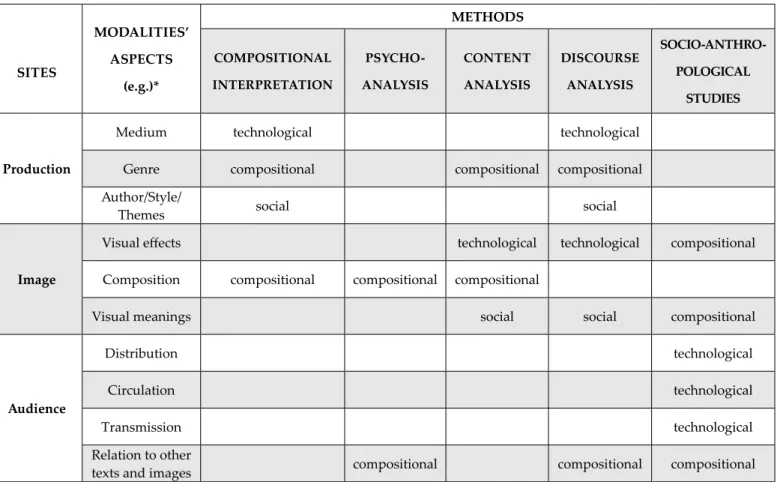
How-soever, the interpretations of visual images broadly concur that there are three sites at which the mean-ings of an image are made: the site(s) of the image itself; the site(s) of production of an image; and the site(s) where it is seen by various audiences. Each of these sites has three different aspects or modali-ties contributing to a critical understanding of im-ages: technological (any form of apparatus desig-nated either to be looked at or to enhance natural vision, from oil paintings to television and Internet [Mirzoeff 1998:1 in Rose 2007:13]); compositional (refers to the specific material qualities of an image or visual object, namely, related to formal strate-gies, like content, color, special organization); and social (the range of economic, political and social relations, institutions and practices surrounding an image and through which it is seen and used). These sites and modalities often intersect and are accompanied by several methodologies, such as semiology, compositional interpretation, discourse analysis, content analysis, psychoanalysis, anthro-pological and audience studies (Rose 2007).
In the analysis of one image, and according with each method, the following aspects of each modal-ity can be considered:
7 See also Becker (1995); Panofsky (1995); Banks (2001);
Hence, the methodological perspective is based on the assumption that the various dimensions and levels of human life; physical, biochemical, bio-logical, psychobio-logical, economic, social, political, or semiotic (and linguistic), have their own dis-tinctive structures, which have different effects in generative events through their particular mecha-nisms (generative powers). Because the operation of a mechanism is always mediated by others, no mechanism has precise effects in an event, that is, the events are complex and multidimensional and not predictable as effects of those mechanisms. Thus, life, and therefore discourse, can only be conceived as an open system, which is determined
by mechanisms (hence, structures) but in complex ways (Bhaskar 1986; Collier 1994 in Chouliaraki and Fairclough 2005:19). Namely, a system in which their structural properties (that is, internal and nec-essary relations), institutionalized in relative per-manencies, are not reducible to the parts that com-pose them; they emerge from their relationship, as well as from the networks of practices which are interconnected on an external level. In summary, discourse (visual and social representations of the body) is, at the same time, the genesis (cause) and outcome (result) which was instituted in the course of the practice. But, since the phenomenon of repre-sentation and/or the production of discourses takes
SITES MODALITIES’ ASPECTS (e.g.)* METHODS COMPOSITIONAL INTERPRETATION PSYCHO-ANALYSIS CONTENT ANALYSIS DISCOURSE ANALYSIS SOCIO-ANTHRO-POLOGICAL STUDIES Production
Medium technological technological
Genre compositional compositional compositional Author/Style/
Themes social social
Image
Visual effects technological technological compositional Composition compositional compositional compositional
Visual meanings social social compositional
Audience
Distribution technological
Circulation technological
Transmission technological
Relation to other
texts and images compositional compositional compositional Table 1. Sites, modalities and methods to interpret found visual materials.
* These are the aspects of each modality that have interest in the present study. When analyzing visual objects, other aspects can eventually be considered according to the research objectives of each investigator. The method of psychoanalysis was not used for the purposes of this analysis, but it is considered that it could be interesting to evaluate ot the composition level in the case of some of the images (see Taylor 2006).
Source: Adapted from Rose (2007:30-31).
place during the interaction (either between differ-ent agdiffer-ents, or at the individual level between em-bodied and internal structures of the thinking of the artist), it is considered that external and contin-gent relations are also determinants of their results and, as such, of their principles (although, from the perspective of critical realism, they are less impor-tant than the previous in explaining the genesis of the events; they are relevant for the understand-ing of its effects) (cf. Archer 1995; Chouliaraki and Fairclough 2005).
In this theoretical and methodological framework, and in order to present the biographical reading and visually interpret the empirical materials, it
was possible to differentiate five main theoretical categories of analysis and interpretation taken from the existent literature on the subject: corporeality, identity, expression, technological and aesthetic discourse, and immediacy spaces. The decoded of artists’ embodied experiences by the biographical and visual interpretation of the works through the categories of analysis and methods (namely the critical [that is, ontological] content and biographi-cal, compositional, interpretative analysis of the visual discourse in a socio-anthropological sense of the approaches of the body) allows the percep-tion of the artist’s world, as of the image as object of artistic expression, besides enhancing the social imagery of one particular cultural period.
Subcat
egories
CATEGORIES
Corporeality Identity Expression Technological & Aesthetical Immediacy Spaces
Lived Body Identity of the work Fiction Technological discourse Original conditions
Living Body
Identity of the subject
of the work Narrative
Aesthetic discourse
Disclosure conditions Identity of the subject
in the work
Self-representation Acceptance conditions Body discourse Interaction conditions Table 2. Categories & Subcategories of visual interpretative analysis.
Source: Self-elaboration.
In the construction of their professional profiles and through the conception and creation of the works, HA and JM, add different social experienc-es of subjectivity, moreover, of their own bodiexperienc-es, to the space of contemporary art, (re)presenting un-equally their singularity.
The representativeness and the specificity of the works, of international dimension, thus, justify the purpose of selecting the two cases for analysis: both
artists had diverse but noteworthy roles in the ad-vance and construction of the field of art in Portu-gal, highly thought-provoking and even worldwide spread of the thinking on the differences existing between the self-representation and the self-portrait in the arts.
Transgressing the limits of painting, Helena Almei-da (1934- ), with a solely artistic path, had a funAlmei-da- funda-mental role in creating almost a new genre in the
undersized field of the 70’s Portuguese art where she transcended orthodox standards and disciplines initiating new processes of making art, and leading photography, drawing and painting practices to an-other level:
[t]here is in Helena Almeida an evident “archeol-ogy” of painting. Thus, in many series of photos and pictures (in the 70’s: works or series, such as “Inhab-ited Canvas” [1976], “Inhab“Inhab-ited Drawing” [1975] and “Inhabited Painting” [1976]), the author tends to ap-proach more of the structural elements of visual lan-guage (point, line, plane, gesture, color, space, etc.) than from what they can offer as a “finished paint-ing.” (Vidal 2009, n. pag [trans. A.P.])
Jorge Molder (1947- ) also had major significance in structuring visuality in the 80’s in Portugal, causing his work to be as critical as is creative to the world of photography, and thus to the arts. His incomparable path, not utterly artistic, is remarkably acknowledged as their ideas are unequally expressed in the works:
Jorge Molder’s work uses all the artistic devices of classical photography: composition, subtle nuanc-ing of black and white [and color], use of intense light and shadow, recording the intensity of an at-mosphere or capturing a poetic moment. But, before these are given artistic expression they are first im-ages in the artist’s mind. The series and their titles pursue an idea, a vision; [as] nothing is in there by chance or coincidence. (Bergmann 1999:35)
Results
Body-representation analysis allowed the life di-mensions (experiences, expression and narrative) and the visual perspective (consenting in interpret-ing the artists’ works) to be put in an equation plac-ing the subjects in a multidimensional framework for the construction of their cultural and reflexive forms of identity, and, on the other hand, their nar-rative and social forms of identity, a process that was defined by the categories inscribed in the analysis. Also, this analysis allowed differentiating the main aspects of the artists’ works in a biographical, narra-tive and visual-critical perspecnarra-tive: ichnographically the visual analysis relative to each of the theoretical categories of interpretation has identified: black and white photography, almost always big formats, most-ly of the author’s proper body/figure. Occasionalmost-ly,
artists work with other mediums, such as the video and, in the case of HA, drawing and painting; and each work is usually part of a series.
The evidence of visual materials confirms the exis-tence of the three main analytical categories of identi-ty: the “subject of the work;” the “subject in the work” and identity of the work itself.
It was verified that technological and aesthetical dis-courses are extremely important to the cases catego-ries confirming that body experience, body image and body sense are linked (through the instrumental use of the body in the work). The practice of self-rep-resentation implies cognitive, emotional and physi-cal mechanisms of perception in their realization in which the body is instrumentalized in the work as its proper composition (technical characteristic of the work), working in conjunction with a repository of institutionalized schemes of (social) representations
Figure 3. O Perdão I [The Forgiveness I] (2006) by Helena Almeida.
Source: Retrieved January 7, 2012 (http://arte-factohereges-perversoes.blogspot.com/2010/02/helena-almeida-2.html).
Figure 4. O Perdão II [The Forgiveness II] (2006) by Helena Almeida.
Source: Retrieved January 7, 2012 (http://arte-factohereges-perversoes.blogspot.com/2010/02/helena-almeida-2.html).
Figure 5. The Portuguese Dutchman (1990) by Jorge Molder. Source: Retrieved January 10, 2012 (http://www.jorgem-older.com/gallery/gallery.php?id=6).
Figure 6. The Secret Agent (1991) by Jorge Molder.
Source: Retrieved January 10, 2012 (http://www.jor-gemolder.com/gallery/gallery.php?id=6).
that artists mobilized to the works through a prag-matic consciousness of the subjects (reflexivity) and an unconscious, mimetic process of reproduction (the
habitus) of those abstract schemes of representations
and embodied dispositions.
Self-representation is built in relation with others and the world (embodied experiences and knowl-edge) being both cause and outcome of the practice establishing it; the “subject in the work” is, thus, a re-flexive representation, which through the body con-figuration (sense, image, experience) is, thusly, part of the identity construction process of the subject of the work. At the same time, as demonstrated previously, life and work are difficult to distinguish in real terms, especially in the case of artists whose singularity is built through the work and its recognition. Analyti-cally, life, identity and work are, thus, considered as a (reflexive) project and a process built in the cross of interaction between the individual and the world, his practices and their acknowledgment by others (that is, external relations). These factors, arising from the singularity of the proper cases and inherently related to artists and the works’ identity construction and recognition processes, are, at the same time, related to the image dynamics (that is, have their own mech-anisms and causal powers on an internal level). The three main lines defining the approaches of the body in the cases are: the experience, the expression, and narrative, namely, through their biographical and visual or discursive dimensions. The first is pre-sented in the similarity agent/image and in the em-bodied nature of human actions, which is brought to the work in that way; and the second dimension is comprised with techniques, mediums, styles, and formal and plastic characteristics of the works in its visual and plastic sense. The decoding of this sense is in the image itself as narrative (that is, as product of the previous internal and external relations).
However, it is at this level – the visual – that the works assume different aspects between the two art-ists; since on the other level – the biographical – dif-ferent aspects of their cultural and reflexive identities influence the approaches of the body in a different way to their works.
Therefore, the narrative aspect of the proper image is different in the two cases. It is noteworthy, how-ever, that even if each image is part of a narrative, in a sequential sense of the term, images can also func-tion separately. Namely, each series doesn’t offer to the spectators fixed messages or interpretations held in immutable representations of the artist’s thought, on the contrary, and although the biographical aspect is present in each image proper language (represent-ing its consistency, its structure), visually what hap-pens is the dissolution of the certainty, a melting of ideas in each composition without the imposition of an order or inevitabilities by the artists, since the con-junction of signs in each work offers to every person different readings (and because each observer has their proper vision); each image (or each body of im-ages) has, thus, a narrative of its own, as the image is a place of resistance and confrontation of movement and change (a proper distinctive feature of the photo-graphic, movies or video images); it has in this sense its proper dynamic, its own agency.8
In the cases of HA and JM the image itself is where the binary relation absence‒presence is eliminated towards the emergence of an exchange field between these terms, an intermediary field between absence and presence, as Derrida (1978) states in the scope of the difference, a field continuously in process. The art, as proposed by Derrida, rejects the “form,” which
8 Roland Barthes (1981) uses the idea of “punctum”
(wound, object or detail within an image that establishes a direct relationship with its observer); as opposed to the idea of “studium” or “the cultural, linguistic and political interpretation of a photograph.”
represents the immobility, electing instead the dis-continuities and slippages:
[t]he images have to do with us; we have to do with us, with some continuity. The question of continuity of time is curious. We cannot find a unit with respect to time, but we find this: time does not exist, there are many times. And, our memory, for these times, is discontinuous. When we are young, we have the idea that the time will create a thickness, through which we will one day look at the past. The experience of the passage of time is exactly this: that thickness is discontinuous. There are things that have happened many years ago and could have been yesterday, and there are things that have happened recently and they were lost. … Is all our experience configured from a principle and a sequel? I think so, and I think not. We found marks of the primordial things, which are making their reappearance… [sometimes founding unforeseen things]. (Molder 2010:46-47 [trans. A.P.])
The rejection of a pure presence (free from the con-tamination of language, discursive thinking and traditional symbolic systems which reproduction structures derives their powers from an original es-sence) is the only possible answer to this problem lying between the artist(s), the other(s), and con-tinuity of time, once the human conscious cannot escape from their proper reproduction schemes. The removal of a fixed center takes the action and discourse to a game of significances in which the representation subverts the established order.9
Artistic production is, thus, a generator of thoughts, attitudes, interpretations and meanings, indepen-dently of the intention of its author. In this sense,
9 To look at the representation as a pure abstraction or
dis-continuous entity is the only way of solving the problem of self-representation as a non-fixed reproduction of the subject’s image. Because the conscious will always make that connection in the first place since the evidence of the visual object and its perception has been cognitively and physically apprehended immediately by the body. The image always offers to the spectator a non-linear decod-ing of meandecod-ings since each person has one’s own under-standing of the world. In this sense, each image has also its own dynamics.
the image is movement and time (present in the series character of the majority of photographic works, in the video modality and in the proper repetitive usage of the same image/figure), having two identification or definition mechanisms: the “differentiation” (a whole that changes), and the “specification” (the relation of the image with the signs that are part of its compositions). Those com-positional elements of specification and differentia-tion are a matter of signs with traces of moduladifferentia-tion of all types: sensorial (visual and sonorous, as is the case of the video-works), kinesthetic, affective, rhythmic, and tonal (as in performance levels). The image-movement is a plastic matter with semiotic significances. It is not one enunciation; it is one statement (Deleuze 1990:42):
[i]t’s like a temptation, to stay there and watch my own process, as in a dream with two directions. But, this is intolerable and urgently something is released from me as if I wanted to leave ahead of myself. All the way through, I already managed to get, by my own fingers... I wanted to experience a supreme ef-fort in that empty and dense area of pre-movement, pre-event with their own dark and misshapen weight as kind of a penultimate expression. (Almeida 1982, n. pag [trans. A.P.])
Nevertheless, the biographical interpretation sug-gests that HA’s exclusive artistic path is predisposed by her biographical origins affecting her relation with the arts, namely, the relation with a sculp-ture inherited from her father’s background,10
clearly inducing her choices with respect to the pro-cesses of how she makes, looks and, maybe, feels the work. In her approaches of the body she always
ex-10 HA is the daughter of the sculptor Leopoldo de
Almei-da and one of the main contemporary Portuguese art-ists. She started her career by participating in collective exhibitions in 1961; in 1967 she carried out her first solo exhibition; she studied painting in the Fine Arts School at the University of Lisbon.
presses the will to explore her own physical limits, which she experimented with since the time she posed as a model for her father. Evidently, those experiences shaped her work; along the way, that became a model of her own work. In fact, on numerous occasions she expresses the desire to become the work (obvious in the first works where she “dresses” the canvas, or even suggested by several titles named “inhabited”). For these reasons, in the work of Helena Almeida bound-aries of disciplines were transposed from the begin-ning, as she felt the need to break away from painting, mixing the different genres and techniques.
On an external level, her cultural and artistic back-ground also had an impact on her work, for example, being inspired by the performance’s practices aris-ing from the 60’s, with direct connection with the arts of the body (body art), environment that justifies also her choice of the photographic use of the image, as she states: “…I think my main influences arise from the field of performance and installations,” as with photography practices, “I think it was also important to know the work of other artists of my time who became interested in photography. It was my time; I used the medium of my time” (Almeida 2000, n. pag [trans. A.P.]).
Finally, other aspects influencing HA’s work come from social experiences, like proposals and invitations in which themes are suggested by particular institu-tions or agents, and later lead to the creation of other works, as is the case of the video-work A experiência do
Lugar II (2004), which symbolizes at the same time one
affective experience of the artist with her atelier. In fact, the space is a physically powerful component of her work that visually enunciates its own singularity:
[t]he atelier is both my body and a working material, such as pencils and ink. The atelier exists as if it were my own body [and]…I hope that in this body is con-tained all the painting. All painting has to go through my body…the presence of the real body is
fundamen-tal because the painting and drawing only exist when I exist as a body. (Almeida 2000, n. pag [trans. A.P.])
These biographical, cultural and social influences are transposed to the work through the artist’s embodied experiences, providing its uniqueness and singularity: “I transpose to the medium my stories, my problems” (Almeida 1996:10 [trans. A.P.]). At the same time, as the work is being cre-ated, exposed and recognized, the artist’s identity is also being built through this process that like-wise involves a personal project, linked by ideas, intentions and personal needs. The approaches of the body in the work incorporate these reflexive and cultural identity aspects, that is, they are un-consciously structured by the artist’s lived experi-ences, and, at the same time, they are structuring living experiences, defining in turn the meaning and identity of the work:
[t]he “body-testimonial,” with all the characteristics of the body...artist’s daughter, artist’s mother, art-ist’s wife...but those attributes are disappearing to be only the painting, the body of Helena, Helena’s painting. (Almeida 1982, n. pag [trans. A.P.])
In the case of JM, the process of identity construction of the work (and of the subject of the work) is similar, however, the artist has a distinct path, namely, in how it is related to the biographical, cultural and reflexive identity aspects, which give to his work its own sin-gularity, as well: with a path not exclusively artistic, a degree in Philosophy and being half Hungarian and half Portuguese, JM transposes in a non-linear way those influences to the works, a fact that gives them their unique character:
I can say, for example, that it is not by chance that the 1990 series is called The Portuguese Dutchman. I am indeed half Portuguese and half Hungarian, with a Dutch surname; the title refers directly to events in my past or present life. (Molder 1998, n. pag)
In his work the body is explored in a perspective of questioning the relation between the self and the oth-er, between the self-portrait and self-representation as Molder plays with the endless variety of images of himself, which always ends up being the images of each other without ever ceasing to represent him. In this game he plays also with the paradox of life and identity: the representation is him but always medi-ated by others that the picture reveals (Oliveira 2009). Daily experiences, inspirations, dreams but also his characteristic pragmatic reflection are usually trans-posed to the works as what can be interpreted as
ha-bitus transference (Bourdieu 1984:175). Actually, as he
confirms, “or by inclusion or expulsion, everything we do always marks everything that is happening in our lives (Molder 2009:16 [trans. A.P.]).
Uncertainty and hesitation are aspects that JM appre-ciates and always explores in the images. He is inter-ested in the material aspect of the image questioning its immaterial essence. In the scope of that essence, he positions himself playing with ideas, with otherness: self-representation as the possibility of discovering the other in him, the double, a face and a body that in a certain way is liberated from the author, which lies between the abstract and the concrete, creating, in the end, a sort of confusion (Oliveira 2009).
Regarding his social and narrative identity, the weight of his other professional occupations11 and personal
11 JM has a B.A. in Philosophy at Lisbon’s Classical
Univer-sity, and began his artistic career with his first individual exhibition in 1977. Professionally, he worked for the Justice Ministry (1976-1990) where he occupied several duties. In 1990, he began working as a consultant for the Fundação Calouste Gulbenkian (1994-2000) after which he was the executive director of José de Azevedo Perdigão Modern Art Center which he left for alleged personal reasons in 2009. However, as the artist affirms, he always has been close to the arts and artists’ problems − “it is true that, as hav-ing no artistic trainhav-ing, I always tried to live closely with artists, and think about the problems of art with them” (Molder 2011, n. pag [trans. A.P.]).
experiences is evident in his work, besides answering also in his course to solicitations and honors. Lastly, the artist also had the influence of the art of the 70’s, as well as of the structuring of the field of art in Por-tugal during the 80’s as Helena Almeida, and which determined, in a relative way, the characteristics of the work. In the same way as HA, he went through a process of individuation culminating in the recog-nition (that is, identification, first of the image with the person, then of the image by itself).
Besides habitus and embodied experiences, the bio-graphical condition is, thus, present in the works by the evidence of the passage of time through body (as through life), as Molder notes when he speaks about his images:
[i]f I work with myself, there is a point in common. When an artist works always with the same model, this inevitably implies a constancy and variation. A con-stant because there is an element that is recognizable, because such a variation will suffer constant changes that are noticeable. For example, they cannot escape the tyranny of time. (Molder 2009:14 [trans. A.P.])
However, the other dimension of image is also en-hanced in JM’s case, the quality of the visual object as a pure abstraction, which has a dynamic and own character:
…the truth is that [the image] produces a strange ef-fect, because I find someone who, to some extent, is a double. I recognize him. I recognize certain traits that I am sure that belong to me, but at the same time, I do not recognize myself in…the images I produce... But, let us turn from the mirrors to the photographs: when I see an image that does not coincide with me and I don’t recognize anyone in particular, still I recognize that there is someone who is not anyone in particu-lar. I think it’s an amazing experience and I would say that these images are abstractions. (Molder 1999:177)
As a final point, in this analysis the use of the bio-graphical and visual interpretation methodologies
![Figure 2. Dentro de mim [Inside me]](https://thumb-eu.123doks.com/thumbv2/123dok_br/18175152.873946/2.1785.940.1723.114.614/figure-dentro-de-mim-inside-me.webp)
![Figure 4. O Perdão II [The Forgiveness II] (2006) by Helena Almeida.](https://thumb-eu.123doks.com/thumbv2/123dok_br/18175152.873946/8.1785.950.1321.110.518/figure-o-perdão-ii-forgiveness-ii-helena-almeida.webp)
